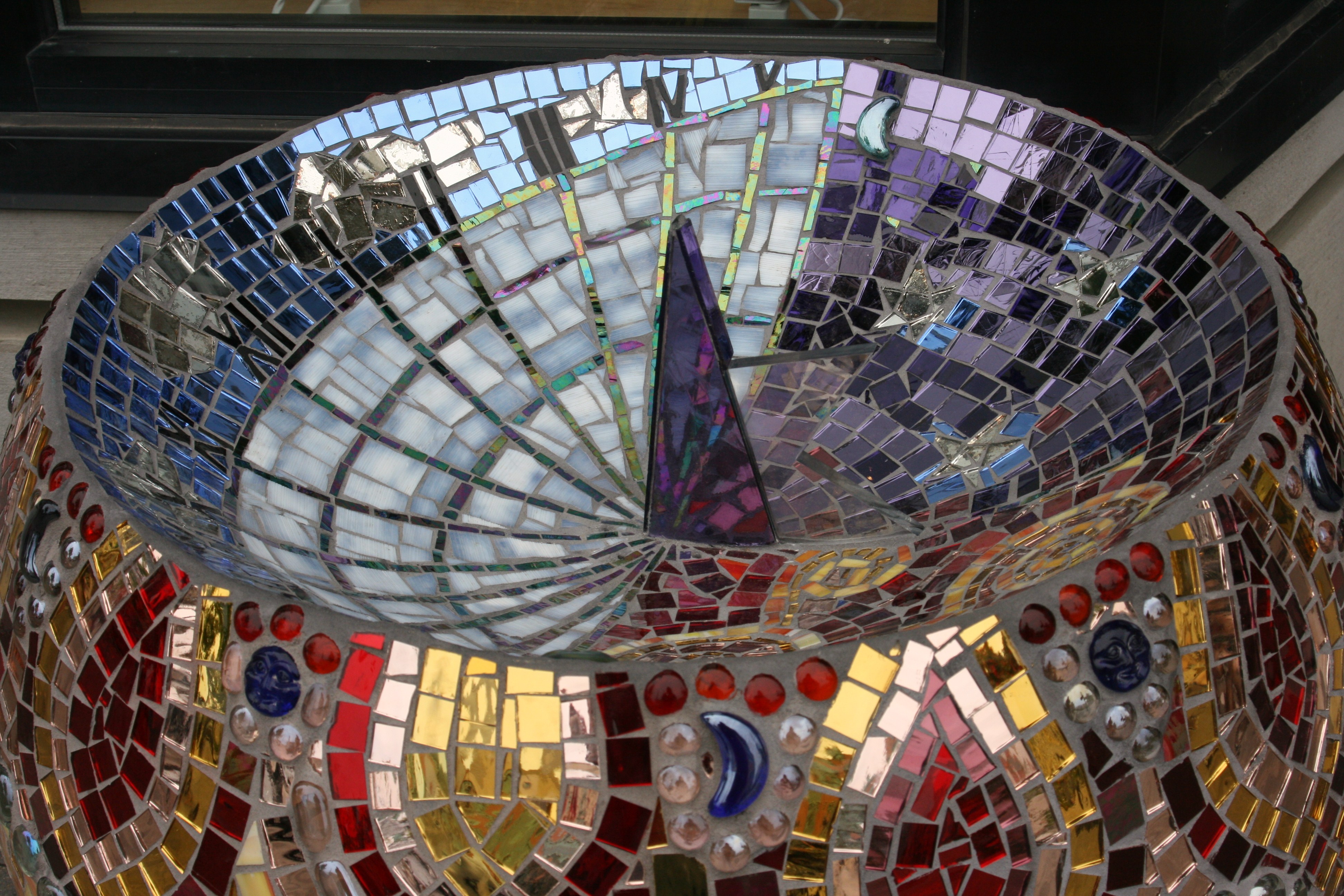
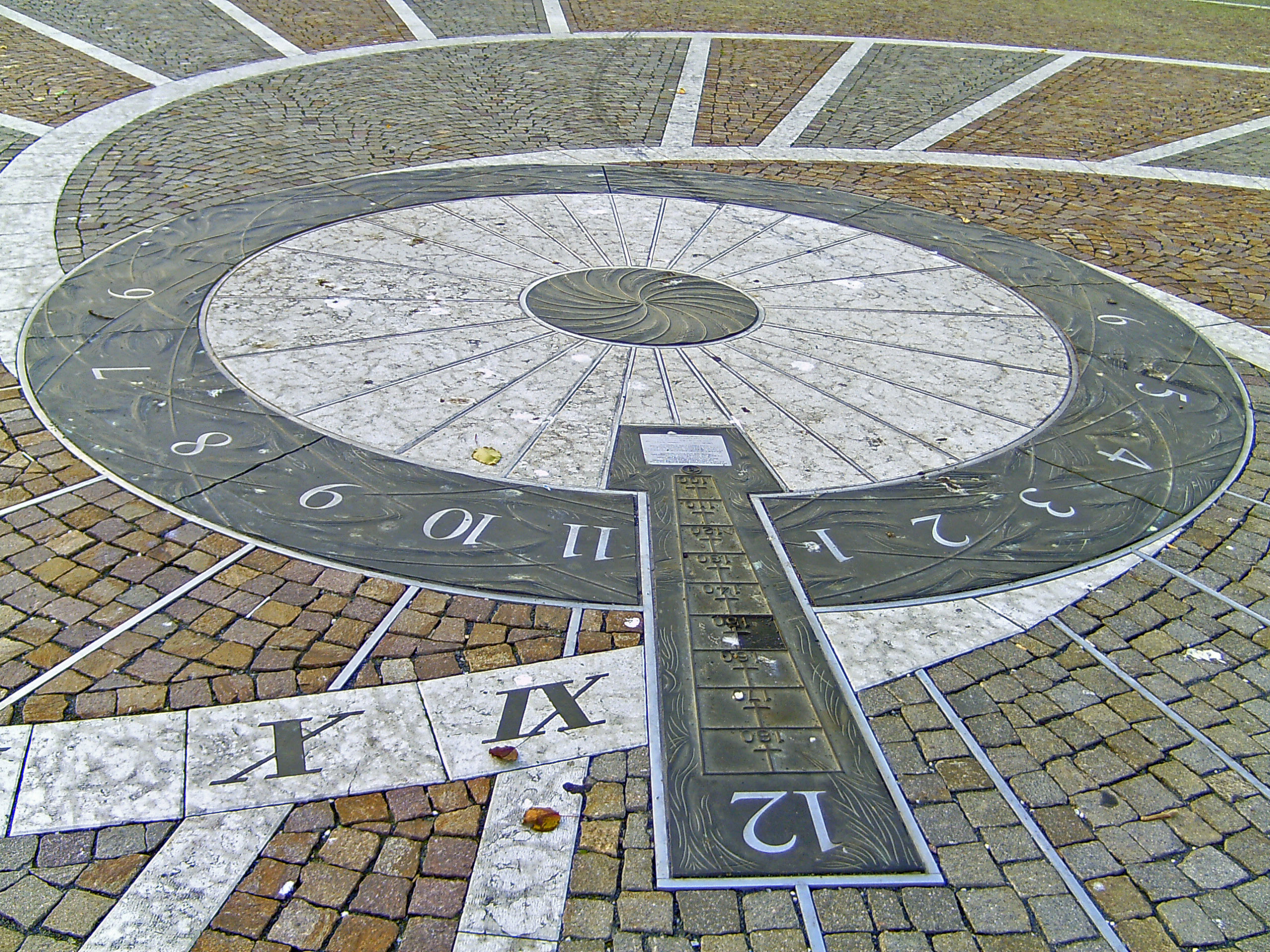
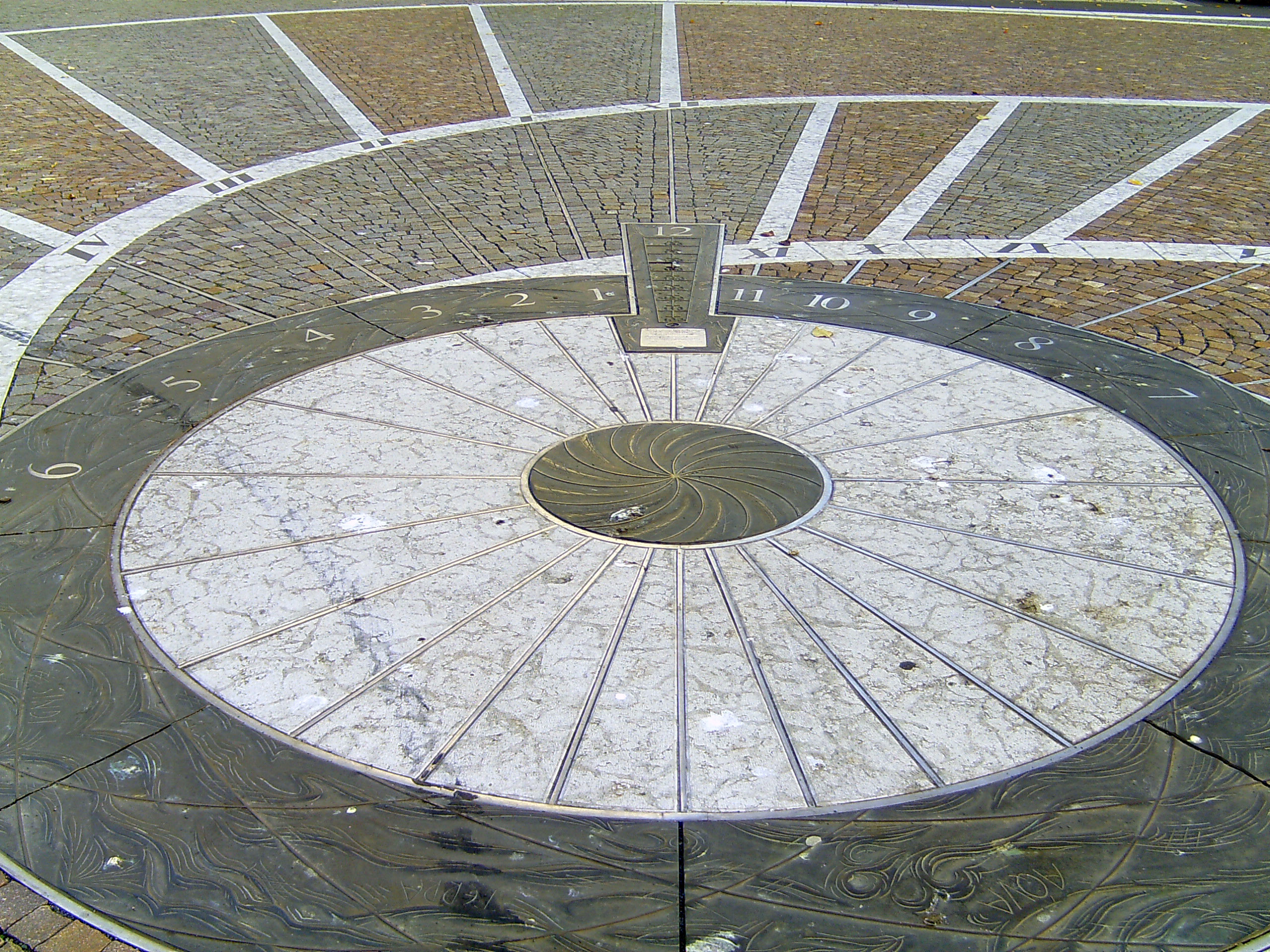
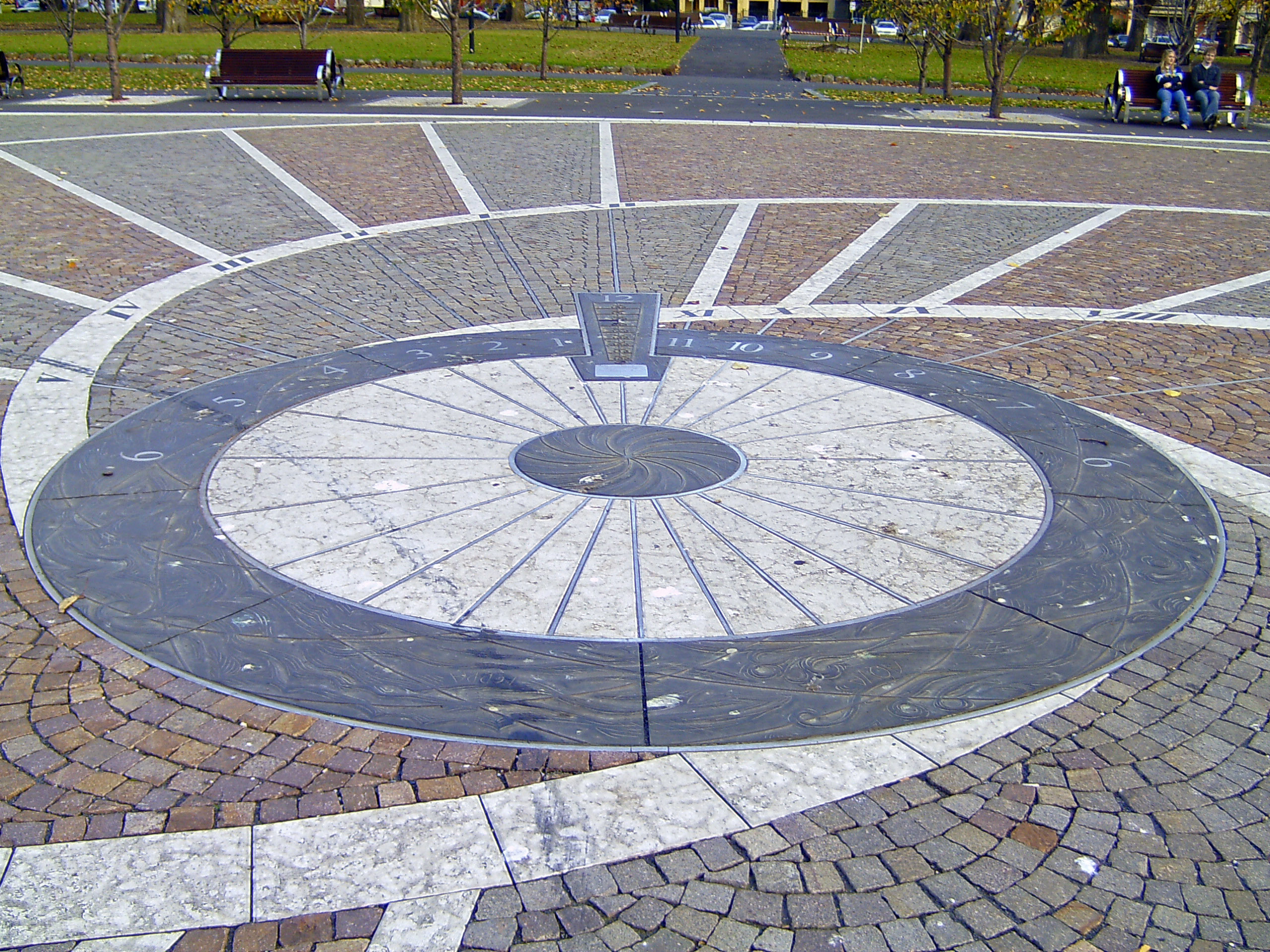
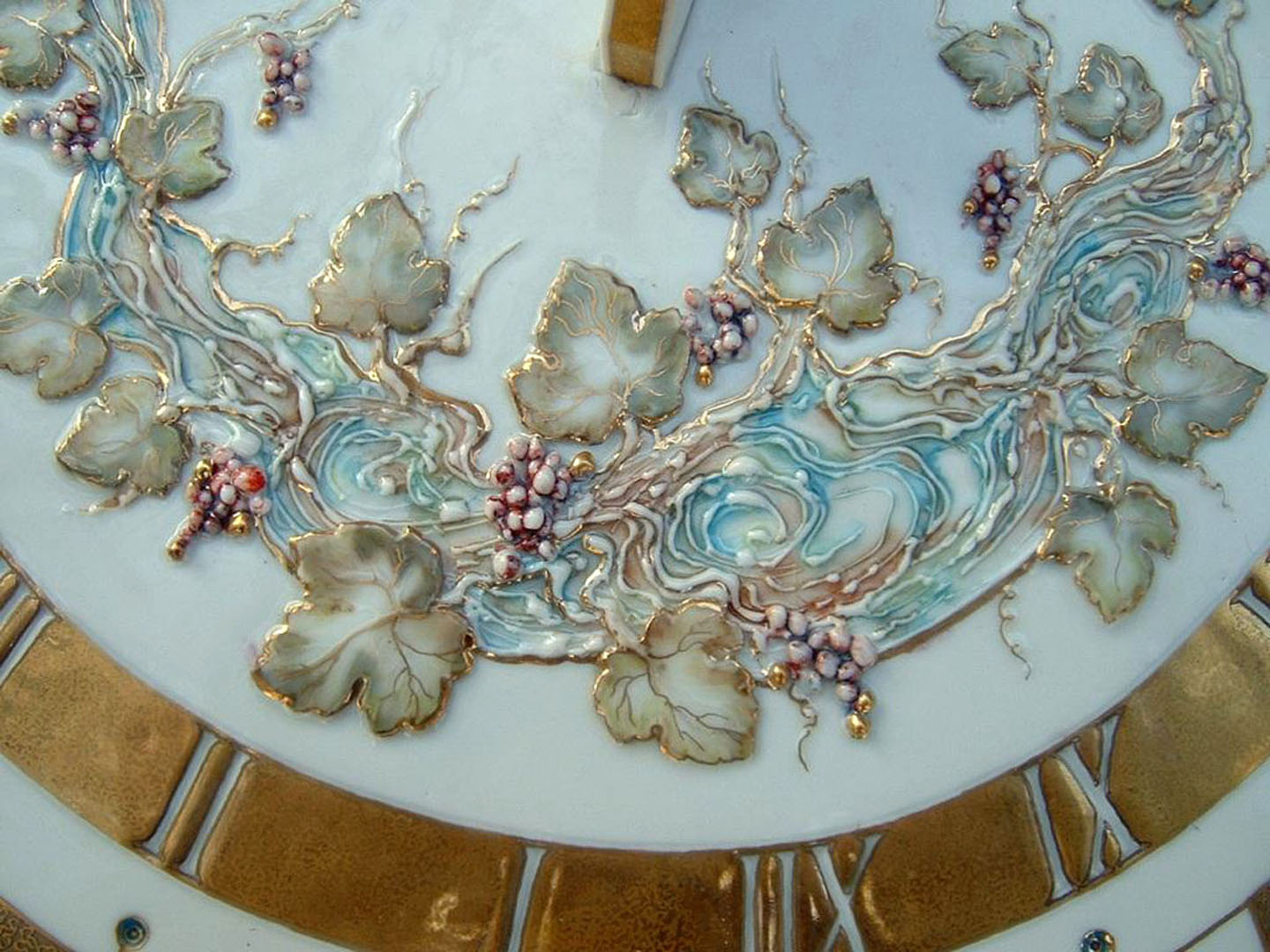
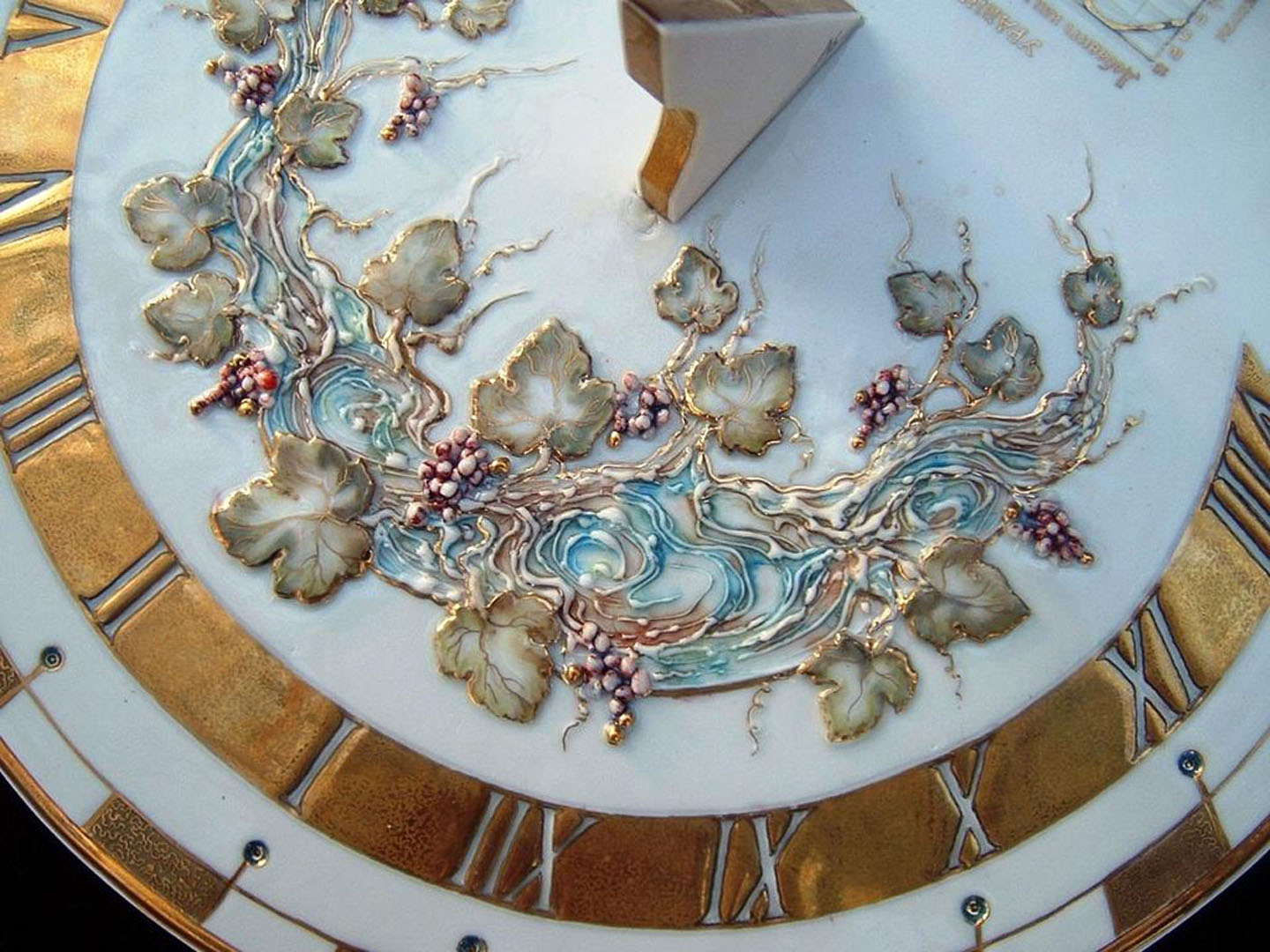
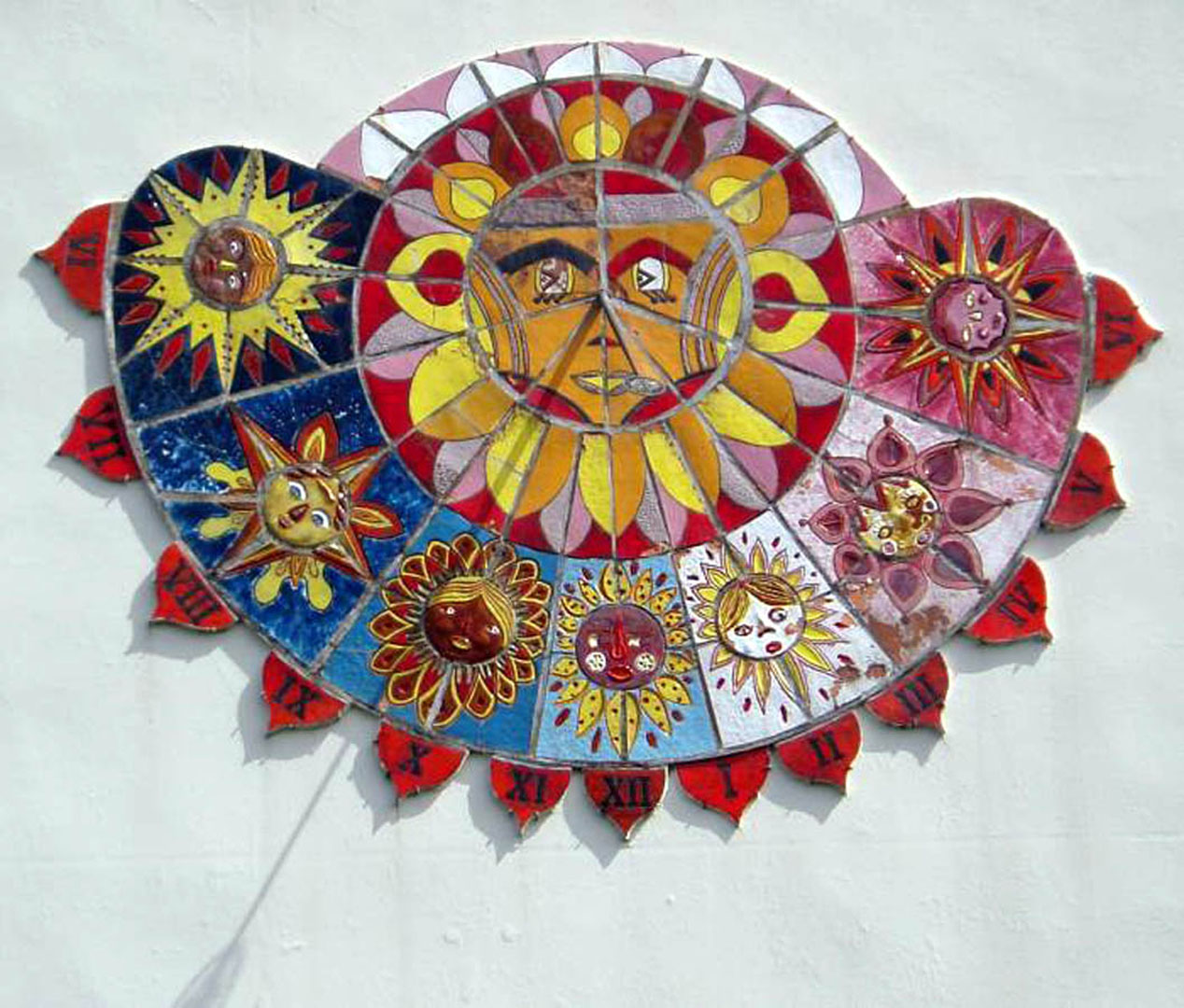
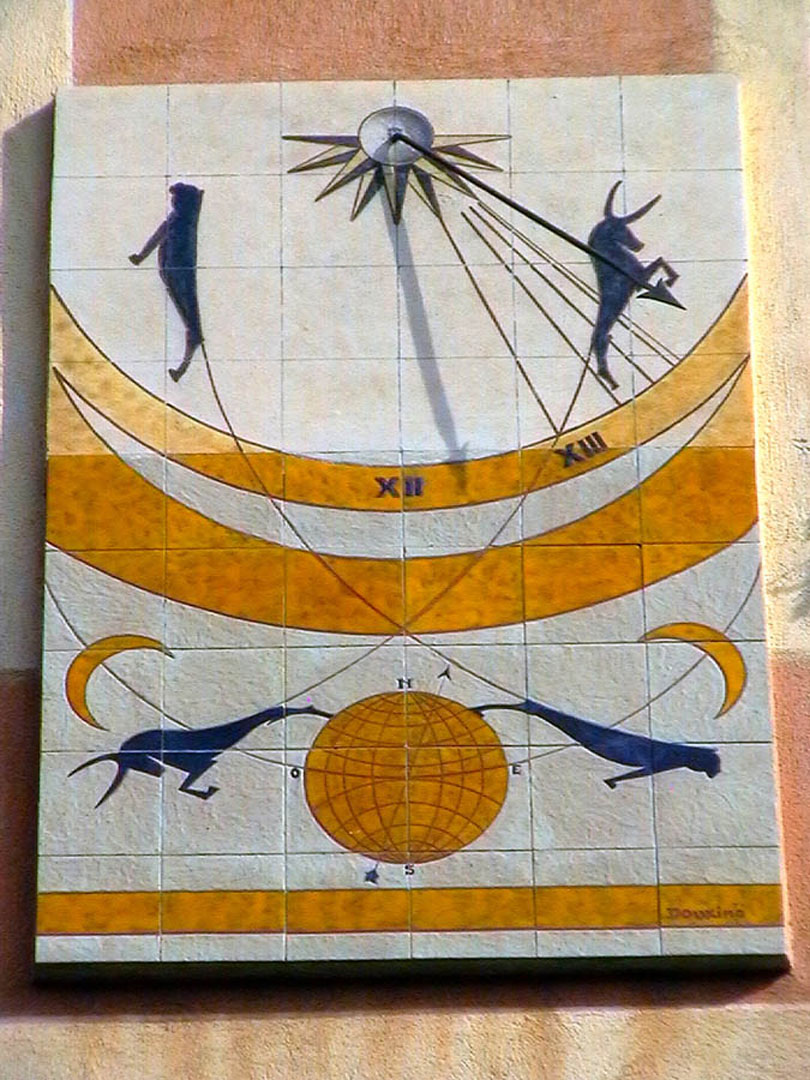
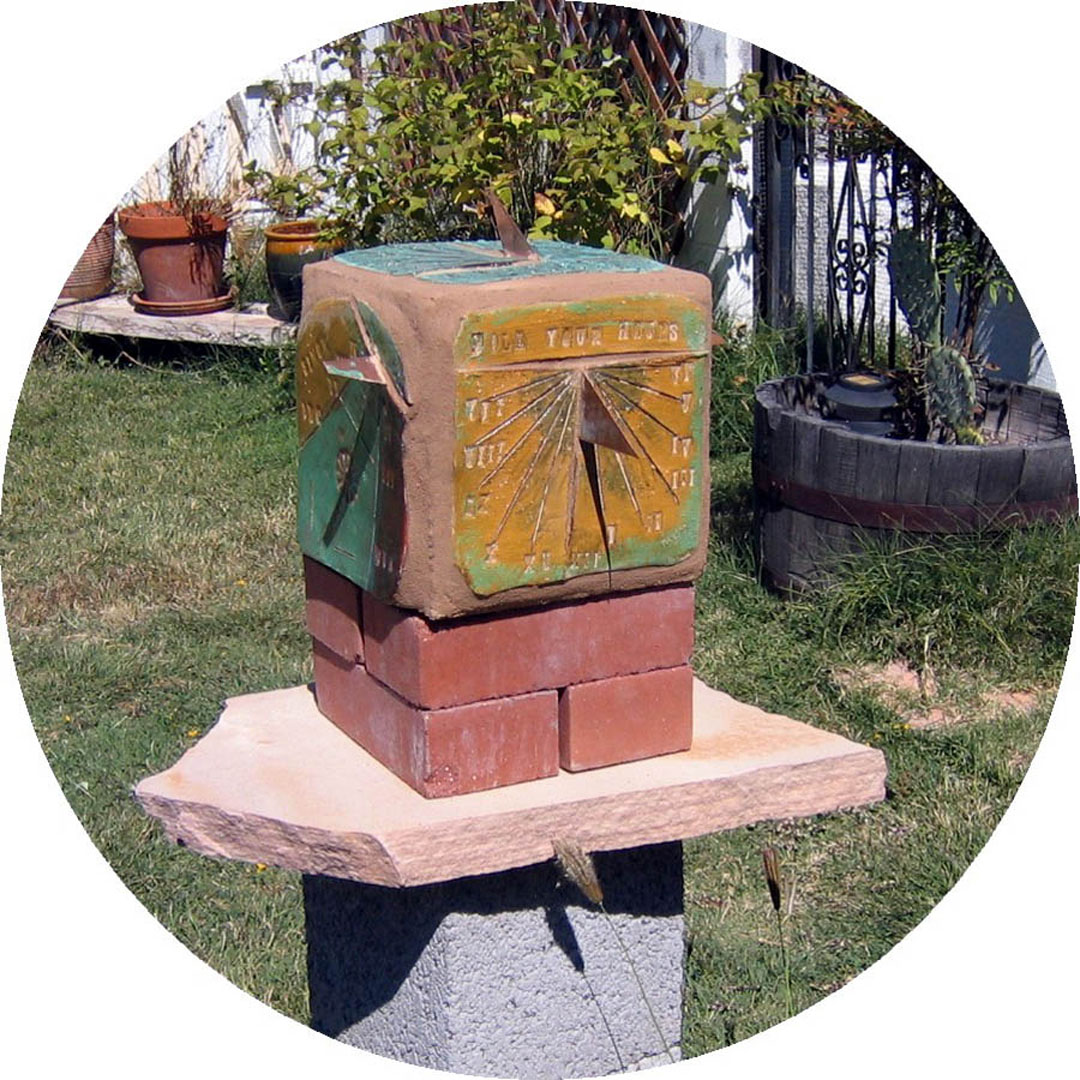
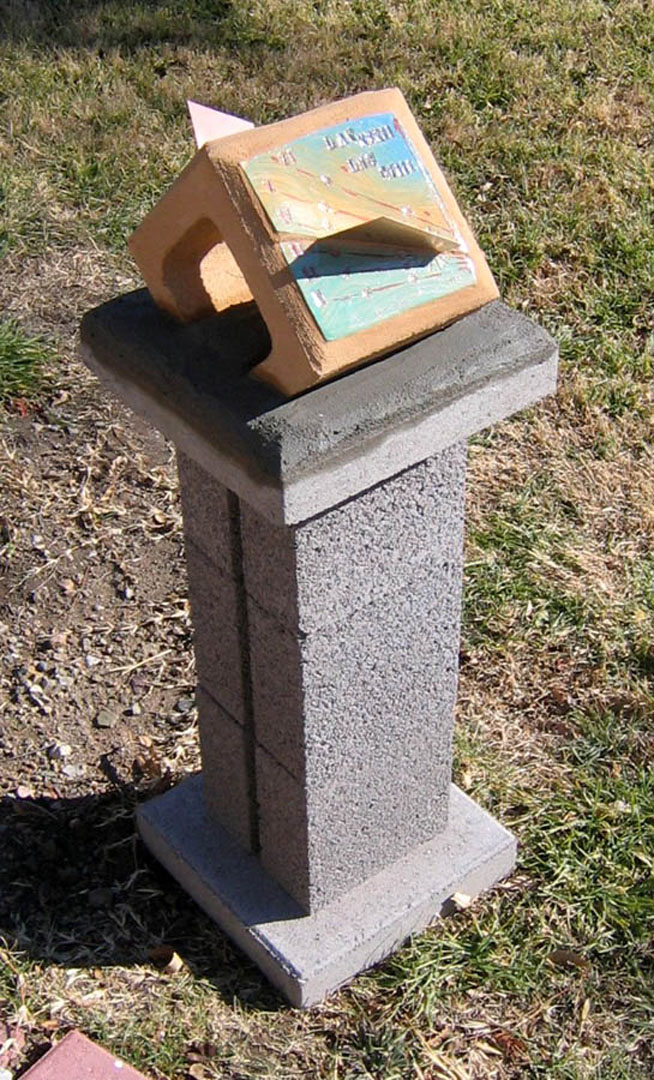
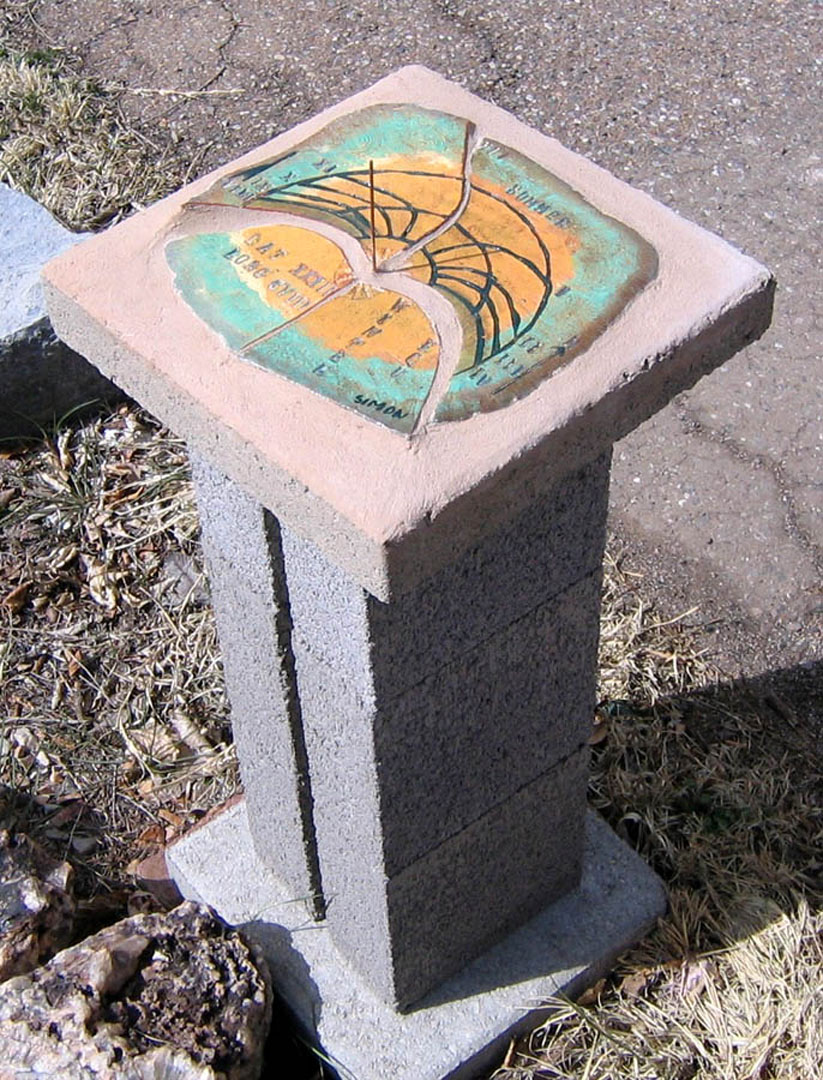
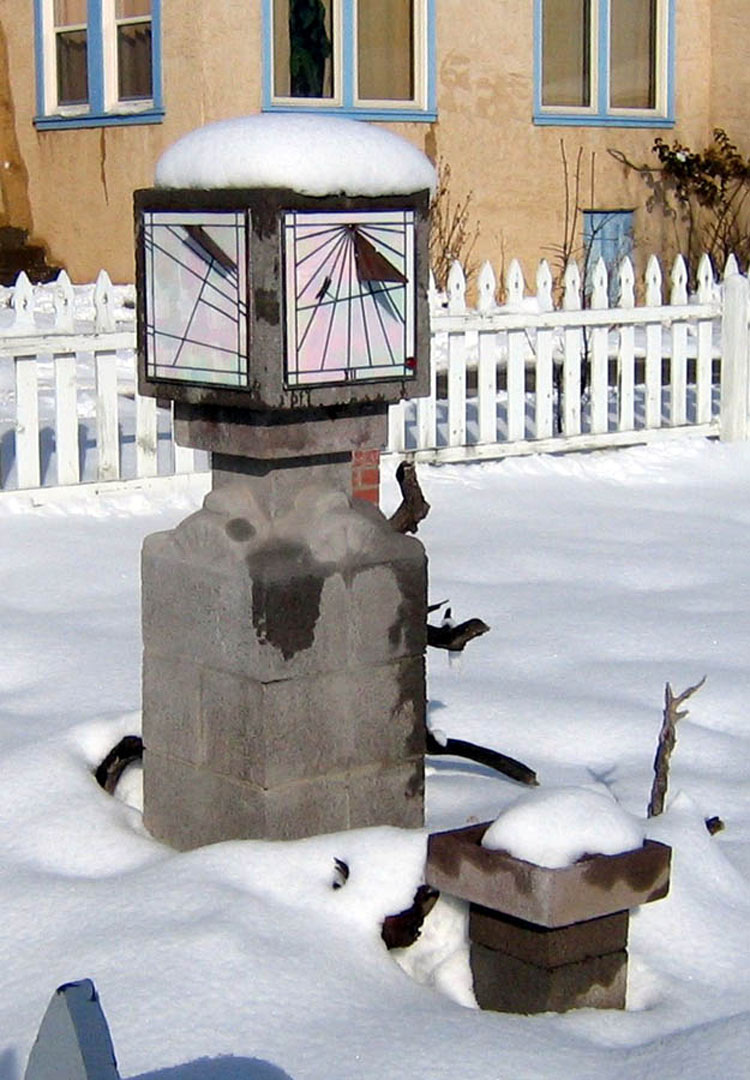
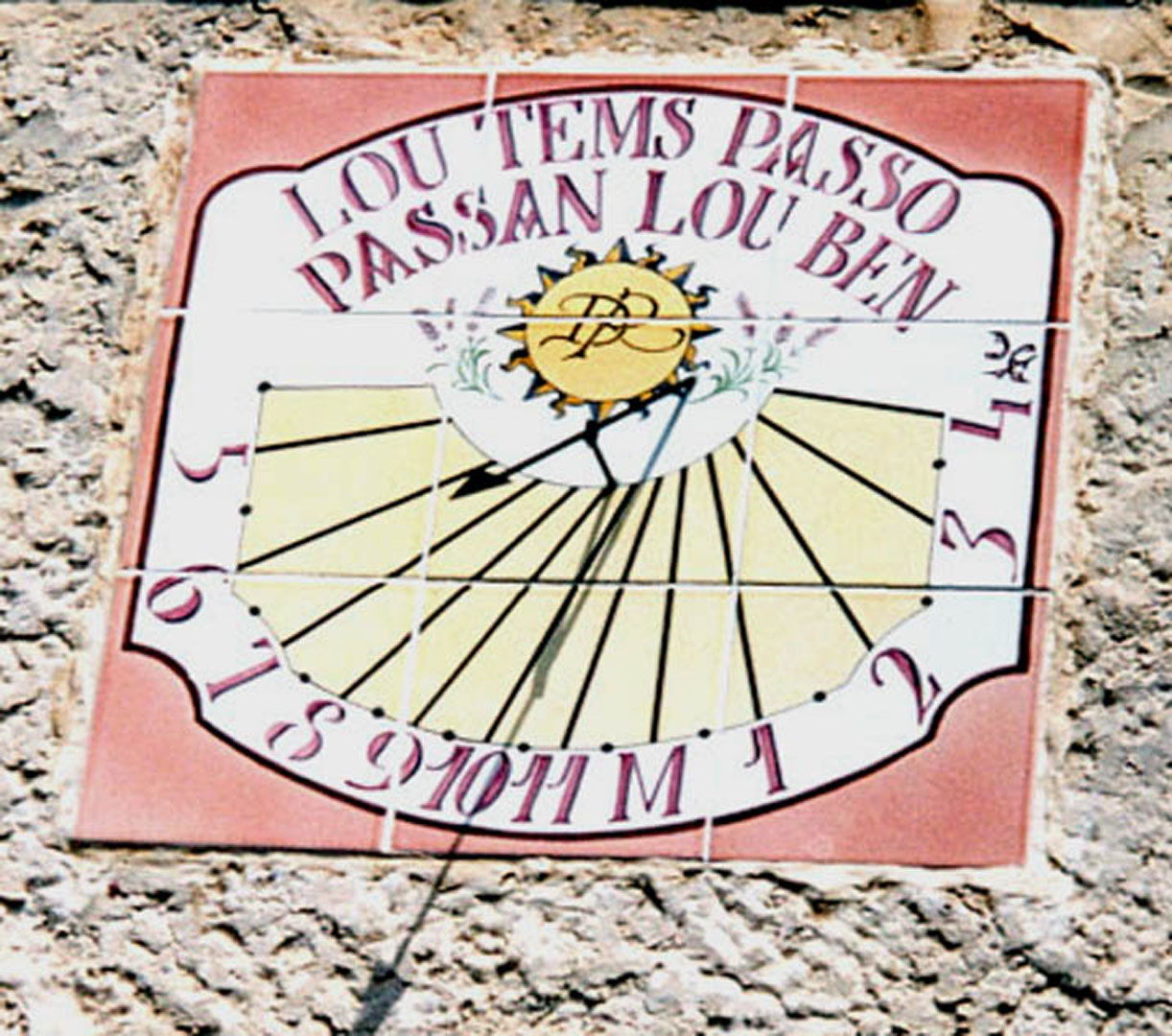
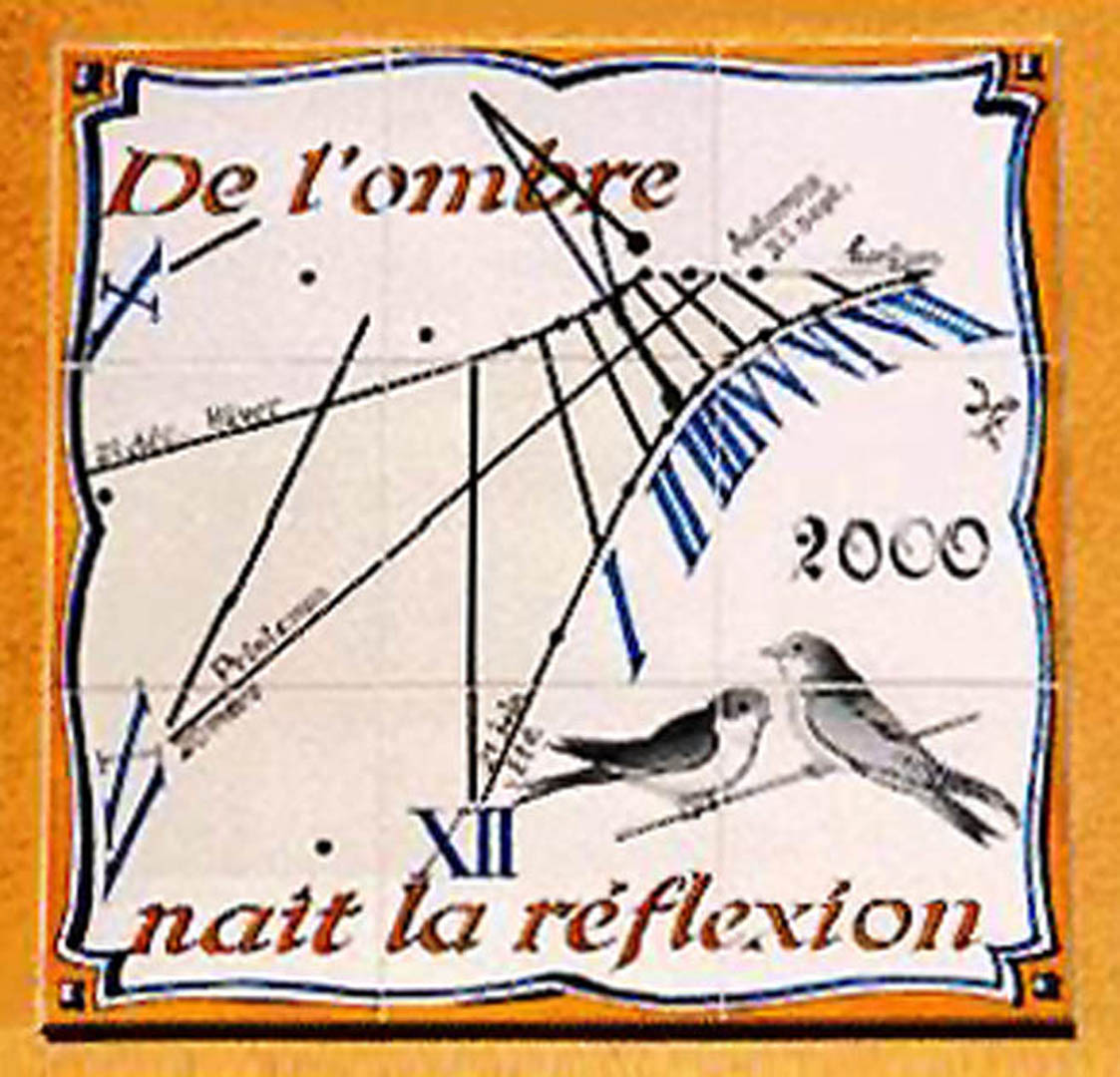
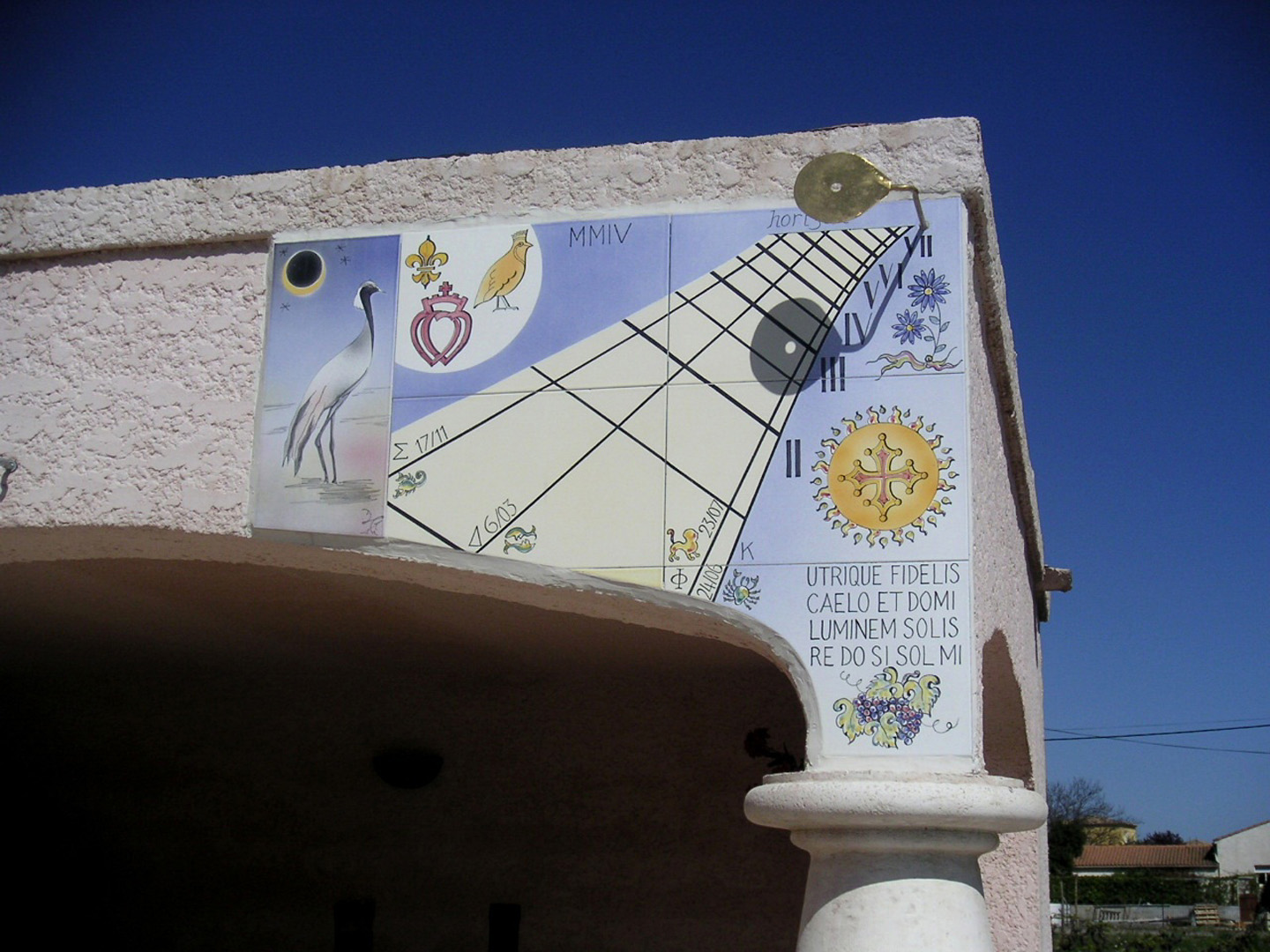
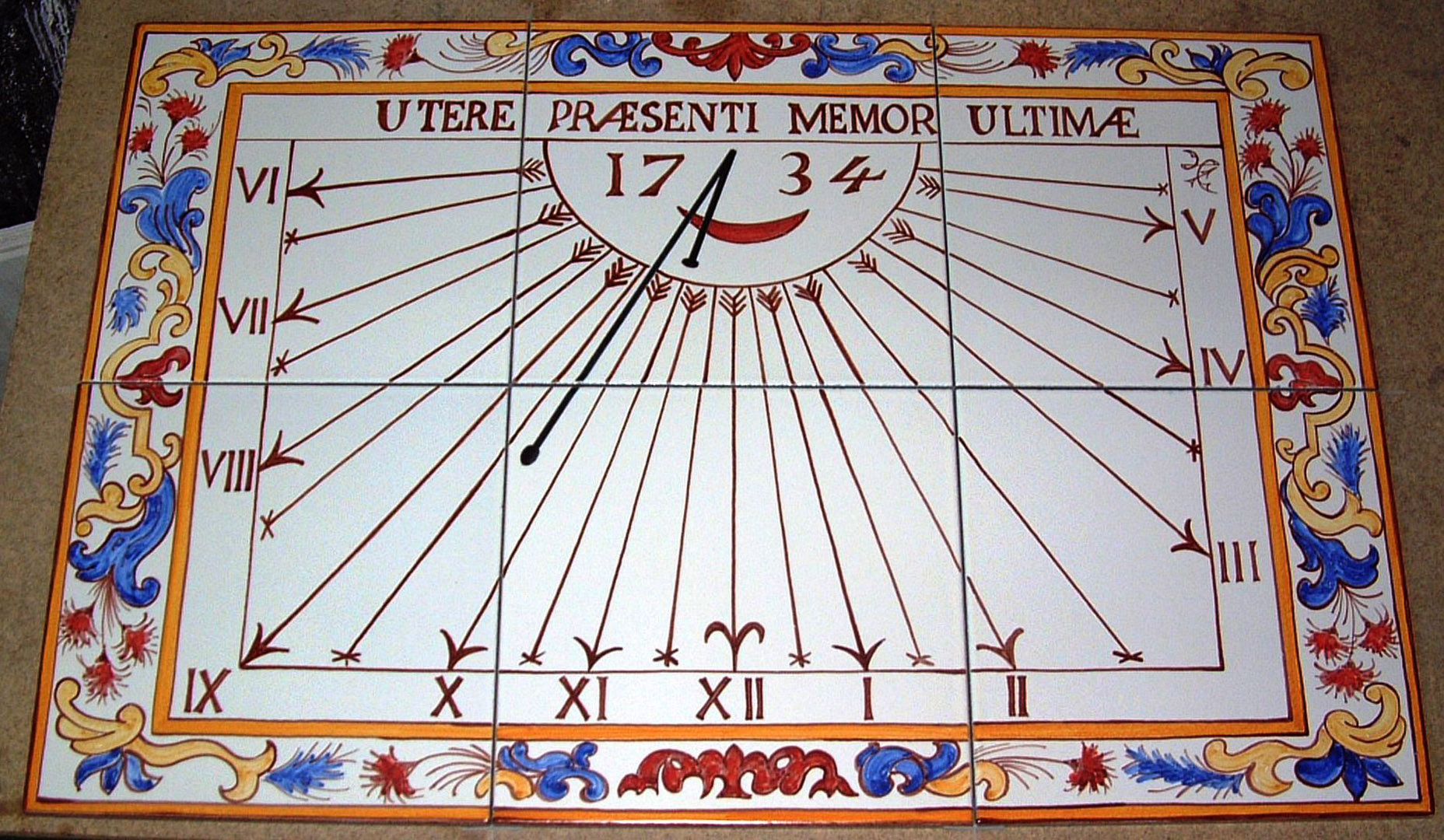
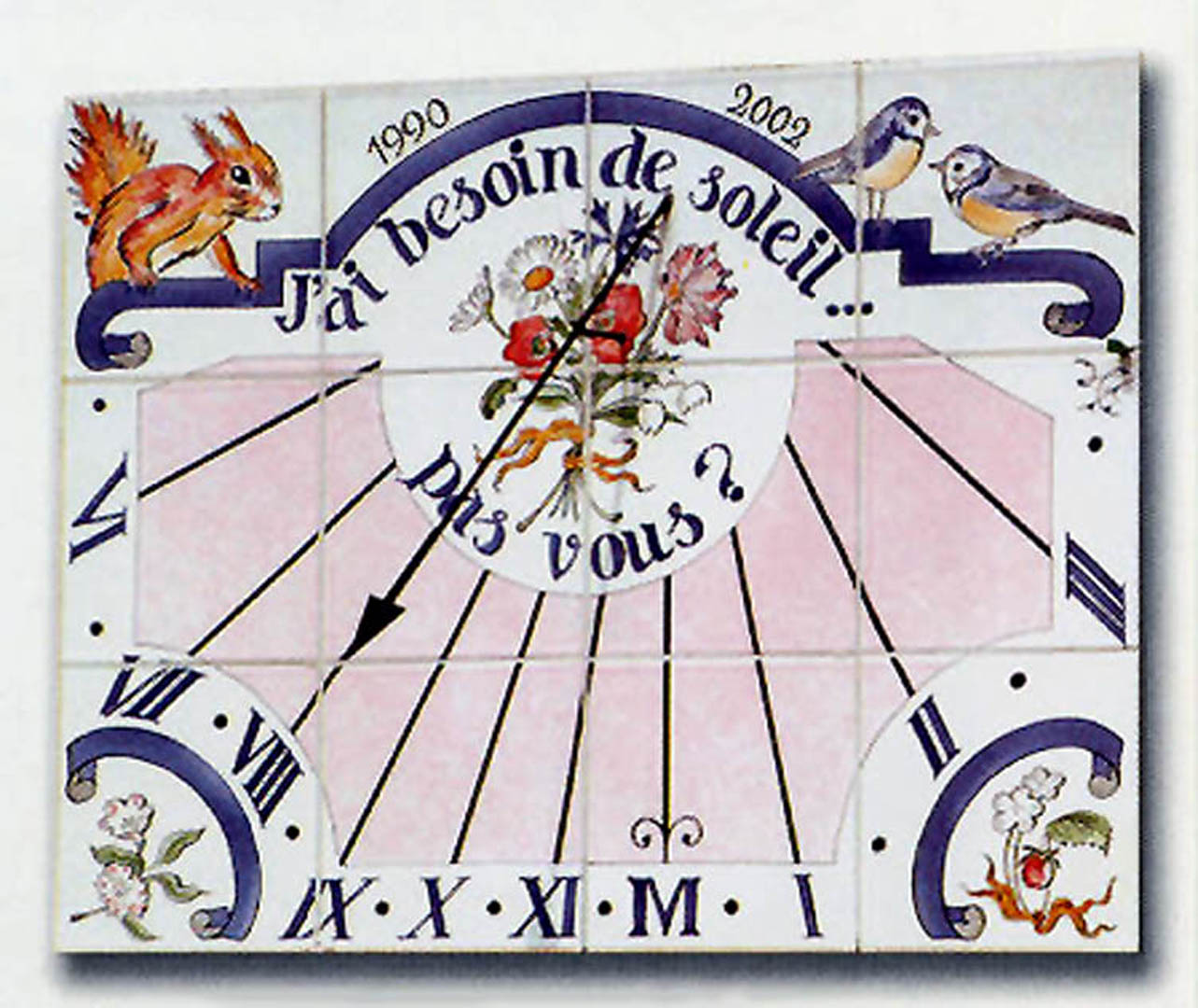
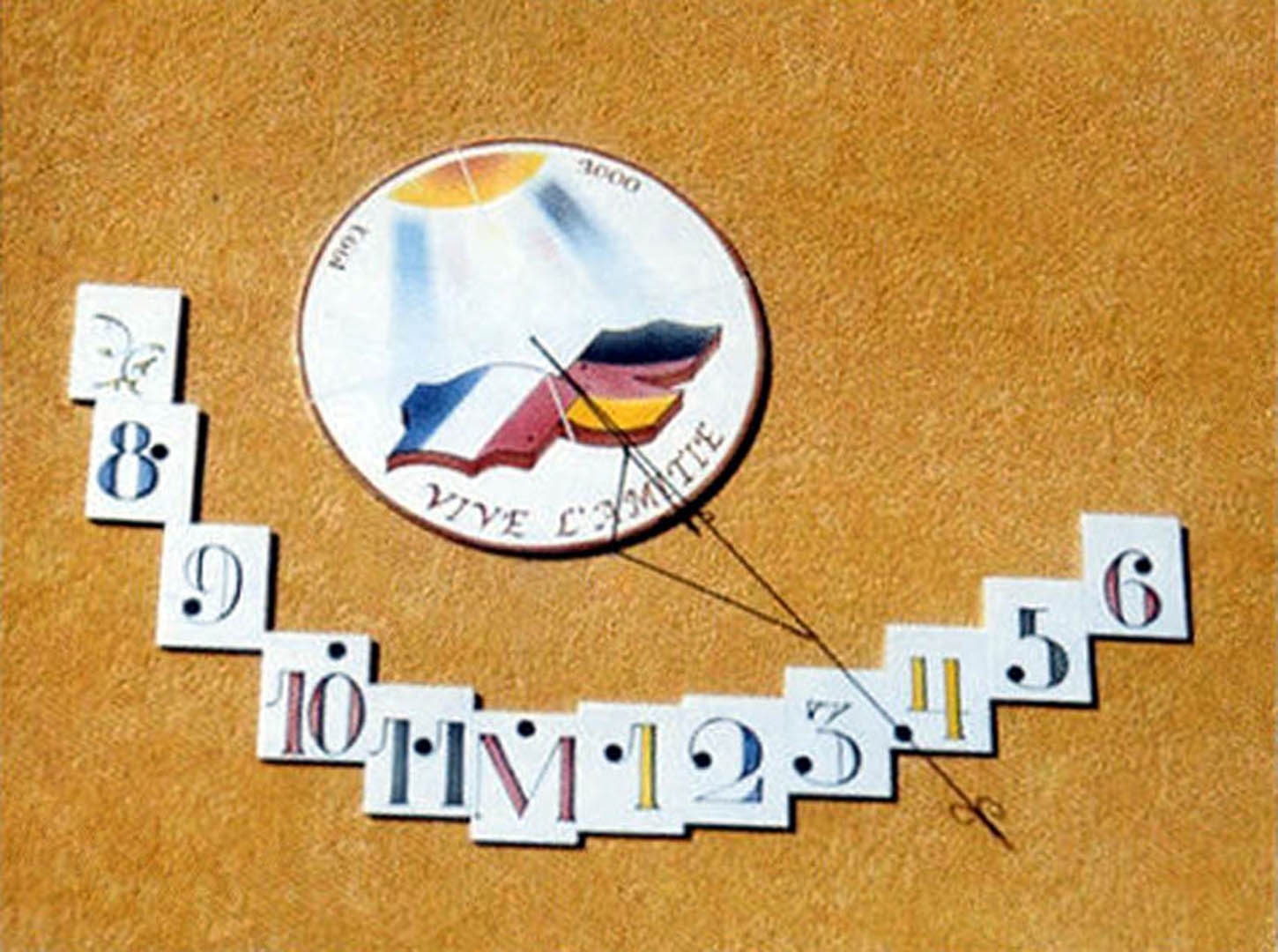
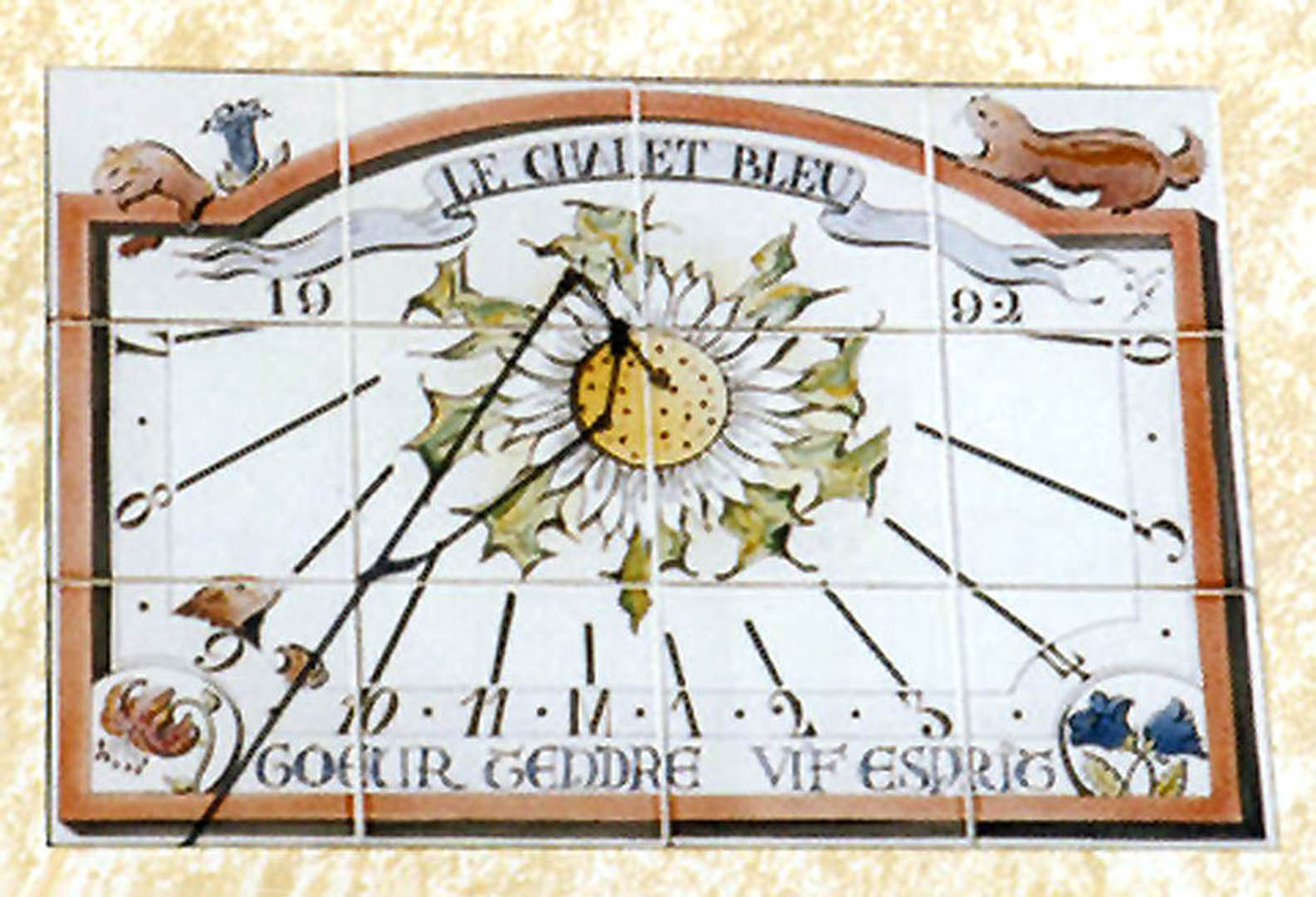
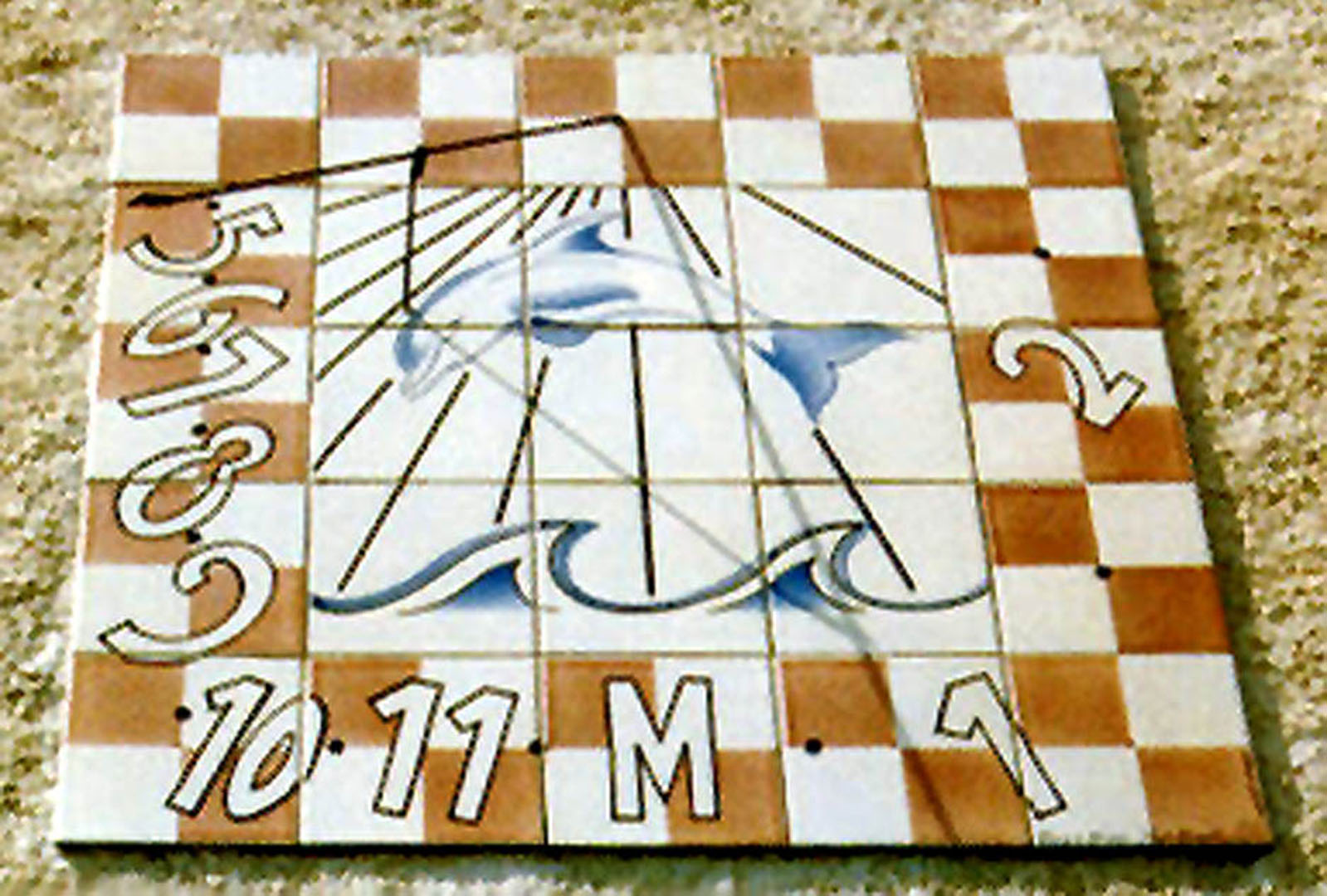
For optimal viewing, set your browser's "View" to Full Screen. Click on any of the images for a larger view. Your browser will automatically downsize the large picture to fit your computer monitor screen. We resized all photos to the standard high definition television height of 1080 pixels or higher so that they will completely fill the height of a 1080 HDTV screen because we think many people will soon connect their computers to new widescreen HDTVs, and some people will want this large picture size. Unless otherwise noted, please ask permission from the photographers if you want to use their photos.
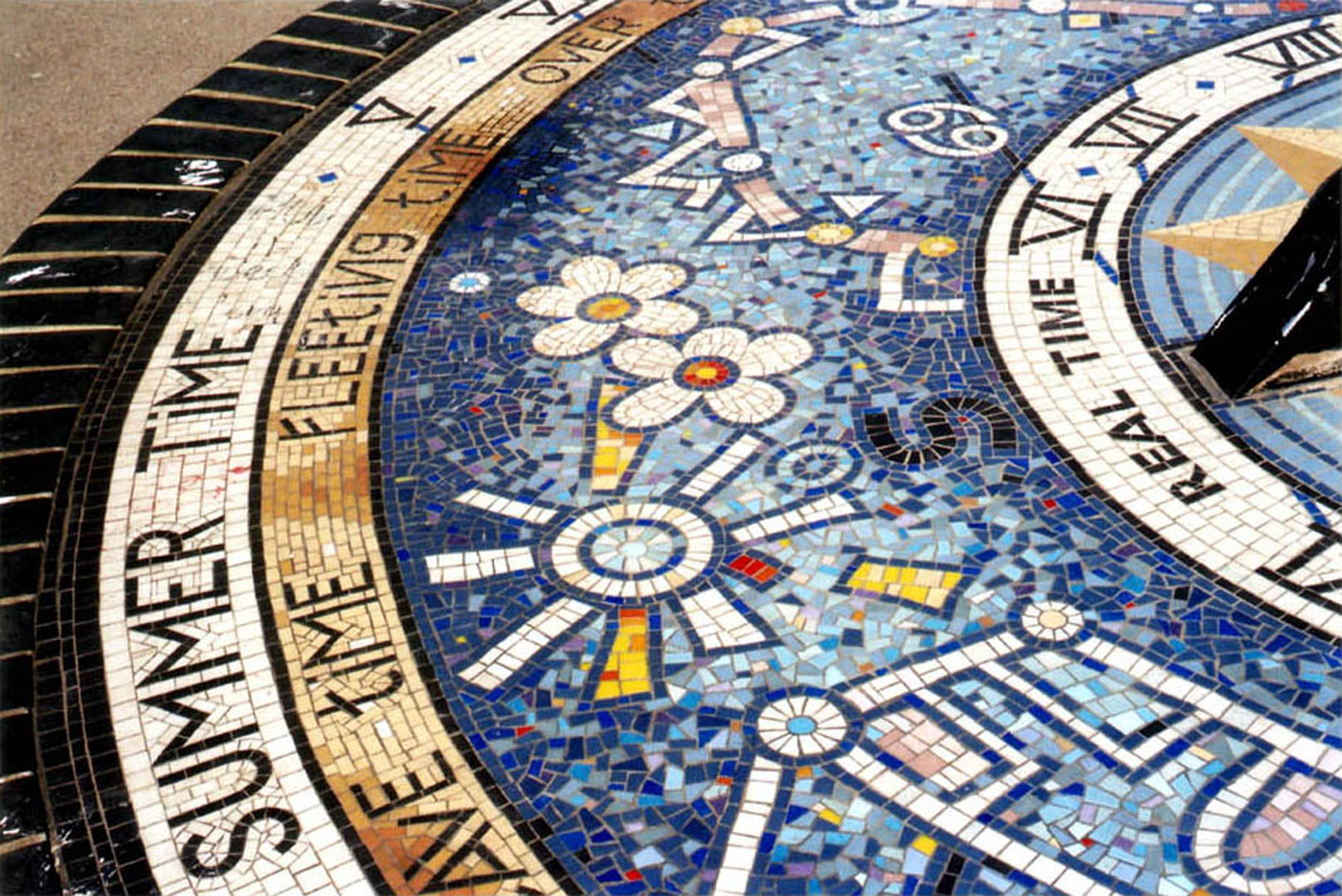
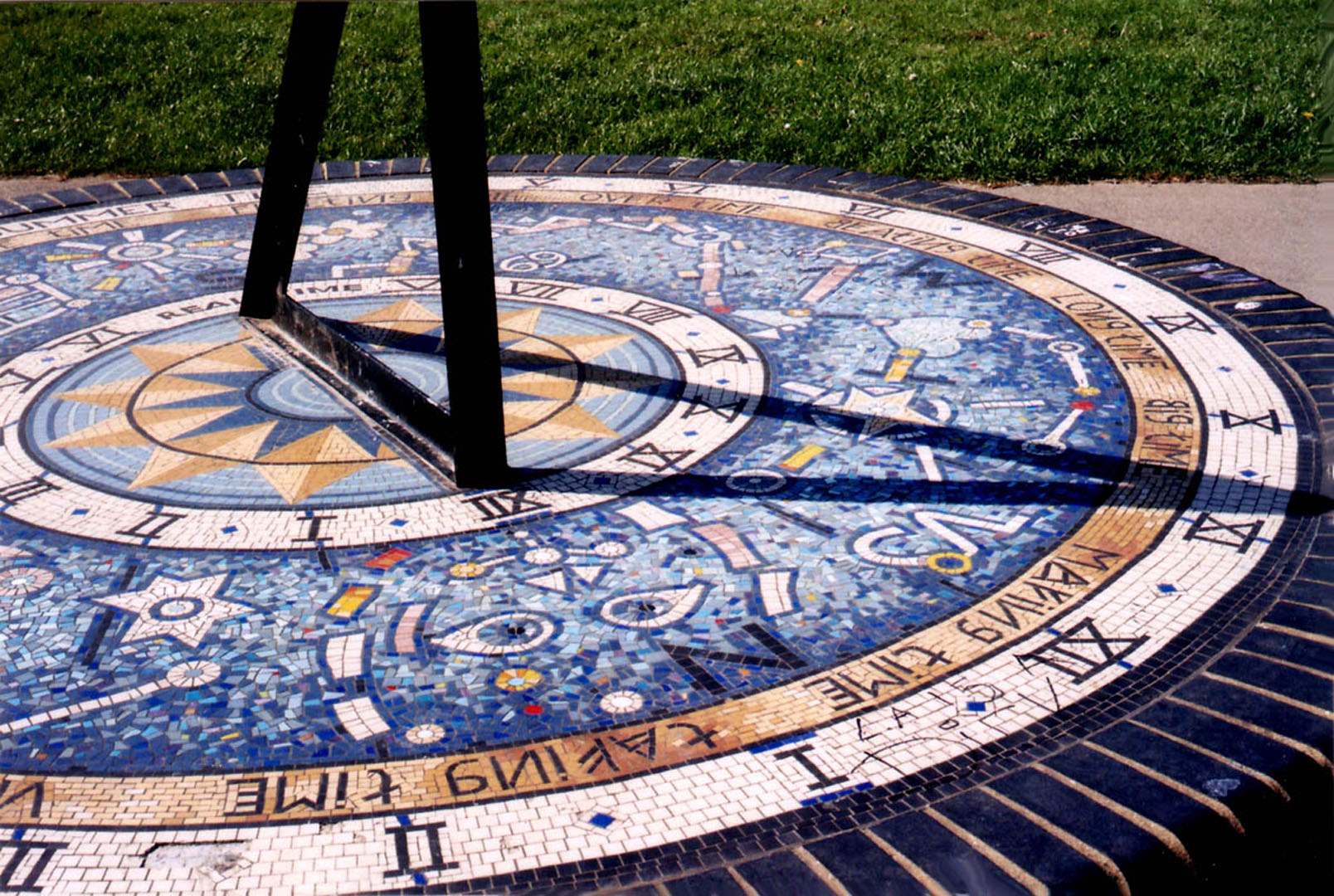
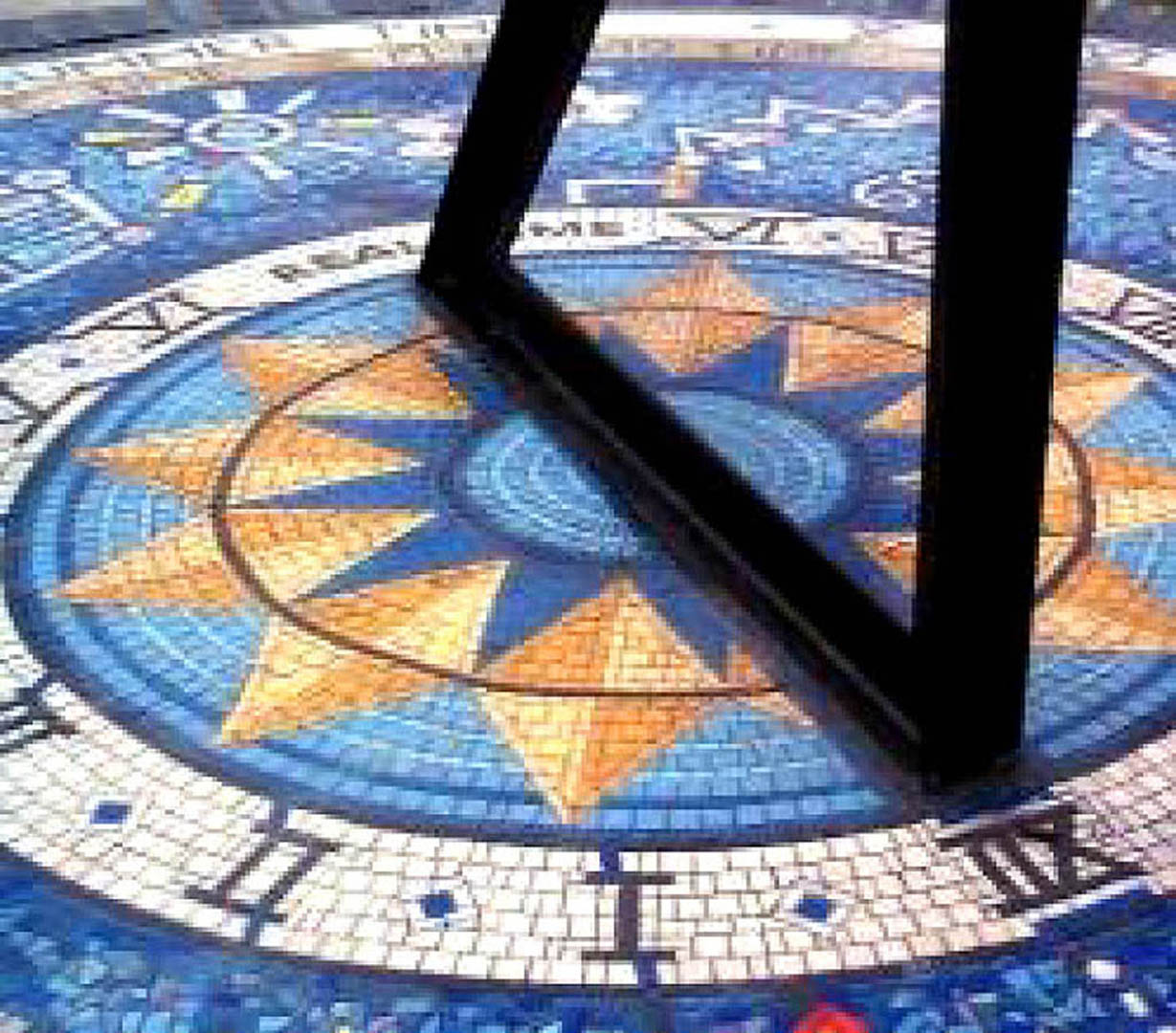
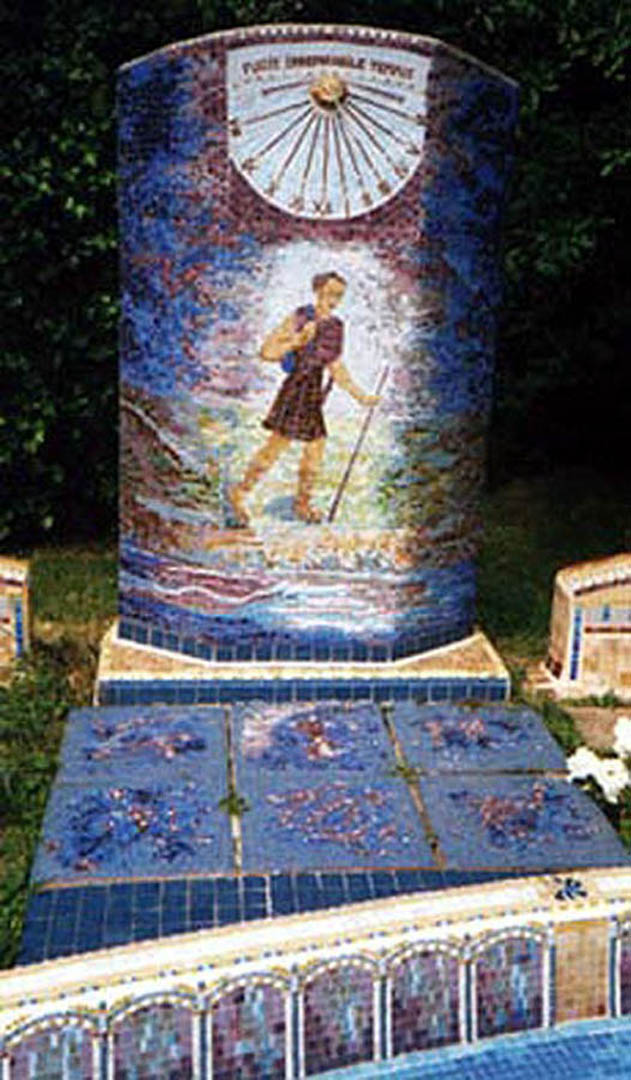
The term "stained glass" commonly refers to any colored flat glass or any object made of this glass joined by metal strips. The term originally applied to colored or clear flat glass cut to fit an artist's design, on which details were painted with a brush using glass enamel. The glass pieces were then heated in a kiln or oven to bond and fuse the enamel to the glass surface. This firing made the painted detail as durable and permanent as the glass itself. Most stained glass sundial and religious windows from medieval times until this century were executed in this manner. In our website, we use a broader definition that includes glass colored by any means including inks and non-fired enamels. Etched glass is not stained glass. But we included a separate etched glass section in the Image Archive since they are so similar in function and use. Some sundials have both stained and etched glass pieces in them, making them difficult to classify, so I follow this rule: If most of the sundial is of stained glass, then I put it in the stained glass section, otherwise I classify it as etched glass.
 |
 |
 |
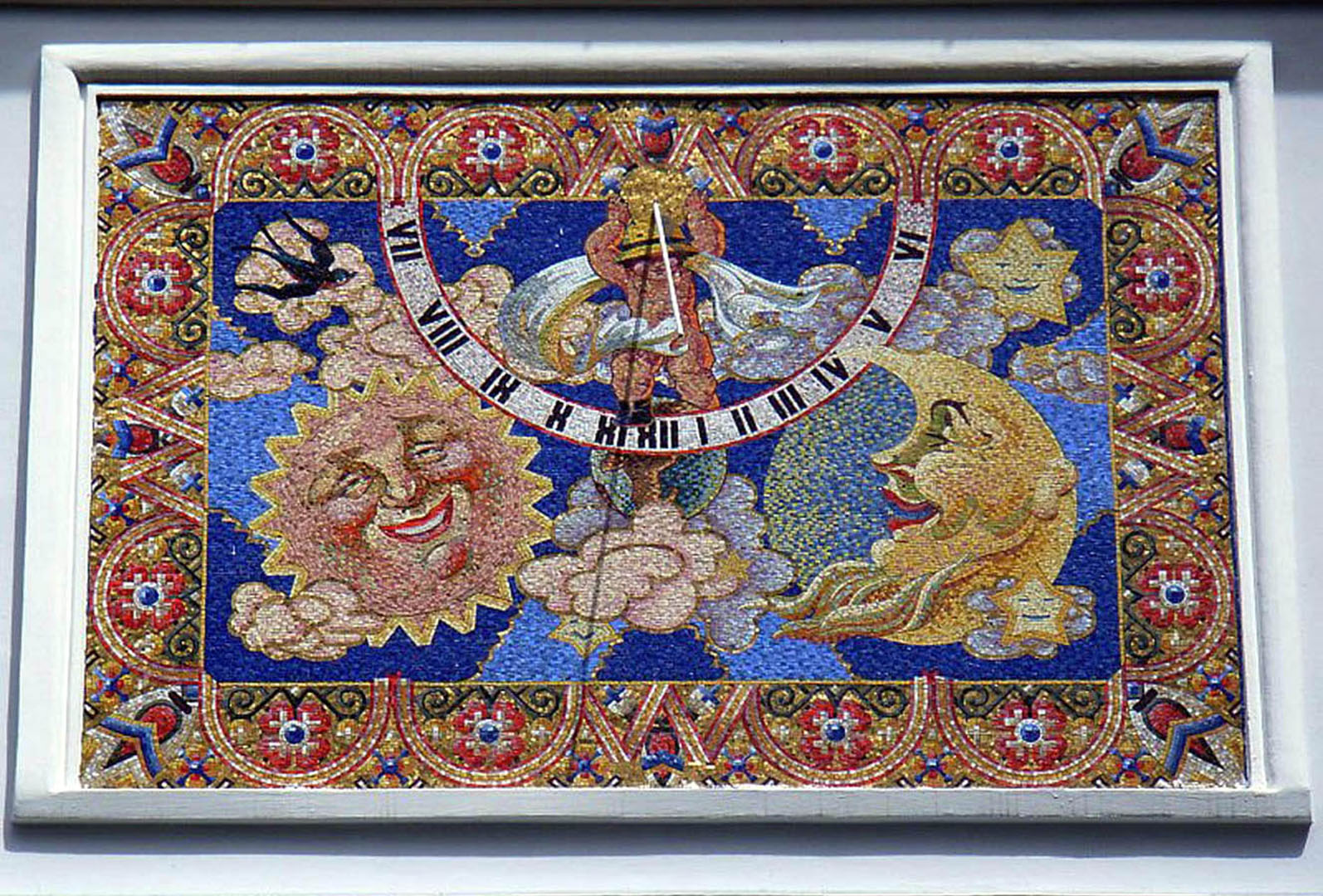
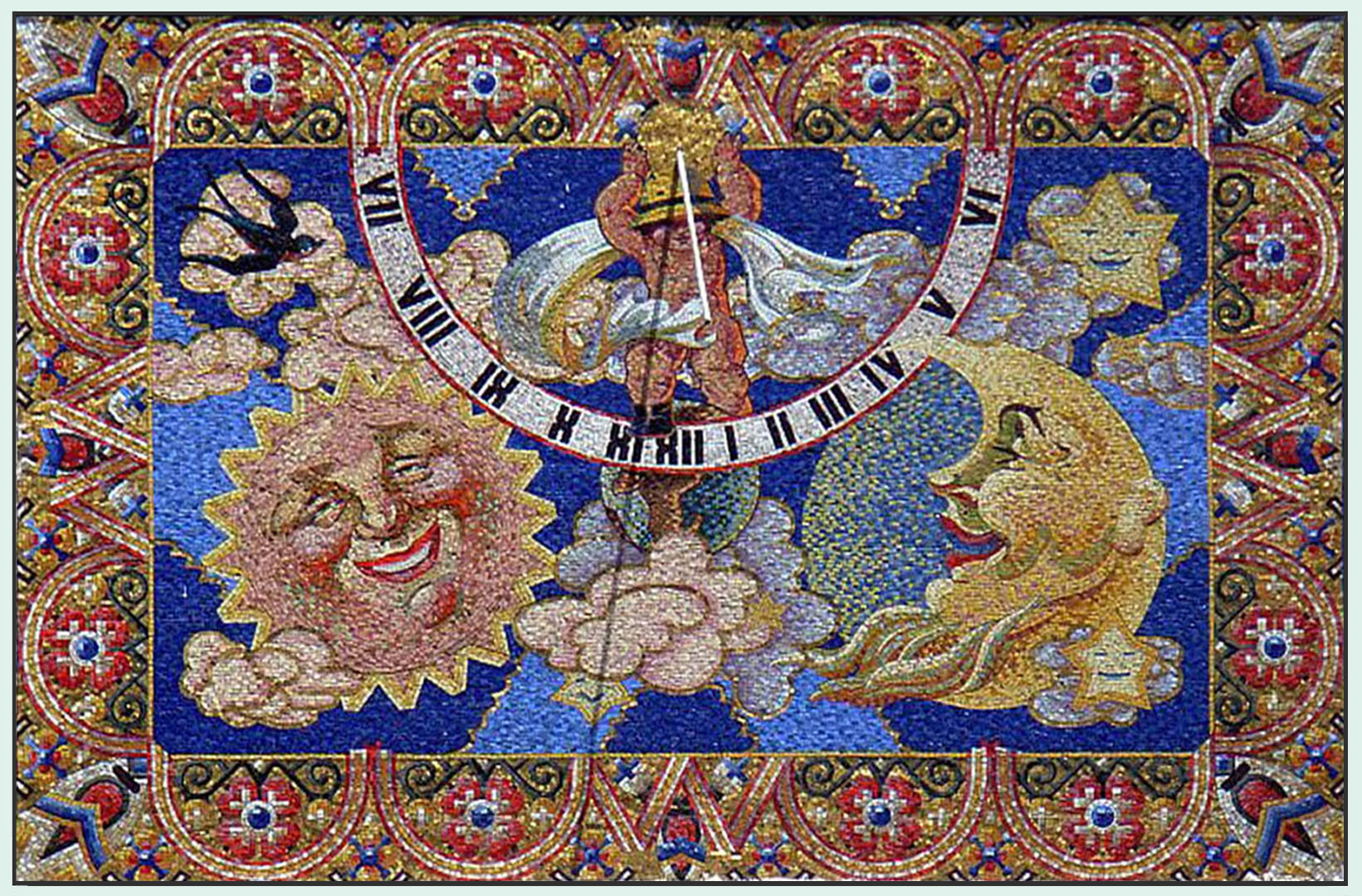
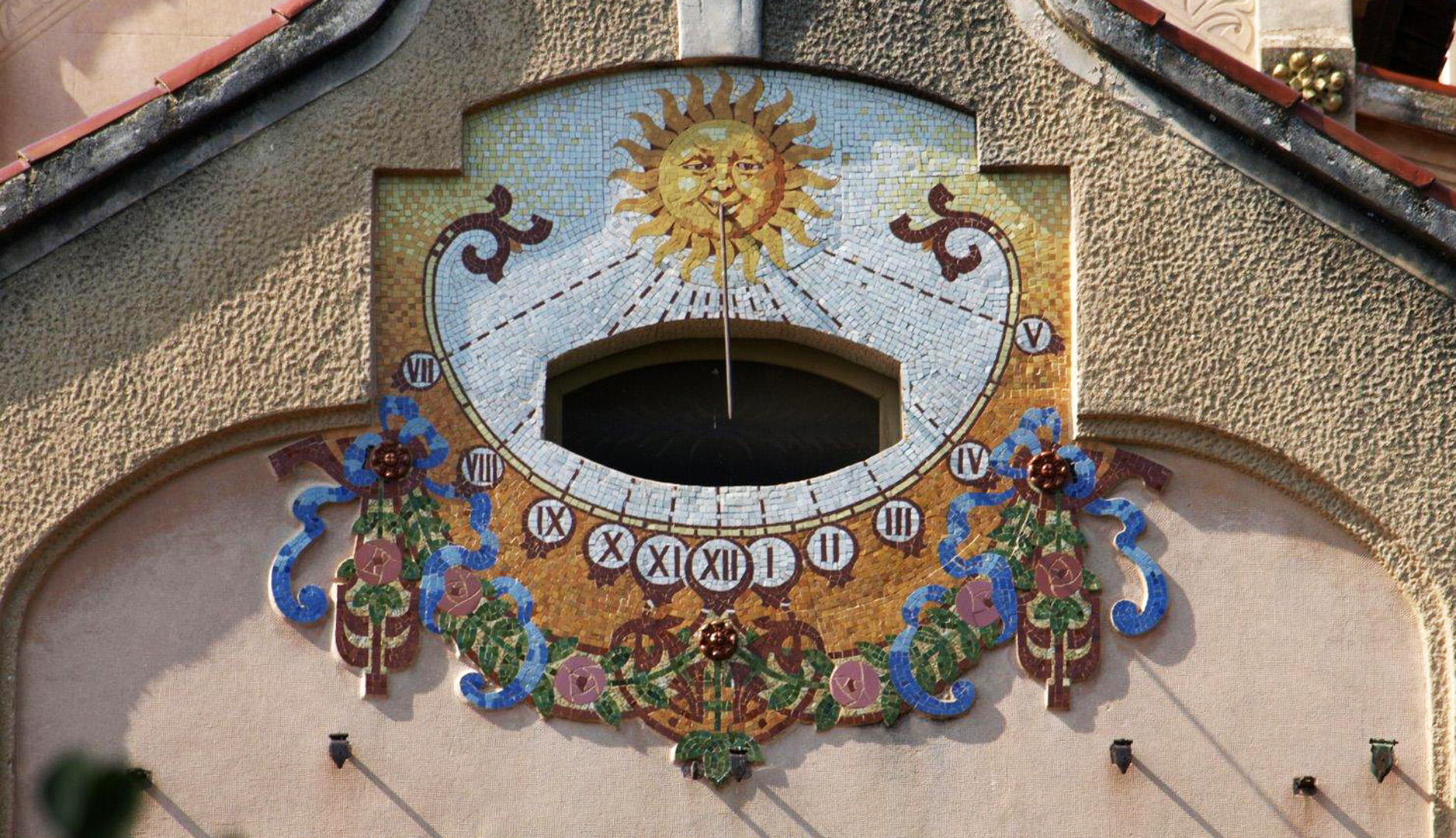
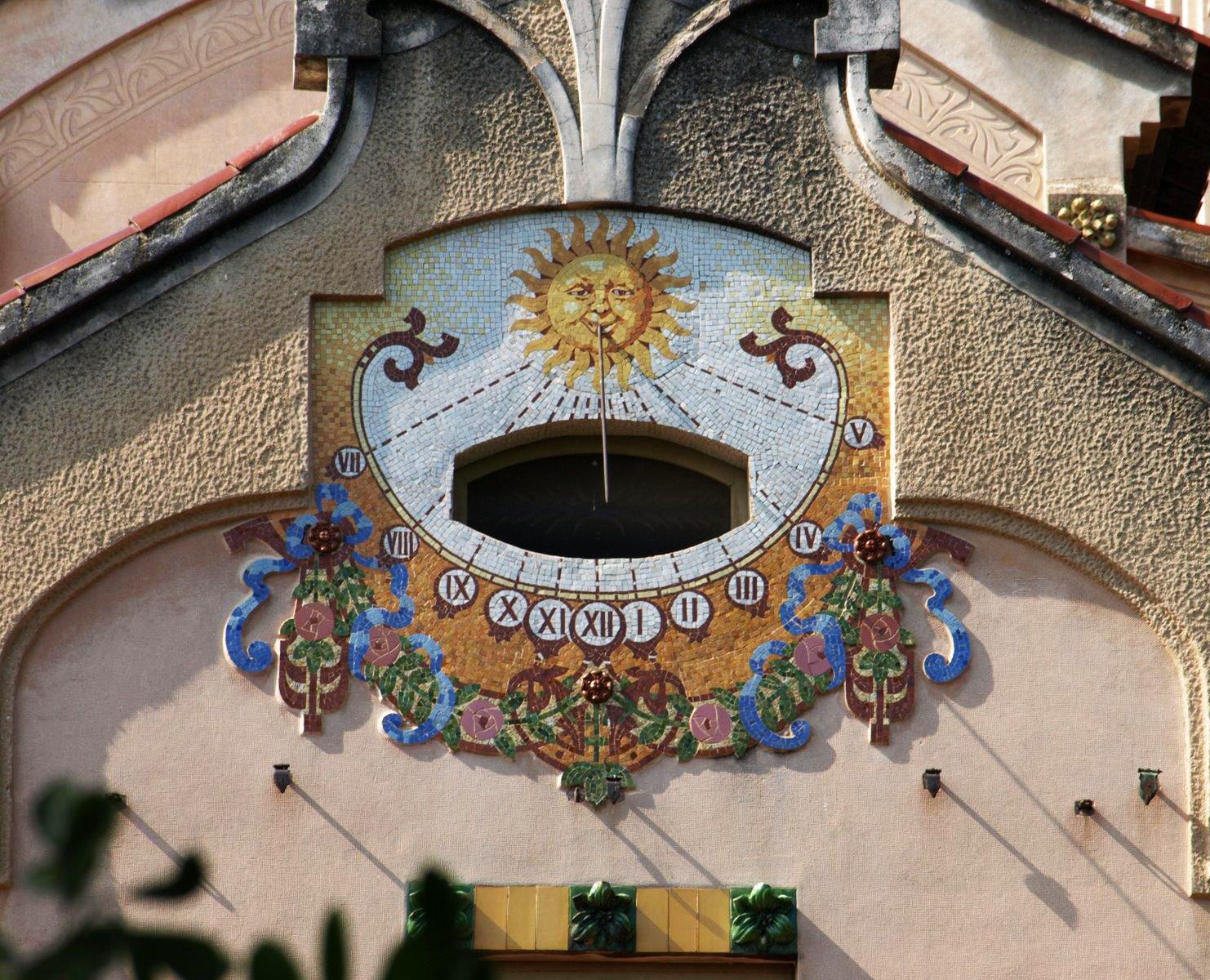
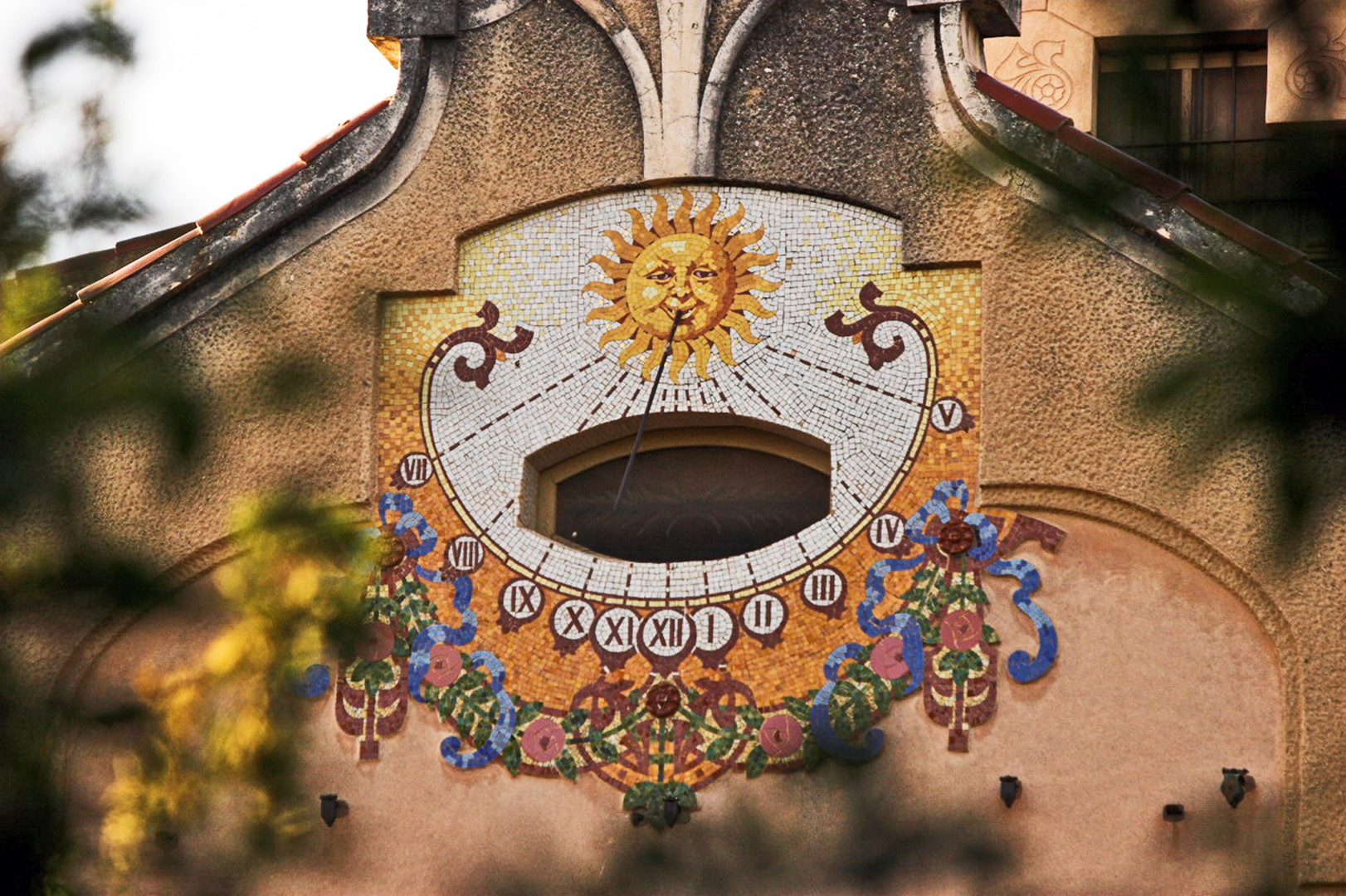
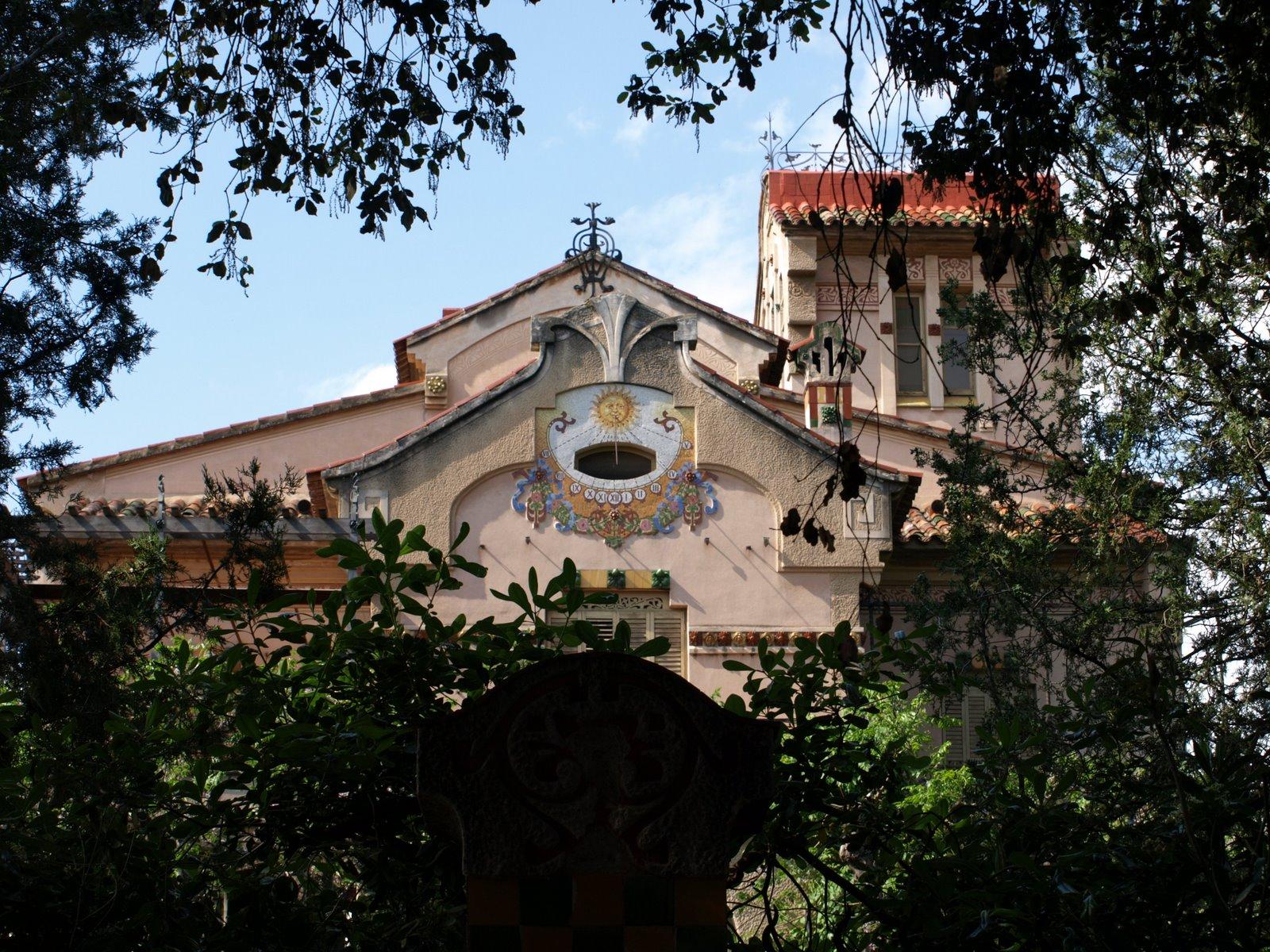
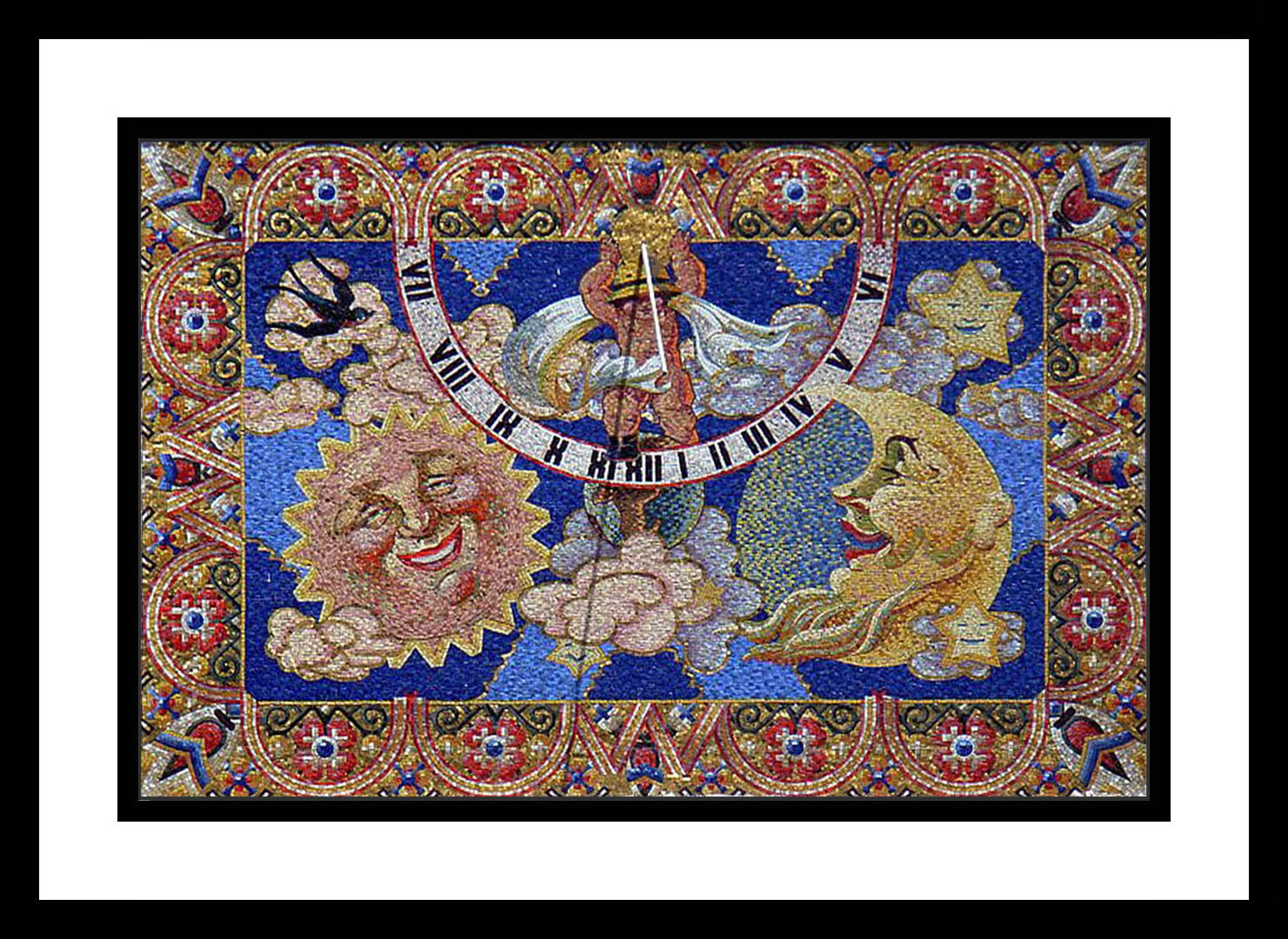
| Delineator: unknown Artisan: unknown Date: 1920? Original Location: e pavilon M, neurology, Kosumberk, lécebna Luže. Czech Republic Present Location: probably at original location Orientation: Vertical, faces due south Size: 3 x 7 m (9 x 23 ft). very large! Adornment: complex and intricate modern design of smiling sun, moon and stars with a capped cherub holding the gnomon and a very fancy border. Composed of many ceramic pieces and gold leaf. Mottos: none Inscriptions: none Condition: unknown Comments: This is certainly one of the most intricate and beautiful sundials in our mosaic dial collection. It is a true work of art. Because it is so large, the artist was able to achieve fine details, precise patterns, and intricate shading and using standard sized 1 cm mosaic tiles. From a distance, it almost looks like a painting. We need better photos and more information about this magnificent sundial. Astro.mff Website: Here Flickr Website: Here Photo Descriptions: Photo ‘a’ by Marian Repáš (2006), copied from Astro.mff website. Photo ‘b’ copied from flickr website. Photo ‘c’ is a photoshopped version of photo ‘a’ that corrects perspective distortion and crops out border. Photos: a b c |
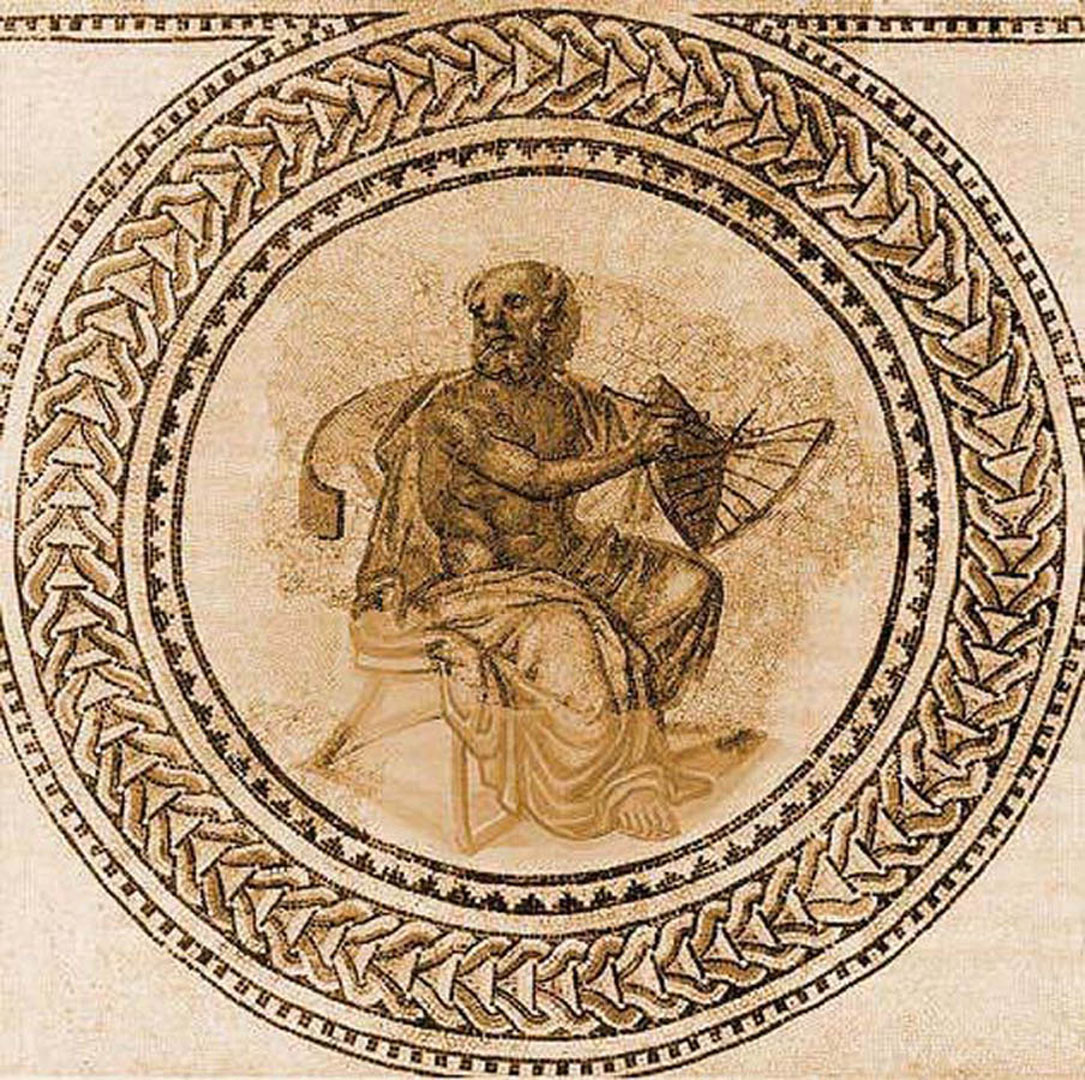
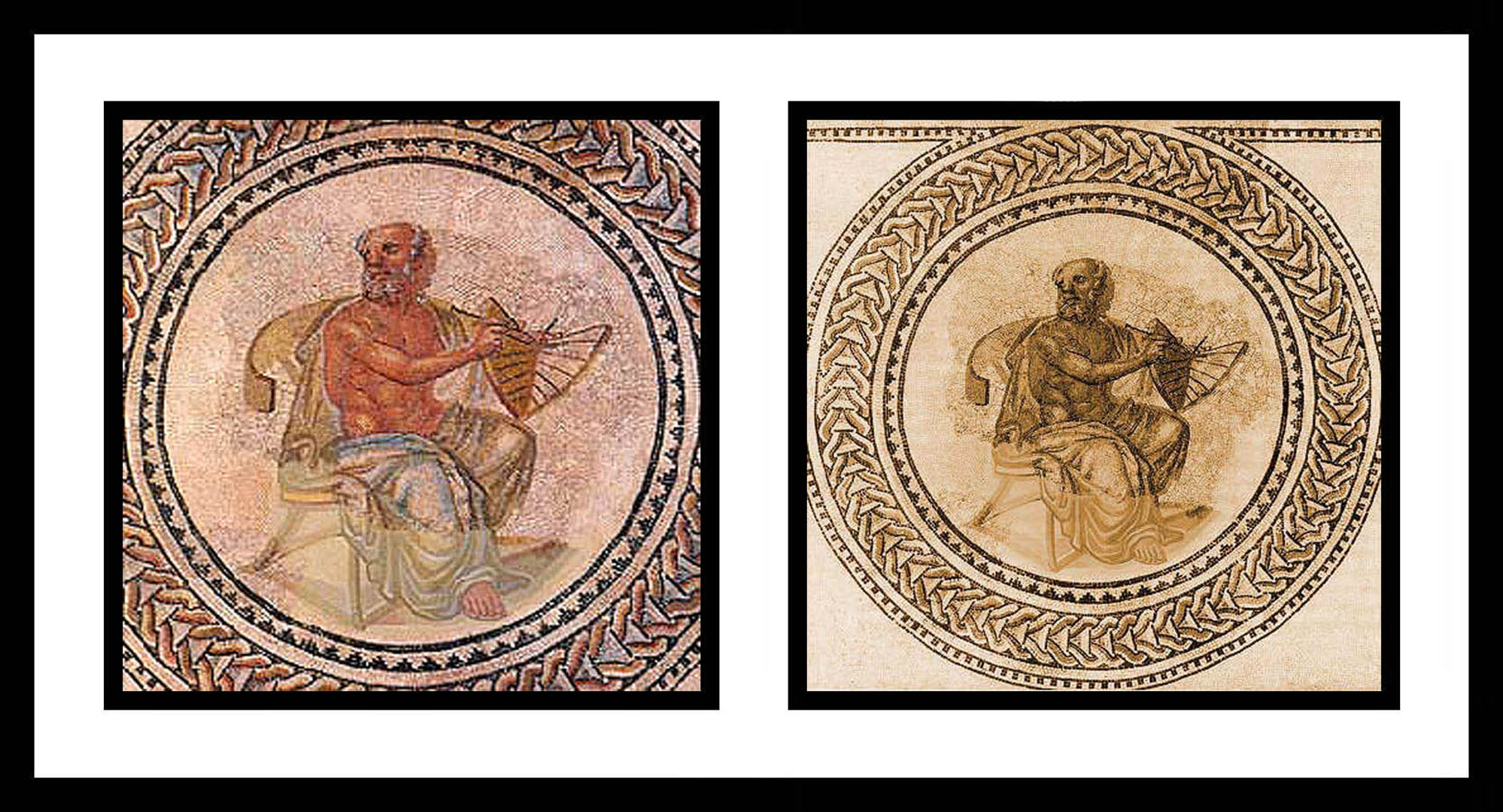
Designer & Maker: unknown, anonymous Date: 3rd. century BC Original Location: mosaic on a floor, Greece Present Location: Rhineland Museum, Trier, Germany Orientation: unknown Size: unknown Adornment: The mosaic shows an old man with a solar clock, generally recognized as Anaximander of Miletus in Asia Minor (c. 610-546 BC). Mottos: none Condition: good Comments: This is a depiction of a sundial and is not a working sundial. The historians believe that the philosopher Anaximander found for the first time the equinoxes, the solstices and that the Earth is perfectly in the center of the celestial sphere. It also introduced the gnomon. He wrote "Around the nature", "The earth's turn", "About the fixed stars", "The sphere" and other works. A moon crater bears his name. Article by Galanakis: (2010) The Construction of an Equatorial Sundial with a Reference to Anaximander's Skiatheron. "The British Sundial Society Bulletin" Vol. 22(iv), December. 22-25 Hans Arnfed Astel Website: Here Mario Arnaldi Website: Here Mario Arnaldi Website (English Translation): Here Photo Descriptions: Photo ‘a’ is from The Hans Arnfed website. Photo ‘b’ is courtesy of Mario Arnaldi and is from his website. Photos: a b |
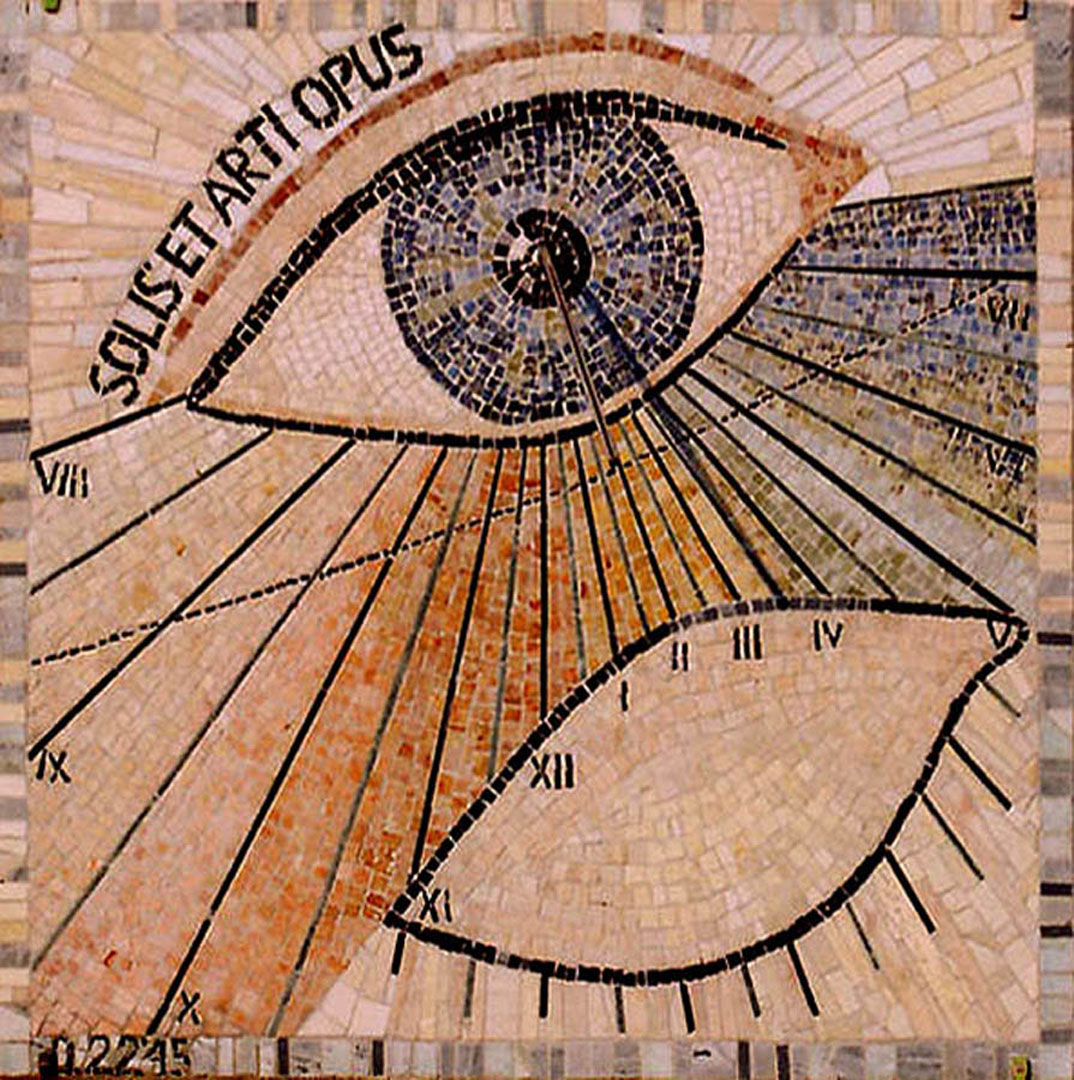
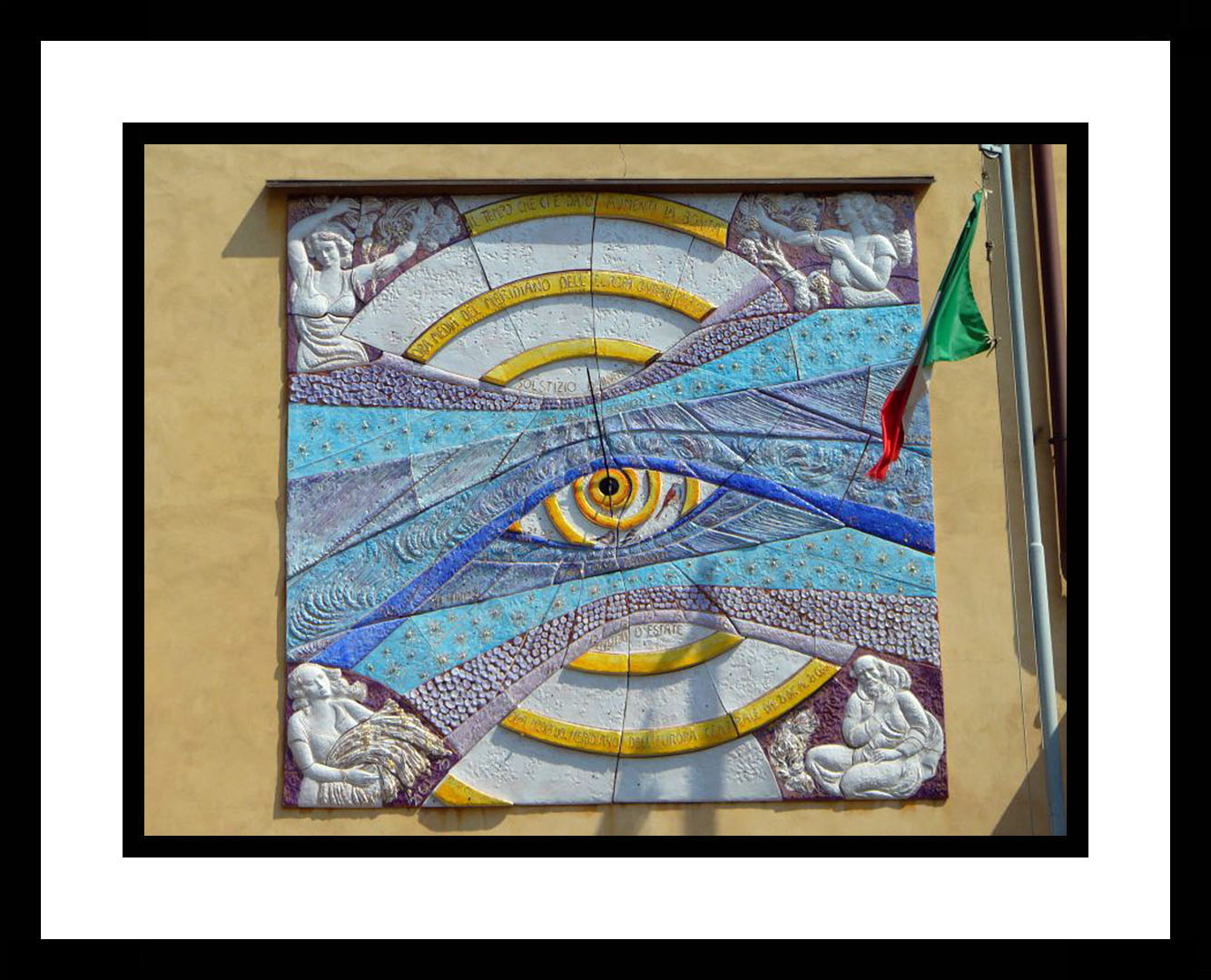
Designer and Maker: Daniela Caravita at Mos Art studios in Ravenna Italy Date: 2004 Original Location: lat: 44° 25' N, lon: 12° 12' E. On wall. Made for a private house in Ravenna, northern Italy. Present Location: at original location Orientation: Vertical. Declines 22°45" west of south. Size: 92 x 98 cm (36.2 x 38.6 in) Adornment: Gnomon protrudes from the iris of a human eye. Has Solstice and Equinox lines. The bottom of the eye is the curved part of the winter Solstice line. In lower left appears: “0.22'.45” indicating the declination to the west of south Mottos: "SOLIS ET ARTI OPUS" (A Work of Sun and Art) Condition: good Comments: Information was copied in 2005 from website below. Dial is made from stones and marbles in traditional ancient Roman and Ravenna Byzantine Mosaics. We are looking for better photos and more information on this dial. Mos Art Website: Here Mos Art Email: Here Photo Descriptions: Photos are copied in 2005 from website above. Photos: a |
 |
 |
 |
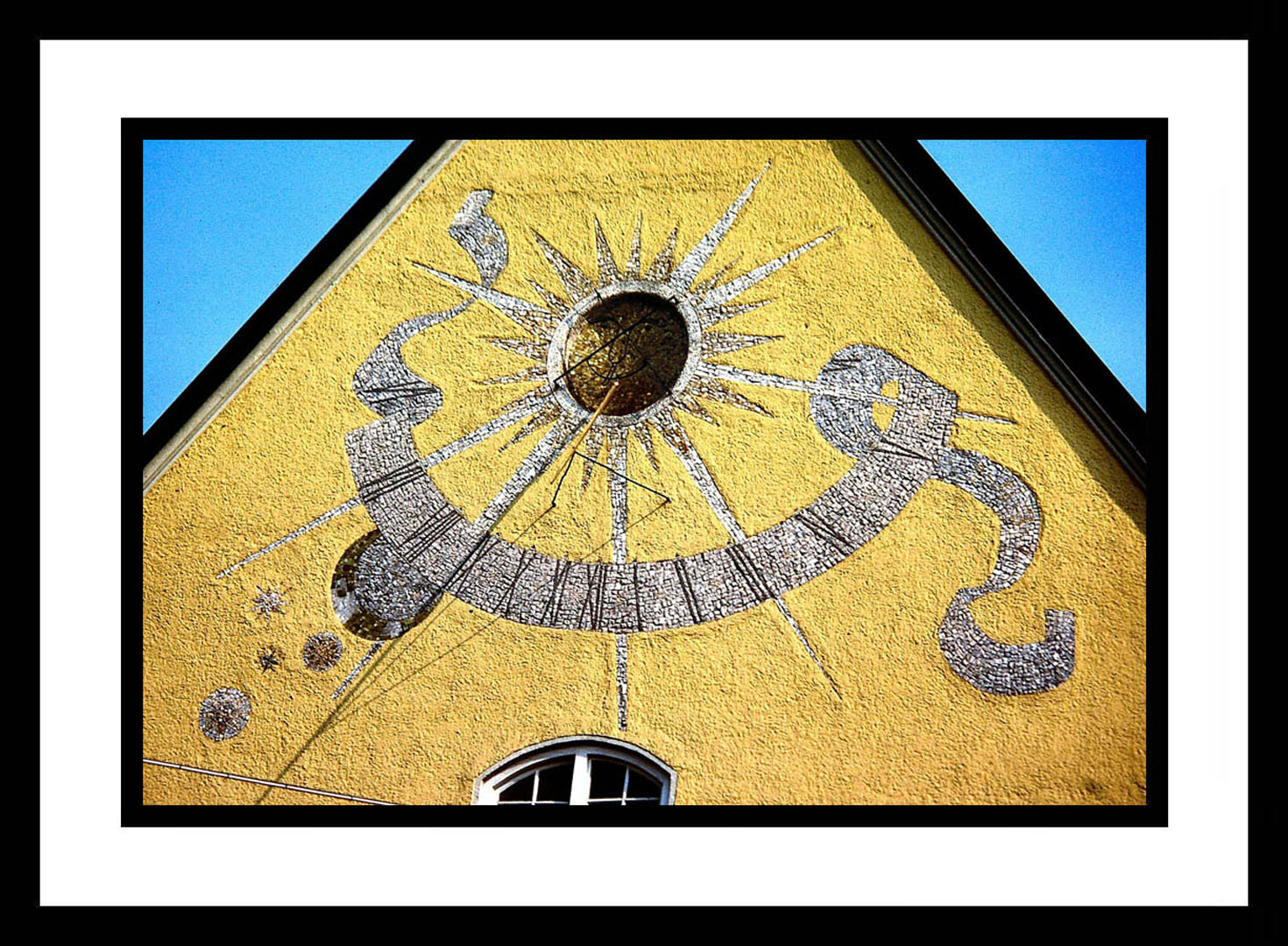
| Delineator & Maker: unknown Date: unknown date in 20th Century Original Location: unknown building in Munich Germany Present Location: at original location Orientation: Vertical. Declination-unknown, but close to south, Size: unknown Adornment: a modernistic design of the sun with rays, the moon and stars. Mottos: none Inscriptions: none Condition: unknown. Probably still good Comments: We’d like to know more about this dial Robert Sylvester’s Email: Here Photo Descriptions: Photo taken in 1996 and sent to us by Robert Sylvester in 2007. Photos: a |
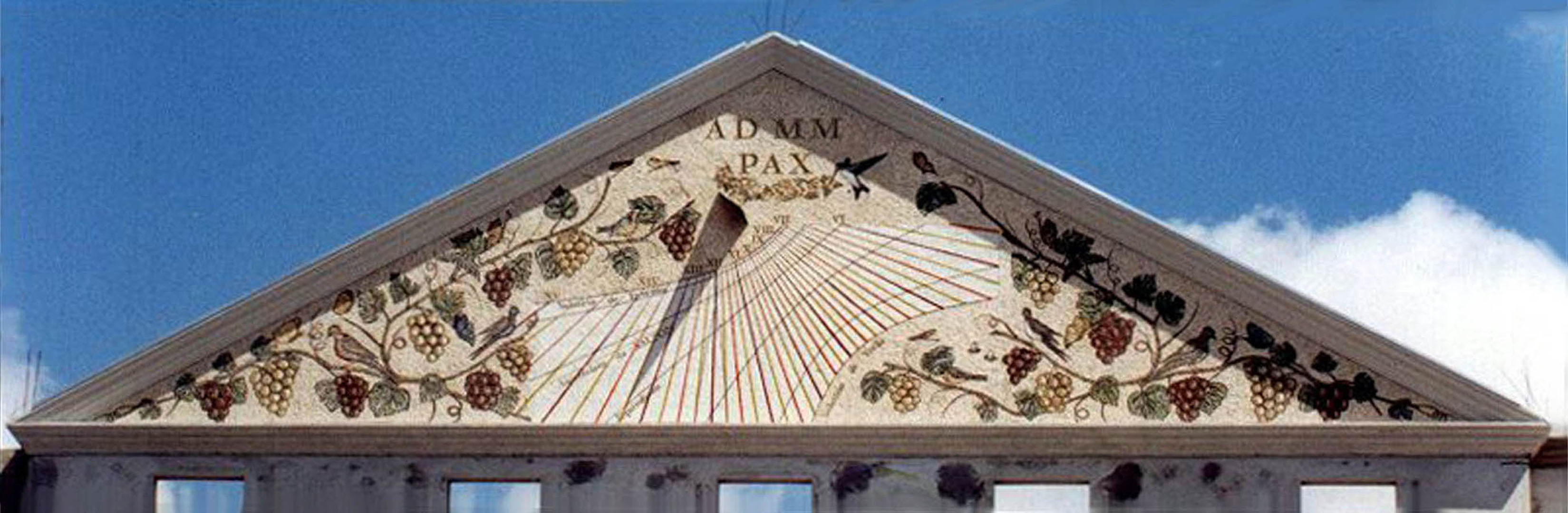
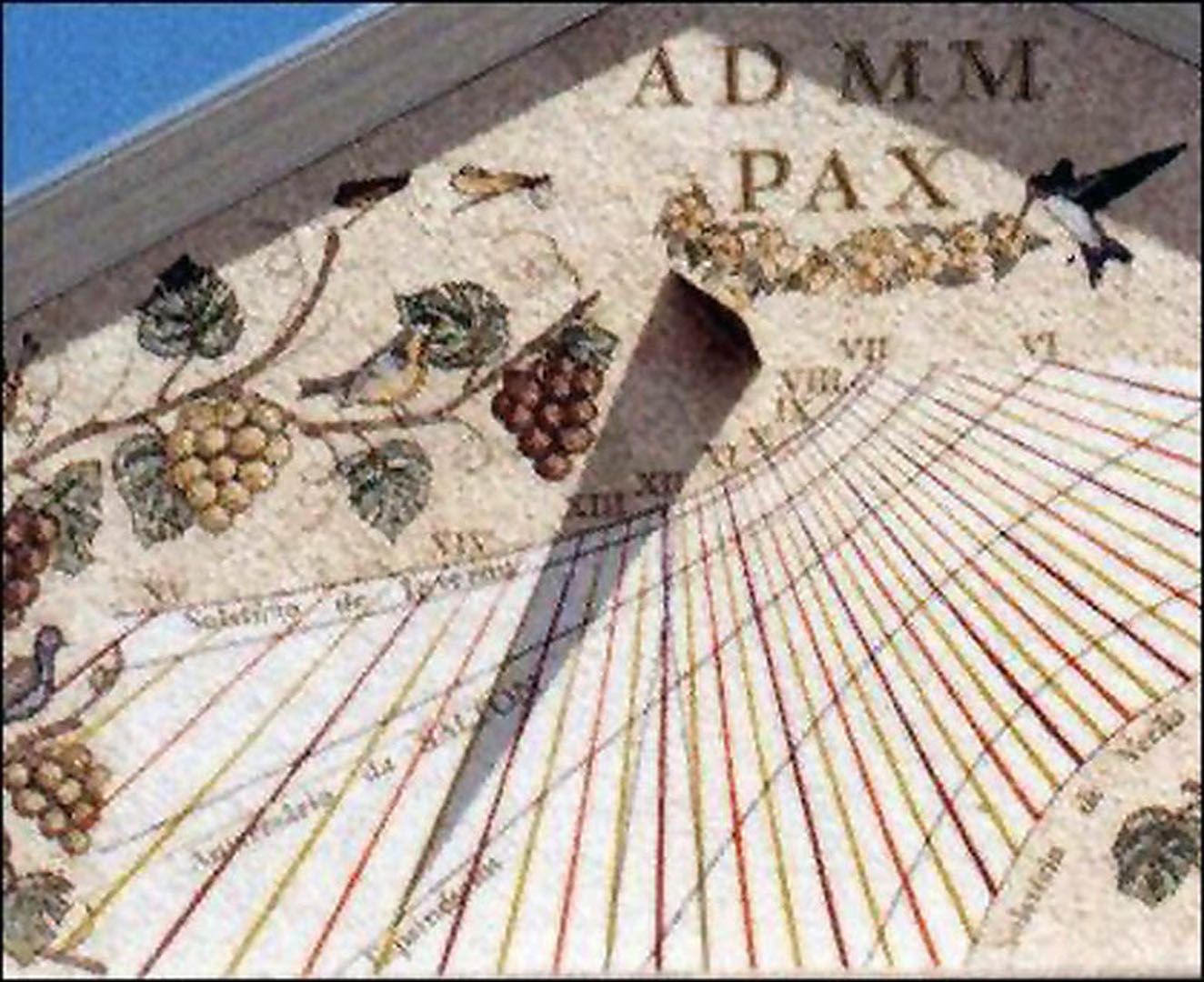
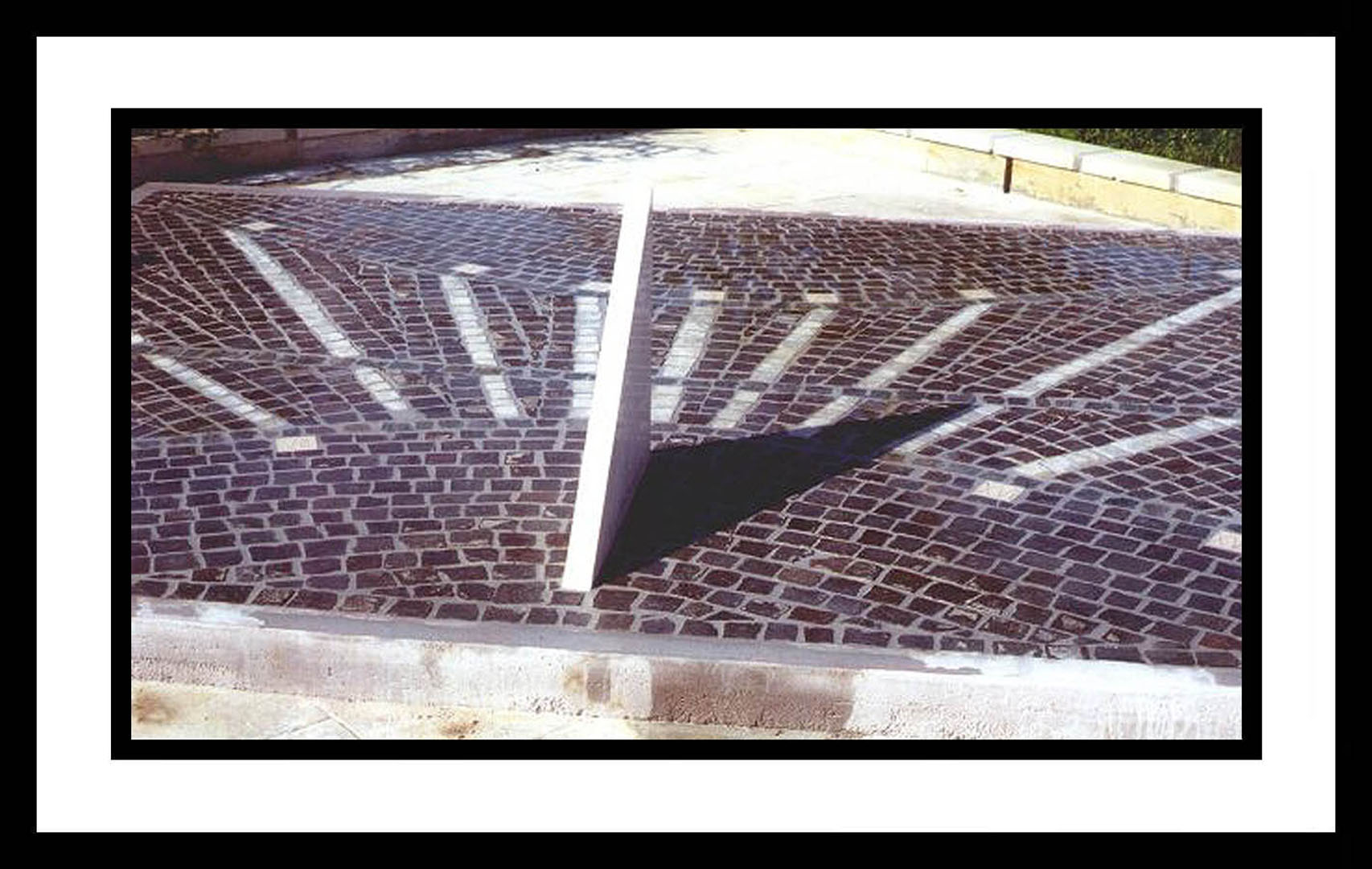
Designer: Adriana Florin and Júlio Posenato, architect, for a Brazilian wine company. Makers: Cinthia Moran Andrea, Fabiano Petozzi and Leonardo Posenato and many assistants. Delineator: Francois Blayteron using Shadows Pro software. Date: Inaugurated in the presence of the Mayor and press on August 25, 2000 . Next to the building is an antique chapel (Notre-Dame des Douleurs) where the ceremony was held. A chorus sang Handel's Halleluiah. Original Location: Lat: 29° 5' S; Lon: 51° 33' W. The sundial occupies the central part of the pediment of the main building of Vinhos Salton SA in Salton Brazil Present Location: at original location Orientation: on vertical wall. Wall declination unknown. Size: unknown Adornment: Below the date, a border made of almond tree branches, with a hummingbird sipping nectar, symbolizes the harmony of nature and the love between creatures. The lateral parts are made of Italian marbles, granites and semi-precious stones, represent leaves, branches, grapes (its a wine company) and animals usually found in vines fields during grapes harvesting: birds (symbolizing music), dragonflies and butterflies - especially a blue butterfly (symbolizing poesy)- and bees (symbolizing work). Mottos: "AD MM - PAX"(Anno Domini (year of the Lord) MM (for 2000), PAX (peace).) Condition: excellent in 2005 Comments: Information is from website below Magnificent mosaic sundial made for the 90th anniversary of "Vinhos Salton SA", a wine company located in Salton, Brazil. It's a mixture of the Roman and Venetian styles, and is made of more than half a million pieces of Italian marbles, granites from various origins, special enamels, semi-precious stones and a special type of mosaic gold (a 24-carat slice of gold enclosed in two glass layers); the mosaic contains more than 24 kg of this material! Dial shows Solar Time. It has 15 minute hourlines and declinations lines drawn for the solstices, the equinox and each Zodiac change date. A special line drawn for the 25th of August recalls the inauguration date of "Vinhos Salton SA". It has a solid triangular sheet gnomon. Pagesperso-orange Website: Here Júlio Posenato Email: Here Vinhos Salton SA Tel: 55 54 451.1611 Photo Descriptions: Photos are copied from website above. Photo ‘b’ shows shadow pointing to 3:15 pm on the Equinox. Photo ‘c’ is project sketch. Photos: a b c |
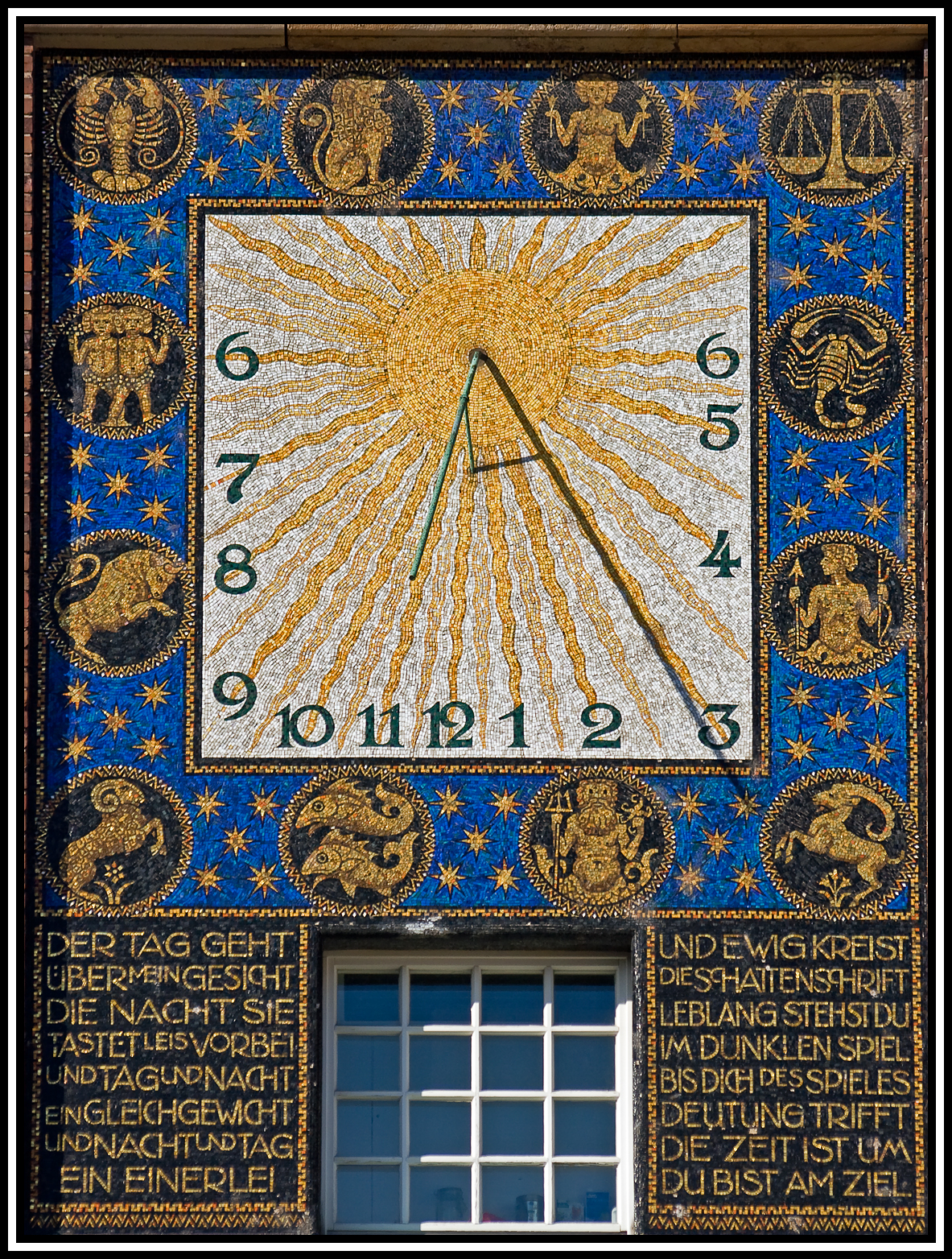
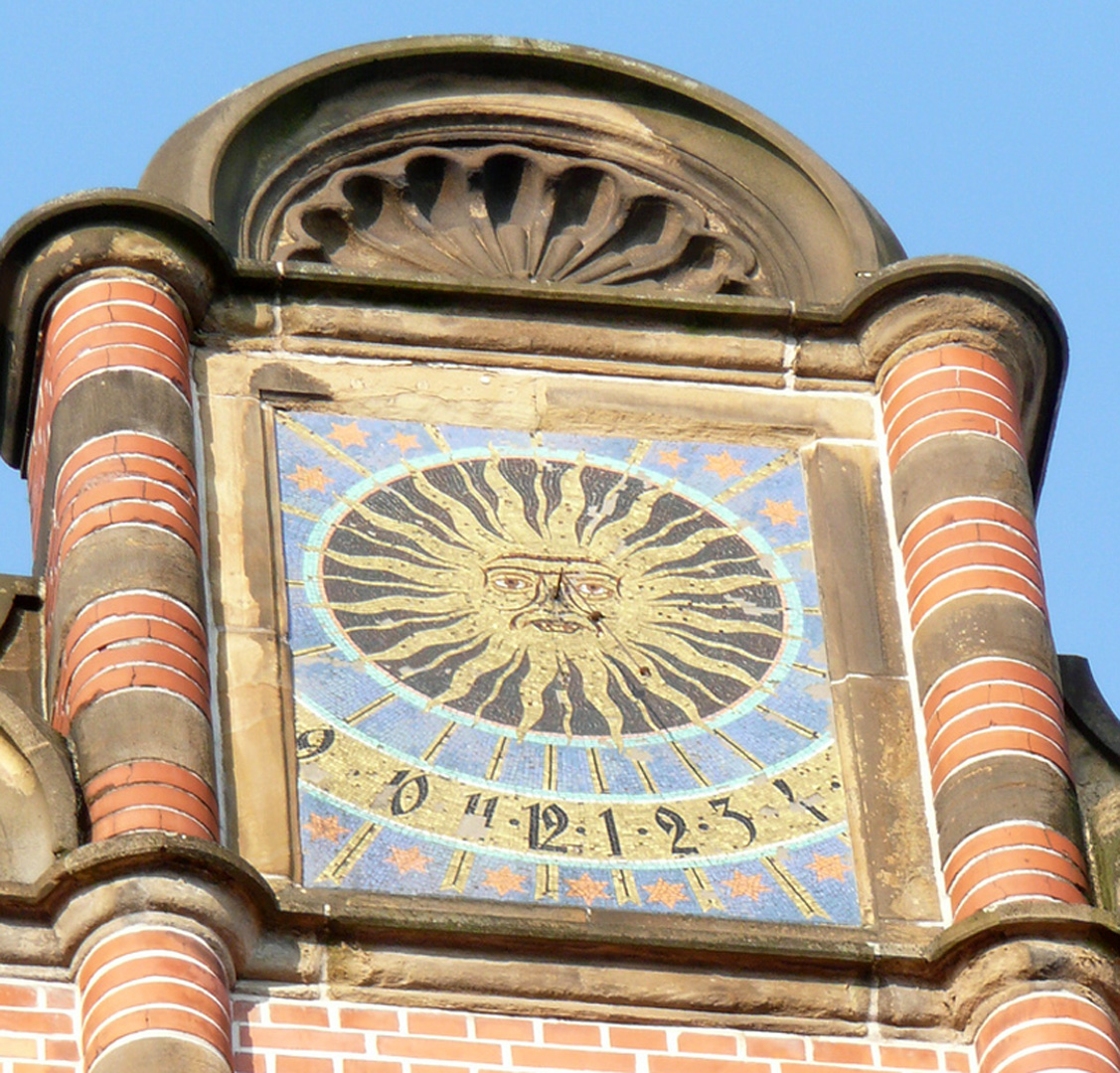
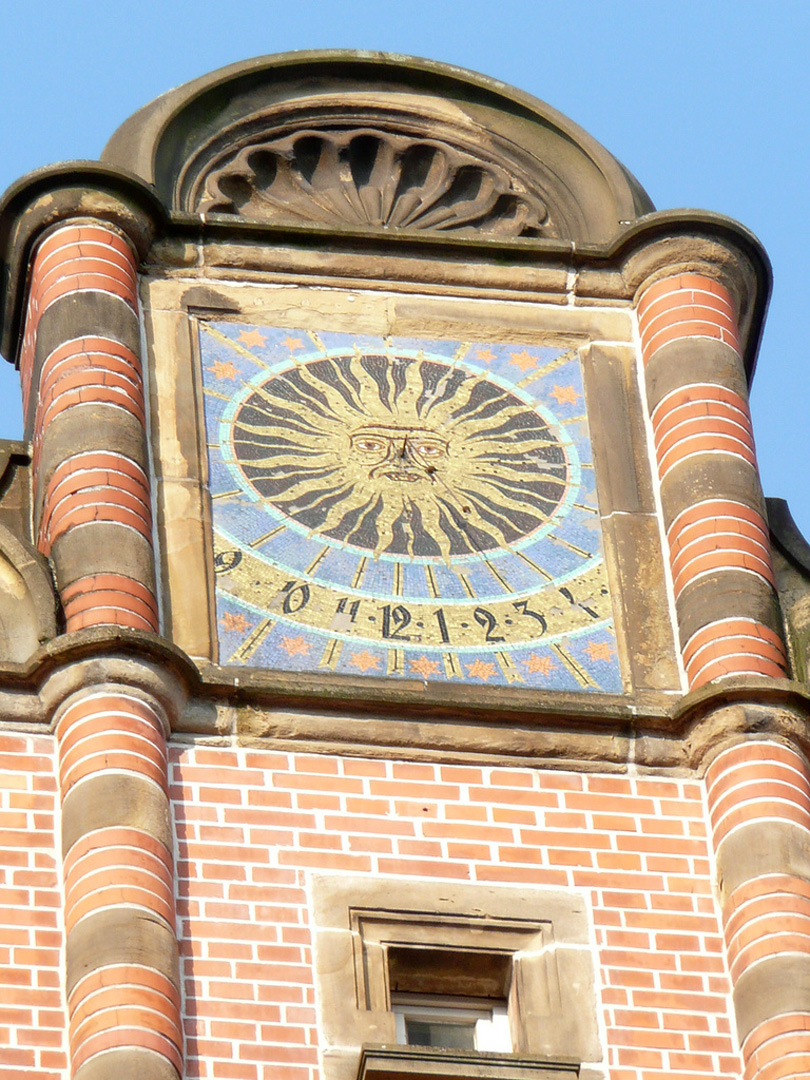
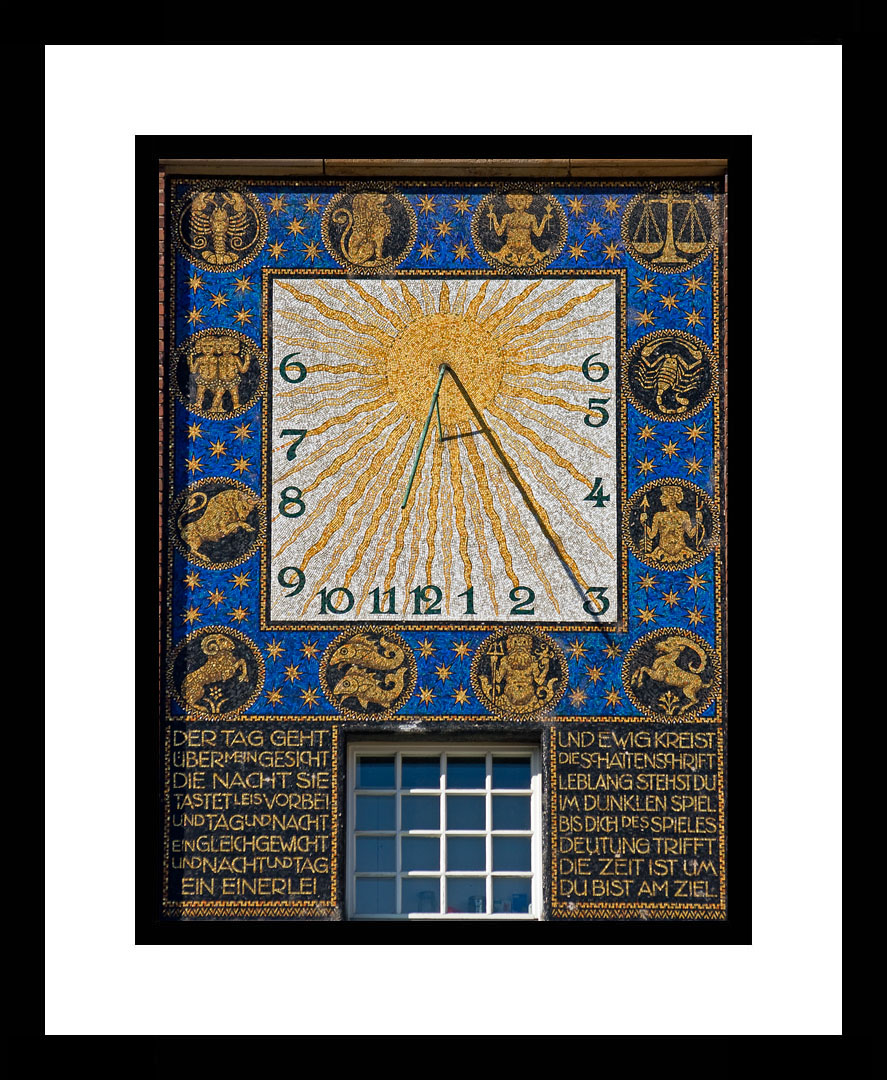
Makers and Designers: unknown. Date of Installation: unknown for sure. Probably made in the 20th century because tower was built in 1908. Original Location: Sundial is on the south side of the Hochzeitsturm (Wedding Tower) at the Mathildenhöhe in Darmstadt, Germany. Orientation: Vertical. Declines south. Size: unknown exactly, but it is big and covers two levels of the tower. I’m guessing that the little mosaic tiles are the standard size of one centimeter. By counting the number of them in a straight line, I estimate that the dial is about 3.1 meters tall (10 ft) and 2.1 meters wide (8 ft). j.c. Adornment: The inset circles represent the 12 signs of the zodiac. Mottos: none Inscriptions: The German text is a poem by Rudolph Binding, and is a reflection on the transient character of life. It reads- “DER TAG GEHT ÜBER MEIN GESICHT, DIE NACHT SIE TASTET LEIS VORBEI, UND TAG UND NACHT EIN GLEICHGEWICHT, UND NACHT UND TAG EIN EINERLEI, UND EWIG KREIST DIE SCHATTENSCHRIFT, LEBLANG STEHST DU IM DUNKLEN SPIEL, BIS DICH DES SPIELES DEUTUNG TRIFFT, DIE ZEIT IST UM DU BIST AM ZIEL”. Condition: excellent in 2008 Comments: Information is courtesy of Neil Gallop (2008). This is a fantastic mosaic sundial! A lot of work must have gone into making it. Wedding Tower Website: Here Flickr Website: Here Photo Descriptions: Super high resolution photo (3 MB) is courtesy of Neil Gallop © All rights reserved. It is from the flickr website and is used with his special written permission. Please do not use his copywrited photo without his written permission. (see his Flickr site above for contact information). Photo ‘b’ is from Google Earth. Photos: a b |
 |
 |
 |
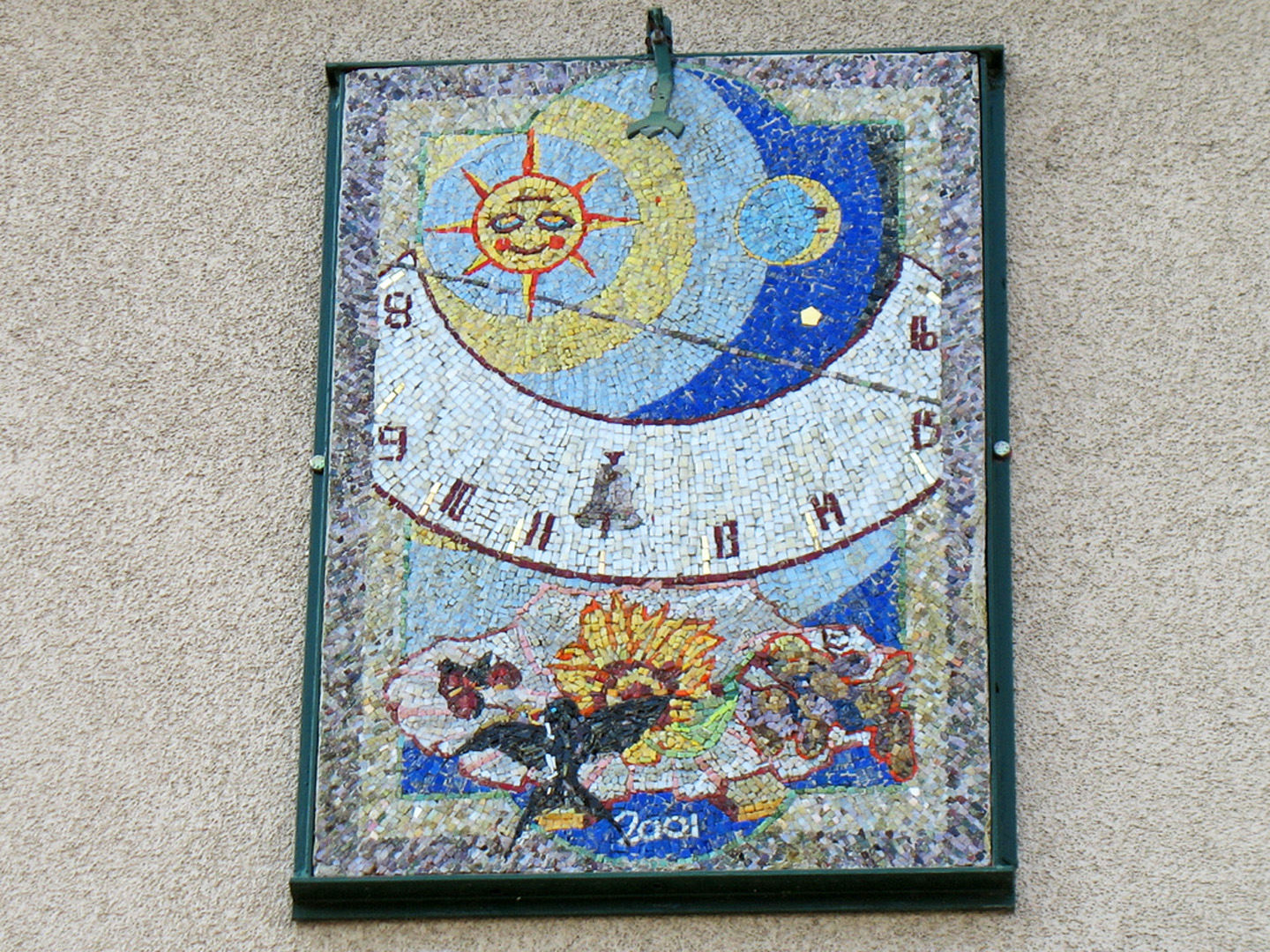
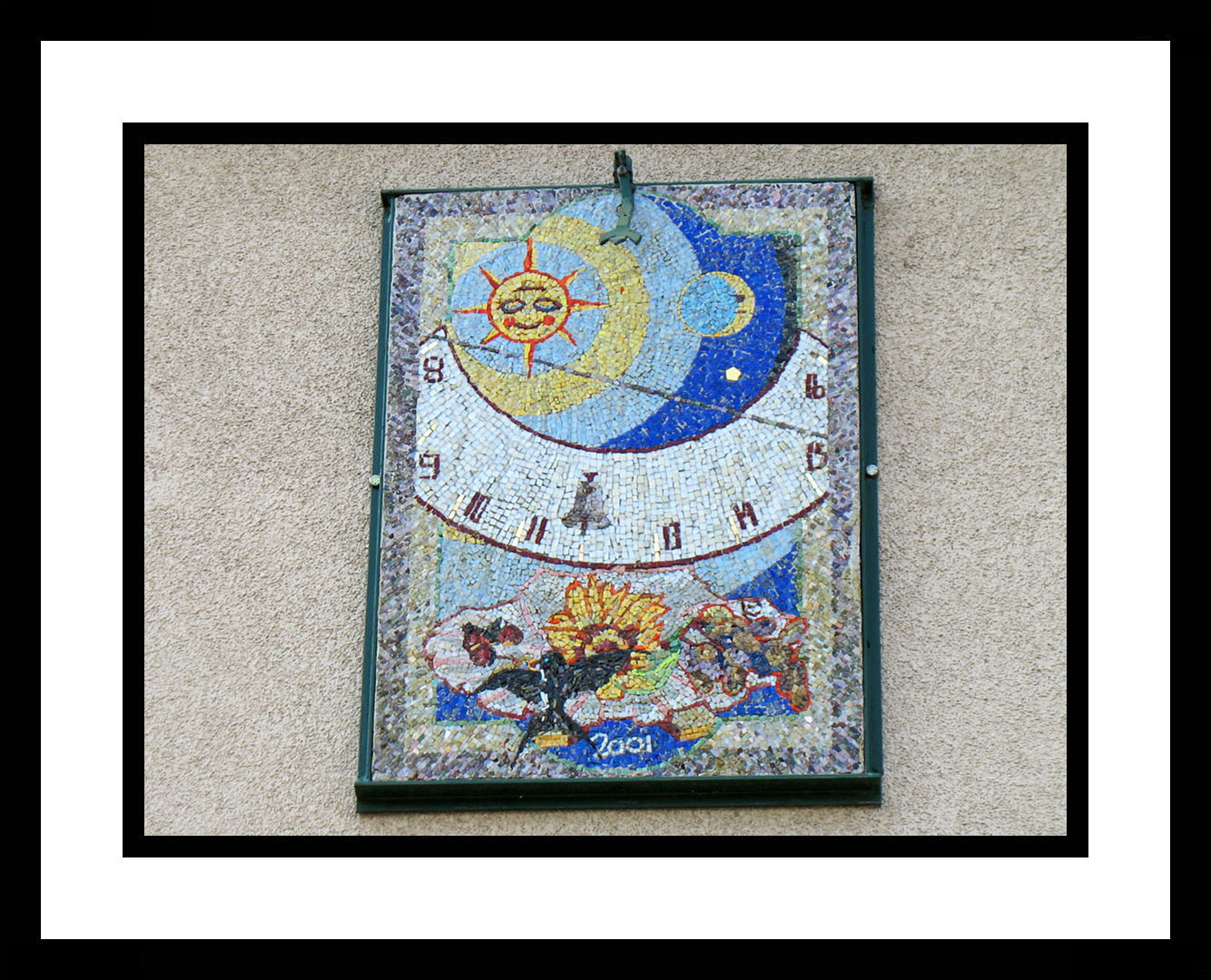
| Delineator: unknown Ceramic Artist: unknown. Date: 2001 Original Location: on via Monte Santo in Paderno Dugnano (MI) Italy Present Location: at original location Orientation: Vertical. Declines west of south by unknown amount Size: unknown Adornment: birds and flowers Inscriptions: 2001 Mottos: none Condition: excellent Comment: none Website: Here Photo Descriptions: Photo is by Matilde Lamperti and was copied with her permission from Flickr website above. Photos: a |
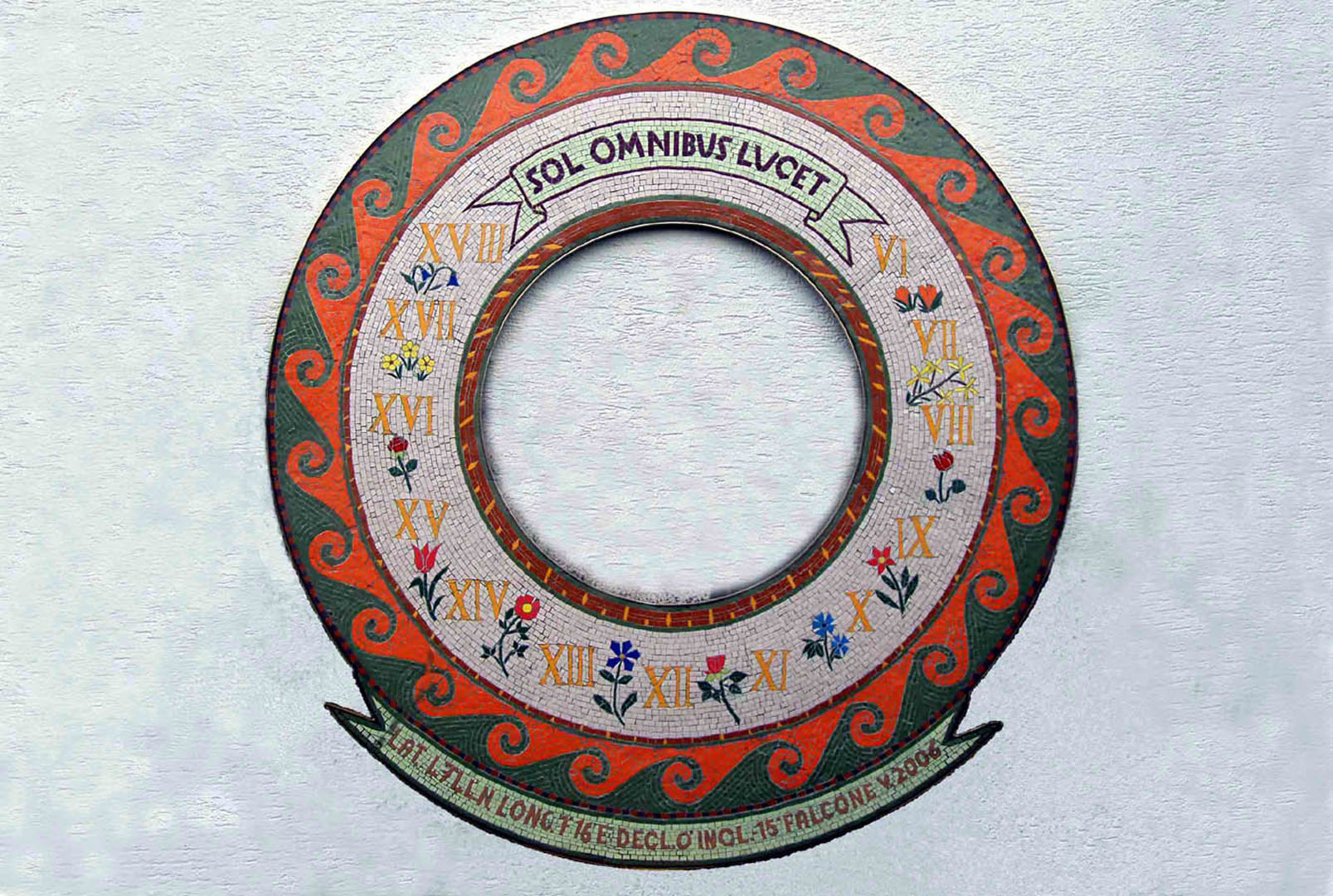
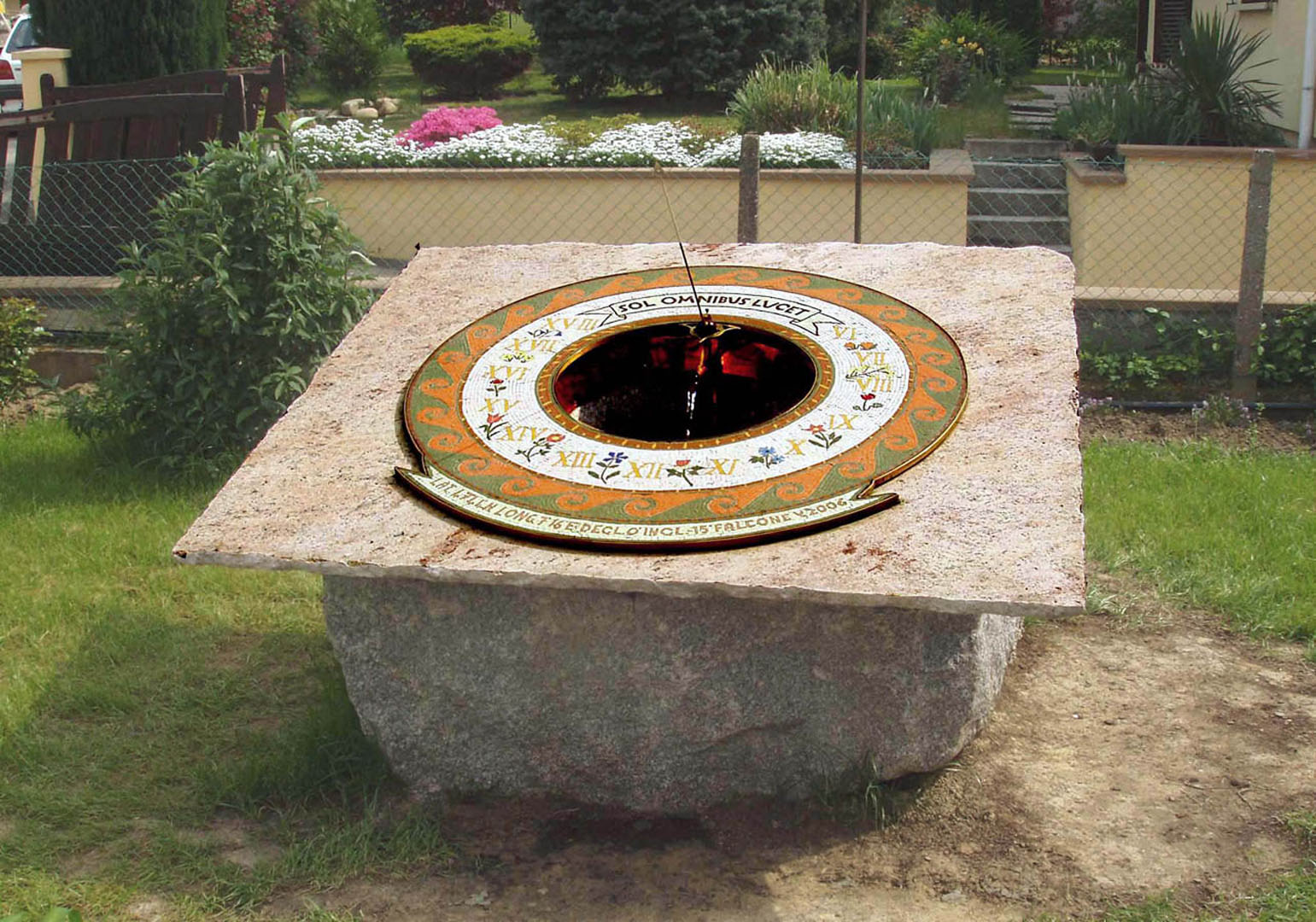
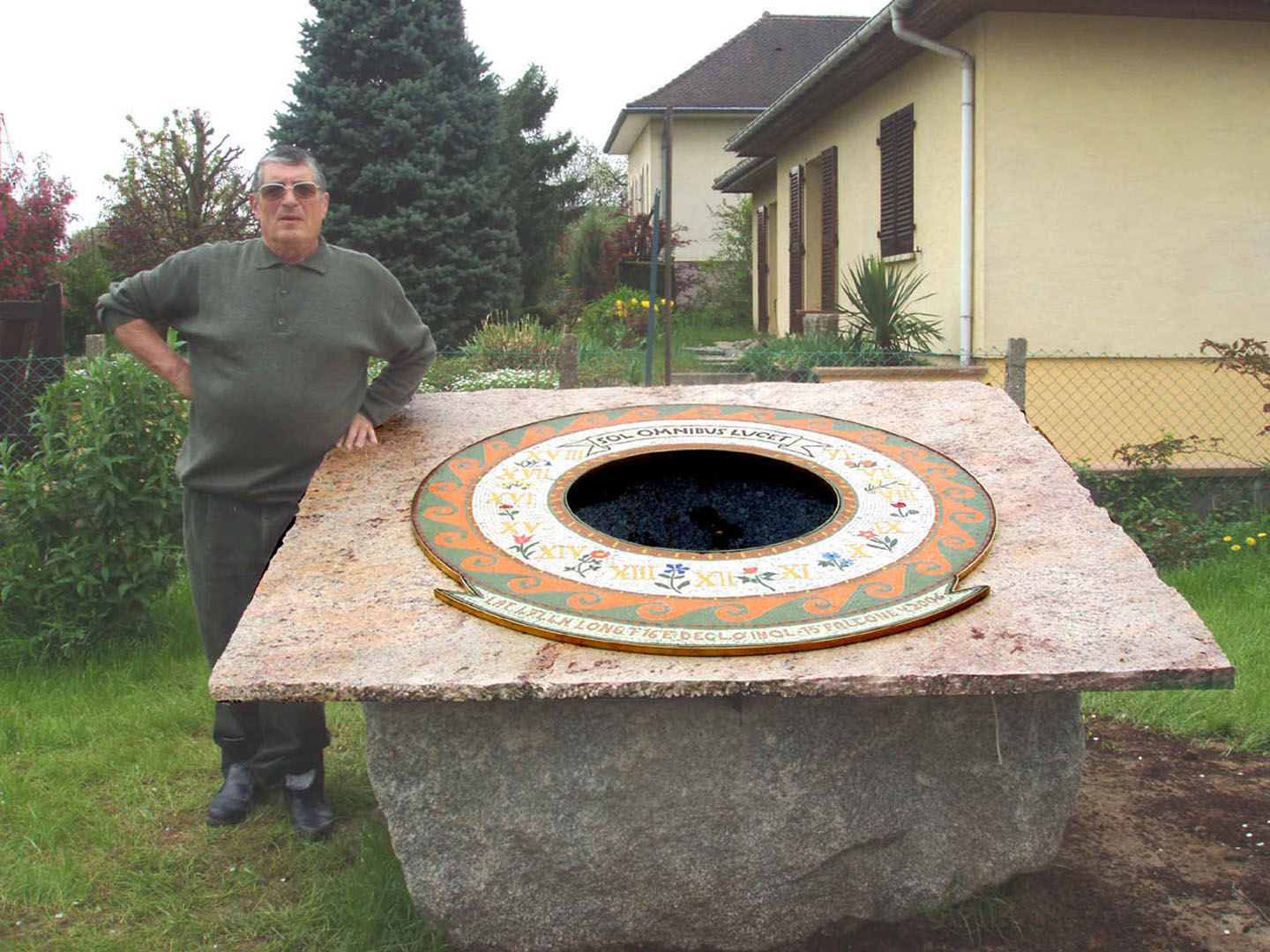
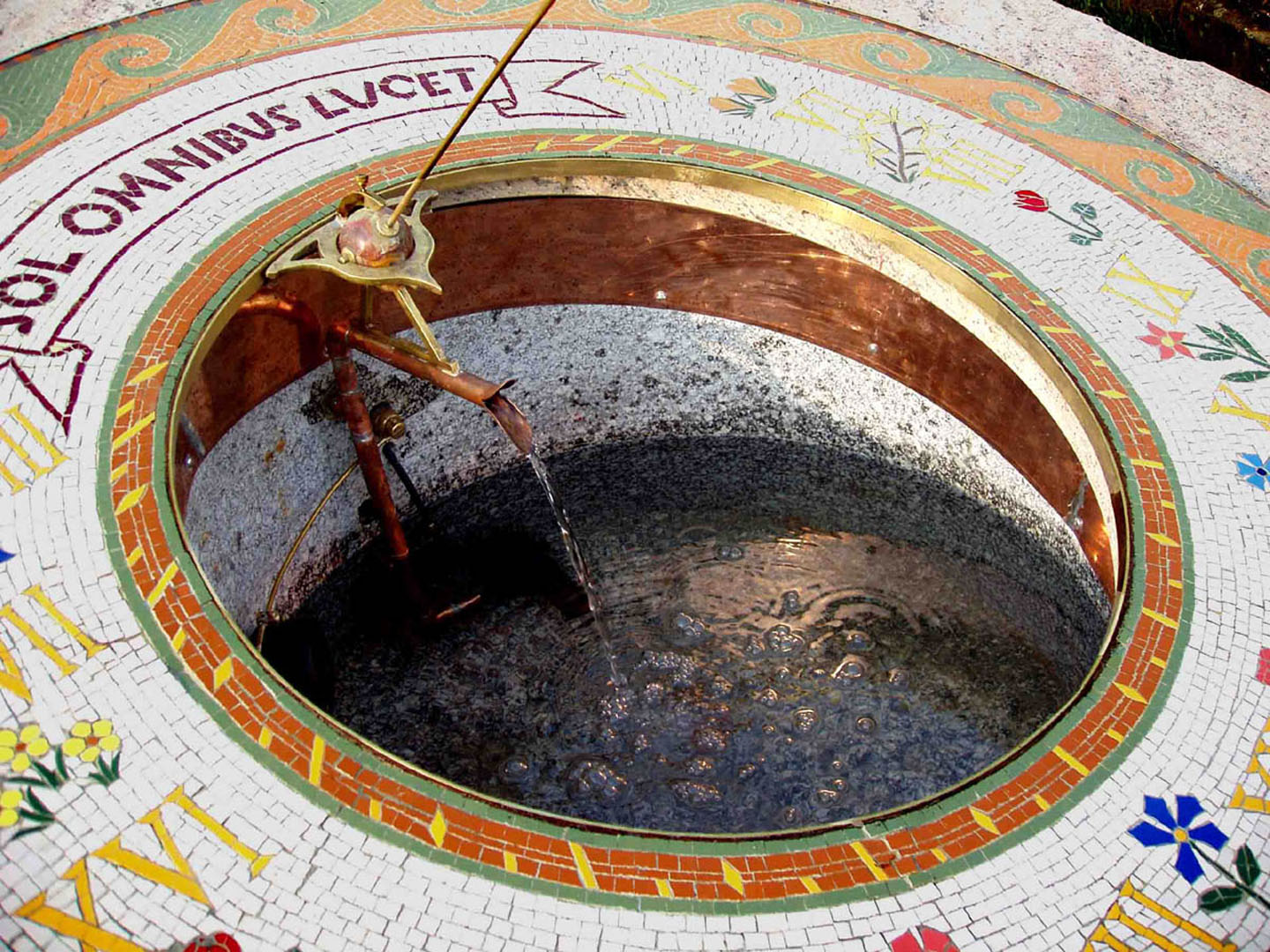
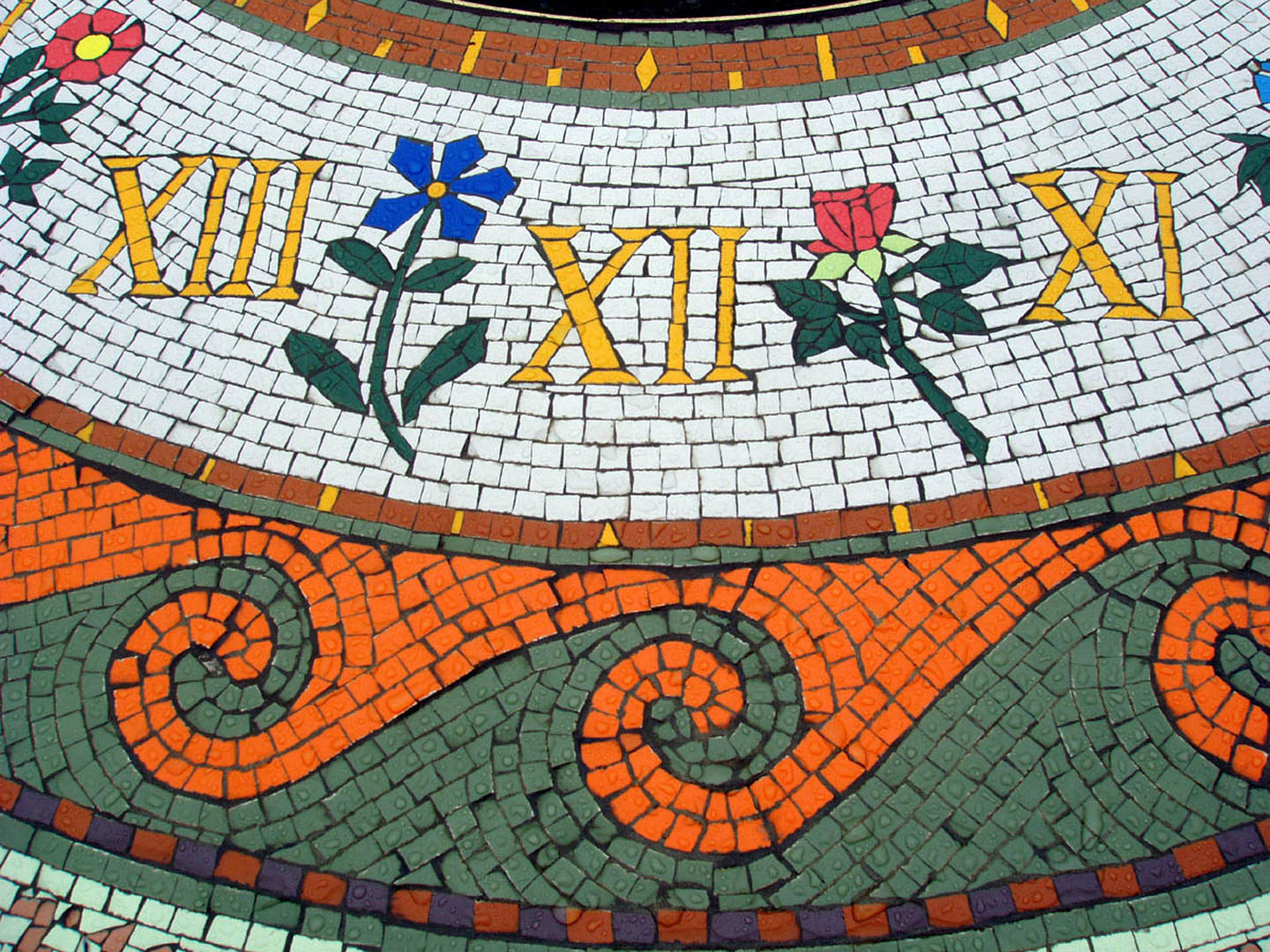
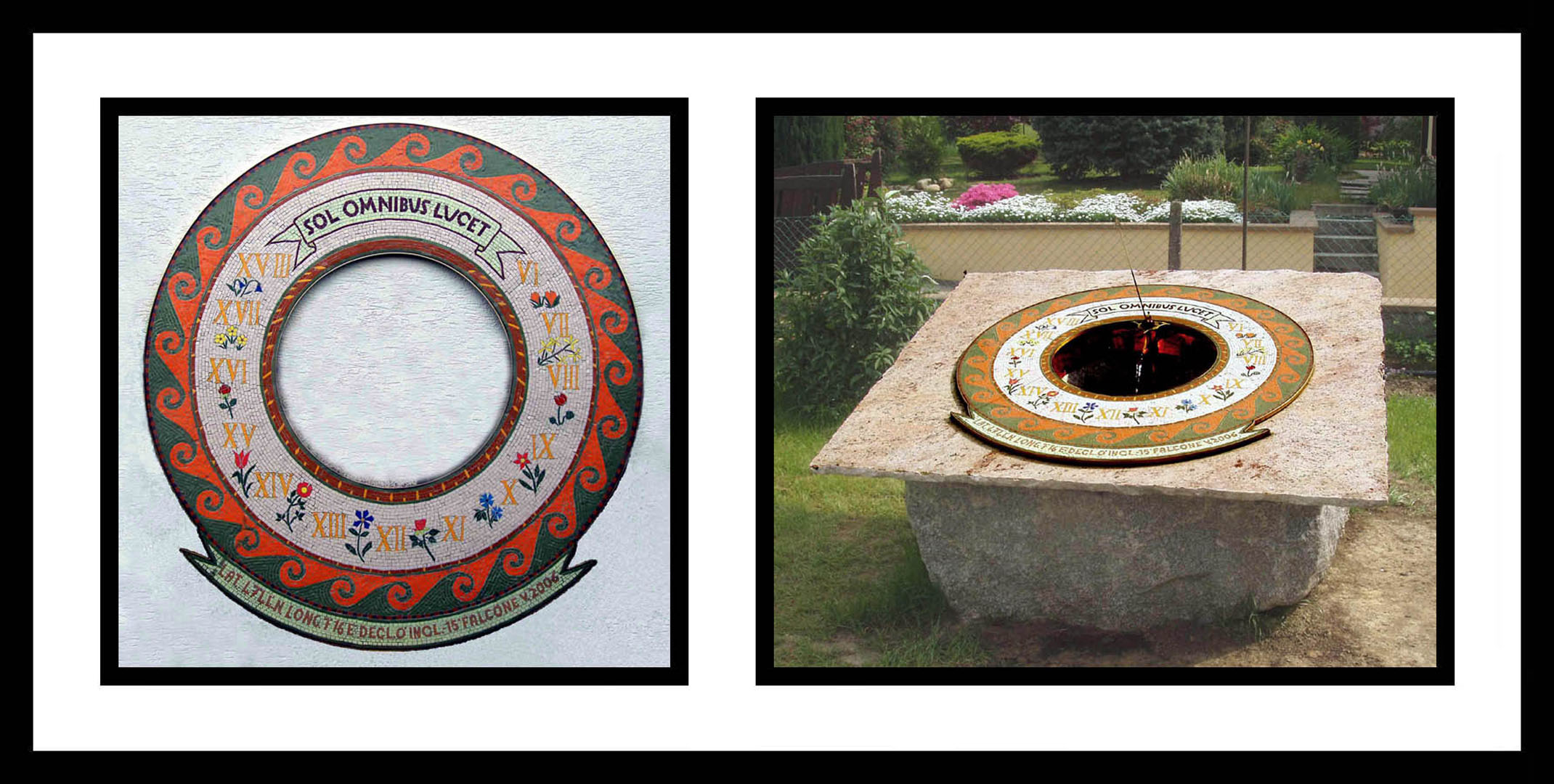
Designer & Maker: Valentino Falcone Date: installed April 2006 Original Location: Lat: 47° 44' N; Lon: 7° 16' E. In the garden of Mr. Falcone's home at 18, Rue du 21 Novembre, 68790 Morschwiller Le Bas, France Present Location: at original location Orientation: Inclines –15°, Declines south Size: diameter of circular face- 125 cm (49.2 in); granite base- 145 x 130 x 57 cm (57 x 51 x 22.4 in); flagstone top- 160 x 170 x 3 cm (63 x 67 x 1.2 in). Weight- about 4 tons. Polar style is a 15.46 mm rod with a 3 cm arrow that has a hole. The fountain, in the central part of the face, has a diameter of 67 cm (26.3 in). and a depth of 25 cm (10 in). Adornment: different flowers are between the roman numeral hours. Motto in a ribbon. Beautiful edging of orange waves on a green background. Inscriptions: Latitude, longitude, wall declination, the words: "Falcone V", and the date Mottos: "Sol omnibus lucet" (The sun shines for everyone) Condition: excellent Comments: The face is a mosaic of about 20,000 tiles of wills cérame, hand-crafted by Mr. Falcone, is surrounded by a brass strip. The tiles and the other components of the piece will withstand temperatures from – 20° to + 80° C. The metal parts, strapping and supports, are of stainless steel. The fountain is supplied by a recirculating mini-pump. Valentino Falcone Email: Here Photo Descriptions: Photos are courtesy of Valentino Falcone. Photos: a b c d e |
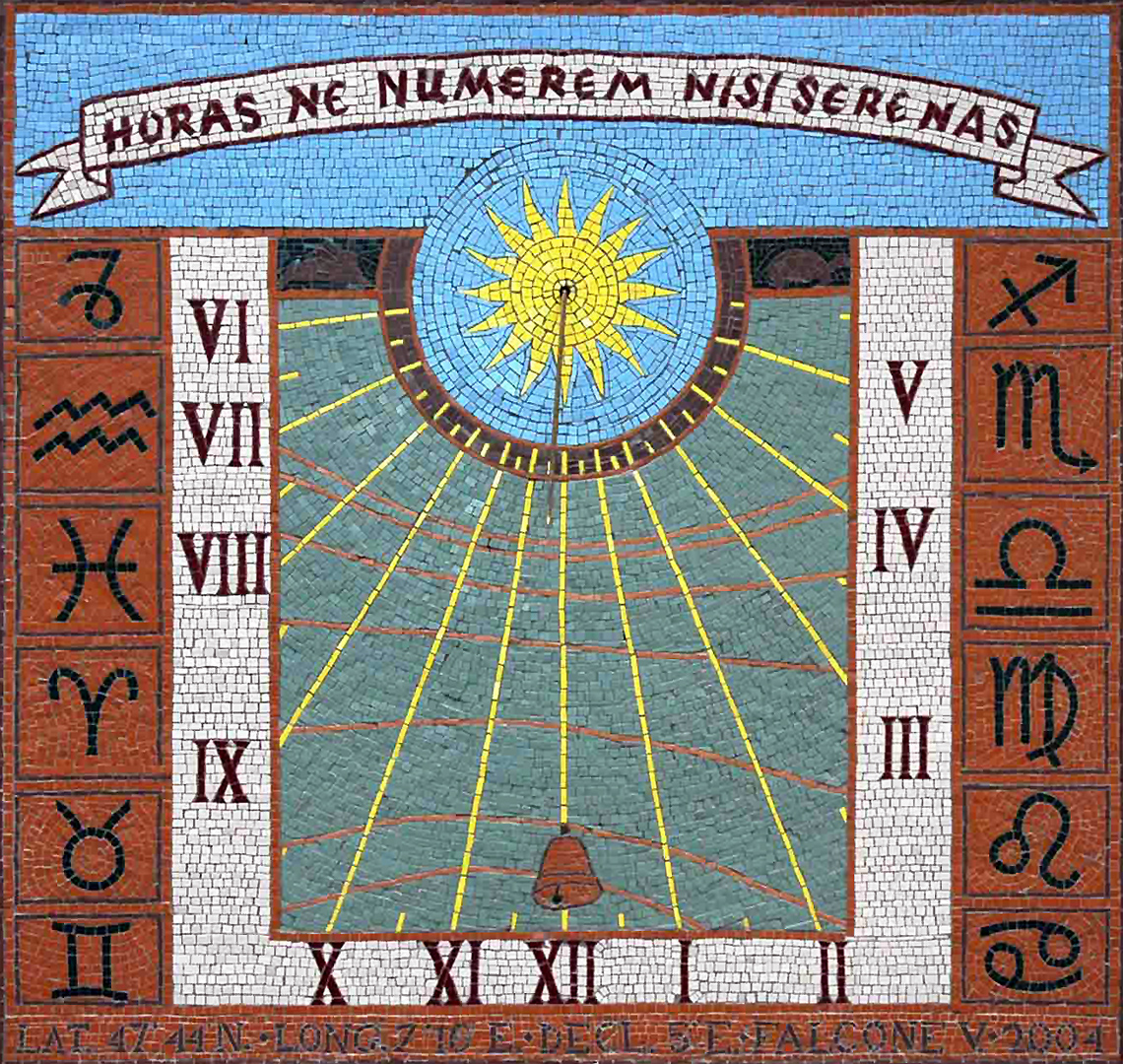
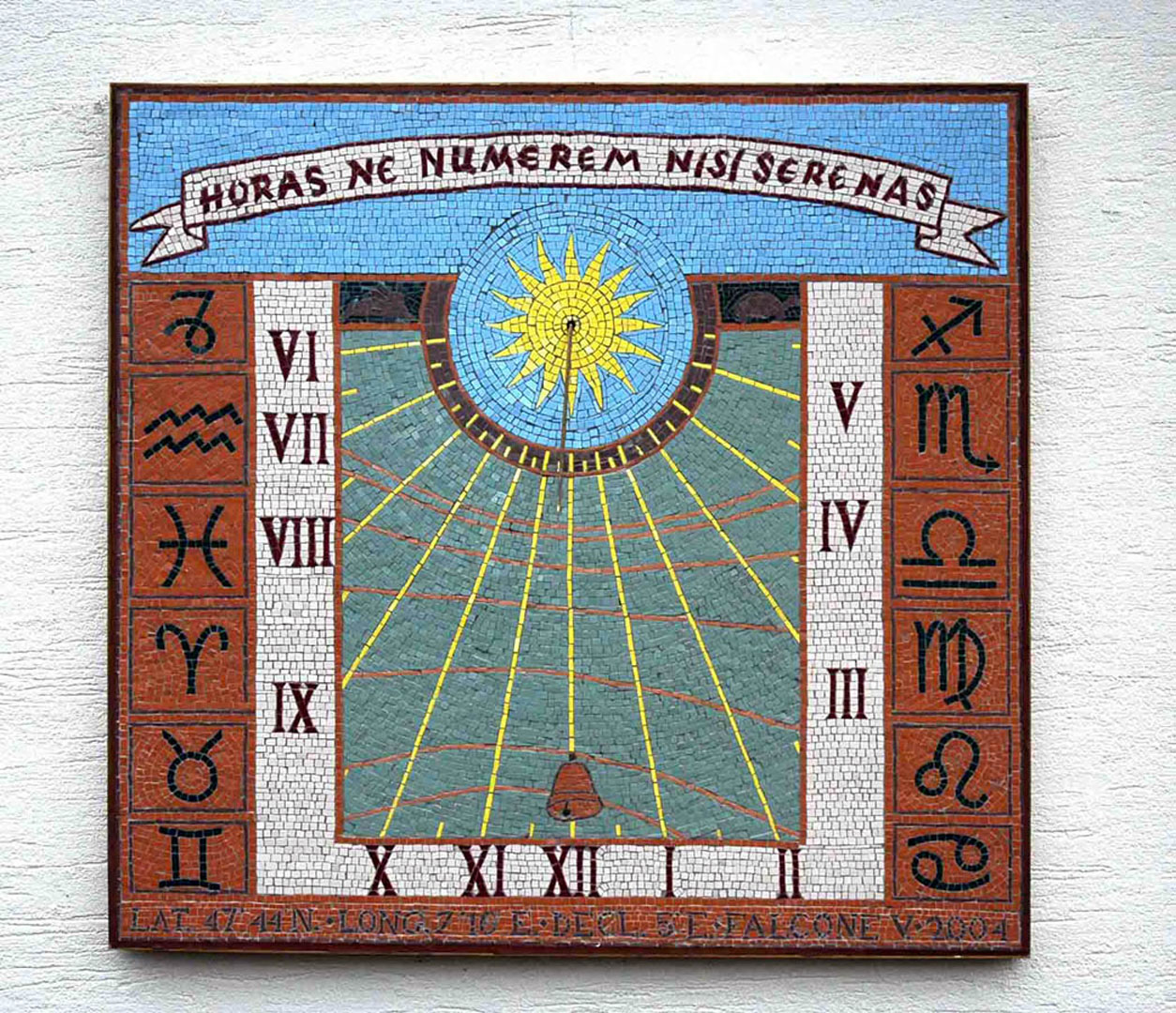
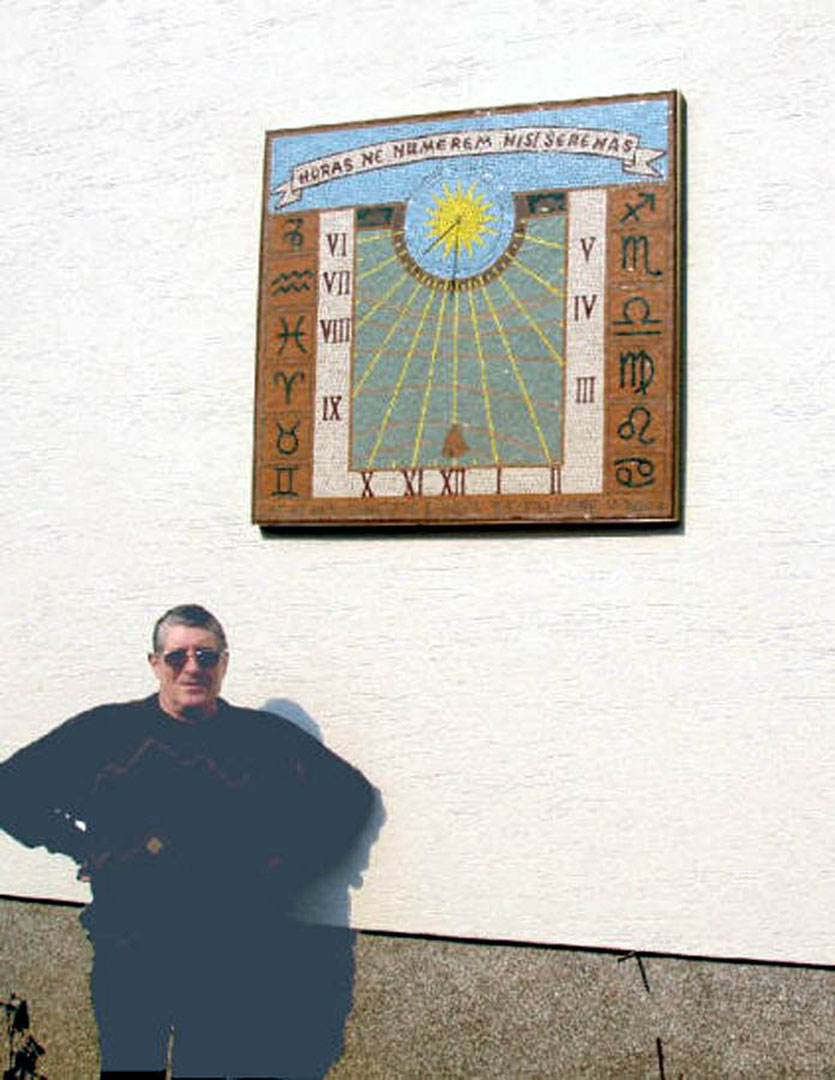
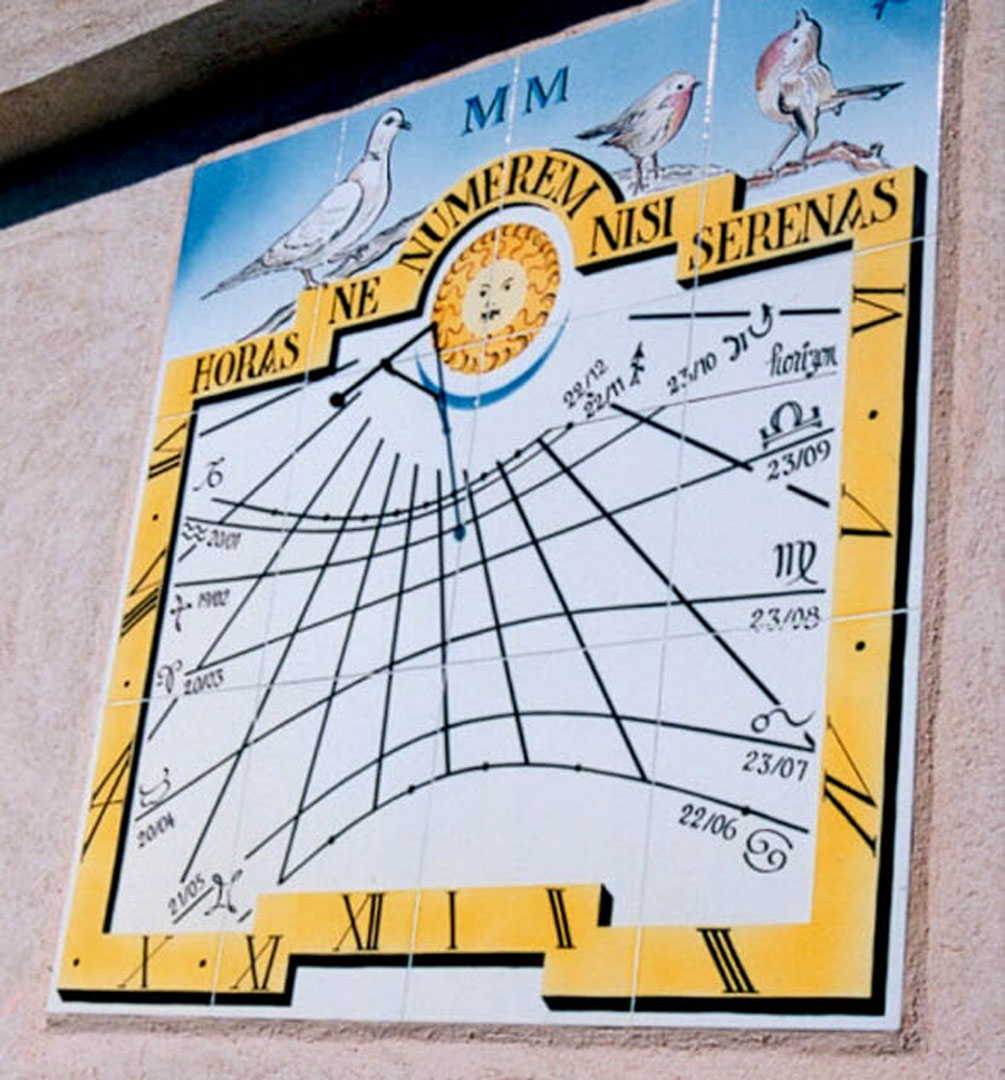
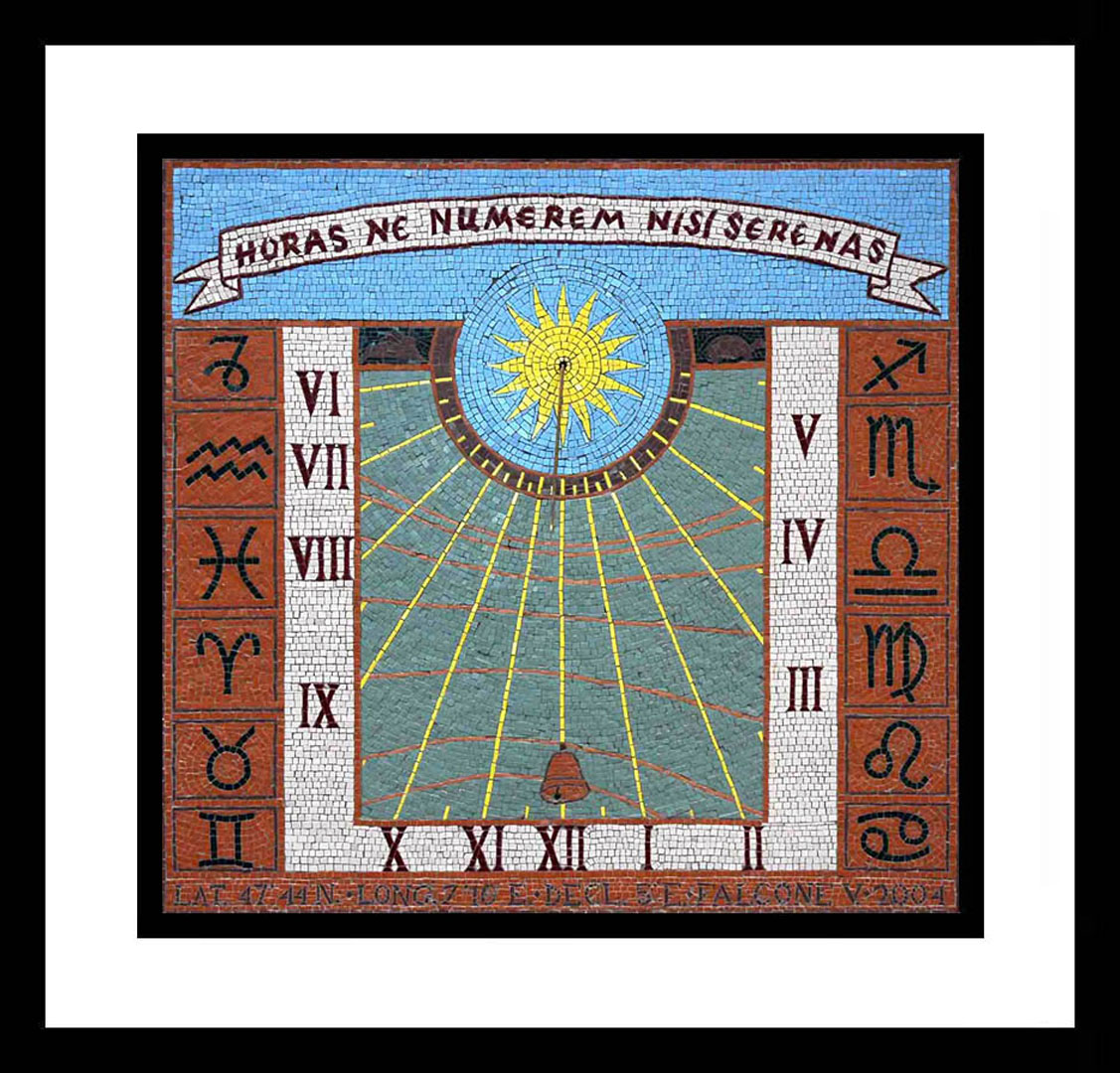
Designer & Maker: Valentino Falcone Date: installed March 7th 2005 Original Location: Lat: 47° 44 12'' N; Lon: 7° 16' 36'' E. On southern wall of Mr. Falcone's home at 18 Rue du 21 Novembre, 68790 Morschwiller Le Bas, France Present Location: at original location Orientation: Vertical. Declines 5° east of south Size: length- 112 cm (44 in), height- 106 cm (41.7 in), weight- 96 kg (211 lbs). There are between 15,000 and 20,000 porcelain tiles. Adornment: signs of the zodiac, sun in center, 7 solar declination date lines Inscriptions: Latitude, longitude, wall declination, the words: "Falcone V", and the date Mottos: "Horas Ne Numerem Nisi Serenas" ("I count no hours except tranquil [ones]") in a white ribbon. Condition: Excellent Comments: One of the finest examples of a mosaic wall sundial. Nicola Severino Website: Here Rosetonline Website: Here Valentino Falcone Email: Here Photo Descriptions: Photos are courtesy of Valentino Falcone. Photos: a b c d |
 |
 |
 |
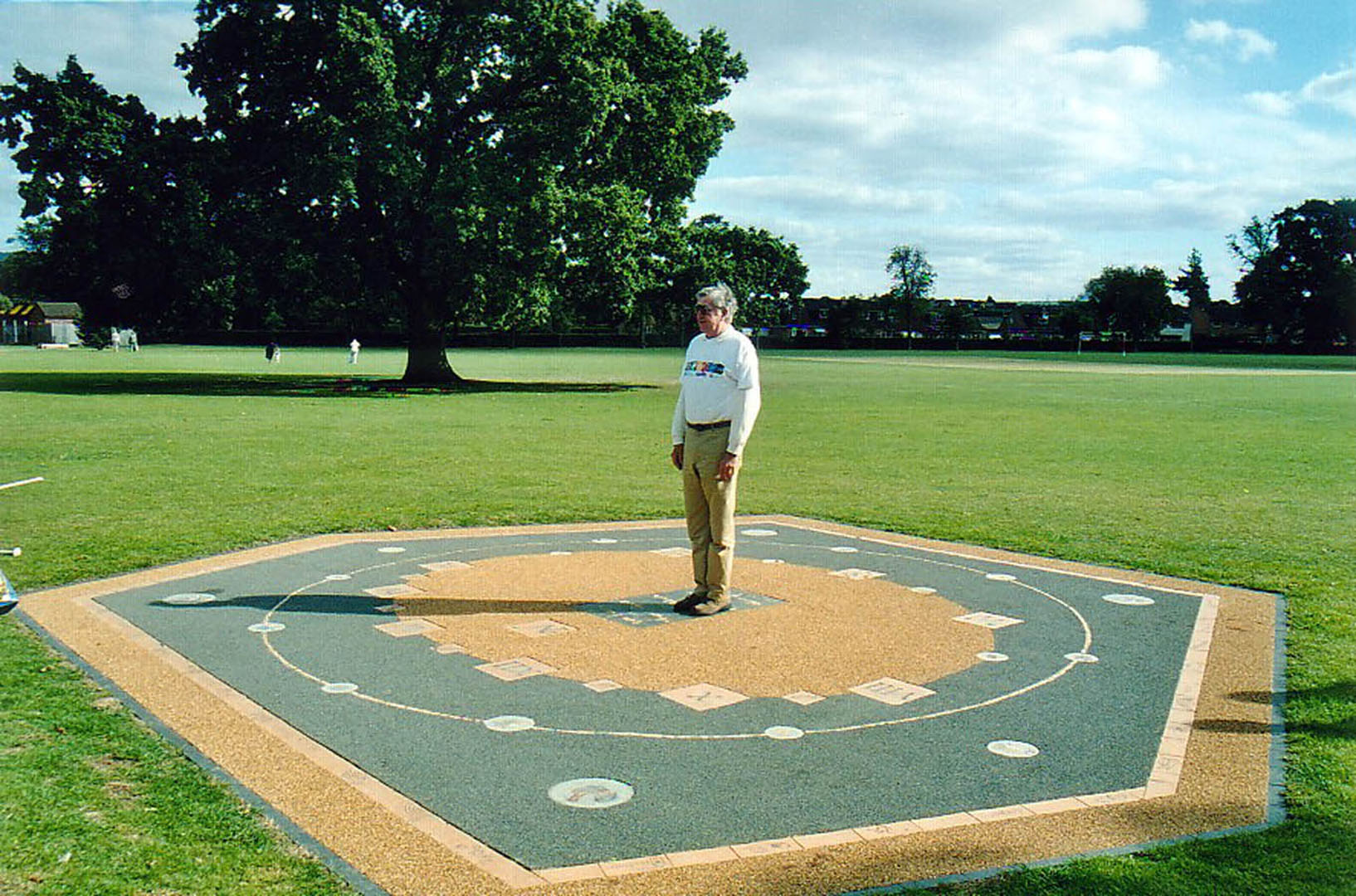
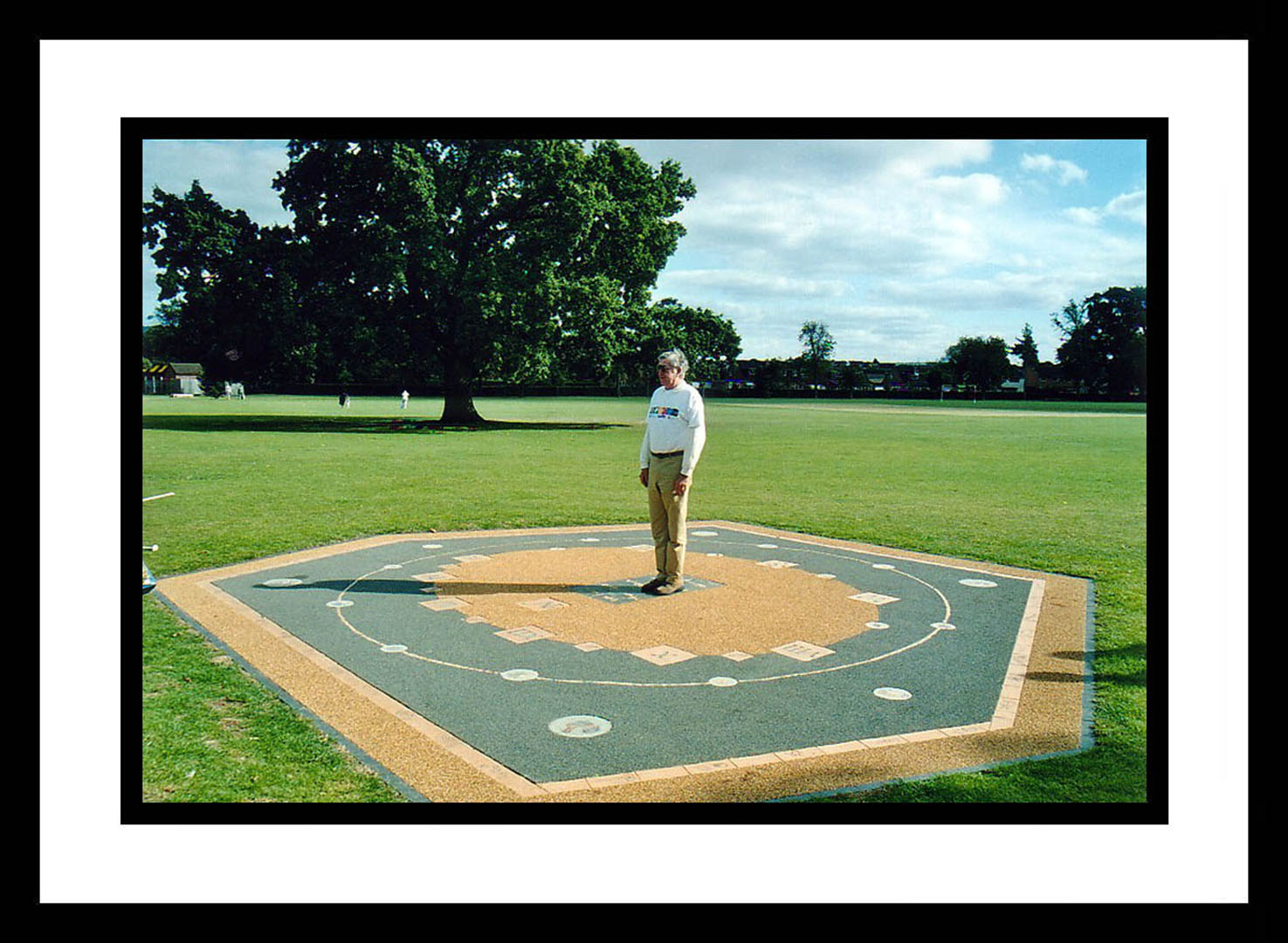
| Designer & Maker: unknown Date: unknown, probably early 2000s Original Location: Swindon Village, Gloucestershire England Present Location: at original location Orientation: horizontal analemmatic sundial Size: unknown Adornment: beautiful! Mottos: unknown Inscriptions: unknown Condition: unknown Comments: This is a human interactive sundial that uses the shadow cast by a human to tell time. Local Heritage Website: Here Swindon Pareish Website: Here Photo Descriptions: Photo was copied from website above. Photos: a |
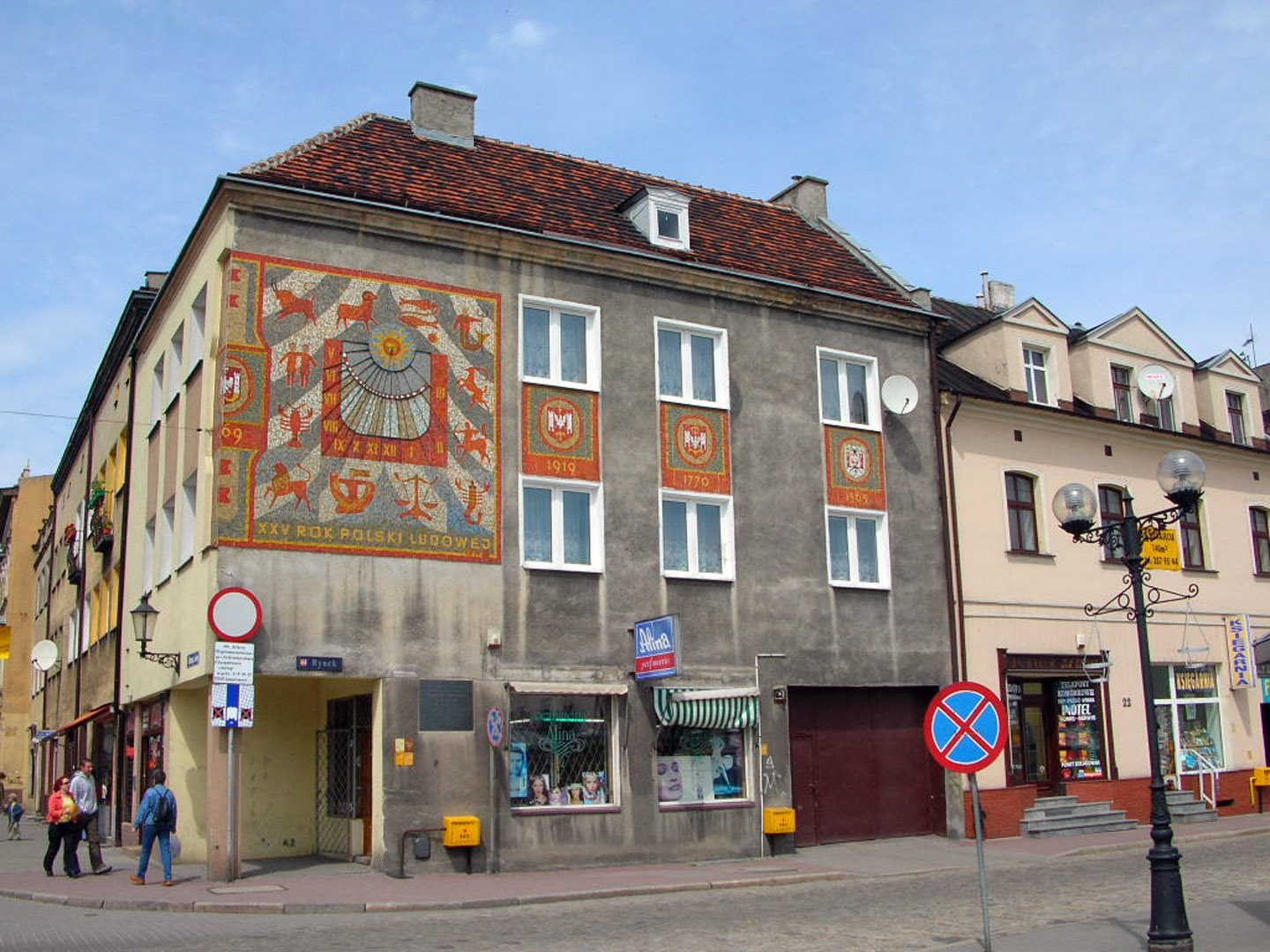
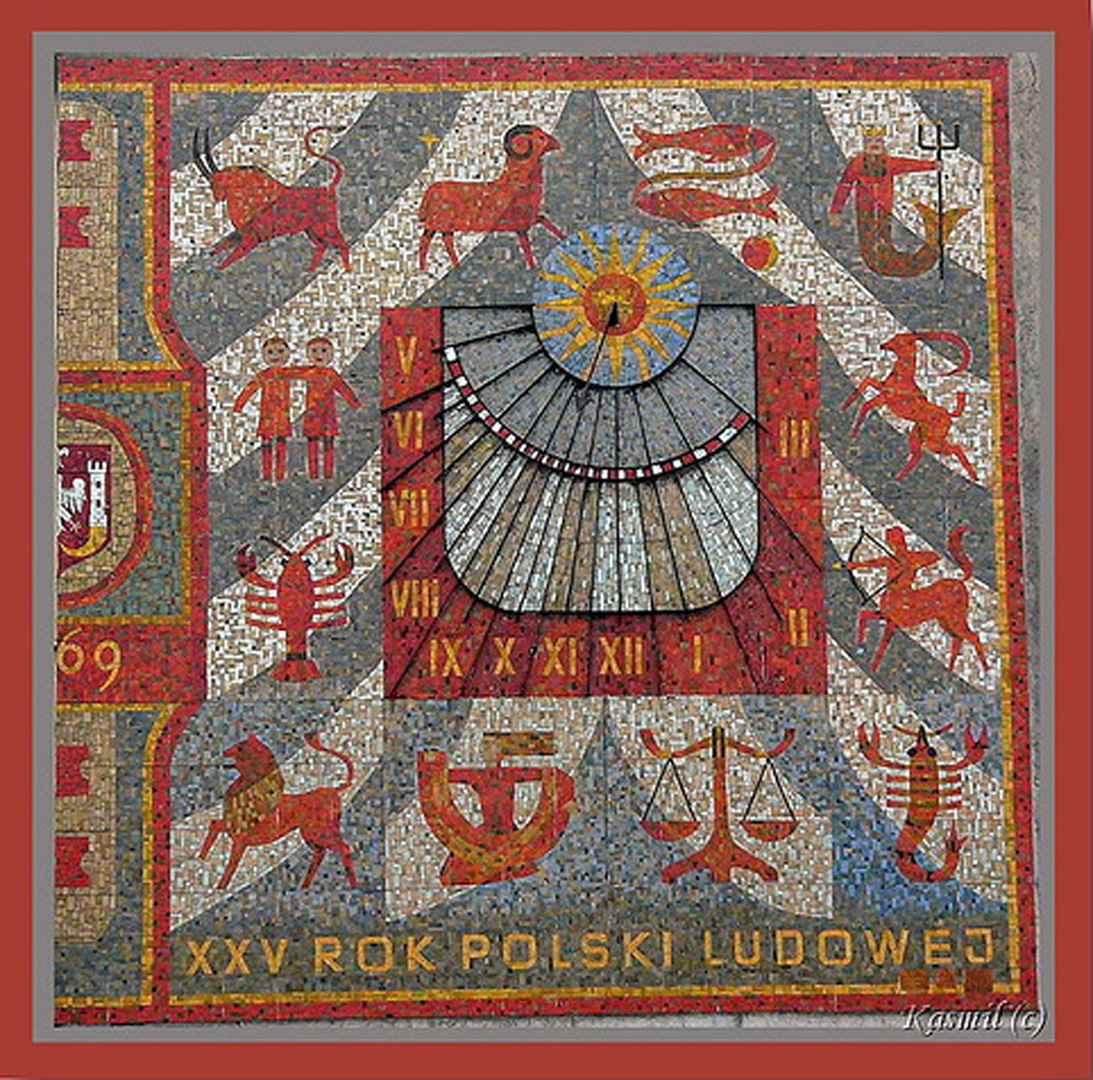
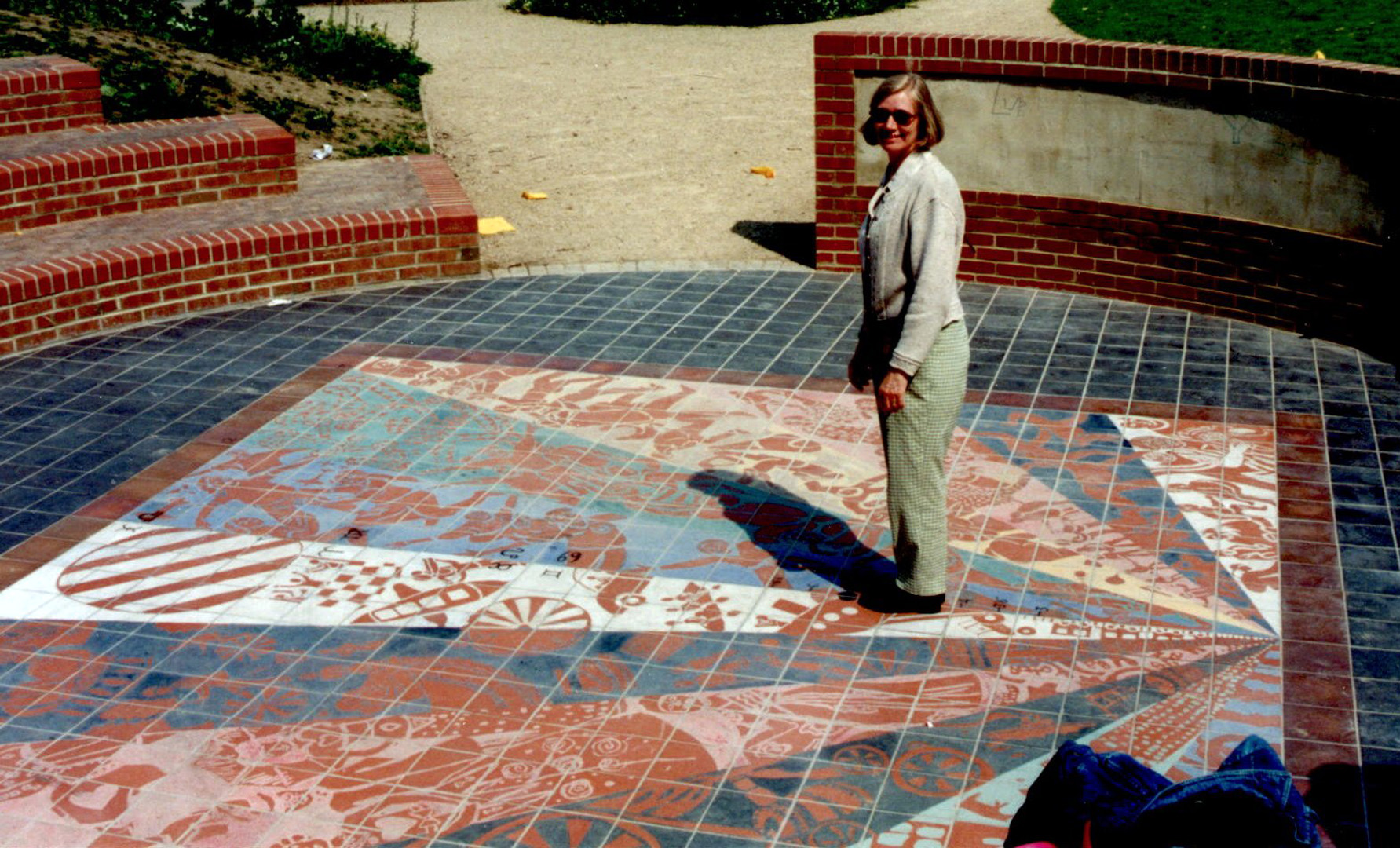
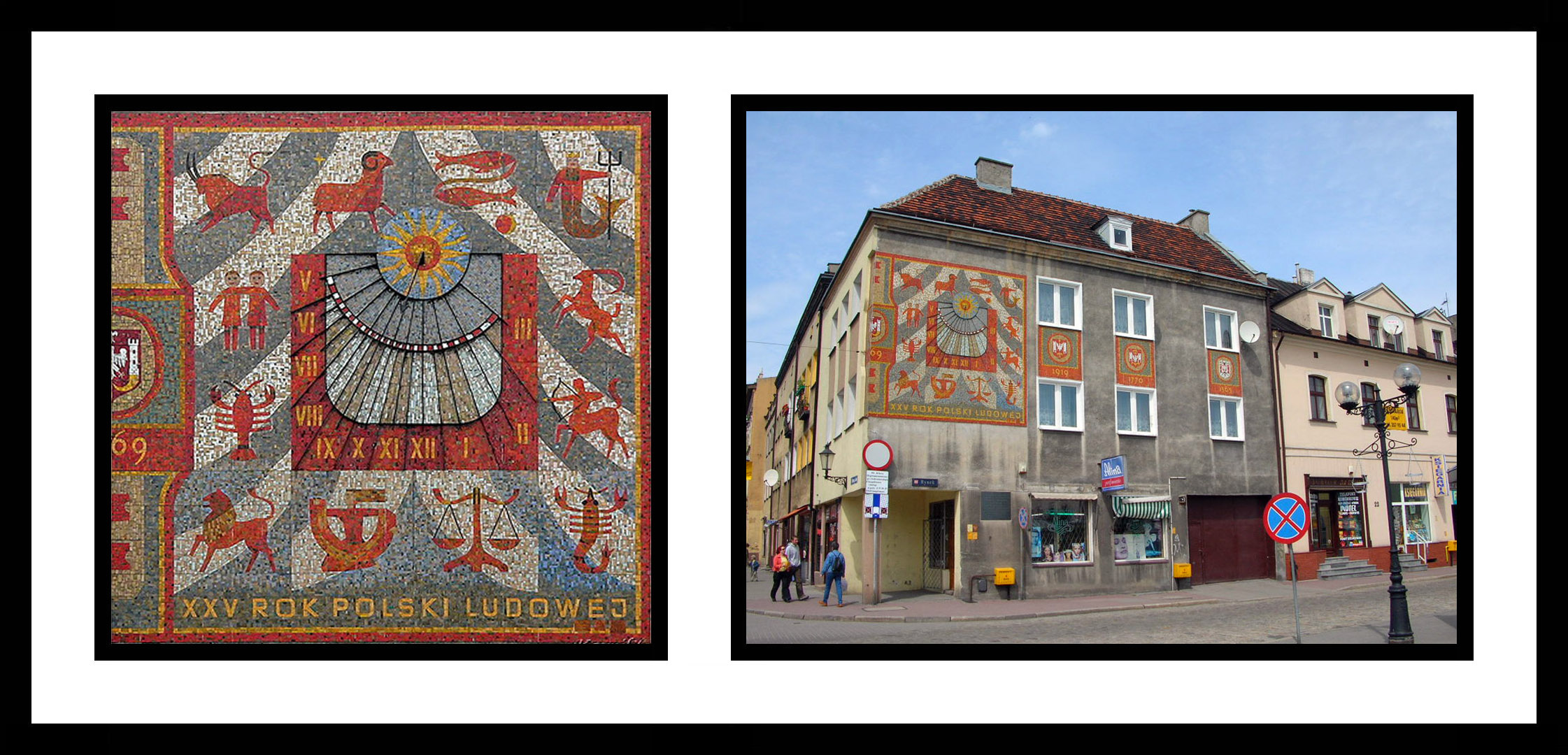
Designer & Maker: unknown Date: probably 1969 since the number ’69’ is on the dial face. Original Location: Kamienica w rogu rynku z zegarem. Poland Present Location: at original location Orientation: Vertical. Declines by unknown amount East of South Size: unknown, but huge! Adornment: zodiacal signs Inscriptions: "XXV ROK POLSKI LUDOEJ" Mottos: none Condition: probably good Comments: We need better photos and more information on this magnificent dial. Wikimedia Website: Here Wikimedia Commons License: Here Flikr Website: Here Photo Descriptions: Photo 'a' is by Macdriver (Bartek Wawraszko) in 2005 and copied from Wikimedia website below. Photo 'b' by kasmil/Krystyna and copied from Flickr website. Photo 'a' is used under terms of Wikipedia Commons license above. Photo 'b' does not require permission. Photos: a b |
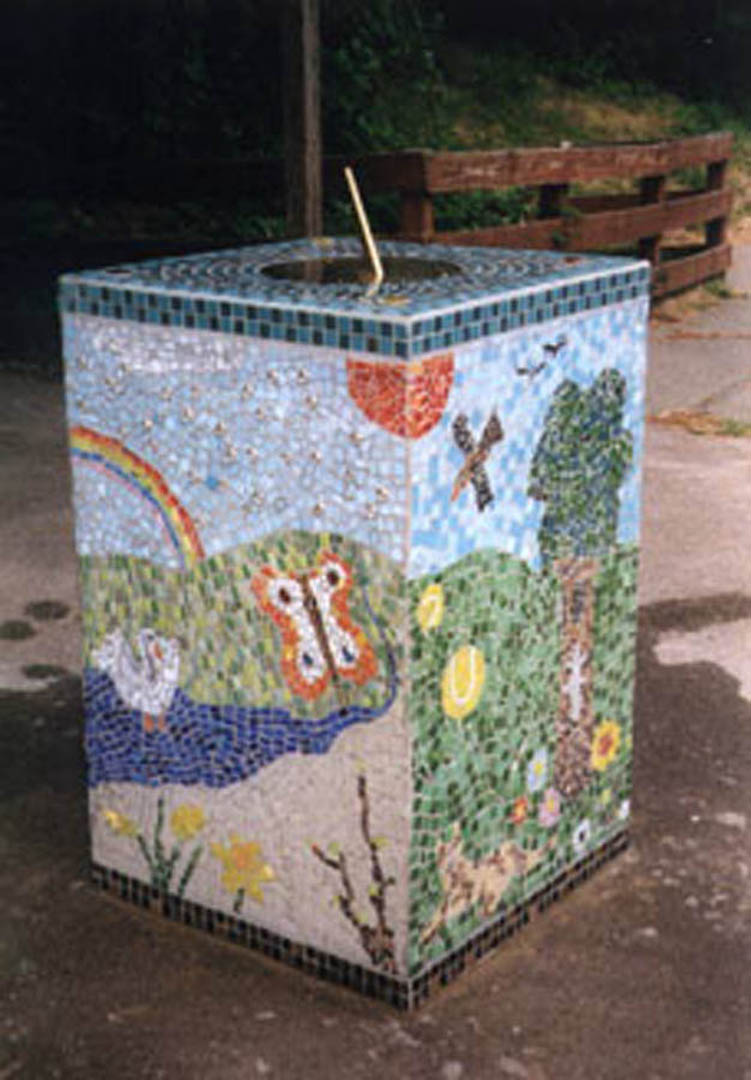
Designer & Maker: Sundial designed by Merlin Design Sundials in collaboration with the client and artist Sue Edkins. Mosaic plinth designed and made by Sue Edkins. Date: unknown, probably early 2000s Original Location: unknown. Somewhere in England Present Location: unknown. Somewhere in England Orientation: Horizontal Size: unknown Adornment: The sundial has a sun in the center Mottos: unknown Inscriptions: present, but unknown Condition: unknown Comments: The sundial is accurate and very well made. The plinth is a hand-made box with mosaic landscape designs on all sides. Easyweb Website: Here Photo Descriptions: Photo was copied from website above. Photos: a |
 |
 |
 |
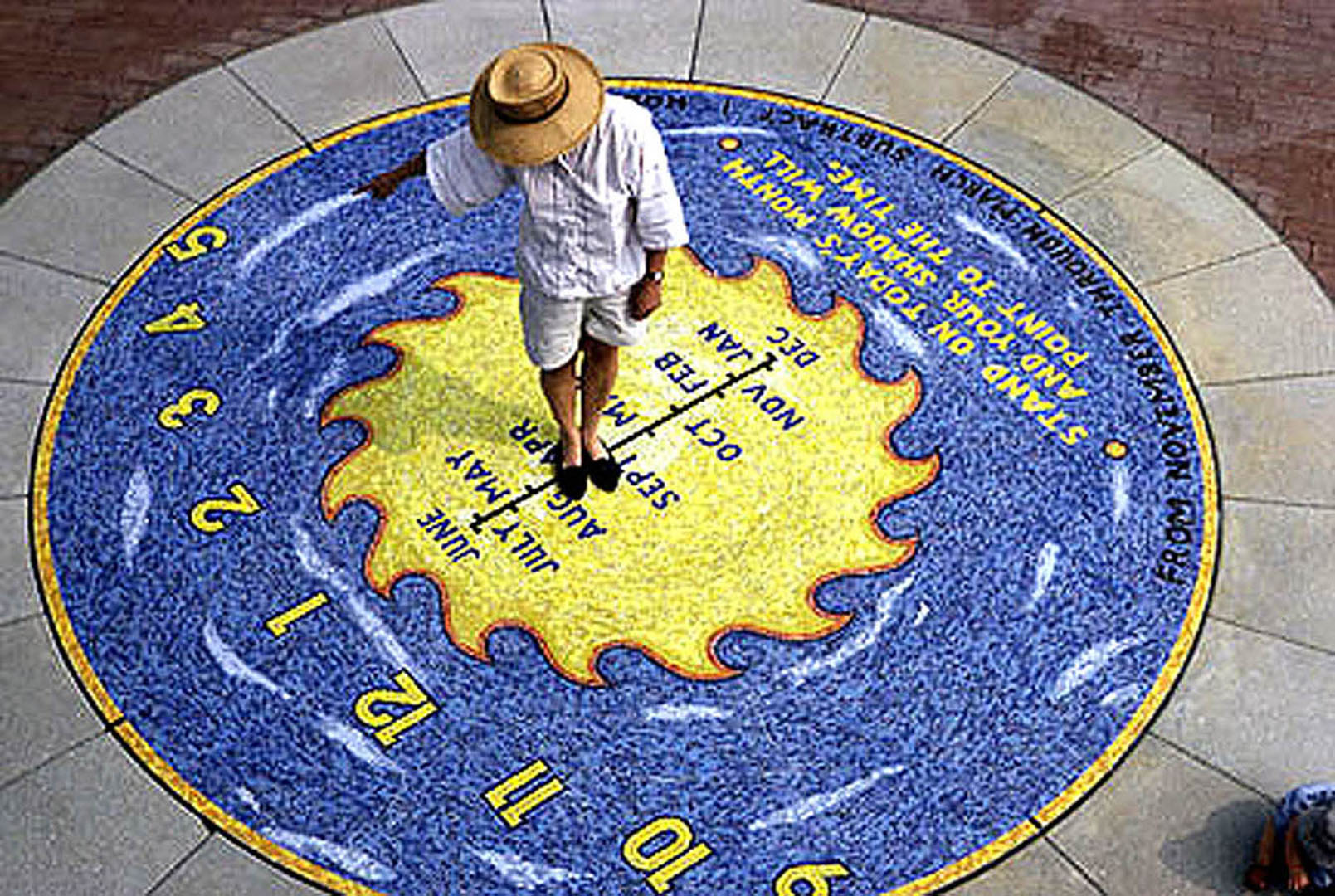
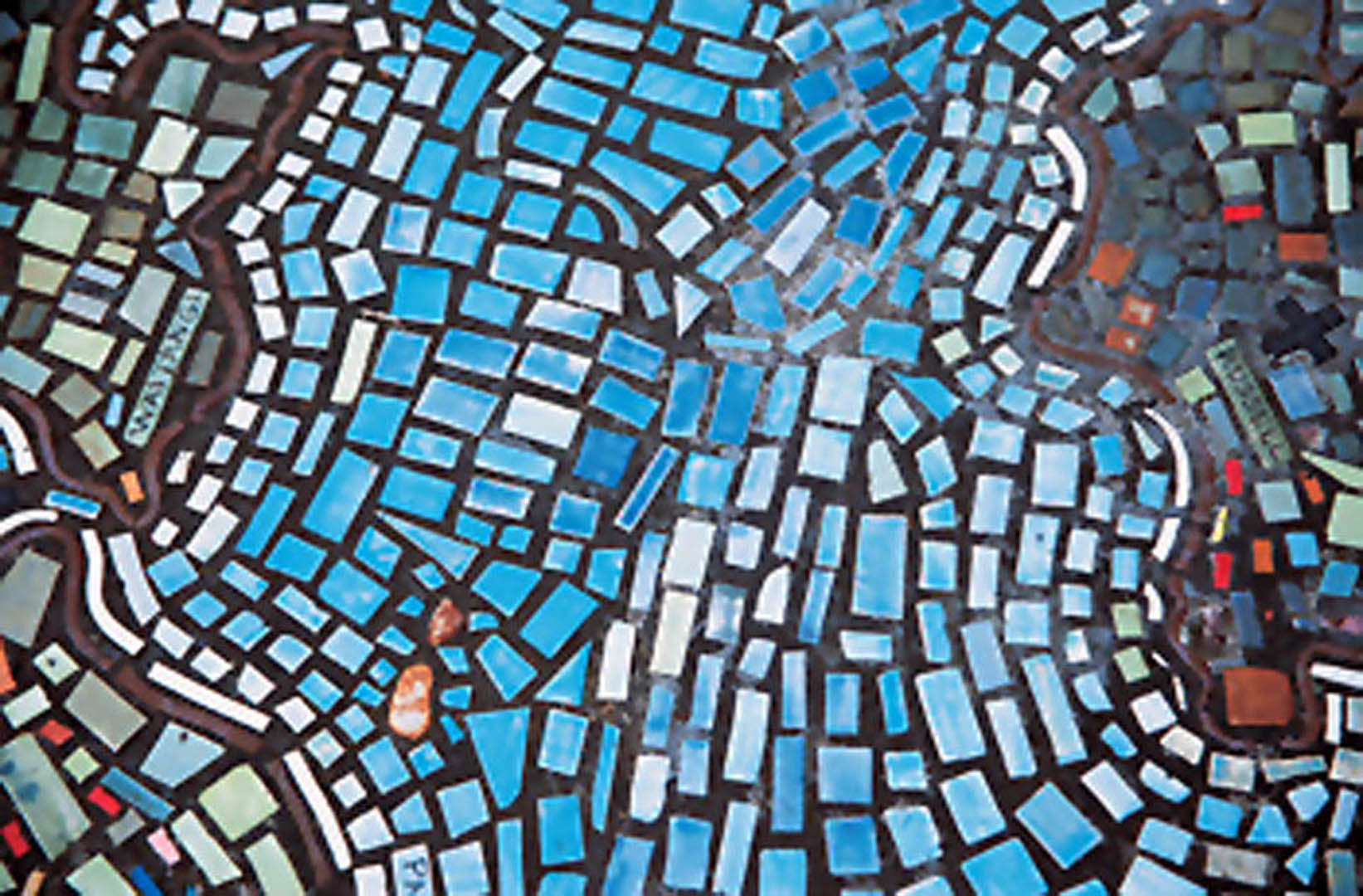
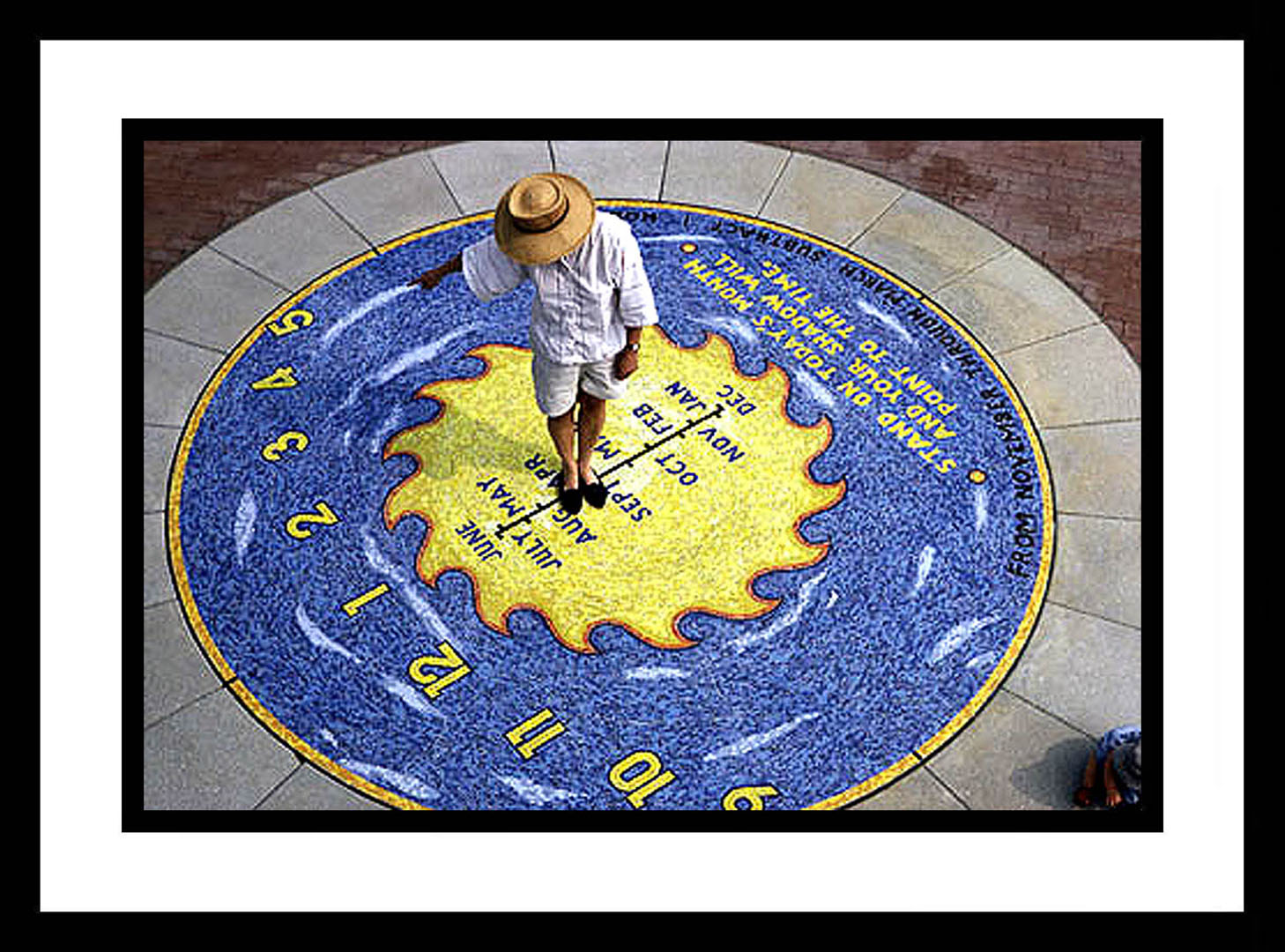
| Designer: Robert Adzema, famous sundial designer and award winning member of The North American Sundial Society Date: unknown, prob. 1990's Original Location: the Brooklyn Children's Museum, Brooklyn, New York USA Present Location: at original location Orientation: Horizontal Size: unknown Adornment: large yellow sun in center with date line on top. Sky blue background with clouds. Inscription: Has these user instructions: "stand on today's month and your shadow will point to the time. from November through March subtract 1 hour." Condition: unknown Comments: This is a human analemmatic sundial mosaic made from hundreds of 1" bathroom tiles. We found this photo on Adzema's website and have contacted him asking for more information and photos. Robert Adzema Website: Here Robert Adzema’s Email: Here Photo Descriptions: I found this photo on Adzema's website and have contacted him asking for more information and photos. j.c. Photos: a |
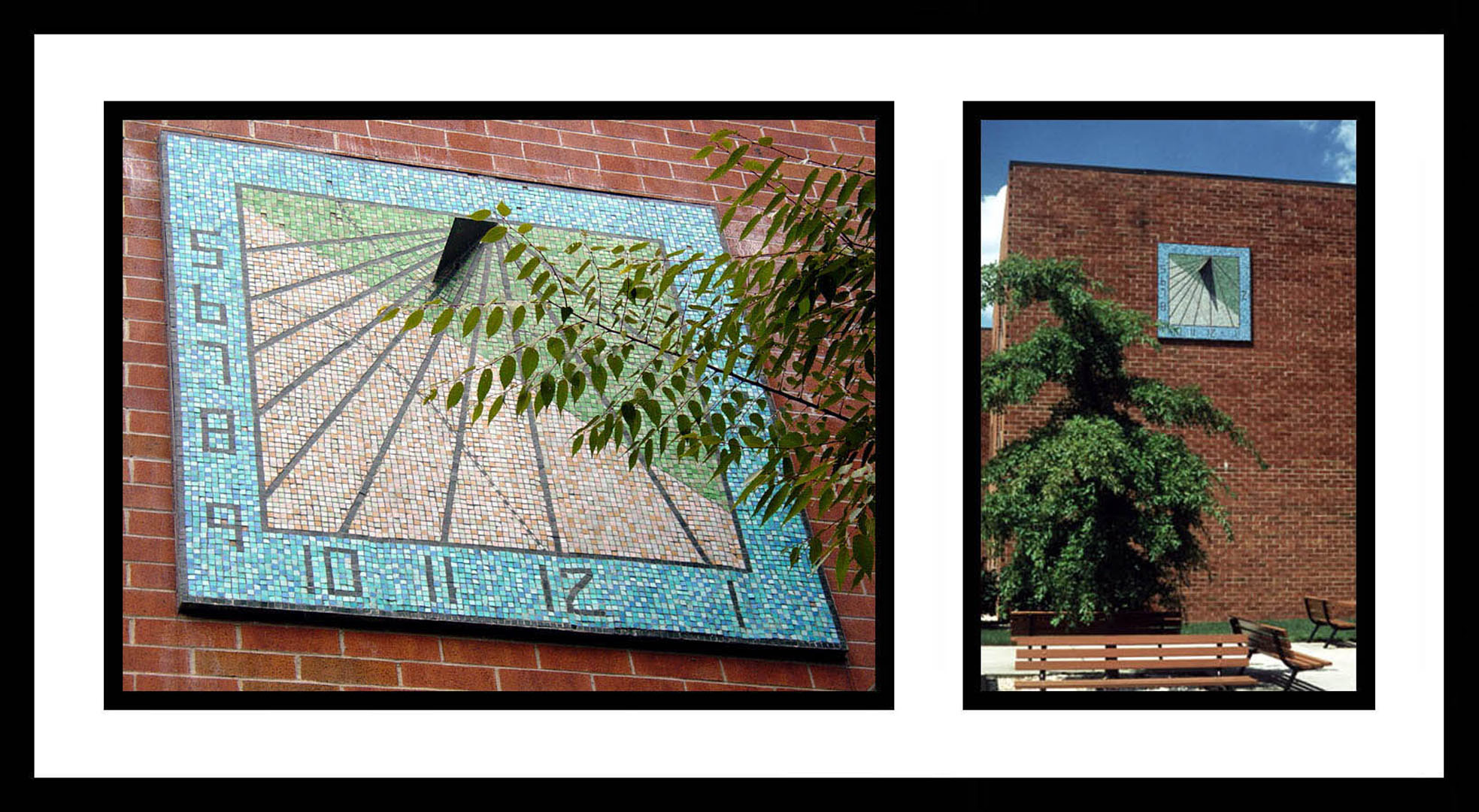
Designer: Robert Adzema, famous sundial designer and award winning member of The North American Sundial Society Date: 1991 Original Location: lat: 41° 2' 30'; Lon: 35° 56' 15" W. High up on brick wall of the Thorp Village Senior Center, Box 254, Route 340, Sparkill, NY 10976-0254, USA. Present Location: at original location Orientation: Vertical. Declines 38° 14' 42" to the east of south. Size: face- 213 x 213 cm (7 x 7 ft). gnomon length- 35.5 cm (14 in) Adornment: Solstices and equinox lines. Mottos: none Condition: good, but some tiles are missing. Unfortunately, it's shaded for much of the day by a nearby tree. The tree needs pruning! Comments: The gnomon is bronze and tilework is framed in copper. It has hundreds of 1" square ceramic bathroom tile mosaics mounted on four seamless panels. Gnomon is attached to directly to bricks underneath the dial plate. We're looking for a sunny day photo taken before the tree grew so big. Robert Adzema Website: Here Robert Adzema’s Email: Here Photo Descriptions: Photos are courtesy of John Carmichael & Mike Shaw. Photos: a b |
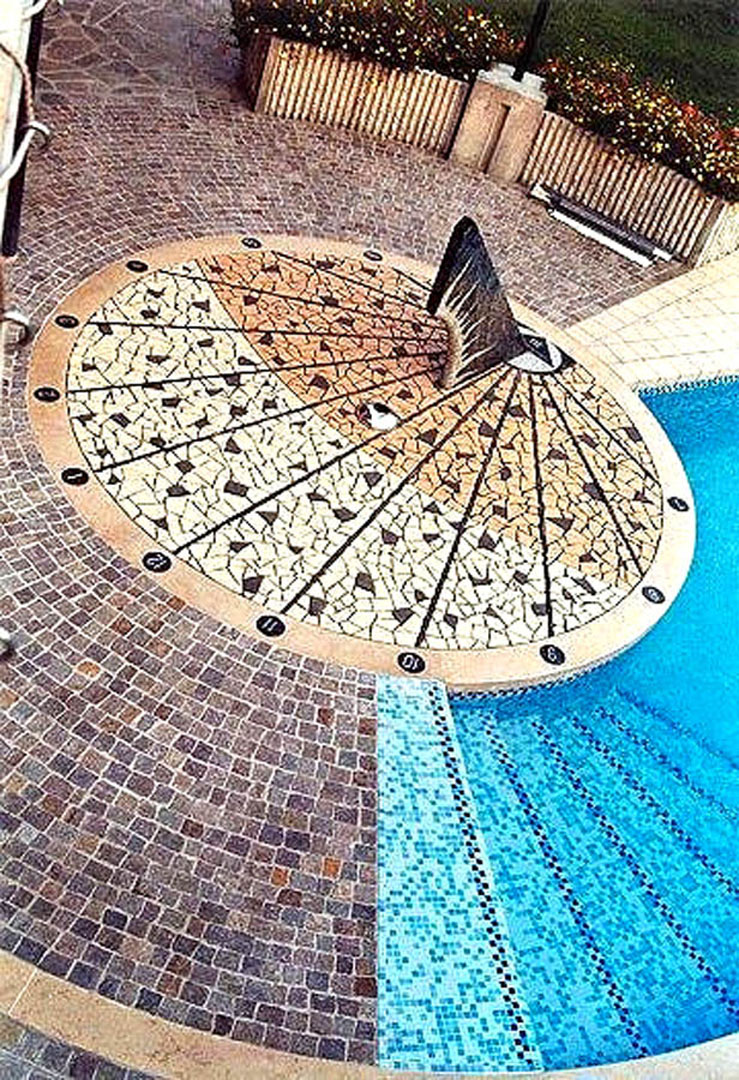
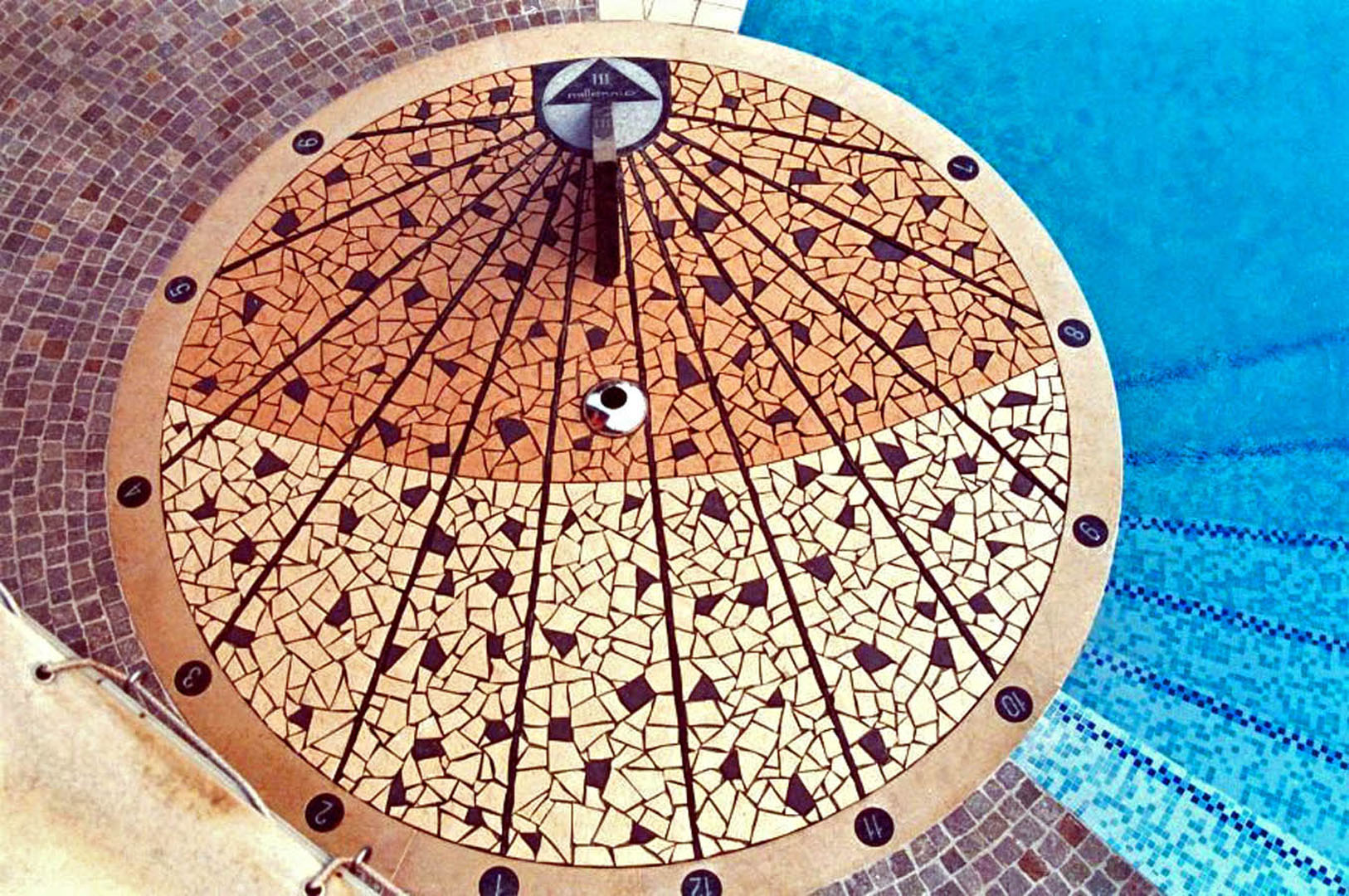
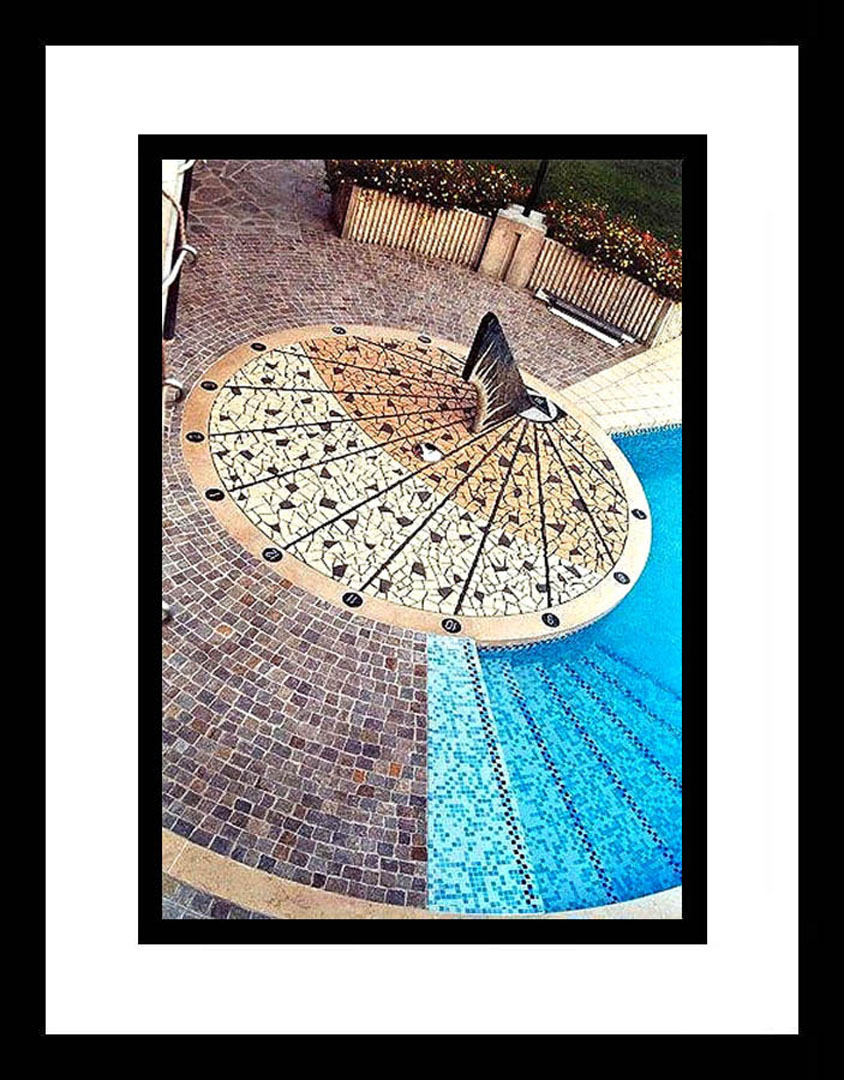
Designer & Mosaic Artisan: architetto Giuseppe Ferlenga Date: begun in 2000, finished in 2001 Original Location: Lat: 45° 34’ N; Lon: 10° 34’ E. Installed next to a swimming pool in Rivoli Veronese (Verona) Italy Present Location: at original location Orientation: horizontal Size: 2 m (6.5 ft) Adornment: Pool steps follow the design of the dial’s hourlines. Mottos: III millenio (3rd Millennium) Condition: excellent in 2007 Comments: Information is courtesy of Giuseppe Ferlenga. Dial is made from various types of marble. The Sundial is part of a swimming pool. Tiscali Website: Here Giuseppe Ferlenga Website: Here Giuseppe Ferlenga’s Email: Here Photo Descriptions: Photos are courtesy of Giuseppe Ferlenga sent to us in 2007. Photos: a b |
 |
 |
 |
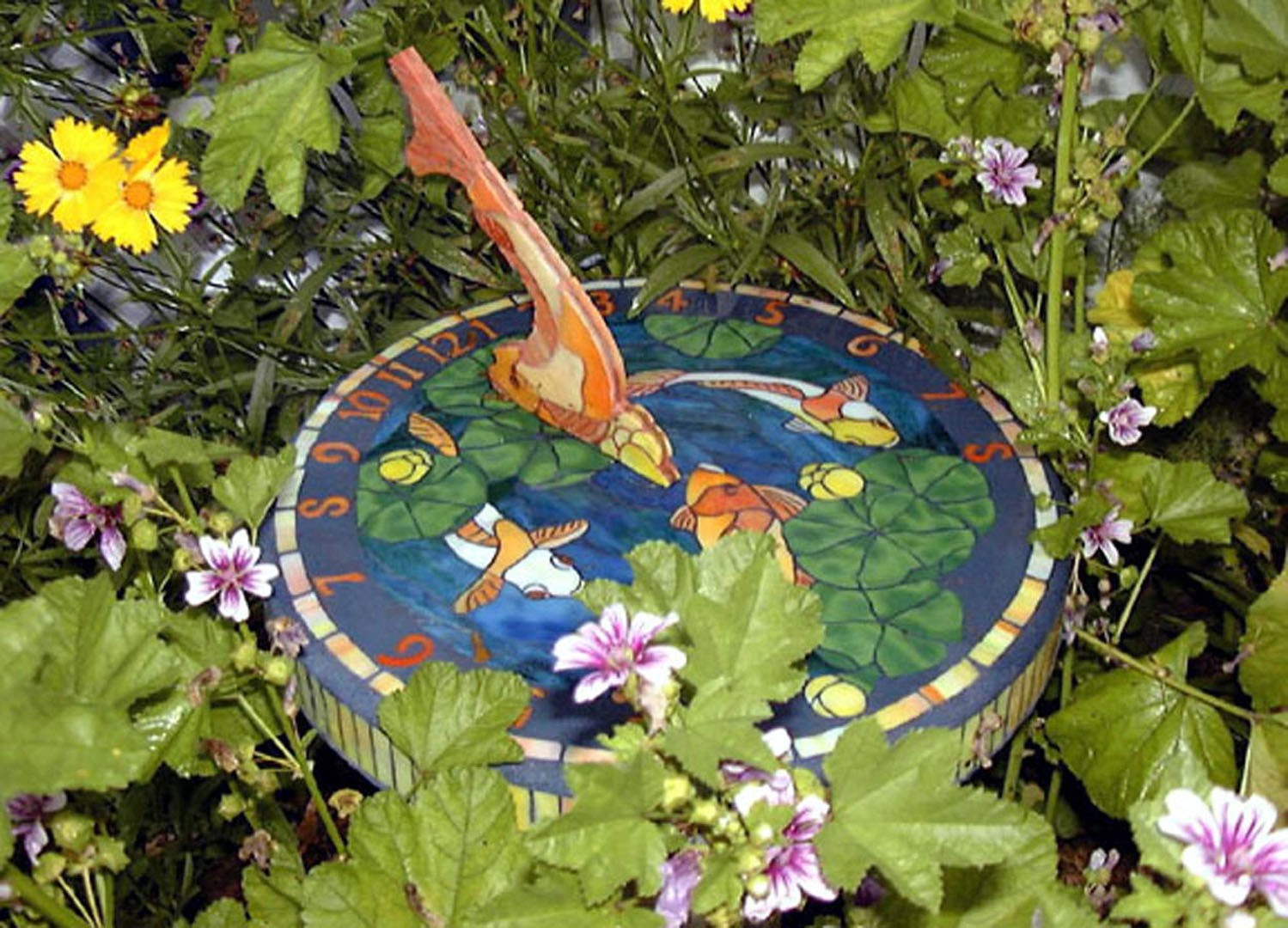
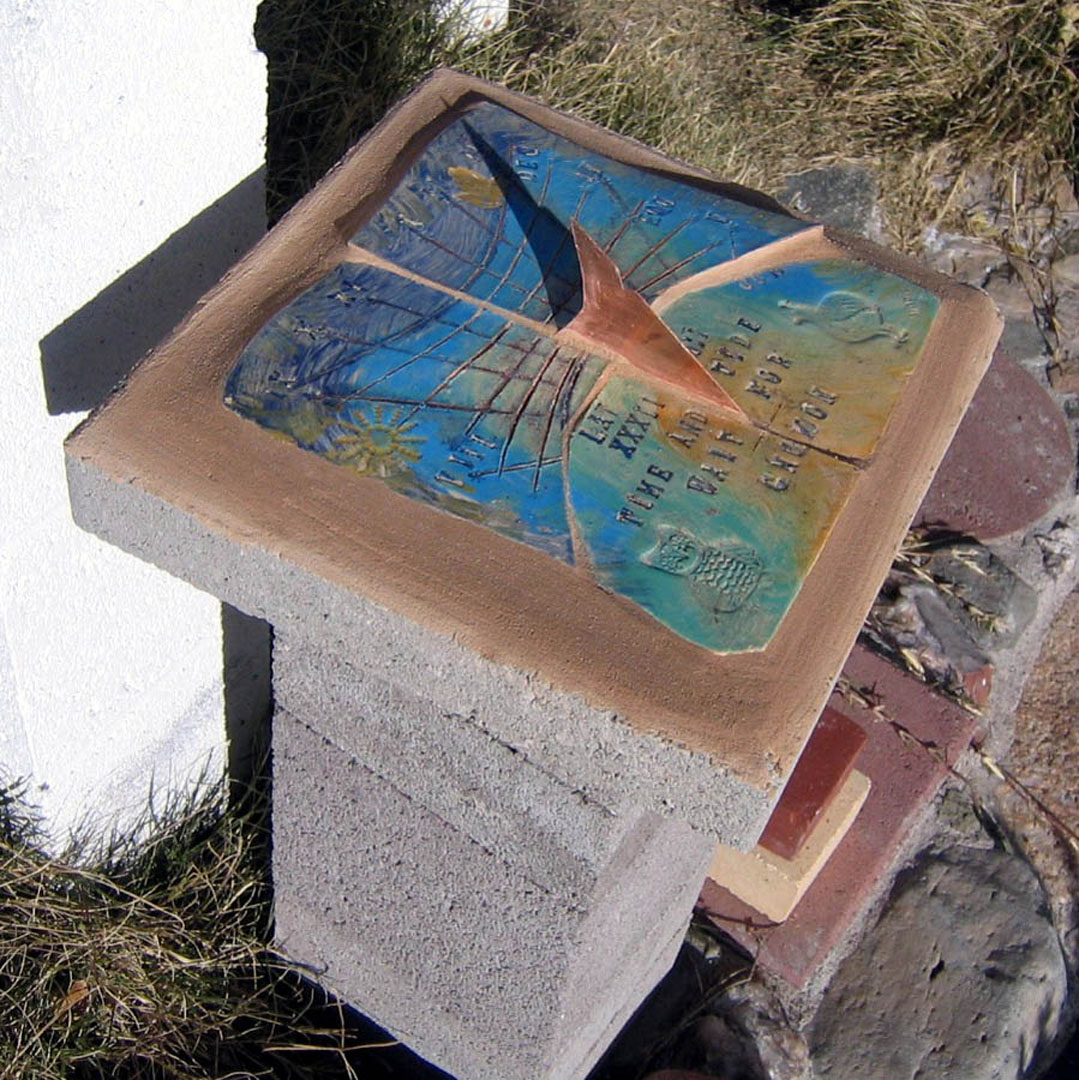
| Designer & Glass Artisan: M. Koehl Date: unknown, probably early 21st century Original Location: unknown. Somewhere in the USA Present Location: unknown Orientation: Horizontal Size: unknown Adornment: Beautiful artistic design of both the face and the gnomon. The gnomon is a stunning mosaic sculpture of a Koi fish jumping out of the sundial face which is a pond with swimming Koi and flowering water lilies. Condition: unknown, but great in this photo Comments: Very nice artwork design! The gnomon, while beautiful, could be considered gnomonically flawed since part of the shadow casting edges are curved and not flat. Without more information, it's impossible to determine if this dial's face is correctly delineated. The numerals on the face might be correct since they are closely spaced around noon and the 6 o'clock numerals line up correctly with the base of the gnomon. This dial might function as a sundial since there are no obvious design errors. I'd like to find out if the mosaic pattern is printed in the mosaic "how to" books and if there are similar twin dials of this pattern being made by others. If so, these dials may not function correctly for their owners if they are at different locations. Inland Craft Website: Here Photo Descriptions: Photo was copied from Inland Craft website. It originally appeared in the "how to" booklet, "Mosaic Sundials" by M. Koehl. Photos: a |
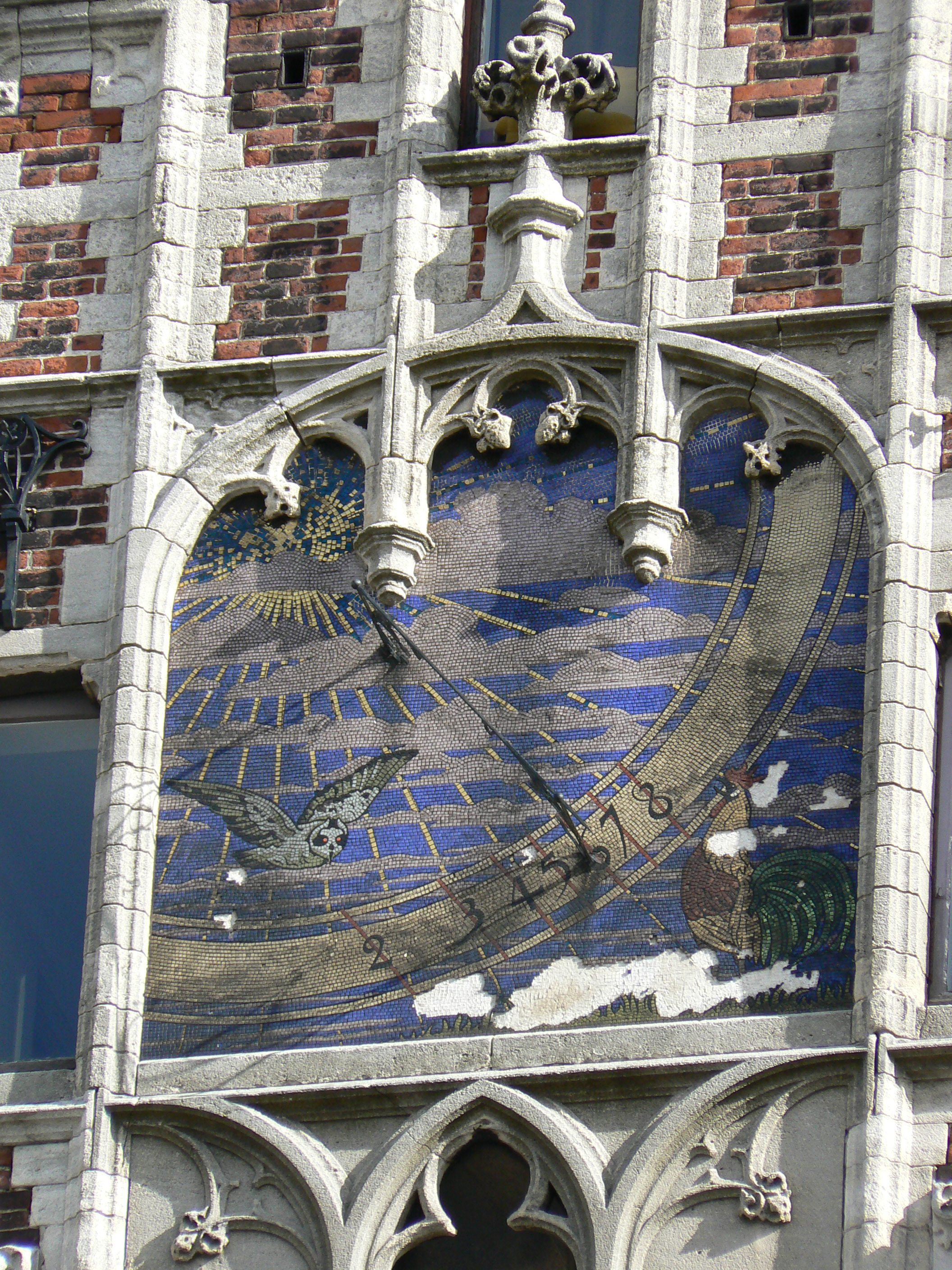
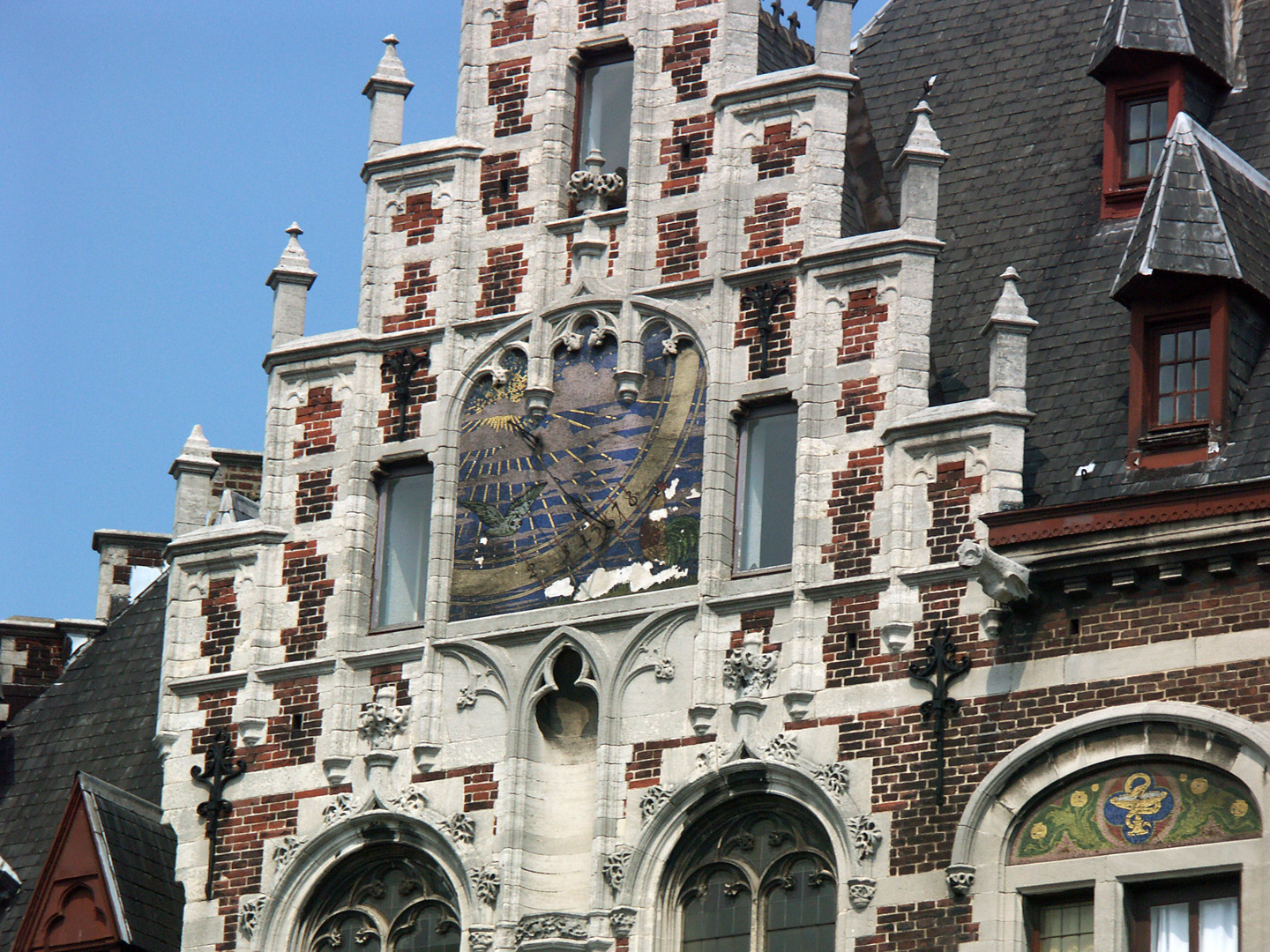
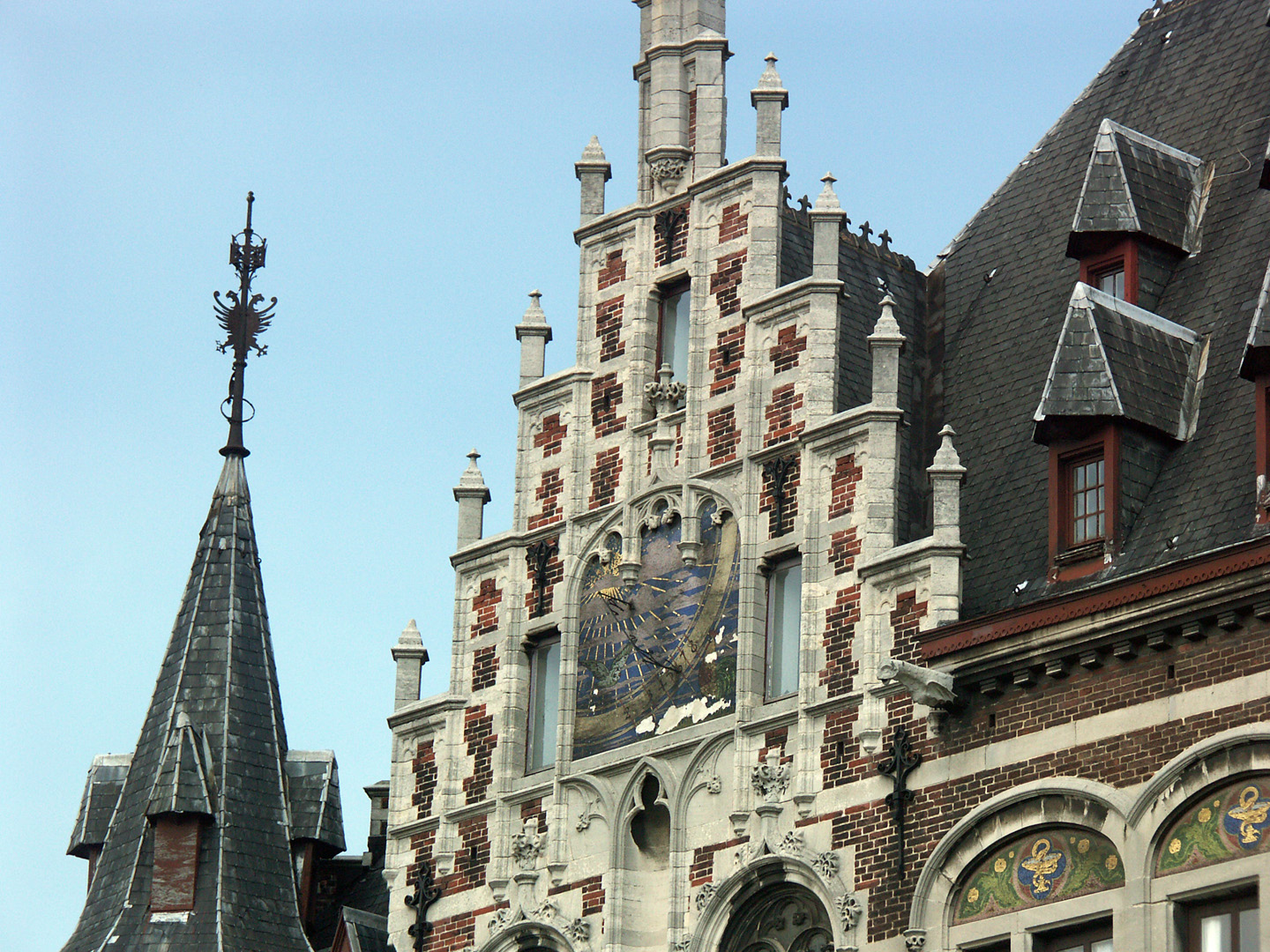
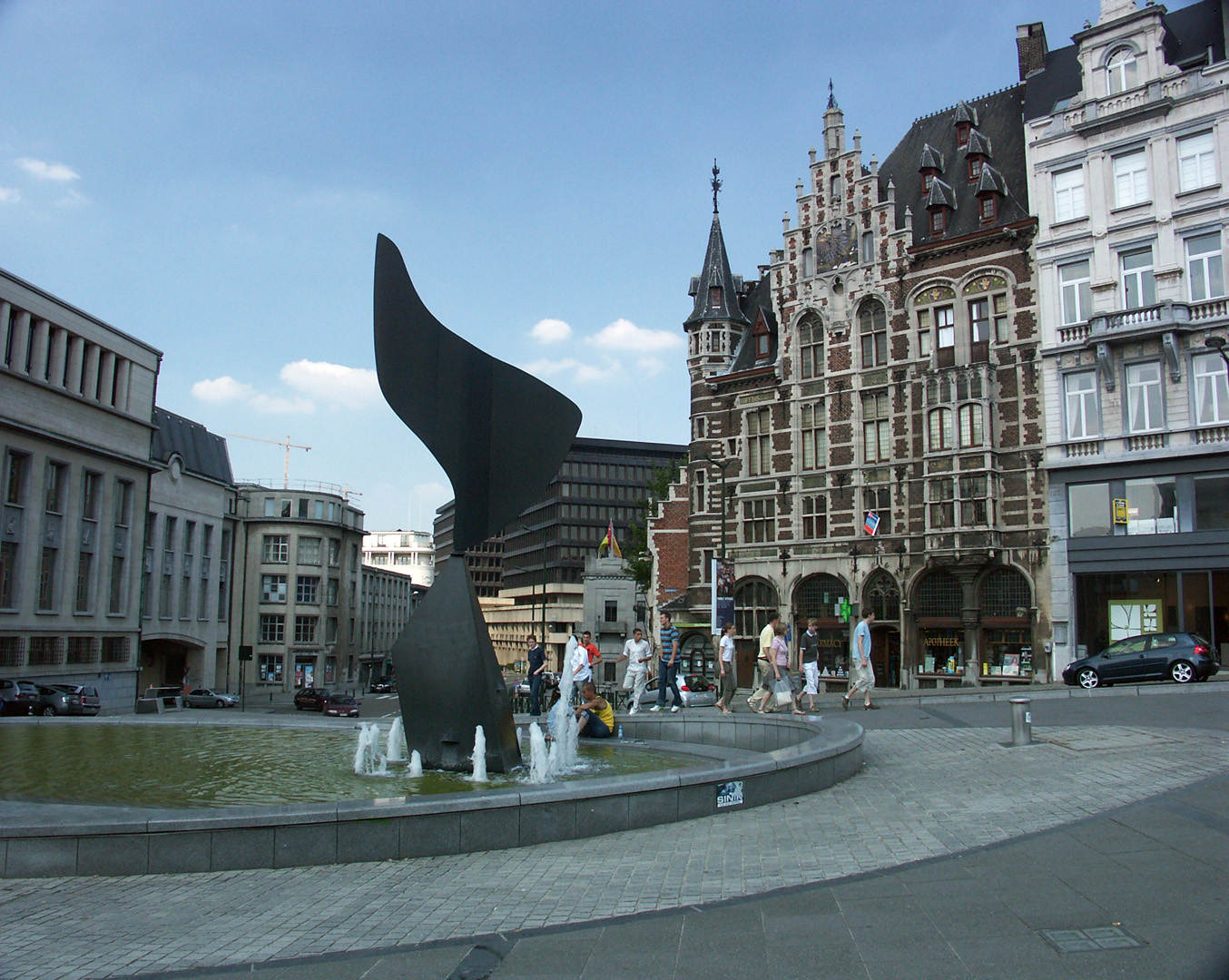
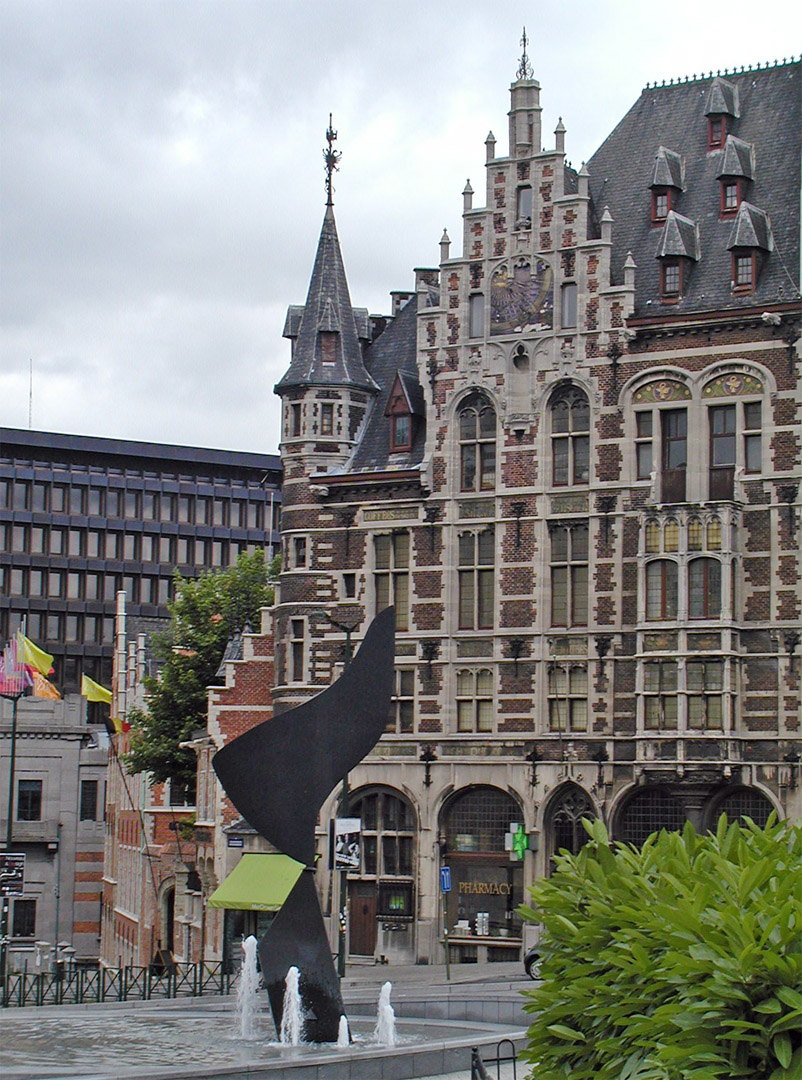
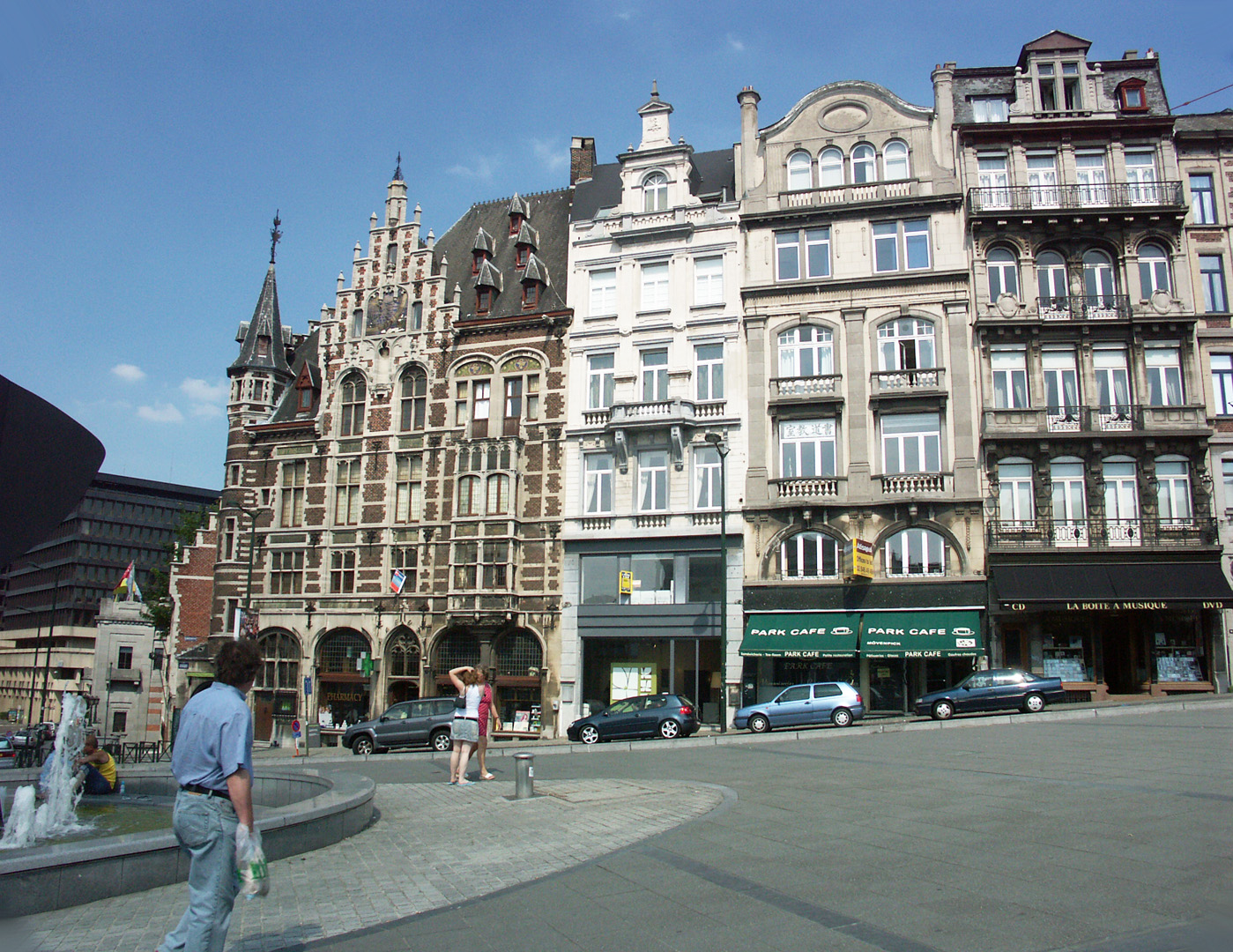
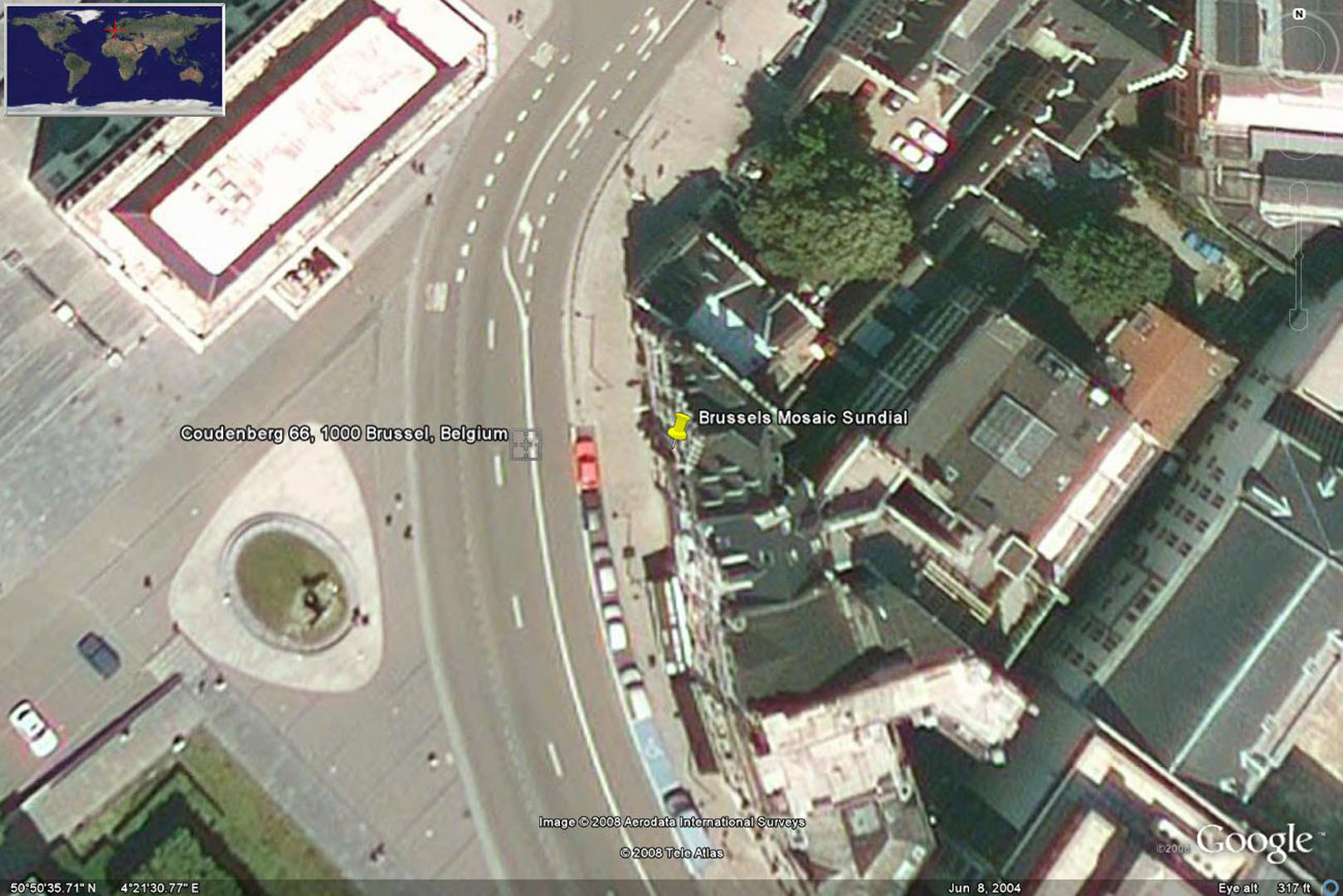
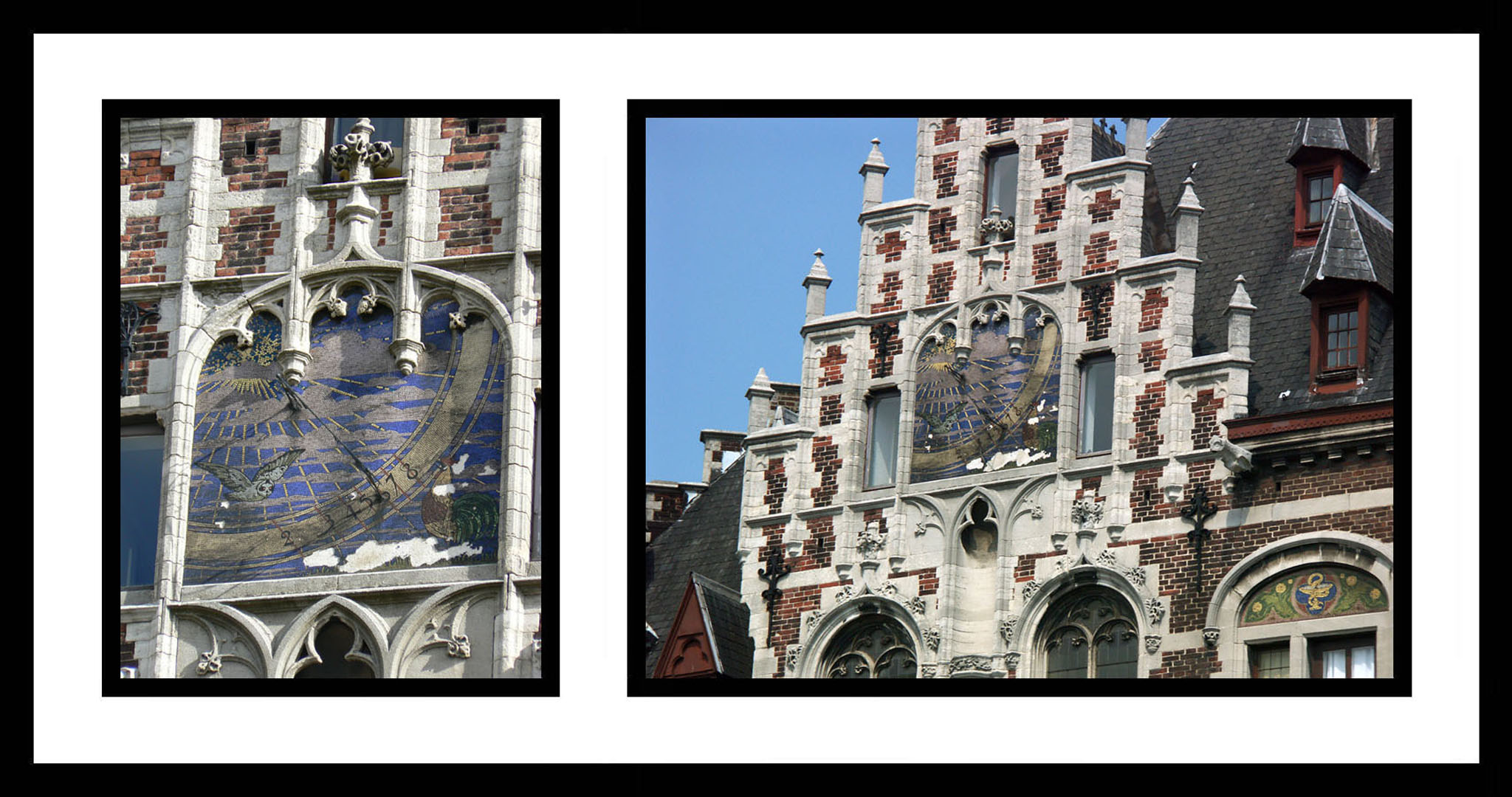
Designer & Maker: from www.gnomonica.be: "Project leader: Paul Saintenoy ?, Author of the sunDial: Silvio Tolomei" Date: from www.gnomonica.be: "± 1895" Original Location: from Thierry van Steenberghe: It is high up on the "Pharmacie Anglaise" at Coudenberg 66, 1000, Brussels Belgium (near the Royal Palace). This is a nice neo-gothic house which was built in 1895 on rue Montagne de la Cour at the corner of Coudenberg in central Brussels, for pharmacist, Charles Delacre, born 1826. It was designed by architect Paul Saintenoy who became famous for his "art nouveau" buildings, most notably the nearby steel frame department store "Old England" now refurbished as the Museum for Musical Instruments. Present Location: at original location Orientation: Vertical. Declines by unknown amount towards the northwest. Size: unknown, but quite large Adornment: an owl with red eyes, a rooster, a sunburst with golden rays Inscriptions: none visible Mottos: none visible Condition: restored at unknown date, but deteriorating quickly. Many tiles are missing in the lower right quadrant and upper left edges. Tiles are very dirty. Comments: This is a mosaic dial of small tiles of venetian glass. This important dial needs immediate restoration to save it! Please contact the authorities in Brussels to help us persuade them. Coudenberg Map: Here 360 Degree View Website: Here Gnomonica.be Website: Here Kerrin Kastorf Website: Here Willy Leenders Website: Here Photo Descriptions: These photos were taken between 2004 and 2008 and are used here with permission of photographers: Kerrin Kastorf, Mike Isaacs, Willy Leenders, and Thierry van Steenberghe. Thanks to these people and to Patrick Powers for their information and photos. Please ask photographers for permission to use their photos. Photos: a b c d e f g |
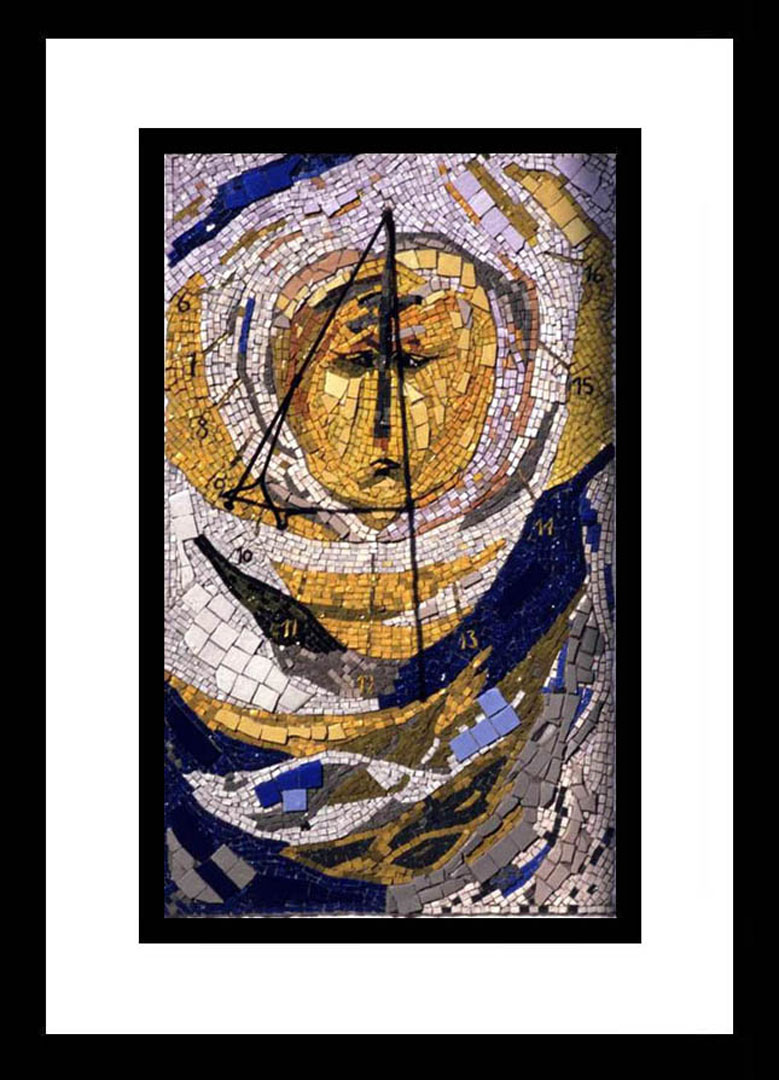
Designer & Maker: unknown Date: 1986 Original Location: Lat: 47° 16' N; Lon: 11° 23 E. unknown location in Innsbruck Austria Present Location: probably at original location Orientation: Vertical. Declination unknown. Size: unknown Adornment: The sun looks sadly at the city of Innsbruck. Mottos: none Condition: probably good Comments: Bizarre and evocative design uses mosaics of different sizes, colors and textures. Schwarzinger wrote: "In 1986 an artist has created a sundial in Innsbruck from mosaic stones. The sun looks sadly at the city of Innsbruck. At this time there was the accident in the nuclear power station in Chernobyl in Ukraine". We are seeking more information on this dial. Photo Descriptions: Photo is courtesy of Gianni Ferrari and Karl Schwarzinger. Gianni Ferrari forwarded us this photo that Karl Schwarzinger (Austria) sent to him in 2005. Photos: a |
 |
 |
 |
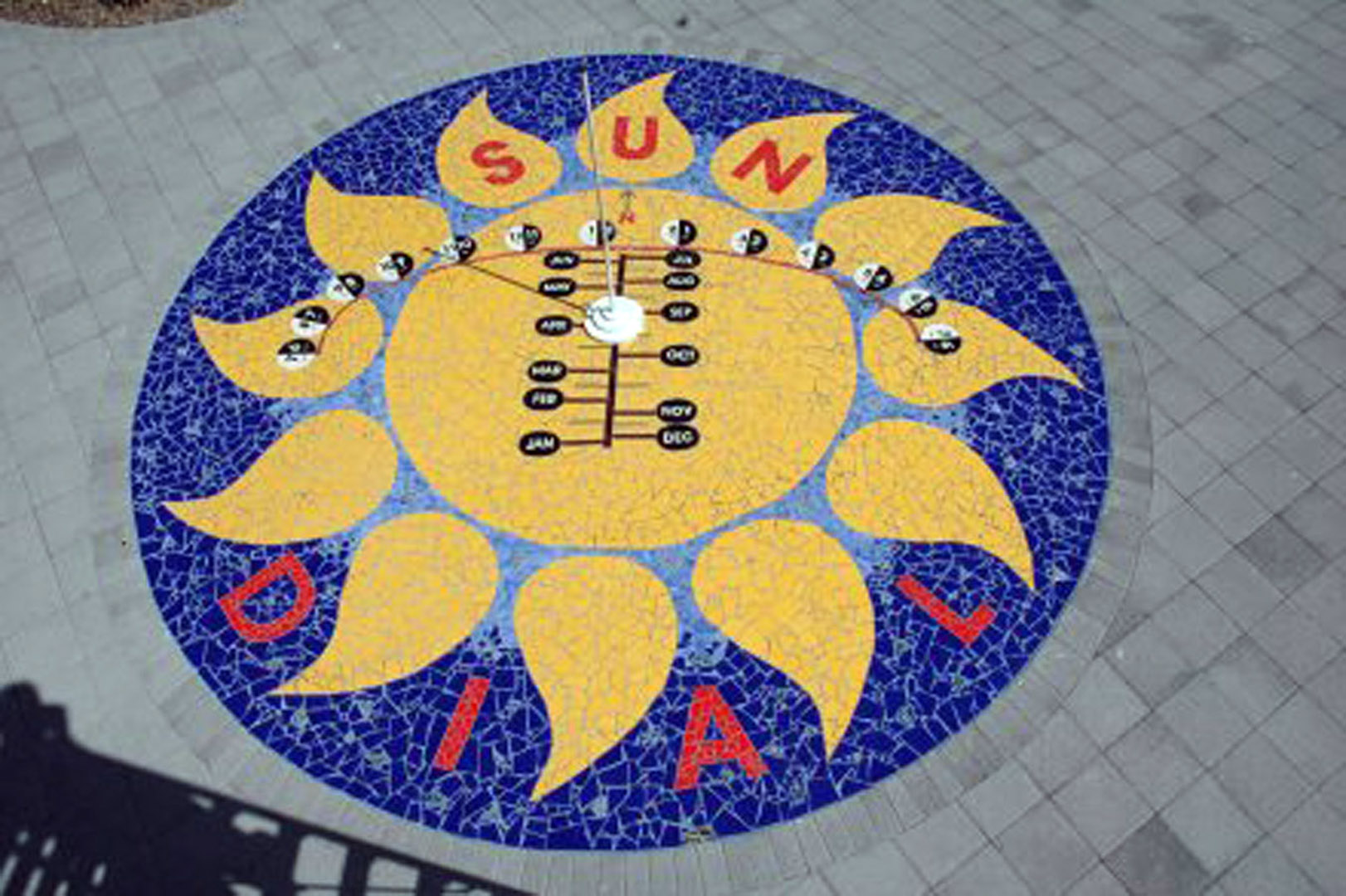
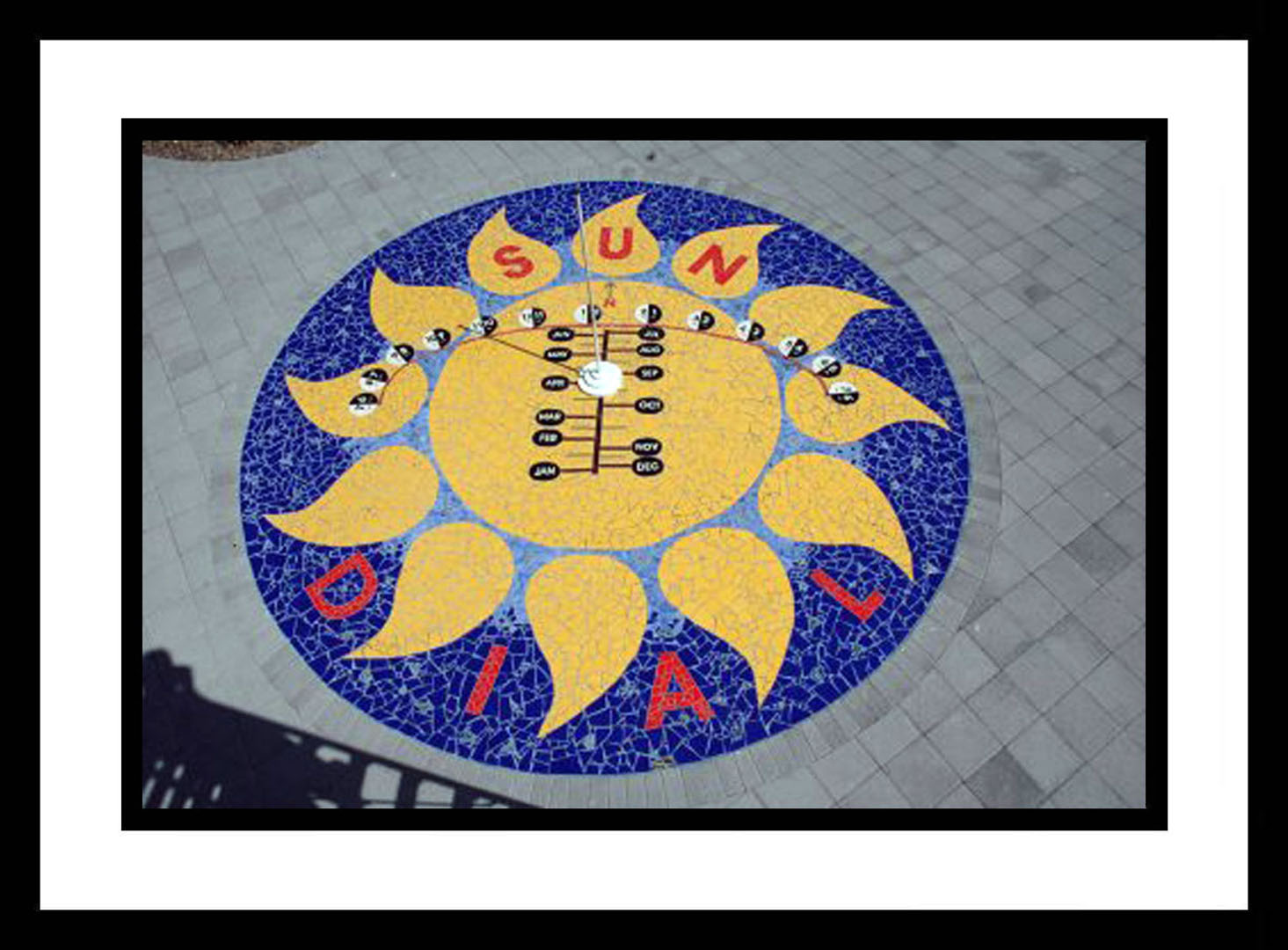
| Designer & Maker: unknown Date: unknown Original Location: MacArthur Causeway at The Miami Children's Museum, Watson Island, Miami Florida USA Present Location: at original location Orientation: Horizontal Size: major diameter- 4.9 m (16 ft) Adornment: a simple flaming sun design Inscriptions: "Sun" and "Dial" Mottos: none Condition: unknown, probably good in 2008 Comments: We need better photos of this dial. NASS Sundial Registry Website: Here Children’s Museum Website: Here Photo Descriptions: Photos are copied from The NASS online registry. This is dial #573 in the NASS online registry (Florida). From NASS Registry: "Attractive analemmatic in brightly colored mosaic tiles." We need better photos. Photos: a b c |
Designer & Maker: Alrakis, a scientific instrument company in Italy. Date: delivered in 2002 Original Location: Lat: 40° 21' N, Lon: 18° 10' E. At the Istituto di Istruzione Secondaria Superiore "L.G.M. Columella" - Lecce Italy Present Location: at original location Orientation: horizontal. Size: 5 x 4 m (196 x 157 in) Adornment: Hourlines are white carrara marble. Green quartzite makes the Solstice and Equinox lines. Mottos: none visible Condition: probably excellent Comments: Shows the dates and time. We are looking for more information on this dial. Alrakis Website: Here Photo Descriptions: Photo copied from the Alrakis website. Photos: a |
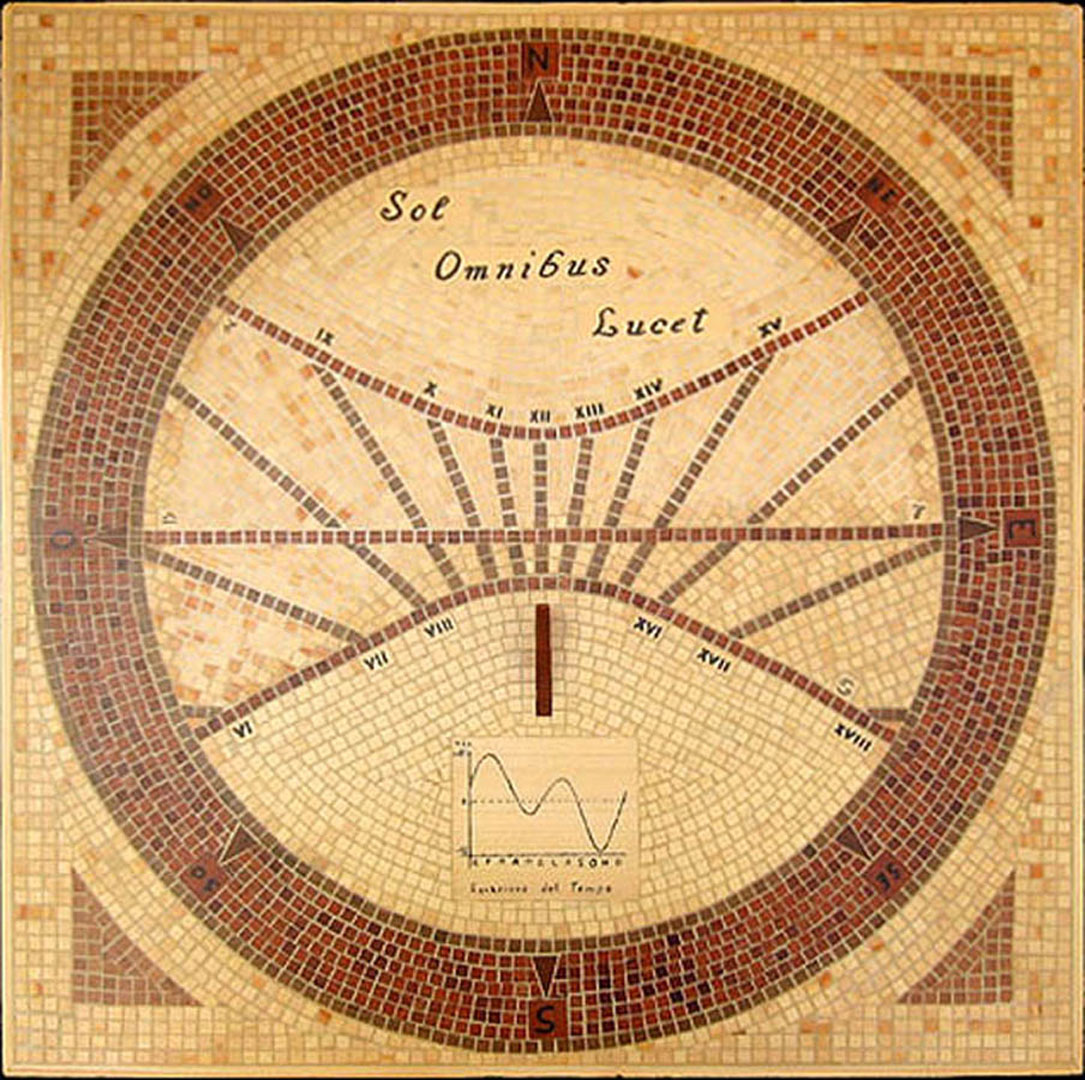
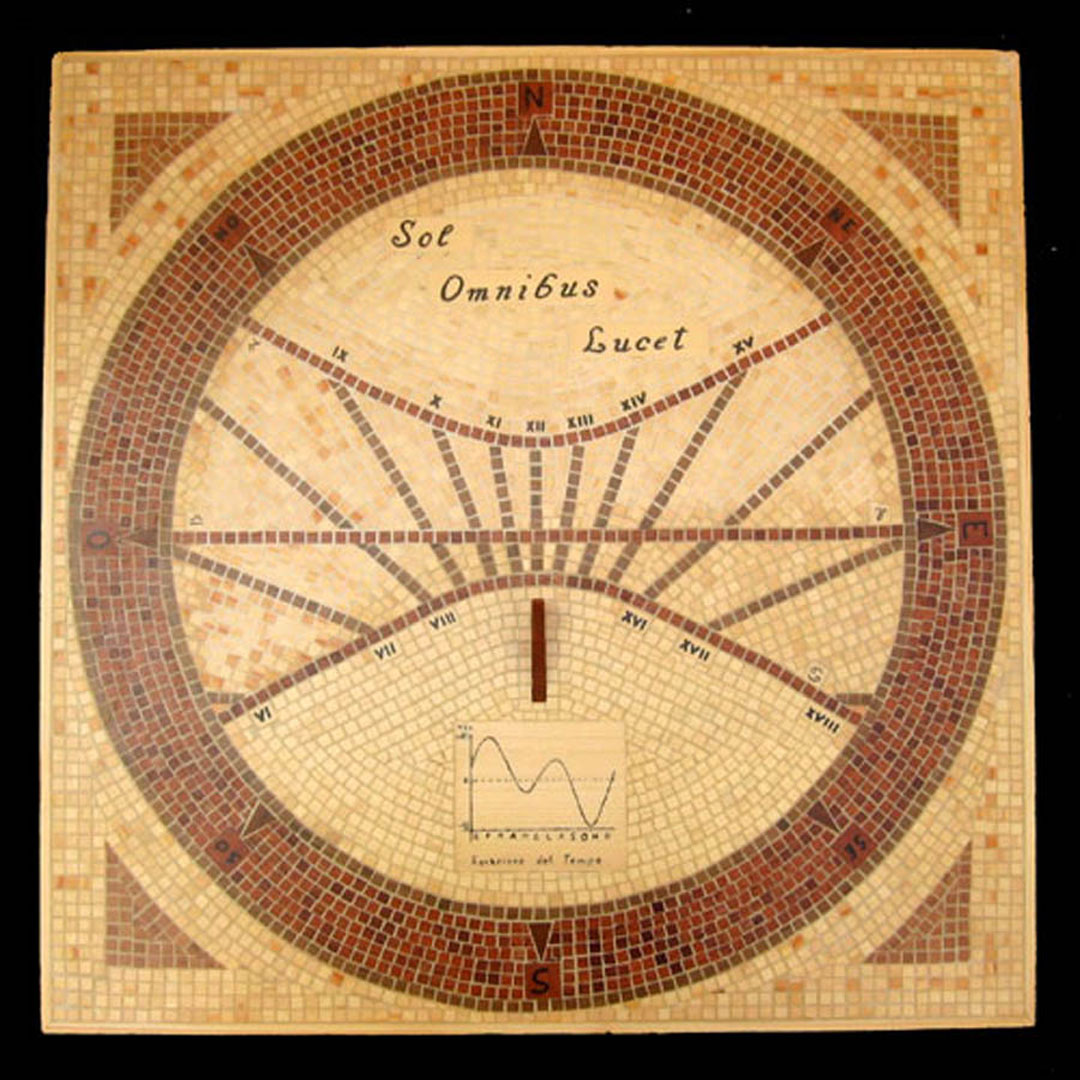
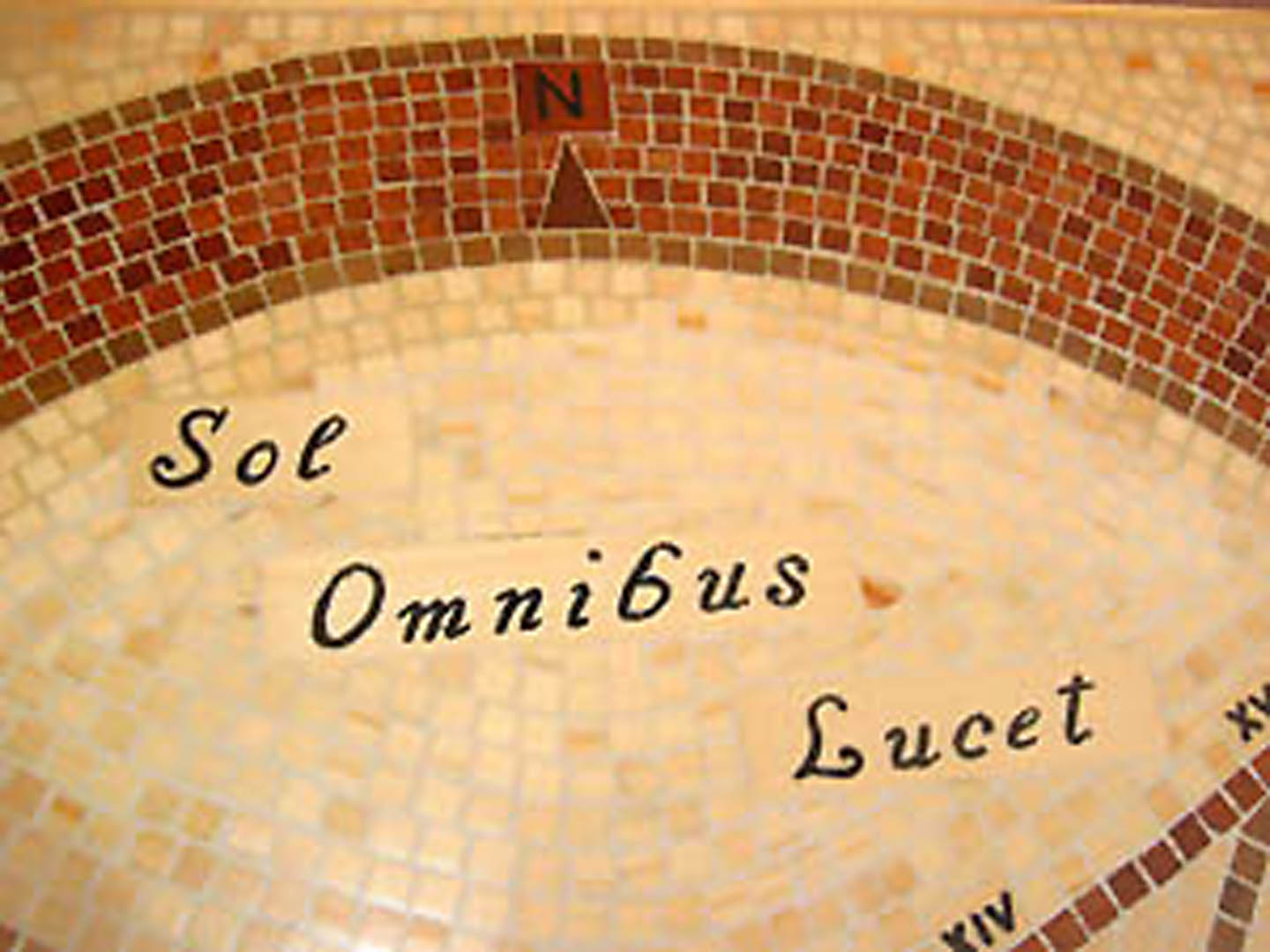
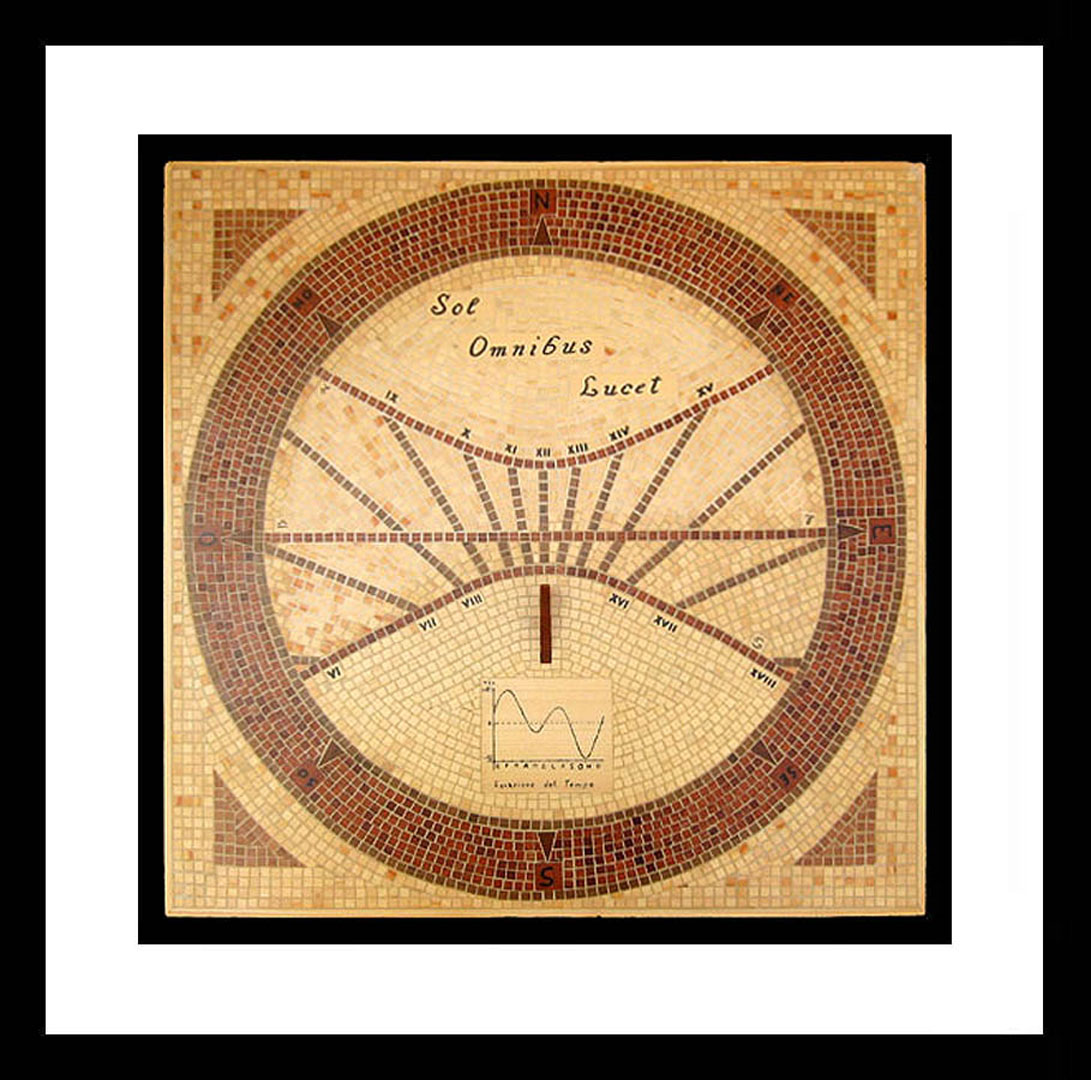
Designer & Maker: Vito Lecci Date: 2002 Original Location: Lat 39° 51 N; Lon 18° 18' E. In the Astronomical Observatory “Sidereus” in the little town of Salve, near Lecce in southern Italy. Present Location: at original location Orientation: Horizontal. Size: 60 x 60 cm (23.6 in) The 4000 mosaic pieces are each about 9 mm square. Adornment: has date lines, the Equation of Time, motto Mottos: "Sol omnibus lucet" (The sun shines for all) Condition: excellent in 2005 Comments: Although this handsome mosaic is made from wood, we are including it because it is so similar to ceramic and glass mosaics and because it’s just so nice! It features walnut houlines, mahogany diurnal lines, and a rosewood gnomon. The bottom is pine. It's probably used as interior decoration since the wood will not hold up well outside. We are looking for better photographs and more information on this piece. Sidereus Website: Here Sidereus’s Email: Here Photo Descriptions: Photos are courtesy of Siderous website. Photos: a b c d |
 |
 |
 |
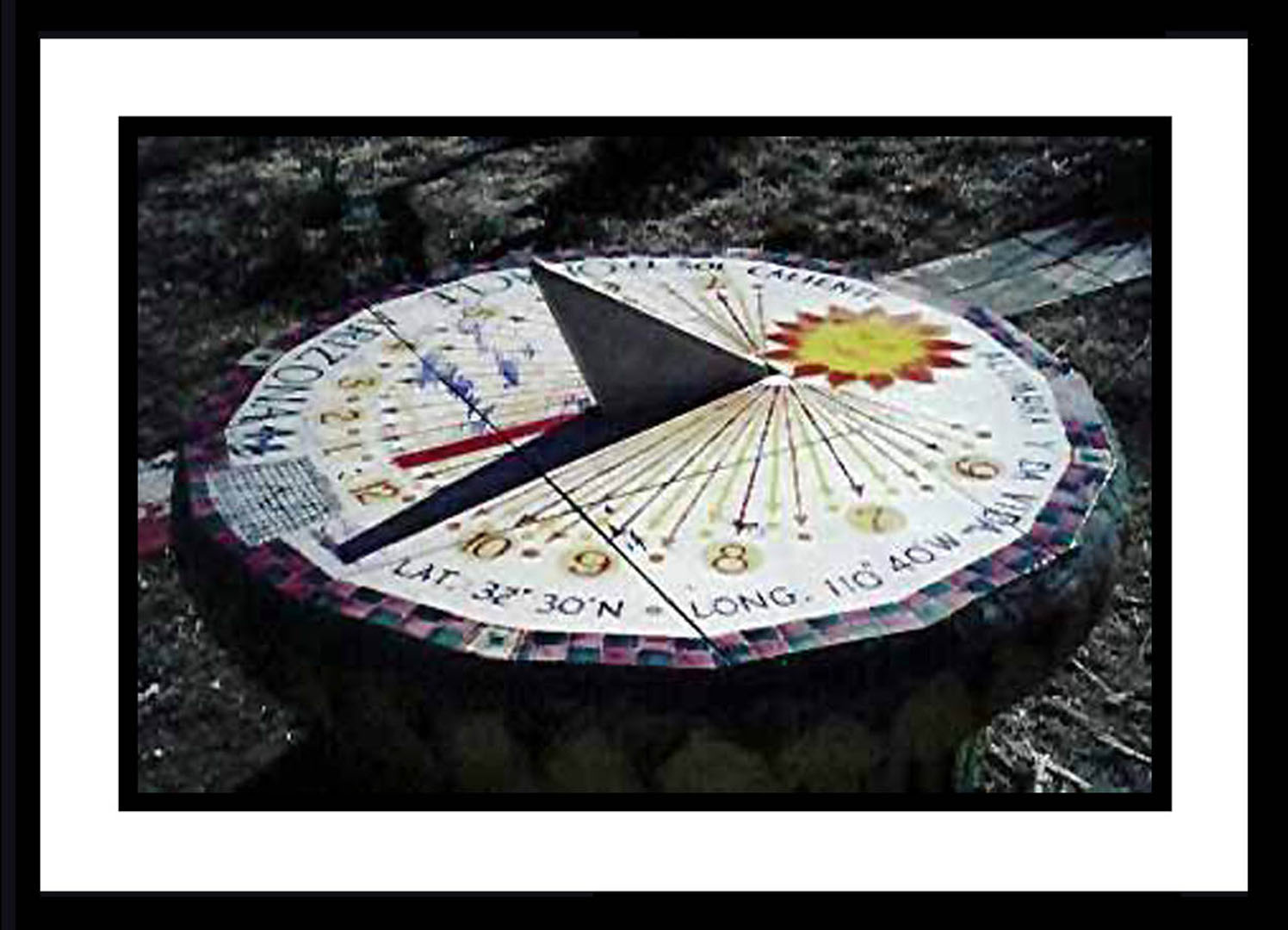
| Maker: unknown Date: late 1900's Original Location: Oracle Public Library, American Avenue, Oracle AZ, USA 85623 Present Location: at original location Orientation: Horizontal Size: 91.5 cm (4 ft) Adornment: At the north point is a graph of the Equation of Time and at the south point is the bright face of a sun. Ringing the dial is an inscription. Base is a concrete "flower" approximately 2 feet high. Dial is white ceramic with tile edging. Hour lines are bright arrows. Mottos: undetermined Condition: unknown Comments: This is a brightly colored ceramic tile mosaic dial. Hour lines adjusted for local longitude. Nearby, is an approximately 3.8 m (15 ft) long Noon Mark or Meridian Line with the months of the year marked on it. The shadow is cast by a small electric power pole. We are looking for more information and better photos of this dial. Arizona Highways Website: Here Photo Descriptions: I have forgotten the source of this photo. My apologies to the phgotographer. j.c. Photos: a |
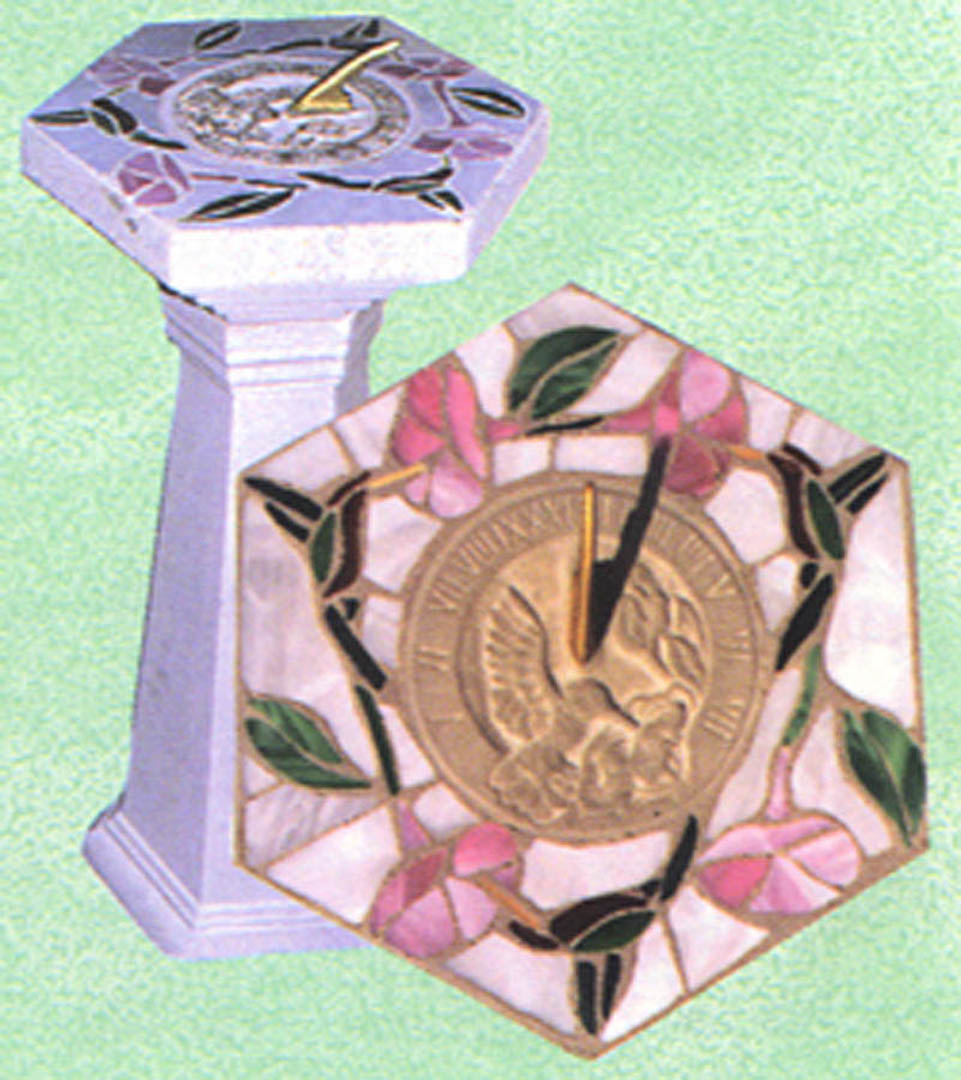
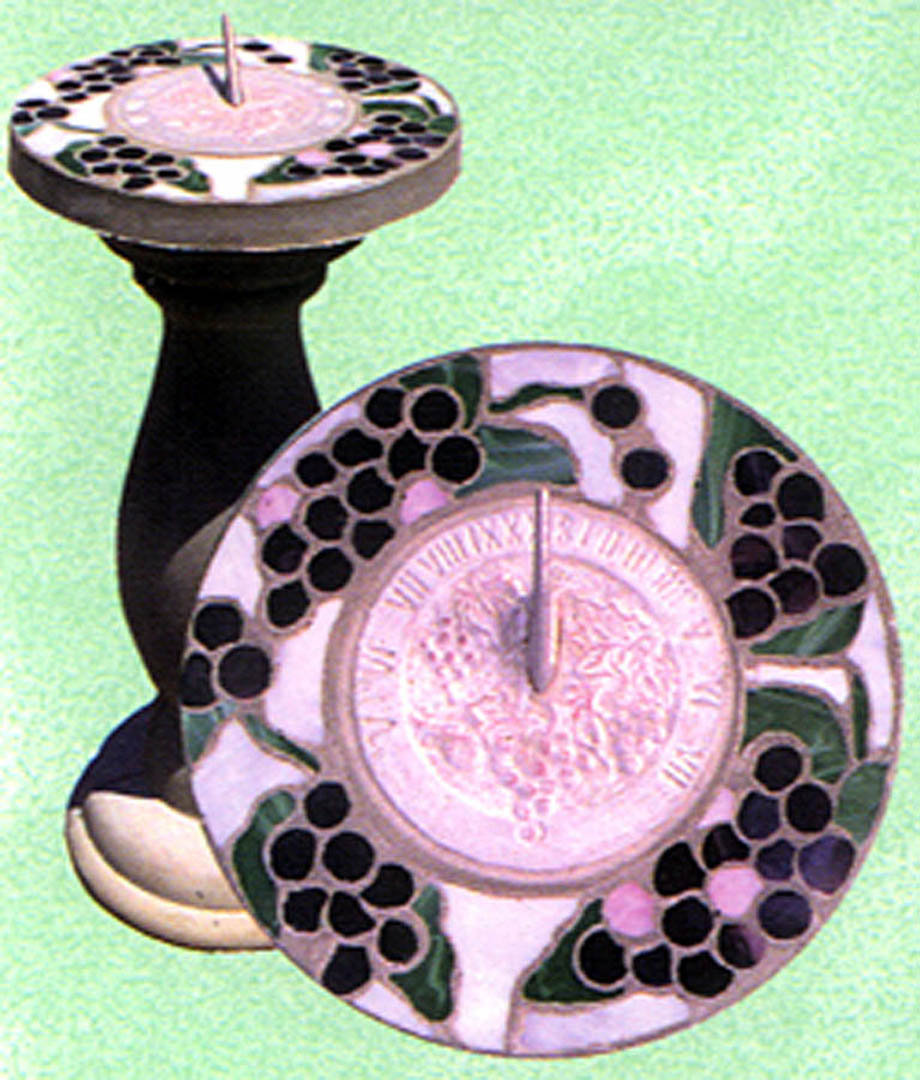
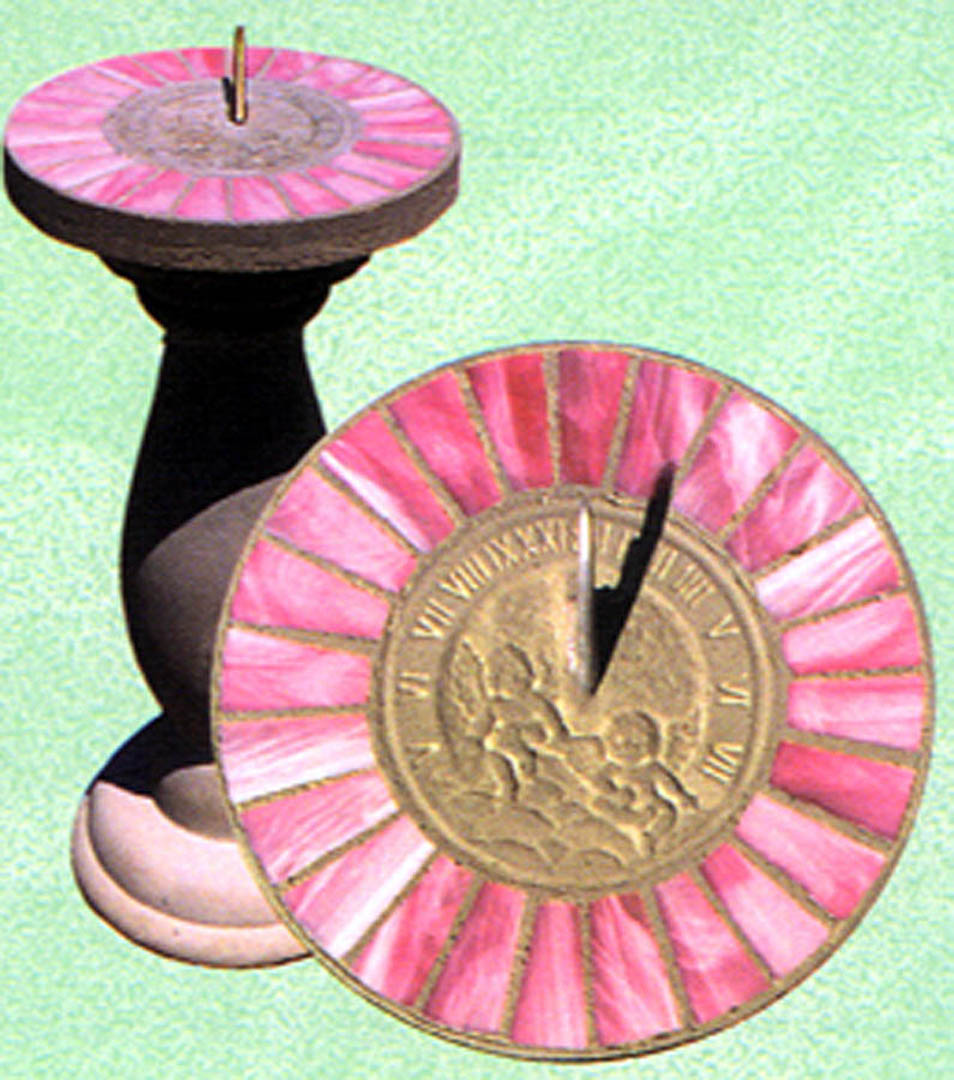
Designer and Glass Artisan: unknown Date: unknown, probably early 21st century Original Location: unknown. Somewhere in the USA Present Location: unknown Orientation: horizontal Size: unknown Adornment: the molded designs on the brass sundial faces are a hummingbird (Dial 324), grapes (Dial 325), and angels (Dial 326). The brass sundials are surrounded by a borders of leaded stained glass mosaics. Condition: unknown, but good in this photo Comments: These are just ornamental dials and can not function because they are gnomonically flawed. The brass dials are mass-produced cast ornamental sundials with curved gnomons. But the idea of putting a mosaic border around a metal sundial is artistically a good one. Garden Ponds Website: Here Photo Descriptions: Photo was copied from website above. Photos: Dial 324: a Photos: Dial 325: a Photos: Dial 326: a |
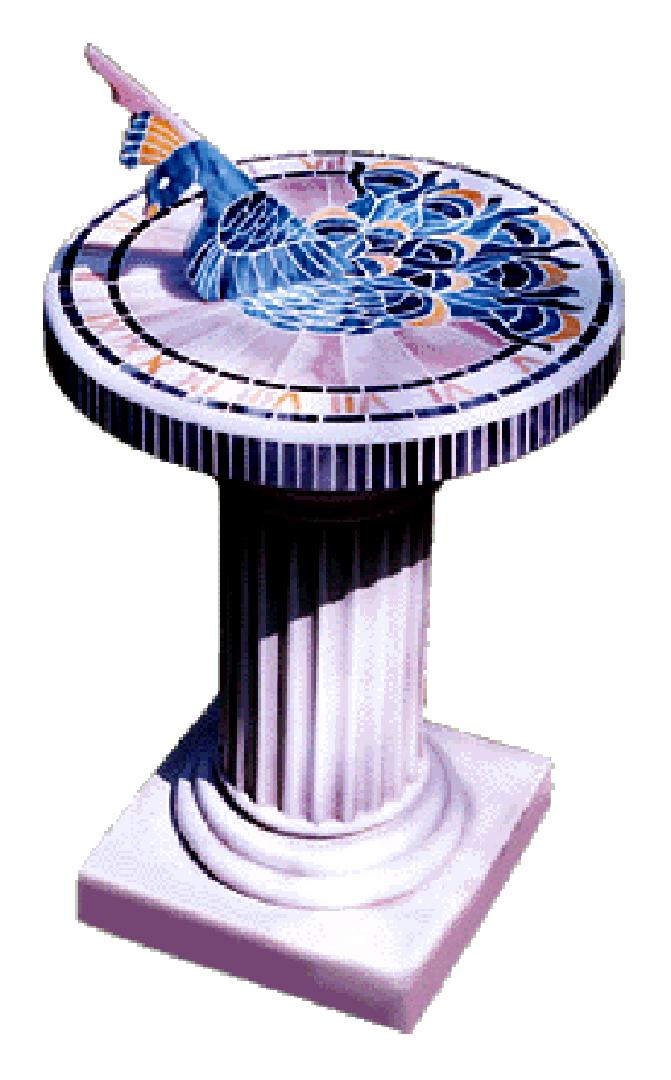
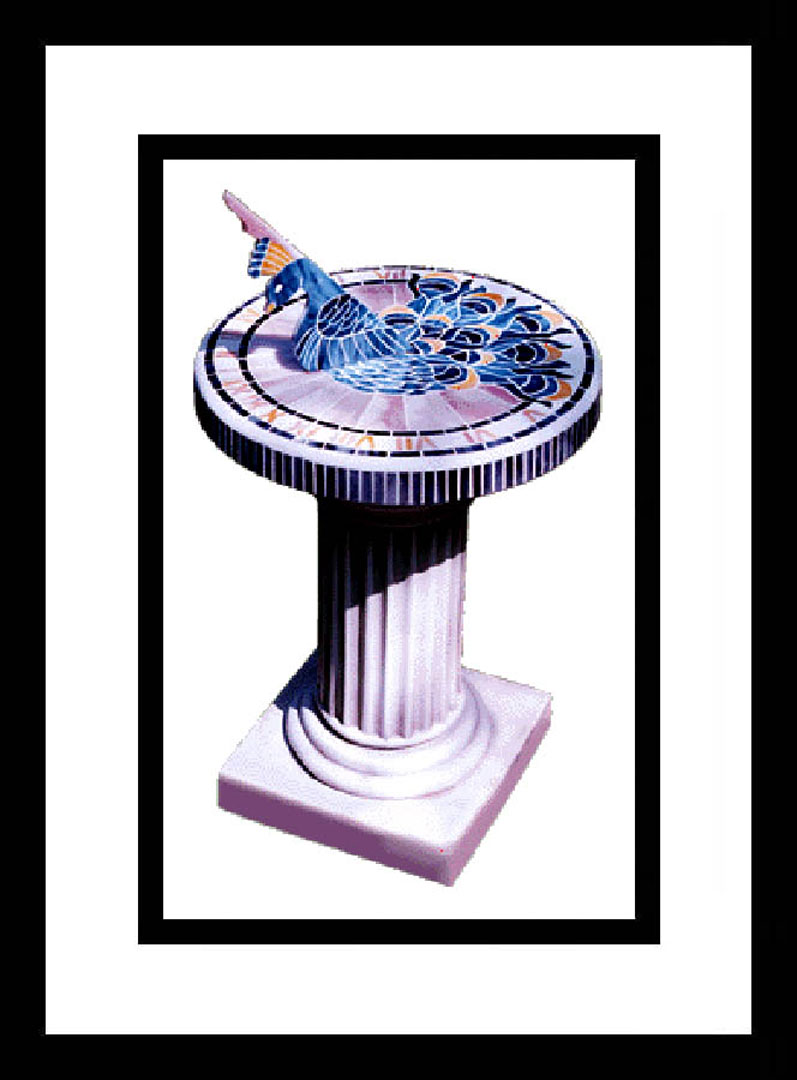
Delineator: unknown Glass Artisan: Mary Koehl Date: unknown, late 1900s or early 2000s Original Location: On pedestal at unknown location in the USA. Present Location: unknown Orientation: Horizontal Size: unknown Adornment: stained glass mosaic of a peacock. The body is the gnomon. The bird's tail feathers are on the face. Mottos: none Condition: unknown Comments: It's unknown if the Koel's sundials are properly delineated for specific locations and if they are accurate. We cannot locate Mary Koehl. We are looking for better photos and more information about her sundials. She wrote a booklet called: "Mosaic Sundials by Mary Koehl" that is for sale. Inland Craft Website: Here YGlass Website: Here Photo Descriptions: Photo was copied in 2005 from Inland Craft website. Photos: a |
 |
 |
 |
| Designer & Maker: Douglas Hunt of 'Sunclocks' Date: unknown, probably early 2000s Original Location: New Tunmarsh Centre, (east London, UK). Present Location: at original location Orientation: horizontal analemmatic sundial with human gnomon Size: unknown Adornment: a date-scale in mosaic, using different colors for each 'month'. Beautiful hour marks. Mottos: none Inscriptions: none Condition: unknown Comments: This is a human interactive sundial that uses the shadow cast by a human to tell time. Sunclocks Website: Here Photo Descriptions: Photo was copied from website above. Photos: a |
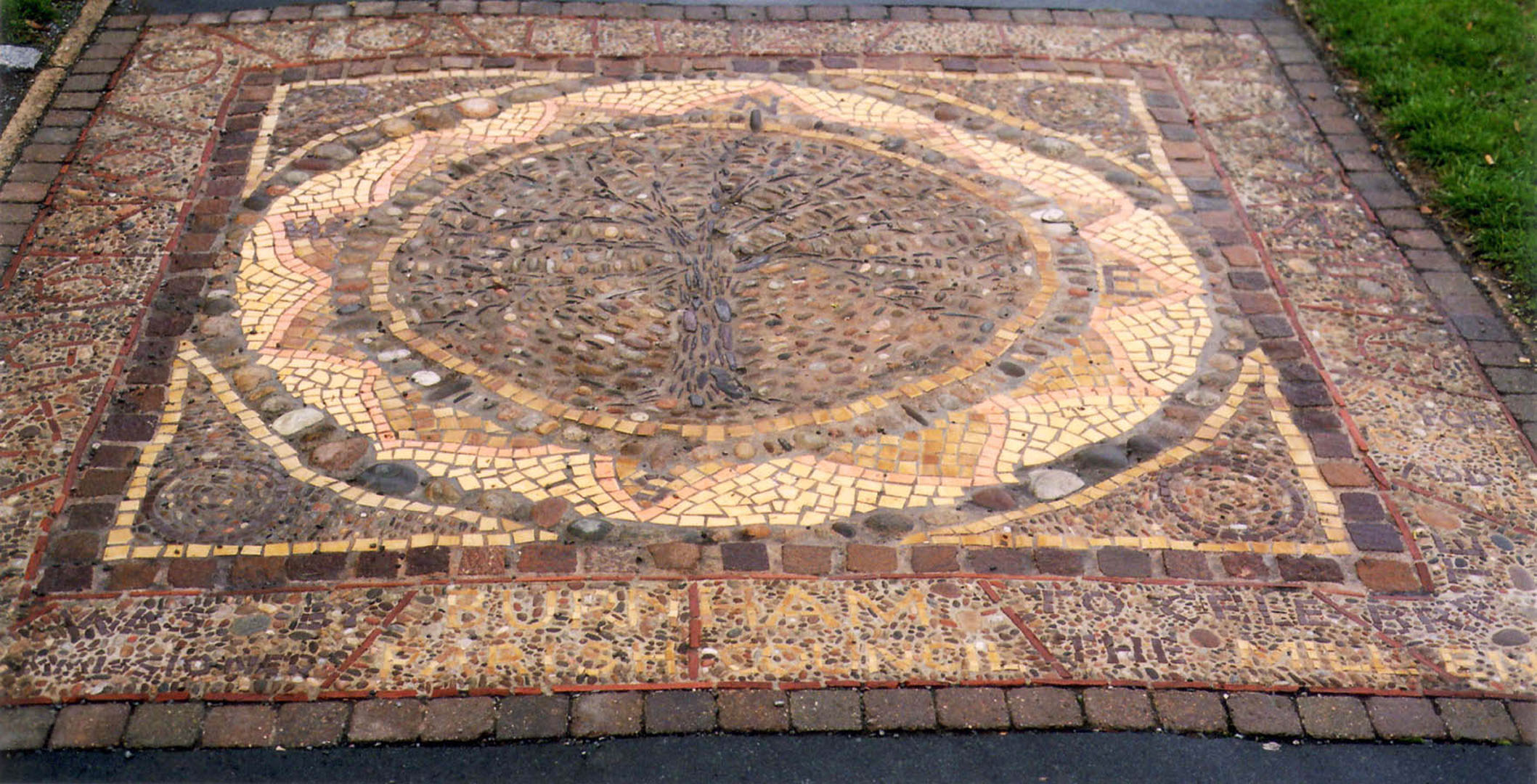
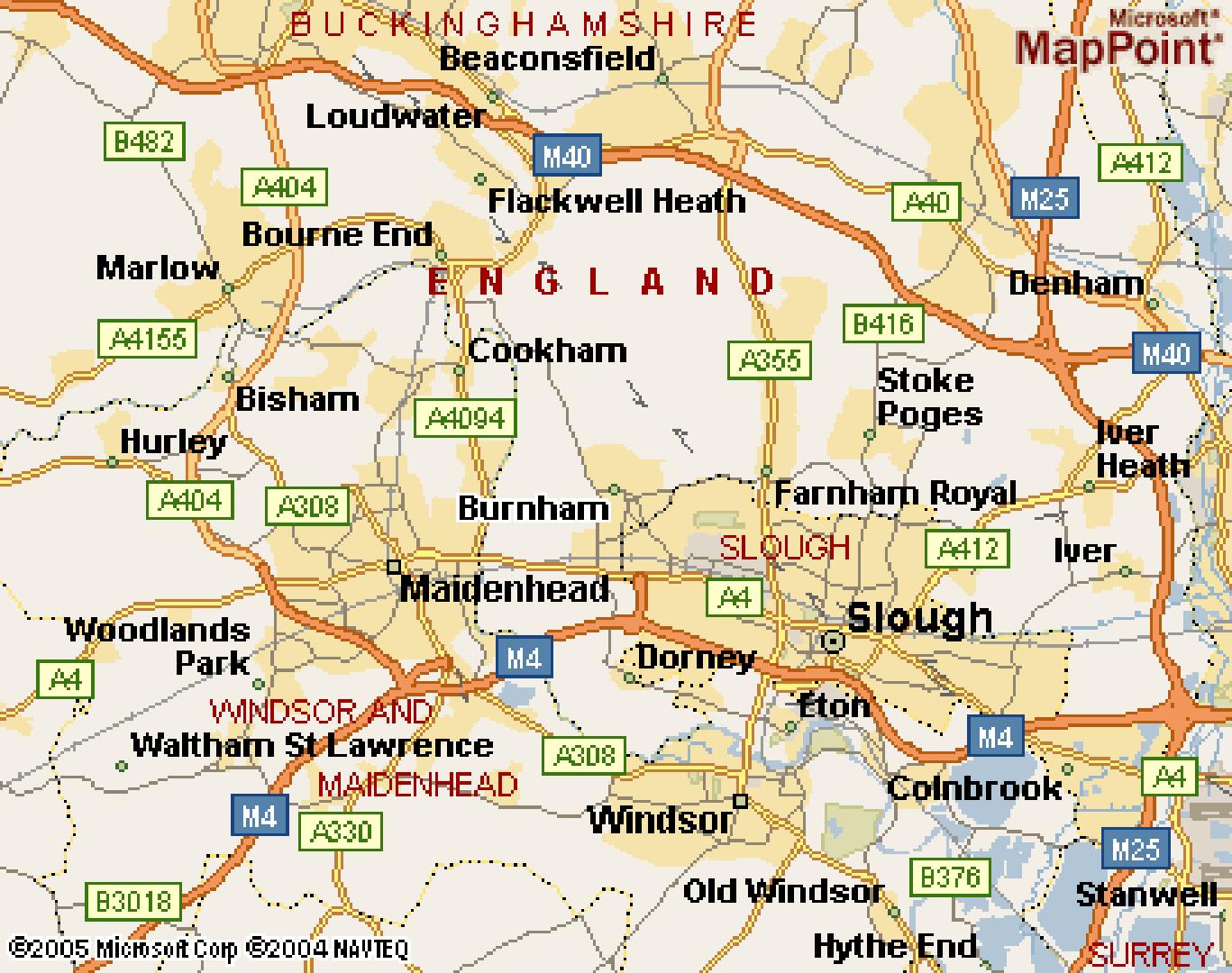
Designer and Maker: unknown Delineator: unknown Date: unknown, probably 1990s or early 2000s Original Location: Lat: 51° 32' N, Lon: 0° 39' W; unknown place in Burnham England Present Location: at original location Orientation: Horizontal Size: about 1.5 m (5 ft) square Adornment: A tree without leaves in the centre of a 12-point flaming sun, the four cardinal points labelled N, S, E, W. Around the W, N and E sides the hour numerals (Arabic), 6, 7, 8, 9, 10, 11, 12, 1, 2, 3, 4, 5, 6. Note that the dial is laid in a path that runs a few degrees west of north, and the compass points and hour numerals are correctly aligned to true north, hence not central in the design. Mottos: none Inscriptions: on the S of the W side "GMT". On the S of the E side "FOR BST ADD I HR". Along the S side "I [?] WAS COMMISSIONED BY / BURNHAM PARISH COUNCIL / TO CELEBRATE THE MILLENNIUM" Condition: very good Comments: brick, ceramic tile and cobblestone mosaic dial. It is a rather strange design since it uses pebbles and has no gnomon. Presumably you are supposed to use a walking stick for the gnomon! But it looks as if it is properly, if approximately, delineated. We are seeking more information on this dial. Photo Descriptions: Photo is courtesy of John Foad (taken in 2005). Photo ‘b’ is map of Burnham. Photos: a b |
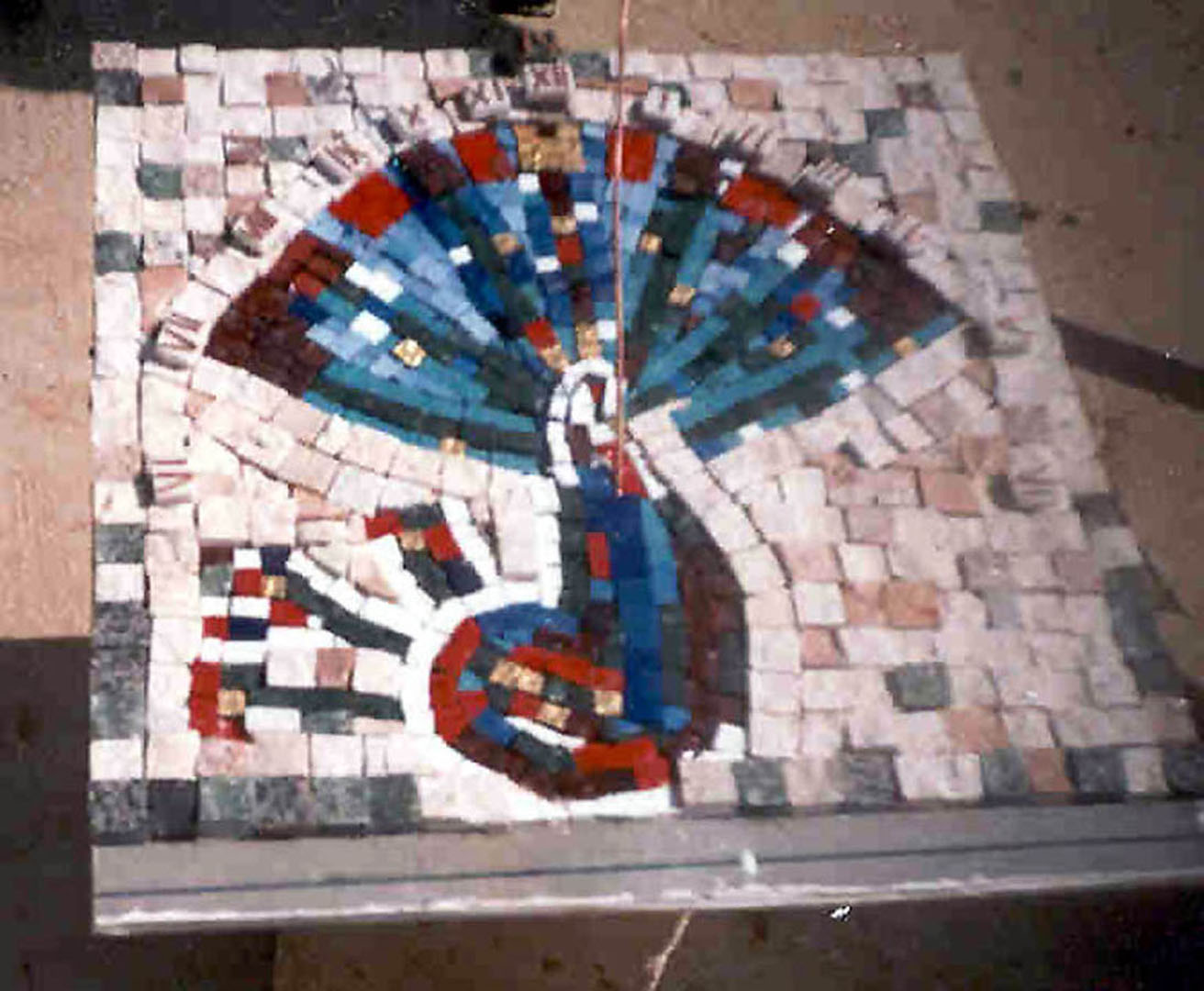
Designer & Maker: Matz Lamdan, Israeli mosaic artist. Delineator: unknown Date: unknown. probably early 2000's. Original Location: Lat: 31.7° N; Lon: 35.3° E. In The Biblical Zoo in Jerusalem, Israel. Present Location: at original location Orientation: Horizontal Size: unknown, but looks to be "coffee table" size. Adornment: a peacock with tail feathers open and raised Roman numerals. The subject of the peacock was chosen for its symbolical guarding of the Garden of Paradise, and for its ability to fan out its feathers to show the sunny hours for the sundial. Mottos: none Condition: unknown Comments: This is a crude mosaic with oddly sized pieces. Appears to have a perpendicular vertical gnomon. Donated by a woman from San Diego who supports the Zoo's educational facilities. Yonina's Sculpture Website: Here Matz Lamdan Email: Here Photo Descriptions: Photo is copied from Yonina's Sculpture Website. Photos: a |
 |
 |
 |
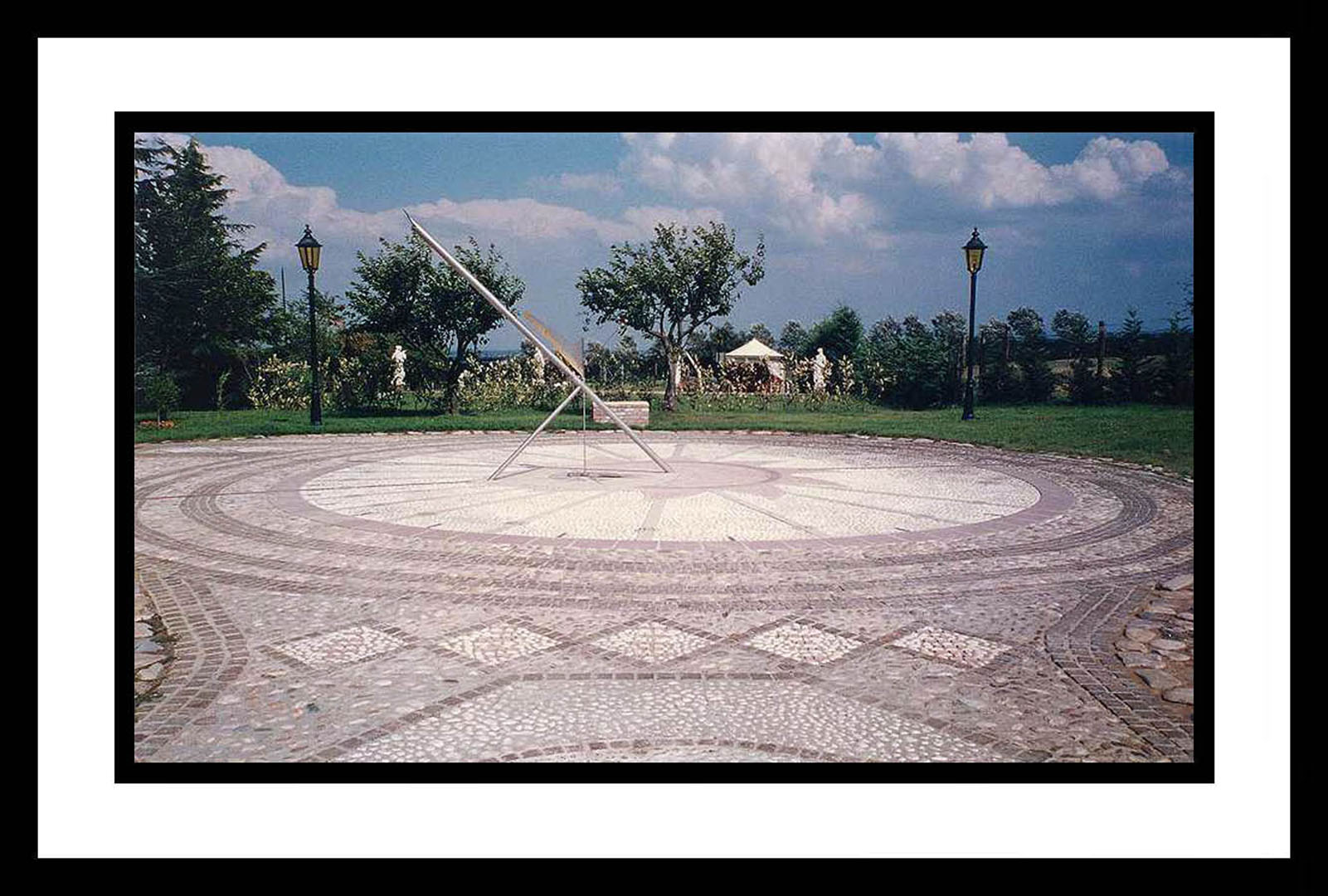
| Designer & Mosaic Artisan: architetto Giuseppe Ferlenga Date: finished 31 December 1999 Original Location: On sundial it says: “Lat: 44° 42' 23" N, Lon: 10° 12' 55" E”. in Salabaganza (Parma) Italy Present Location: at original location Orientation: horizontal Size: 12 m (39 ft) Adornment: Eight types of different marbles have been employed. All numbers and inscriptions were done with set-joint of two marbles. Compass rosette in center. Date, Lat. & Long. Mottos: none Condition: excellent in 2007 Comments: Information is courtesy of Giuseppe Ferlenga. The buyer who commissioned the dial wanted it to be completed on Dec. 31 1999 so that it would be the last important sundial of the second millennium. It appears that there is a working weathervane in the center attached to the top of the gnomon with a shaft that connects to the wind direction arrow which is just above a compass rosette on the face. More photos are on the website below Giuseppe Ferlenga Website: Here Giuseppe Ferlenga’s Email: Here Photo Descriptions: Photos are courtesy of Giuseppe Ferlenga sent to us in 2007. Photos: a b |
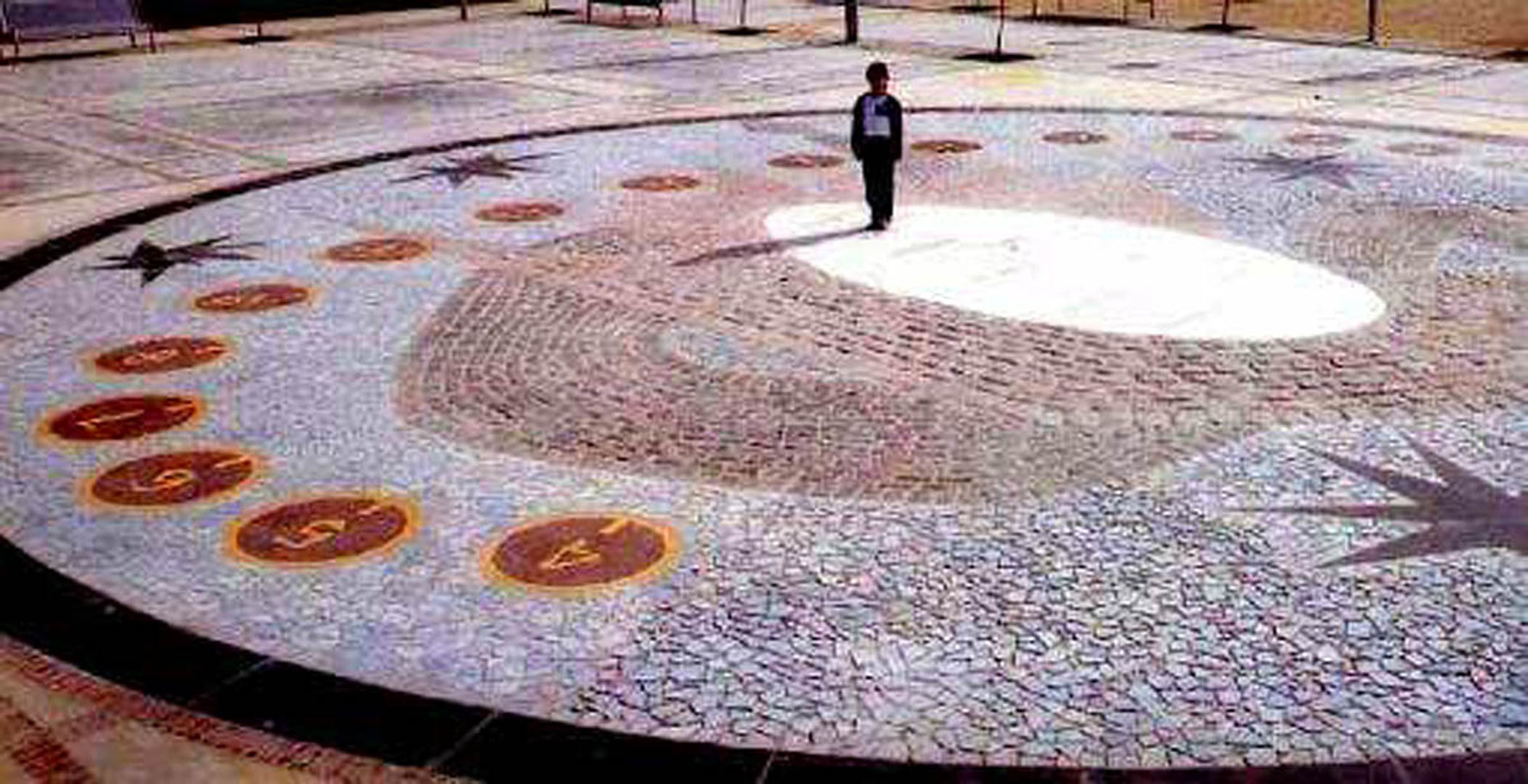
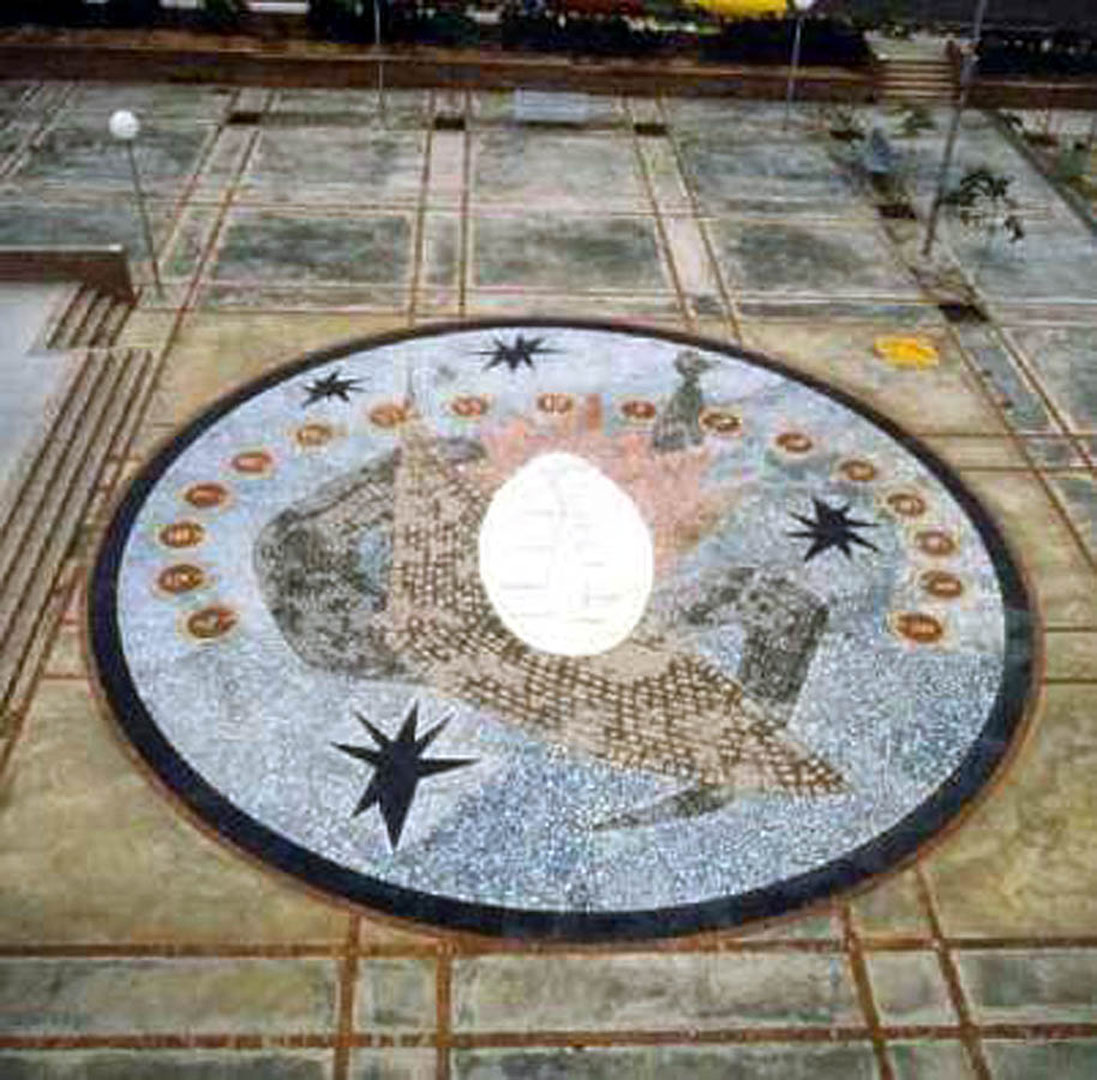
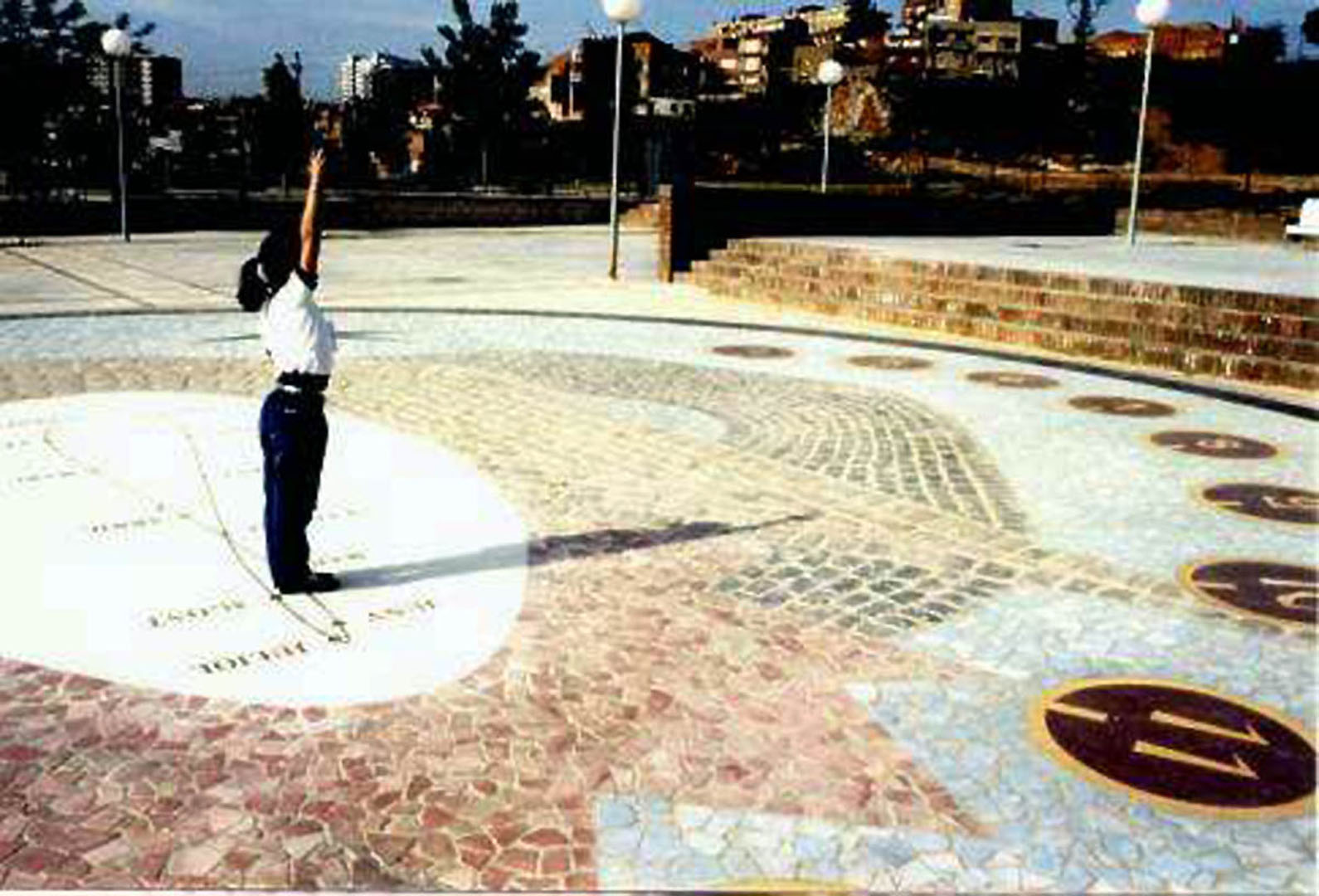
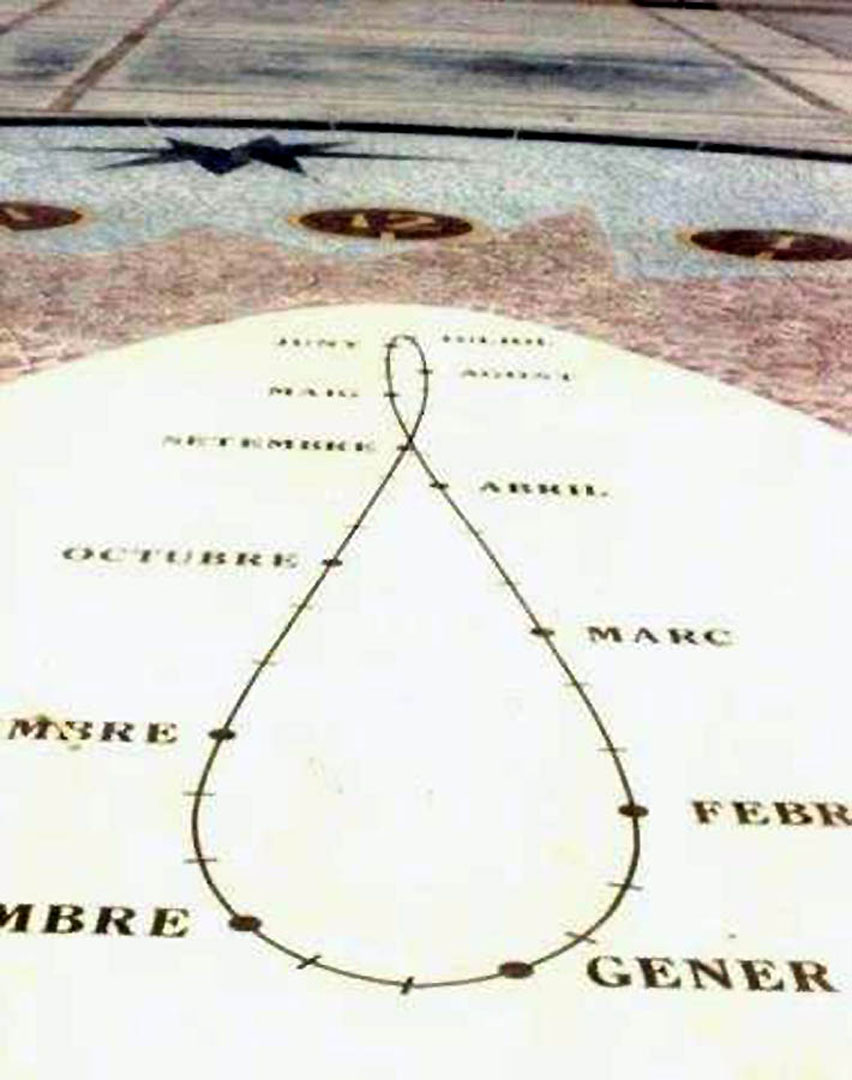
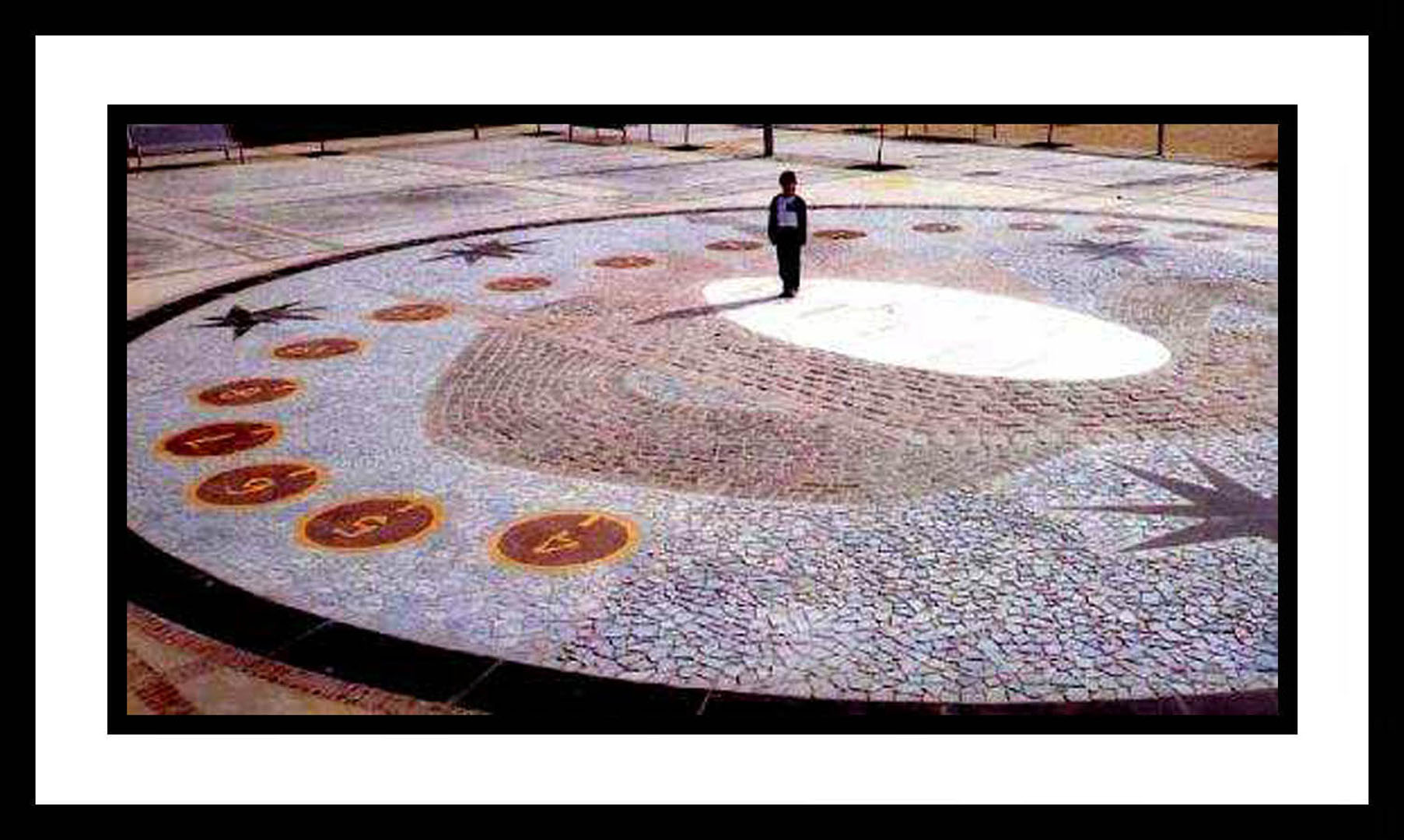
Designer & Maker: Eduard Farré Date: 1986 Original Location: Lat: 41° 35’ N; Lon: - 2° 07’ E. Plaça Primer de Maig, Sabadell Catolonia Spain Present Location: at original location Orientation: horizontal analemmatic human sundial Size: Ellipse measures 12 x 8 (39 x 26 ft) Adornment: Numbers, inscription and analemma are inlayed brass. Background has large blue stars and other impressionistic artistic designs made from different types of stone inlays. Mottos: none Inscriptions: months on analemma are in the Catalan language. Condition: unknown Comments: This is a large beautiful human interactive sundial that was intended to use the shadow cast by a human to tell time. Unfortunately, it is gnomonically flawed in two ways. It incorrectly has an analemma instead of a straight date line. Also, it’s so large that the user’s shadow is far too short to reach the hour markers. This otherwise beautiful mosaic dial must have cost a lot of money to build so it really is unfortunate that it suffers from these two common analemmatic sundial design errors. Members.aon Website: Here Analematic Website: Here Photo Descriptions: Photos were copied from websites above. Photos: a b c d |
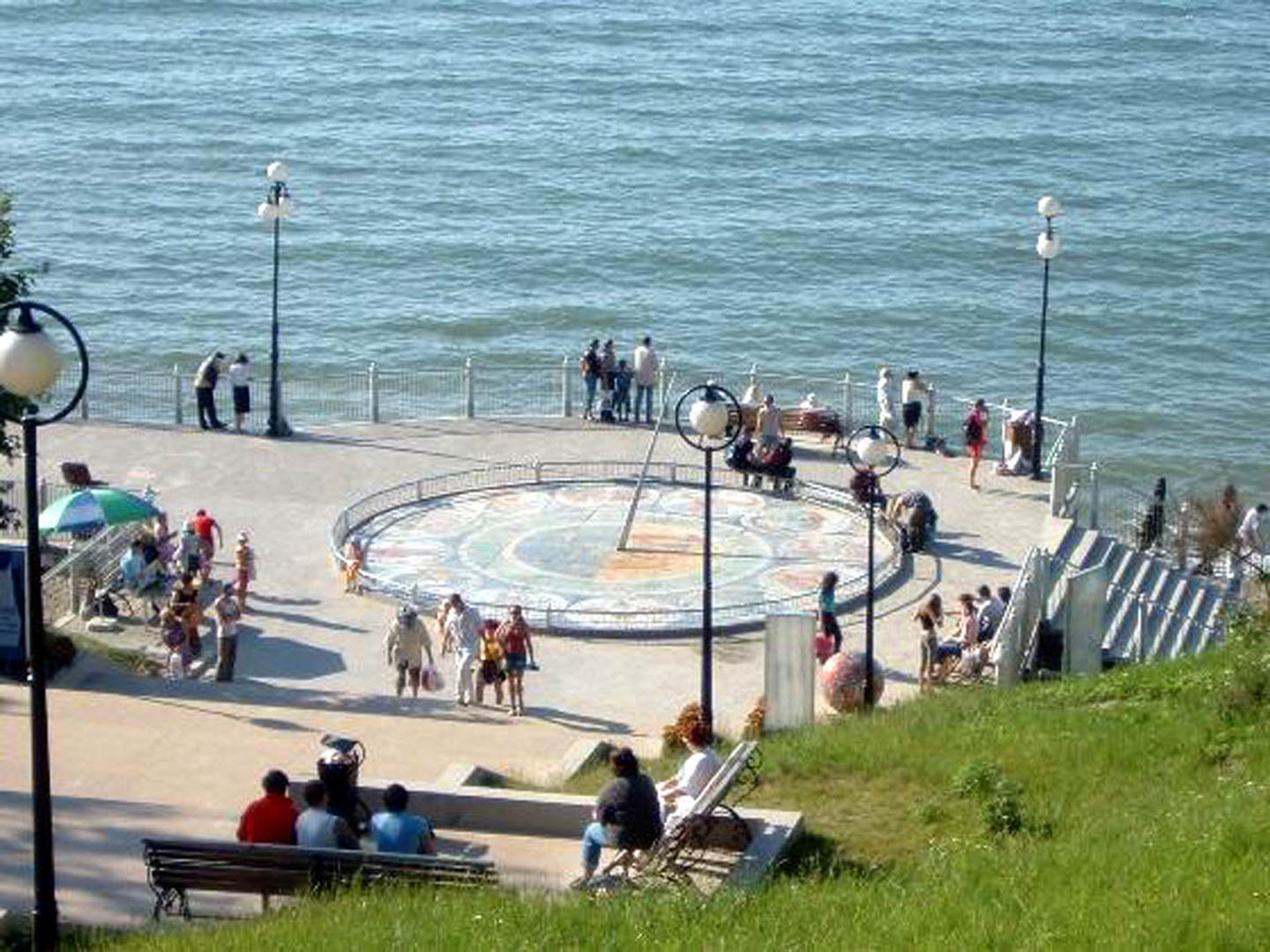
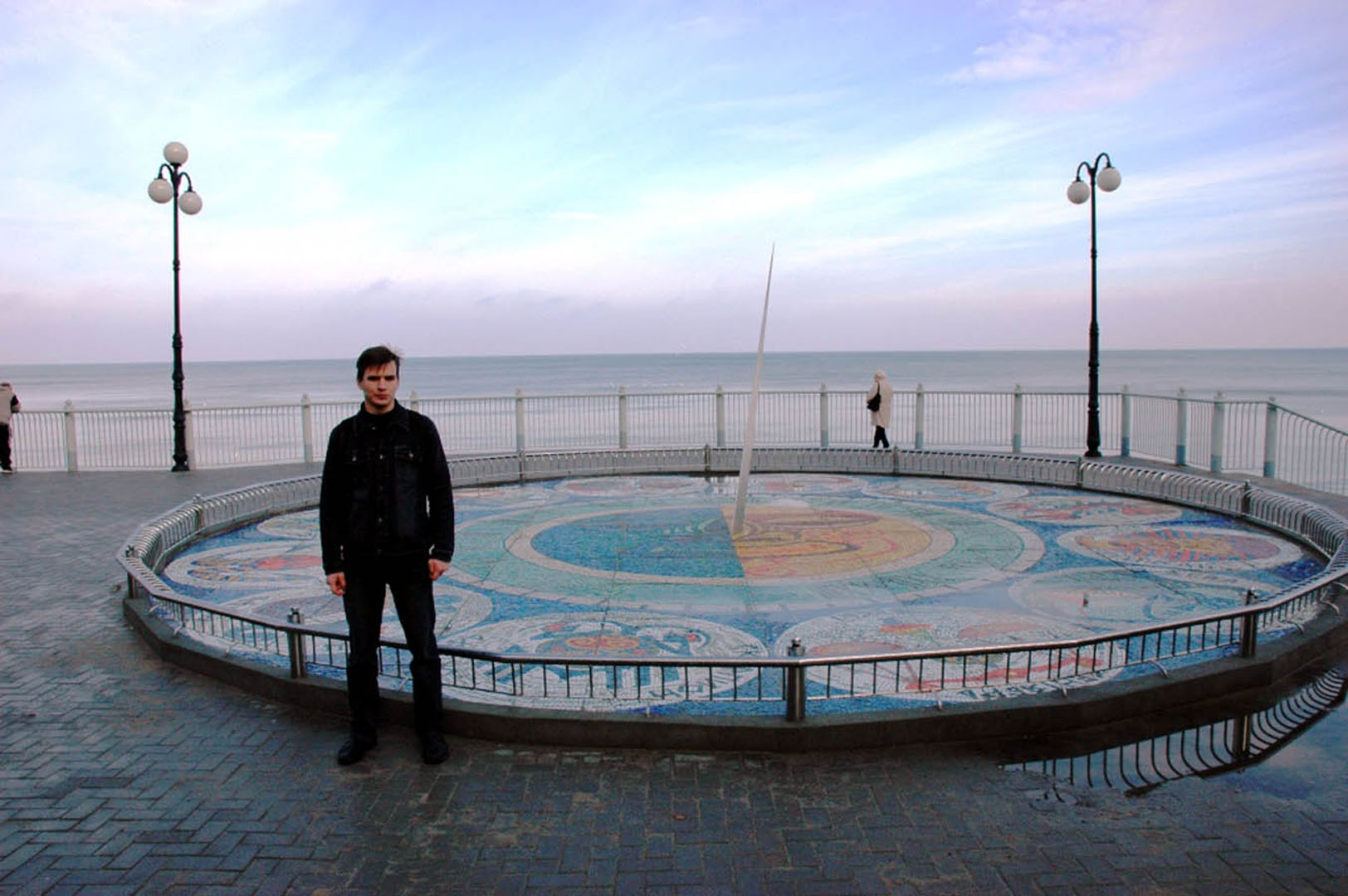
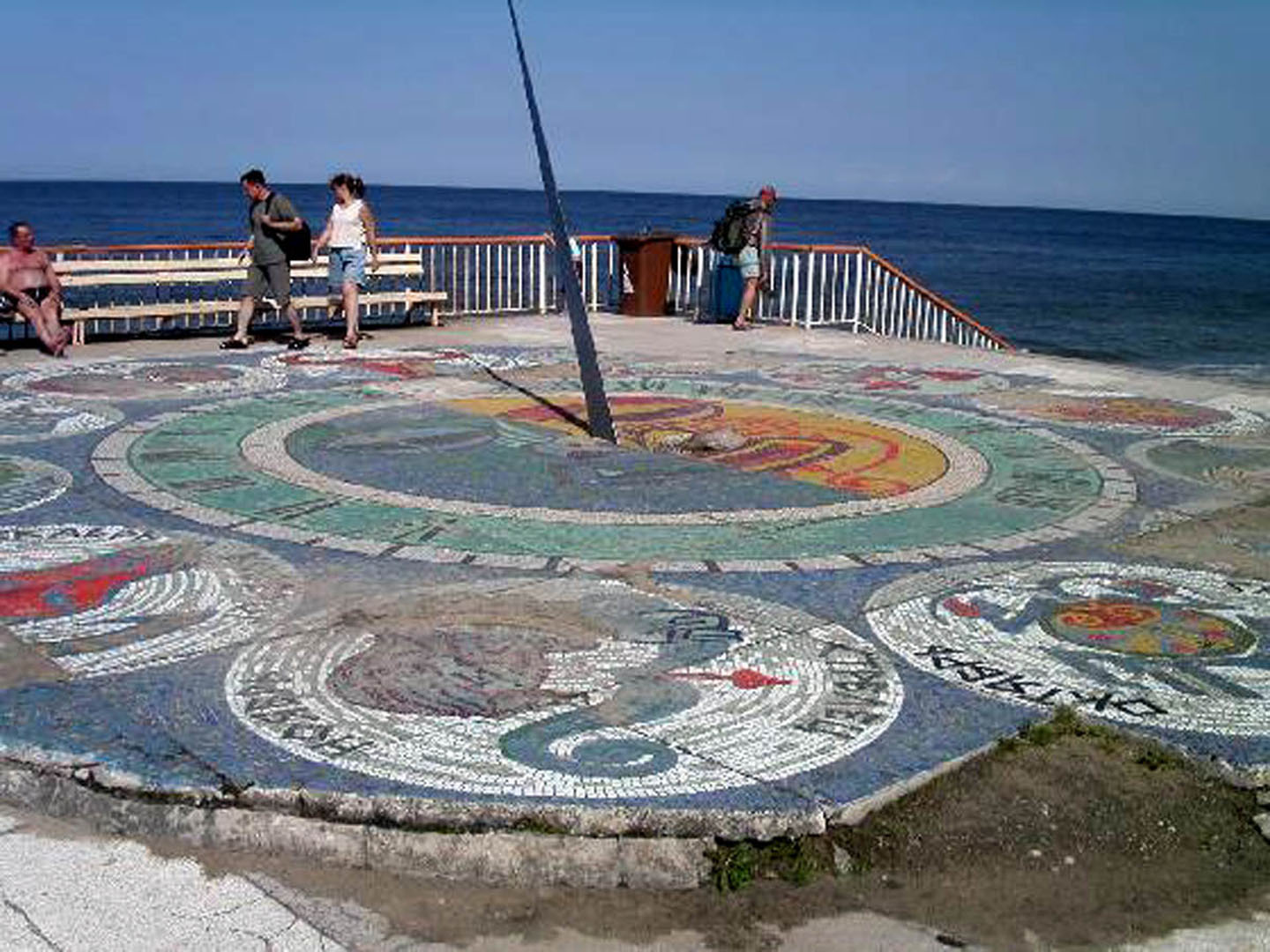
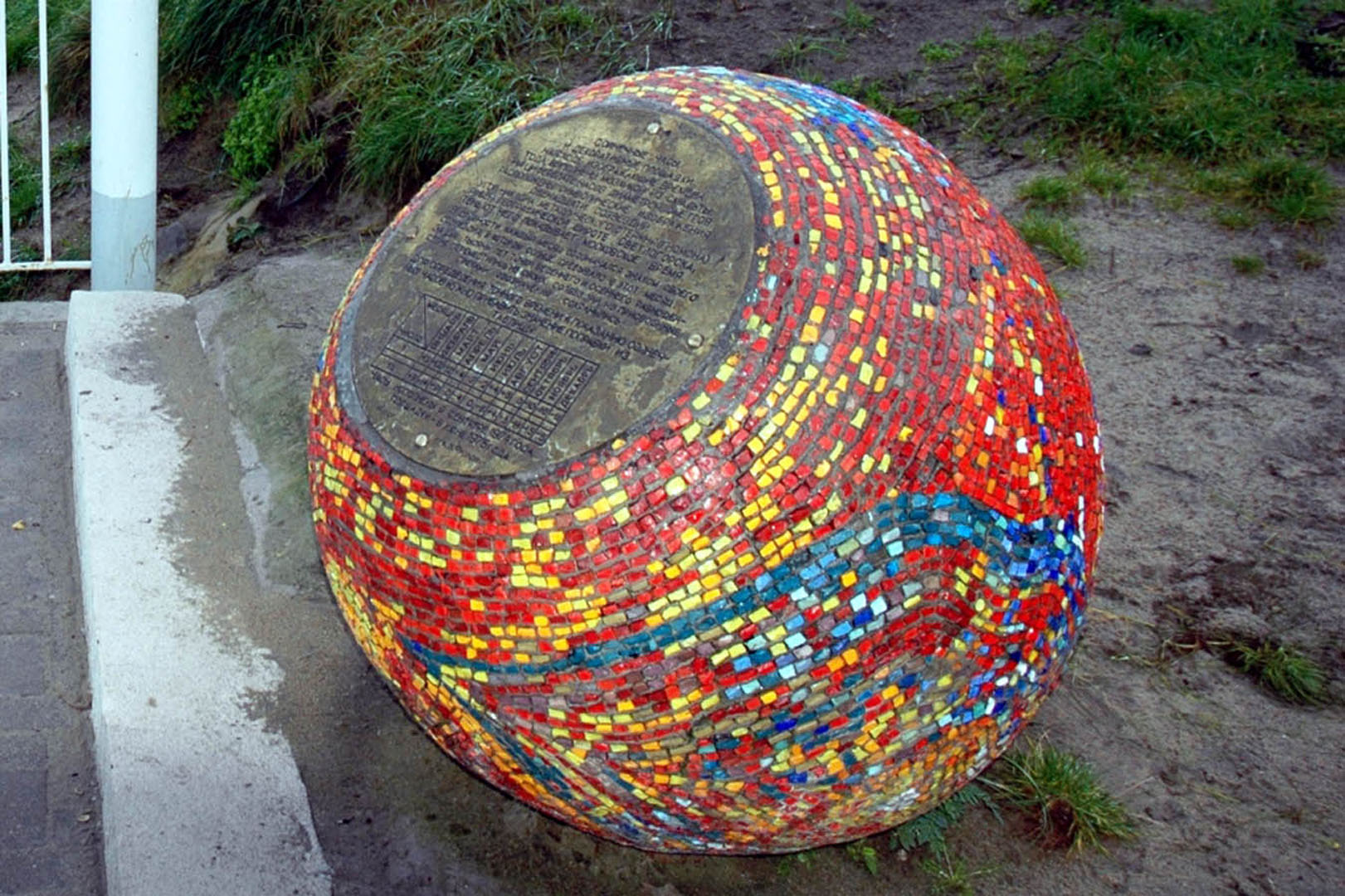
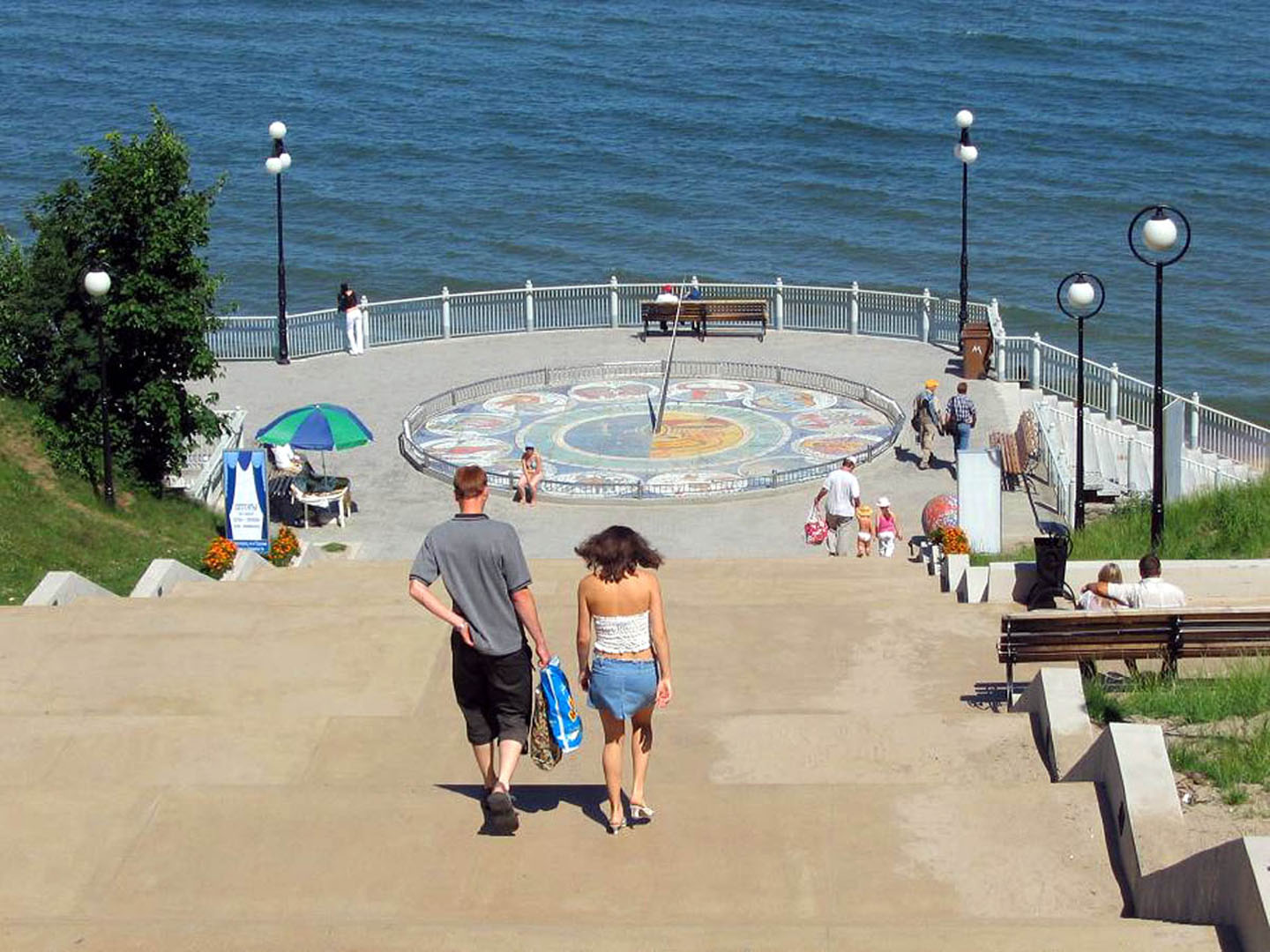
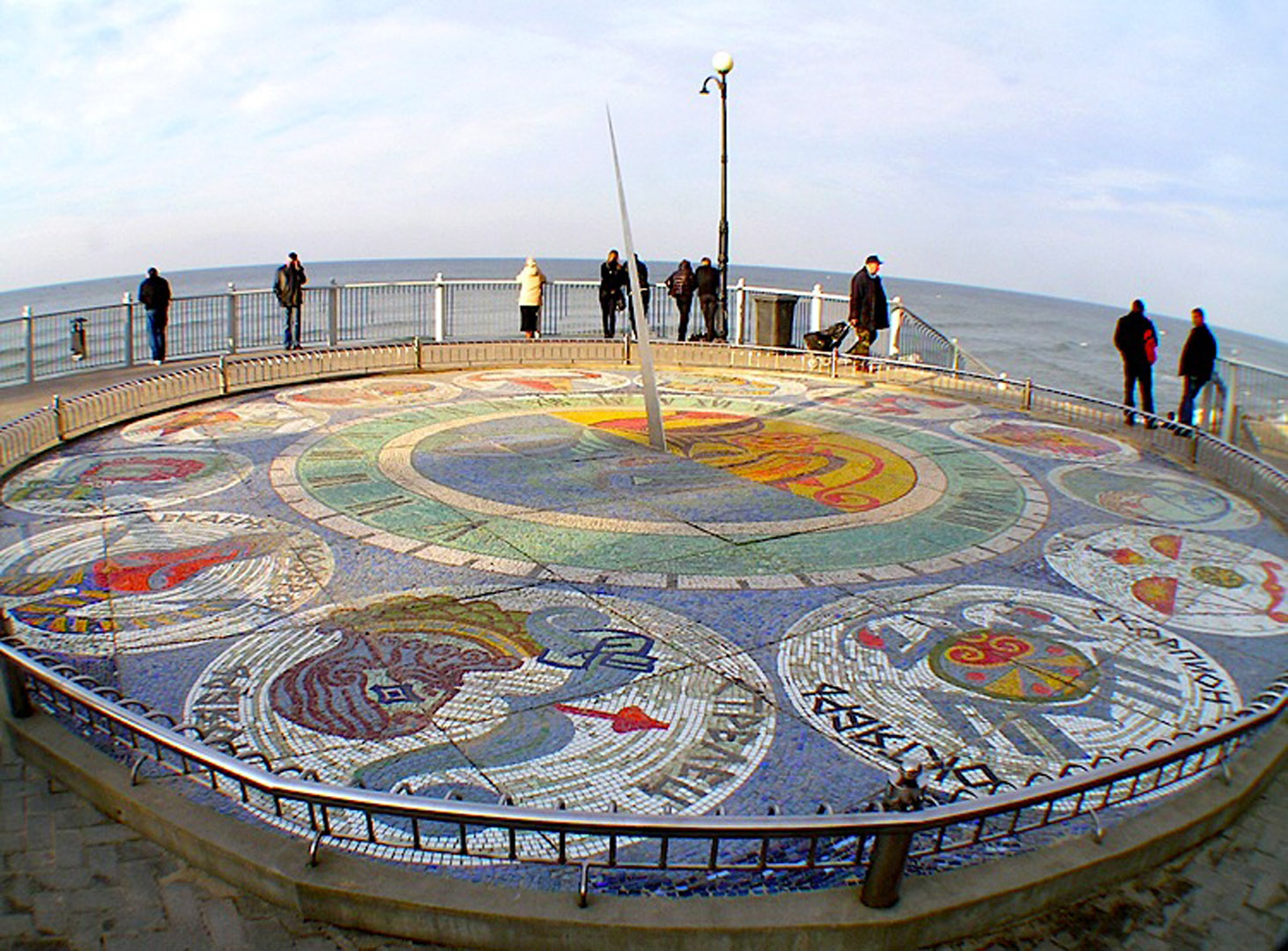
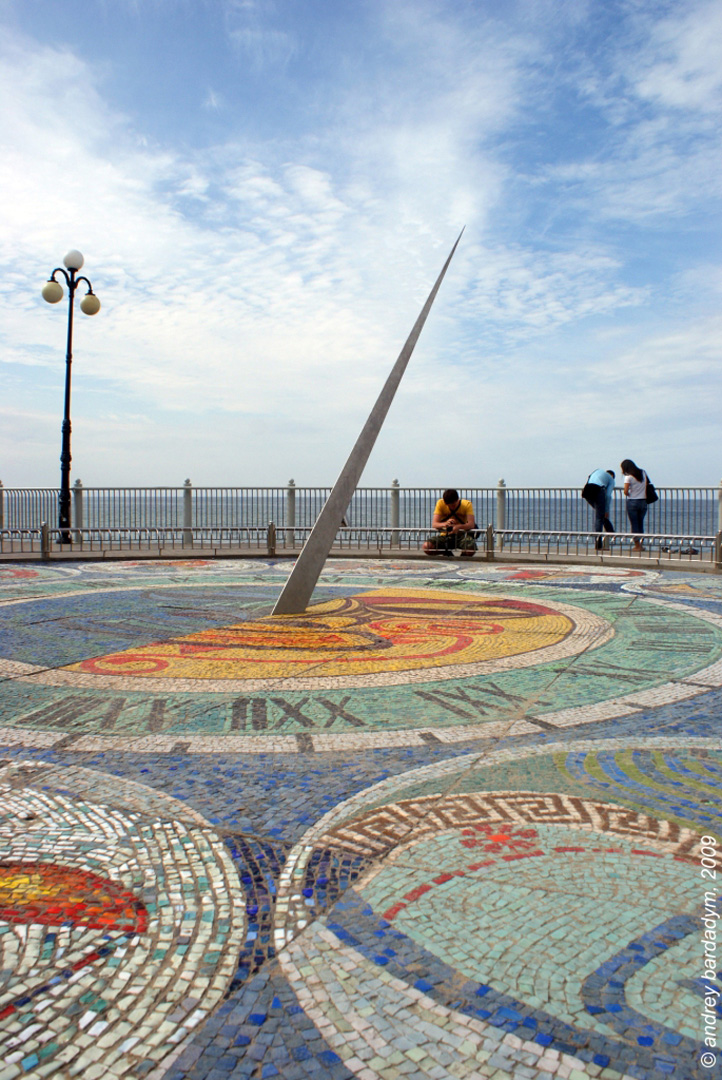
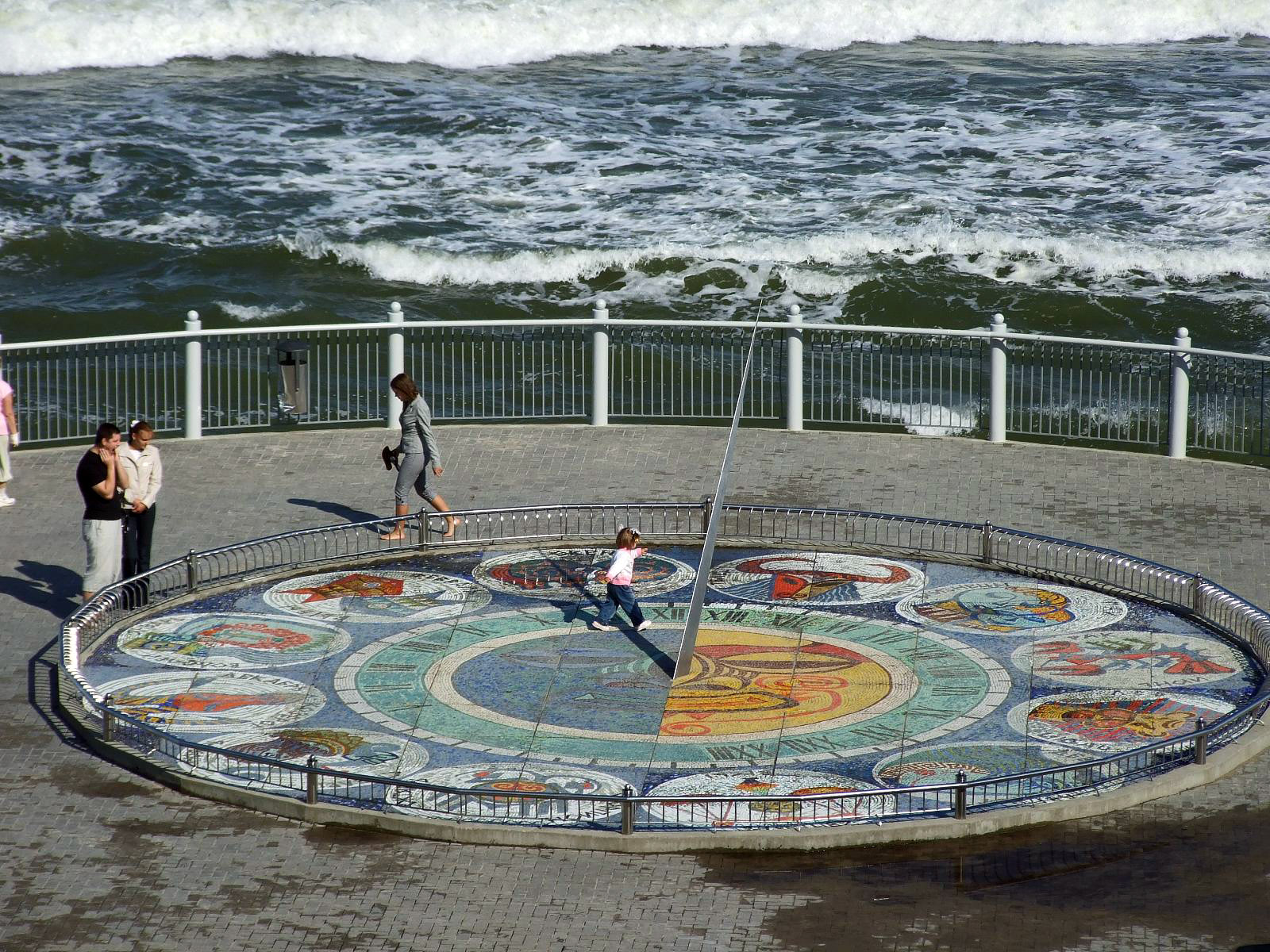
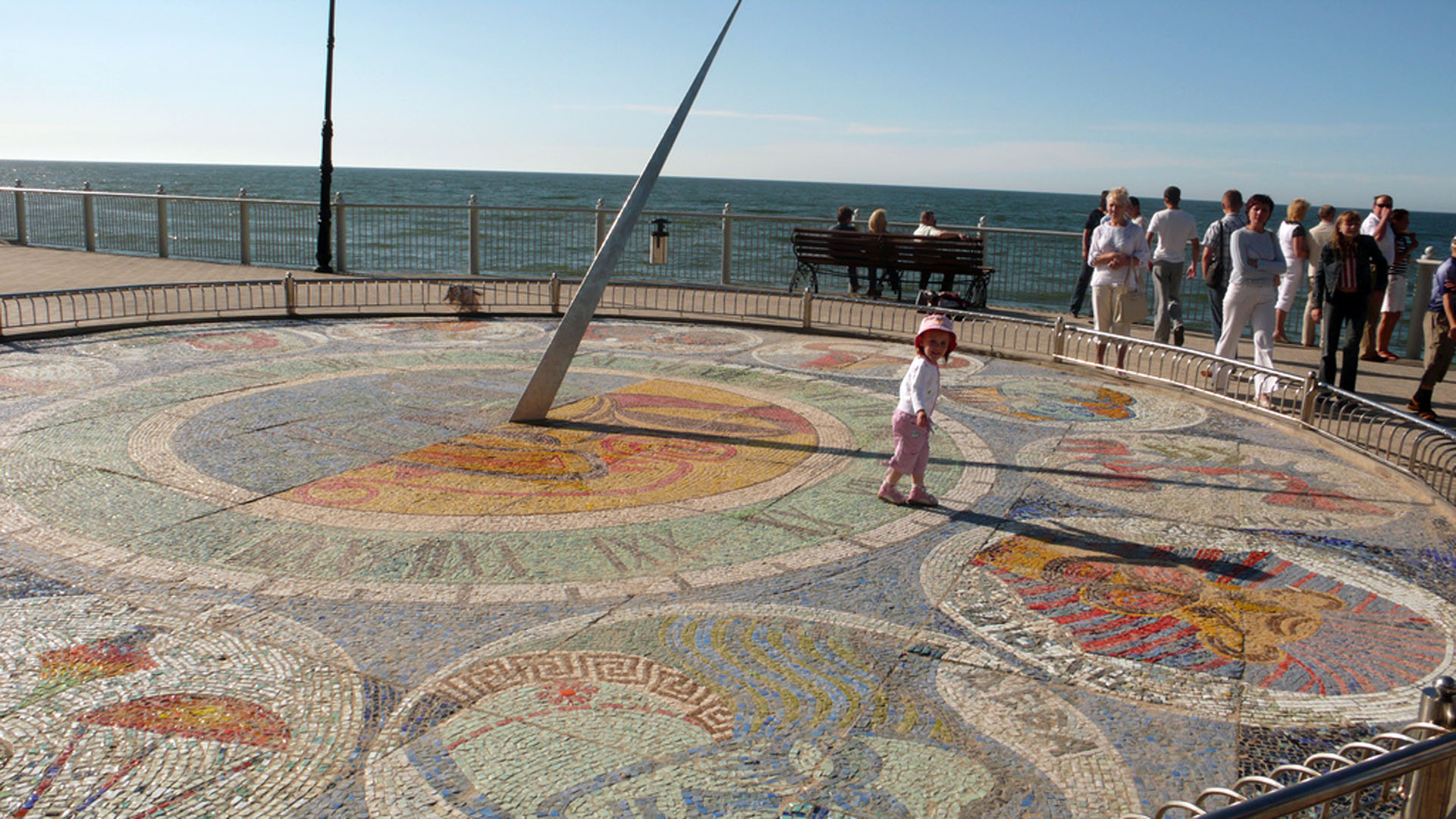
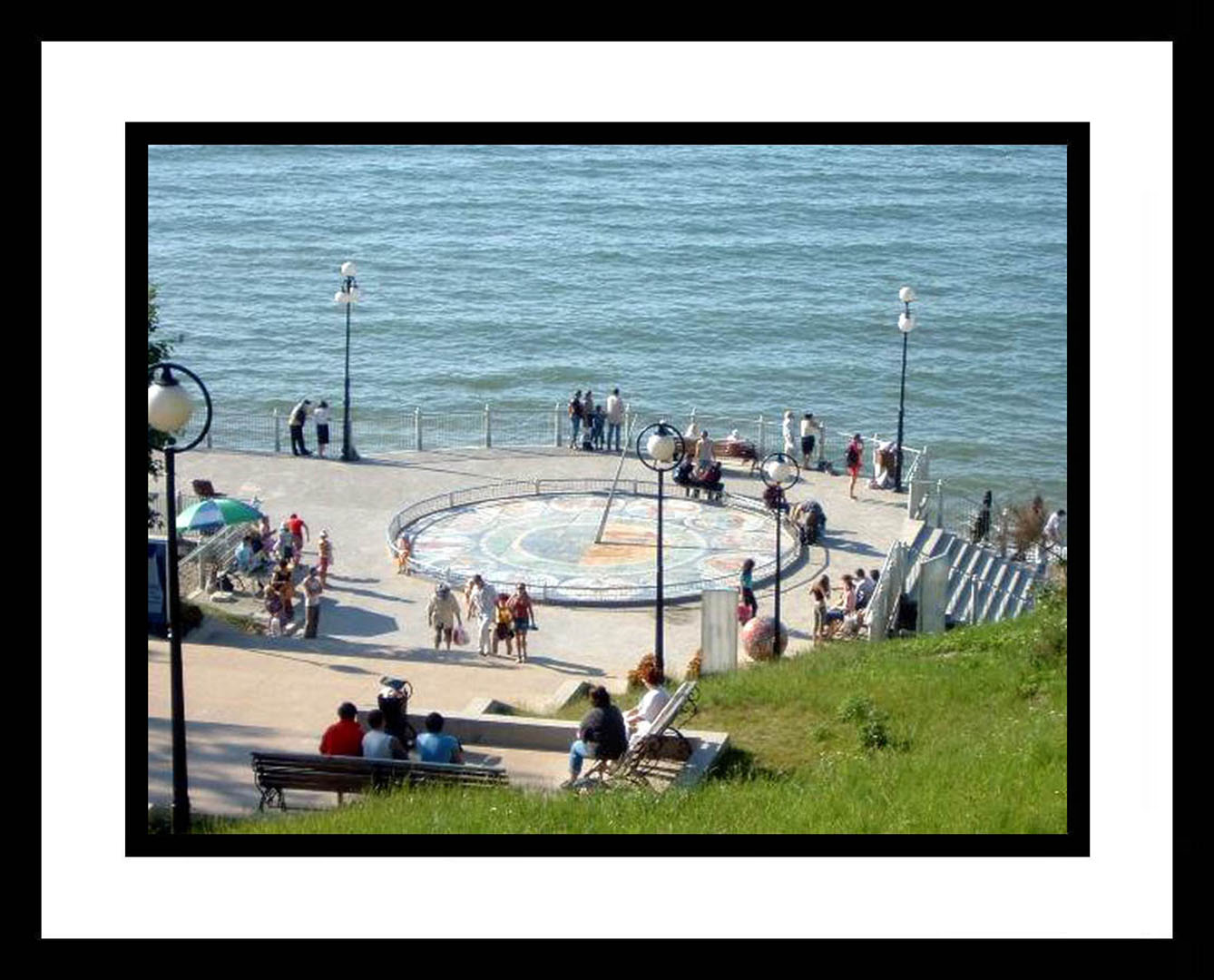
Delineator: unknown Artisan: unknown Date: original construction date is unknown for sure, but was probably in 1973 Original Location: Lat: 54.94609° N; Lon: 20.15158° E. In Svetlogorsk Russia Present Location: at original location Orientation: Horizontal Size: diameter-10 m (33 ft) Adornment: Complex and intricate modern design with the zodiacal signs Mottos: unknown Inscriptions: unknown Condition: An old photo (Photo ‘d’), taken at an unknown date, shows the dial as being nearly destroyed with many of the ceramic tiles missing and crumbling away. Aleksandr Boldyrev says that he saw the dial in 2000 and it was nearly destroyed. He saw it again in 2006 and photographed it (Photo ‘b’). The new photo shows the restored and repaired dial with a new fence around it implying that the dial was restored sometime between 2000 and 2006. Comments: In 1973 a new promenade and staircases with 265 steps were built to the Baltic Sea. The difference in height between bottom and top steps is 35.6 meters. The descent leads directly to the sundial on the promenade. The dial is a colorful puzzle. In its center is a gnomon the shadow of which shows the time. The gnomon is oriented for the Pole Star and is placed at an angle of 55 degrees (the latitude of Svetlogorsk). We need better photos that show the design of the face. And we need more information about this sundial. Virtualtourist Website: Here Redingo Website: Here mooseonthemove’s Flickr Website: Here Andrey Bardadym’s Flickr Website: Here Therkd’s Flickr Website: Here art_pi’s Flickr Website: Here Olga Zvereva’s Flickr Website: Here Aleksandr Boldyrev’s Email: Here Photo Descriptions: Photo ‘d’ shows pre-restoration. Others are post-restoration. Photo ‘b’ was sent to us by Aleksandr Boldyrev. Photos ‘a’, ‘c’, ‘d’, ‘e’, ‘f’, ‘g’ were copied with permission from websites above. Photo ‘g’ was taken by Andrey Bardadym © All rights reserved. We have his permission to post it. Photo ‘h’ was taken by THERKD © All rights reserved. We have his permission to post it. Photo ‘i’ is by art_pi © All rights reserved, and is used with permission. Photos: a b c d e f g h i |
 |
 |
 |
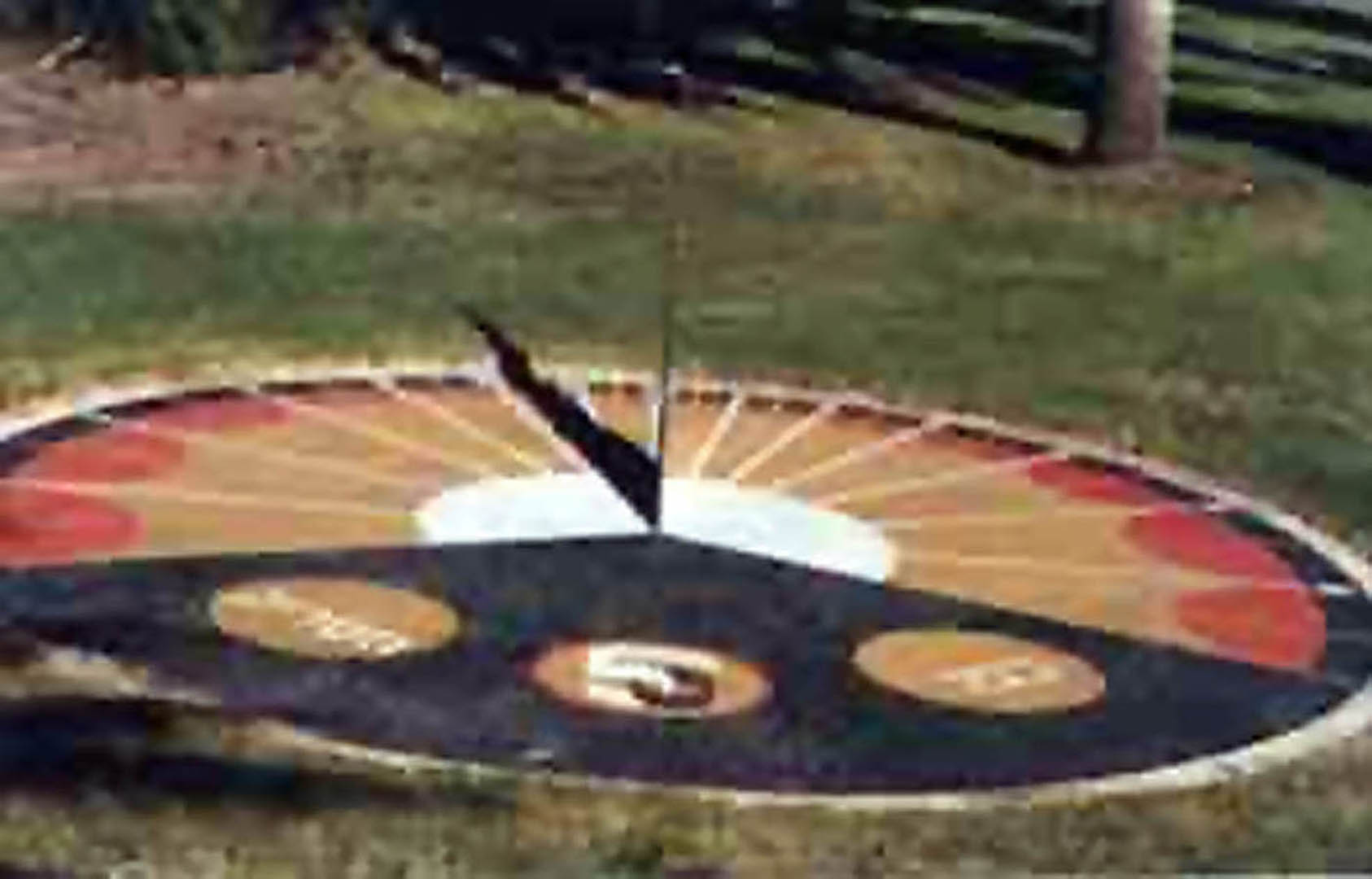
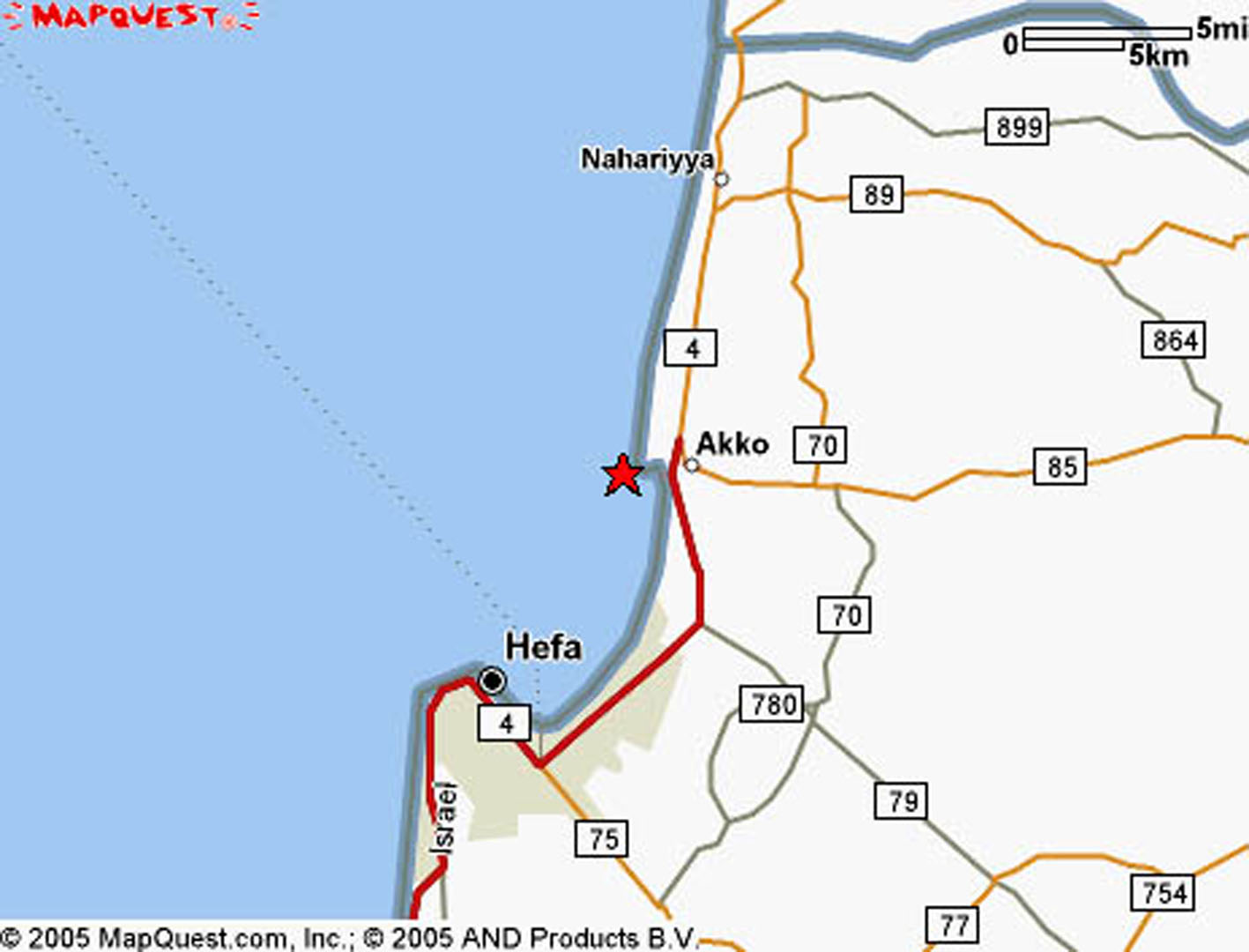
| Designer: unknown Maker: unknown Delineator: unknown Date: unknown Original Location: Lat: 32.9° N; Lon: 35.1° E. on the lawn next to the dininghall entrance, near a pedestrian pass way (about 50 meters, or so, from the dining hall building) in a Kibbutz - "Kfar Masaryk", just south of Akko, Israel. Present Location: at original location Orientation: Horizontal Size: unknown, but large. Adornment: unknown. Not clear in this photo. Mottos: unknown Inscriptions: has inscription that means: "50th (anniversary) of Kfar Massarik". Condition: unknown Comments: Information is from website below. This is a beautiful colorful mosaic sundial with thin triangular sheet gnomon. We are looking for better photos of this dial. The Israel sundial trail Website: Here Kfar Masaryk Website: Here Photo Descriptions: Photo ‘a’ is copied from website above. Photo ‘b is map of Kfar Masaryk. Photos: a b |
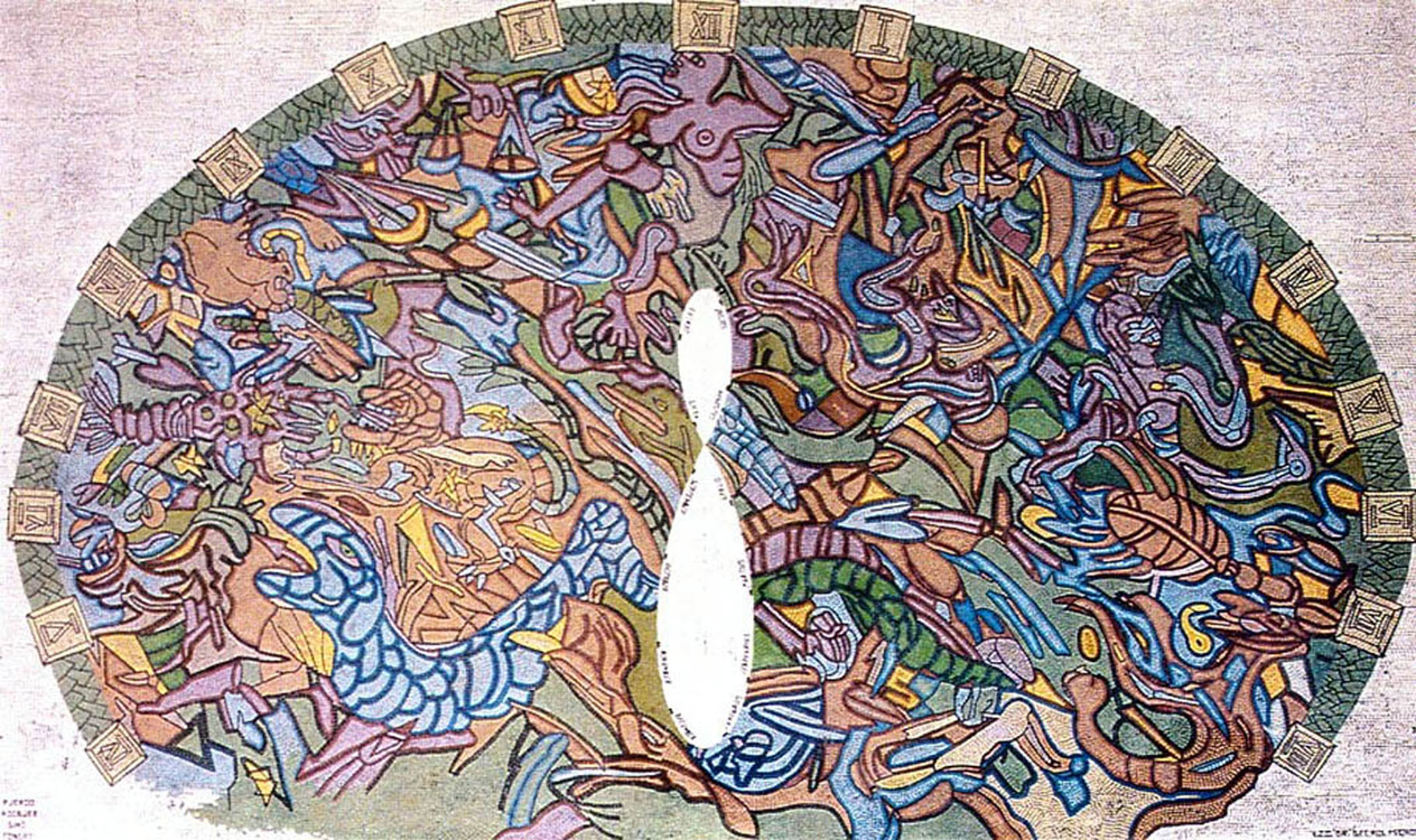
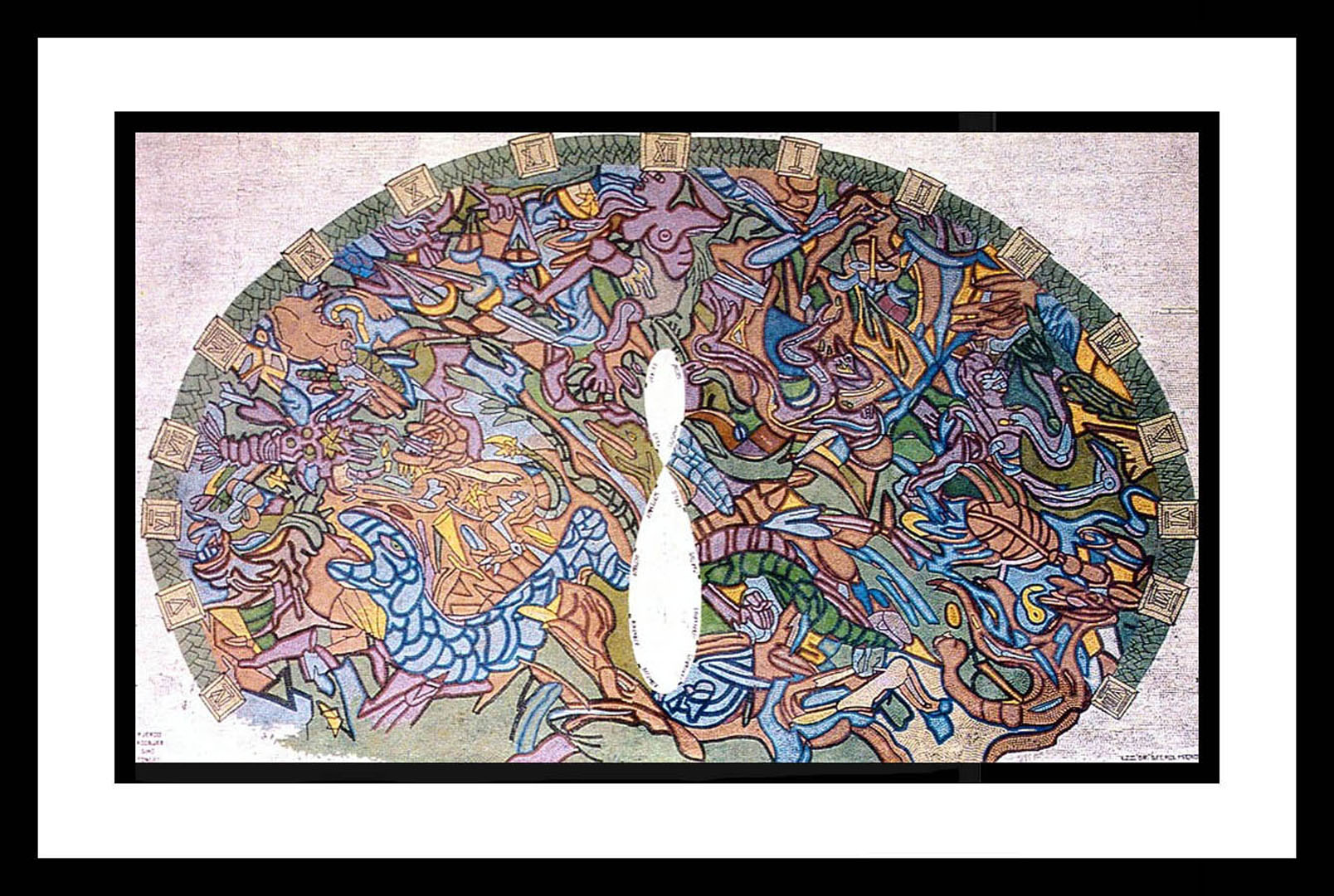
Designer: Pjeroo Robjee Construction: Gino Tondat Date: 1984 Original Location: Lat: 50.7°N, Lon: 3.6° E, Municipal Library in Ronse, Belgium Present Location: at original location Orientation: Horizontal Size: The major axis of the elliptical-shaped dial is about 7 m (23 ft). Adornment: The grotesque figures in the mosaic are mostly inspired by the signs of the zodiac: crab near the number VII, scales between X and XI, the virgin at noon, Aquarius between III and V, scorpion next to the VII at right. Quadrupeds (ram, bull, lion, goat?) dwell between IV and V at left, one next to the crab, and at right between VII and VIII. Can't find the archer or twins. Monster at the lower left may be a fish? Contributions are welcome! Mottos: none Condition: unknown Comments: a beautiful glass mosaic analemmatic dial inspired by the Dr. Ovide Decroly School. They consider this object as an educational-didactical concept. Hour points from IV to VIII local time with an analemma drawn around date line with the names of the months alongside written in Latin: JANUARIUS, FEBRUARIUS, MARTIUS, APRILIS, MAIUS, JUNIUS, JULIUS, AUGUSTUS, SEPTEMBER, OCTOBER, NOVEMBER, DECEMBER. It uses a human standing on the date to cast a shadow that indicates the time. Unfortunately, this is a flawed design since the dial should have a straight date line instead of an analemma. This causes errors in the time readings. Frans Maes Website: Here Gino Tondat Website: Here Stadt Ronse Website: Here Photo Descriptions: I’ve forgotten where this photo came from. My apologies to the photographer. j.c. Photos: a |
Designer & Maker: unknown Date: probably 2000 Original Location: Lat: 35° 15' S; Lon: 174° 7' E. In the Thousand Islands region at a beautiful location on Maiki Hill, Russell (Kororareka), Bay of Islands, New Zealand. Present Location: at original location Orientation: Horizontal Size: unknown exactly, but very large. The gnomon is about 6 feet tall. Adornment: unknown. The design is not clearly visible in these photos, but it looks like a map is depicted on the dial face. Mottos: unknown Inscriptions: unknown Condition: Looks like some of the mosaic tiles might be missing, but it’s difficult to tell for sure from these photos. Comments: This is the centennial sundial for The New Zealand Institute of Surveyors. We are looking for more information and better photos of this nice dial. Russell Website: Here Survey and Planning Website: Here Bill Hetzel’s Email: Here Photo Descriptions: Photos ‘a’ and ‘b’ are © Kim Kavin from Power and Motoryacht website (page not available anymore). Photo ‘a’ shows Yacht Charter broker Barbara Stork examining it in Russell in publicity photos. Photo ‘c’ is courtesy of Bill Hetzel who sent it to us in 2008. Photos: a b c |
 |
 |
 |
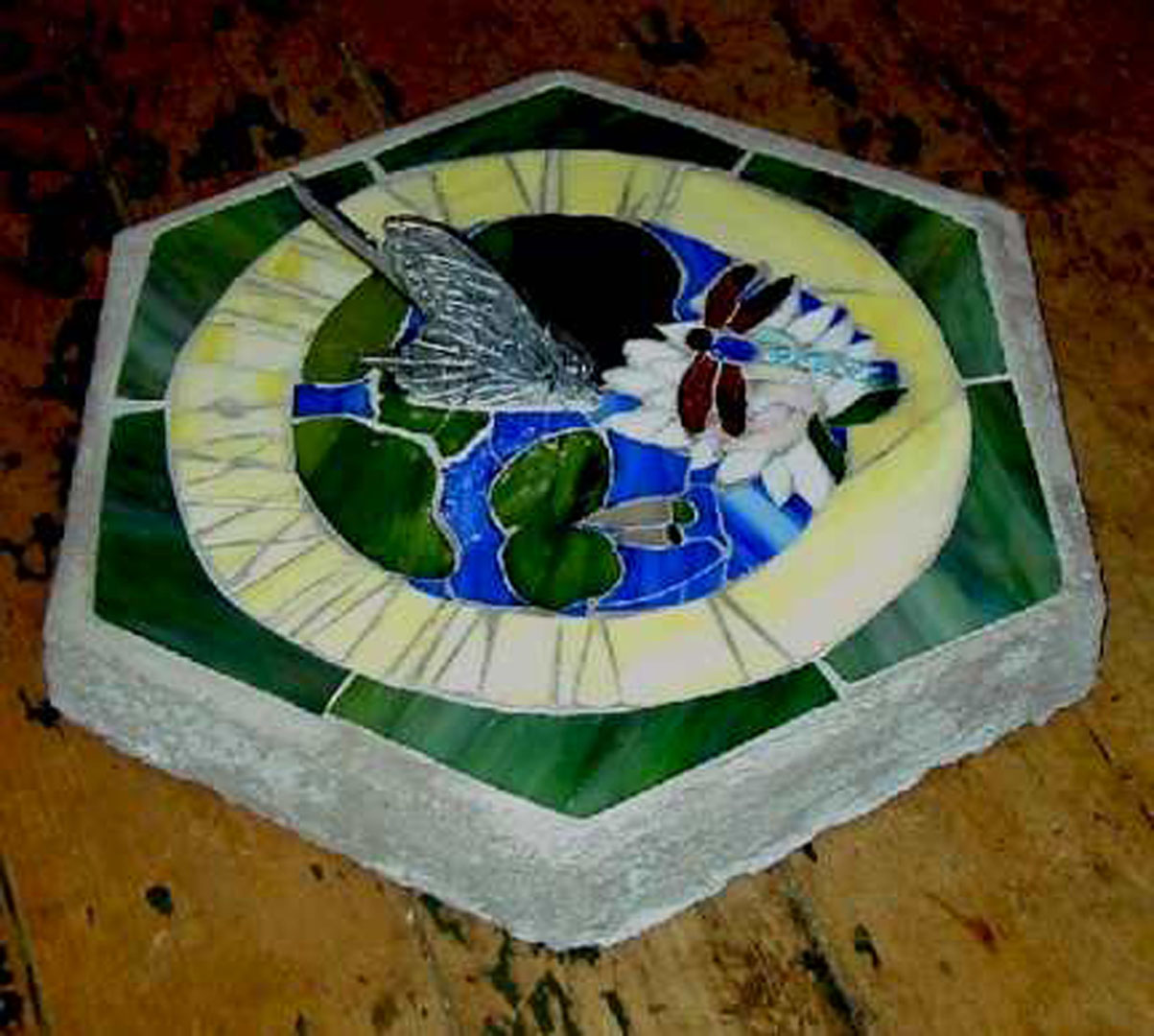
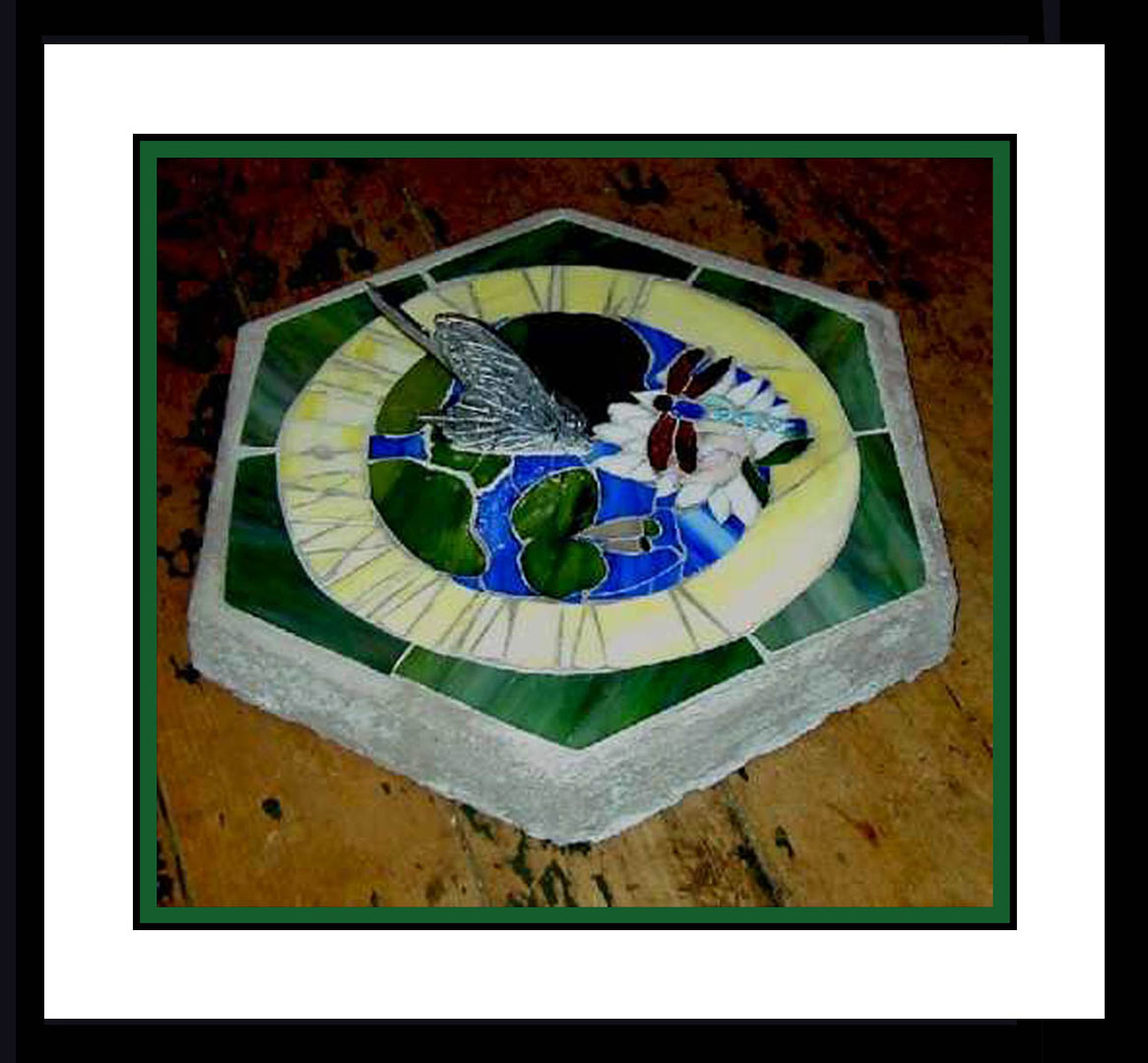
| Maker: Amy R. Handford Date: Late 1900's. early 2000's Original Location: St. Paul MN USA. This sundial is ornamental and not designed for any particular location. Present Location: unknown Orientation: Horizontal Size: unknown Adornment: dragonfly on flower Mottos: none Condition: unknown Comments: This is from a series of similar dials that Handford calls "stepping stone stained glass sundials". They are made from cast concrete with inlaid stained glass. They do not tell time precisely because the decorative gnomons have a nonlinear irregular shadow casting edge, and I doubt they were delineated correctly. j.c. Amy's Art Website: Here Photo Descriptions: Photo was copied from website above. Photos: a |
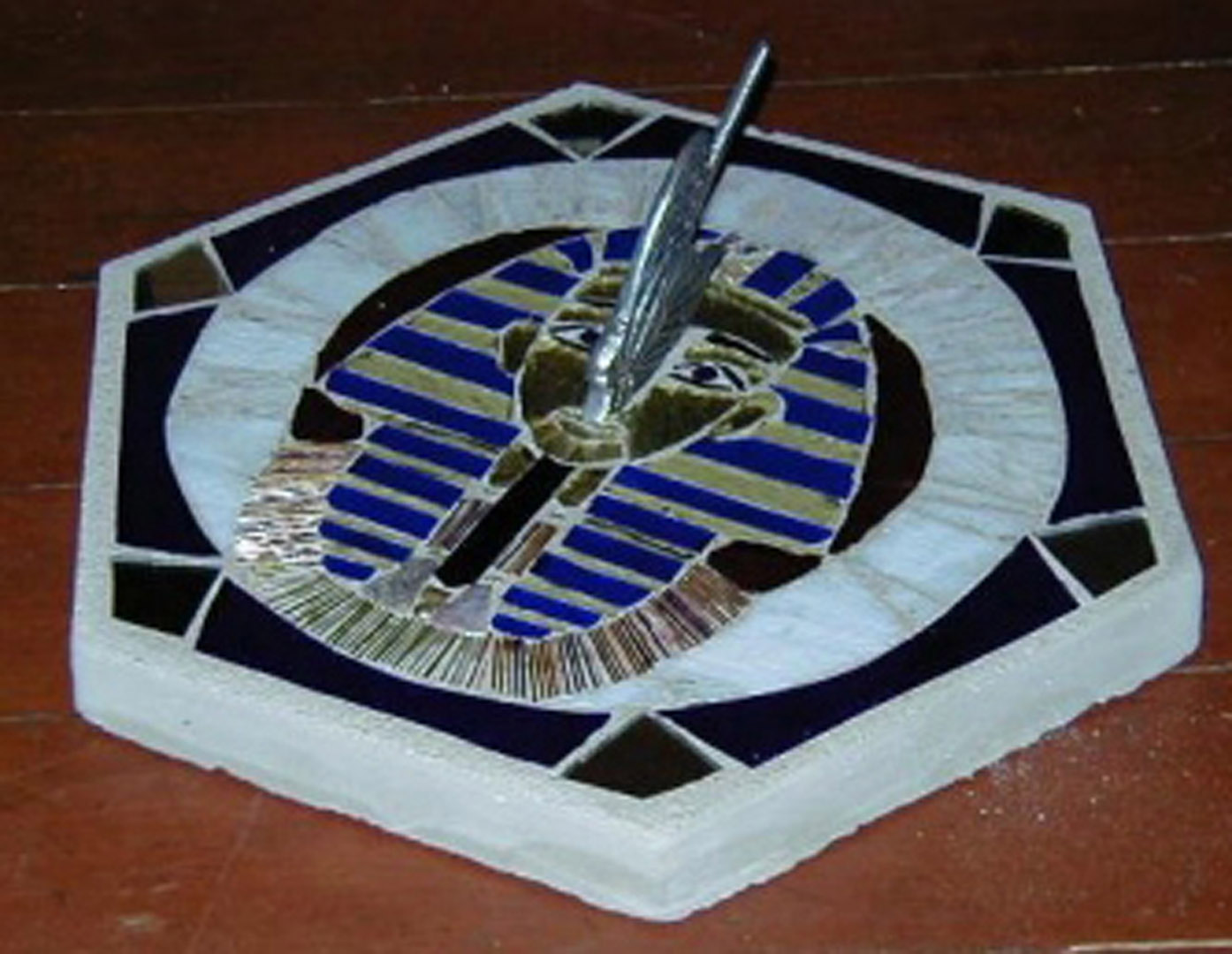
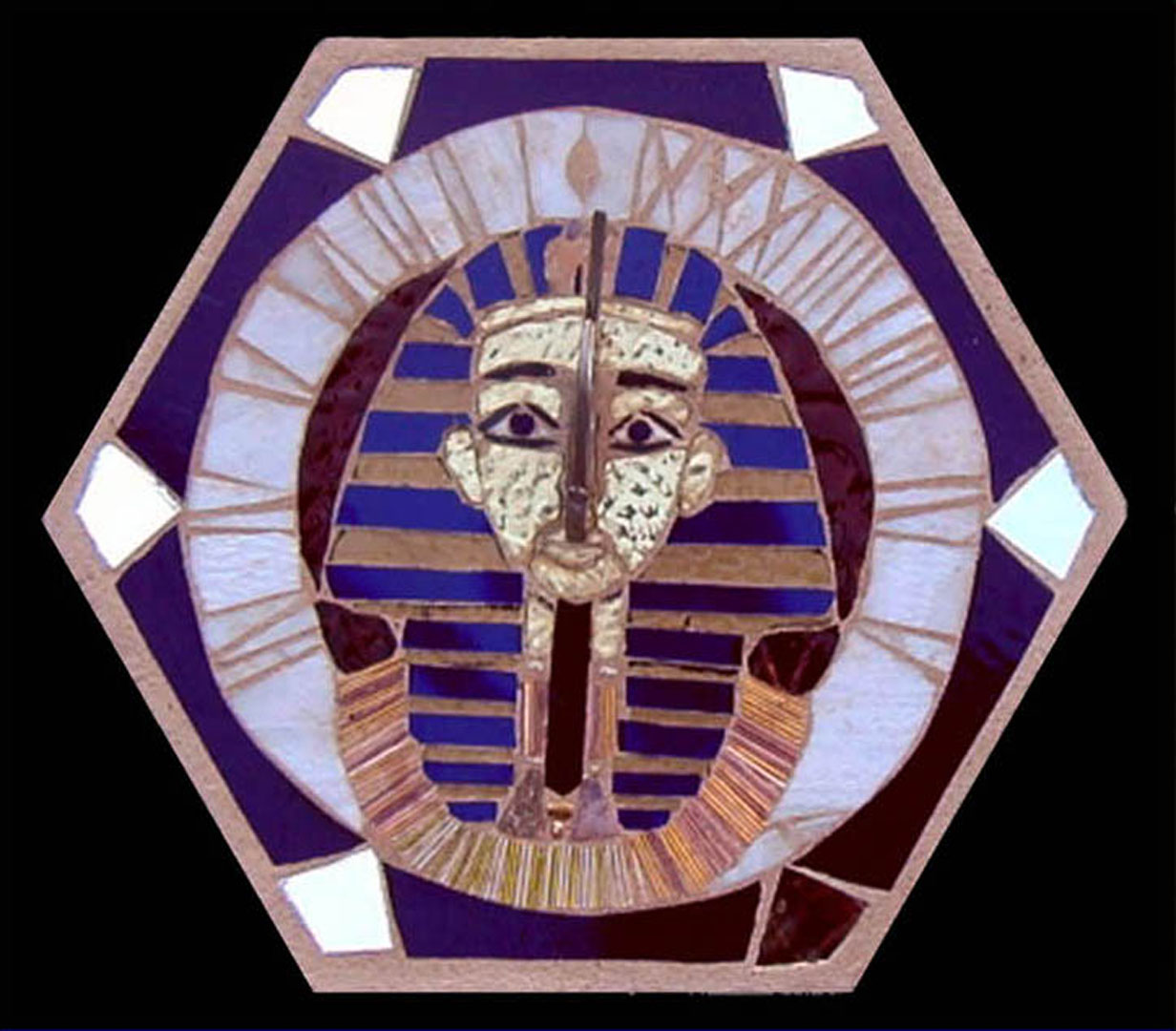
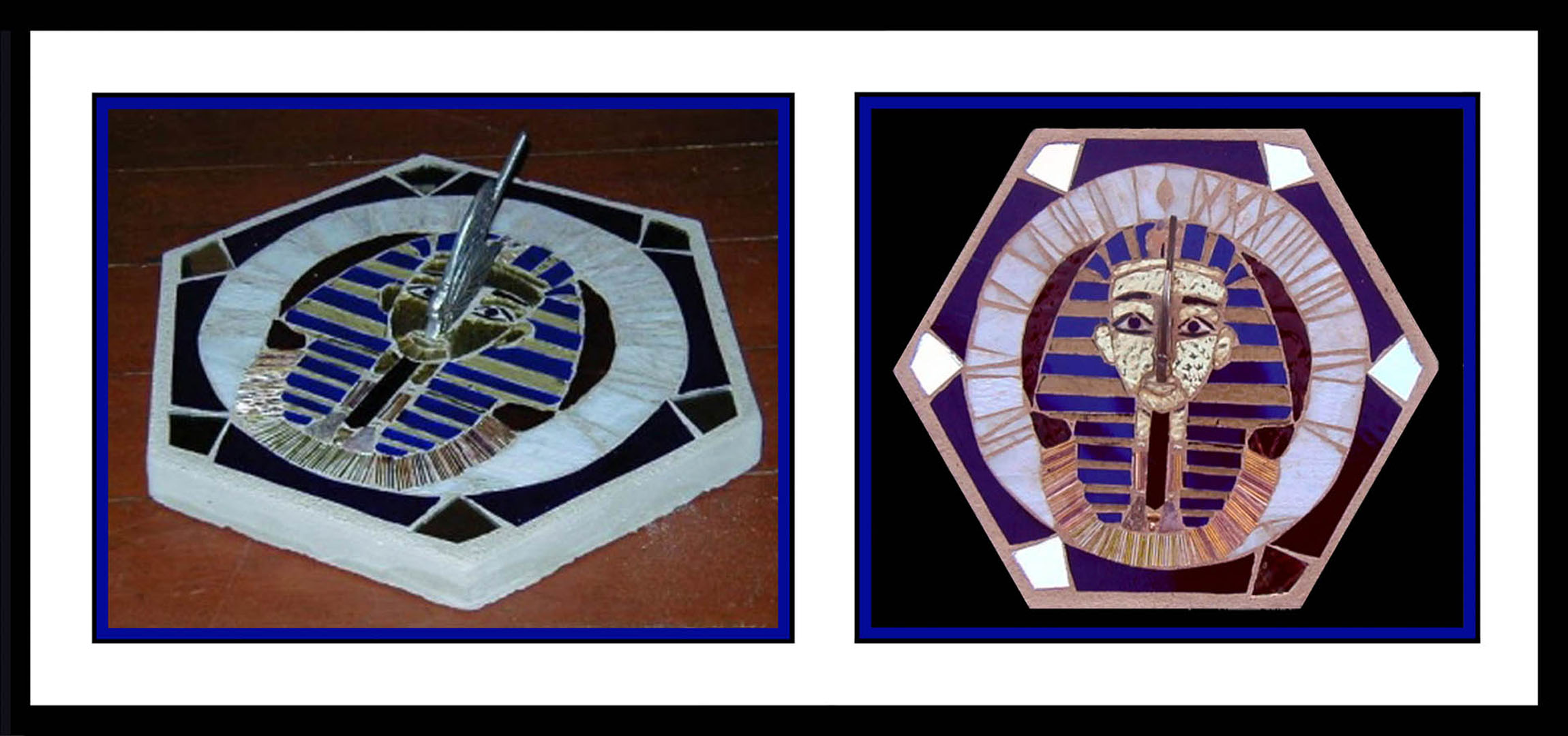
Maker: Amy R. Handford Date: Late 1900's. early 2000's Original Location: St. Paul MN USA. This sundial is ornamental and not designed for any particular location. Present Location: Dallas Texas Orientation: Horizontal Size: unknown Adornment: King Tut Mottos: none Condition: unknown Comments: This is from a series of similar dials that Handford calls "Stepping stone stained glass sundials". They are made from cast concrete with inlaid stained glass. They do not tell time precisely because the decorative gnomons have a nonlinear irregular shadow casting edge, and I doubt they were delineated correctly. j.c. Amy's Art Website: Here Photo Descriptions: Photos was copied from website above. Photos: a b |
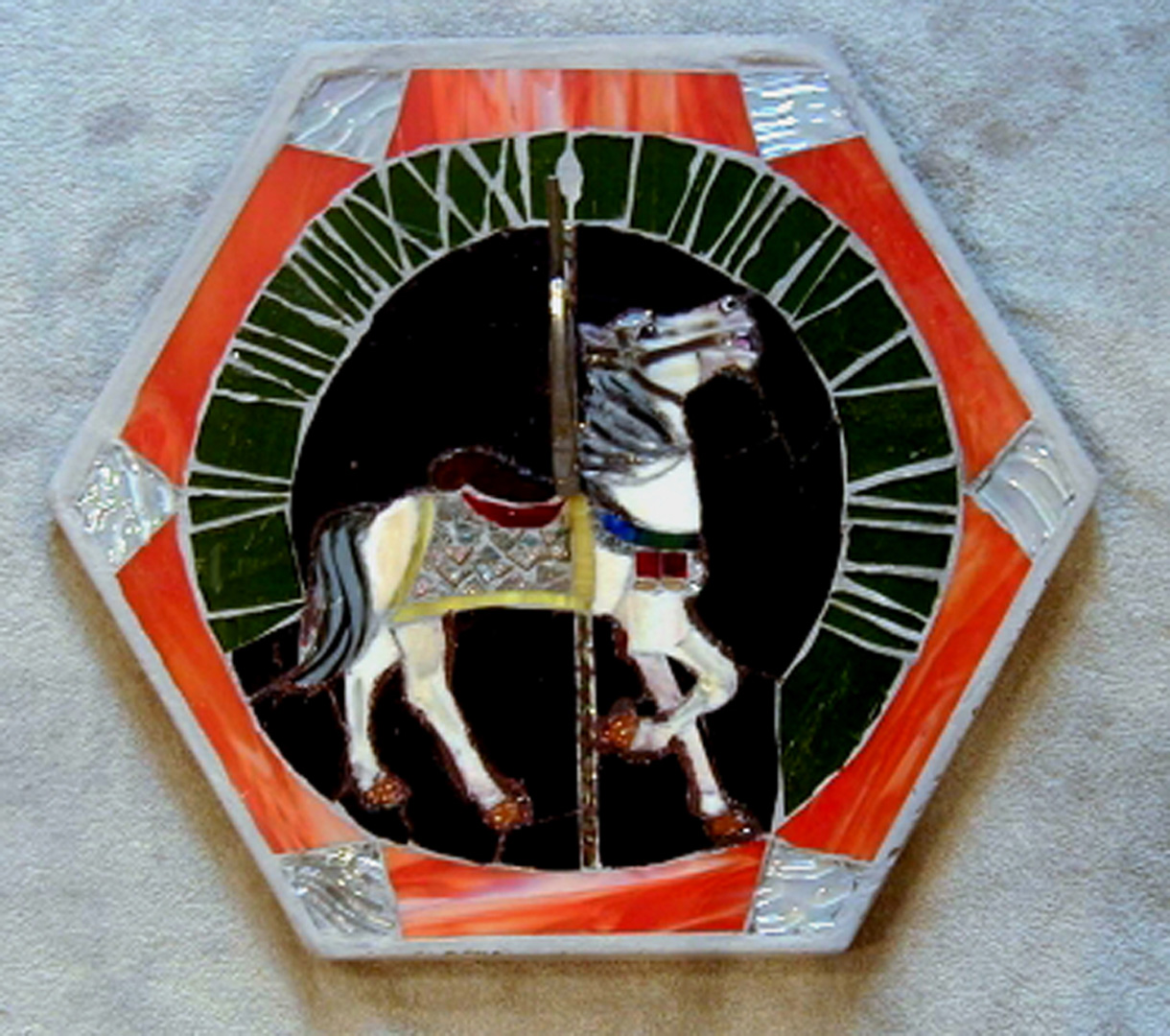
Maker: Amy R. Handford Date: Late 1900's. early 2000's Original Location: St. Paul MN USA. This sundial is ornamental and not designed for any particular location. Present Location: unknown Orientation: Horizontal Size: unknown Adornment: horse on carousel Mottos: none Condition: unknown Comments: This is from a series of similar dials that Handford calls "Stepping stone stained glass sundials". They are made from cast concrete with inlaid stained glass. They do not tell time precisely because the decorative gnomons have a nonlinear irregular shadow casting edge, and I doubt they were delineated correctly. j.c. Amy's Art Website: Here Photo Descriptions: Photo was copied from website above. Photos: a |
 |
||
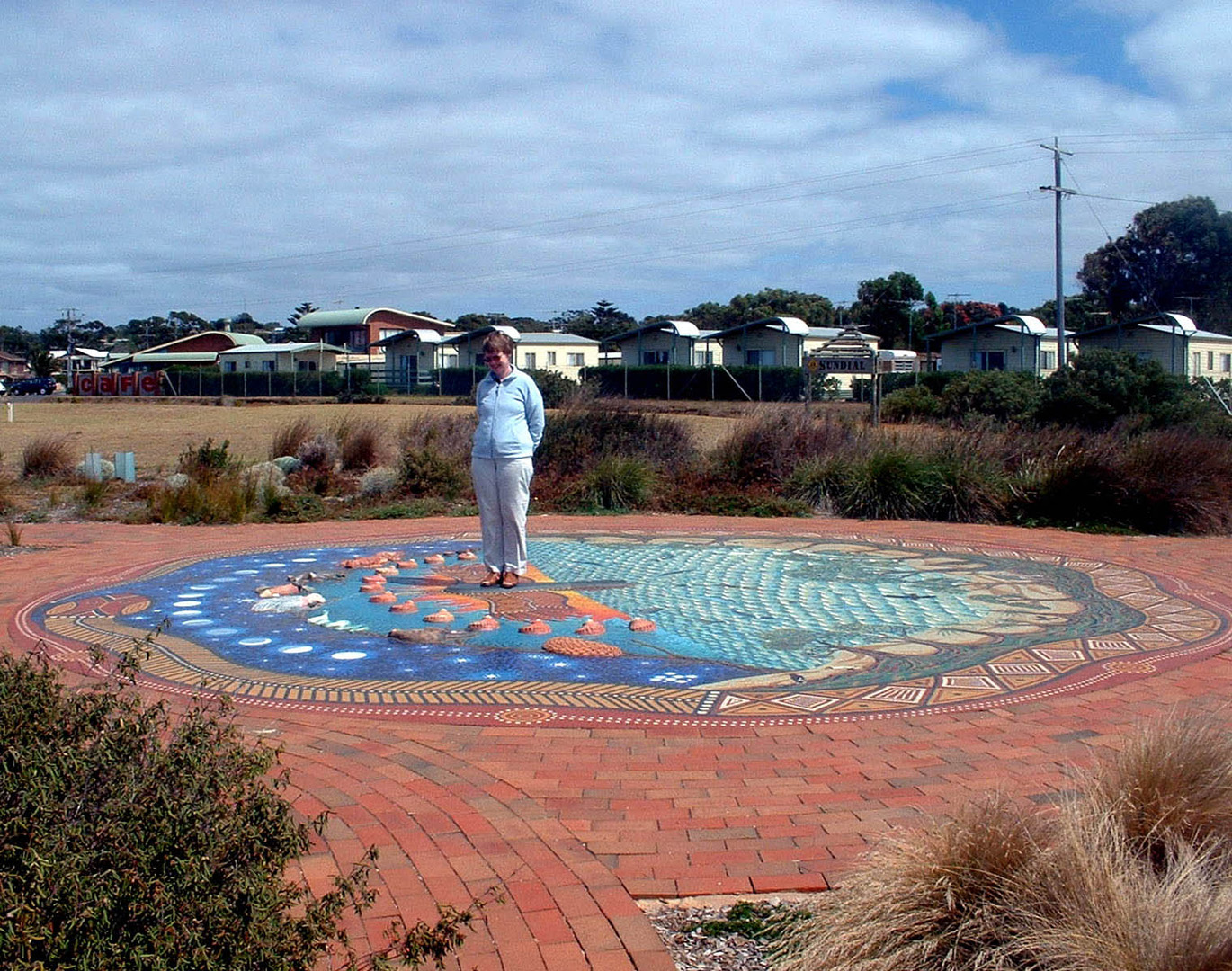
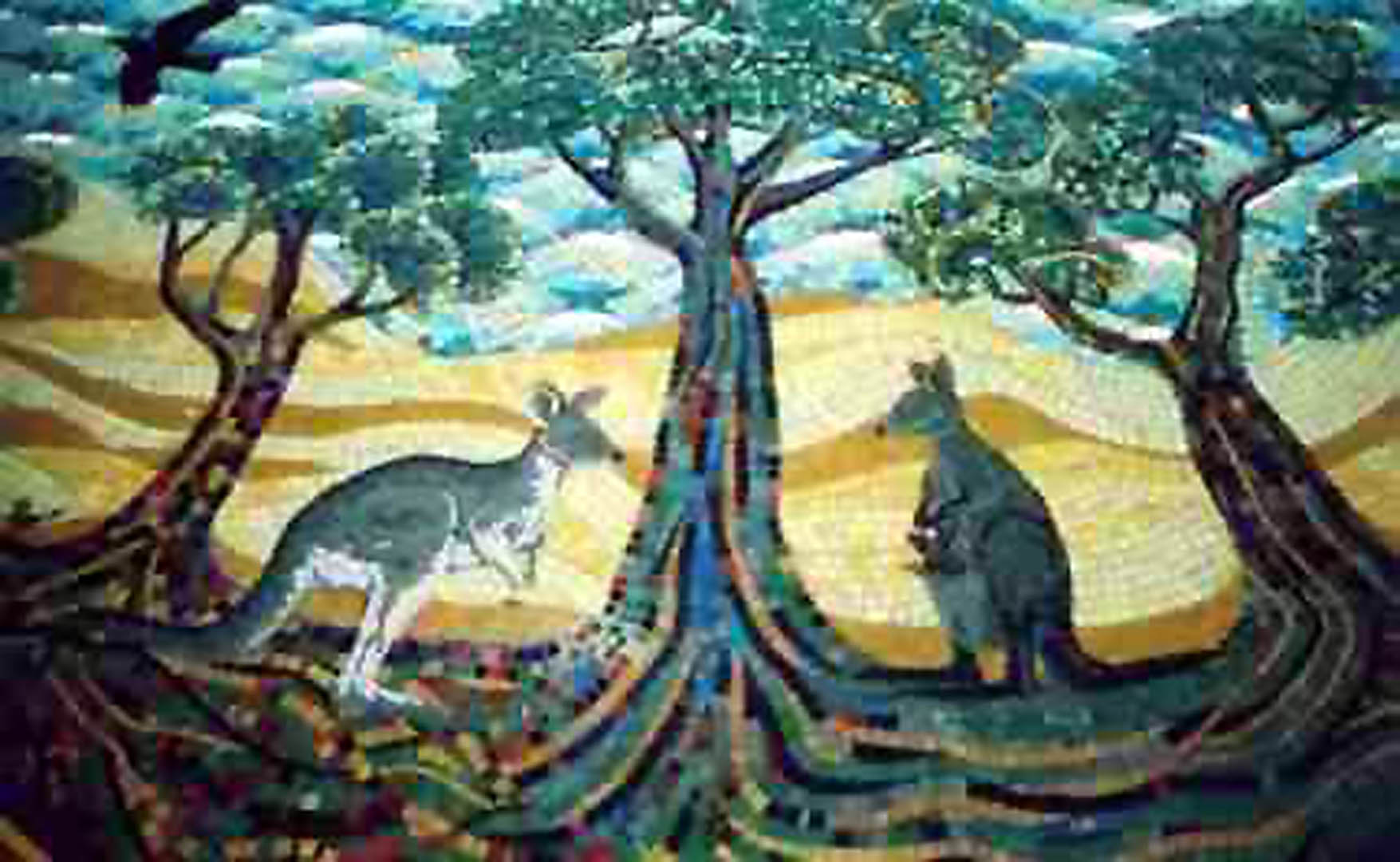
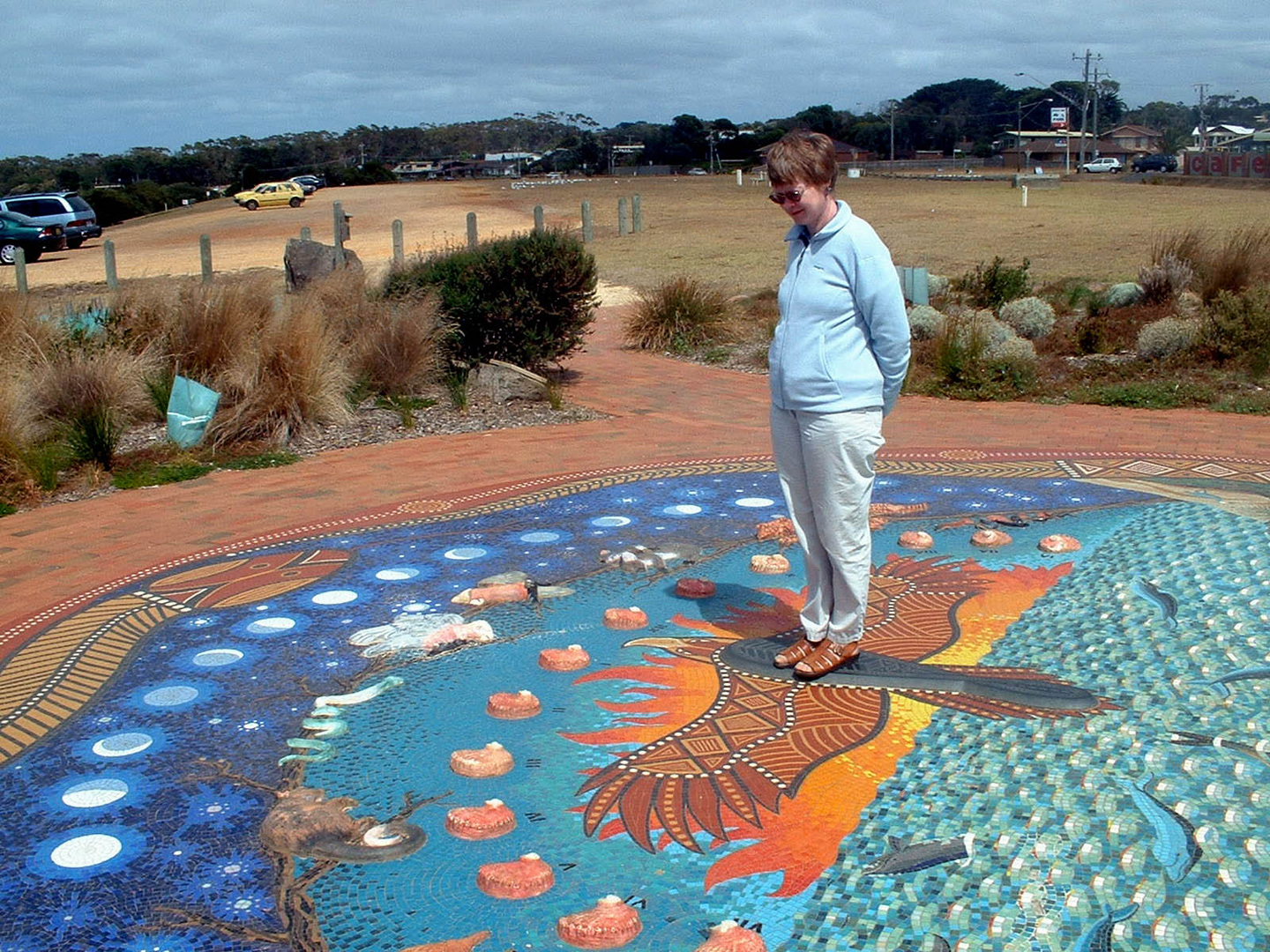
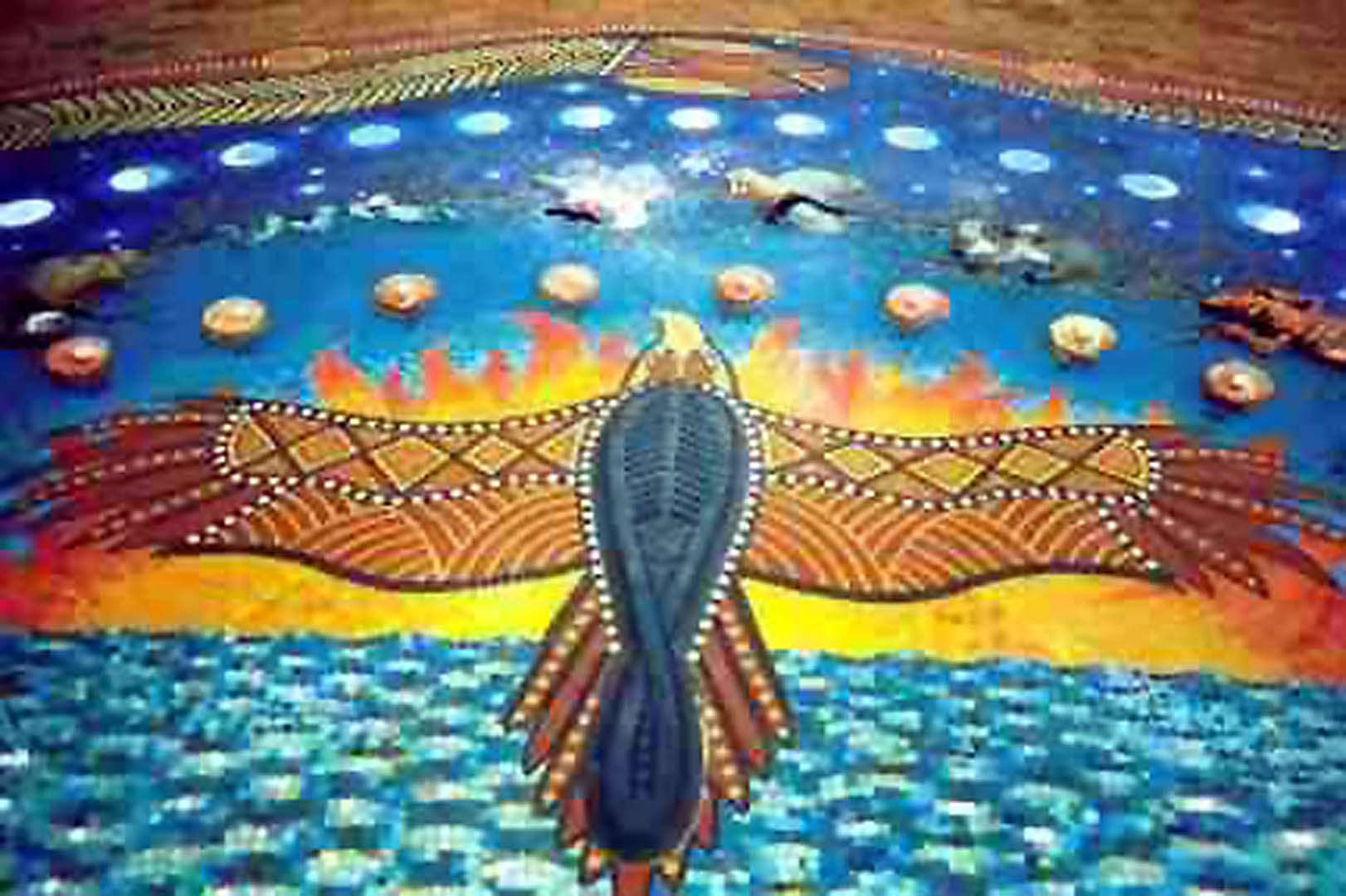
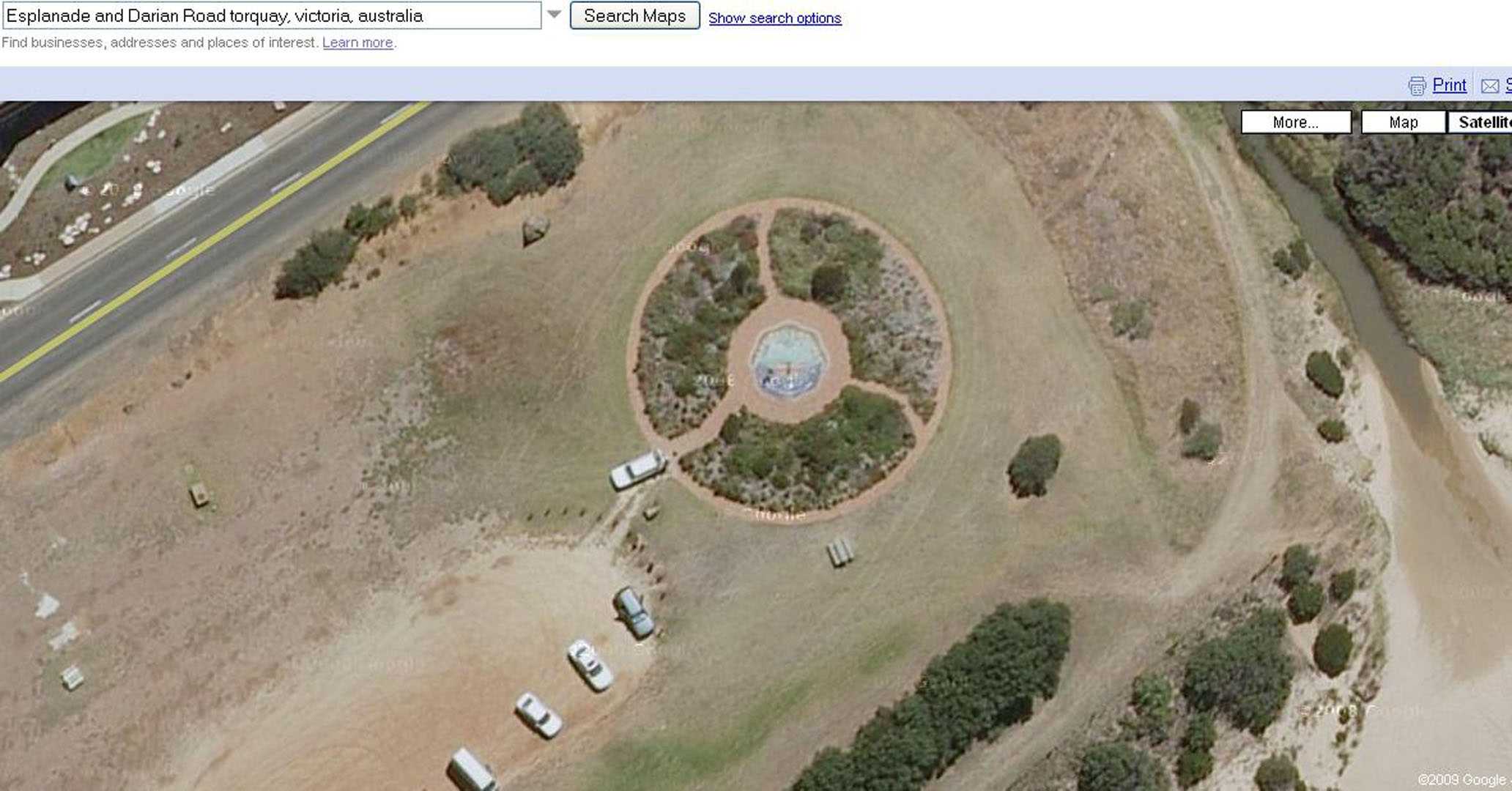
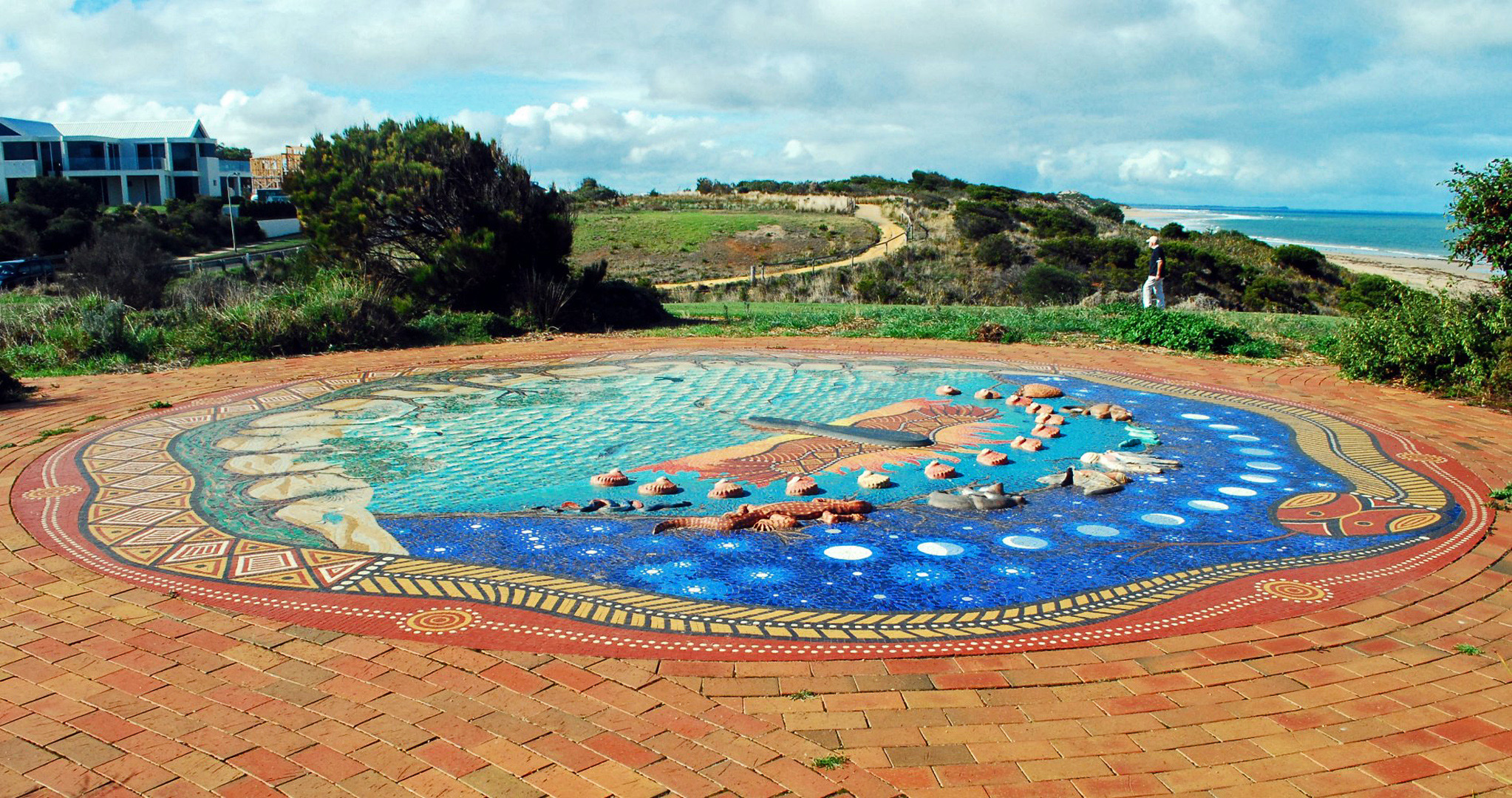
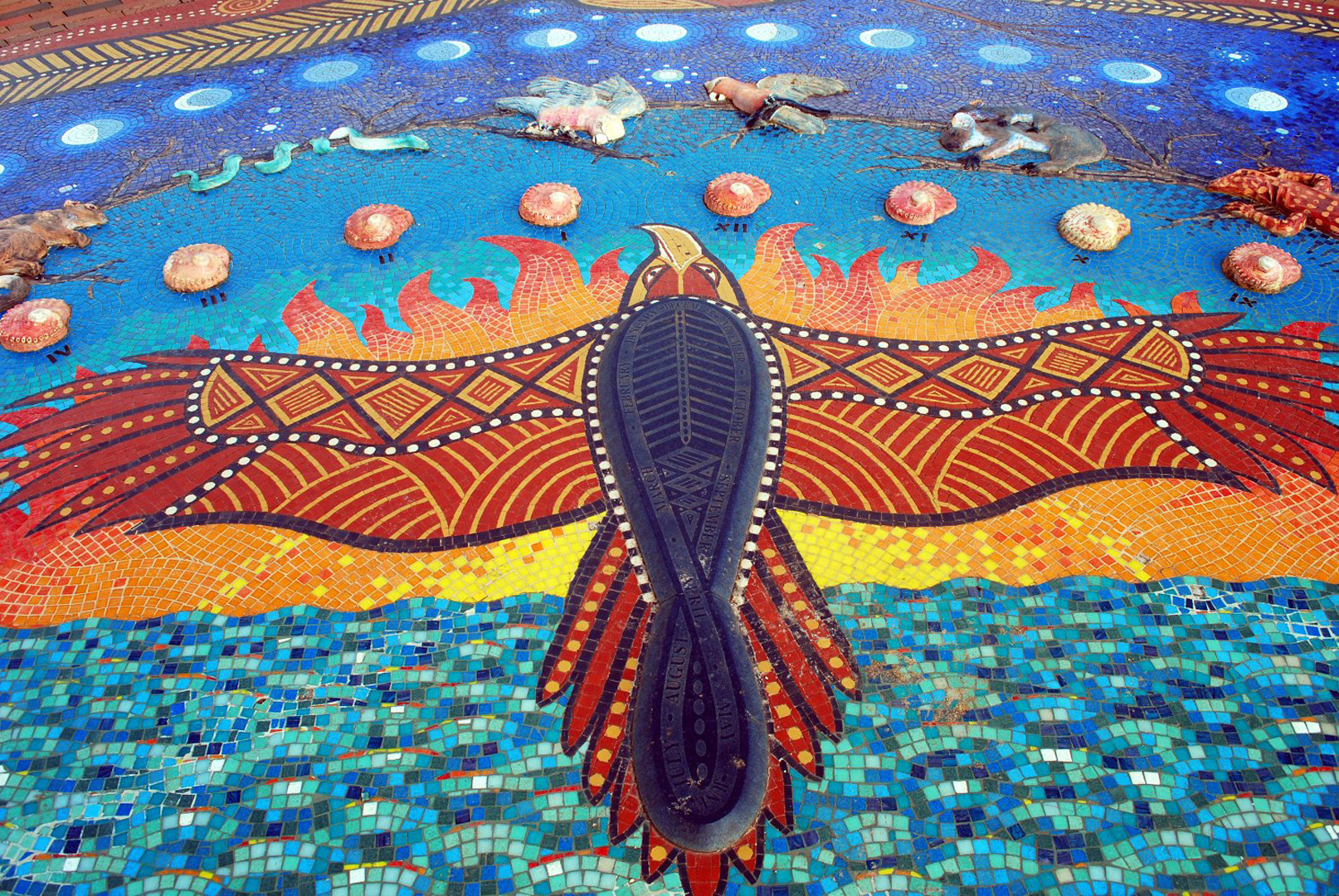
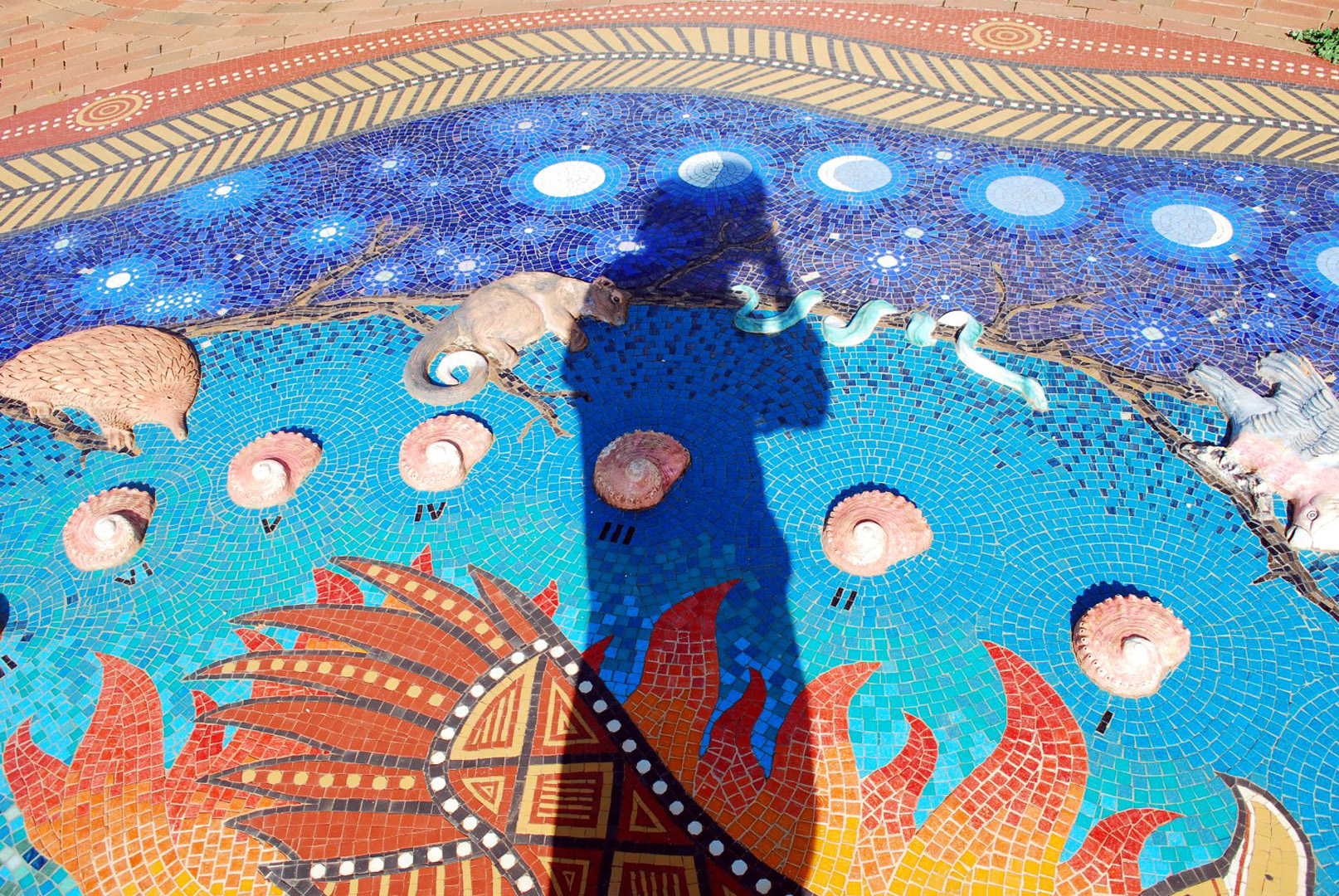
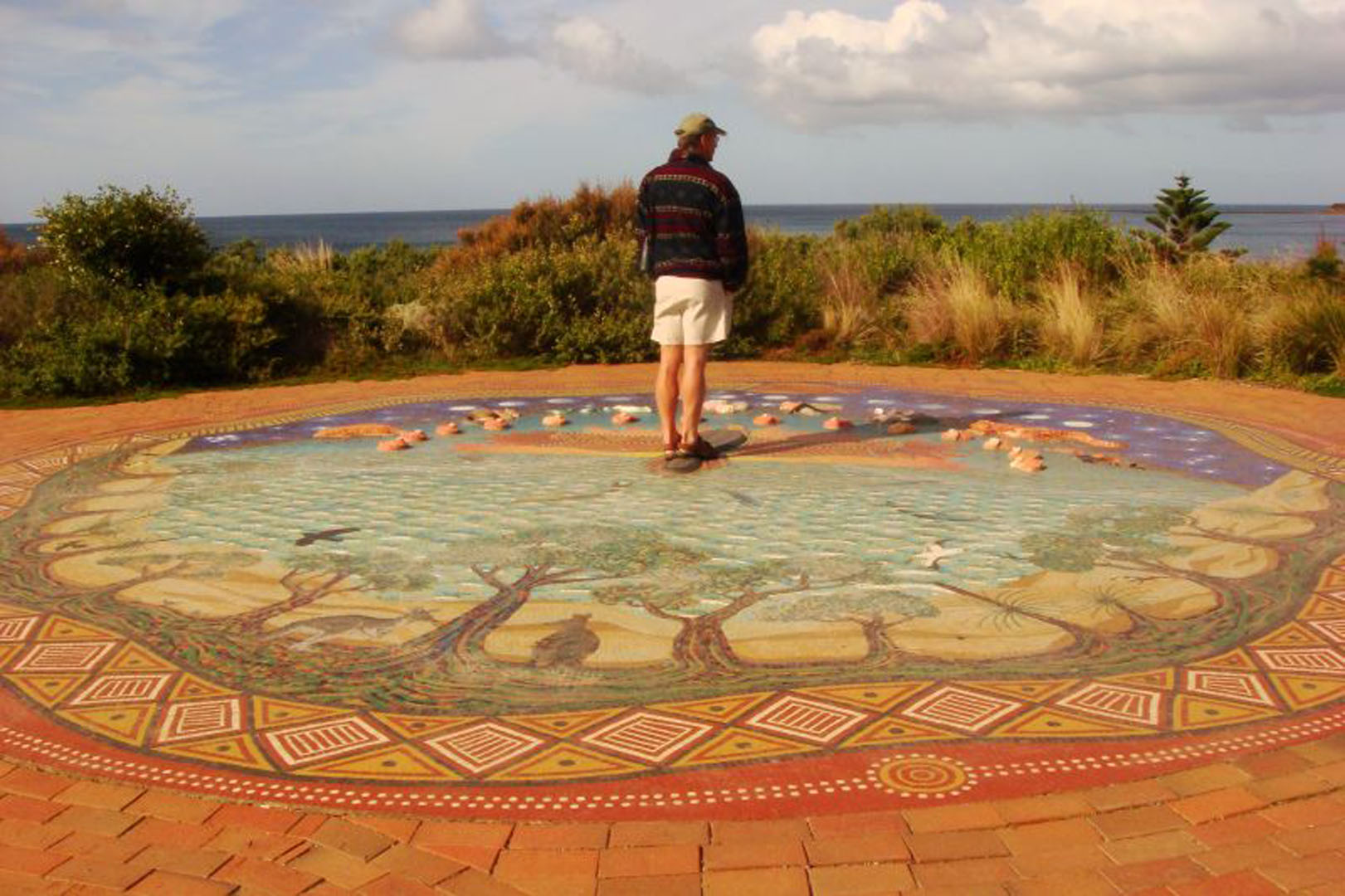
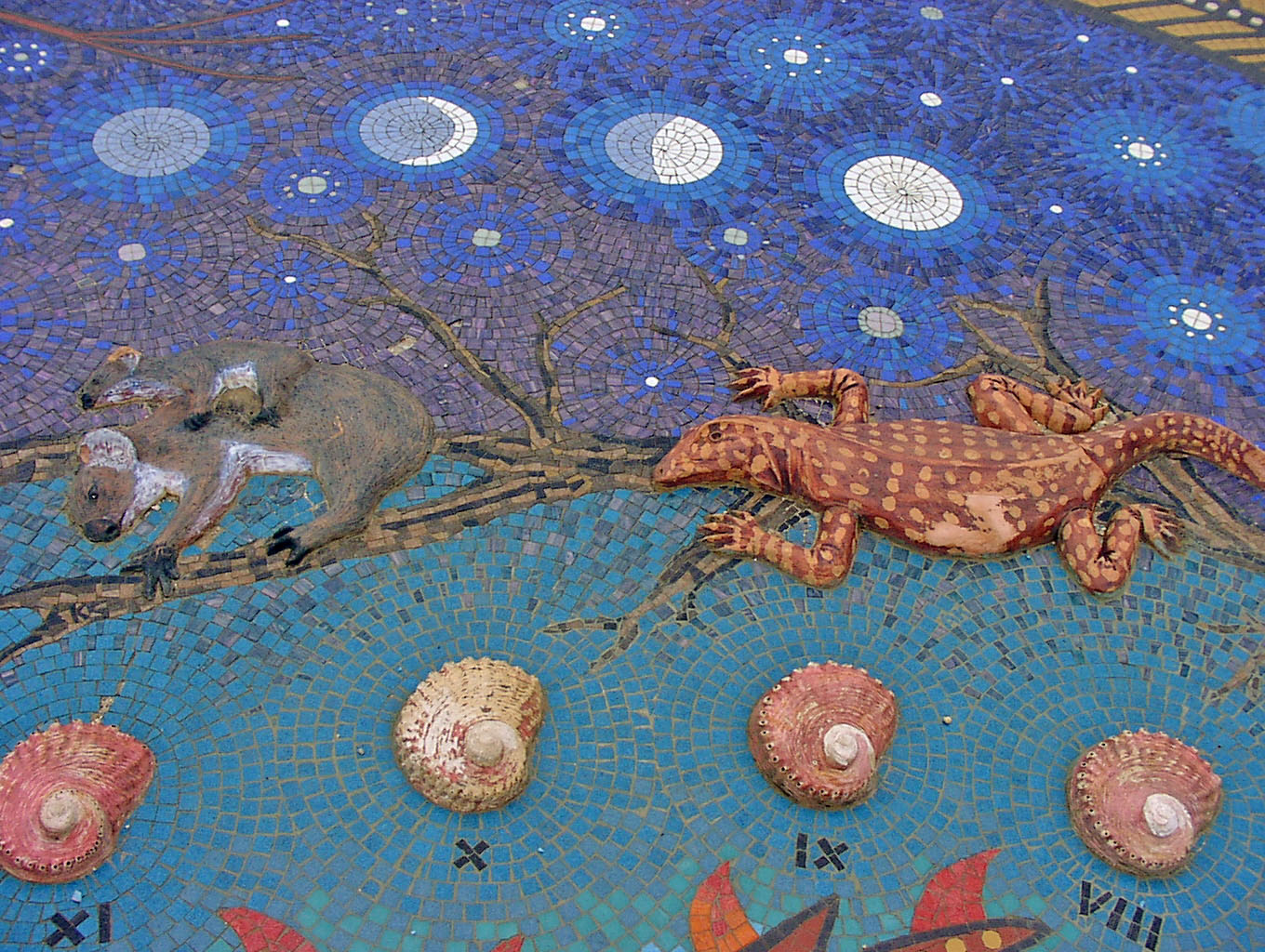
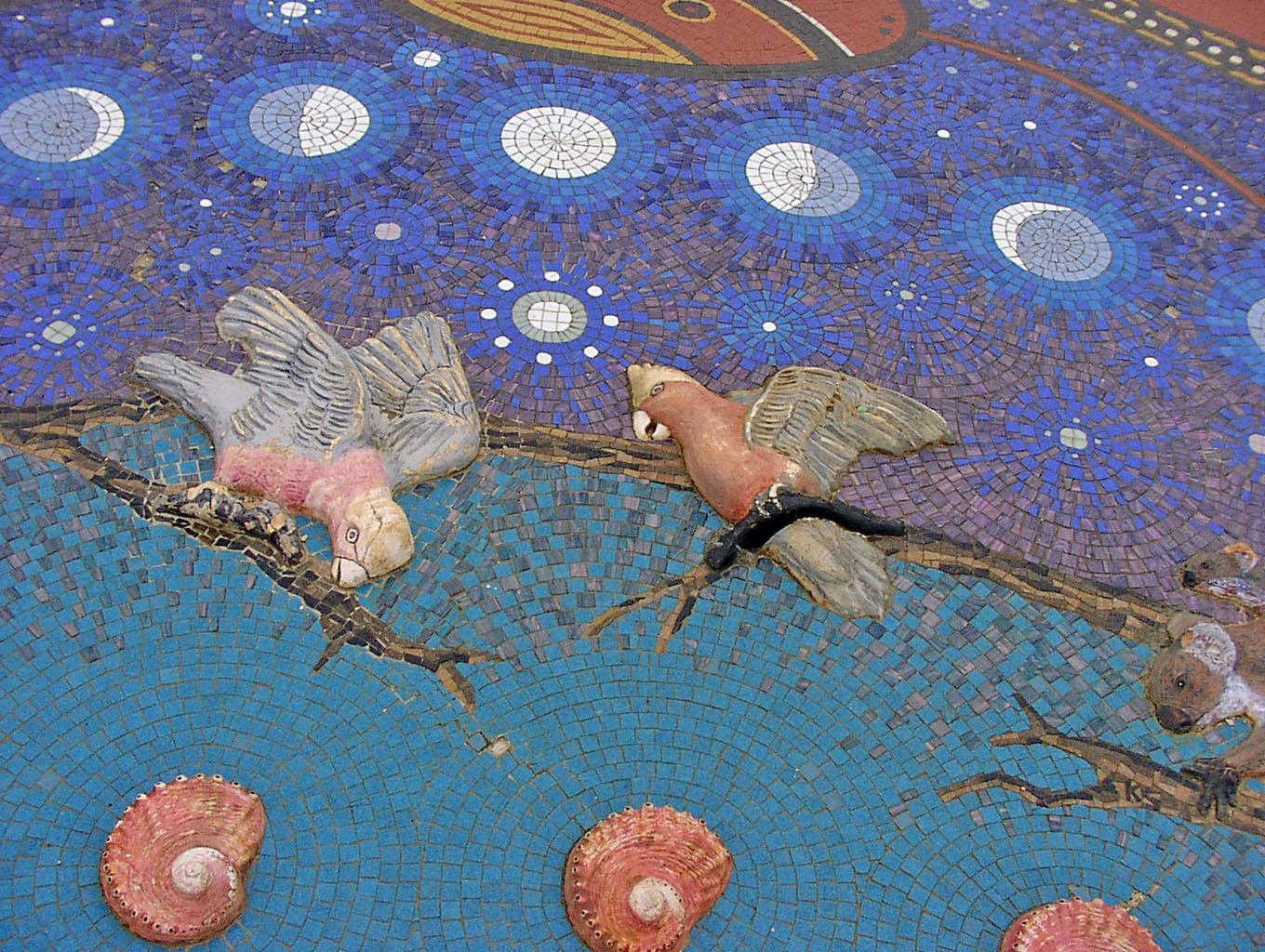
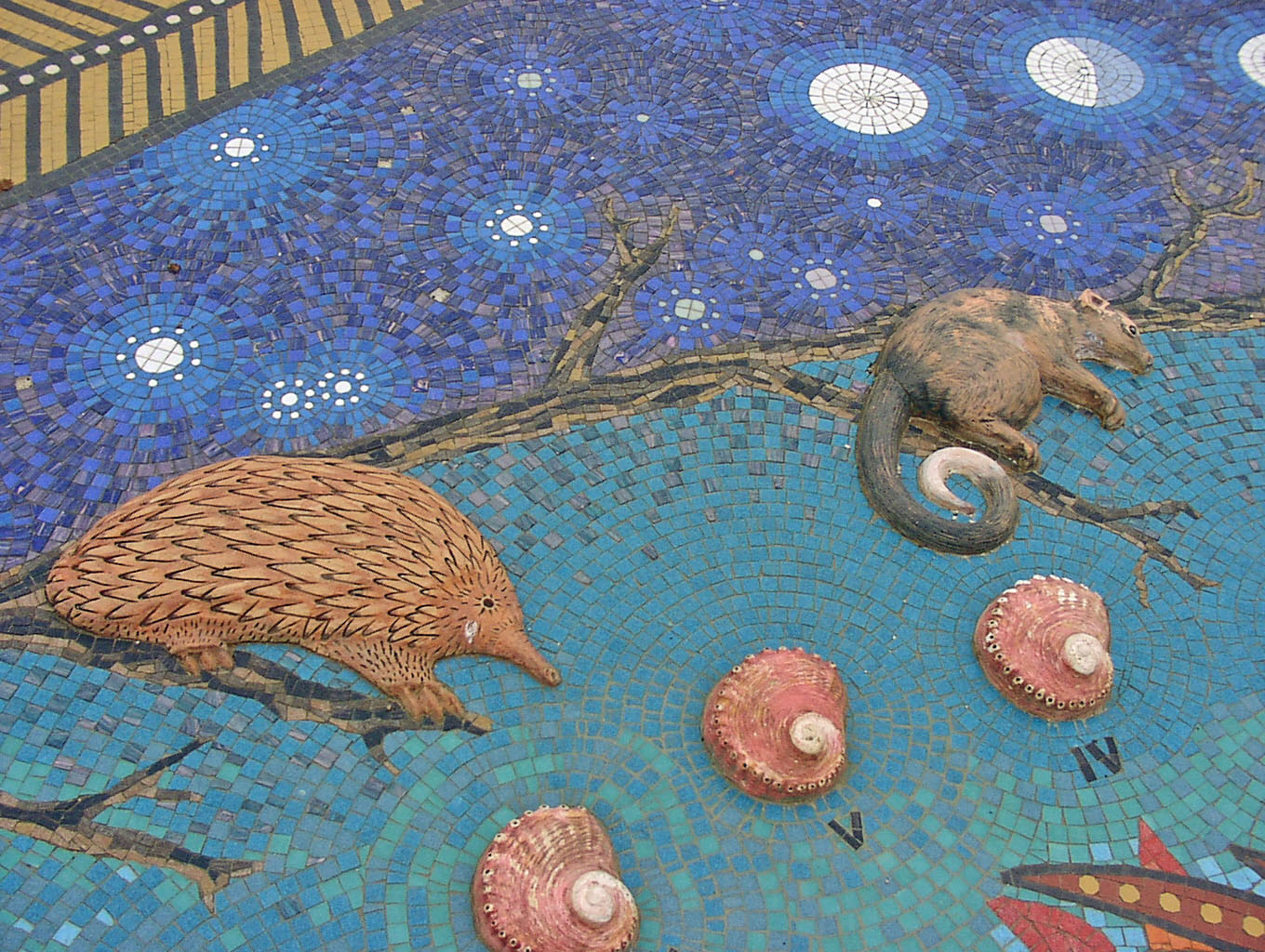
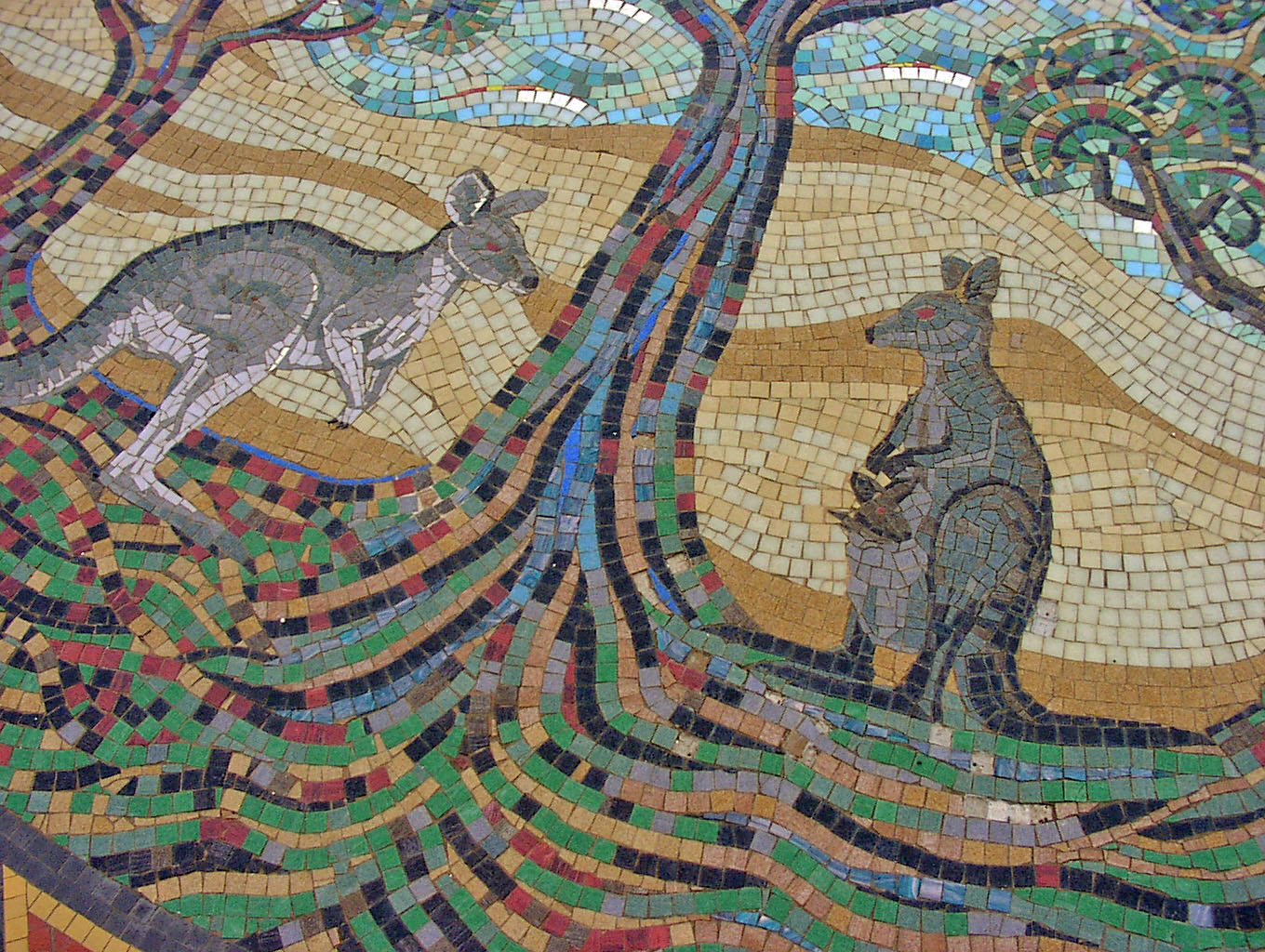
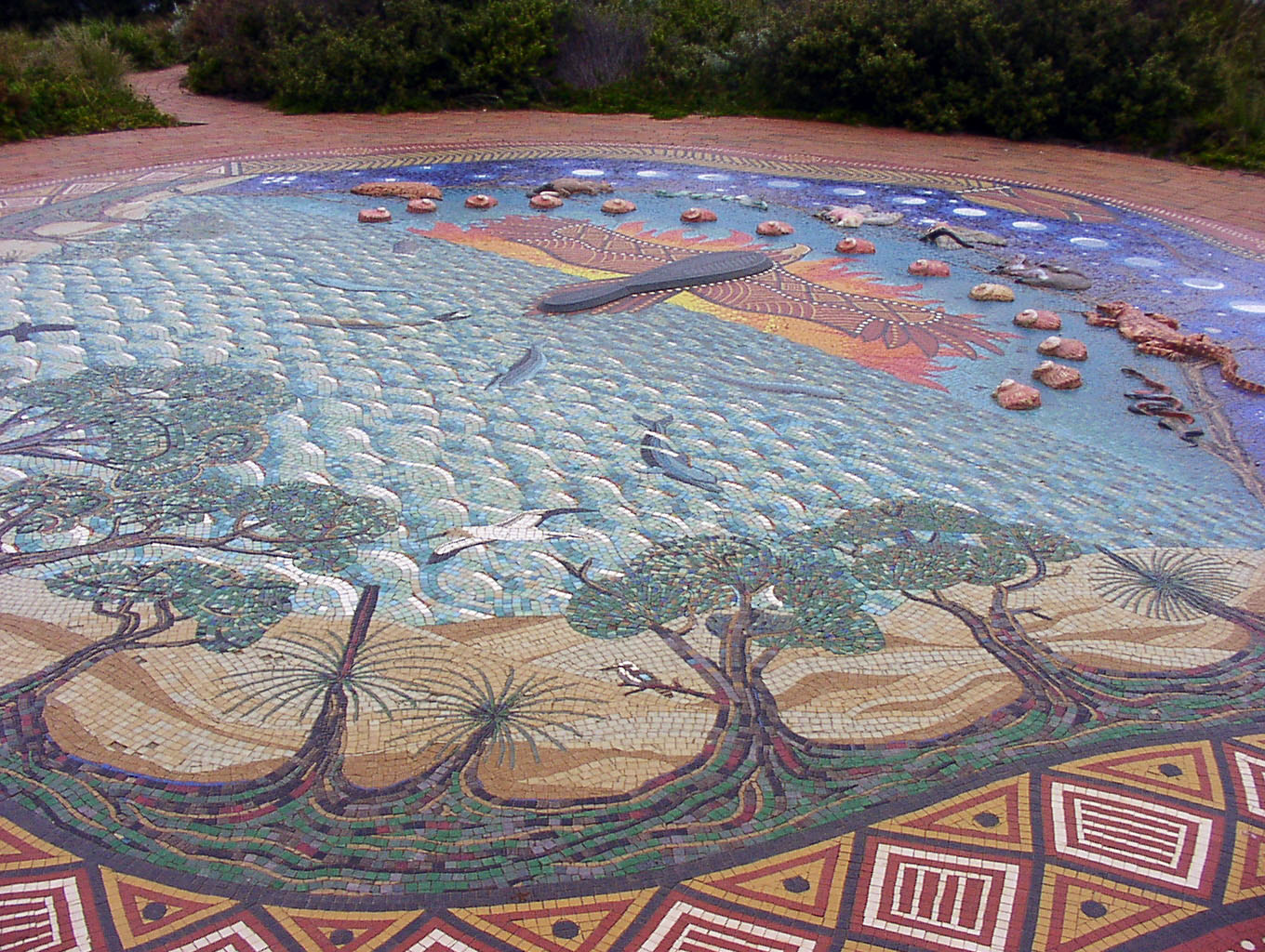
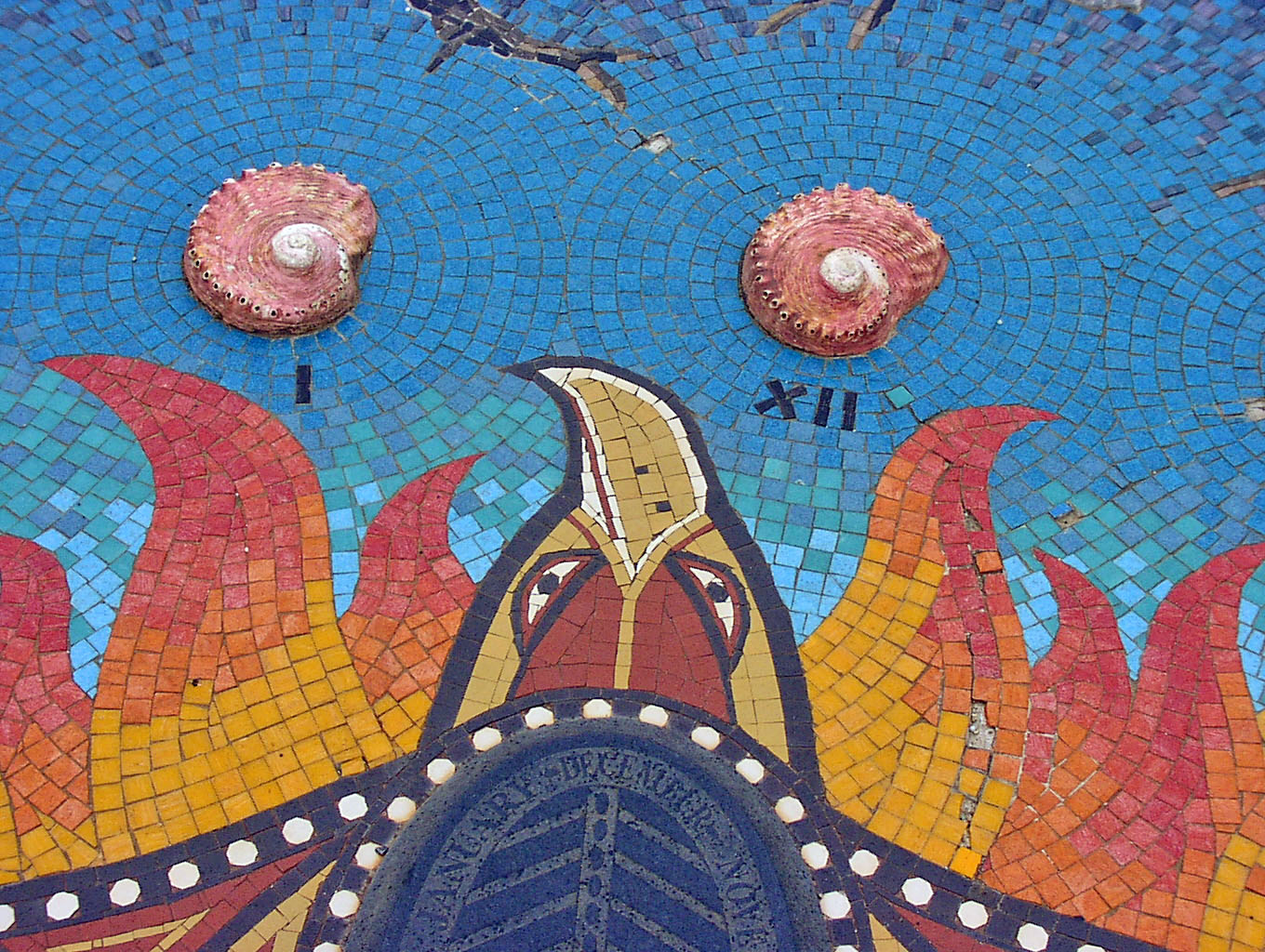
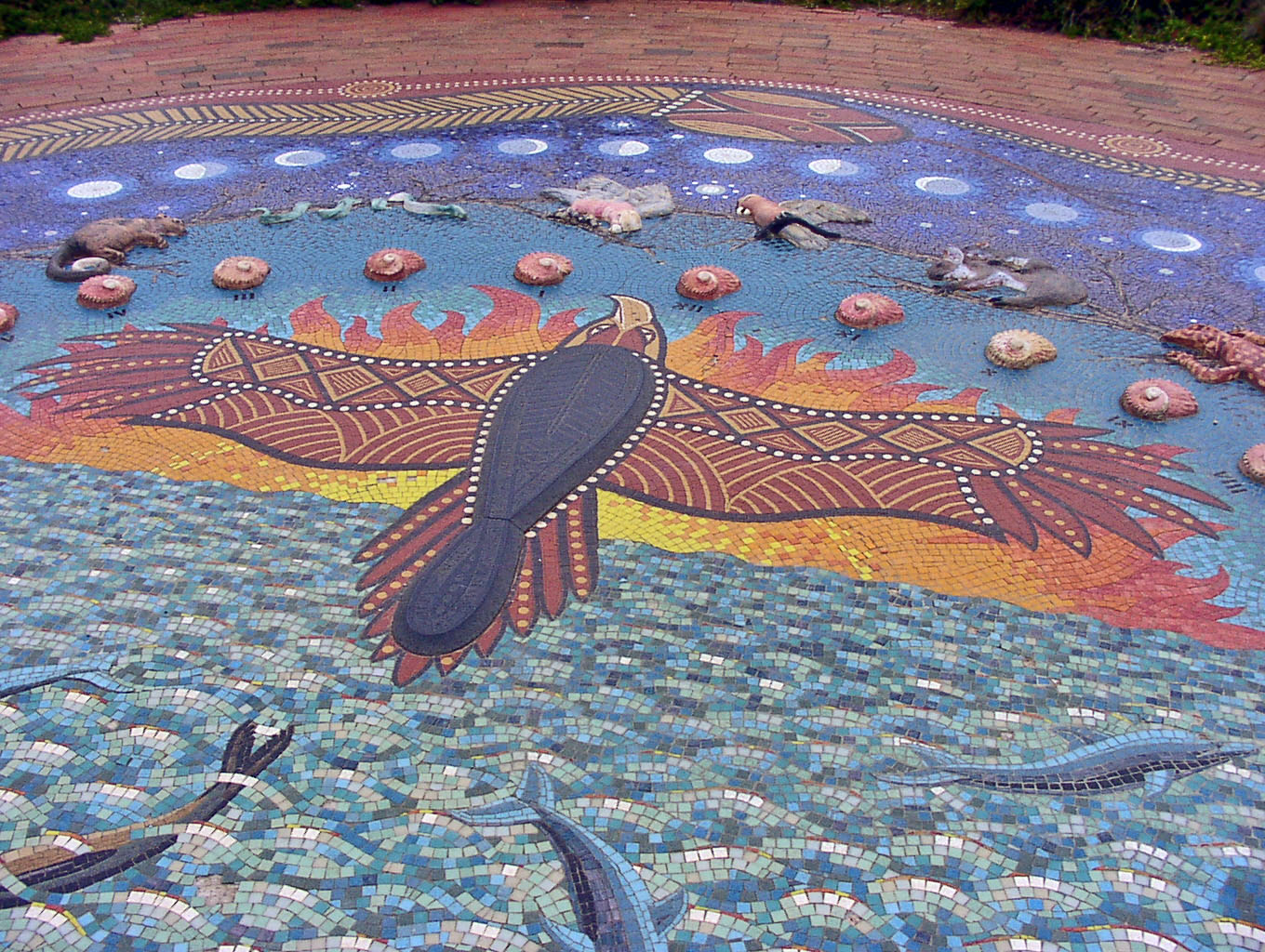
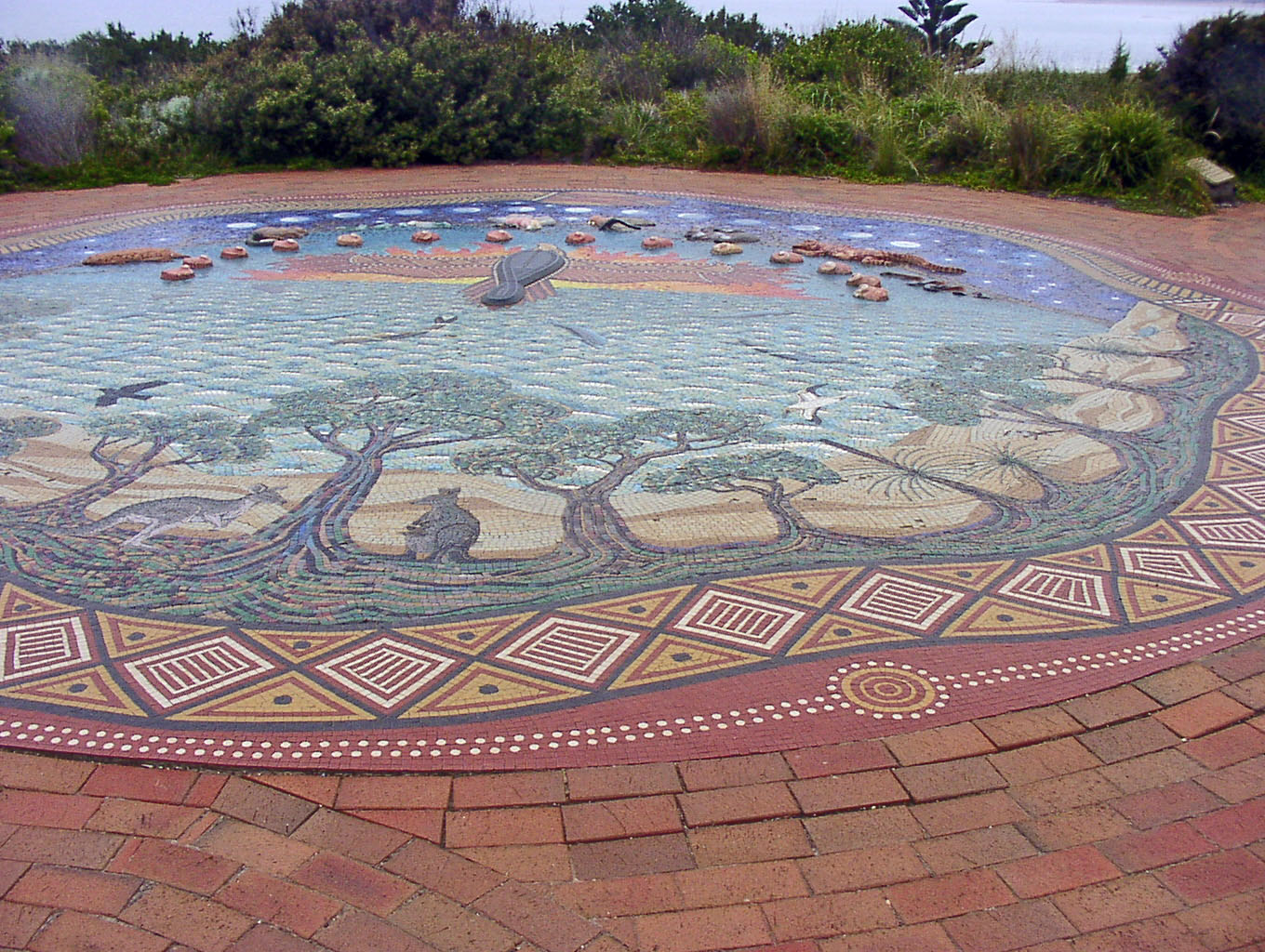
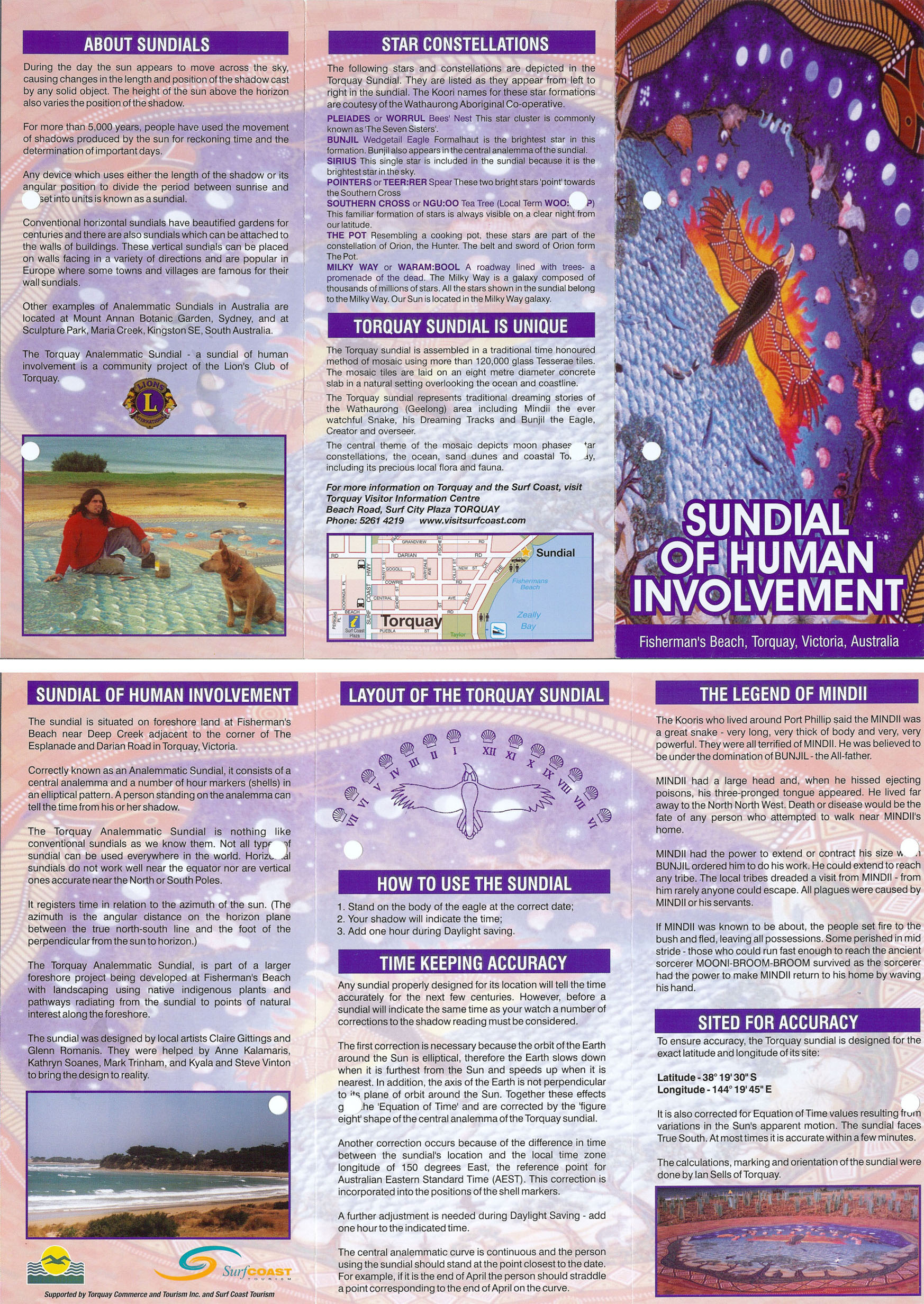
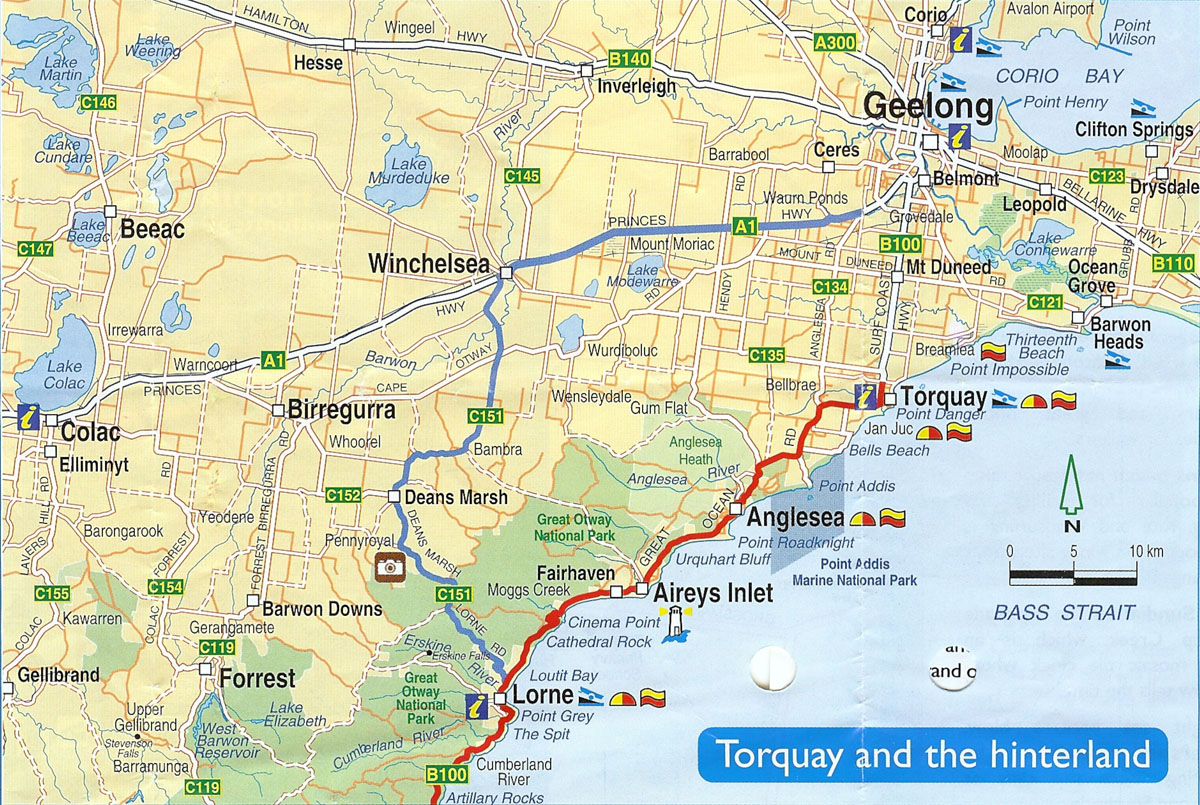
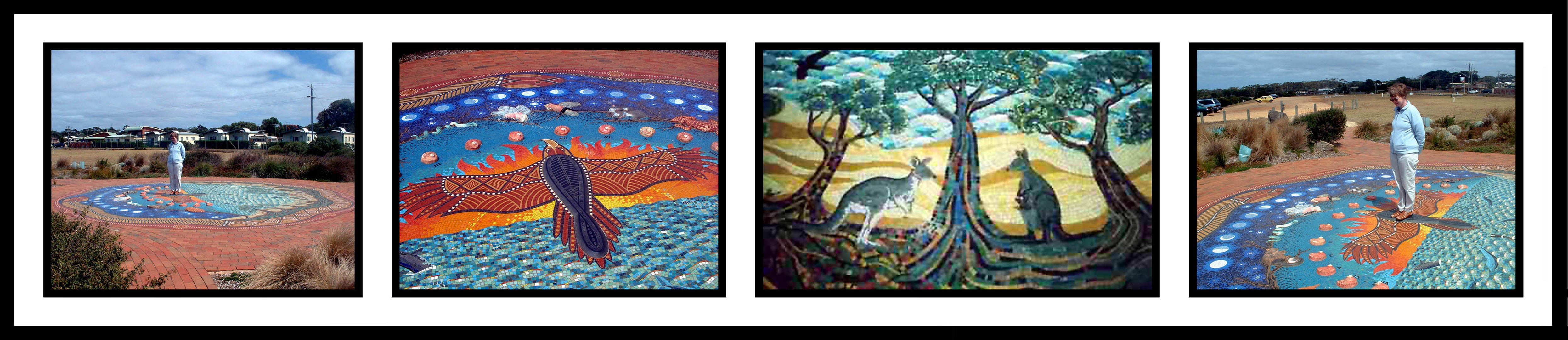
| Sundial Delineator: Ian Sells Artwork Designers and Installers: local artists, Claire Gittings & Glen Romanis and a crew of 4 others. Date: unknown Original Location: Lat: 38° 19' 30" S, Lon:144° 19' 45" E. Adjacent to the corner of Esplanade and Darian Road at Fisherman's Beach, Torquay Victoria, Australia Present Location: at original location Orientation: Horizontal Size: width- 4 to 5 m (157 to 196 in) concrete slab- 8 m (314 in) Adornment: elaborate artwork represents a number of traditional dreaming stories of the Wathaurong aboriginal people, including Mindii, the ever watchful Snake and Bunjil, the Eagle, Creator and Overseer. The analemma is the eagle's body. Mottos: none Condition: unknown Comments: Elaborate Analemmatic interactive sundial that uses a person's body for the gnomon. Standing on the date, a human's body casts a shadow that indicates the time. Unfortunately, this is a flawed design since the dial should have a straight date line instead of an analemma. This causes errors in the time readings. Dial contains about 120,000 glass tiles! Project initiated by the Lions Club. We are looking for better more information on this beautiful dial. Frans Maes Website: Here Torquay Website: Here Photo h original on Flickr Website: Here Photo i original on Flickr Website: Here Photo j original on Flickr Website: Here Linda Grimble’s Flickr Website: Here Photo Descriptions: Photos ‘a’ to ‘j’ came from Frans Maes website, others came from websites that are now offline. Photo ‘g’ is a satellite photo from Google Earth. Photos ‘h’, ‘i’, ‘j’ are by Fil Allen from his ‘Funky Plum’ photostream on the Flickr website above. Photo ‘k’ is by Linda Grimble © All rights reserved, and is used with permission. Photos “l” thru “y” are by Peter Jacobs and were taken on a cloudy day in 2010. Photos: a b c d e f g h i j k l m n o p q r s t u v w x y |
 |
 |
 |
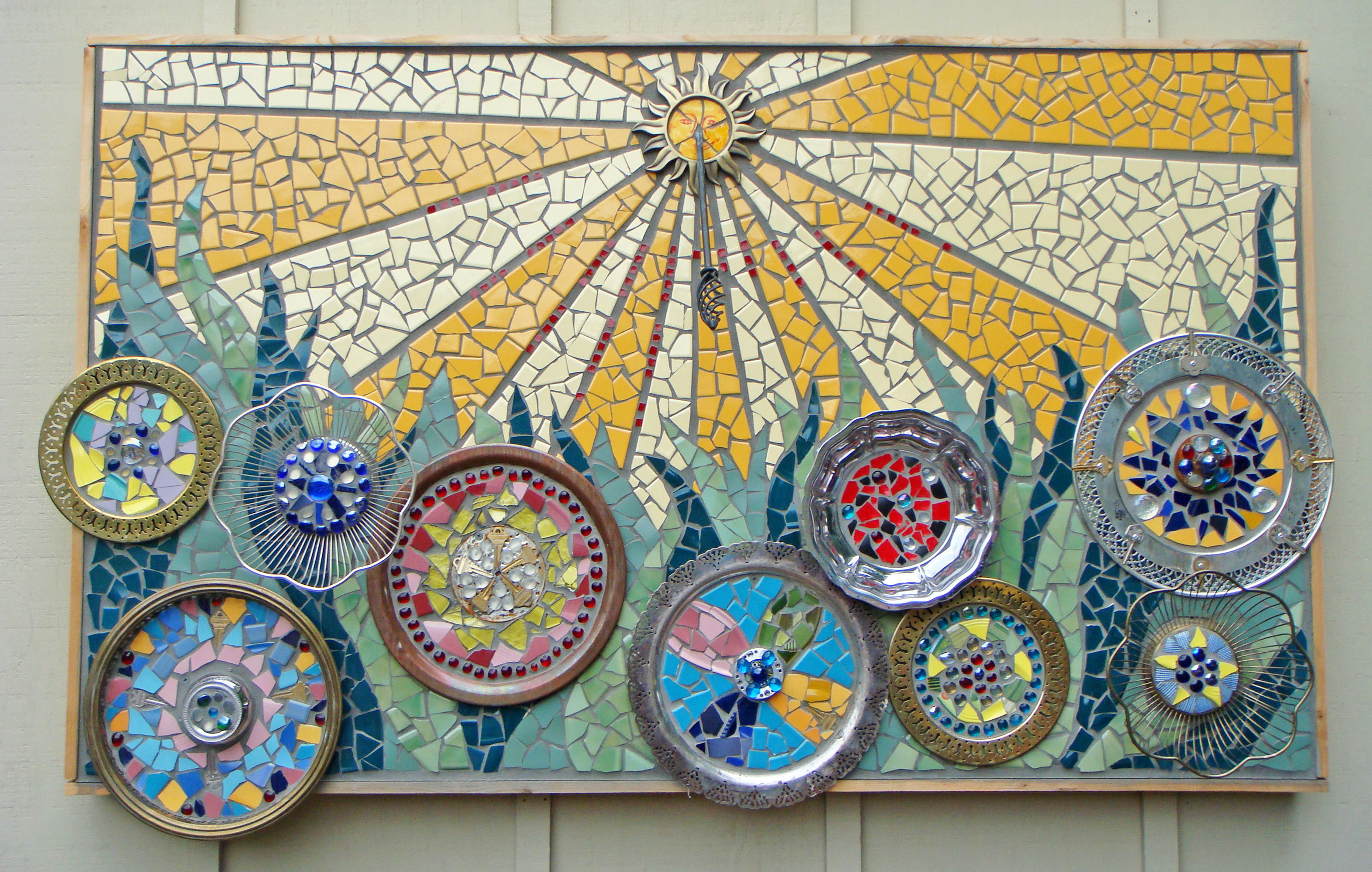
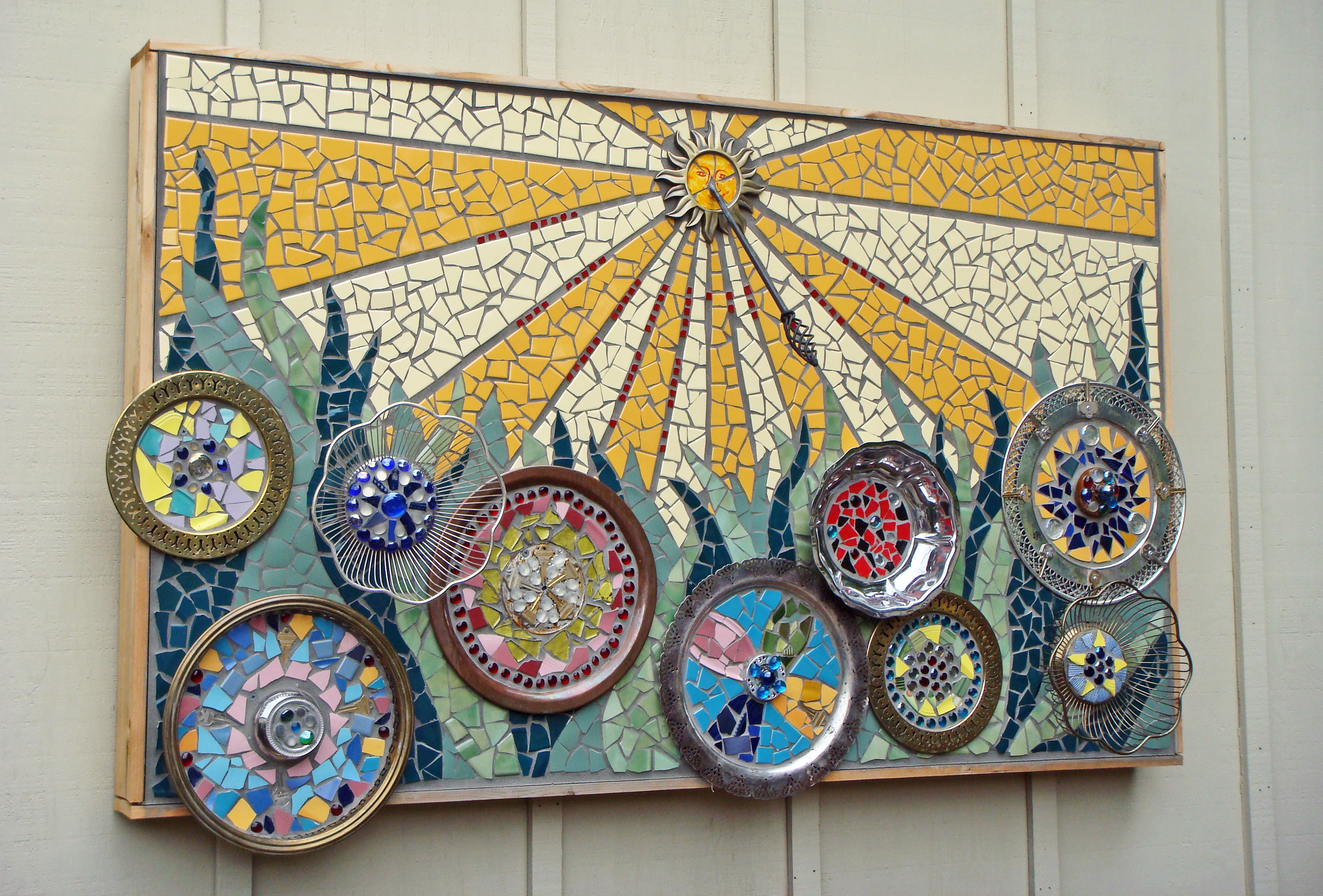
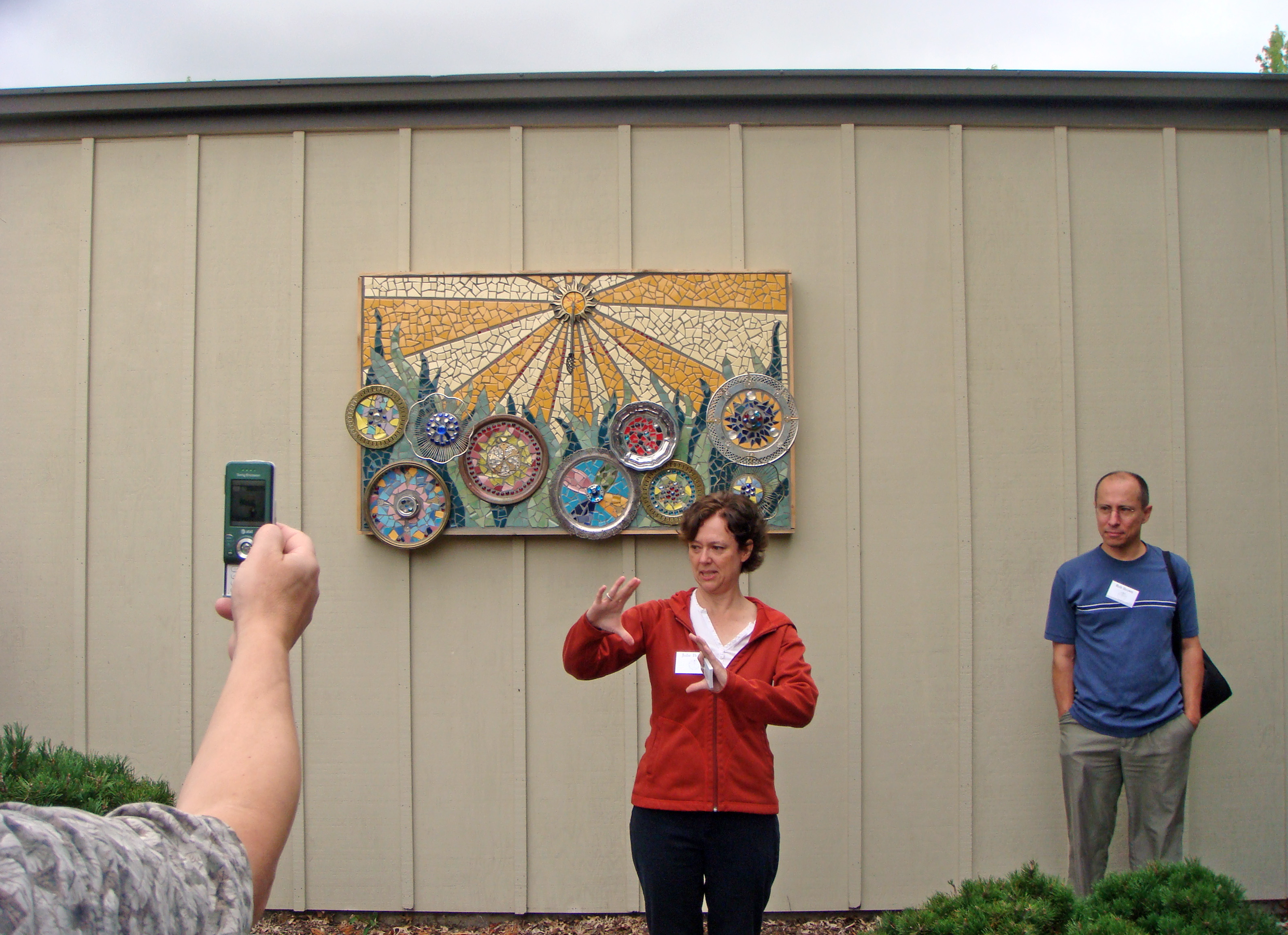
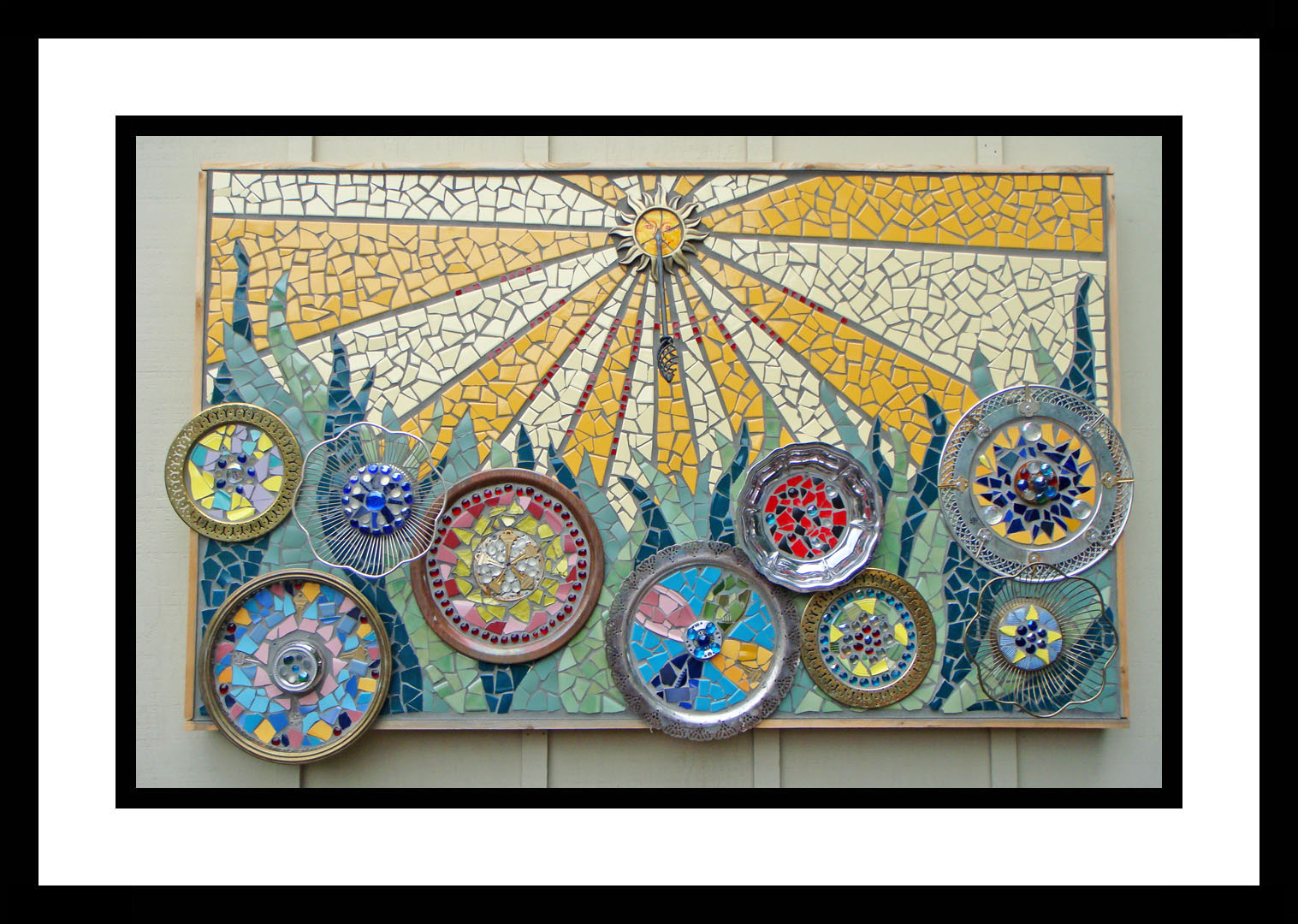
| Delineator: Rob Brown, member of NASS. Tel- 503-724-2497 Ceramic Artist: Julie Brown, wife of Rob Brown Date: unknown Original Location: unknown school in Lake Oswego Oregon, near Portland Oregon, USA Present Location: at original location Orientation: Inclination- vertical, Declination- direct South Size: unknown Adornment: a colorful theme made with all sorts of common household metal hardware, bowls and plates. It has a pretty steel rod gnomon with decorative tip. Very Unique! Inscriptions: none Mottos: none Condition: excellent Comments: This is a most imaginative mosaic dial because the artist incorporated many odd three dimensional objects not usually seen in mosaics. Also, he artist did not want typical hour numerals. Instead she placed small red ceramic tiles into he grouted hour lines. The number of tiles represents the hour numerals for each hour. The gnomon rod was securely placed into a drilled hole in a piece of wood that is hidden underneath the surface. We hope that Julie and Rob Brown collaborate to make more mosaic sundials in the future. The Brown’s Email: Here Photo Descriptions: Photos are by John Carmichael. I give permission to anybody to use these photos. Photos: a b c |
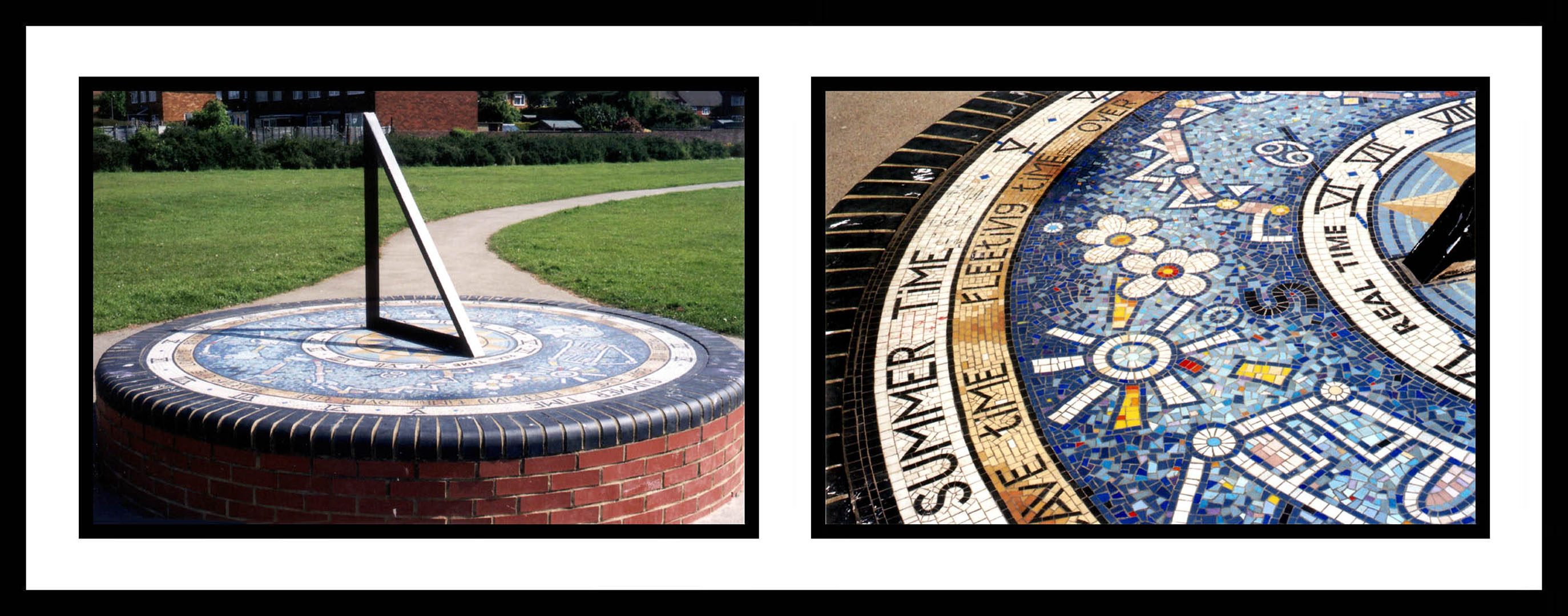
Designer: Rob Turner Maker: Gary Drostle, accomplished English painter and mosaic artist. Delineator: Christopher St.J. H. Daniel FSA Date: 2002 Original Location: Lat: 51.5° N; Lon: 0.6° W. Monksfield Park, Britwell in Slough, close to West London England Present Location: at original location Orientation: Horizontal Size: unknown, but large Adornment: the theme is of time, locality and the stars Mottos: unknown Condition: Excellent in these photos taken in 2005. But dial has some graffiti, is soiled by bird droppings, and needs cleaning. Comments: Information is from website below. Slough Borough Council’s Parks and Allotments Section commissioned public art for the park. The aim was to enhance the park through a project that would involve local people in the regeneration of the area. This offered people the opportunity to work with professional artists and to learn new skills as well as provide a focal point for the park. The dial was designed following workshops that Gary and Rob ran with the local school, youth centre and play centre. The young people worked on the theme of time, locality and the stars. The sundial also acts as a bench on its raised platform. There are two dials (L.A.T.) one for the summer and one for the winter. The mosaic was constructed from vitreous glass and ceramic tesserae with a powder coated steel gnomon in the centre. Drostle Website Website: Here Slough Website: Here Gary Drostle’s Email: Here Photo Descriptions: Photos are courtesy of John Foad. Photos: a b c d e |
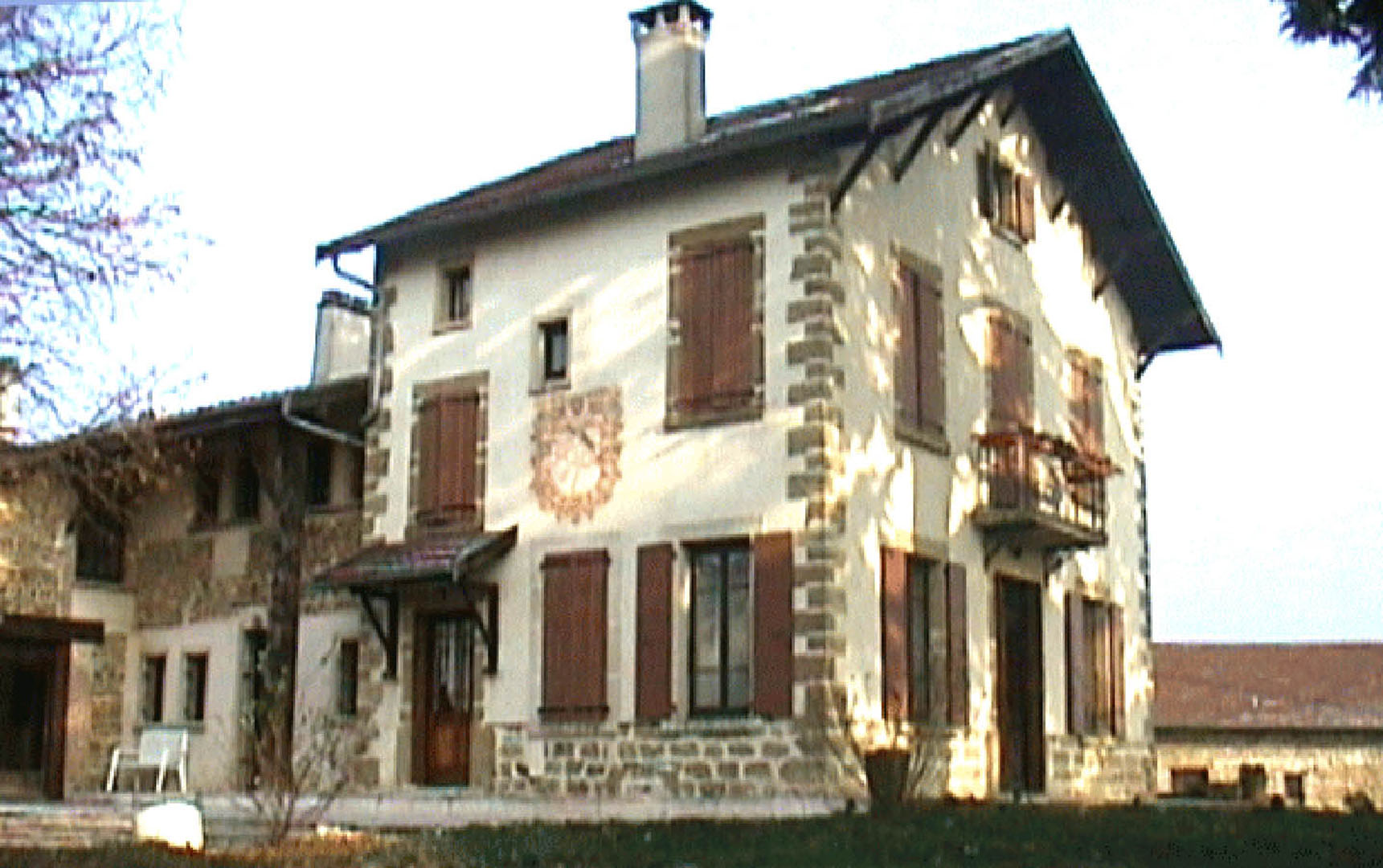
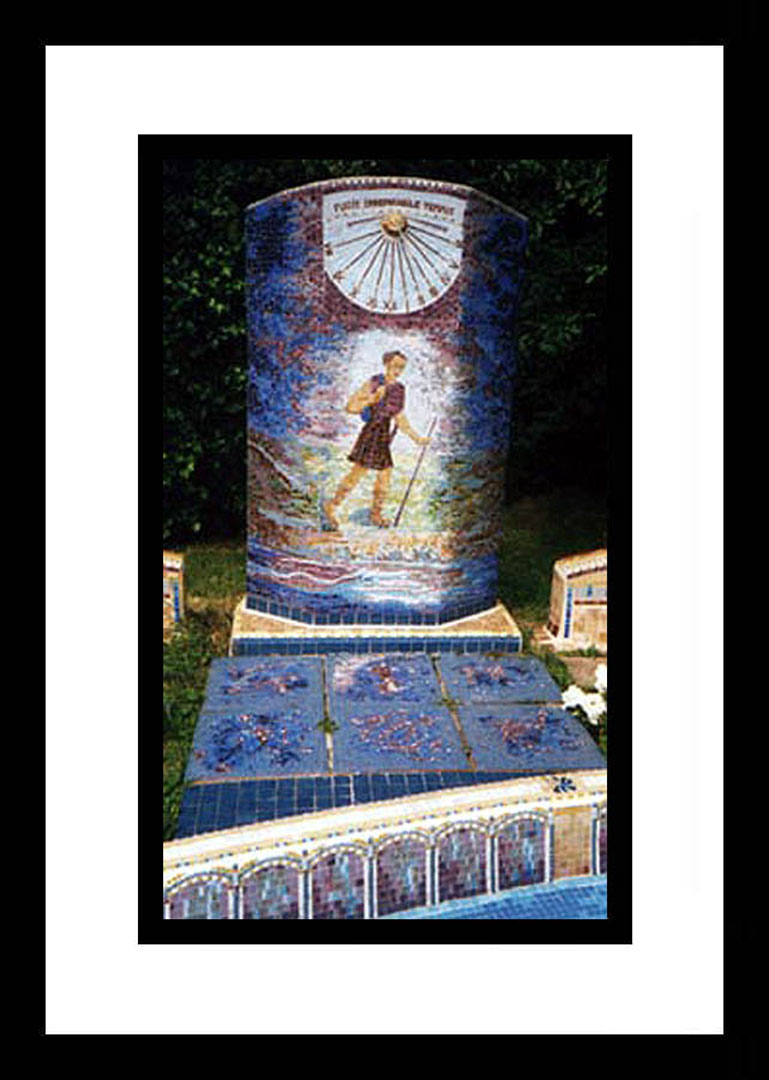
Designer & Maker: A French lady named Hurfane made it. We don't know the dialist who delineated it. Date: unknown, but the sundial was probably made in the late 20th Century. Original Location: Lat: 48° 19' N, Lon: 1° 6 E. In The Blue Garden at Les Jardins de la Feuilleraie (The Mosaic Gardens) of Happonvilliers, near Chartres, France. Present Location: at original location Orientation: Vertical. Declination is unknown, but it’s not south. Size: unknown Adornment: The traveler represents time, passing irretrievably from future to past. A nearby compass rose confirms that the dial doesn't face due south - its angles had to be modified to allow for this. At its base six panels show different constellations of the night sky." Mottos: present, but not readable in this photo Condition: probably good Comments: Information is from website below. For the past 20 years, Hurfane has been creating a vast mosaic landscape deep in the rolling countryside of the French region of Perche d'Eure et Loir. Her work falls into two main gardens: the pink and the blue gardens. The focus of the blue garden is the sundial." They are open during summer, in the afternoons of Saturdays, Sundays and Tuesdays, and possibly by appointment. It would be a good idea to check with local tourist information offices. The Joy of Shards Website: Here Feuilleraie Email: Here Hurfane's Tel: 02 37 29 59 20 Photo Descriptions: Photos copied from Joy of Shards website. Photos: a |
 |
 |
 |
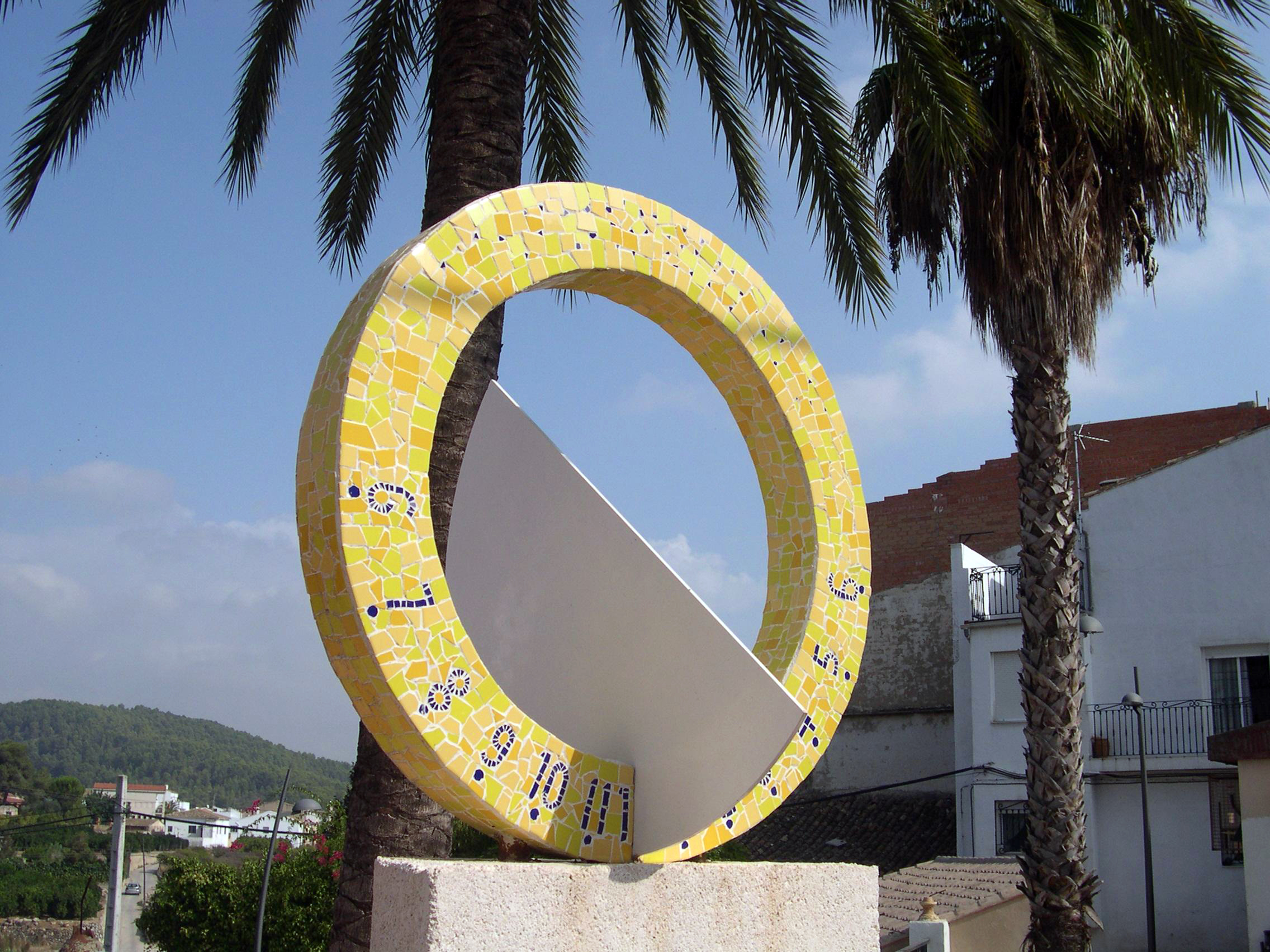
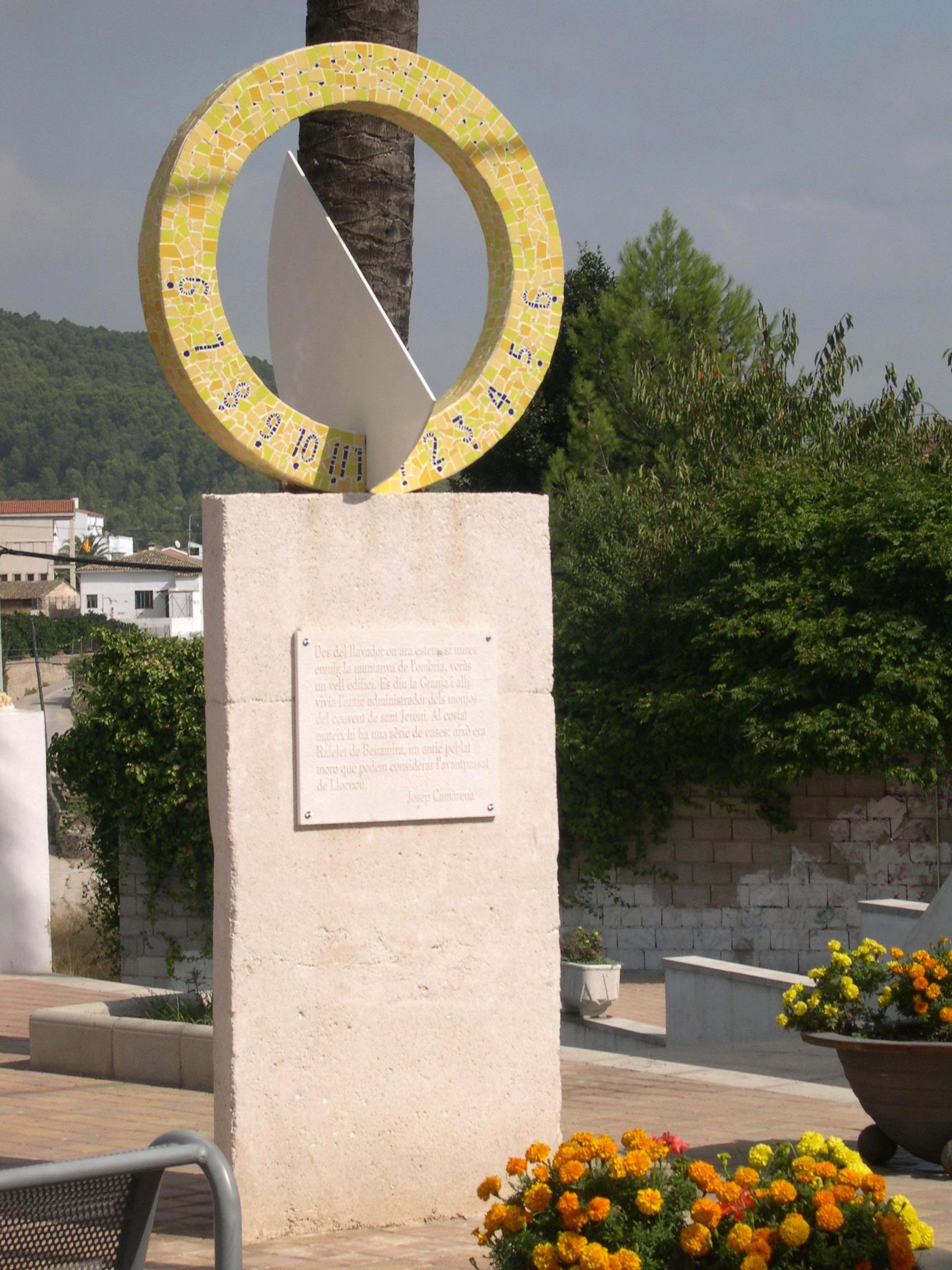
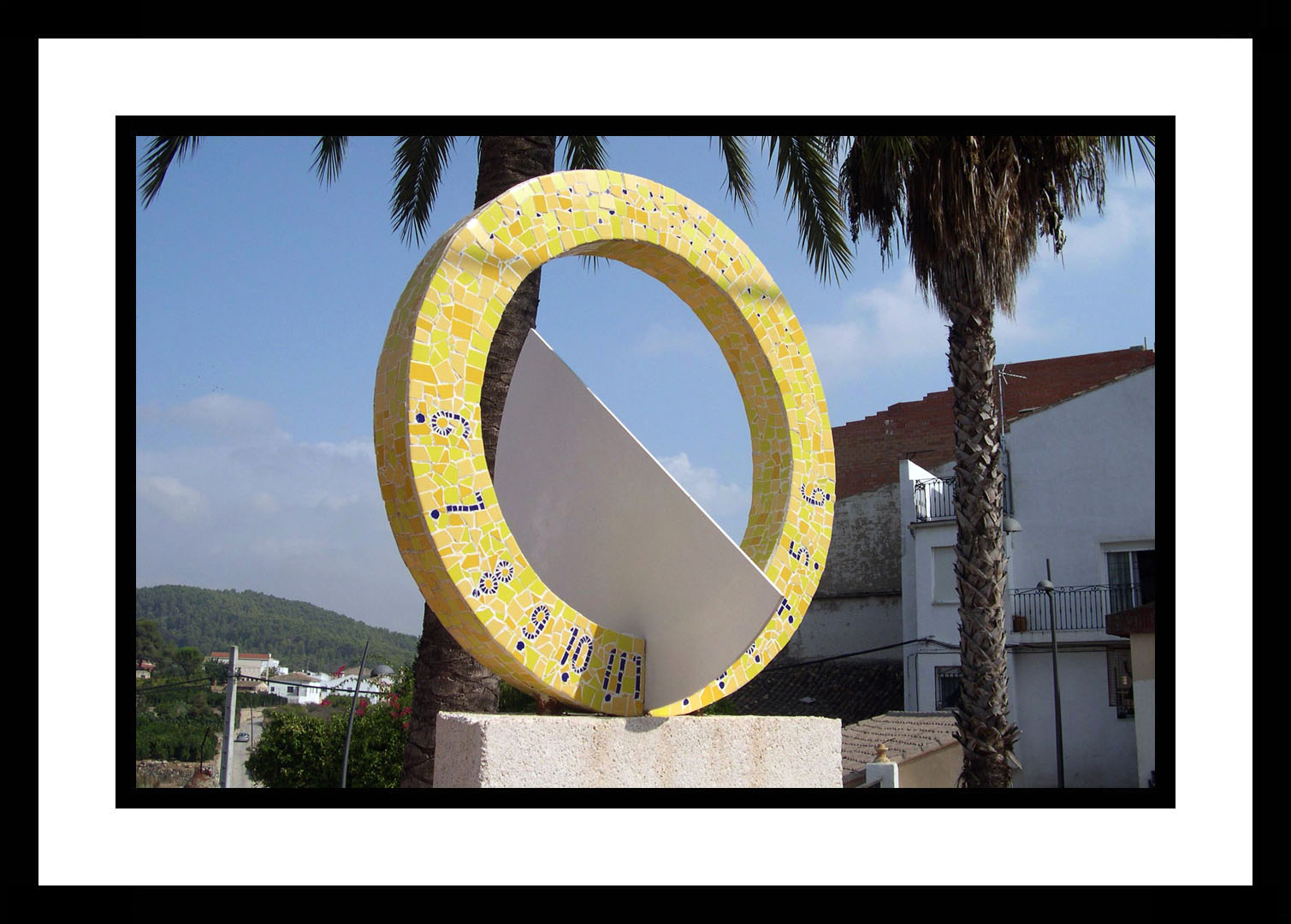
| Delineator: notable Spanish dialist, Joan Olivares Ceramic Artist: constructed by Rafael Amorós and Joan Olivares Date: unknown Original Location: Lloc Nou de Saint Jeroni in Valencia Spain. Present Location: at original location Orientation: Vertical. Declines south. Size: unknown Adornment: none Mottos: none Condition: excellent Comments: This is an interesting vertical ring sundial made from ceramic ‘trencadís’. Joan Olivares Website: Here Otos Valencia Map Website: Here Photo Descriptions: Photos ‘b’ and ‘c’ were sent to us by Joan Olivares. Photo ‘a’ is a cropped version of photo ‘b’ Photos: a b c |
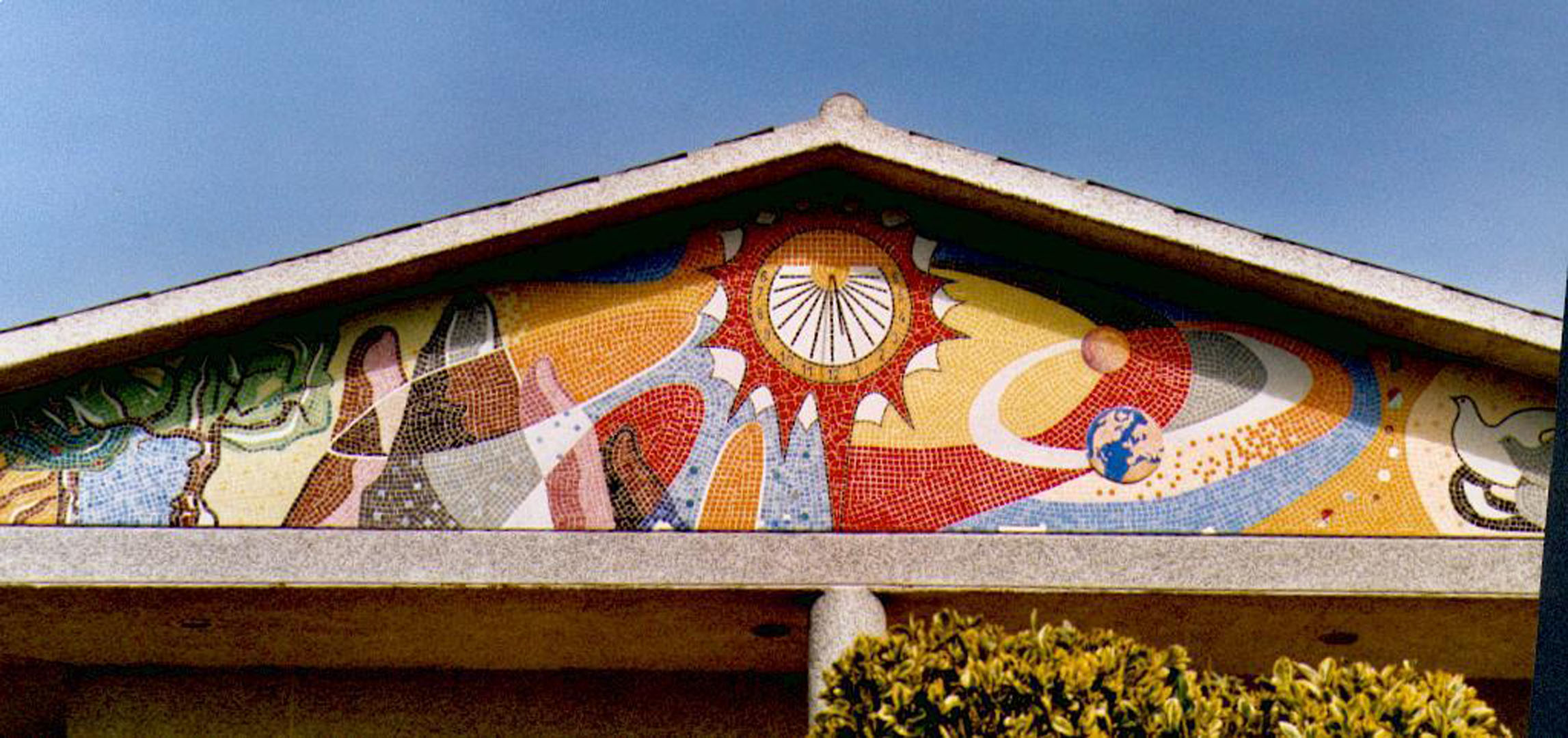
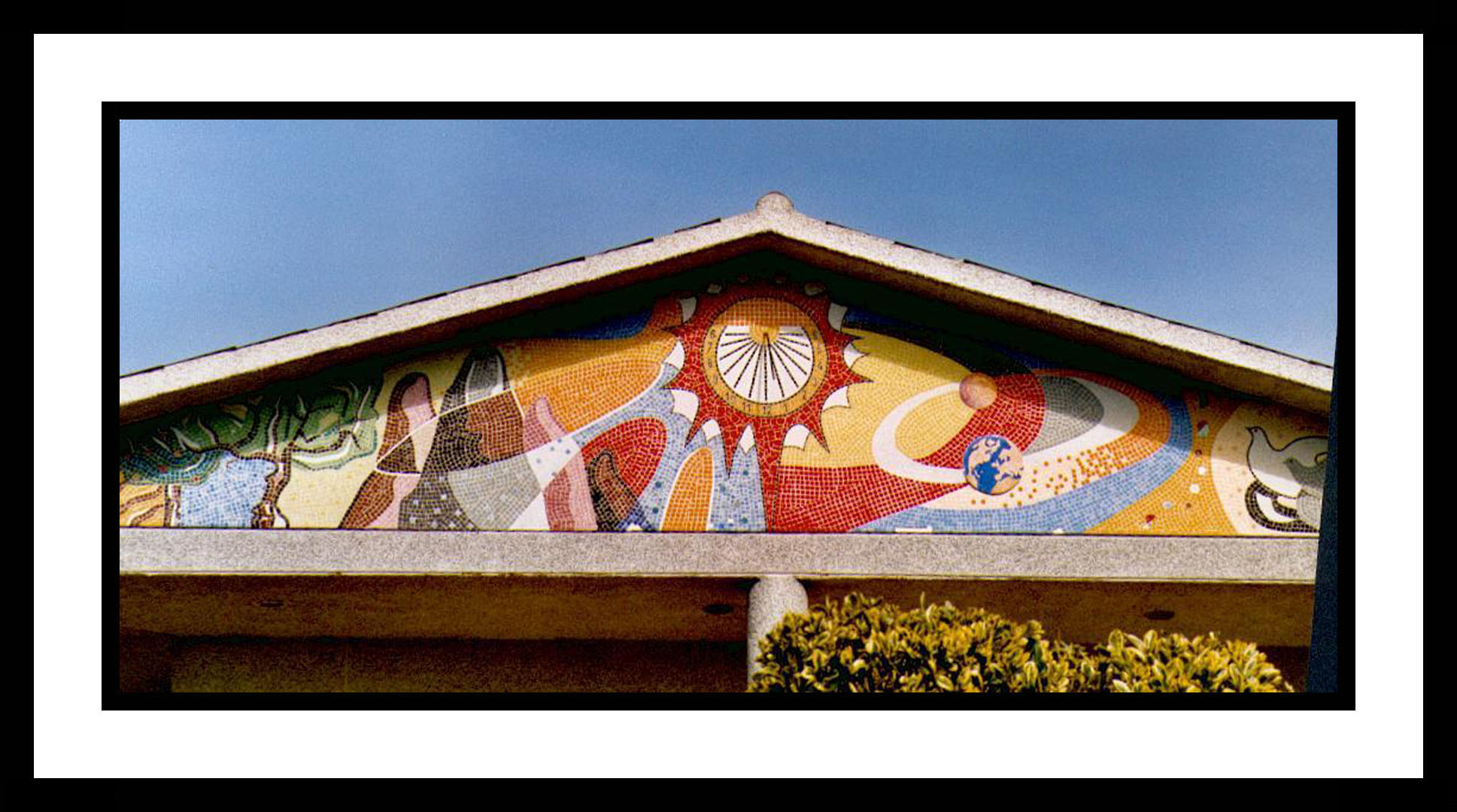
Delineator: unknown Ceramic Artist: Marbel Date: unknown Original Location: Carretera de Cànoves s/n, km 0.2- Cardedeu, Catalonia, Spain Present Location: at original location Orientation: Vertical. Declines by unknown amount, but it might be due south from looking at the photo. Size: unknown Adornment: This is a colorful modernistic design with stylized nuns, dove, trees, moon, and earth. Mottos: none Condition: excellent Comment: We need better high resolution photos of this dial. Gnomonica Website: Here Conxita Bou Vilalta’s Email: Here Photo Descriptions: Photo is from the gnomonica.cat website and was sent to us by Conxita Bou Vilalta in 2009. Photo is used with permission from gnomonica.cat. Please do not copy this photo without permission. Photos: a |
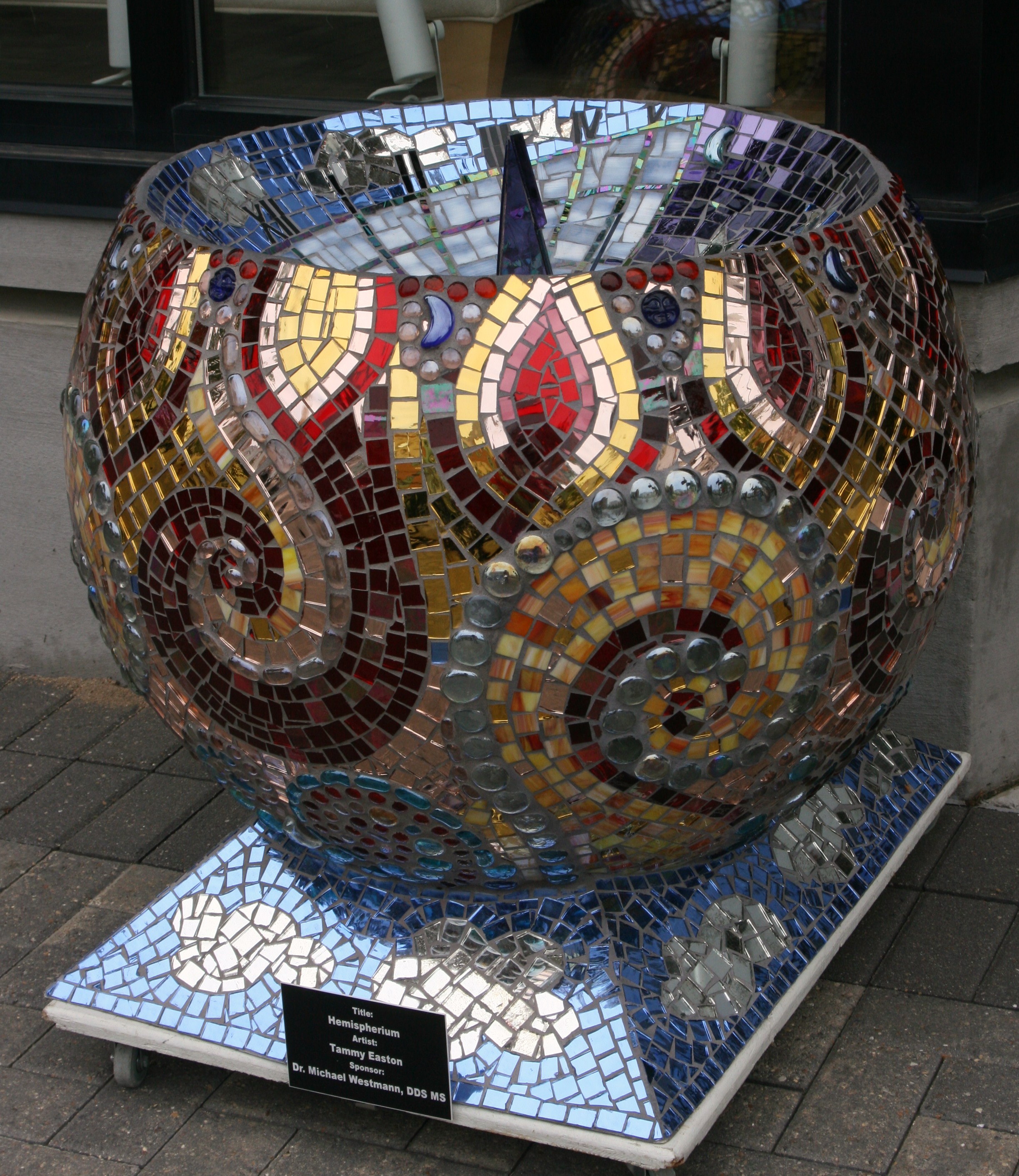
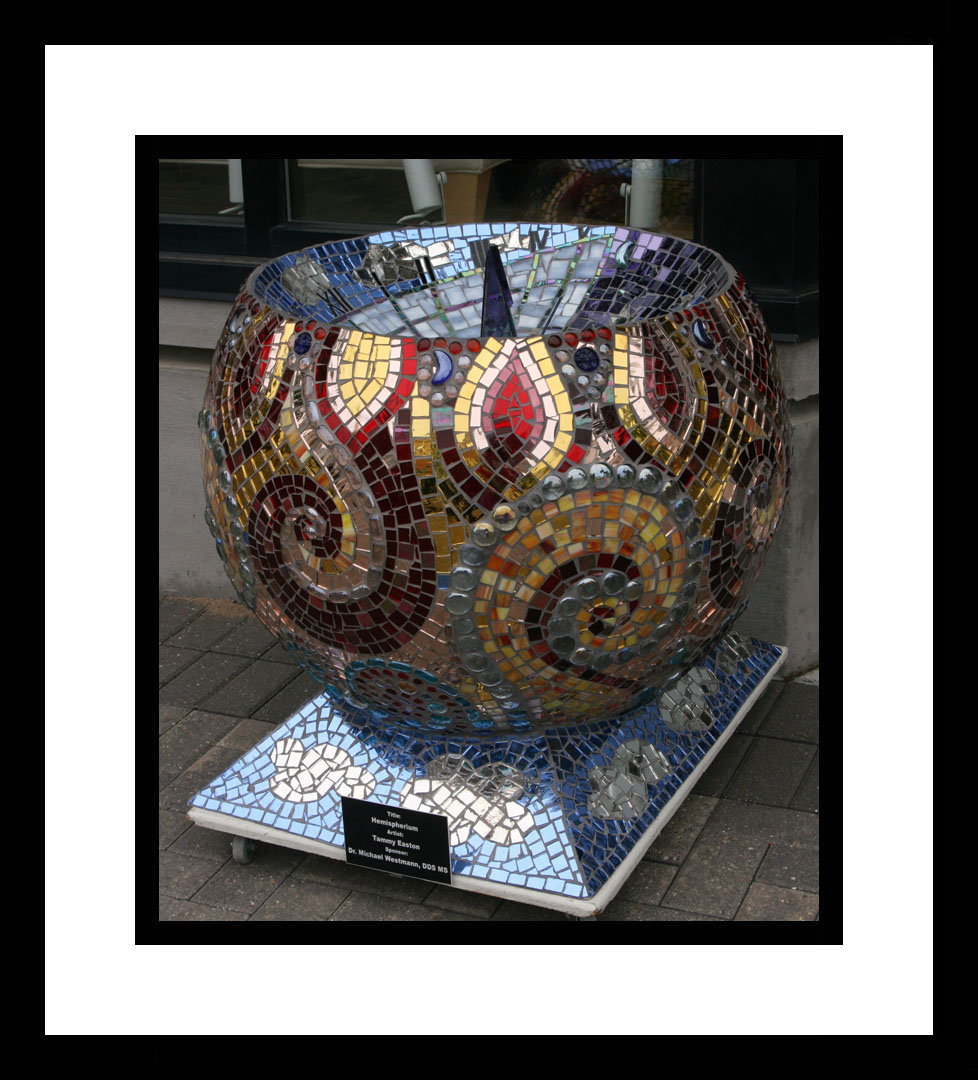
Delineator: unknown Mosaic Artist: Tammy Easton Date: 2008 Original Location: This was put on display in June of 2008 as part of a public art event in Racine Wisconsin USA 2008 called Sphere Madness. The location for which it was designed is not known. It was auctioned off to the highest bidder in Sept, 2008. Present Location: unknown Orientation: equatorial Size: unknown Inscriptions: unknown Mottos: unknown Condition: excellent in 2008 Comments: We’d like more information and other photos of this dial. Artists were given a white sphere on a base and a sponsoring company paid for the art supplies to create an original work of art. Photo Descriptions: Photos are by Kathy (last name unknown) and are used with her permission. Photo ‘a’ Flickr Website: Here Photo ‘b’ Flickr Website: Here Photos: a b |
 |
 |
 |
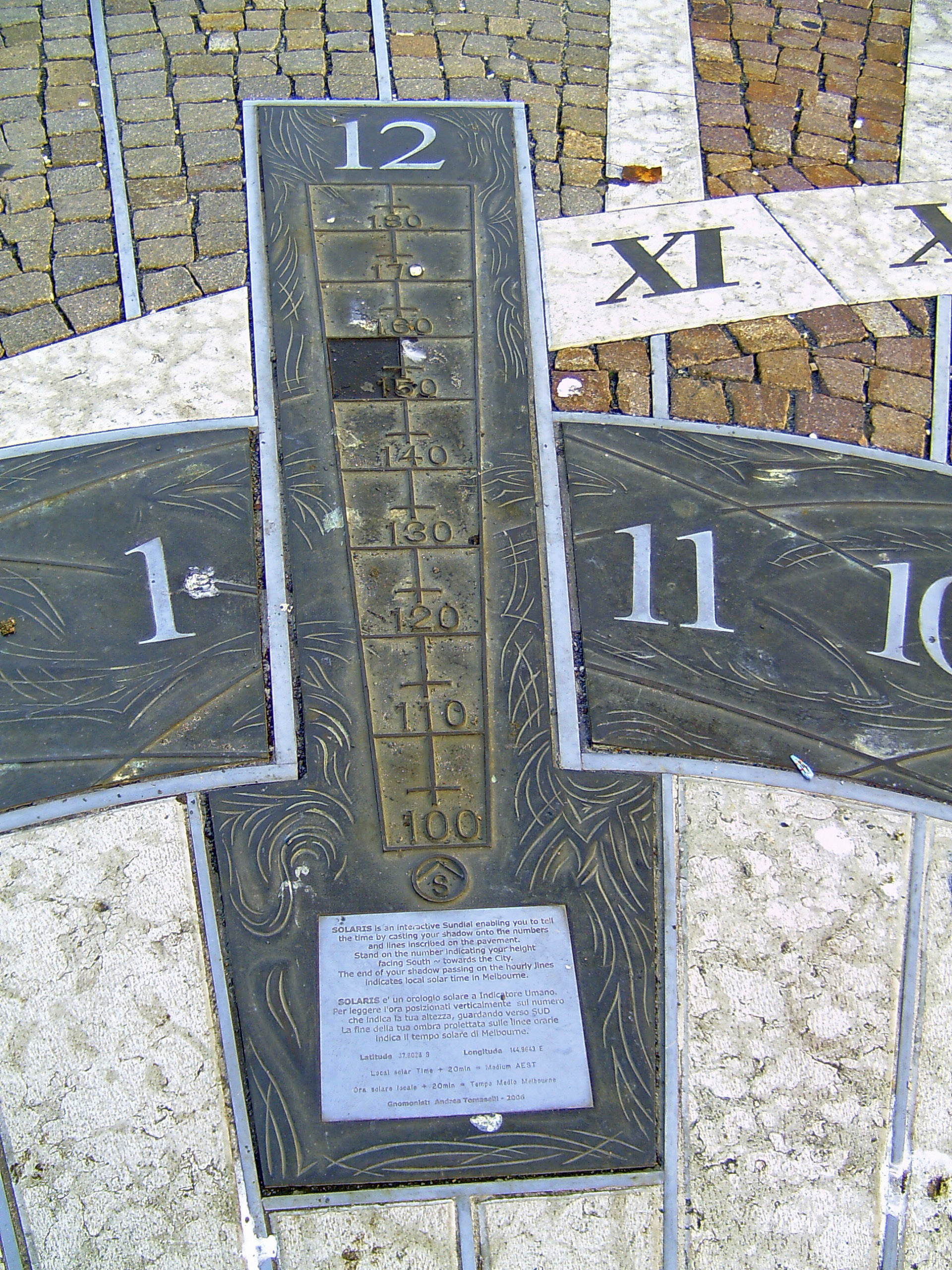
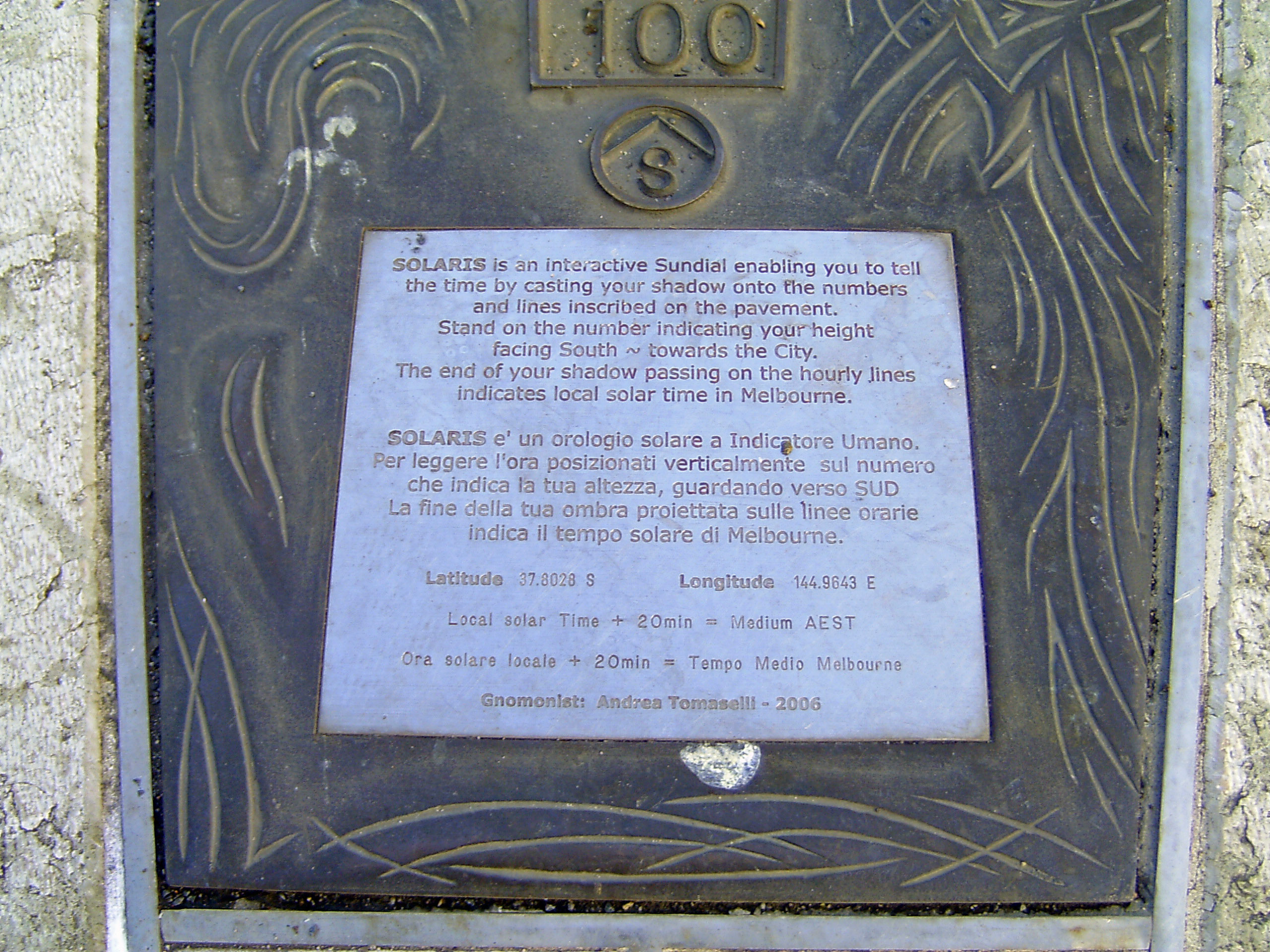
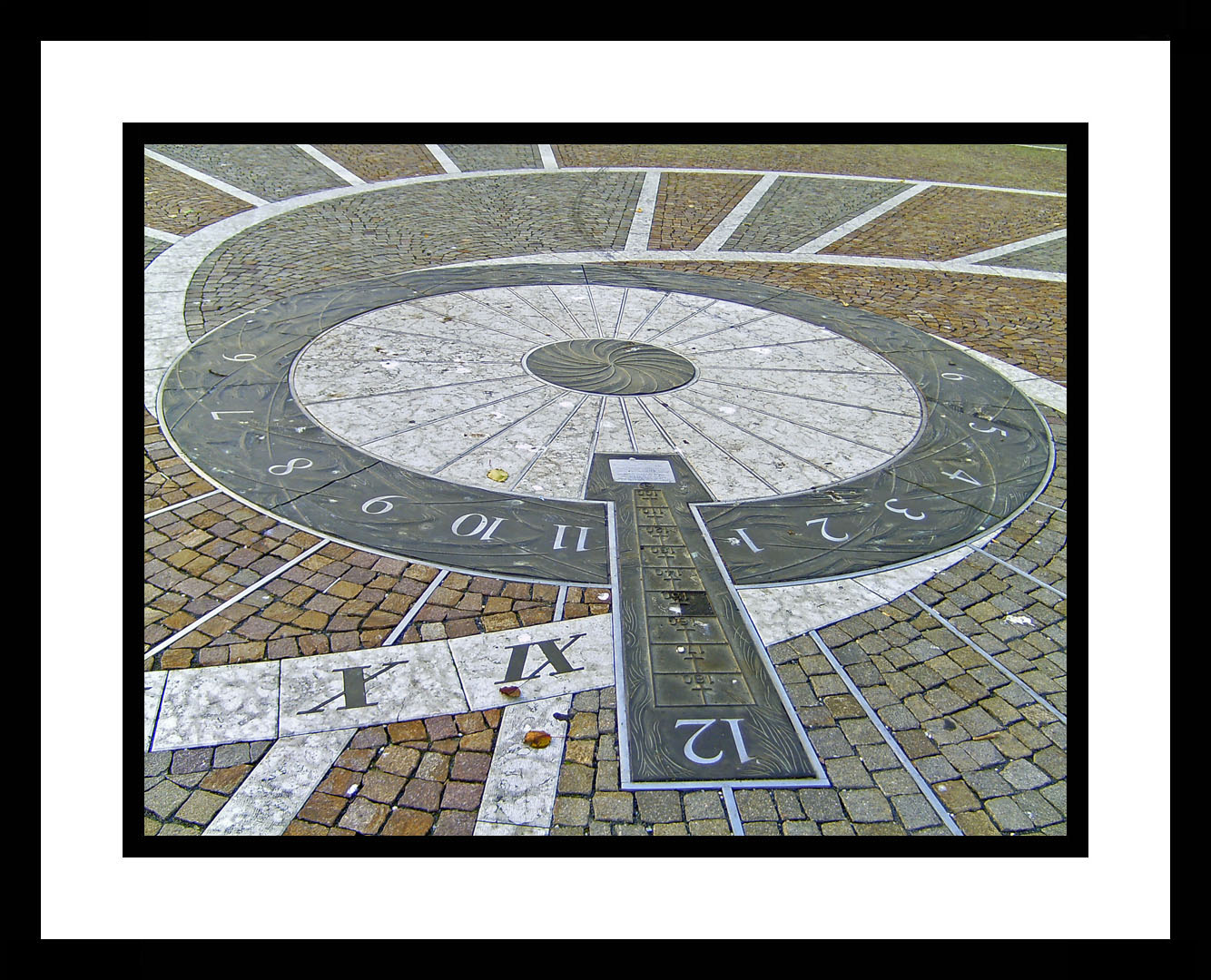
| Delineator: Andrea Tomaselli’s Italian Porphyry group. Commissioned by the City of Melbourne to recognize Italian migration to Australia. Ceramic Artists: Builders 2 Construct and O’Connor & Sons Stonemasons Date: installed in 2005 Original Location: Lat: 37° 48’ 8.78” S, Lon: 144° 57’ 57.19” E. At Argyle Square on Lygon St. in the suburb of Carlton, Melbourne Victoria, Australia. The square is referred to as Carlton's "Piazza Italia" since it seems two Australians went to Italy to study the art of working in this sort of stone and came back and built the square. Present Location: at original location Orientation: horizontal Size: 45 m. x 45 m. (147 ft. x 147 ft.) Adornment: interesting spiral design that draws the eyes to the dial. Inscriptions: unknown Mottos: none Condition: excellent in 2010 Comments: This is a rare interactive type of sundial that uses a human gnomon. The user stands on a height mark that is labled with the user’s height. The shadow of the top of user’s head incates the time. Dial face is made from porphyry cobblestone, and possibly marble and bronze. According to the infolink website below: “The design of the solar clock is the work of Andrea Tomaselli’s Italian Porphyry group and continues their fascination with time pieces and public space. In order to make the 45 m2 solar clock (or sundial) keep the correct time, the stonemasonry had to be exact and so GPS equipment was used to ensure the stone laying was totally precise. All this added an extra layer of complexity and challenge to the job”. The instructions say that the reader should face South towards the city of Melbourne. People may not realise looking south is away from the centre of the dial. People may forget that the sun is to the North in Australia. References: Much of this information was supplied by dialists Patrick Powers, Fer de Vries, and Roderick Wall who found the websites below. Thank you! Flickr Website: Here Flickr Website: Here Infolink Website: Here Porphry Website: Here Italian Porphry Website: Here Another Website: Here Another Website: Here Another Website: Here Another Website: Here Email: Photo Descriptions: Photos are courtesy of Roderick Wall and were taken in 2010 on an overcast day. Photos ‘a’ thru ‘e’ show the dial face. Photo ‘f’ shows the human gnomon height marks. Photo ‘g’ shows the instruction plaque. There are more photos in the websites above. Photos: a b c d e f g |
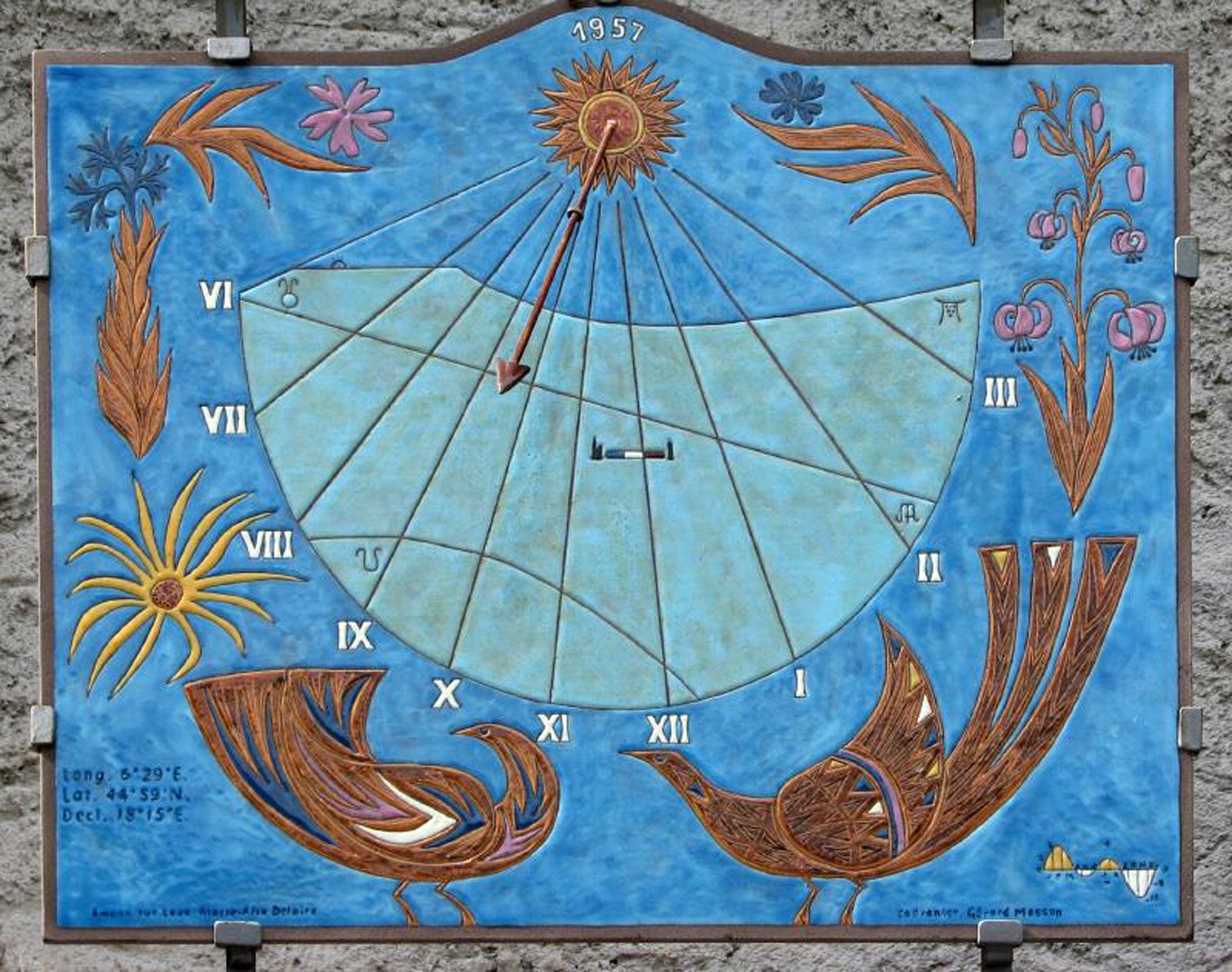
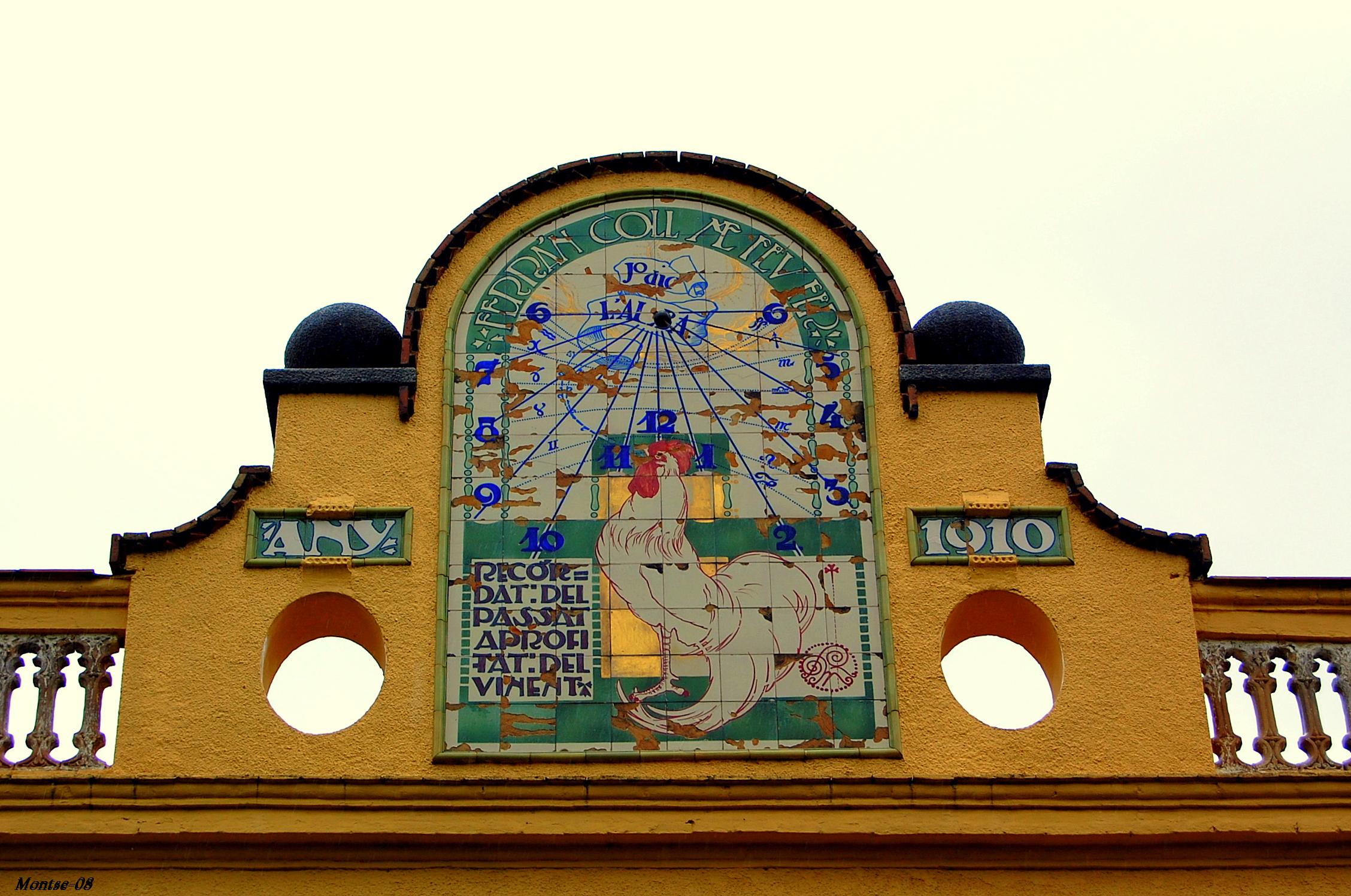
Designer & Maker: Manuel Raspall Date: 1910 Original Location: Home of Juli Barbey and Poinsard (la Garriga-Vallès Oriental-Catalunya), Spain Present Location: at original location Orientation: Vertical. Declines slightly east of south. Size: approximately 1.8 x 1.5 m (71 x 59 in) Adornment: smiling sun, leaves and flowers- typical modernist decorations. Inscriptions: none Mottos: none Condition: probably good Comments: very handsome! Tiscali Website: Here Creative Commons Attribution ShareAlike 2.5 License: Here Photo Descriptions: Photo ‘c’ is copied from website above and is by ca-user-amadalvarez taken in 2007. licensed by the copyright holder under the Creative Commons Attribution ShareAlike 2.5 License below. In short: you are free to share and make derivative works of the file under the conditions that you appropriately attribute it, and that you distribute it only under a license identical to the one above. Other photos were taken by Conista Bou Vilalta in 2009 and sent to us by her. Photos: a b c d |
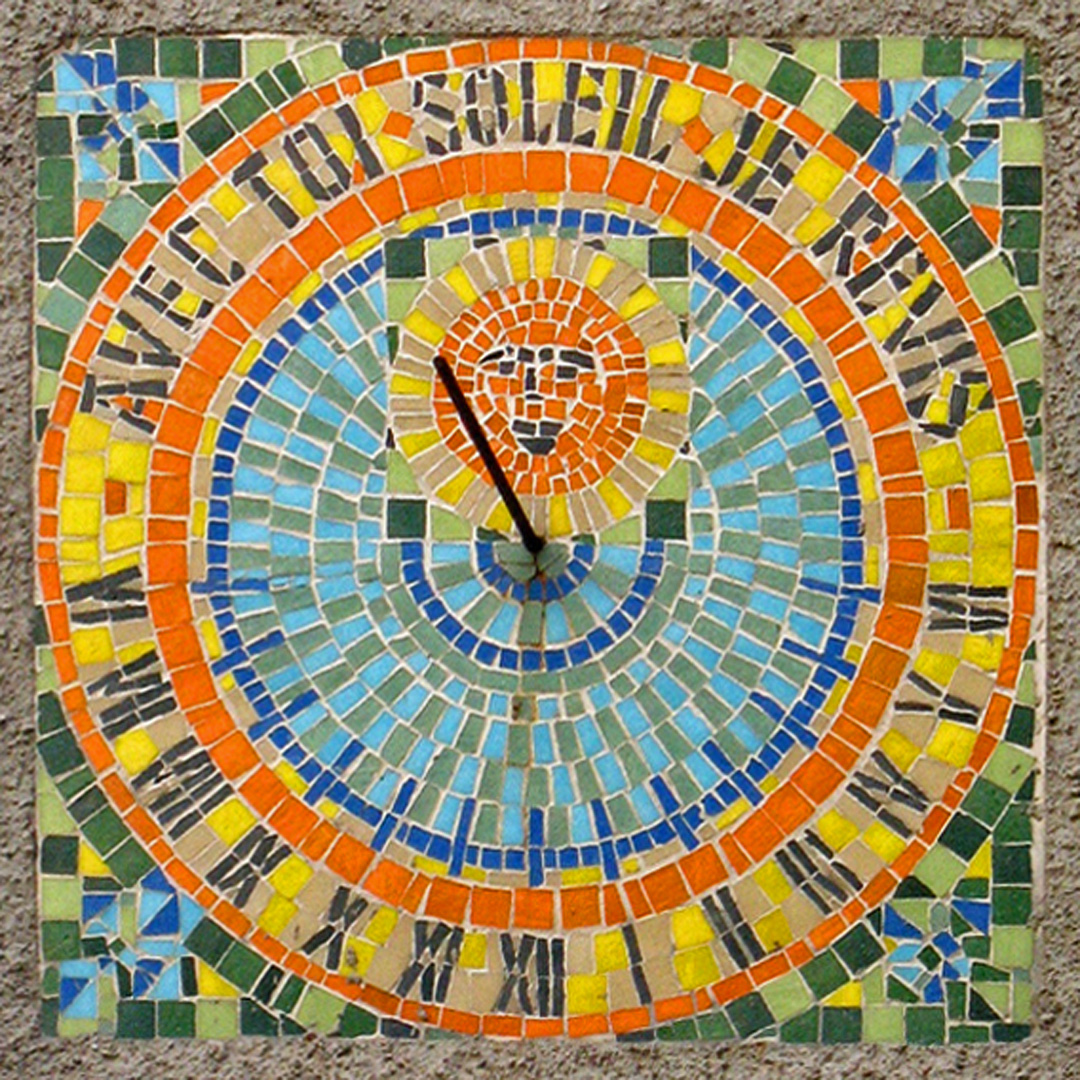
Delineator: unknown Mosaic Artist: unknown Date: unknown Original Location: Unknown. Probably somewhere in France because inscriptions are in French. Present Location: at original location Orientation: Inclination-vertical. Declination unknown. Size: unknown Adornment: none Inscriptions: AVEC TOI SOLEIL JE REVIS Mottos: none Condition: excellent in 2010 Comments: This is a mosaic dial. We’d like more information about this dial. While pretty to look at, it appears that this dial is severely flawed because it was improperly designed. The gnomon is perpendicular and is not oriented to the polar axis. The hour marks are also improperly located for this type of gnomon. Photo Descriptions: Photo ‘a’ is a photoshopped copy of photo ‘b’ which is by Elisebetta Cacioppo Nessuno Flickr Website: Here Photos: a b |
 |
 |
 |
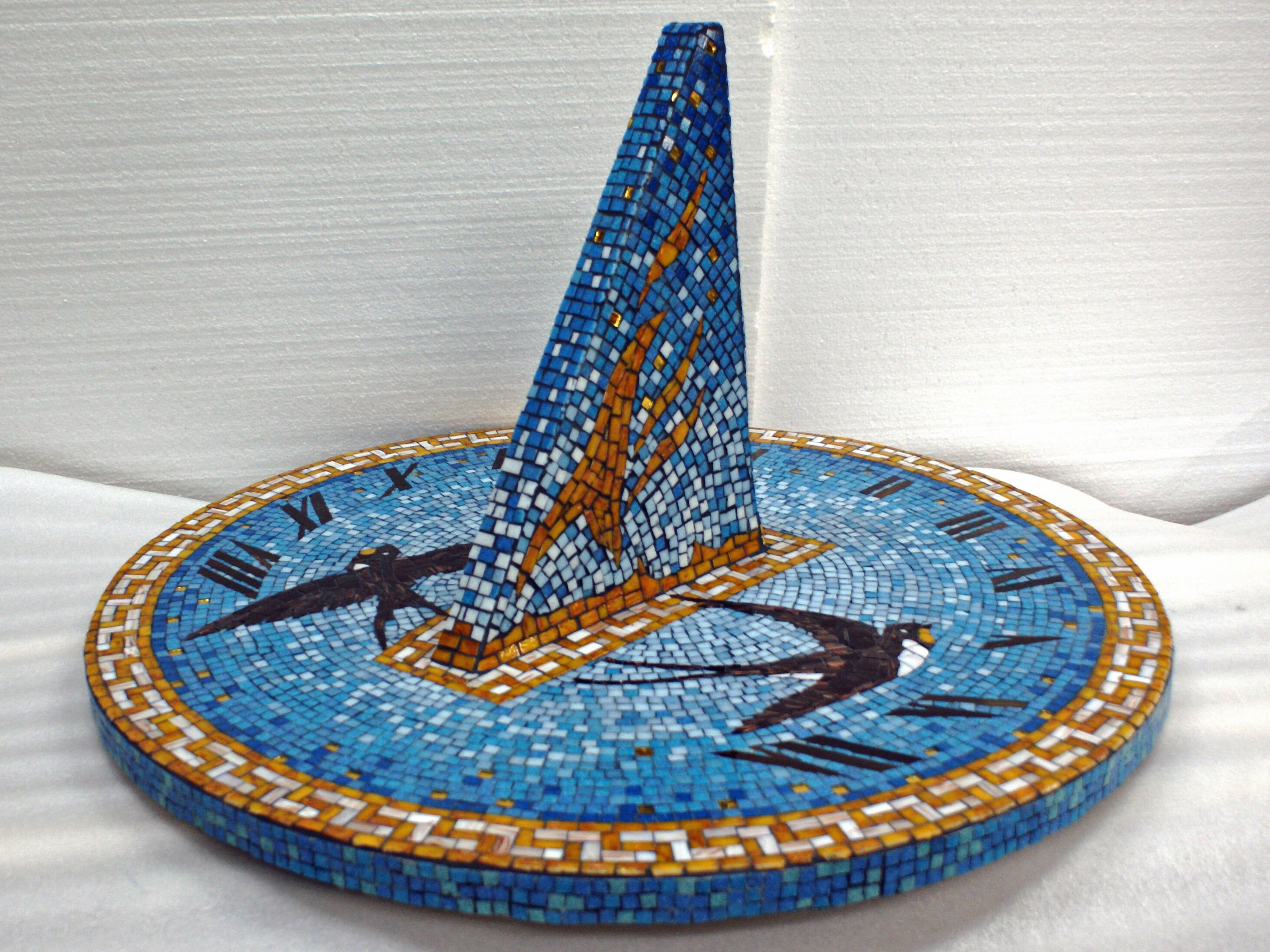
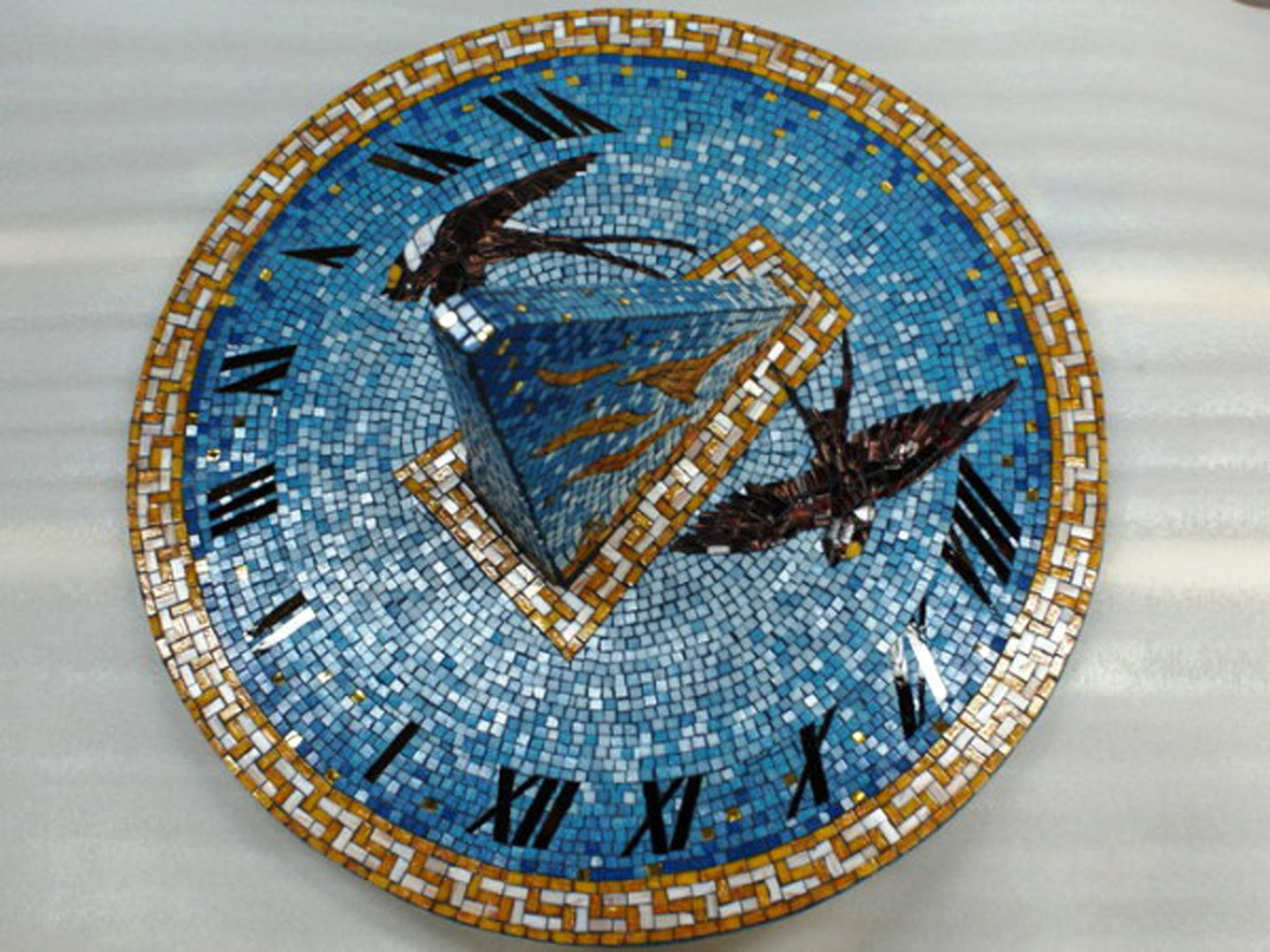
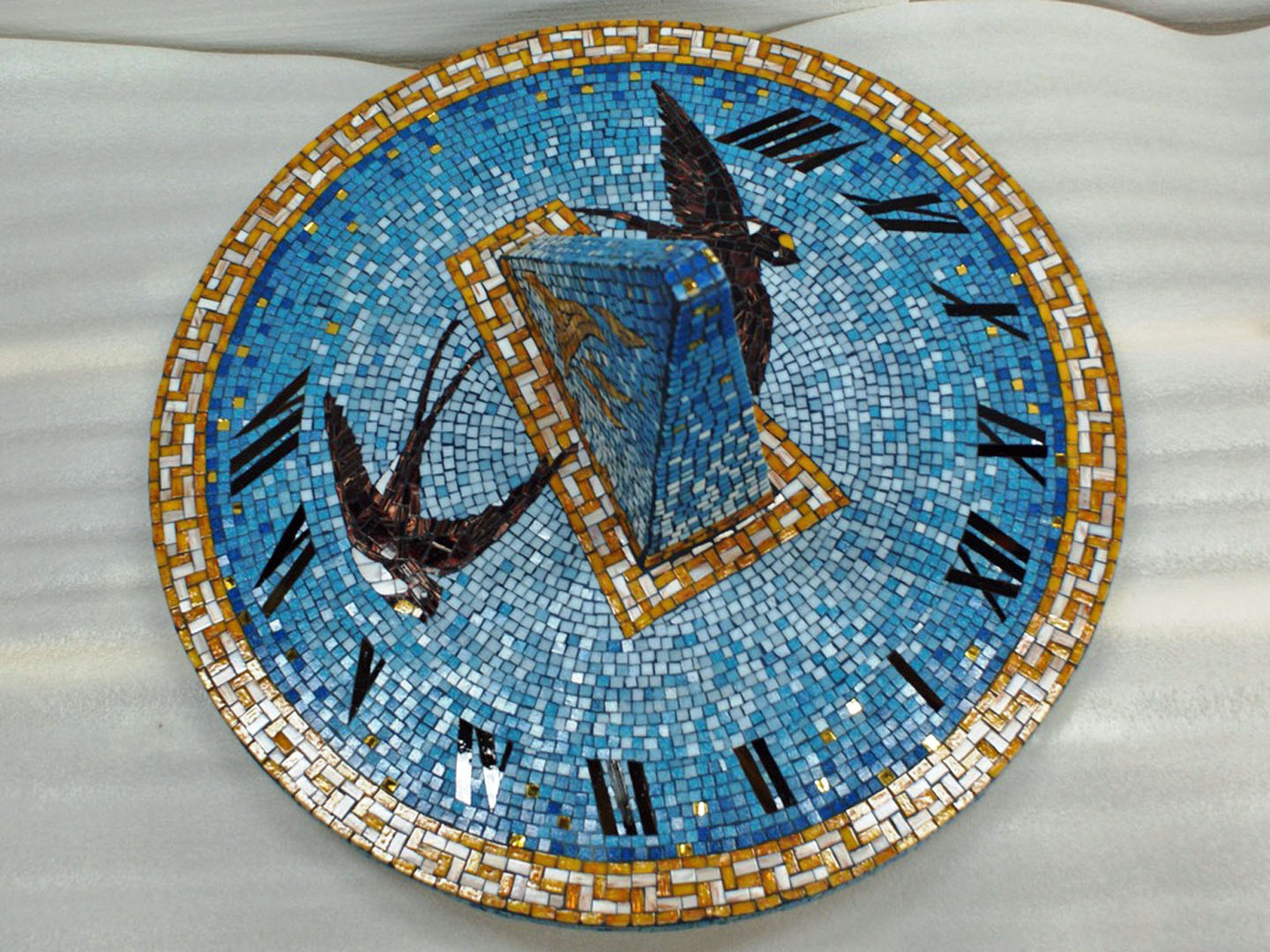
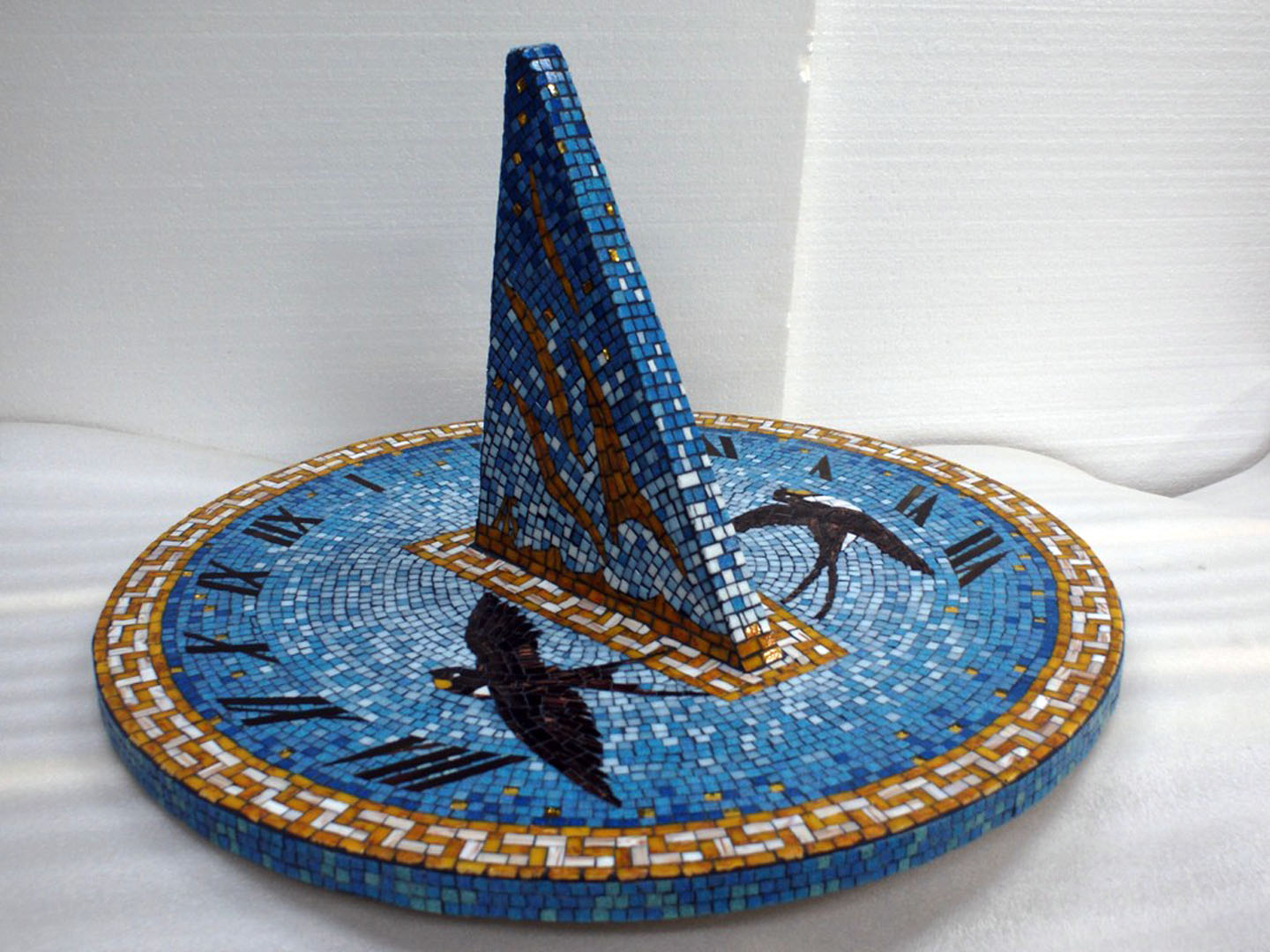
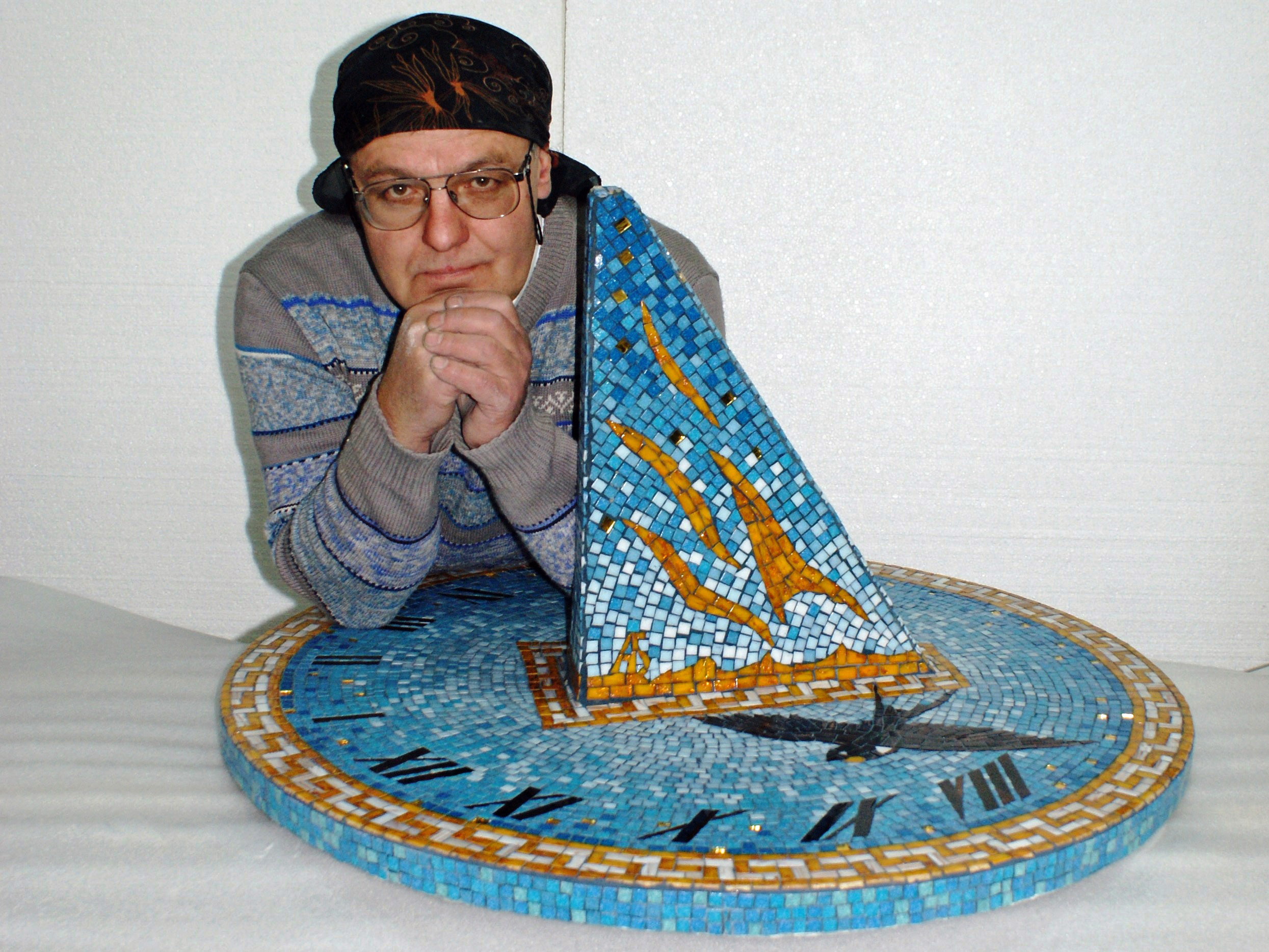
| Delineator: Aleksandr Boldyrev Artist: Aleksandr Boldyrev Date: 2009 Original Location: Aleksandr Boldyrev’s workshop in Moscow Russia Present Location: Aleksandr Boldyrev’s workshop in Moscow Russia Orientation: Inclination: horizontal Size: Small 10 x 10 mm tiles are on a round concrete base that is 850 mm (33 in) in diameter, and 45 mm (1.77 in) thick. Adornment: a beautiful mosaic dial! Swallows against blue sky is a favorite theme on antique mosaics. Ancient Greeks considered swallows as birds that bring spring, and the image of these birds accelerates its arrival. But even when it is cloudy and cold, and all swallows have departed to warm countries, how pleasant it is to see the blue sky and to recollect the summer! Mottos: none Inscriptions: none Condition: excellent in November of 2009 Comments: We are seeking more information about this dial- specifically, were it is located today. Photos Website: Here Photos ‘b’ and ‘c’ Website: Here Boldyrev’s Email: Here Photo Description: Photos are courtesy of Aleksandr Boldyrev, and he sent them to us. Photos: a b c d e f |
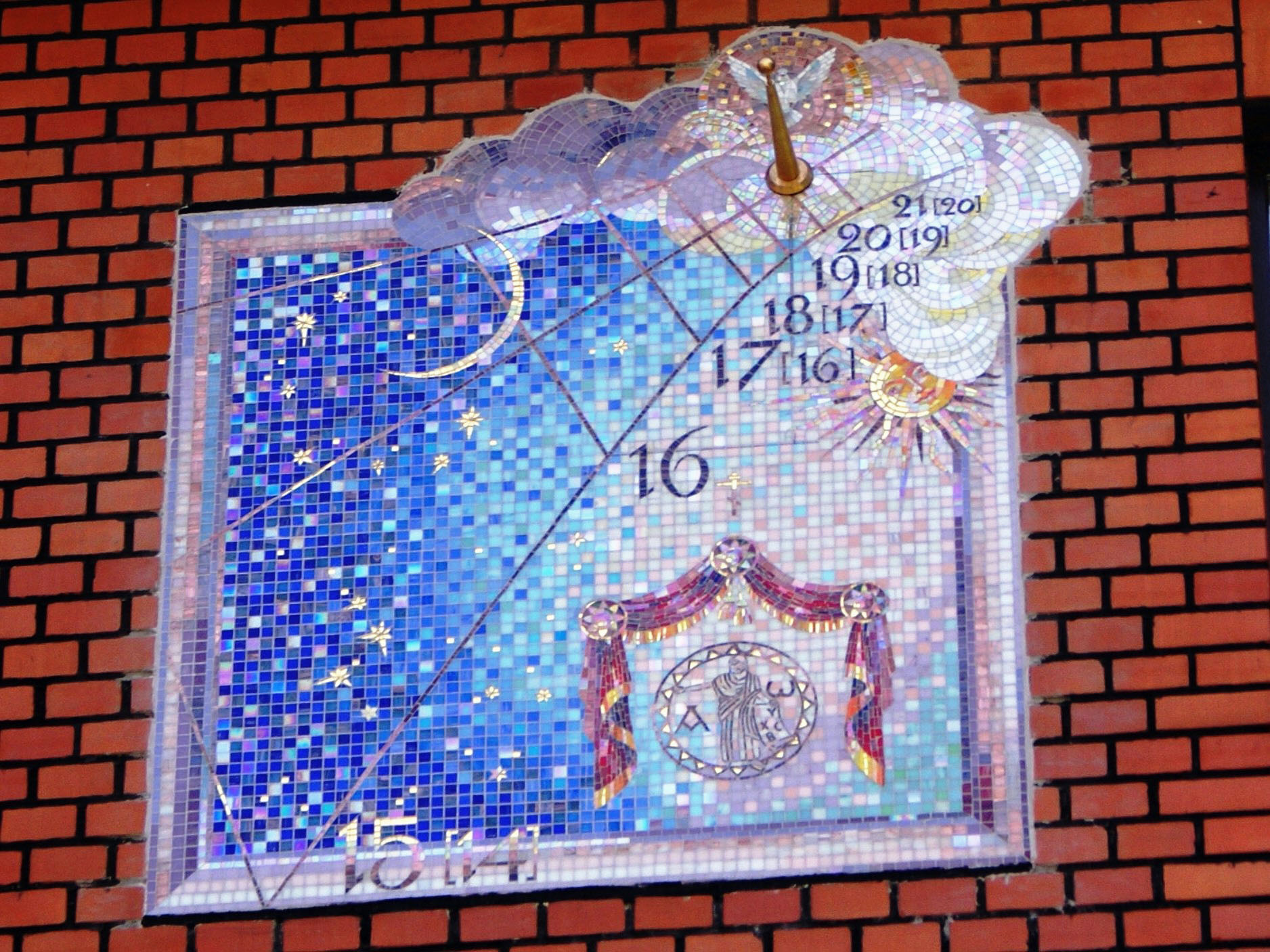
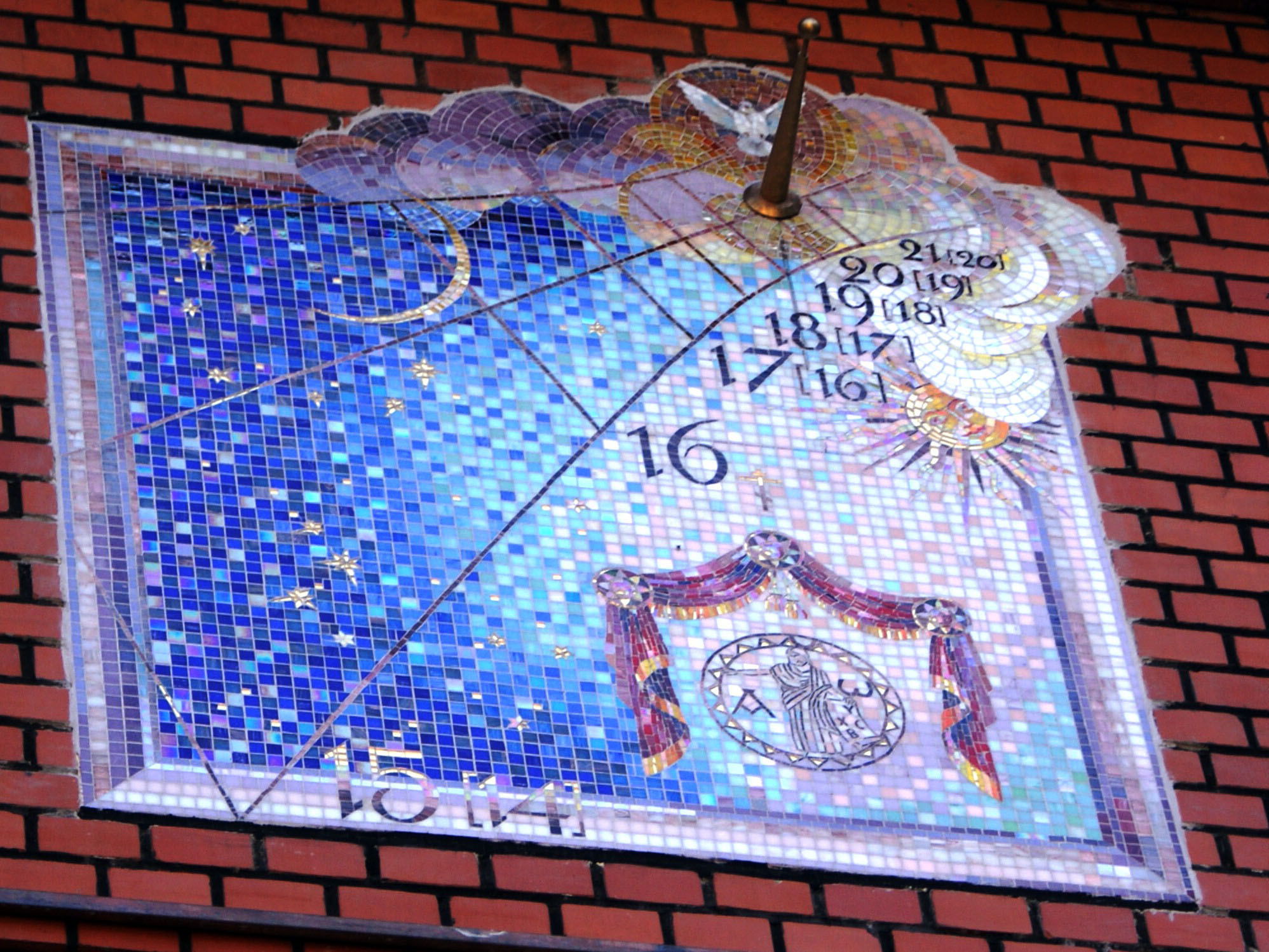
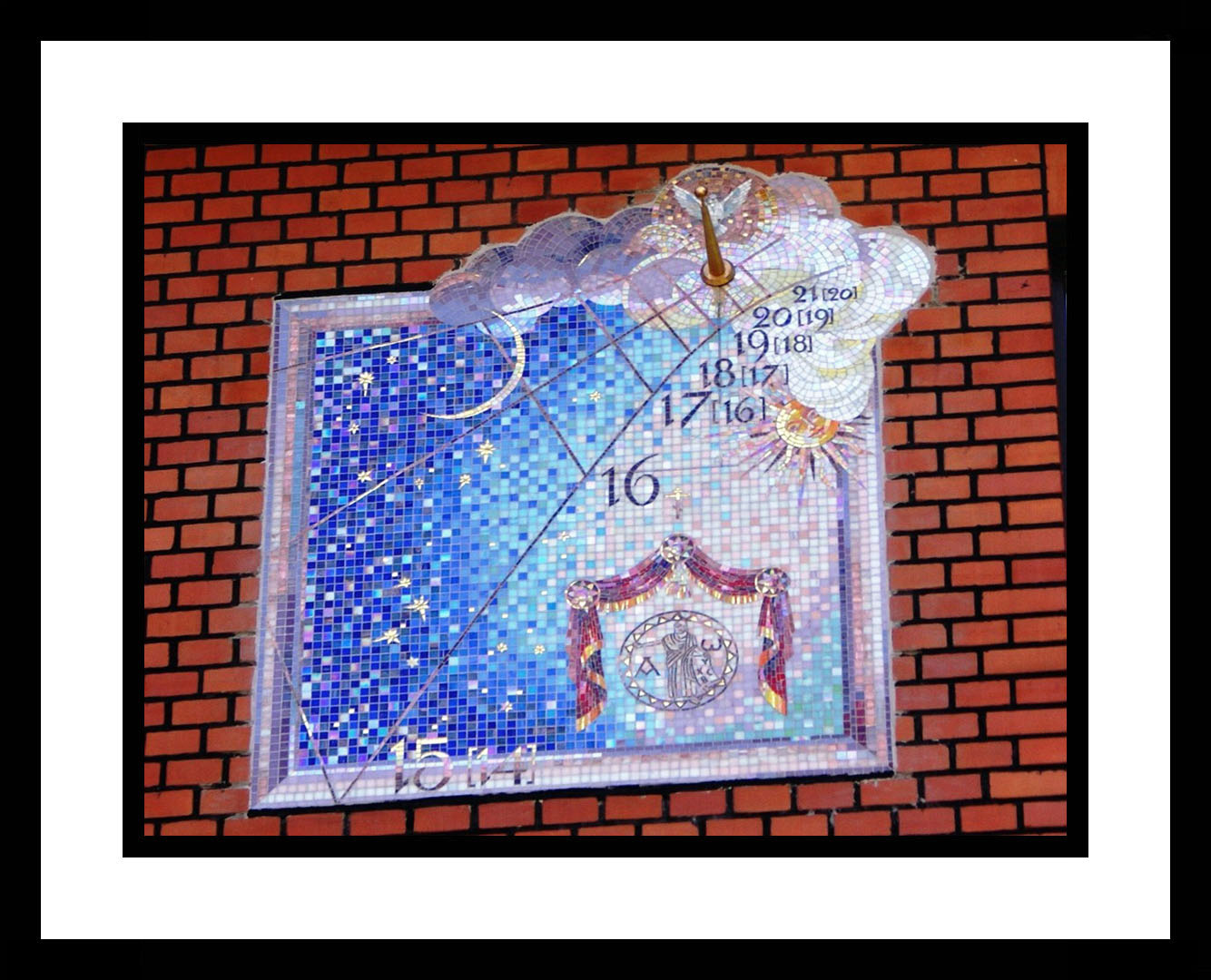
Delineator and Gnomon: Aleksandr Boldyrev Mosaic Artists: Irina Volkova, Eugeny Volkov. Date: installed on June, 2009 Original Location: Lat. 55° 50’ 02.97” N, Lon.38° 05’ 02.46” E. On a brick wall of unknown home in unknown private sundial park in the village of Shevelkino near Moscow Russia. It is on the same building as Dials 460, 461 and 462. Present Location: at original location Orientation: Inclination: vertical, Declination: West Size: Small 10 x 10 mm mosaic tiles. Dimensions of face- 1.5 x 1.5 m (59 x 59 in) Adornment: a beautiful mosaic dial! In the uppermost part of the sundial on the clouds background is a white pigeon, a symbol of the Holy Spirit. The background represents the transition of night into day and is decorated by images of the sun, moon and stars. In the bottom part of the dial is the logo of the Church - "the Orthodox Encyclopedia". Mottos: none Inscriptions: none Condition: excellent in November of 2009 Comments: We are seeking more information about this dial- specifically, were exactly it is located. The perpendicular rod gnomon indicates the days of equinoxes and solstices. Photo ‘a’ Website: Here Boldyrev’s Email: Here Photo Description: Photos are courtesy of Aleksandr Boldyrev, and he sent them to us. Photos: a b |
Delineator: unknown Mosaic Artist: unknown Date: unknown but probably old Original Location: unknown building in Studbrak Bielefeld, Germany Present Location: at original location Orientation: Inclination-vertical. Declination unknown Size: unknown, but it is quite large Adornment: large sunface in center Inscriptions: none Mottos: none Condition: missing some mosaic tiles Comments: We’d like more information about this dial. Photo Descriptions: Photos by © O de Andrade's Flickr Website: Here Flickr Website: Here Flickr Website: Here Photos: a b c |
 |
 |
 |
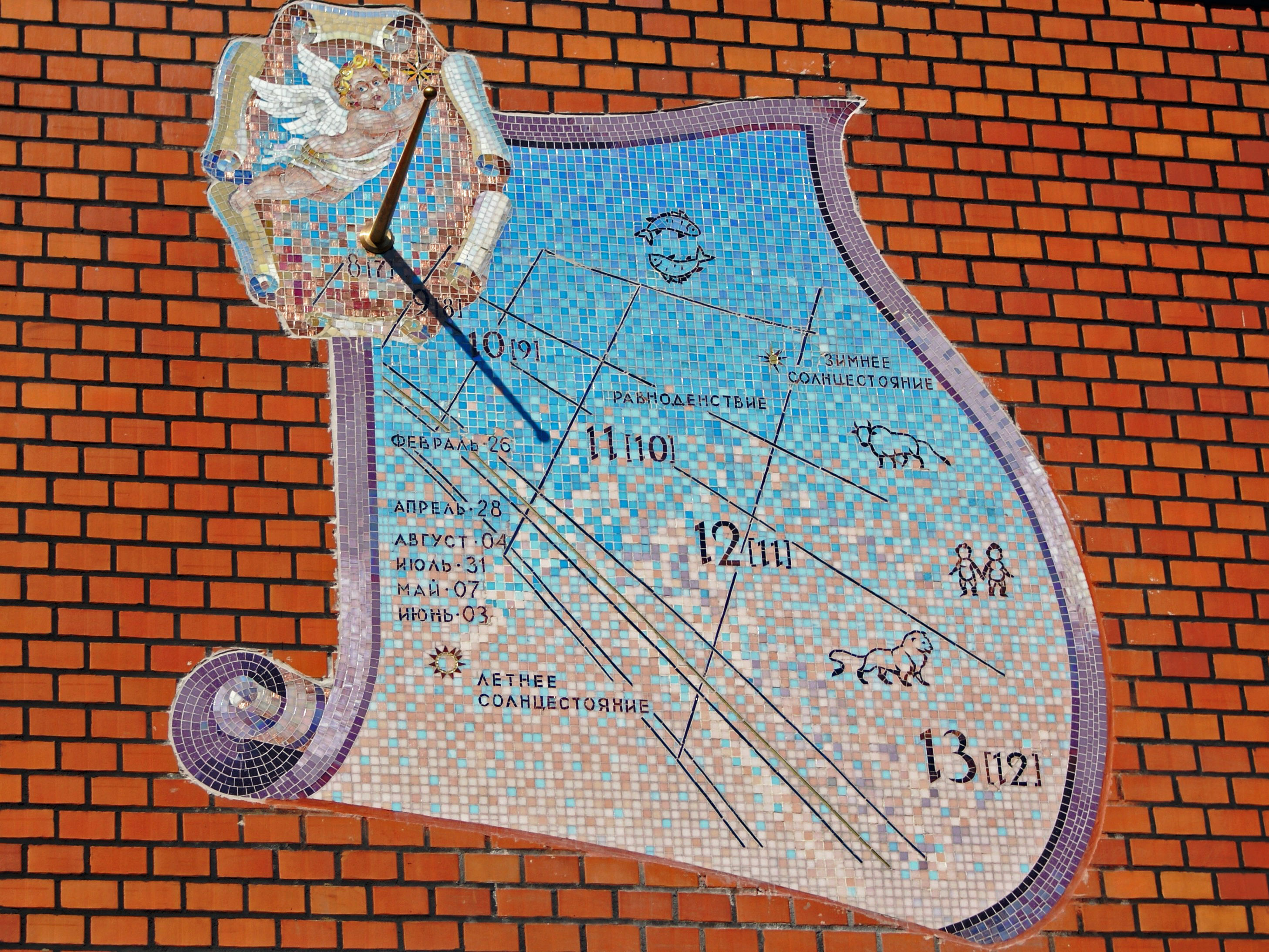
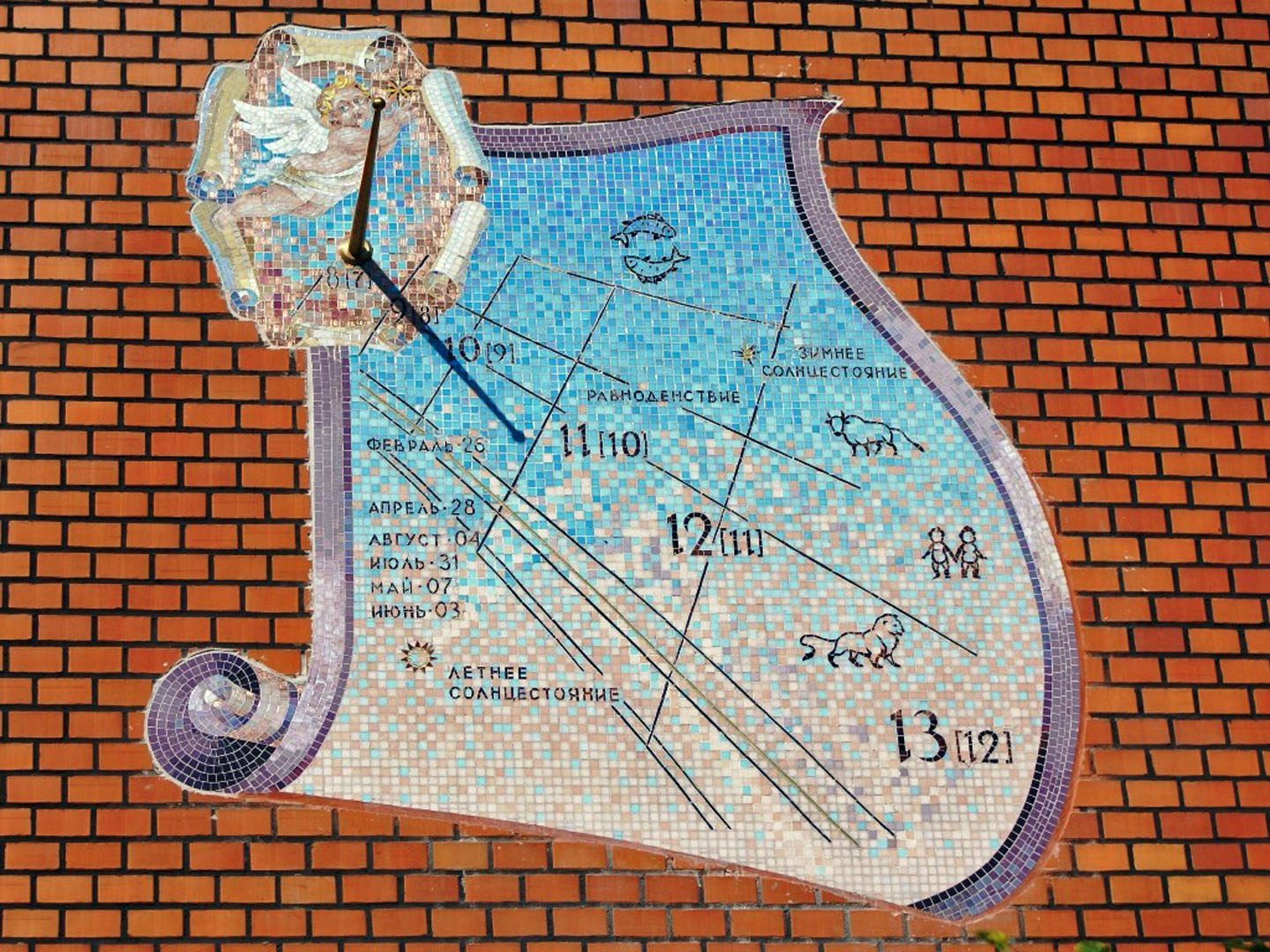
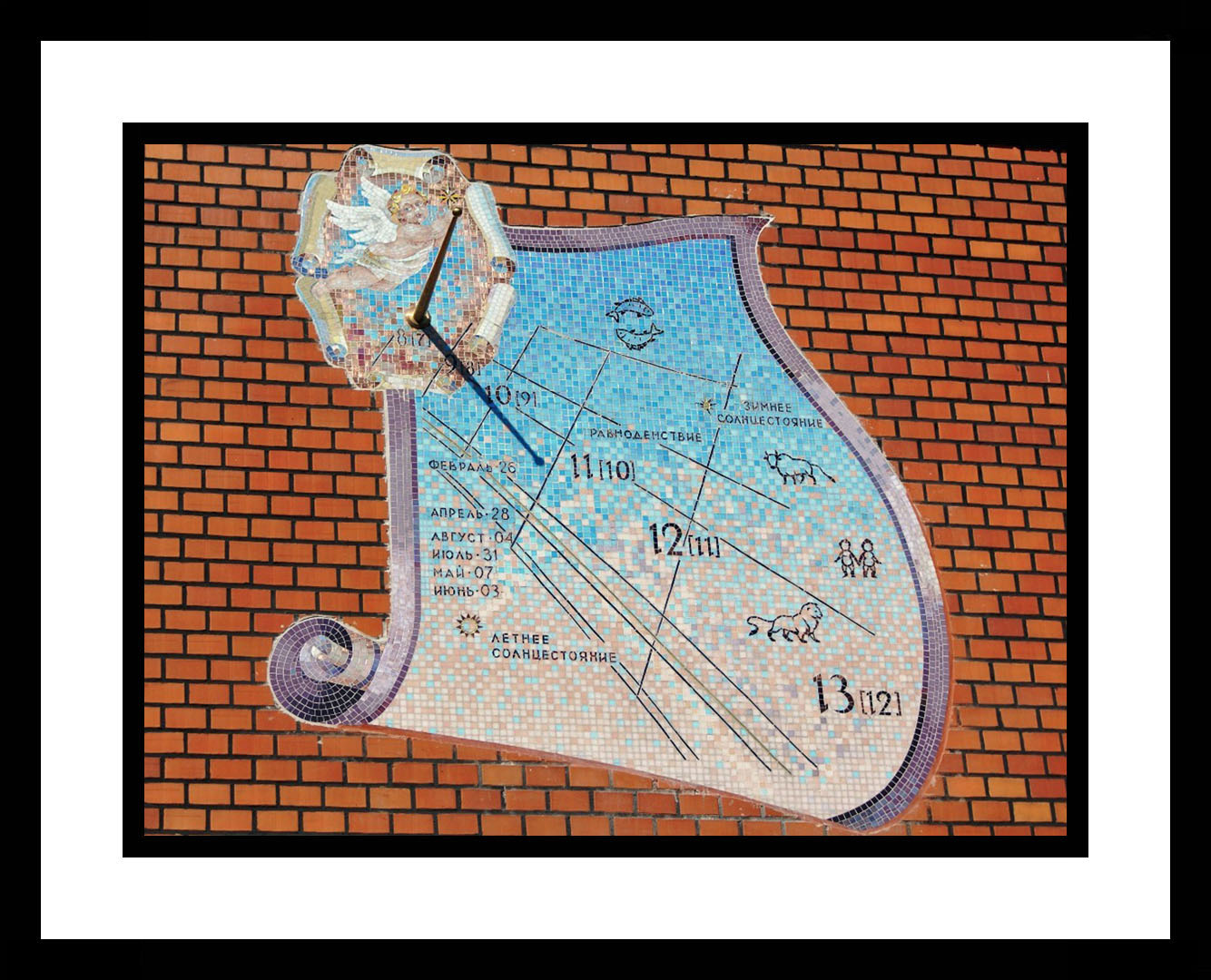
| Delineator and Gnomon: Aleksandr Boldyrev Mosaic Artists: Irina Volkova, Eugeny Volkov. Date: installed on June, 2009 Original Location: Lat. 55° 50’ 2.97” N, Lon. 38° 05’ 2.46” E. On a brick wall of unknown home in unknown private sundial park in the village of Shevelkino near Moscow Russia. It is on the same building as Dials 459, 461 and 462. Present Location: at original location Orientation: Inclination: vertical, Declination: East Size: Small 20 x 20 mm mosaic tiles. Dimensions of face- 2 x 1.7 m (78 x 70 in) Adornment: a beautiful mosaic tile dial! In the left top part of the device there is an image of an angel. Dial looks like a scroll. Mottos: none Inscriptions: present, but they are in Russian. We don’t know what they say in English. Condition: excellent in November of 2009 Comments: We are seeking more information about this dial- specifically, were exactly it is located. The perpendicular rod gnomon indicates the days of equinoxes and solstices and also points at seven anniversary lines. Photo ‘a’ Website: Here Boldyrev’s Email: Here Photo Description: Photos are courtesy of Aleksandr Boldyrev, and he sent them to us. Photos: a b c |
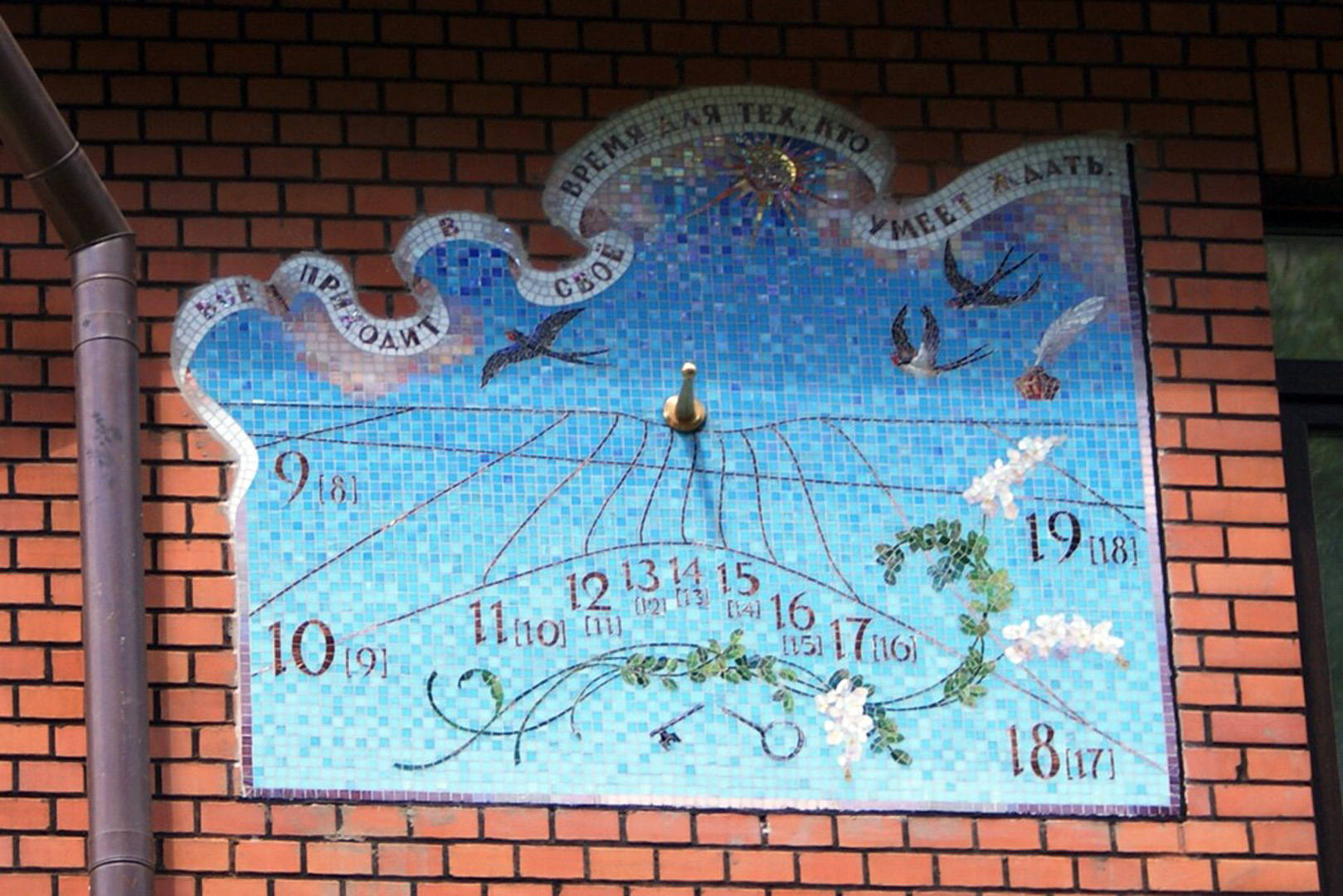
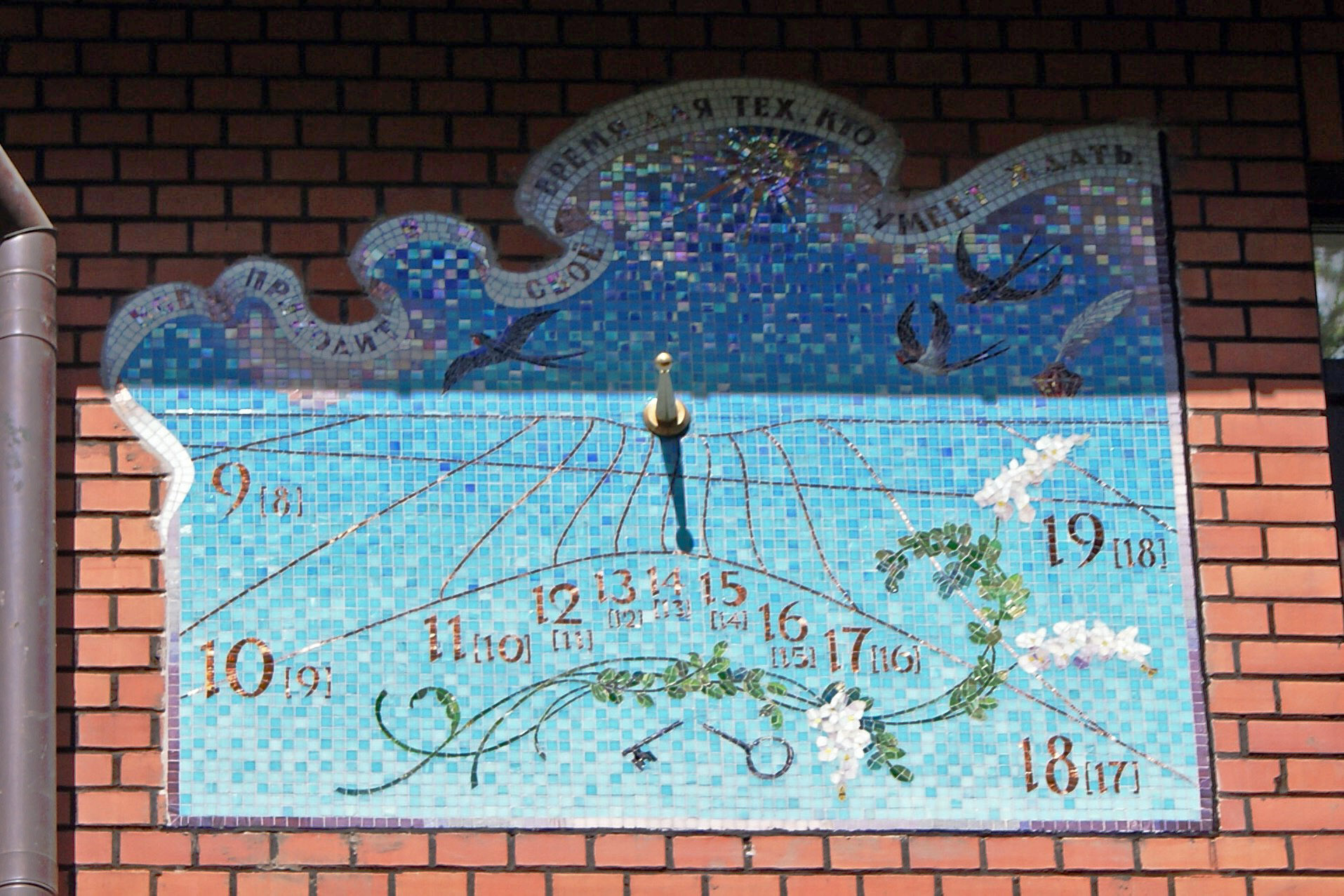
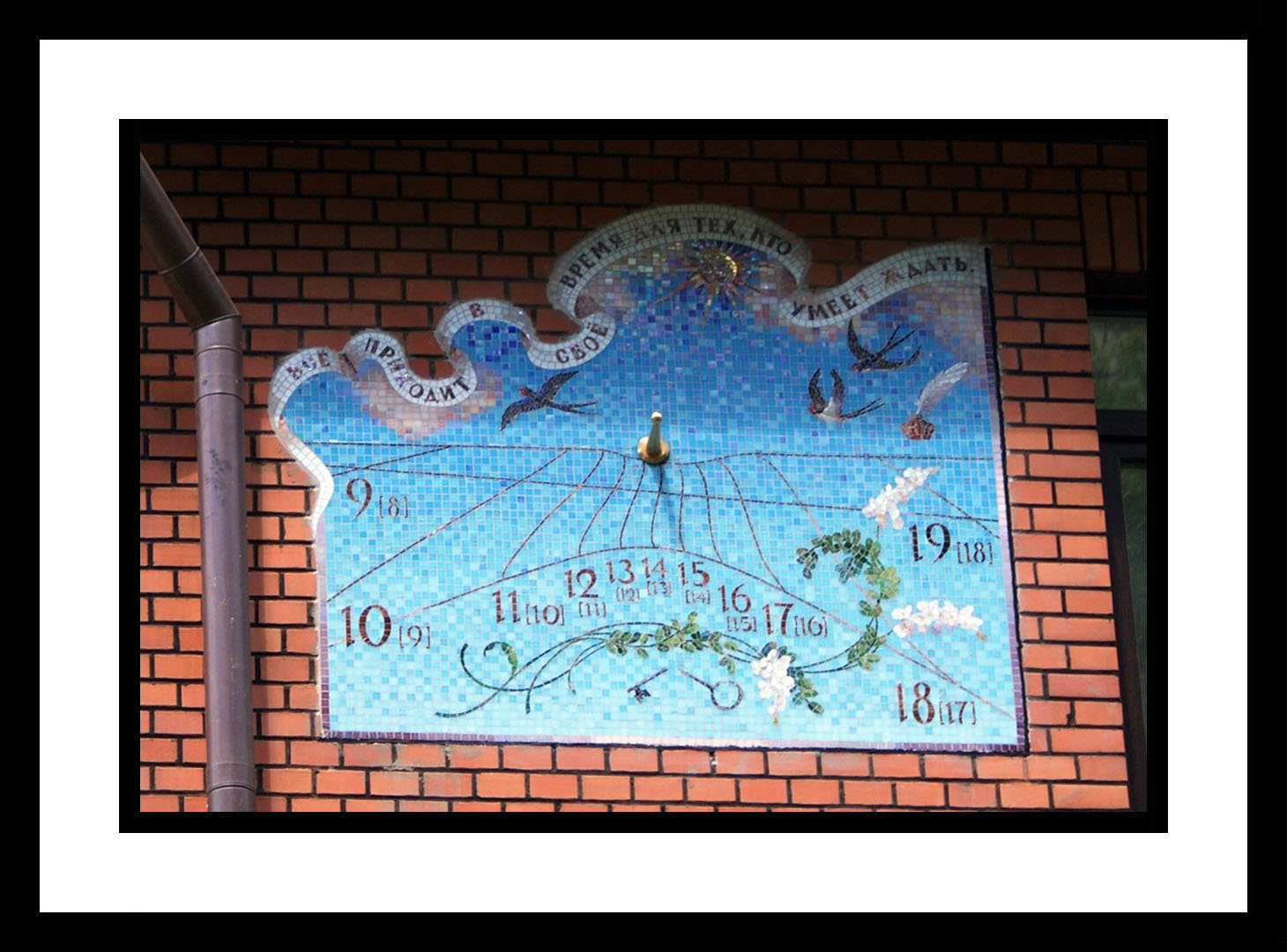
Delineator and Gnomon: Aleksandr Boldyrev Mosaic Artists: Irina Volkova, Eugeny Volkov. Date: installed on June, 2009 Original Location: Lat. 55° 50’ 2.97” N, Lon. 38° 05’ 2.46” E. On a brick wall of unknown home in unknown private sundial park in the village of Shevelkino near Moscow Russia. It is on the same building as Dials 459, 460 and 462. Present Location: at original location Orientation: Inclination: vertical, Declination: South Size: Small 10 x 10 mm mosaic tiles. Dimensions of face- 1.6 by 1.4m (63 x 55 in) Adornment: a beautiful mosaic tile dial! Features a golden sun image at the top. Below, there are flying swallows and an inkwell with an ancient feather against a celestial blue background. In the bottom part of the dial are a branch of white acacia, a cleanliness symbol, and the broken prison key. Mottos: In the top part of the sundial above the sun image there is a motto "All comes in due time for those who are able to wait". Inscriptions: none except the motto Condition: excellent in November of 2009 Comments: We are seeking more information about this dial- specifically, were exactly it is located. The perpendicular rod gnomon indicates the days of equinoxes and solstices. Photo ‘a’ Website: Here Boldyrev’s Email: Here Photo Description: Photos are courtesy of Aleksandr Boldyrev, and he sent them to us. Photos: a b c |
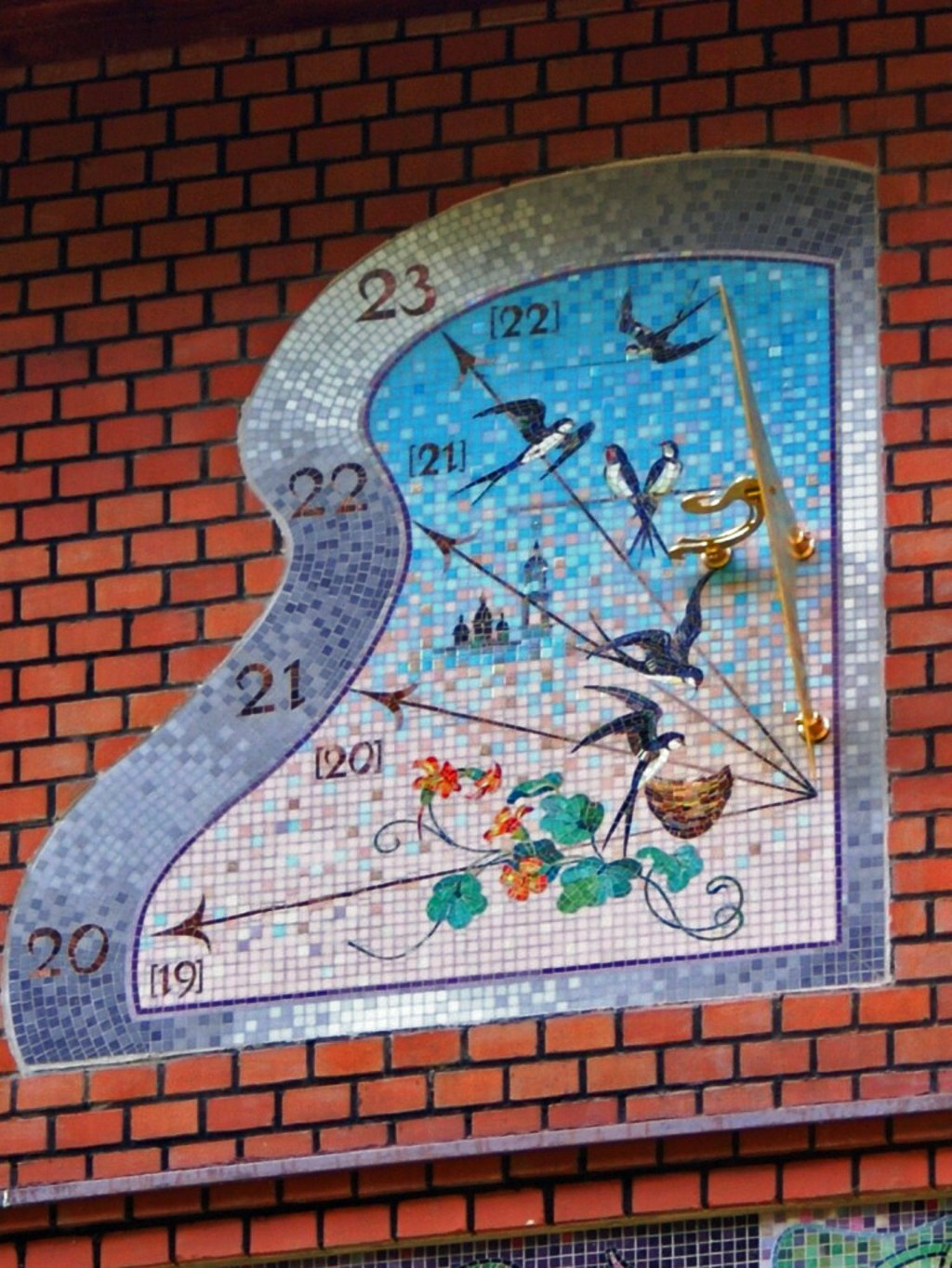
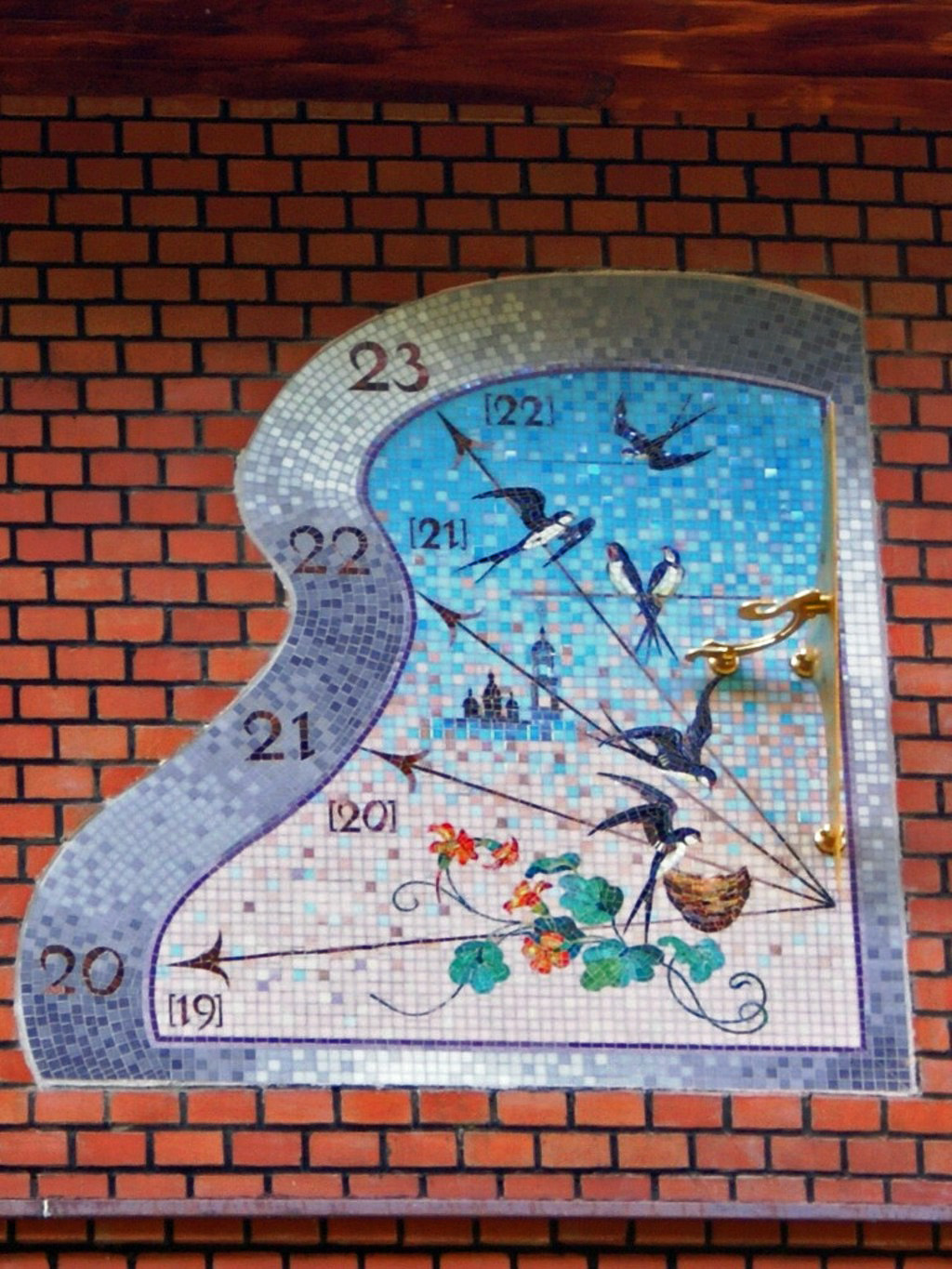
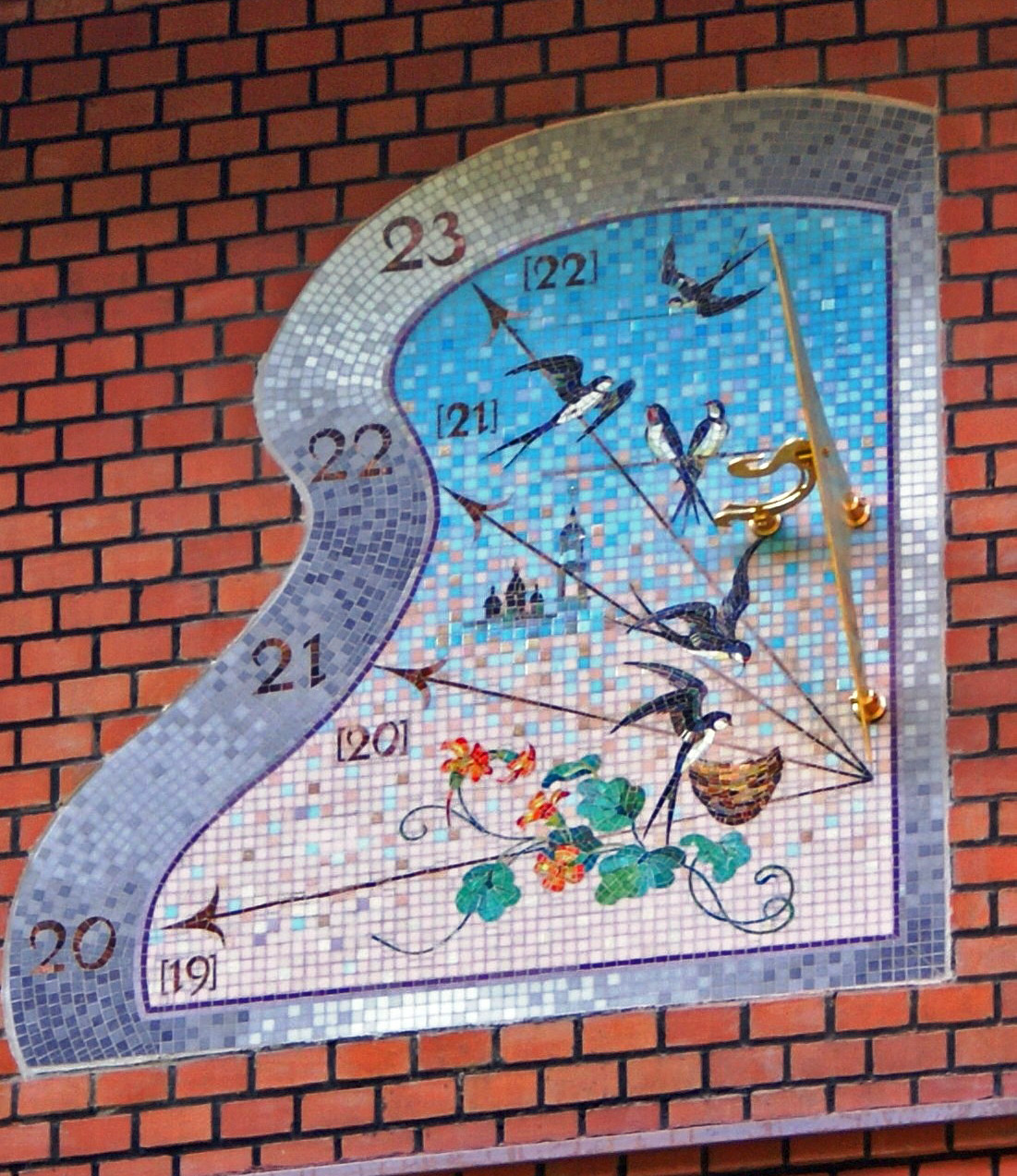
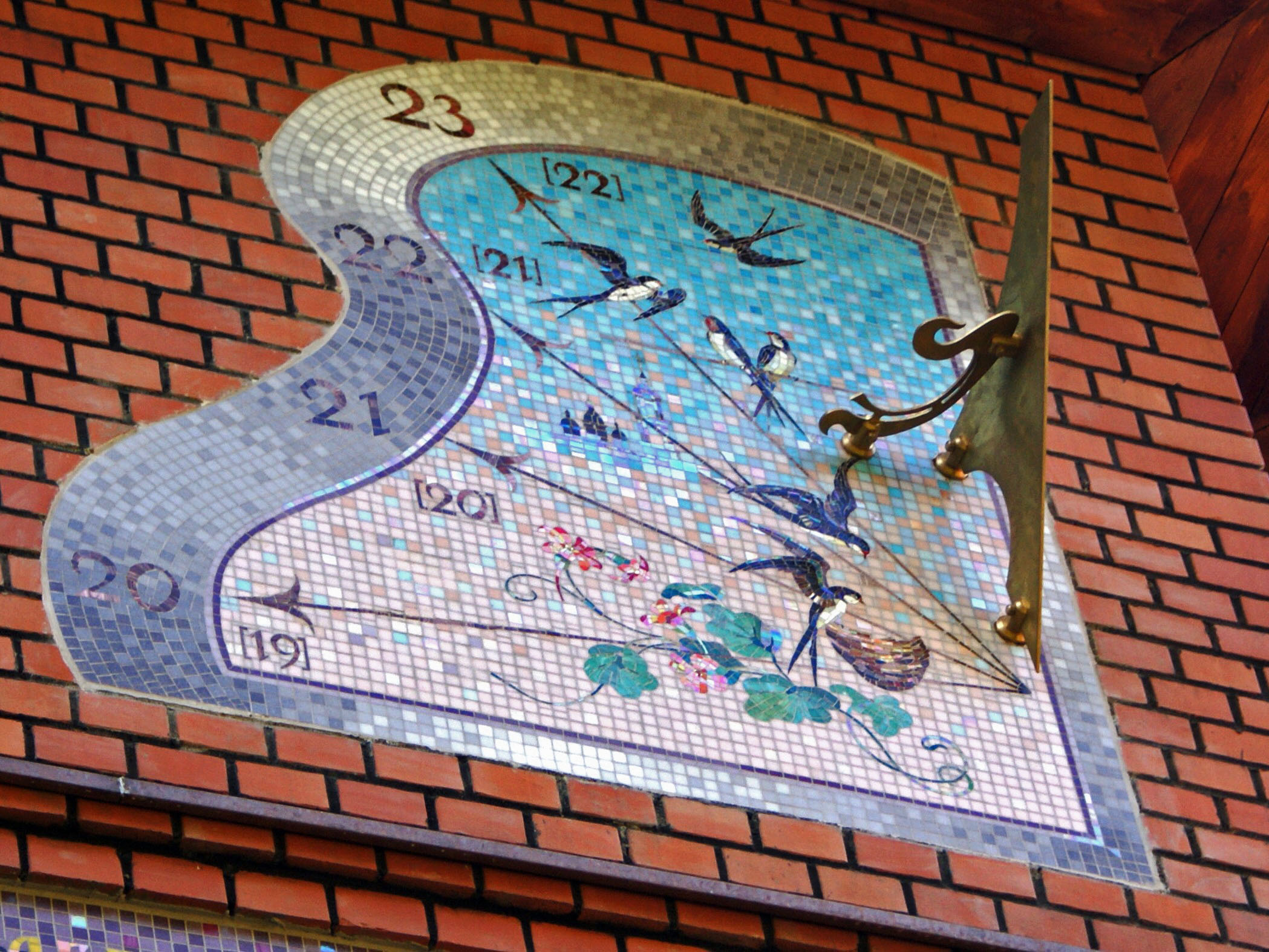
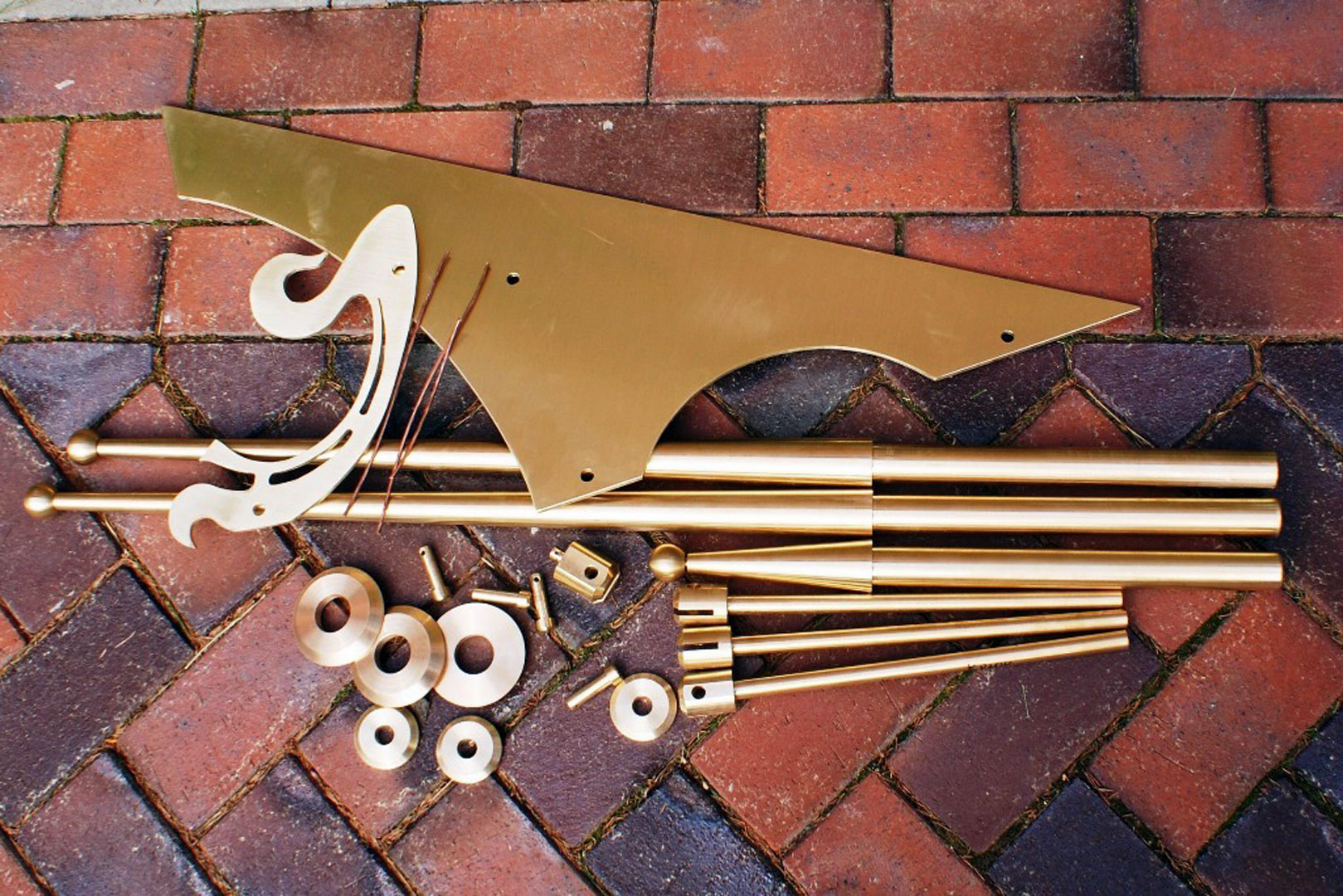
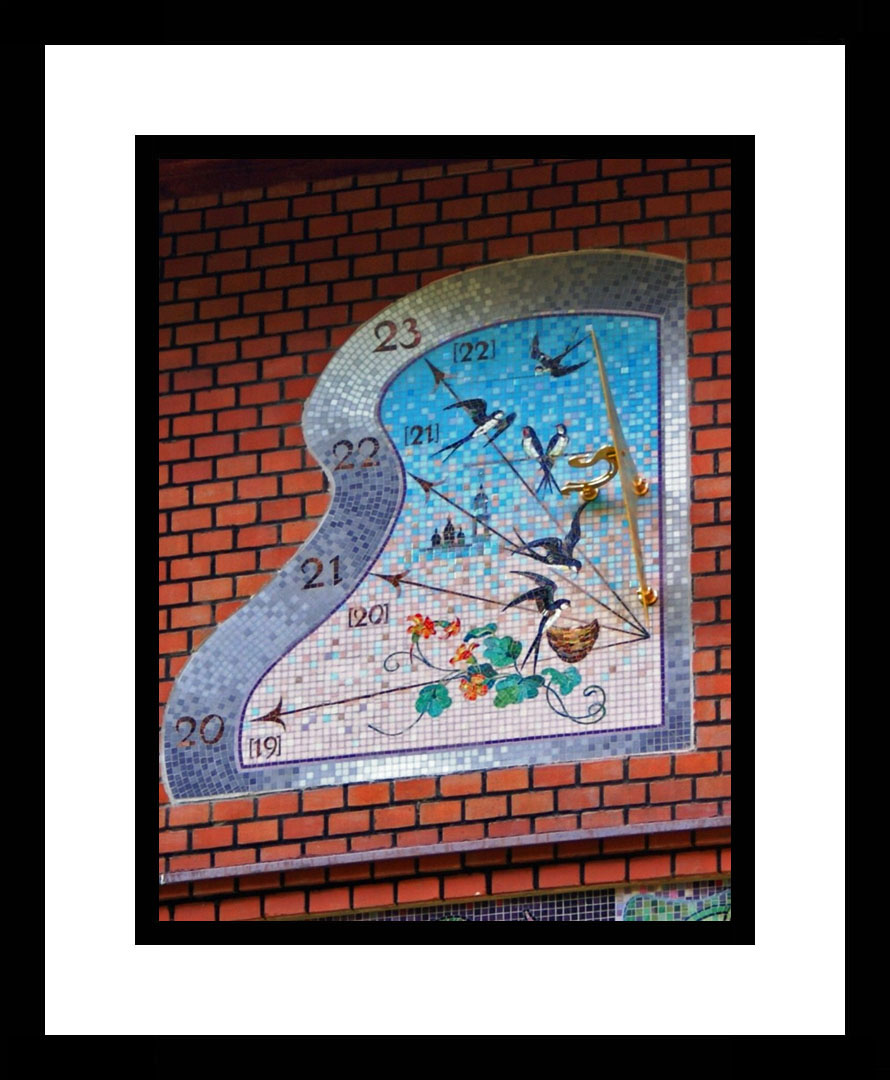
Delineator and Gnomon: Aleksandr Boldyrev Mosaic Artists: Irina Volkova, Eugeny Volkov. Date: installed on June, 2009 Original Location: Lat. 55° 50’ 2.97” N, Lon. 38° 05’ 2.46” E. On a brick wall of unknown home in unknown private sundial park in the village of Shevelkino near Moscow Russia. It is on the same building as Dials 459, 460, and 461. Present Location: at original location Orientation: Inclination: vertical, Declination: northern Size: Small 10 x 10 mm mosaic tiles. Dimensions of face- 1.4 x 1.3 m (55 x 51 in) Adornment: a beautiful mosaic tile dial! On a sky blue background are three pairs of swallows. In the left part of the dial the bell tower of the monastery of St. Seraphim Sarovsky is drawn. In the bottom part of the dial is an image of a convolvulus. Mottos: none Inscriptions: none Condition: excellent in November of 2009 Comments: This is a rare north facing dial. We are seeking more information about this dial- specifically, were exactly it is located. The beautiful unique gnomon is made of sheet brass and measures local and standard time. Photo ‘a’ Website: Here Boldyrev’s Email: Here Photo Description: Photos are courtesy of Aleksandr Boldyrev, and he sent them to us. Photos: a b c d e f |
 |
 |
 |
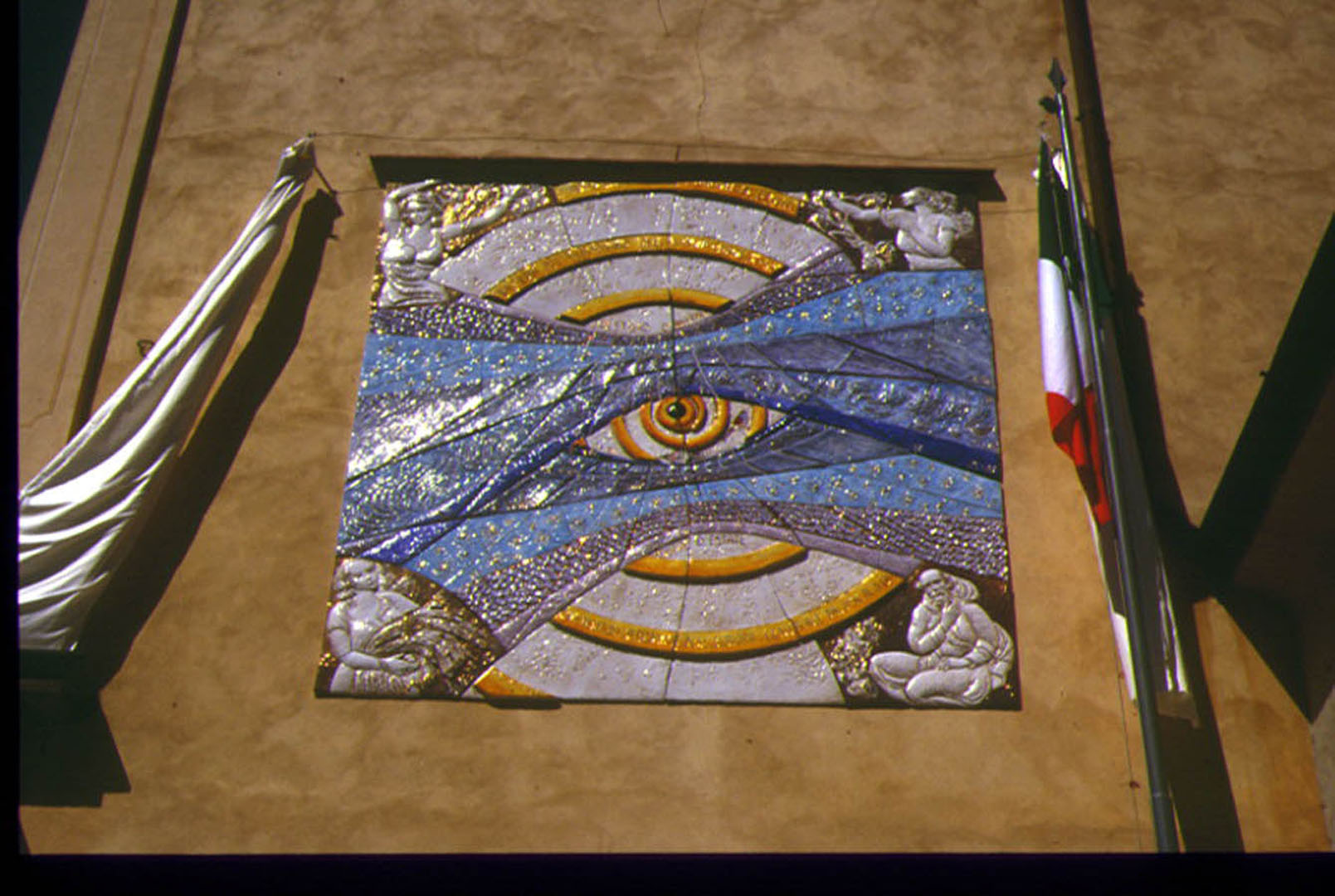
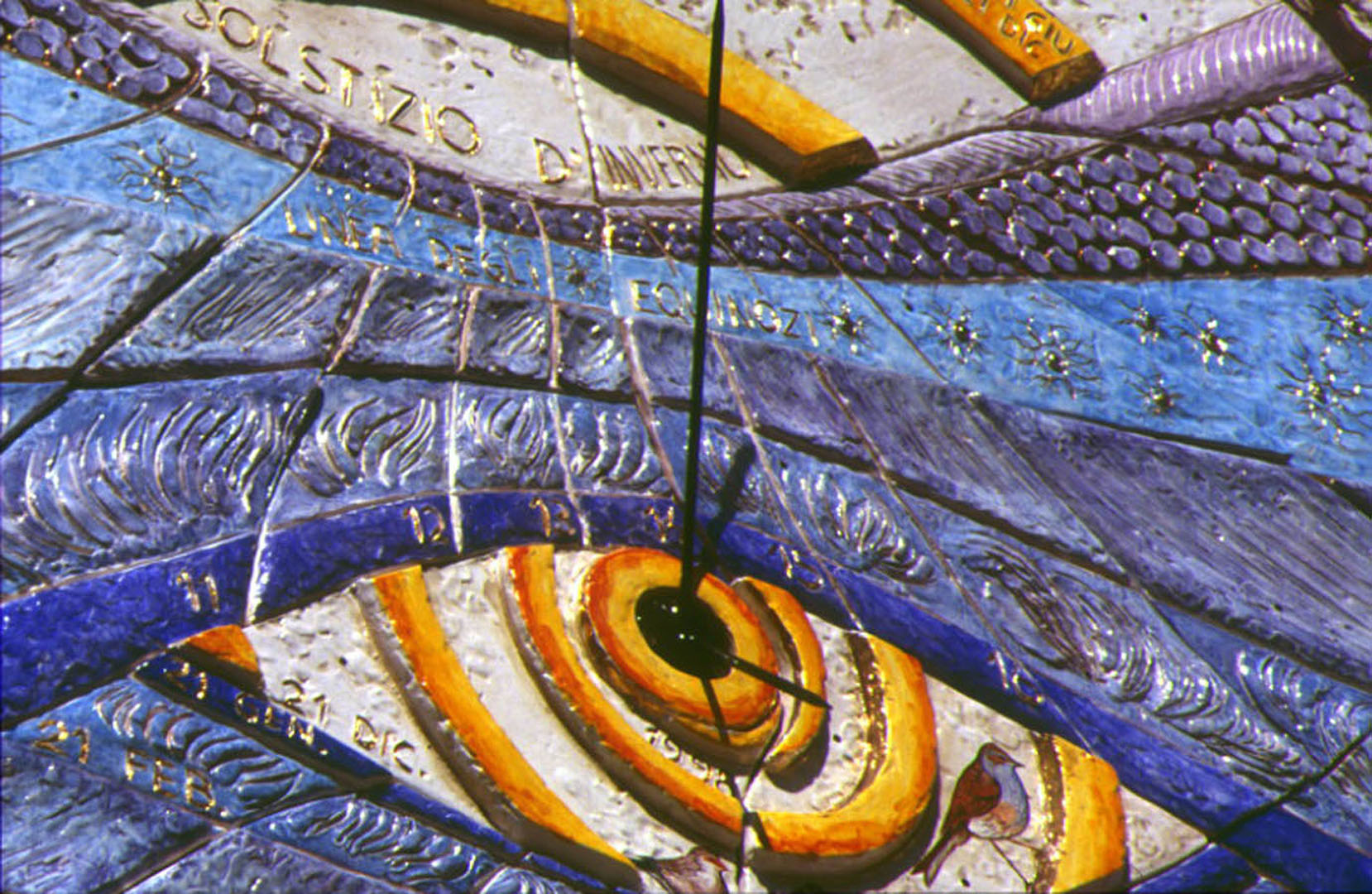
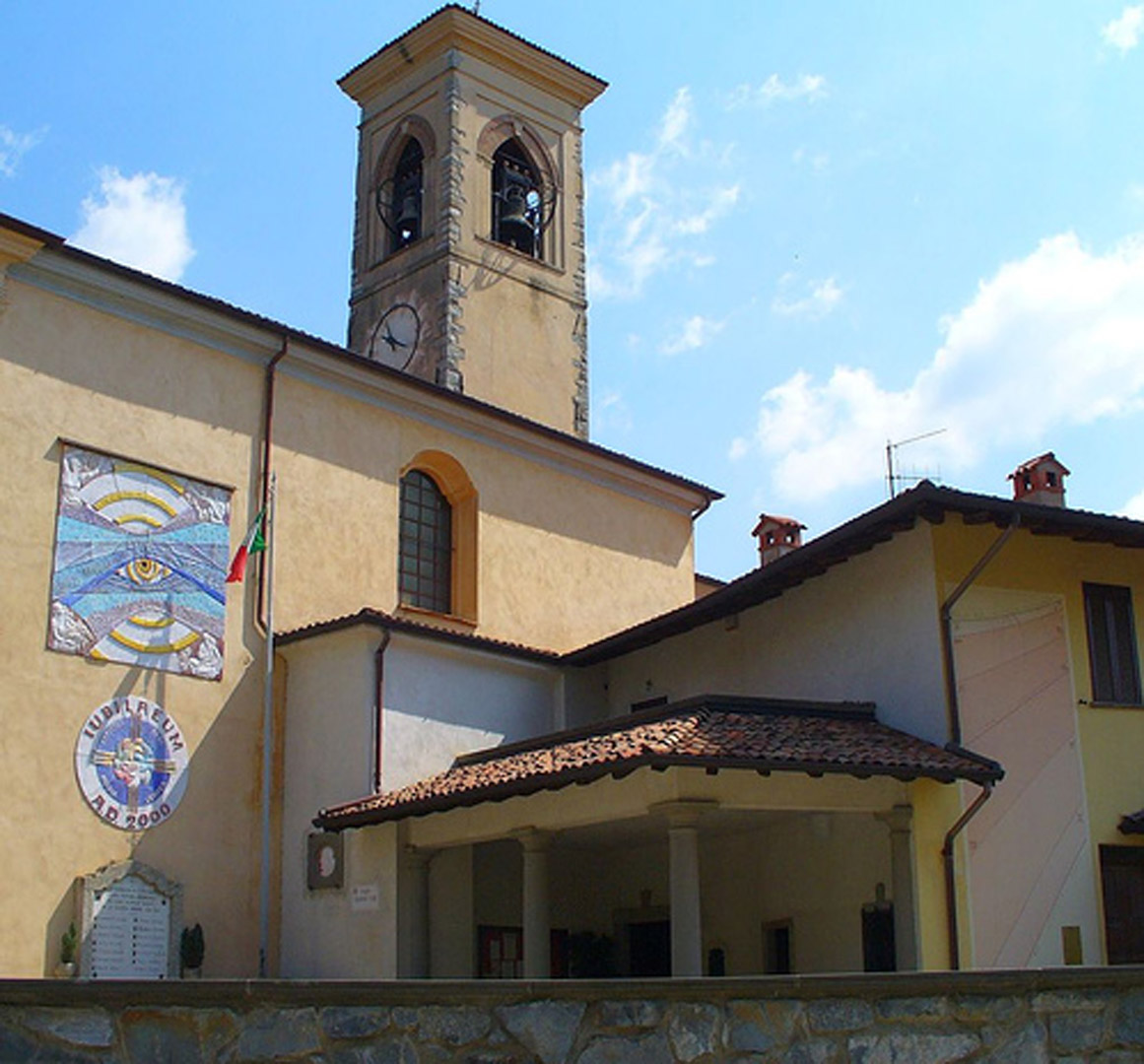
| Delineator: Diego Bonata Artistic Design: Diego Bonata Ceramic Artisan: Diego Bonata Date: 1998 Original Location: in the sanctuary that saw Pope grow Giovanni XXIII, in S. Gregorio (BG) Italy Present Location: at original location Orientation: Vertical. Declines by unknown amount. Size: unknown. There are over 10 square meters of ceramics. Adornment: impressionistic style on ceramics of Forlì. Golden spiral with vertical gnomon in center. Overlaid with two bowtie shaped blue sundial faces with date lines. Four interesting unidentified human figures in each corner. Mottos: none Inscriptions: present, but unreadable in these photos Condition: excellent Comments: This is Mr. Bonata’s personal favorite sundial. I can not determine why there are two sundial faces using one gnomon. Original photos appear to be from the inauguration ceremony. Vialattea Website: Here Photo a on Flickr Website: Here Photo b on Flickr Website: Here Diego Bonata’s Email: Here Photo Descriptions: Photos ‘b’ and ‘c’ are courtesy of Diego Bonata and he sent them to us. Photos ‘a’ and ‘d’ are courtesy of Marsala Florio from Flickr webpages above. Photos: a b c d |
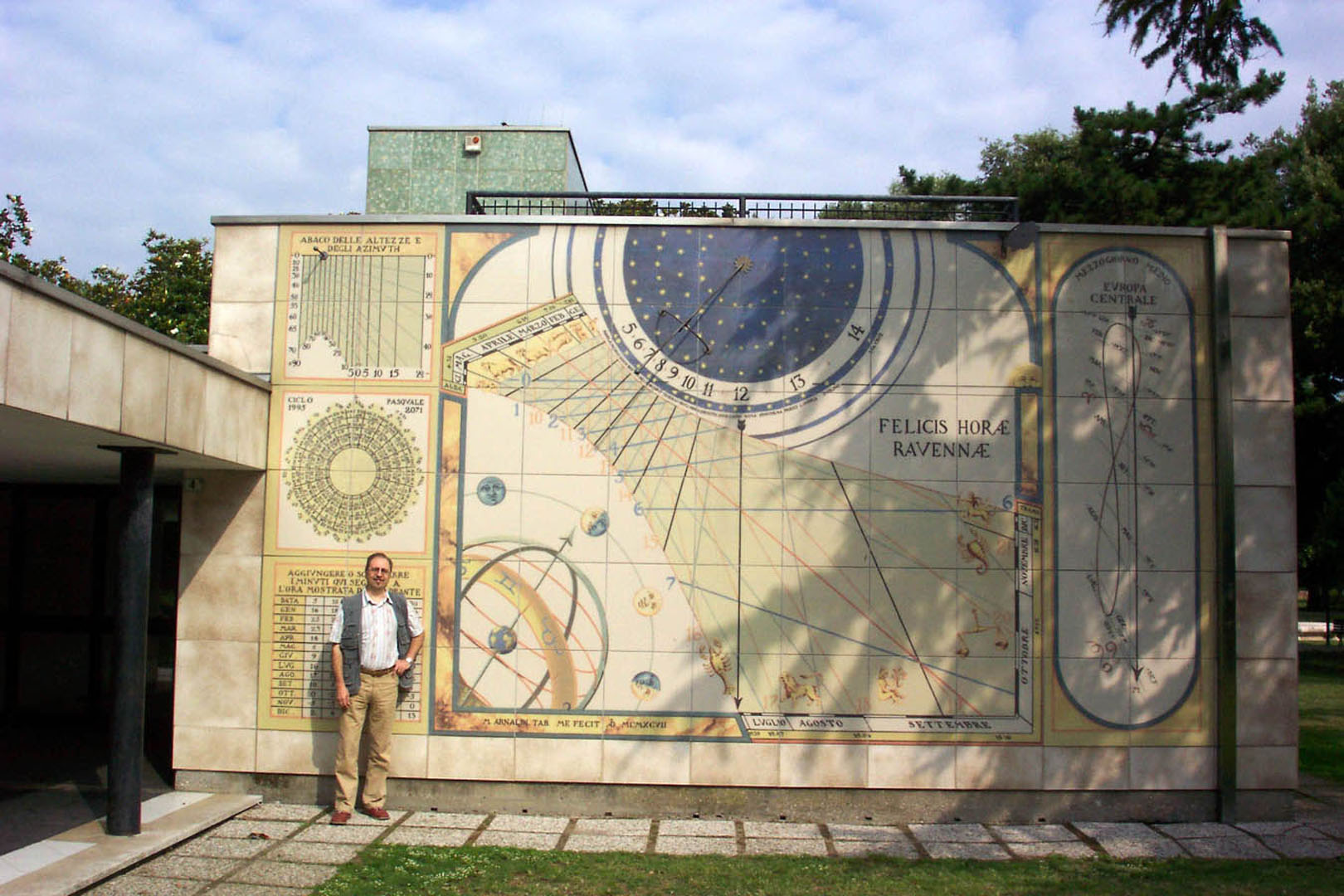
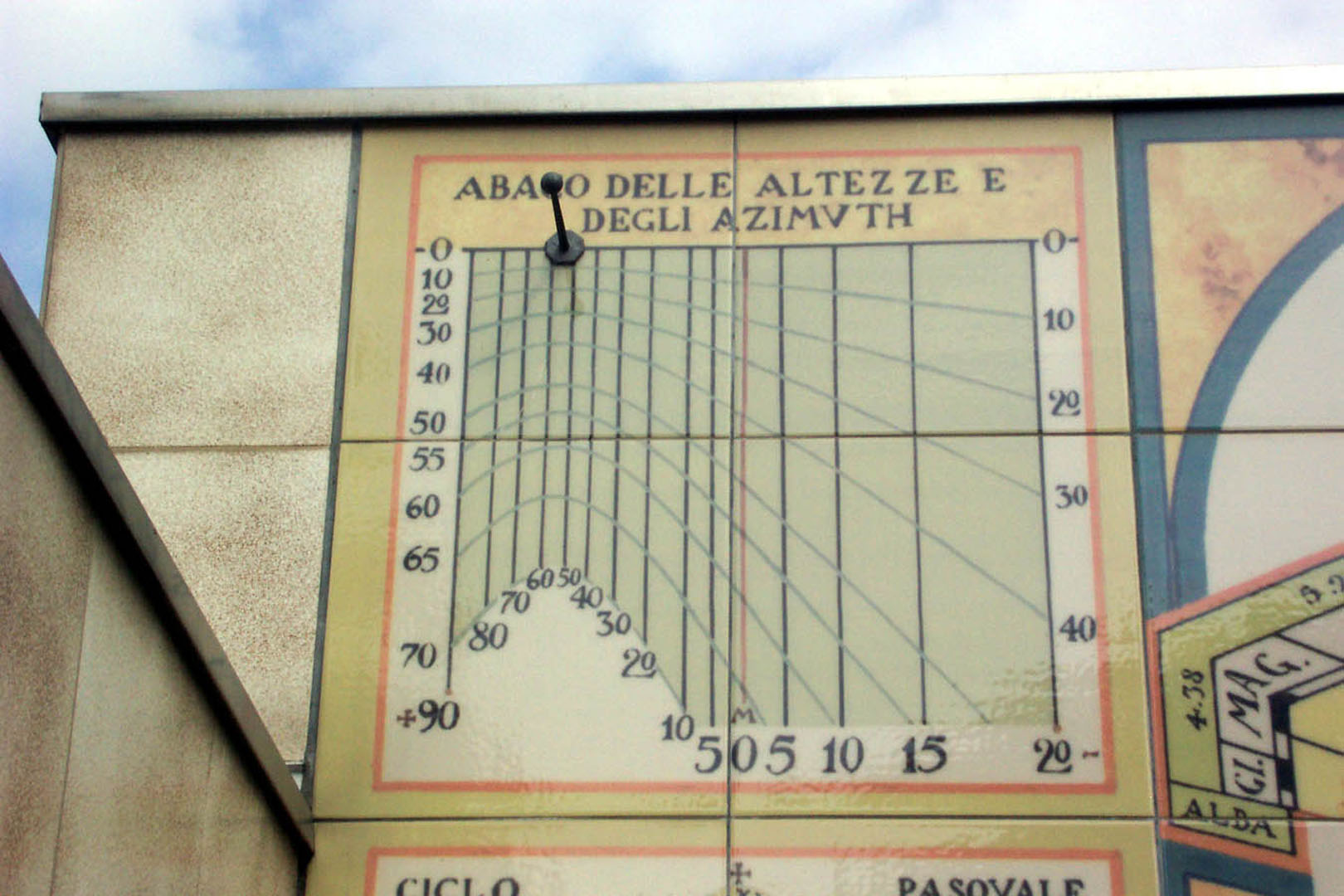
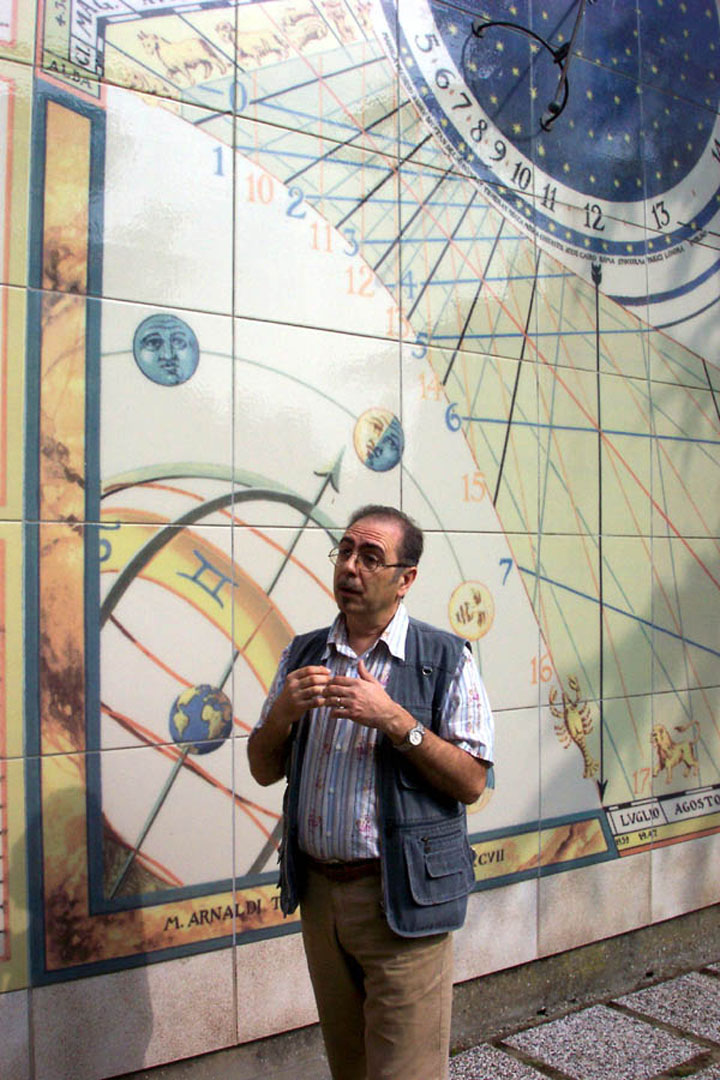
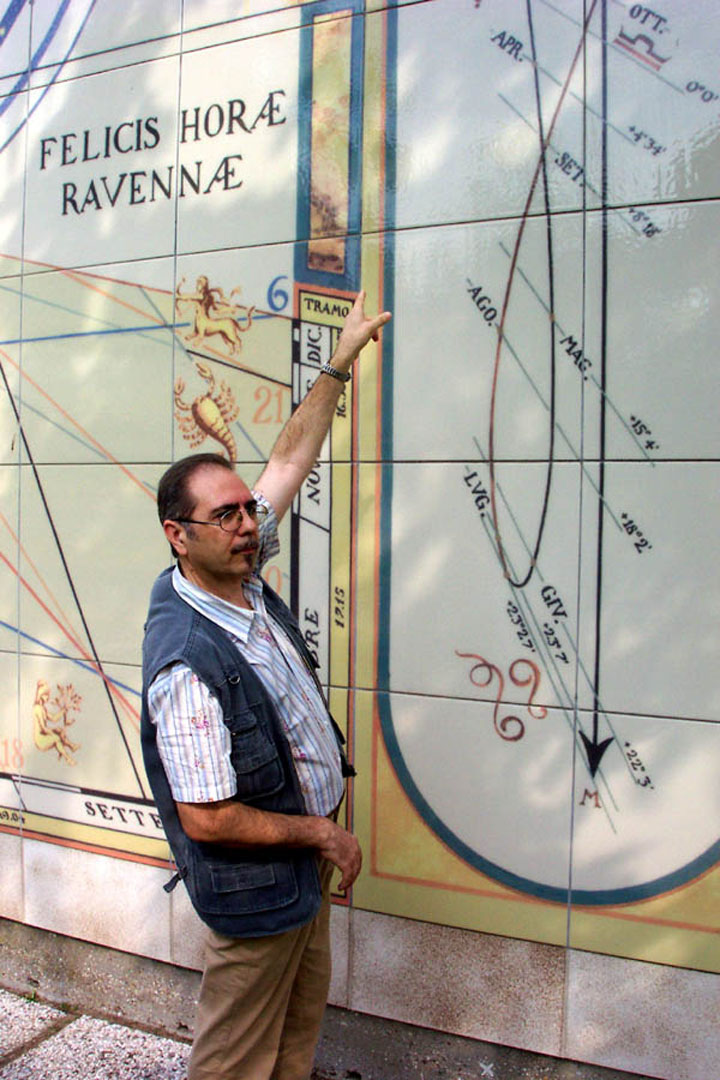
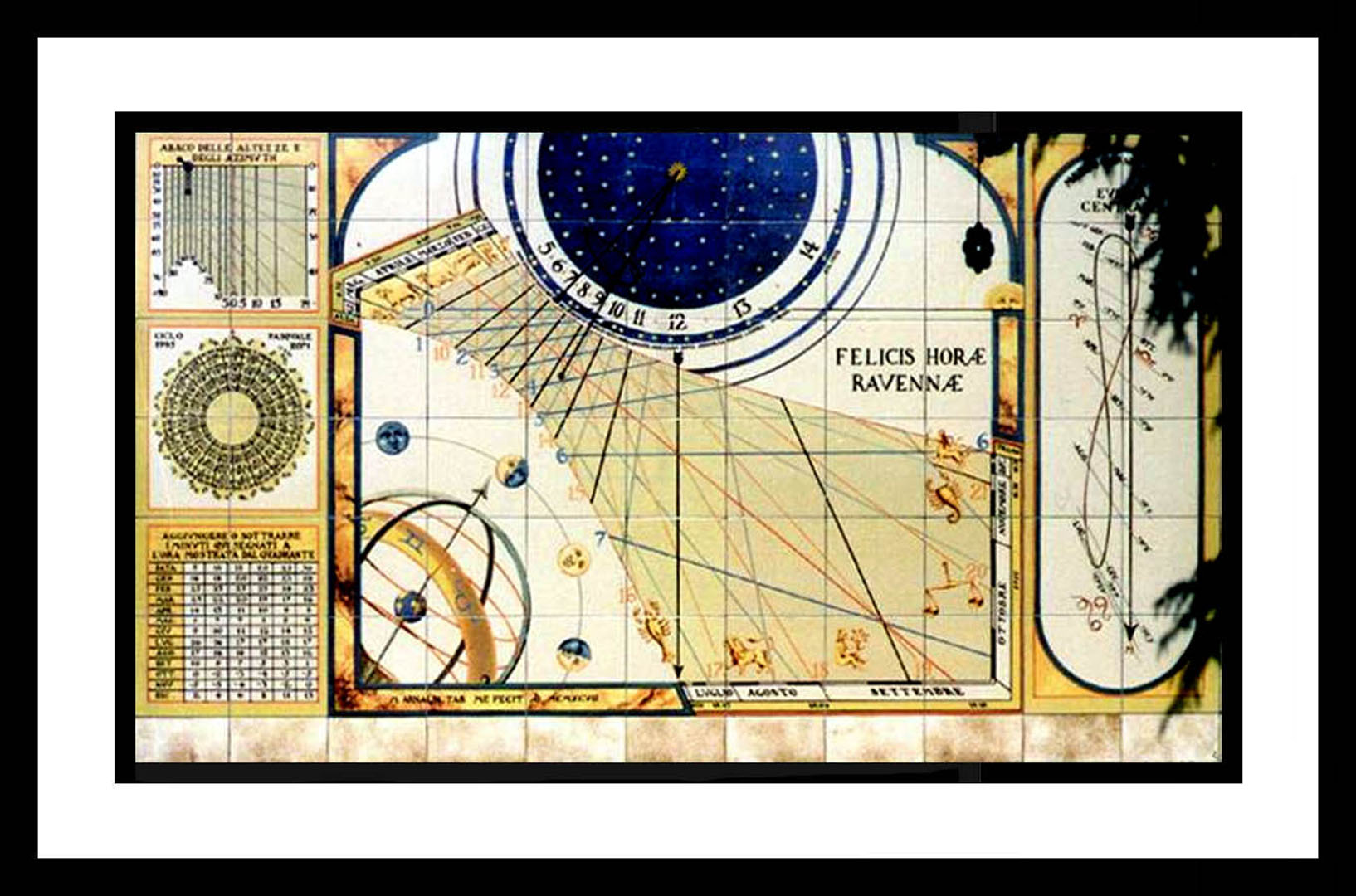
Designer: Mario Arnaldi Ceramic Artisan: unknown Date: 1996 or 1997 Original Location: Planetario di Ravenna, Italy. lat: 44° 25' N, lon: 12° 12' E. Present Location: at original location Orientation: undetermined Size: overall- 7 x 4 m (22 x 13 ft). Each tile- 60 x 60 cm (24 x 24 in) Adornment: In the upper left corner is a separate sundial that shows the solar azimuth and altitude. In the middle on the left, there's an Easter table arranged for modern time. The original from the 6th century is in the bishop's museum. In the big center dial are stars in the sky, inspired by the ceiling of the mausoleum of Galla Placidia, near the San Vitale church. Some stars indicate the solar noon in several world capitals. On the right there's a meridian line with mean time and solar declination. Mottos: “Felicis Horae Ravennae" Condition: good Comments: Mr. Arnaldi calls his large ceramic wall dial the "Il cielo di Ravenna". First he painted the dial to scale on a wood panel. A studio then transferred the image to the tiles by electronic imaging using a plotter that had three spray guns with ceramic colors. Then another studio fixed the colors with fluid glass. Information was updated in June 2005. Planetario di Ravenna Website: Here Digilander Website: Here Mario Arnaldi Website: Here Photo Descriptions: Photos ‘a’ and ‘b’ are courtesy of Mike Cowham. Other photos courtesy of John Carmichael (taken in 2007). Photos: a b c d e f g |
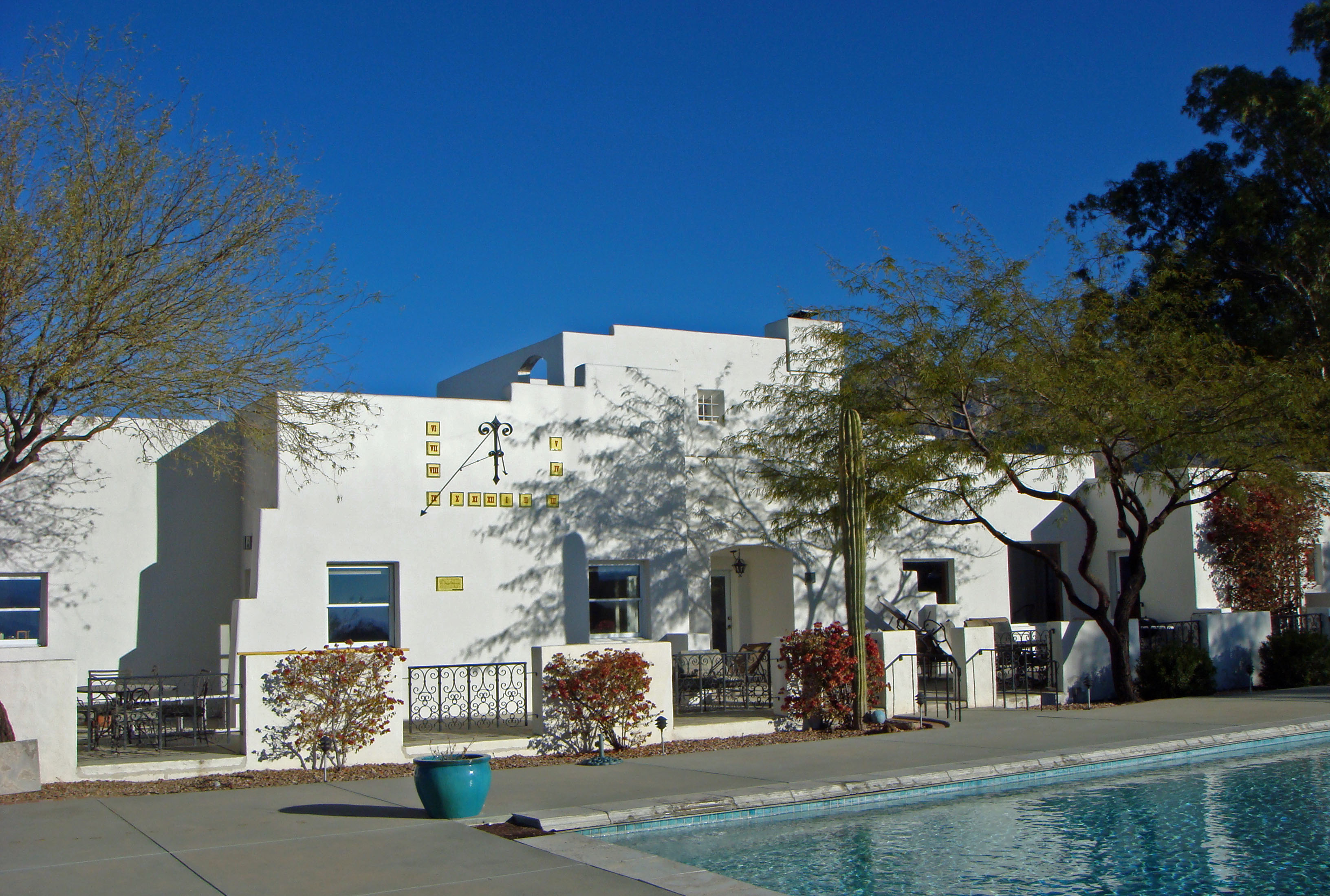
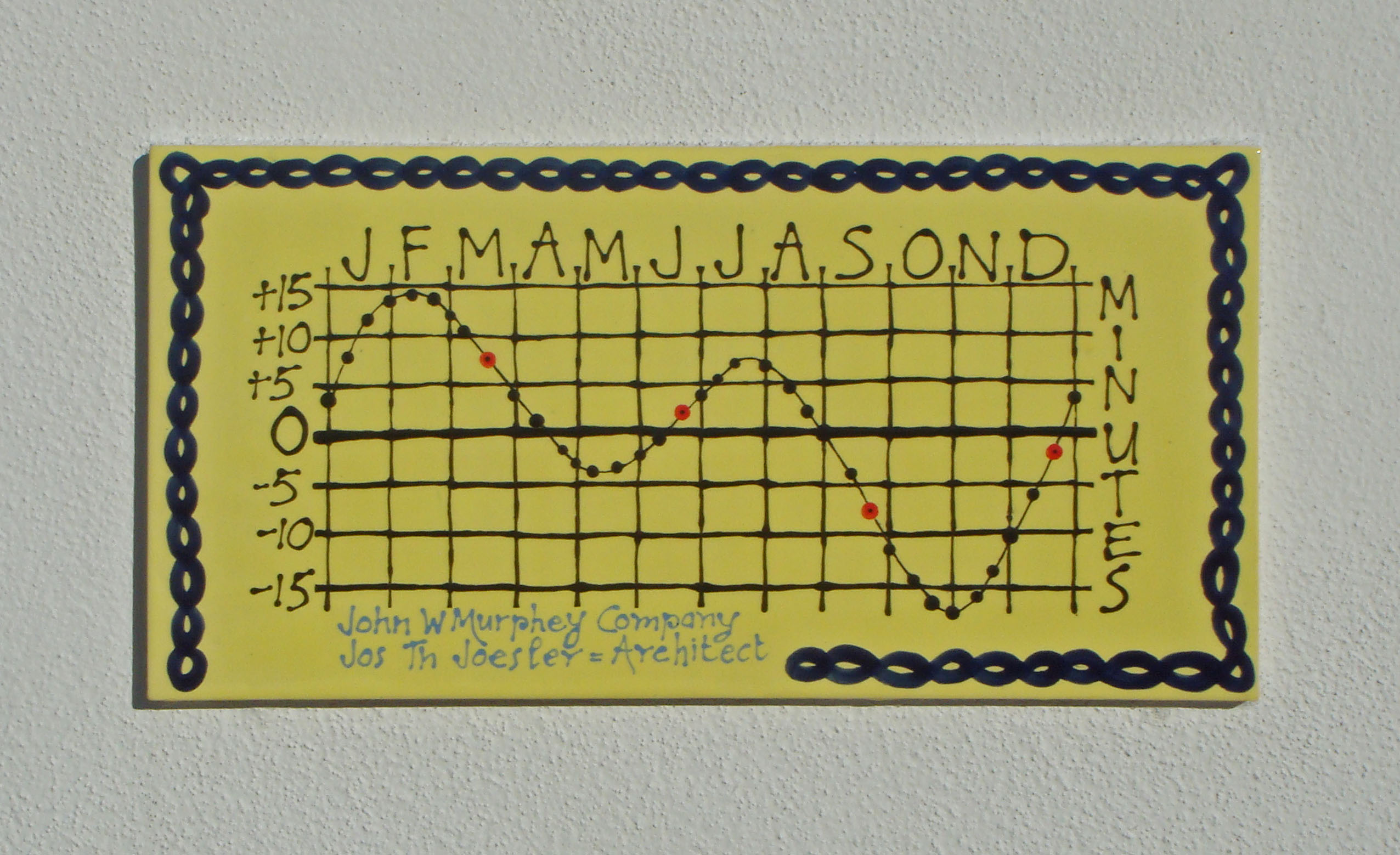
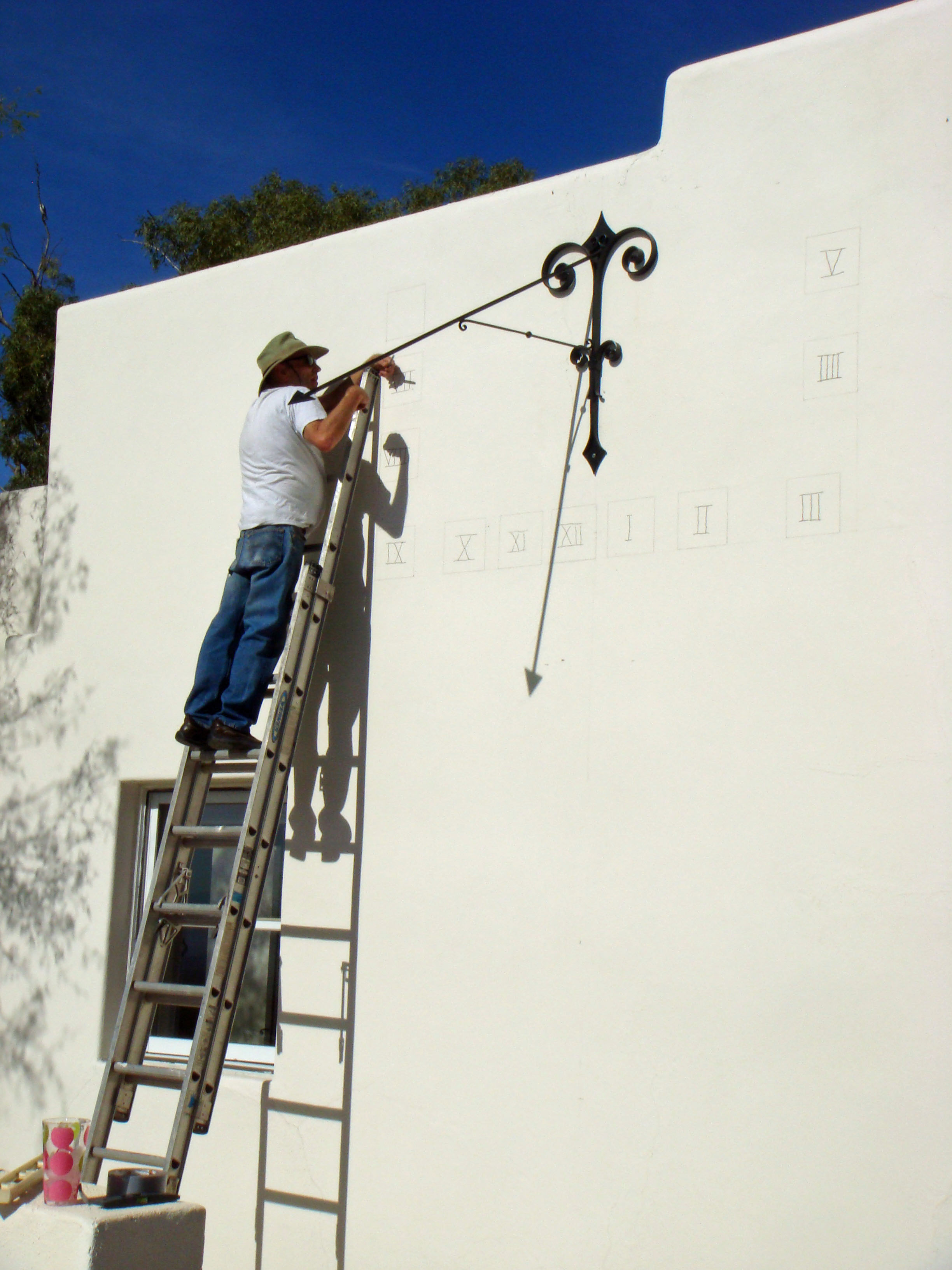
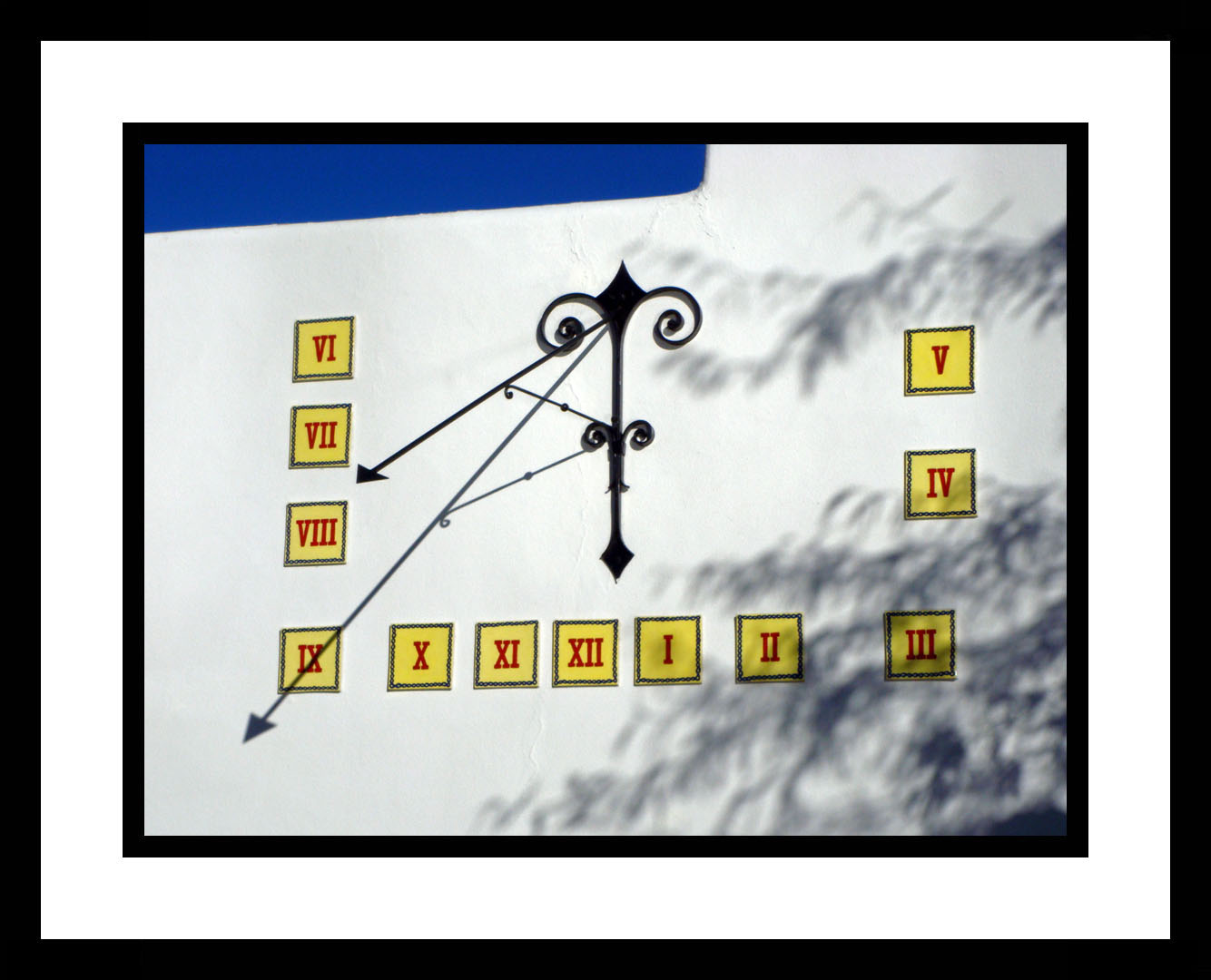
Designer, Delineator: John L. Carmichael, sundial maker and member of The British and North American Sundial Societies. Ceramic Makers: John W. Murphey Company, Tucson AZ Gnomon Maker: Doug Thompson Studios Dates: constructed in Jan 2011 Design Location: Lat: 32° 18' 28.8" N, Lon: 110° 55' 31.95" W. On the southern wall of an historic home designed by Josias Joesler in the foothills of Tucson Arizona USA. Present Location: at design location Orientation: Vertical. Declines 18.0 degrees East of South Size: 84 x 60 inches (213 x 152 cm) with 8” tiles and 74” (187 cm) gnomon Adornment: hand painted porcelain ceramic tiles, and a colonial Spanish style gnomon Inscriptions: none Mottos: none Condition: Excellent. Comments: The home owner found a long lost architectural drawing of his historic Josias Joesler home in the archives of Tucson. A crude gnomonically flawed drawing of a wall sundial was on those plans, but the sundial had never been built. The new owner of the home contacted John Carmichael and contracted him to design an accurate sundial based on Josler’s original drawing. Sundial Sculptures Website: Here John Carmichael’s Email: Here Photo Descriptions: Photos are by John Carmichael and were taken in Jan 2011. Everybody has my permission to use these photos. Photos: a b c d e f |
 |
 |
 |
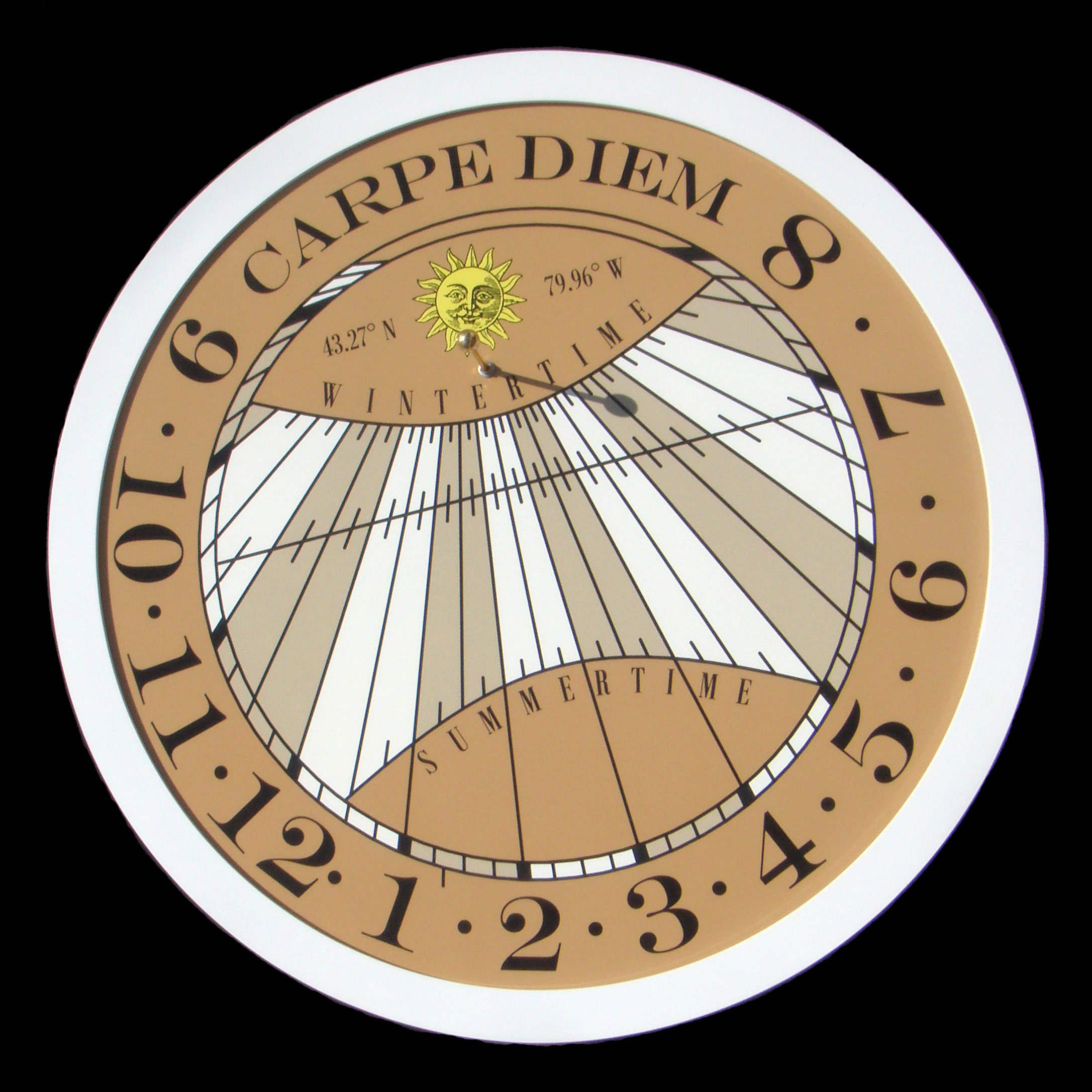
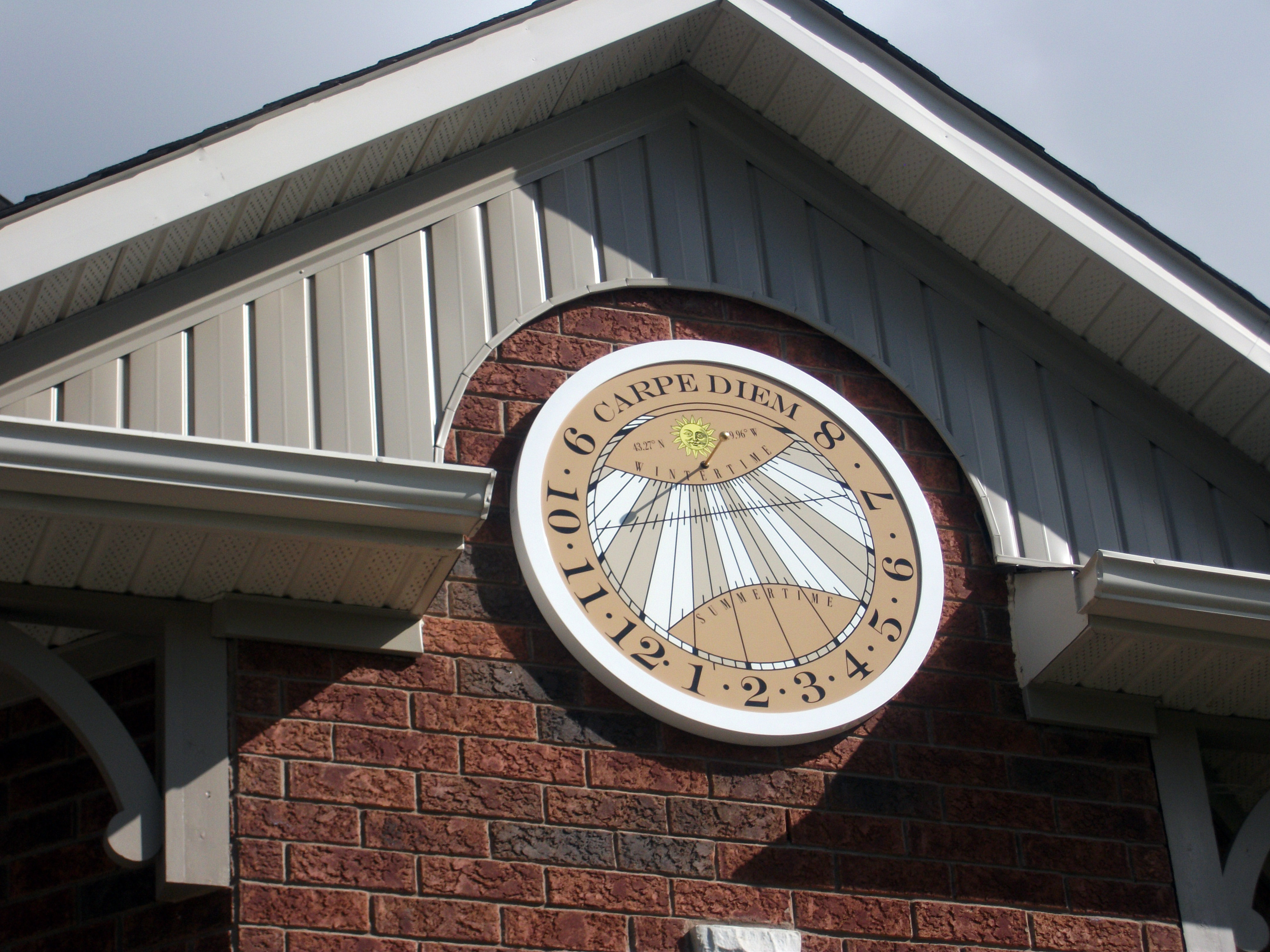
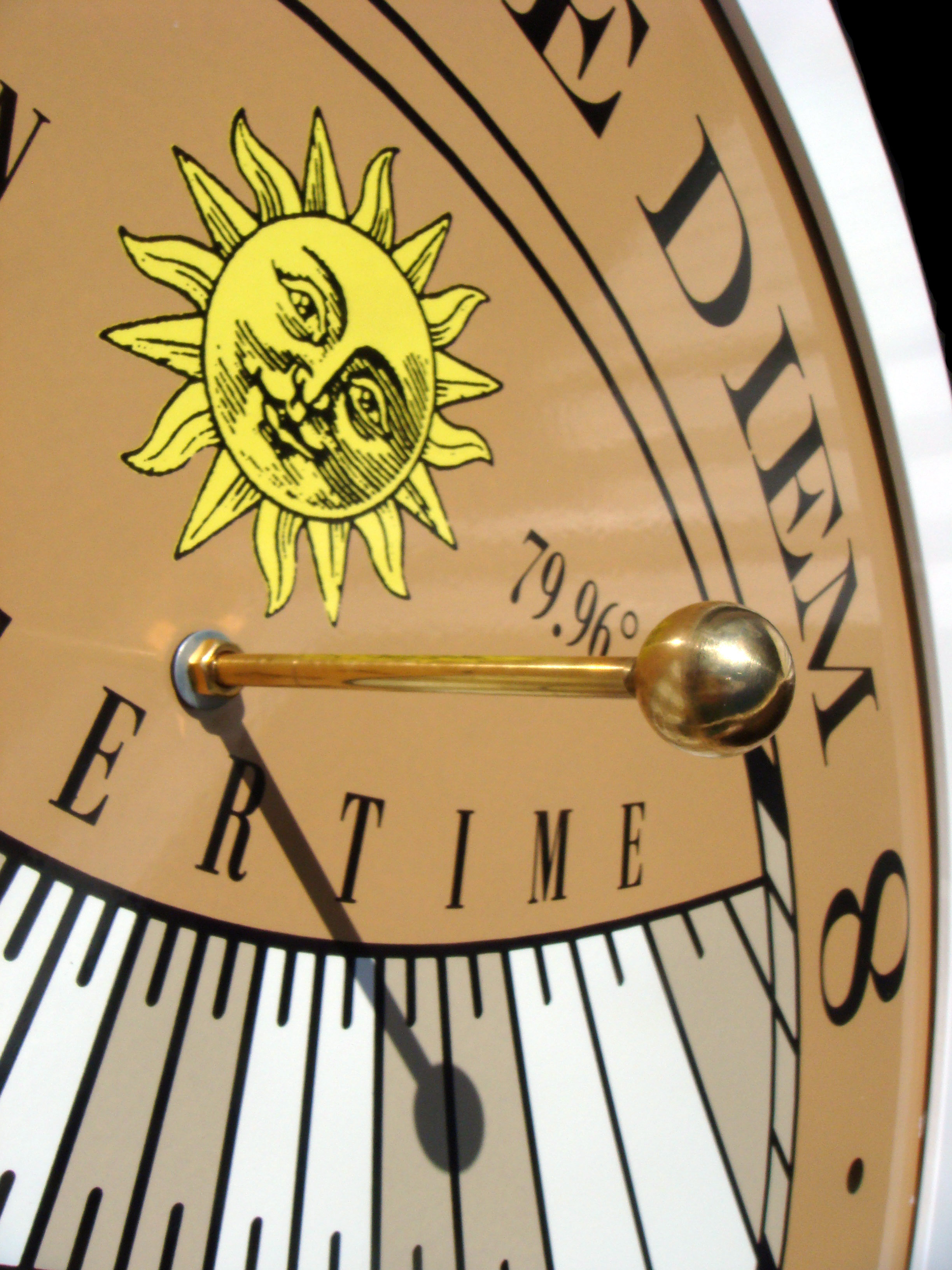
| Delineator: John L. Carmichael Jr. at Sundial Sculptures in Tucson AZ USA Porcelain Maker: KVO Industries, Inc. - Manufacturers of the World's Finest Porcelain Enamel Signs Owners: Dawn and Mike Razem Date: installed September 2010 Original Location: Lat: 43.2718° N, Lon: 79.9617° W. high up on southerly wall of private brick home at 76 Sundial Crescent, Dundas Ontario Canada L9H 7R8 Present Location: at original location Orientation: Inclination-vertical. Declines 14.73° West of Due South Size: 38” (1 meter) diameter, 2” thick Adornment: a yellow sunface Inscriptions: Wintertime, Sumertime markings Mottos: CARPE DIEM Condition: excellent in 2010 Comments: I designed this sundial for the wall of a beautiful red brick home near Toronto Canada. The home owners ordered it for the wall of their home because their street is named “Sundial Crescent”. They also love sundials. They wanted the sundial to be colorful, durable and maintenance free, so we decided to make the face from colored porcelain that was kiln-fired onto a 3/32” thick 38” diameter steel plate. Porcelain on steel is the most durable sundial face material that allows colors to be used. It will never fade or chip with time. If you want a colorful sundial, nothing beats porcelain for durability, longevity, and colors. The bezel is white powder-coated aluminum. Many old clock faces in Europe are made from porcelain and they are just as pretty now as they were two hundred years ago. The dial has an unusual nodus-based (or point-in-space) gnomon. One easily tells the time and date from looking at the center of the shadow cast by the 7/8” brass ball. The top curved line on the face is the winter solstice. The central angled straight line is the equinox line. And the bottom curved line is the summer solstice. The dial indicates Daylight Saving Time and is corrected for longitude. It includes a Solar Noon Mark at 1:19pm. As far as I know, as of this writing (2010), this is the only porcelain dial in Canada and is the largest porcelain dial in North America. Photo Descriptions: Photos are by Dawn Razem and John Carmichael Sundial Sculptures Website: Here Flickr Website: Here KVO Industries Website: Here Photos: a b c d |
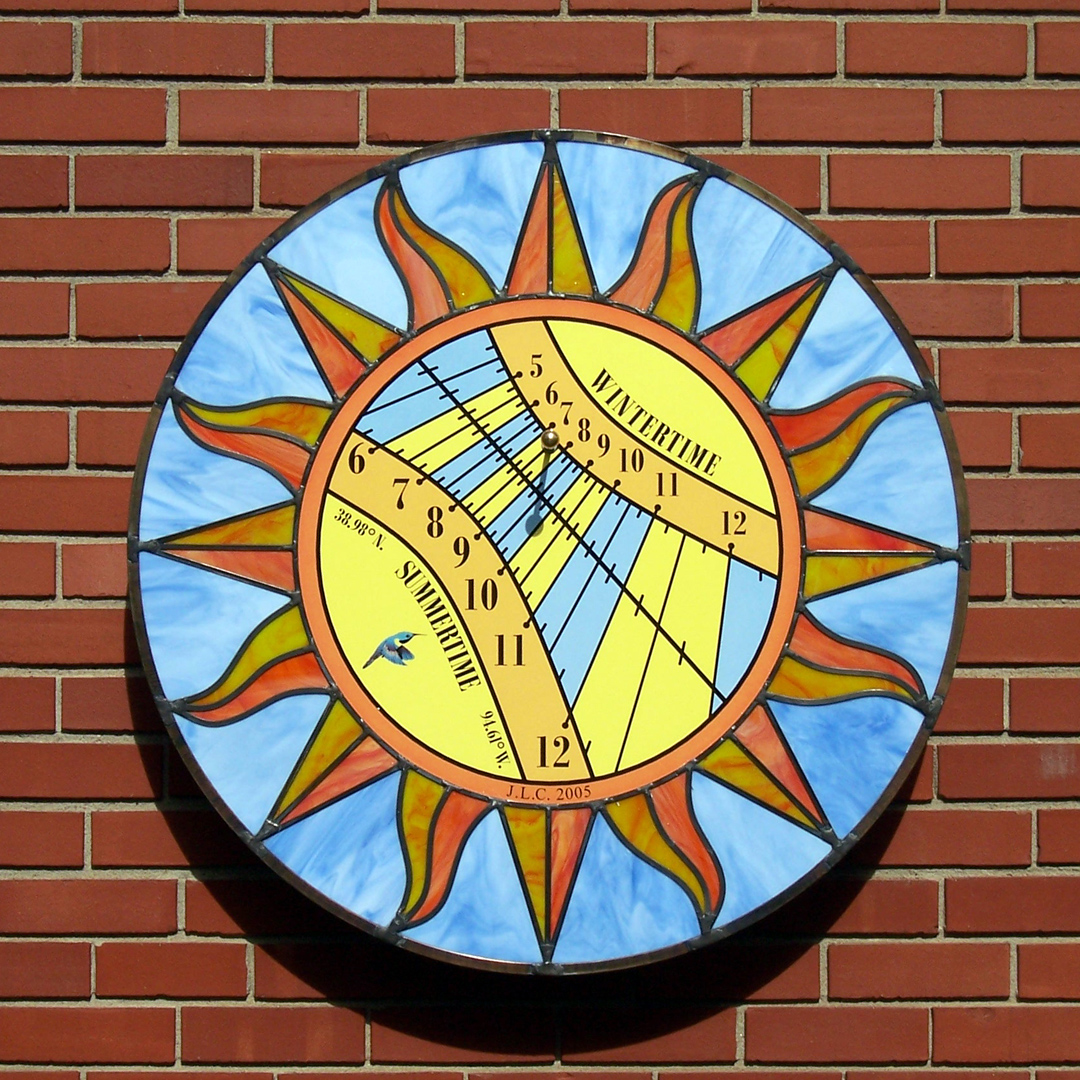
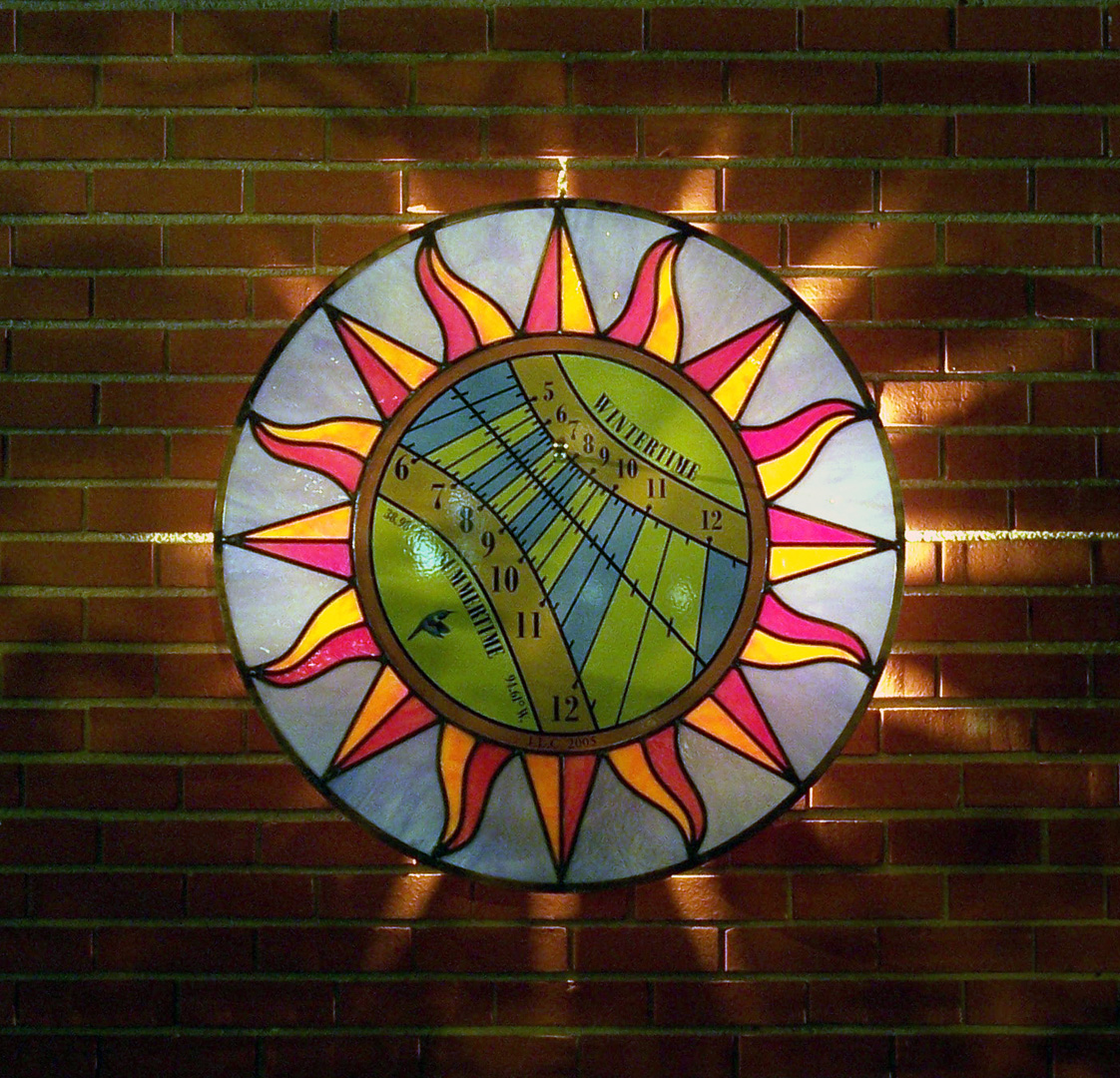
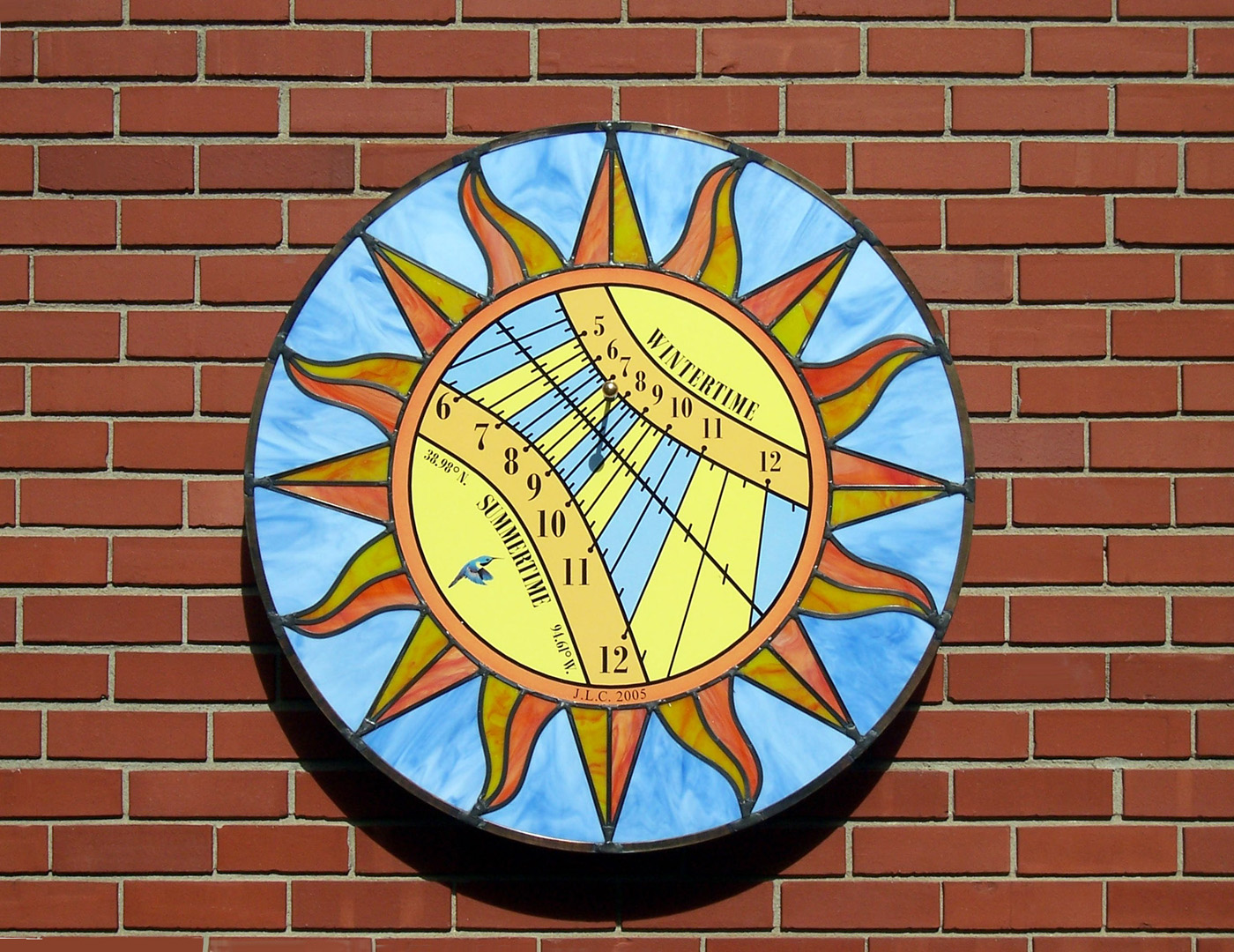
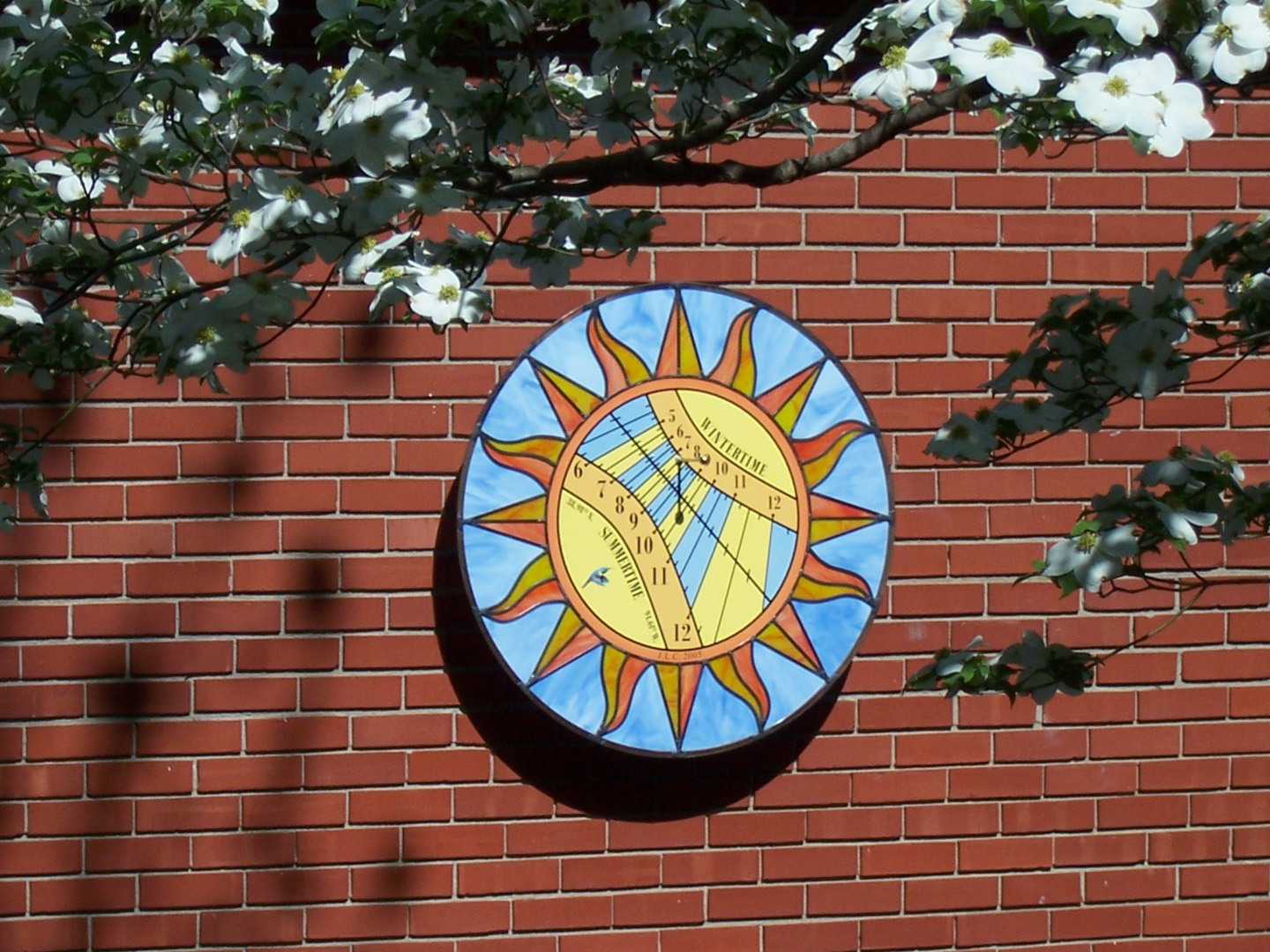
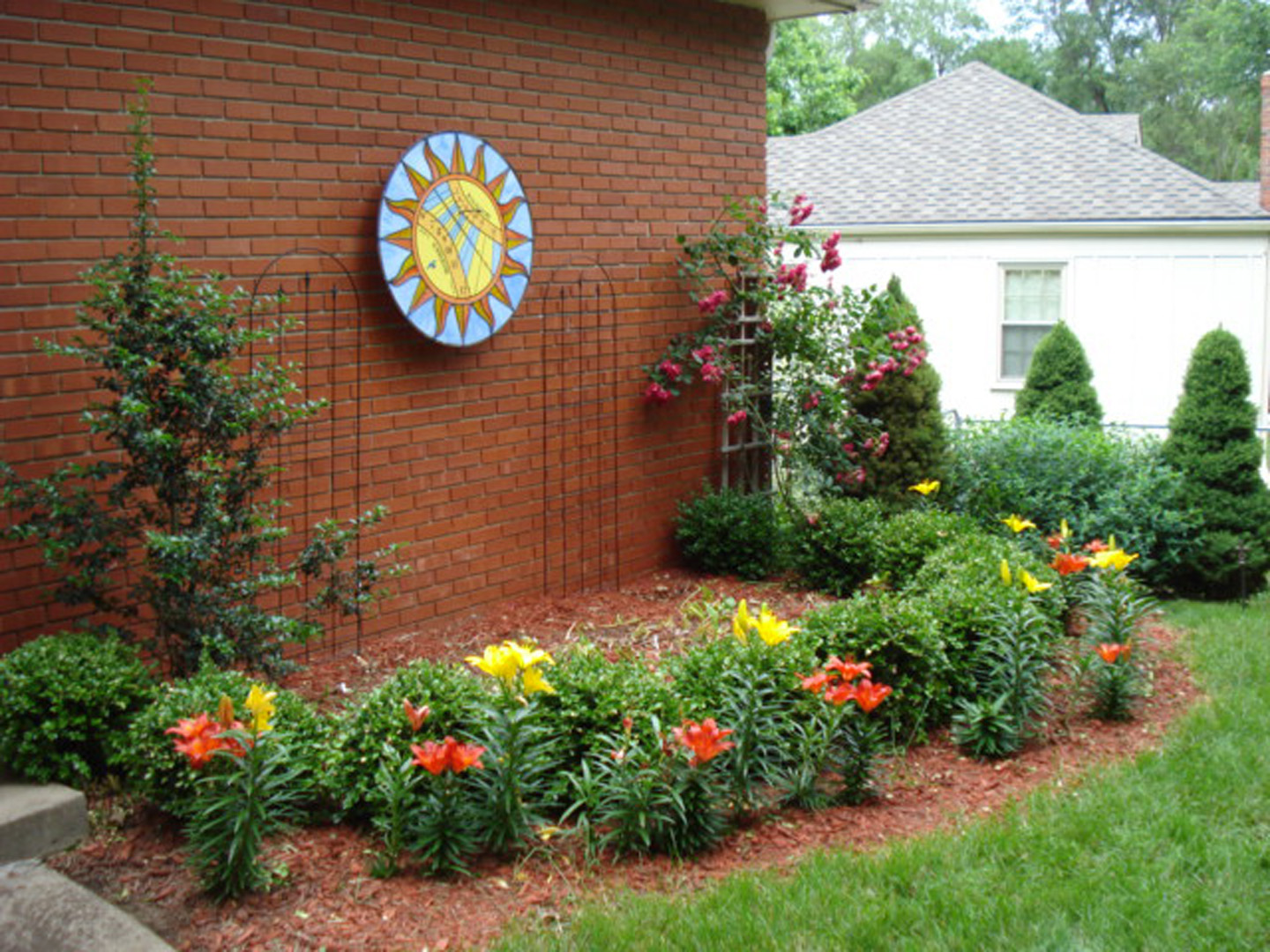
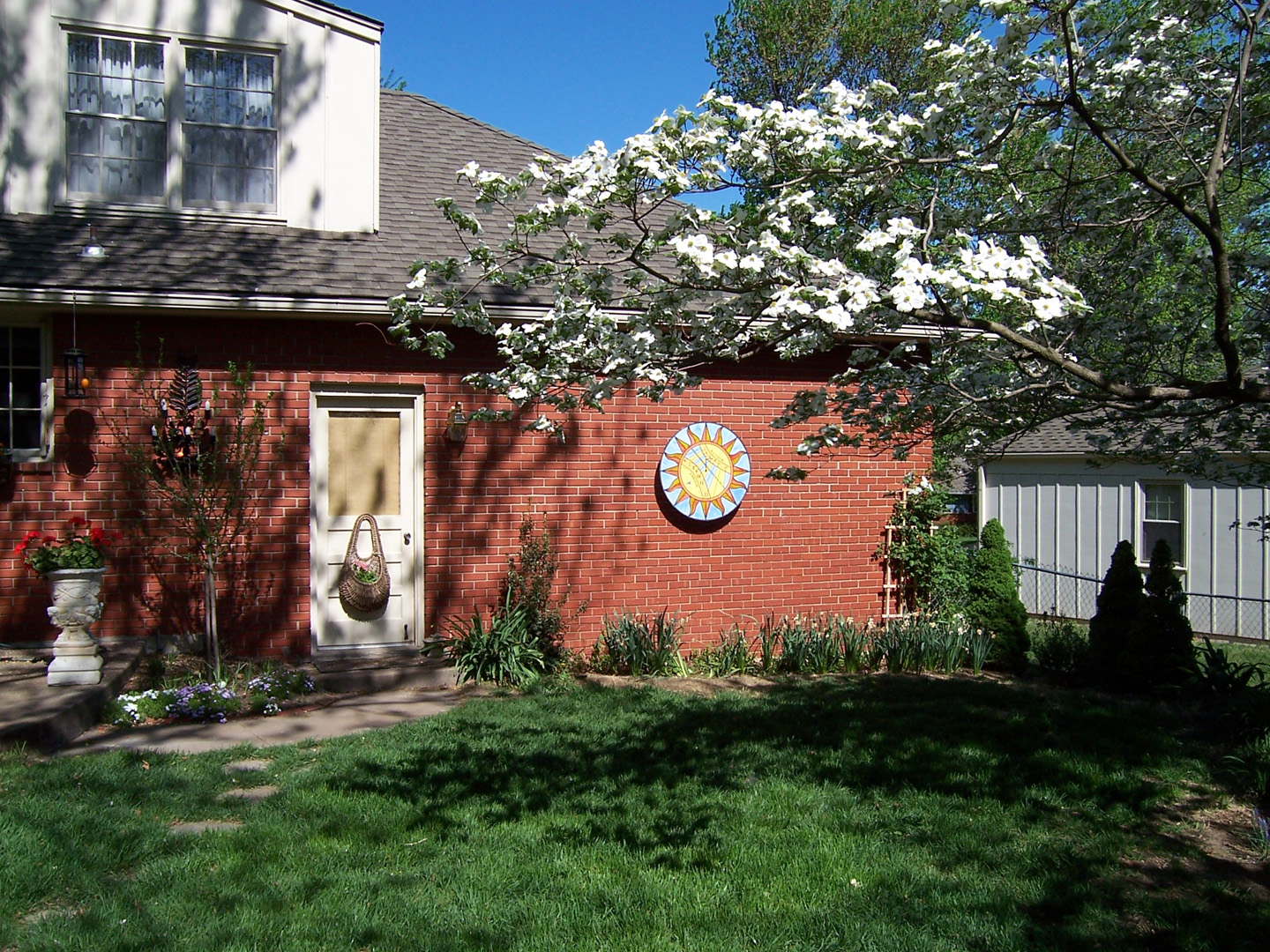
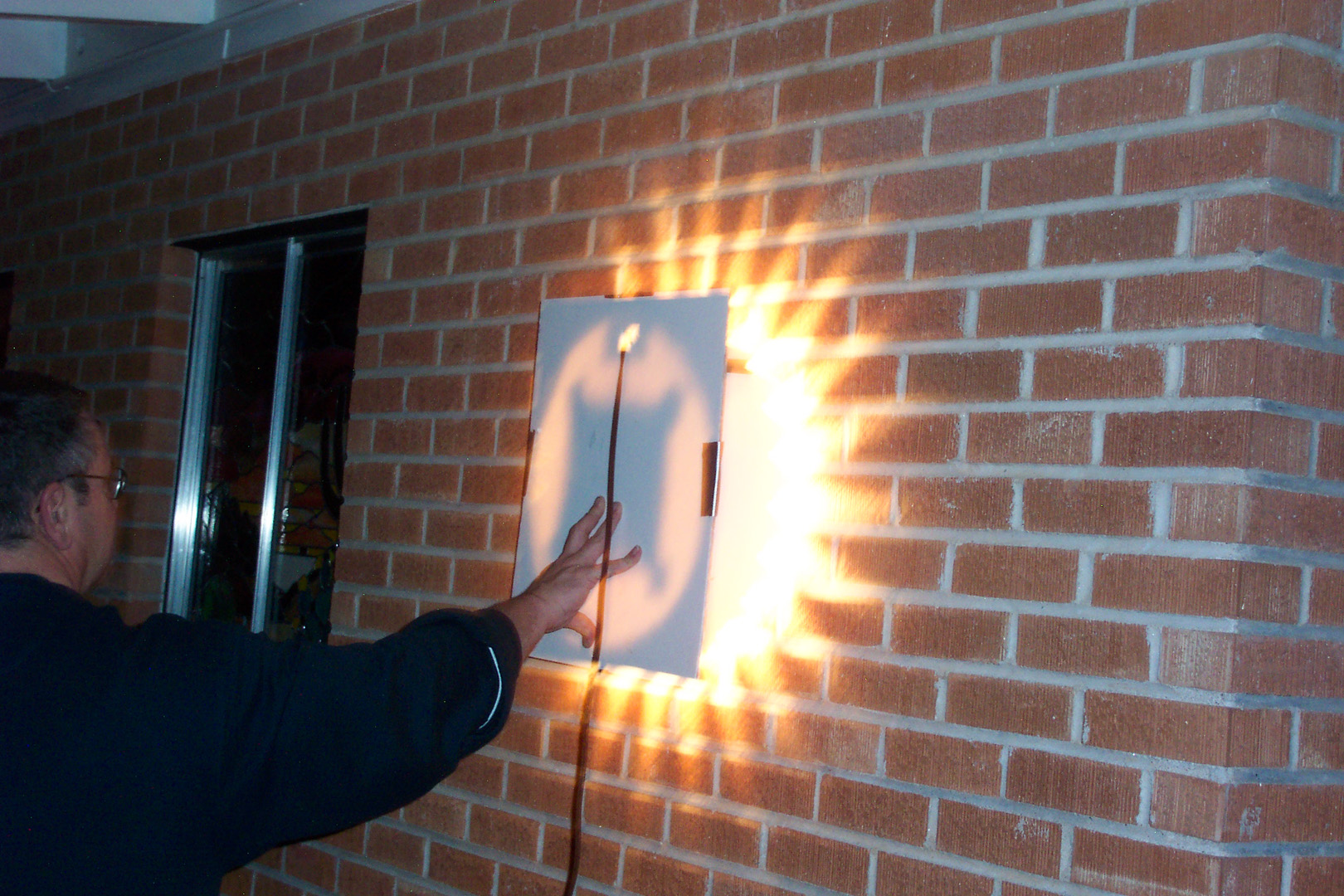
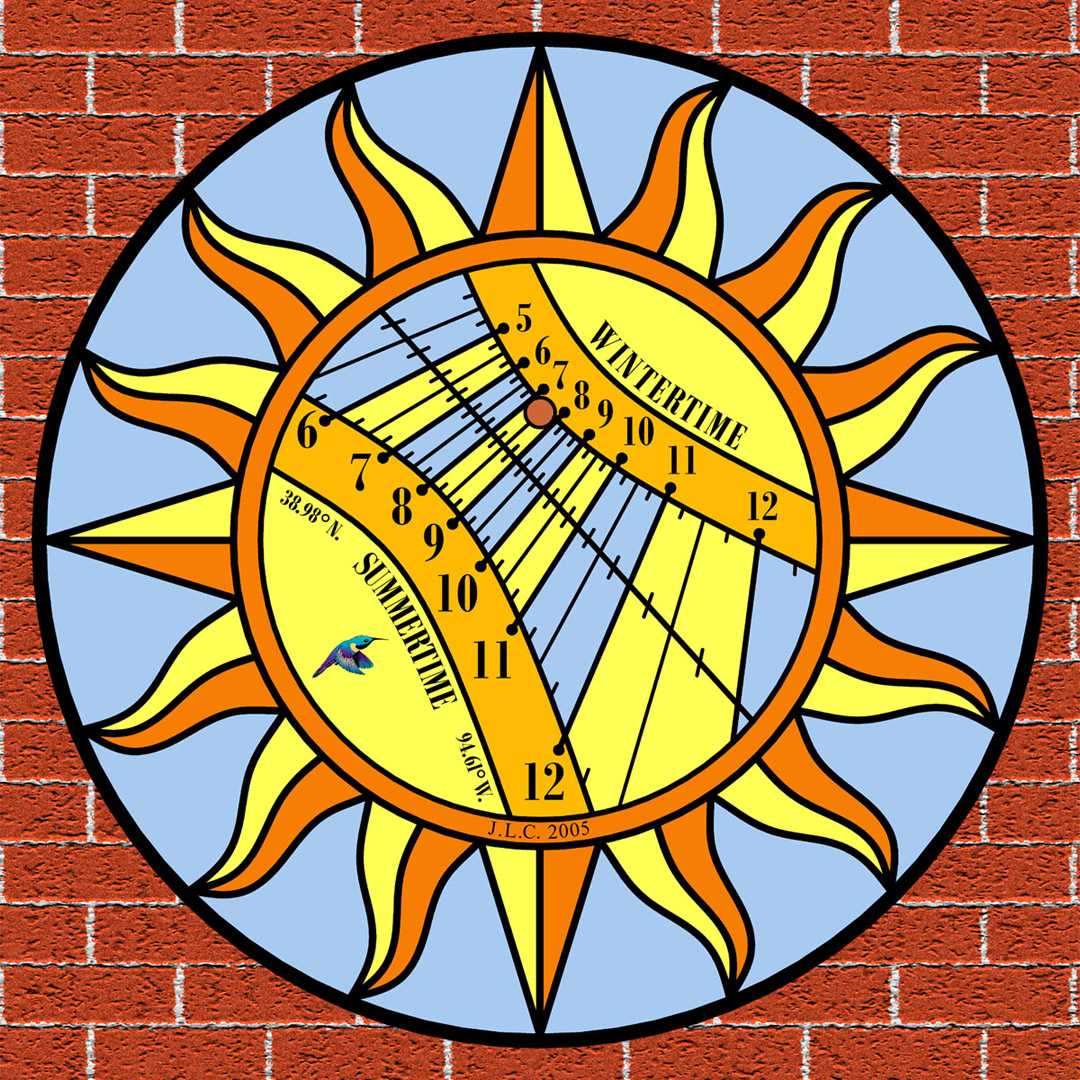
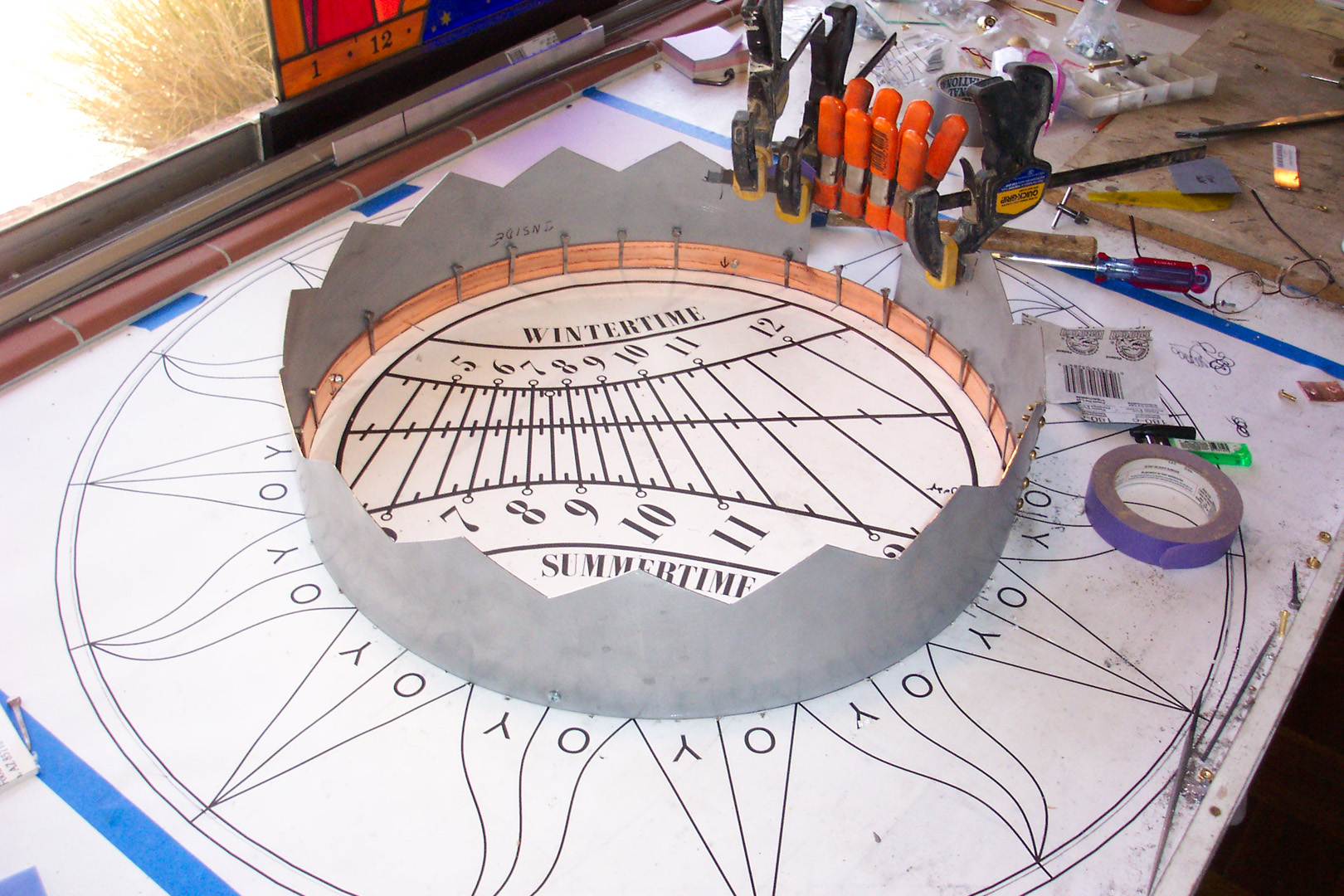
Delineator, Designer: John Carmichael Artisans: KVO industries laser cut the steel dial face and fired the porcelain onto it. John Carmichael did the stained glasswork, assembled and installed the piece. Date: installed April 14 2006 Original Location: Lat: 38.98° N., Lon: 94.61° W. On a southeastern brick wall of a private home in Leawood Kansas USA (near Kansas City). No public access. Present Location: at original location Orientation: Vertical, Declines 63.312° east of south Size: Dial Face only- 51.9 cm (20.425 in), Entire piece- 85.72 cm (33.751 in) Adornment: A hummingbird native to Kansas is in lower left. The colorful porcelain yellow, blue and orange face design is accented by an opalescent stained glass border of orange and yellow sunrays on a sky blue background. Inscriptions: The face has Daylight Saving and Standard Time hour numerals labeled "Summertime" and "Wintertime" respectively. The latitude, the longitude, the designer's initials, and the design date appear. Mottos: none Condition: excellent in 2009 Comments: At night, the piece functions as an electric decorative wall sconce. The dial is elevated about 6" in front of the brick wall and seems to hover in space. Behind it is a metal sheet light shade cut with "shark teeth" notches aligned with the sunrays so that they shine on the wall behind the dial face, illuminating the stained glass border from behind (see photo below). 15 min marks only appear on two solstice lines and the equinox line for easy reading. The time period only includes the hours when the sun lights the dial. Each color of the sundial face was kiln-fired separately onto laser-cut low carbon 14 gauge steel. Sundial Sculptures Website: Here John Carmichael’s Email: Here KVO Industries Website: Here Photo Descriptions: Photos are courtesy of John Carmichael (taken in 2006). Photo ‘a’- daytime photo. Photo ‘b’- nighttime photo with electric light lit. Photo ‘g’- light shade test model. Photo ‘h’- design drawing. Photo ‘i’- stained glass assembly photo. Photo ‘k’- light shade construction photo. Anybody may use these photos without permission. Photos: a b c d e f g h i j |
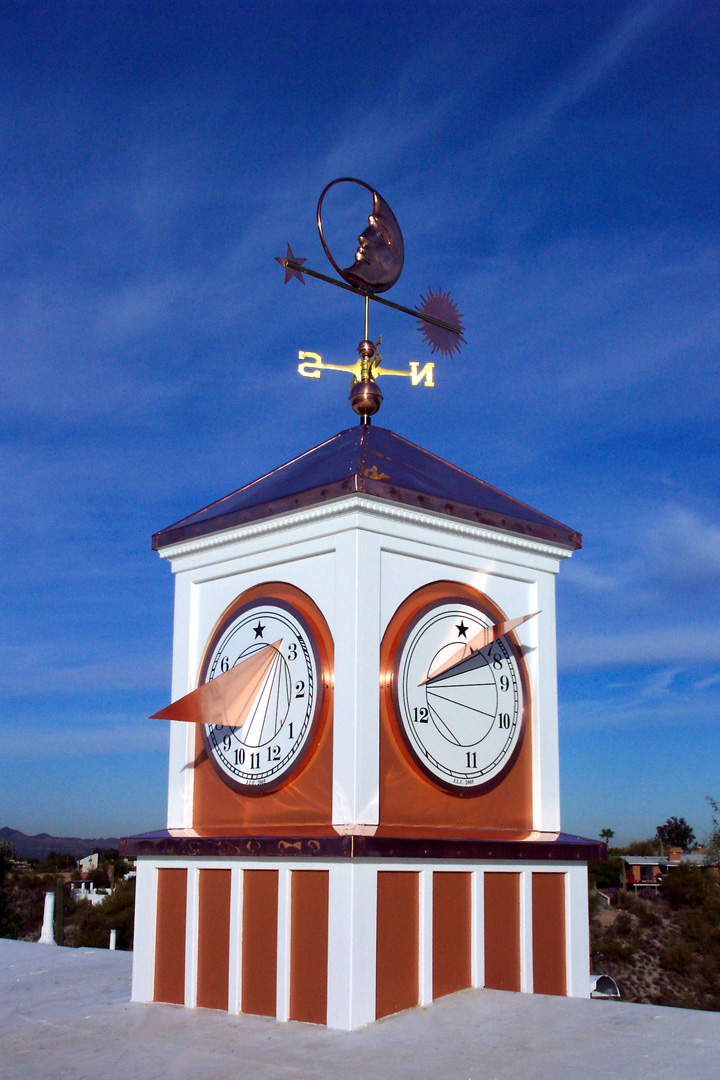
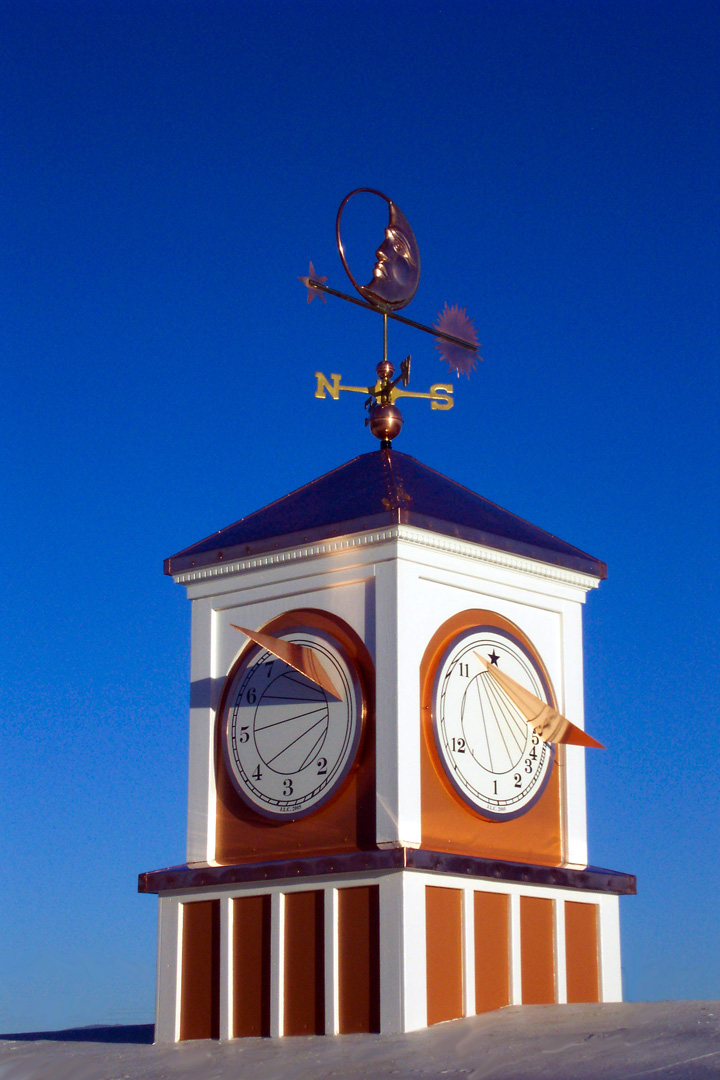
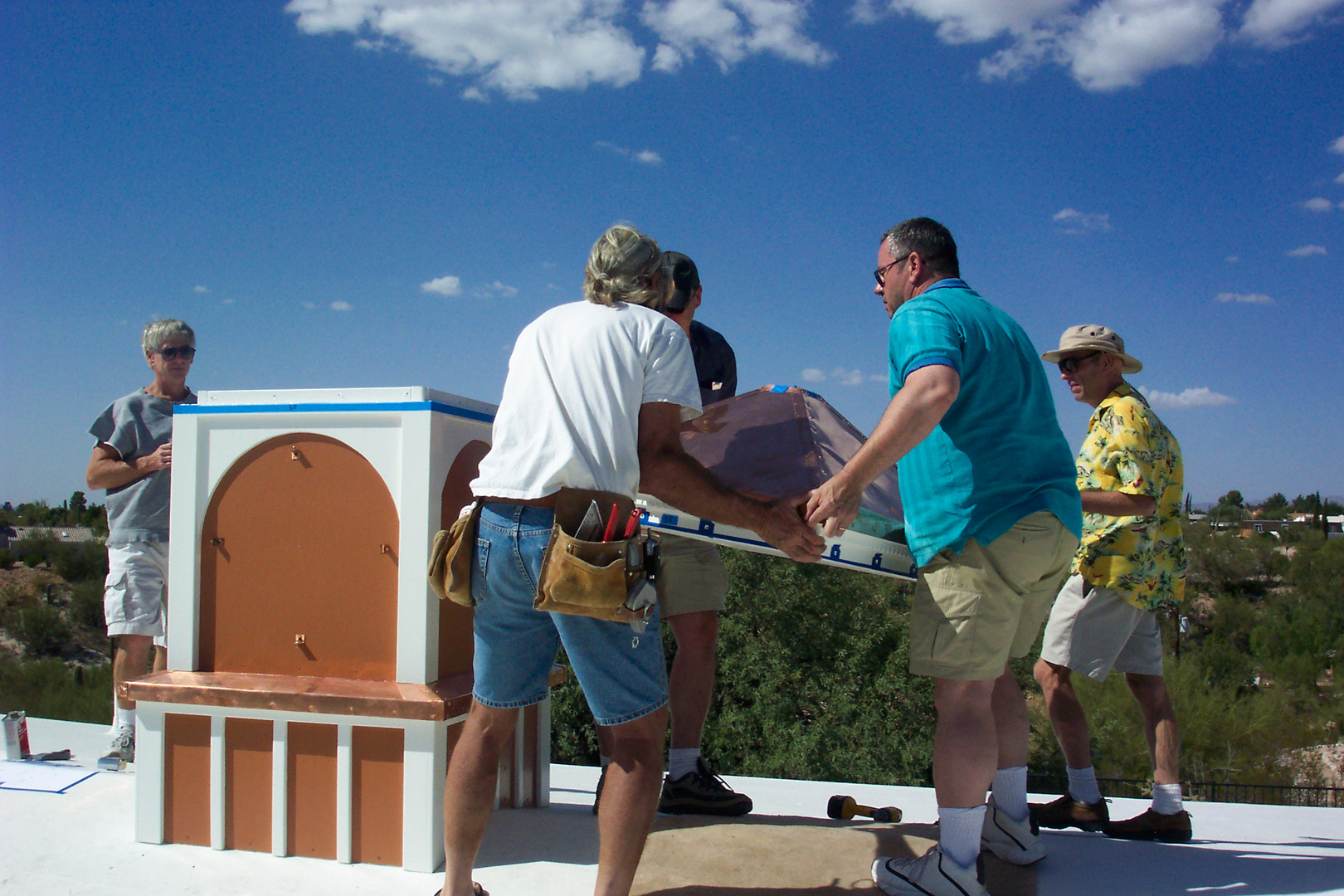
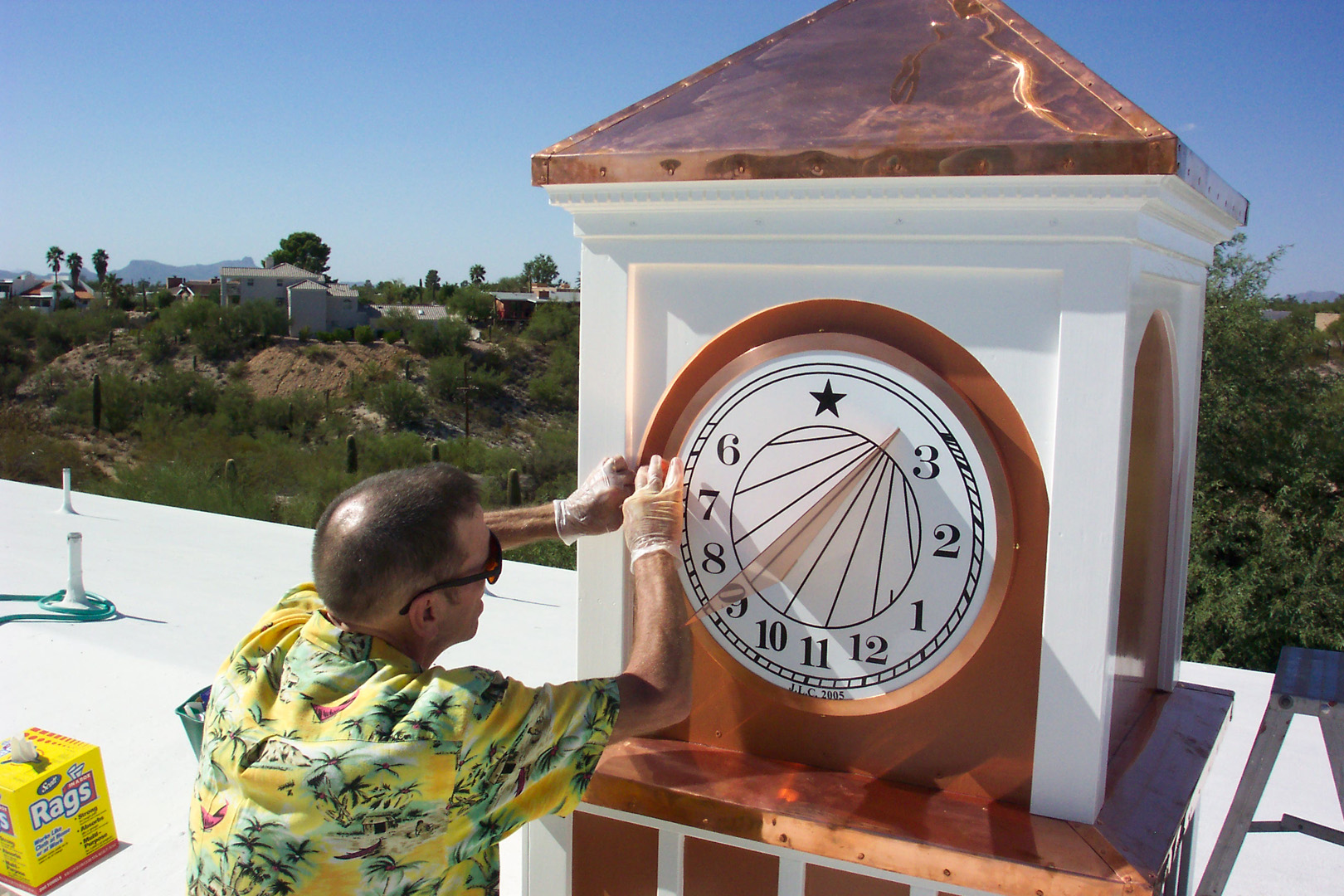
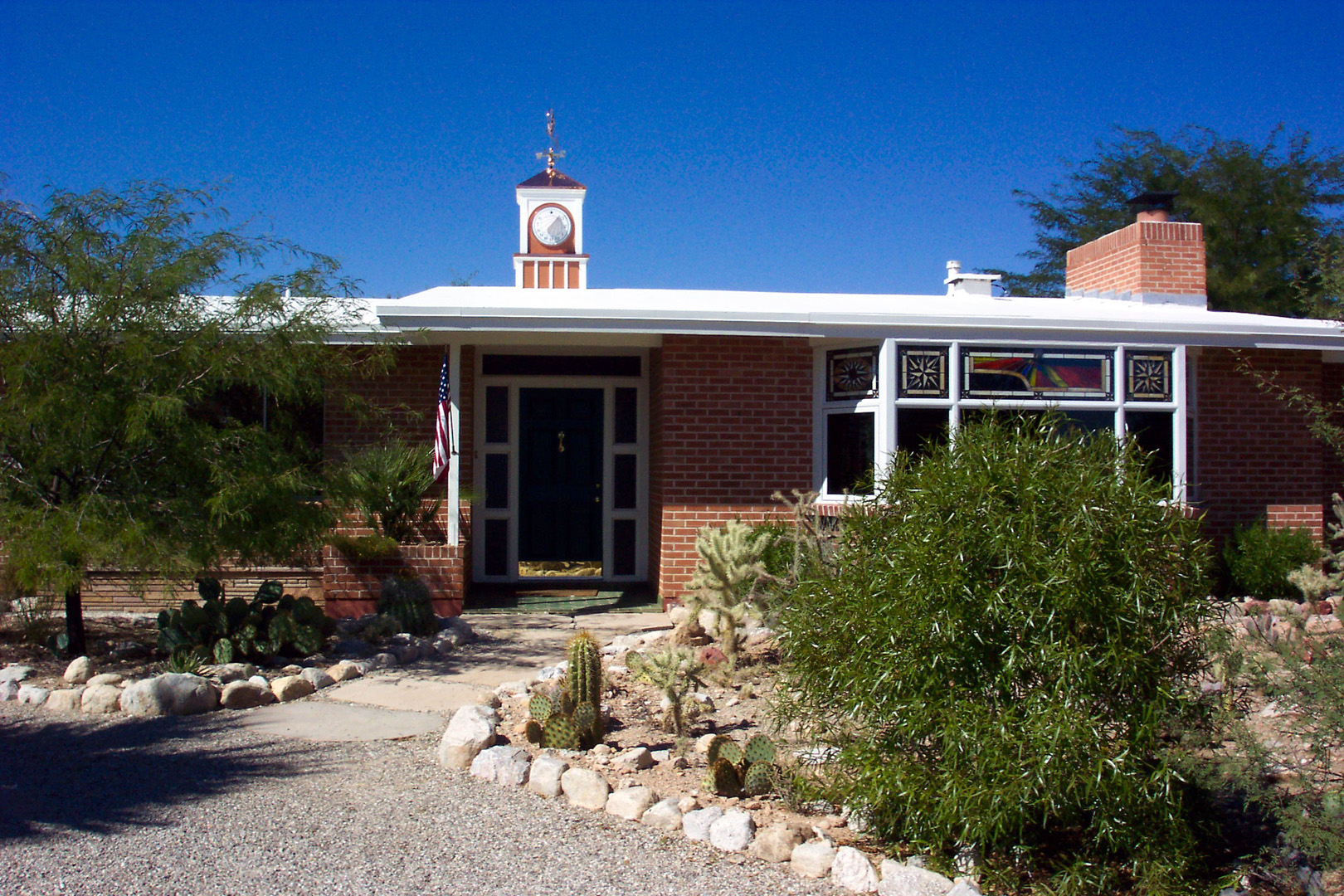
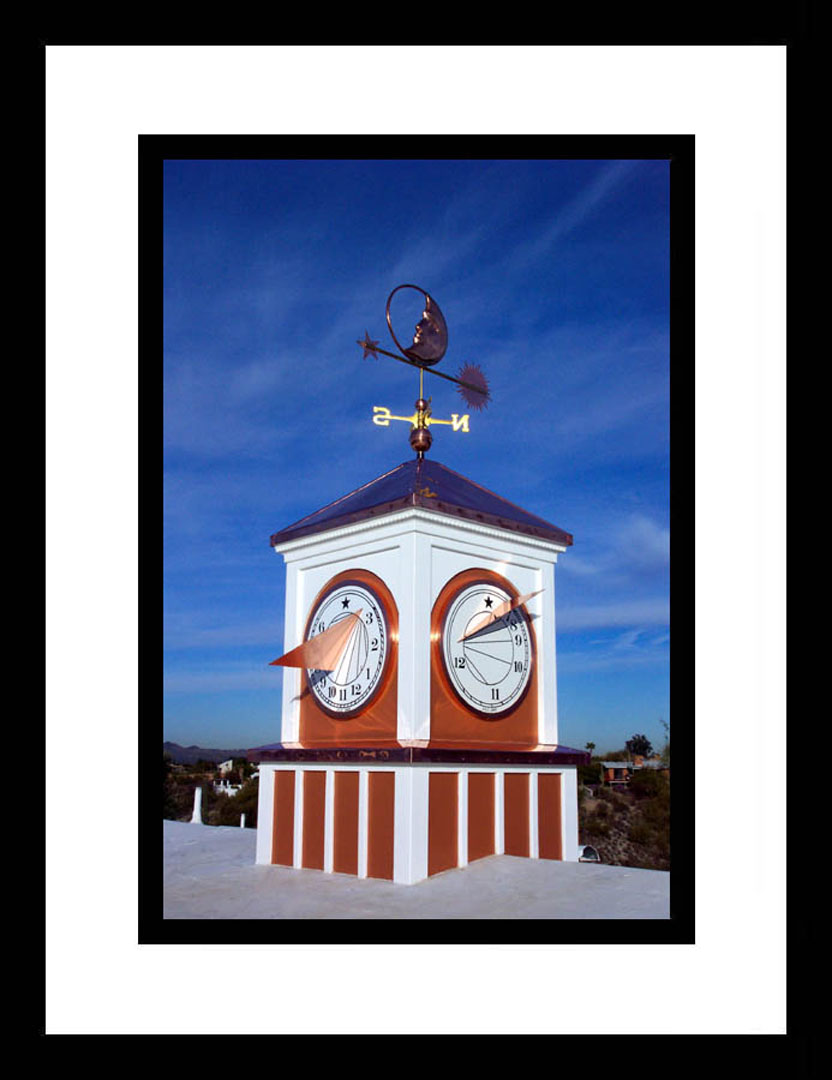
Delineator, Designer & Maker: John Carmichael made the sundial bezels and gnomon, and the entire cupola except for the weathervane. Ceramic Artisans: Ned Ecke made the porcelain face of the SE Dial but he died before he could complete the others. KVO Industries did the porcelain firings of the other three faces. Date: installed February 2006 Original Location: Lat: 32.22° N, Lon: 110.98° W. There are four sundials on the cupola which is on the roof of Carmichael's home at 925 E. Foothills Dr. Tucson AZ, USA. Present Location: at original location Orientation: Vertical, Declinations- SE Dial: 27.96° E. of S; NE Dial: 117.96° E. of S; NW Dial: 152.04° W. of S; 62.04° W. of S. Size: Dial Faces- 53 cm (21 in), Cupola height with weathervane- 2.5 m (100 in) Adornment: Dial faces were designed to look like traditional clock faces with minimal adornment for easy reading. Solar Noon marks are on SE and SW faces. Black star is at top of all faces. Mottos: none Condition: still excellent in 2009. Wood parts repainted in 2009. Patina is beginning to form on copper parts. Comments: This is the first known four-sided sundial cupola in the Western Hemisphere. The designs on the sundial faces are made from the wonderful super-durable media of kiln-fired porcelain on steel, encased in copper bezels with copper sheet gnomons. The cupola is made from painted redwood with copper roofs and a copper weathervane. Sundial Cupolas, Towers & Chimneys Website: Here KVO Industries Website: Here Sundial Sculptures Website: Here John Carmichael’s Email: Here Photo Descriptions: Photos are courtesy of John Carmichael and were taken in 2006.. Photo ‘g’ show the original design plan made with DeltaCad. Anybody can use these photos without permission Photos: a b c d e f g |
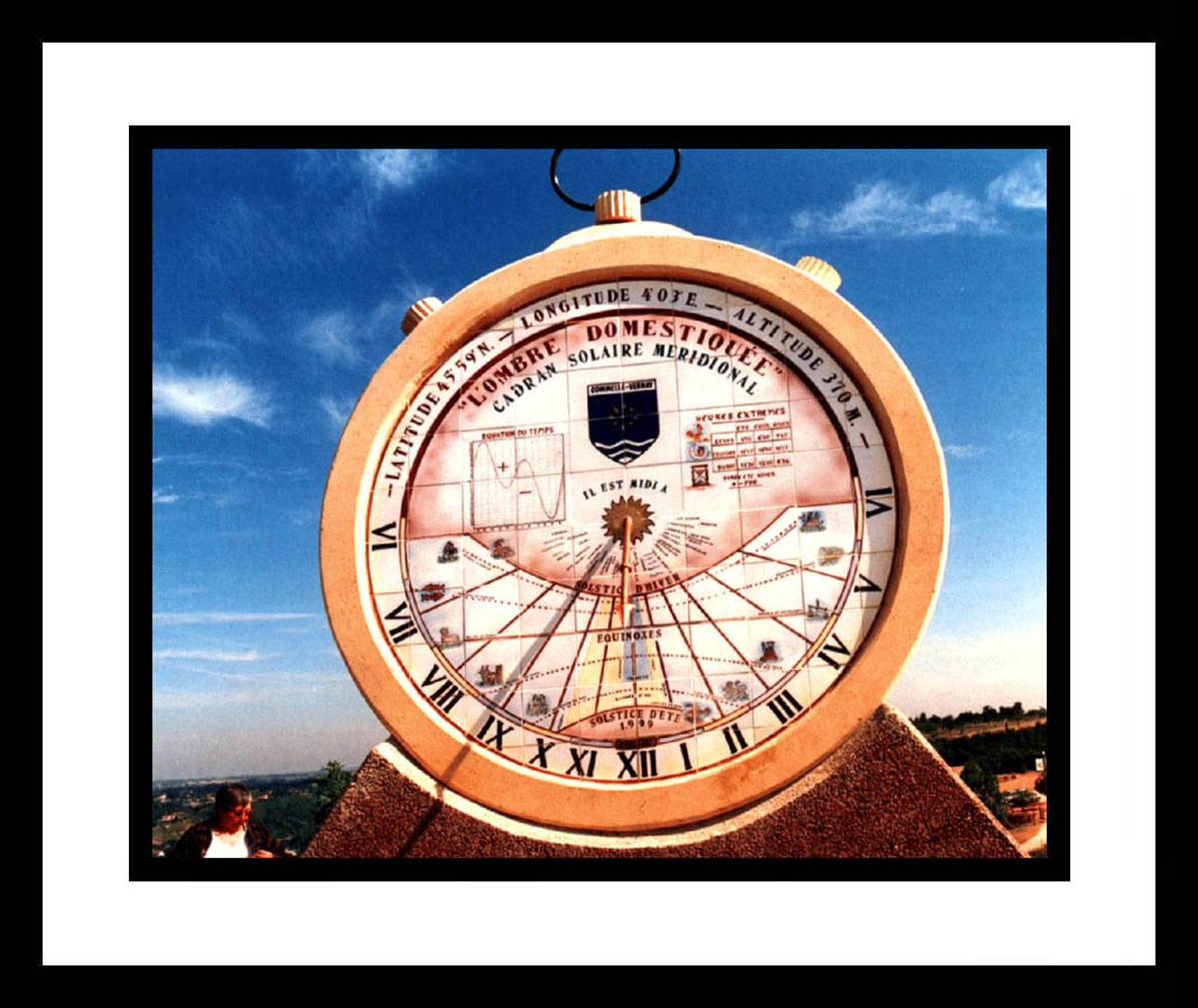 |
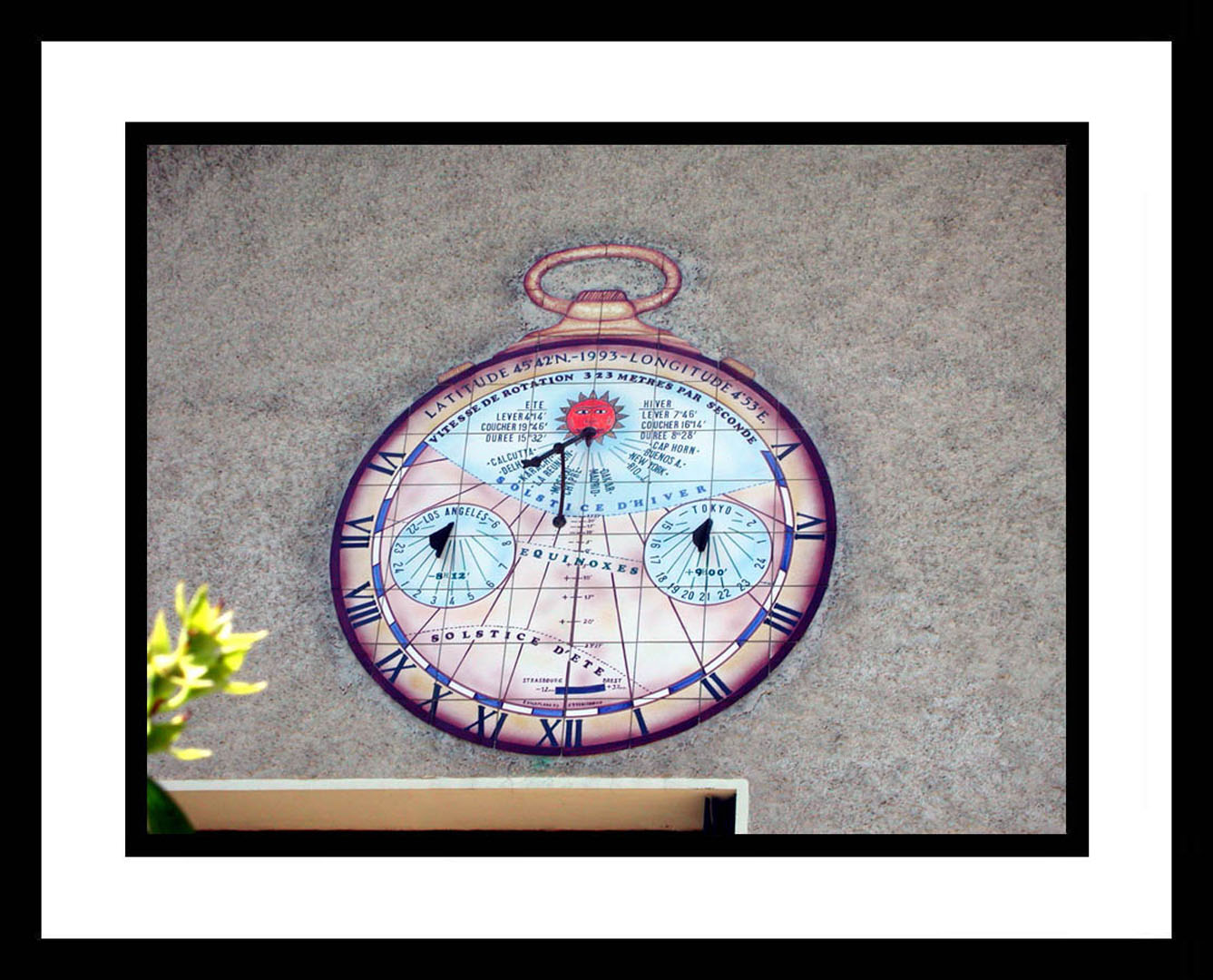 |
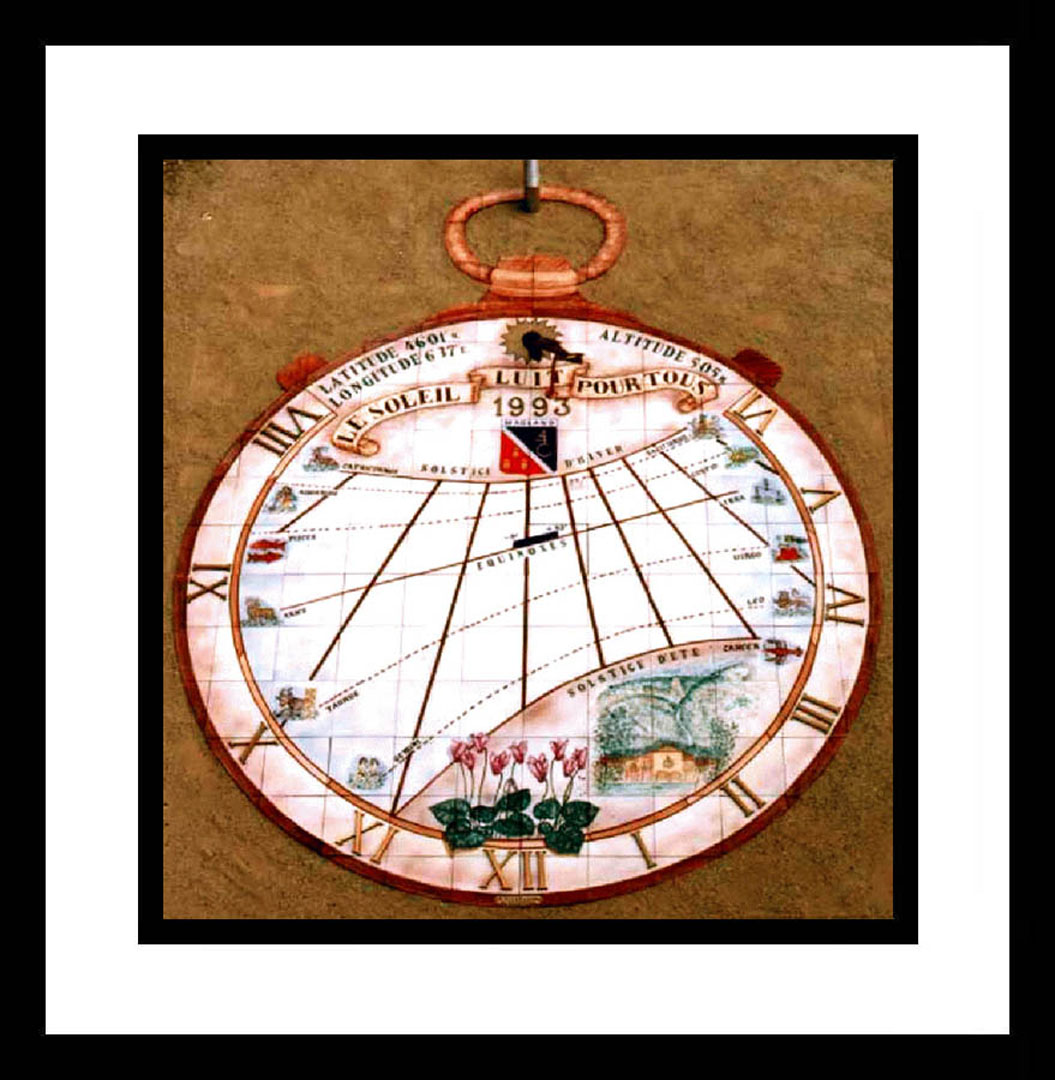 |
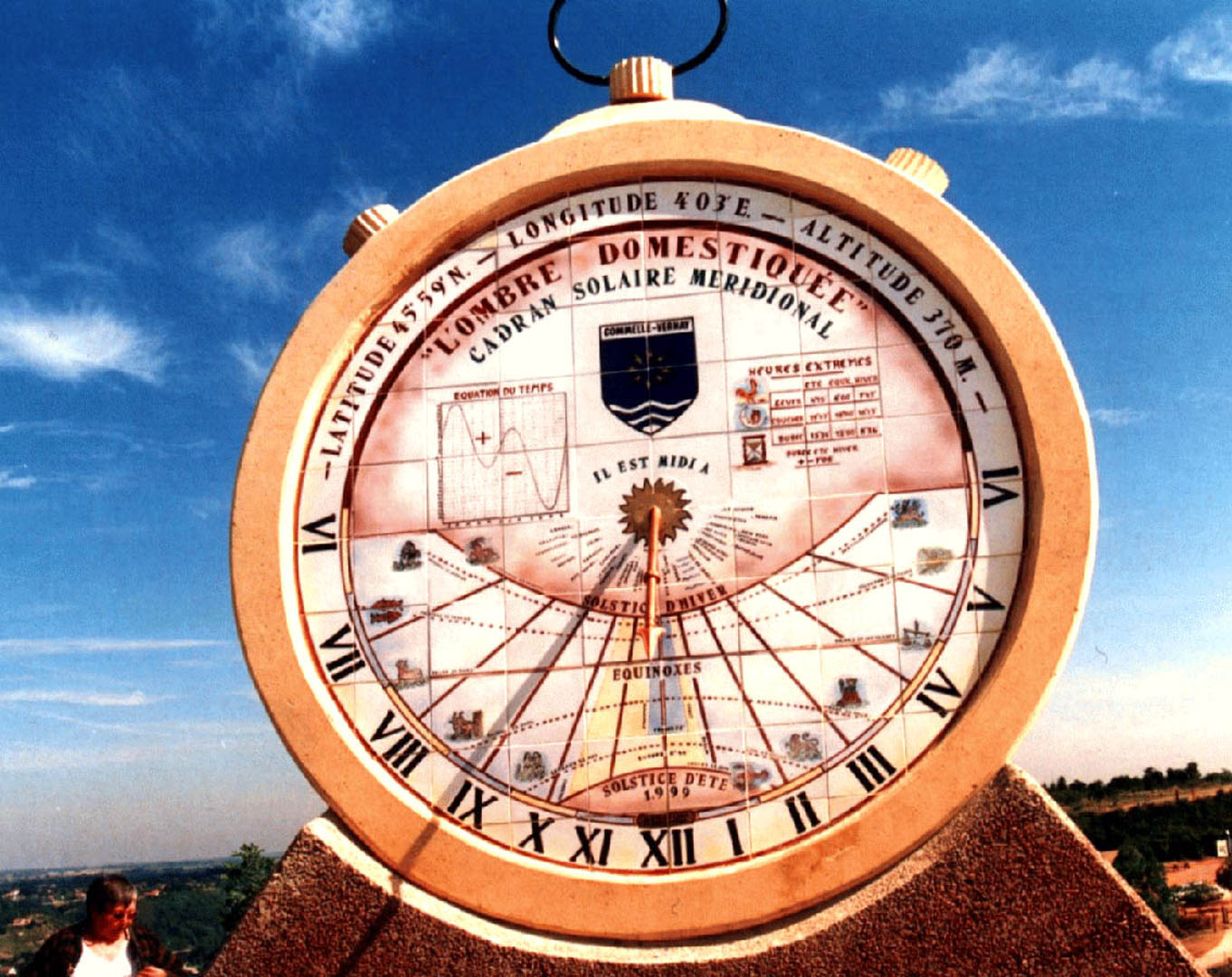
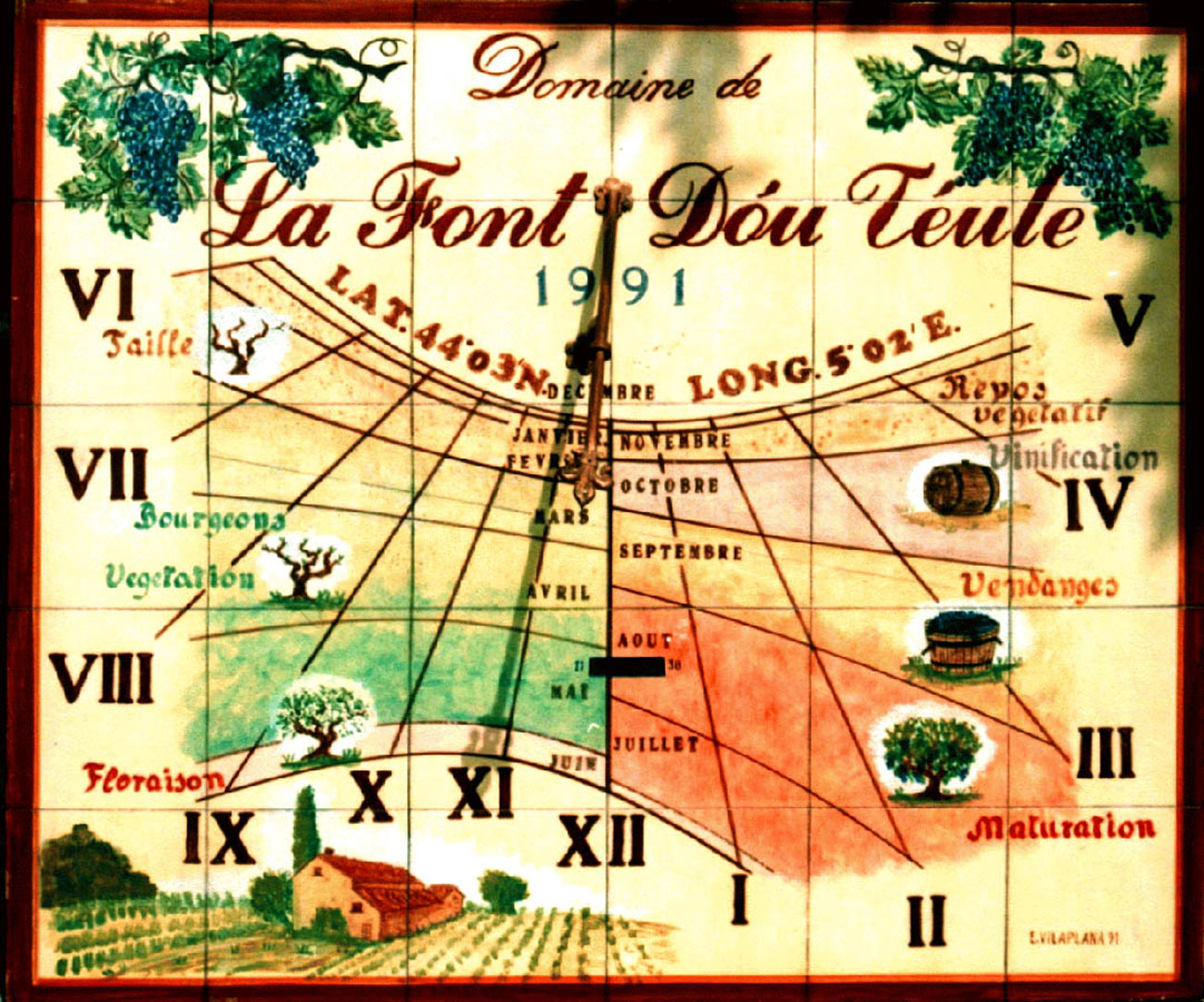
| Designer: M. Vilaplana (cannot find signature, but looks like a Vilaplana) Artist: probably M. Vilaplana (cannot find signature) Date: 1999 Original Location: Lat: 45° 59’ N, Lon: 4° 03’ E. on stand in Commelle Vernay, France Present Location: at original location Orientation: Vertical. Declines south. Size: unknown but quite large Adornment: shield, Equation of Time, extreme hours, rooster, moon, hourglass, zodiacal signs Mottos: “L’Ombre Domestique” (Domesticated Shadow) Inscriptions: coordinates, elevation Condition: unknown Comments: No website known that shows this dial. We need a better photo. This is more like a sculpture that looks like a giant pocket watch. There is another dial on the North face. Alain Ferreira’s Email: Here Photo Descriptions: Photo is courtesy of Alain Ferreira. Photos: a |
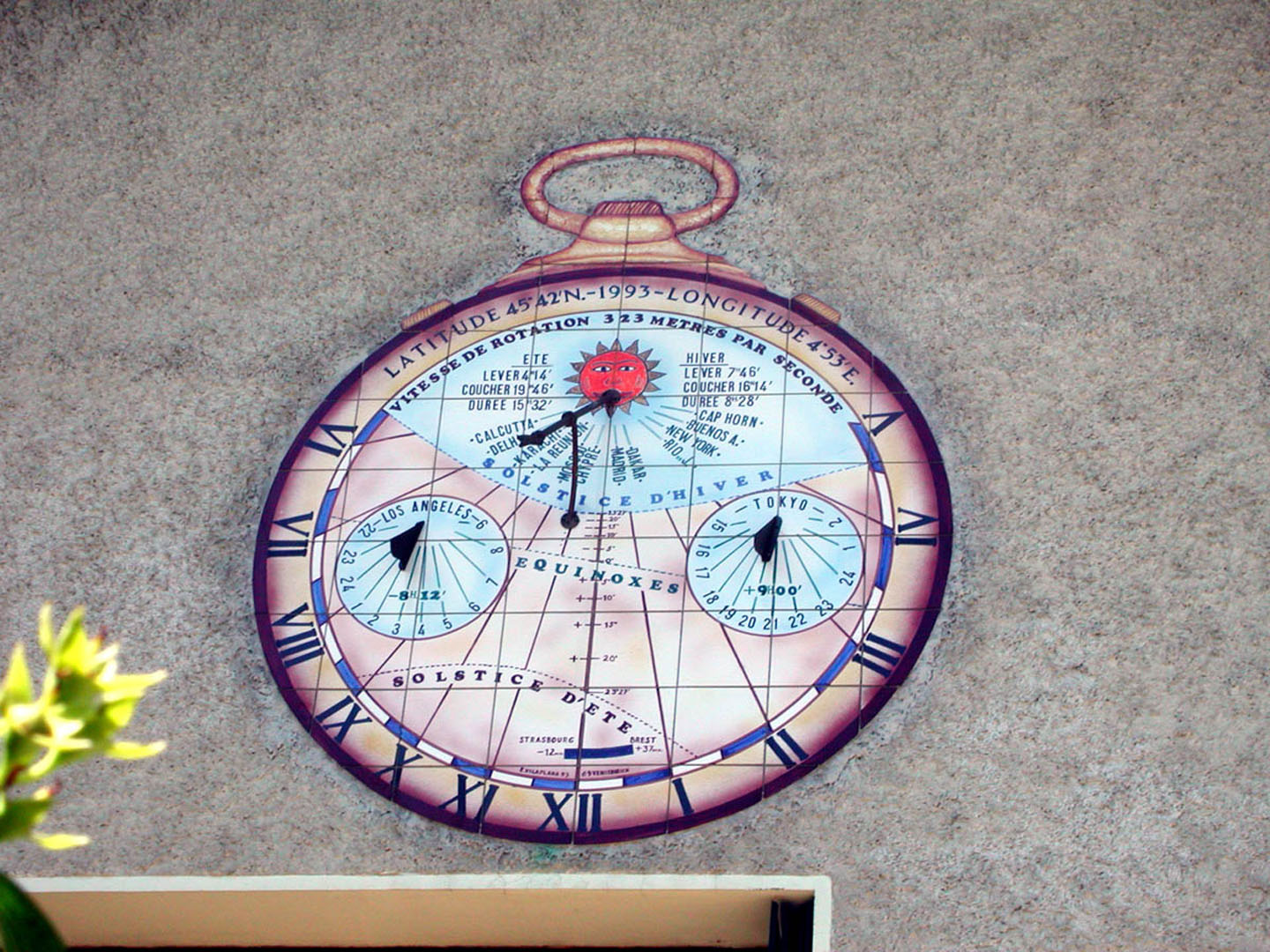
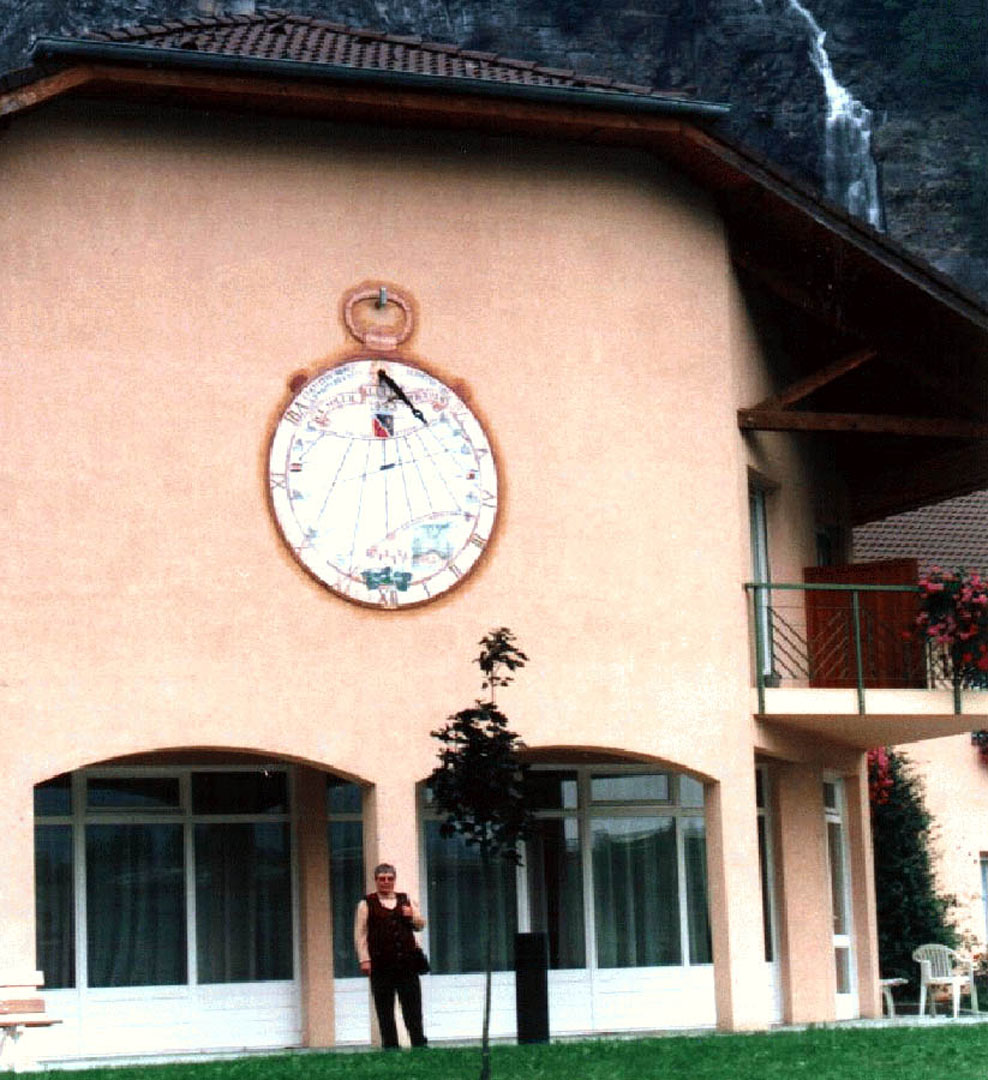
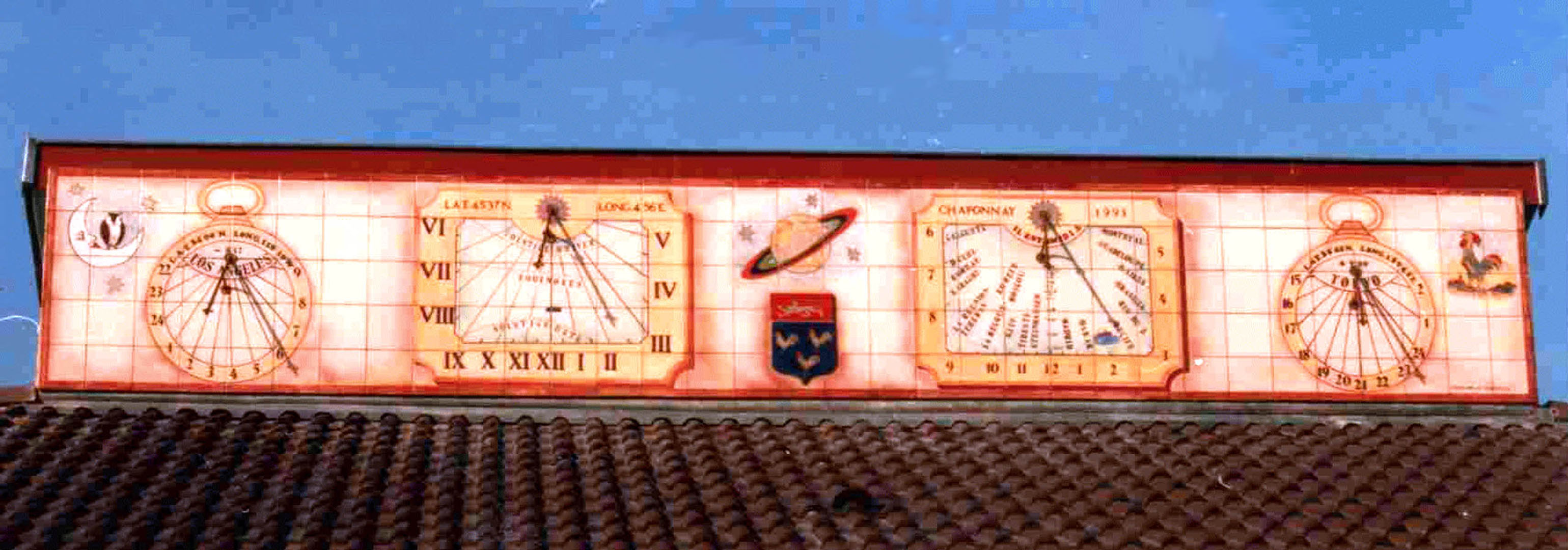
Designer: E. Vilaplana (signed) Artist: possibly by Venissieux-R (signed) Date: 1993 Original Location: Lat: 45° 42’ N, Lon: 4° 53’ E. On unknown building in Lyon France Present Location: at original location Orientation: vertical. Declines slightly to the east of south. Size: unknown but quite large Adornment: dial looks like a pocket watch with chain ring and winding stems. Sun face at center Mottos: none Inscriptions: coordinates, extreme hours, times in world cities, speed of Earth’s rotation- 323 meters per second Condition: unknown Comments: No website known that shows this dial. One large sundial has two smaller dials on each side that tell times in Los Angeles and Tokyo. Similar to Dial 385. Alain Ferreira’s Email: Here Photo Descriptions: Photo is courtesy of Alain Ferreira. Photos: a |
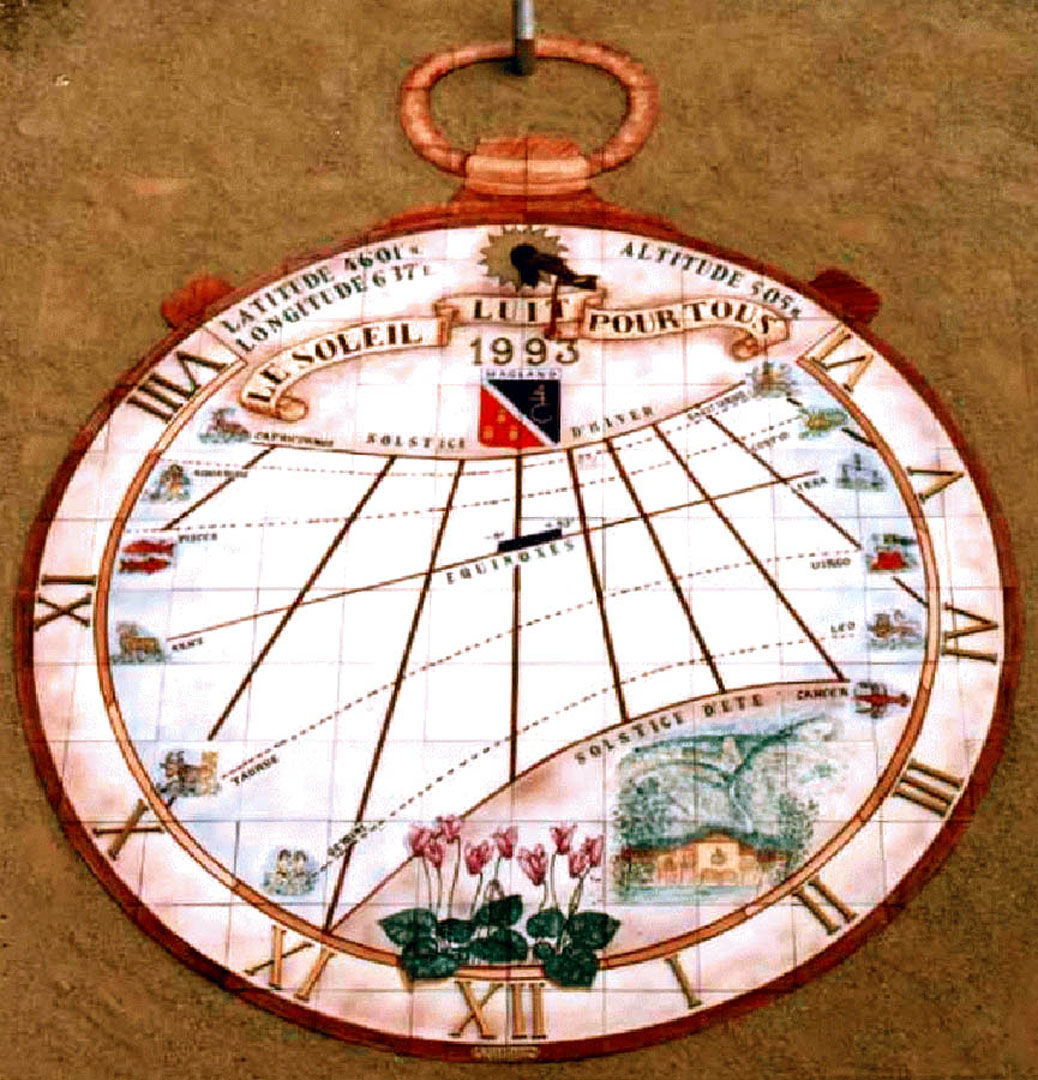
Designer: possibly by E.Vilaplana (unsigned) Artist: possibly by Venissieux-R (unsigned) Date: 1993 Original Location: Lat: 46° 01’ N; Lon: 6° 37’ E. in unknown place in Magland France Present Location: at original location Orientation: Vertical. Declines slightly to the west of south Size: unknown Adornment: dial looks like a pocket watch with chain ring and winding stems. Shield, cyclamen flowers, a house, zodiacal signs Mottos: “Le Soleil Luit Pour Tous” (The Sun Shines for All) Inscriptions: coordinates, elevation Condition: unknown Comments: This dial is similar to Dial 384. No website known that shows this dial. We need a better photo. Alain Ferreira’s Email: Here Photo Descriptions: Photos are courtesy of Alain Ferreira. Photos: a b |
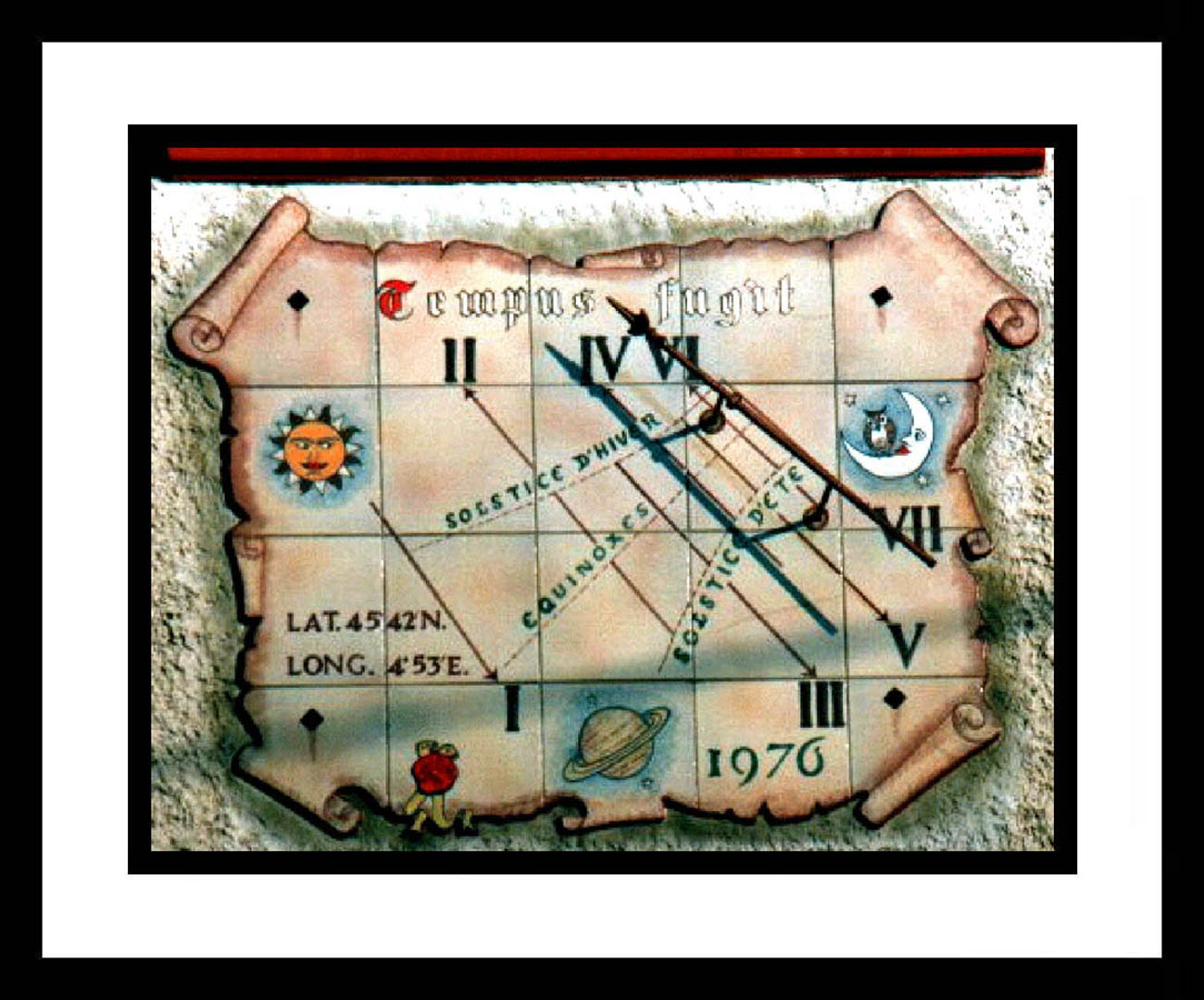 |
 |
 |
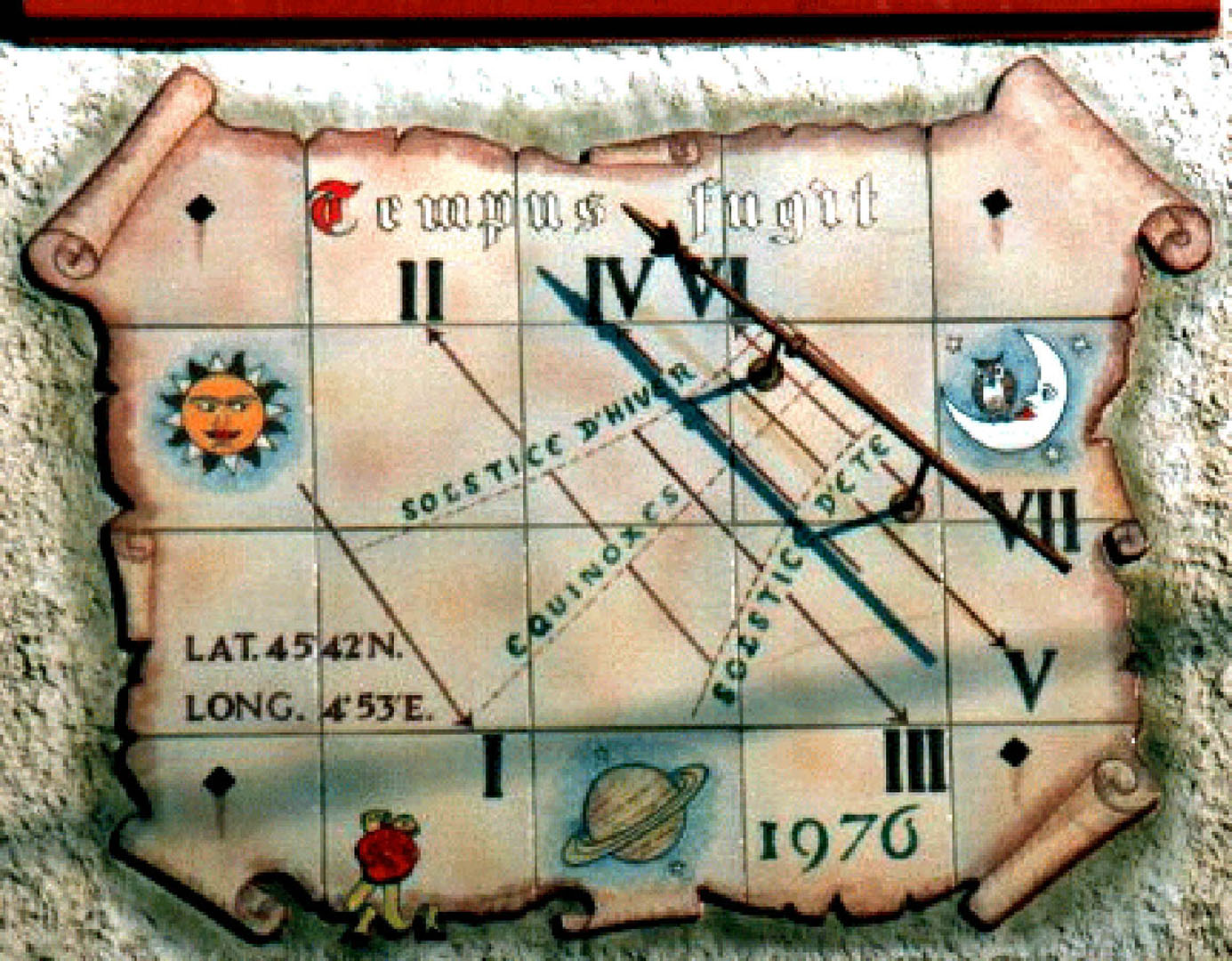
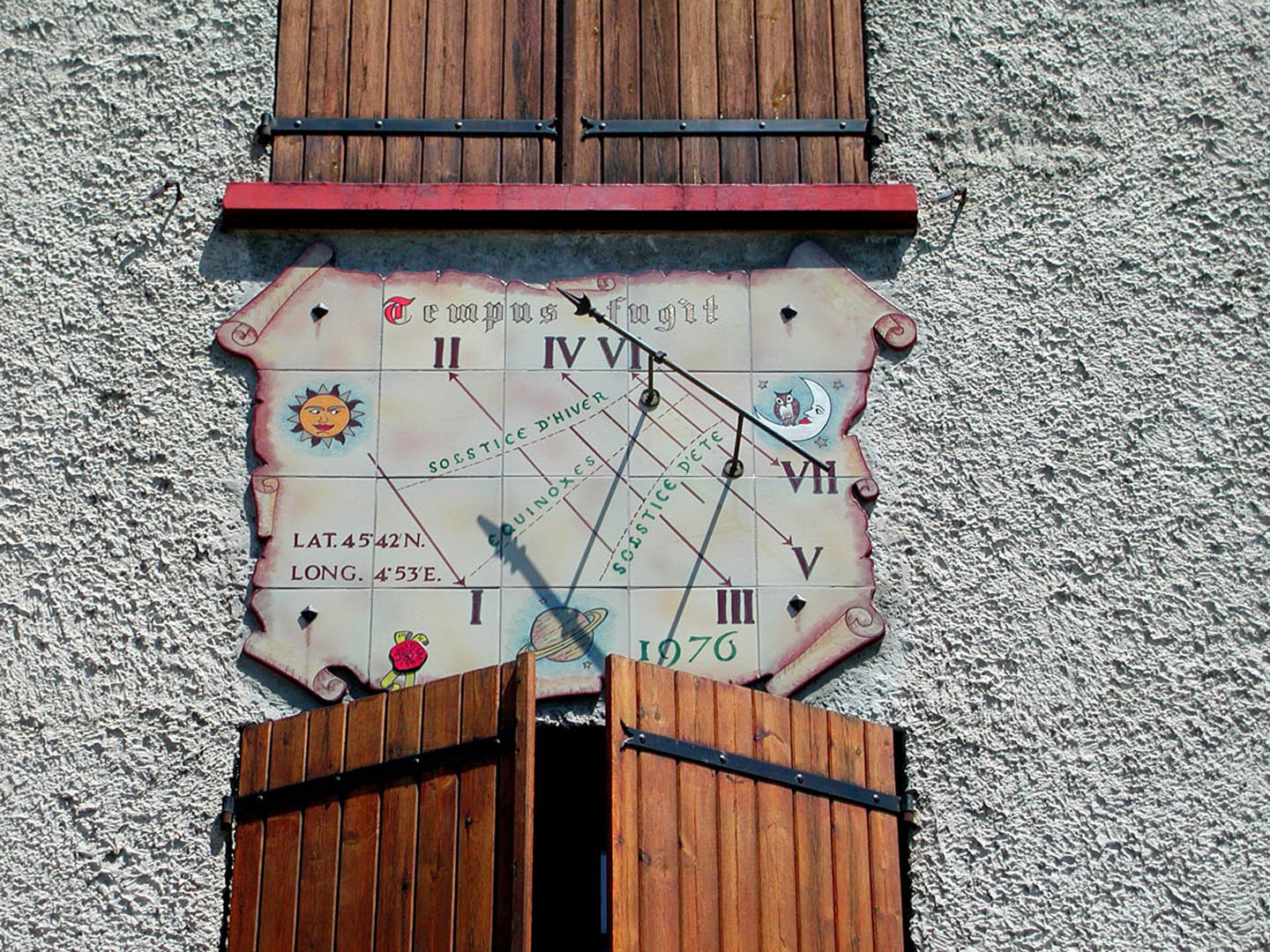
| Designer: M. Vilaplana (unsigned) Artist: M. Vilaplana (unsigned) Date: 1976 Original Location: Lat: 45° 42’ N, Lon: 4° 53’ E. on unknown building in or near St-Fons France. Present Location: at original location Orientation: Vertical. Declines west. Size: unknown but quite large Adornment: interesting dial face looks like old curled parchment with moon & Owl, Saturn & Stars, rooster (same as Dial 380) Mottos: “Tempus Fugit” (Time Flies) Inscriptions: 1976, Lat: 45° 42’ N; Lon: 4° 53’ E. Condition: unknown Comments: No website known that shows this dial. Alain Ferreira’s Email: Here Photo Descriptions: Photos are courtesy of Alain Ferreira. Photos: a b |
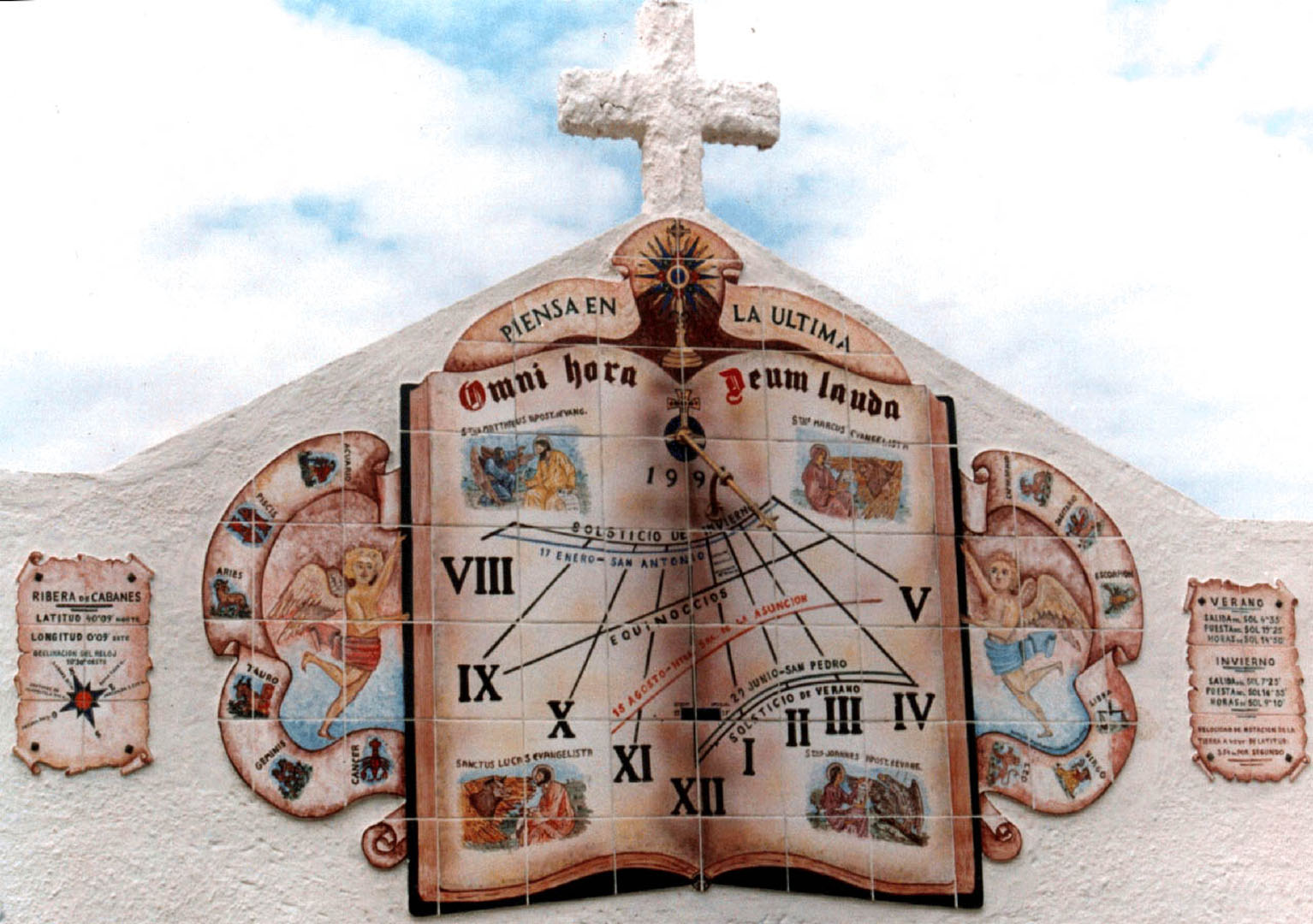
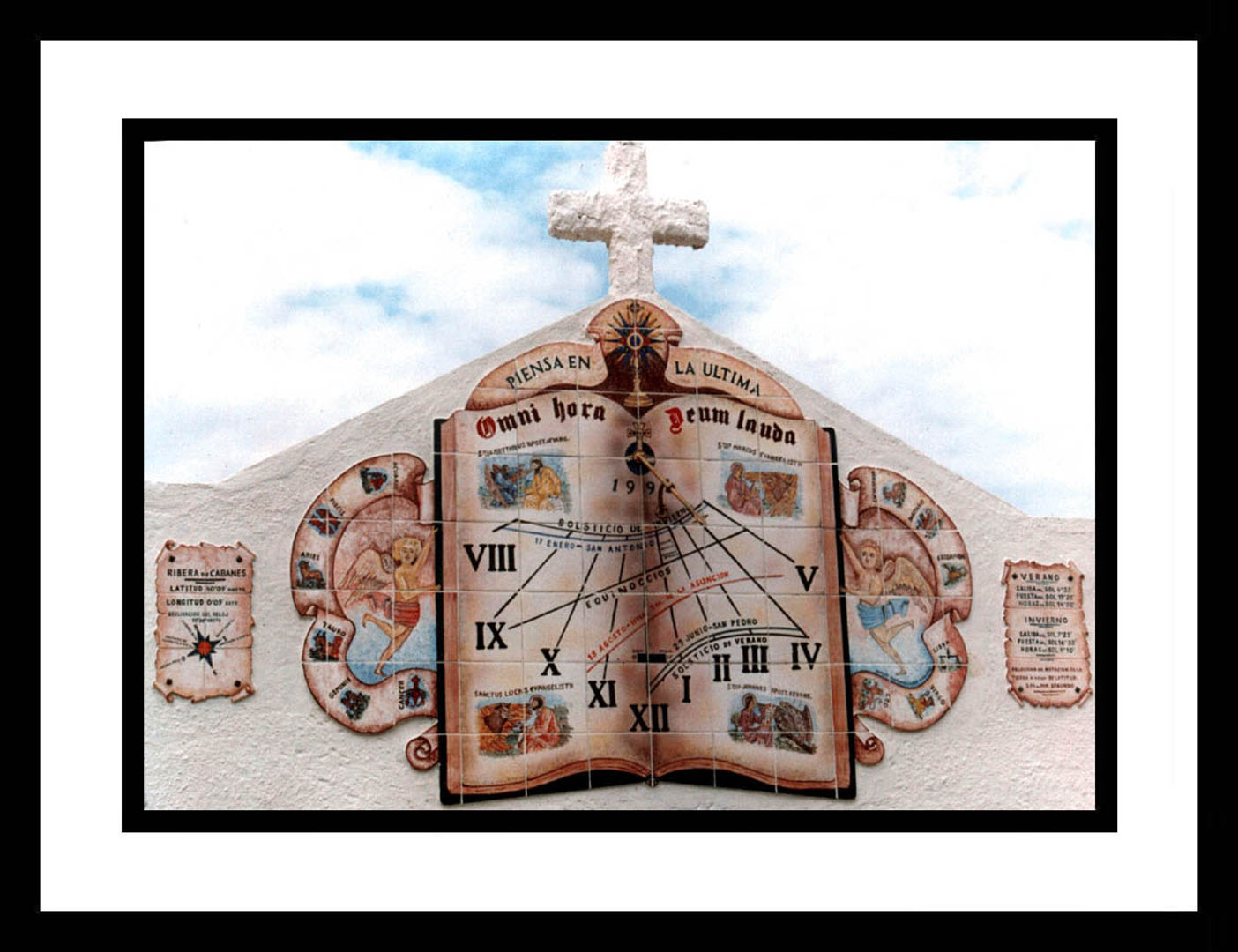
Designer: unknown (unsigned) Artist: unknown (unsigned) Date: 1993 Original Location: Lat: 40° 09’ N, Lon: 0° 09’ E. In Ribera de Cabanes, Spain Present Location: at original location Orientation: Vertical. Declines somewhat west of south. Size: unknown but quite large Adornment: Angels, Signs of the zodiac, several religious depictions Mottos: “Piensa en la Ultima” (Consider the Highest); “Omni Hora Deum Lauda” (trans: ?) Inscriptions: coordinates of the place, times of sunrises and sunsets, and other small inscriptions Condition: unknown Comments: No website known that shows this dial. We need a better photo. This attractive dial has an interesting shape with informative side panels. Alain Ferreira’s Email: Here Photo Descriptions: Photo is courtesy of Alain Ferreira. Photos: a |
Designer: E.Vilaplana (signed) Artist: Venissieux-R (signed) Date: 1990 Original Location: Lat: 45° 25’ N, Lon: 4° 45’ E. In St Alban du Rhone, France Present Location: at original location Orientation: vertical. Declines slightly to the West of South Size: unknown Adornment: dial looks like a book with unidentifiable artwork Mottos: “Omni Hora Deum Lauda” (trans:?) Inscriptions: coordinates and other small unreadable inscriptions Condition: unknown Comments: No website known that shows this dial. Alain Ferreira’s Email: Here Photo Descriptions: Photo is courtesy of Alain Ferreira. Photos: a |
 |
 |
 |
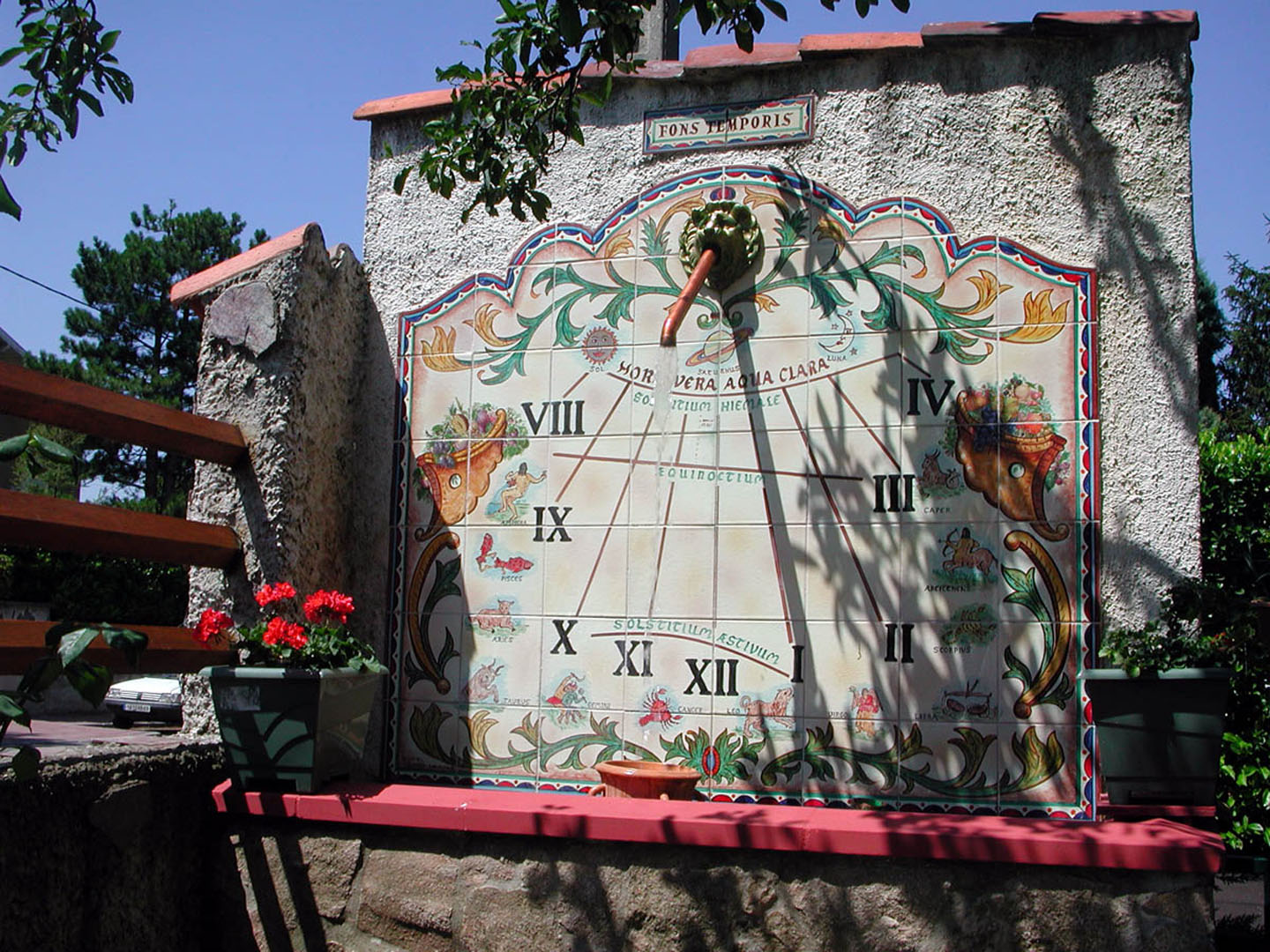
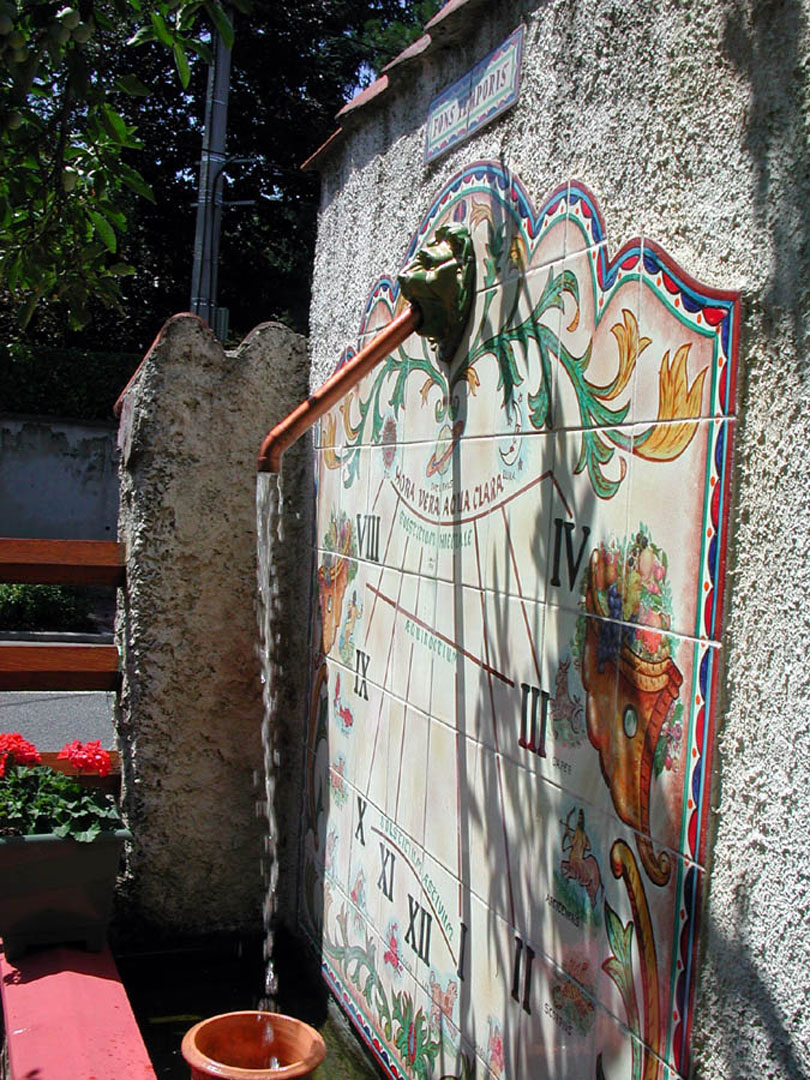
| Designer: possibly by E.Vilaplana (signature in lower left is unreadable) Artist: possibly by Venissieux-R (signature in lower left is unreadable) Date: unknown Original Location: Lat: 45° 35’ N; Lon: 5° 08’ E. In Vilfontaine France Present Location: at original location Orientation: Vertical. Declines slightly to the east of south. Size: unknown Adornment: borders of decorative leaves and fruit, Saturn, zodiacal signs, a lions head sculpture at the base of the gnomon spigot Mottos: “Hora Vera Aqua Clara” (True Time Clear Water) Inscriptions: “Fons Temporis” (Time Fountain) Condition: unknown Comments: No website known that shows this dial. This is a most lovely, interesting and functional sundial! The angled copper water spigot of the fountain doubles as the gnomon of the sundial Alain Ferreira’s Email: Here Photo Descriptions: Photos are courtesy of Alain Ferreira. Photos: a b c |
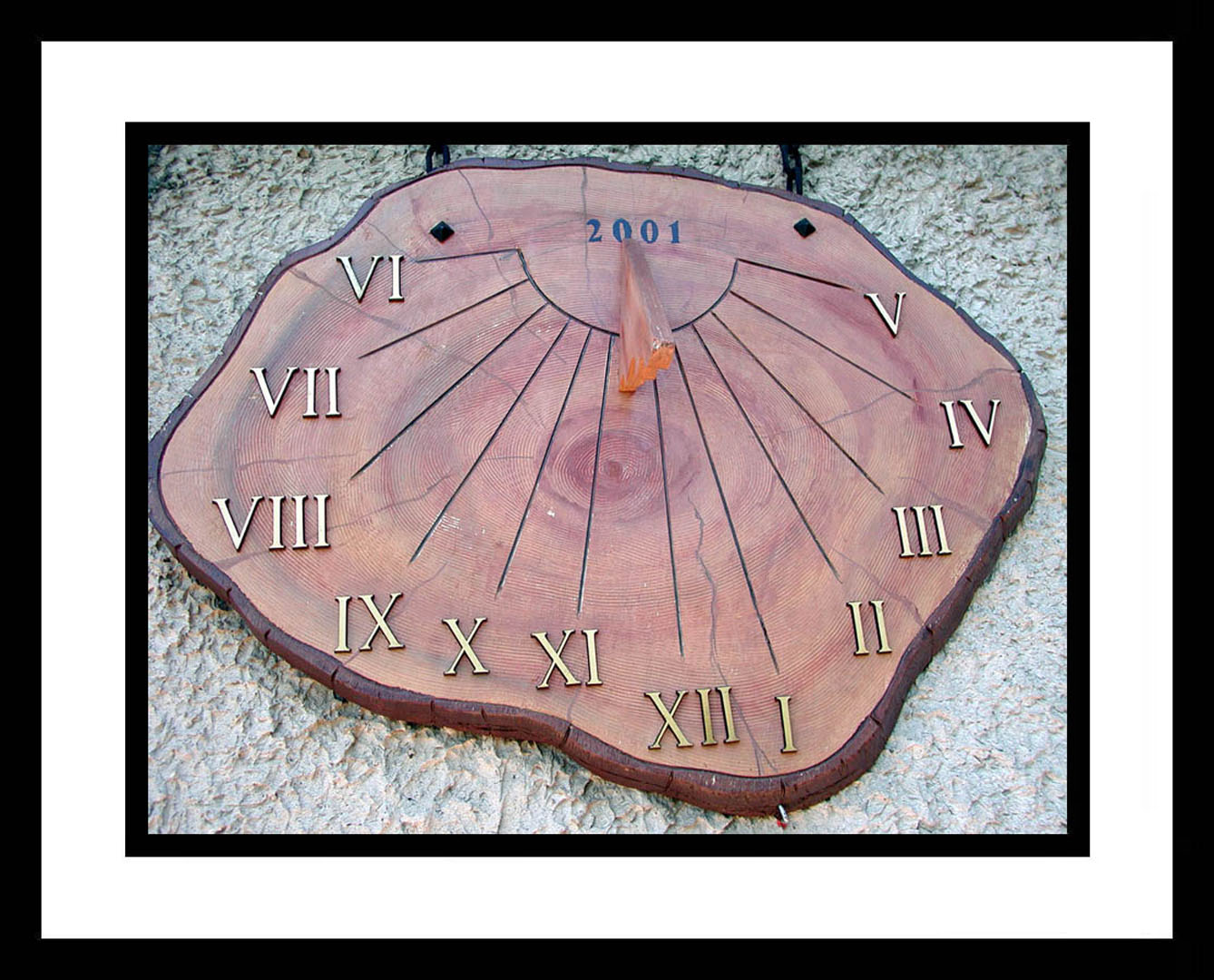
Designer: possibly by E. Vilaplana (unsigned) Artist: possibly by Venissieux-R (unsigned) Date: 2001 Original Location: Location: unknown place in France Present Location: at original location Orientation: Vertical. Declines near or at south. Size: unknown Adornment: ceramic dial painted to look like a slice of wood from a tree trunk Mottos: none Inscriptions: “2001” Condition: unknown Comments: No website known that shows this dial. This fooled me when I first saw it. If you look closely you can see that it is sculpted and painted to look like real wood. Alain Ferreira’s Email: Here Photo Descriptions: Photo is courtesy of Alain Ferreira. Photos: a |
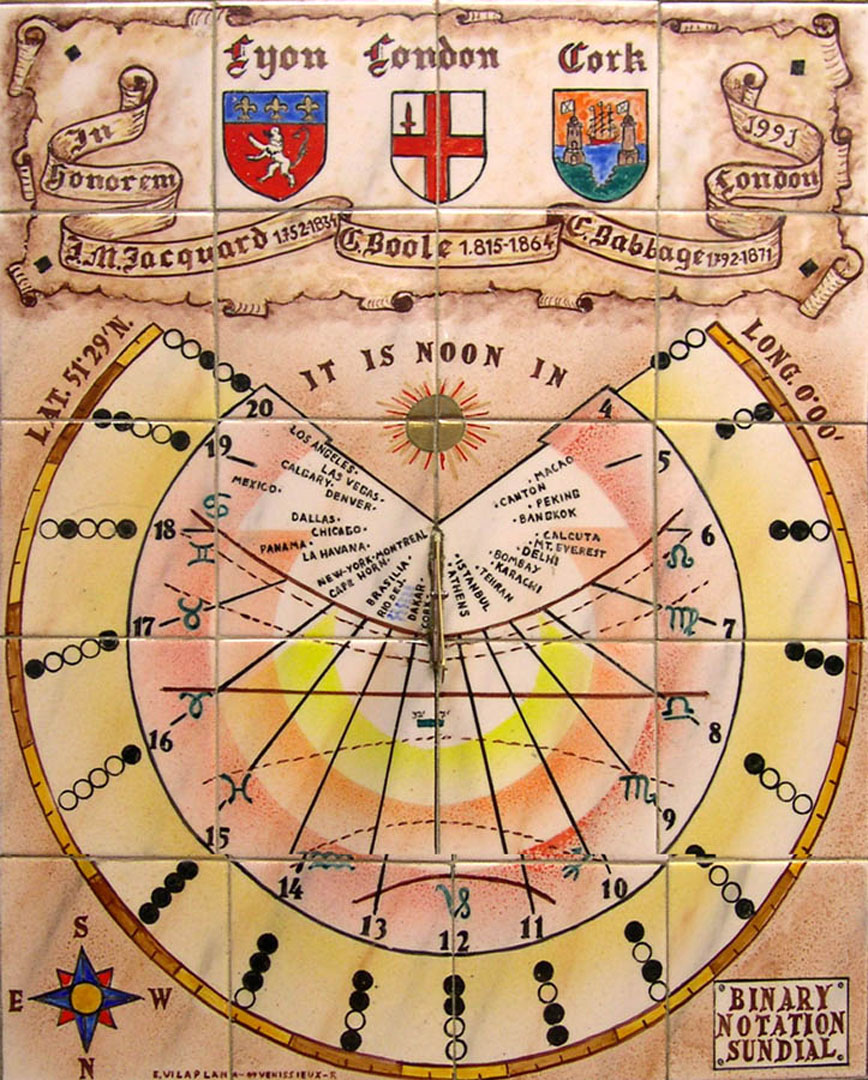
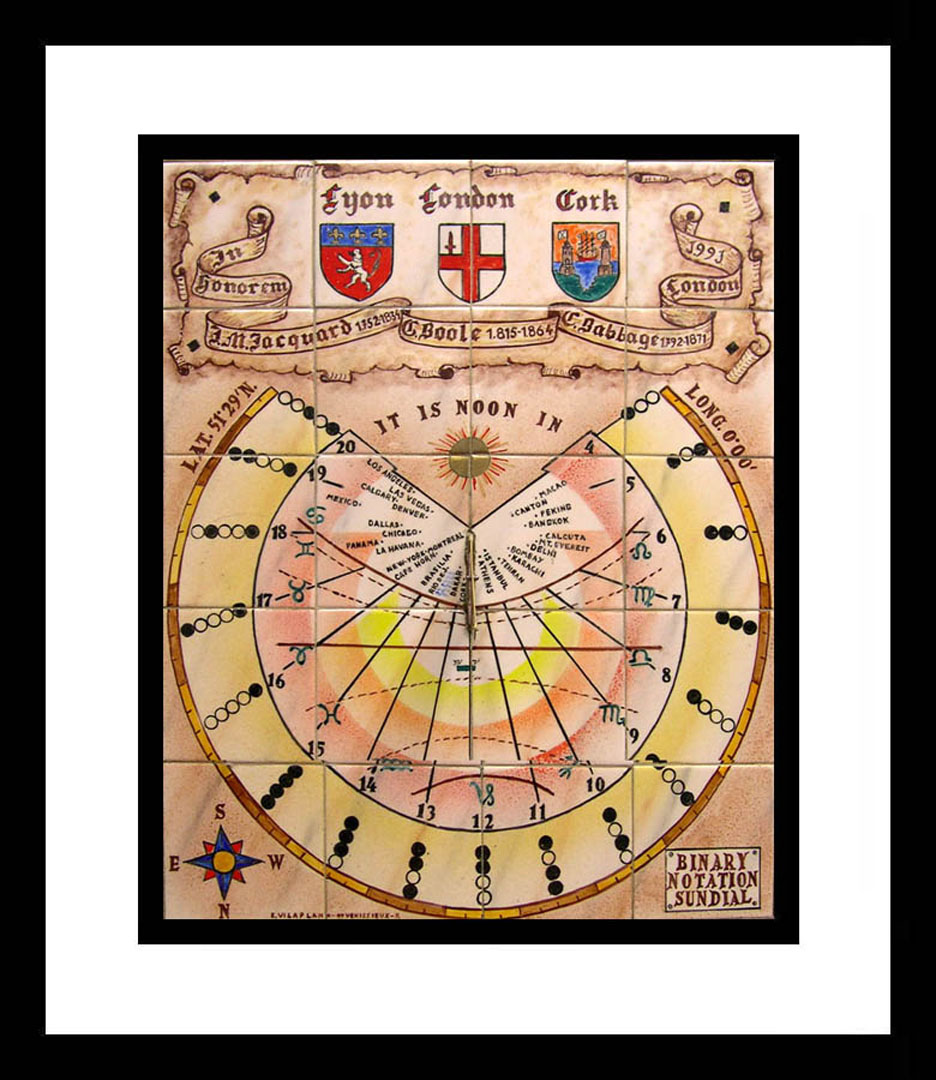
Designer: E.Vilaplana (signed) Artist: possibly by Venissieux-R (signed) Date: 1993 Original Location: Lat: 5° 29’ N, Lon: 0° 00’. At unknown place in London England Present Location: at original location Orientation: Vertical. Declines slightly to the east of south Size: unknown Adornment: shields of Lyon, London & York, compass rosette, zodiacal signs, ribbon Mottos: none Inscriptions: times of noon in world cities, coordinates, “In Honorem J.M. Jacqard 1752-1834, G. Boole 1815-1864, C Babbage 1792-1871, 1993 London” Condition: unknown Comments: No website known that shows this dial. Dial shows the innovative use of binary notation to signify the hours. Jaquard invented a card-programmed weaving loom in the 19th century that could incorporate complex patterns in multiple colors. His card designs and concept became the basis for IBMs punch-card system, many years later. George Boole did pioneering work in binary logic and numbering systems. Charles Babbage created two huge mechanical computational engines. The first, the Difference Engine, was completed and was designed to simplify the creation of tables of trig functions and logarithms. His later work, the Analytical Engine was never really completed, although large sections were built. It was to be a true stored-program general purpose computer- in the 1870's! His "programmer", the mathematician Augusta Ada Lady Lovelace, the daughter of the English poet Lord Byron, was almost equally famous... Alain Ferreira’s Email: Here Photo Descriptions: Photo is courtesy of Alain Ferreira. Photos: a |
 |
 |
 |
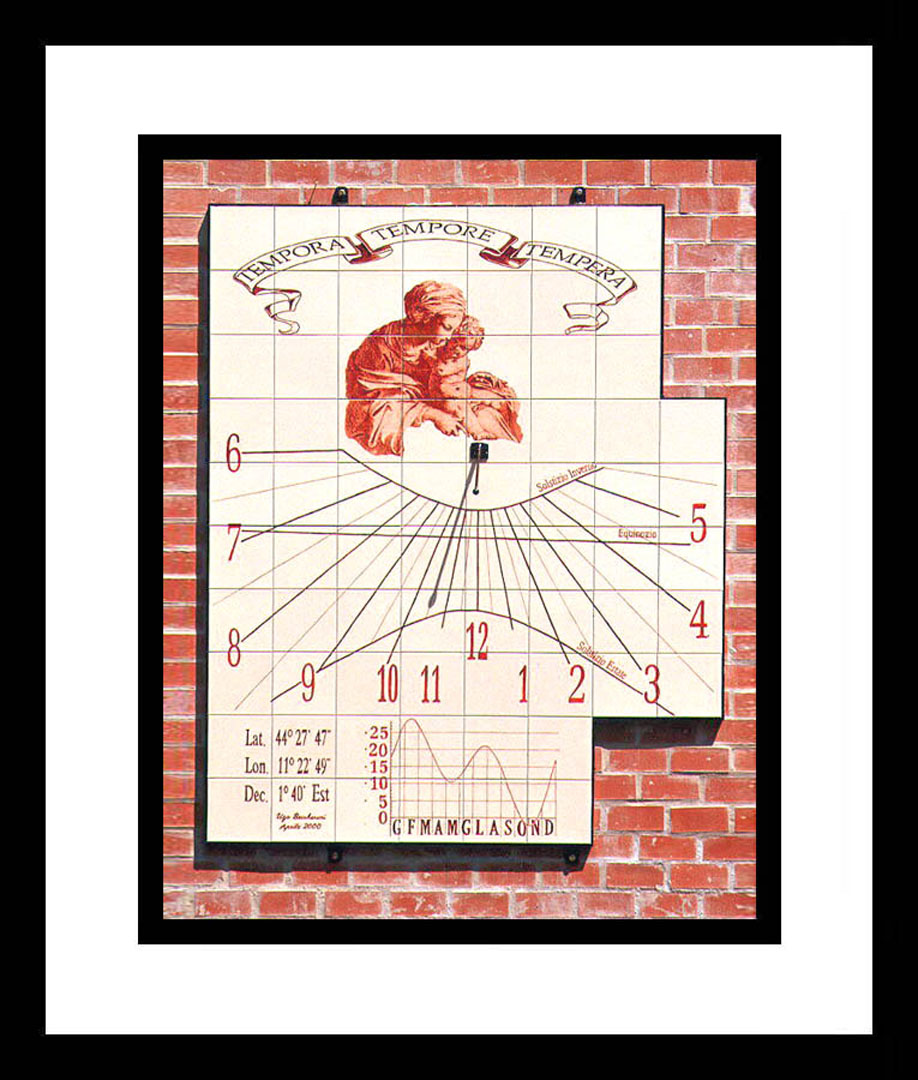
| Designer, Painter, Delineator: Ugo Beccheroni Date: 2000 Original Location: Lat: 44° 27' 47" N, Lon: 11° 22' 49" E. At Mr. Beccheroni's church, Ponticella di San Lazzaro di Savena in Bologna Italy. Present Location: at original location Orientation: on vertical wall. Declines 1° 40' east of south Size: 120 x 150 cm (47 x 59 in) Adornment: Classical depiction of mother and child painted in brick red to match the wall color. Dial has labeled solstice & equinox lines and the Equation of Time graph Mottos: “TEMPORA TEMPORE TEMPERA” (OPPORTUNELY, IT TAKES ADVANTAGE OF THE TIMES) Inscriptions: signed and dated Condition: good Comments: Beccheroni painted the ceramic tiles at his home. Sundial has rod gnomon with a ball nodus. Photo Descriptions: Photo is courtesy of Mr. Beccheroni (taken in 2005). Photos: a |
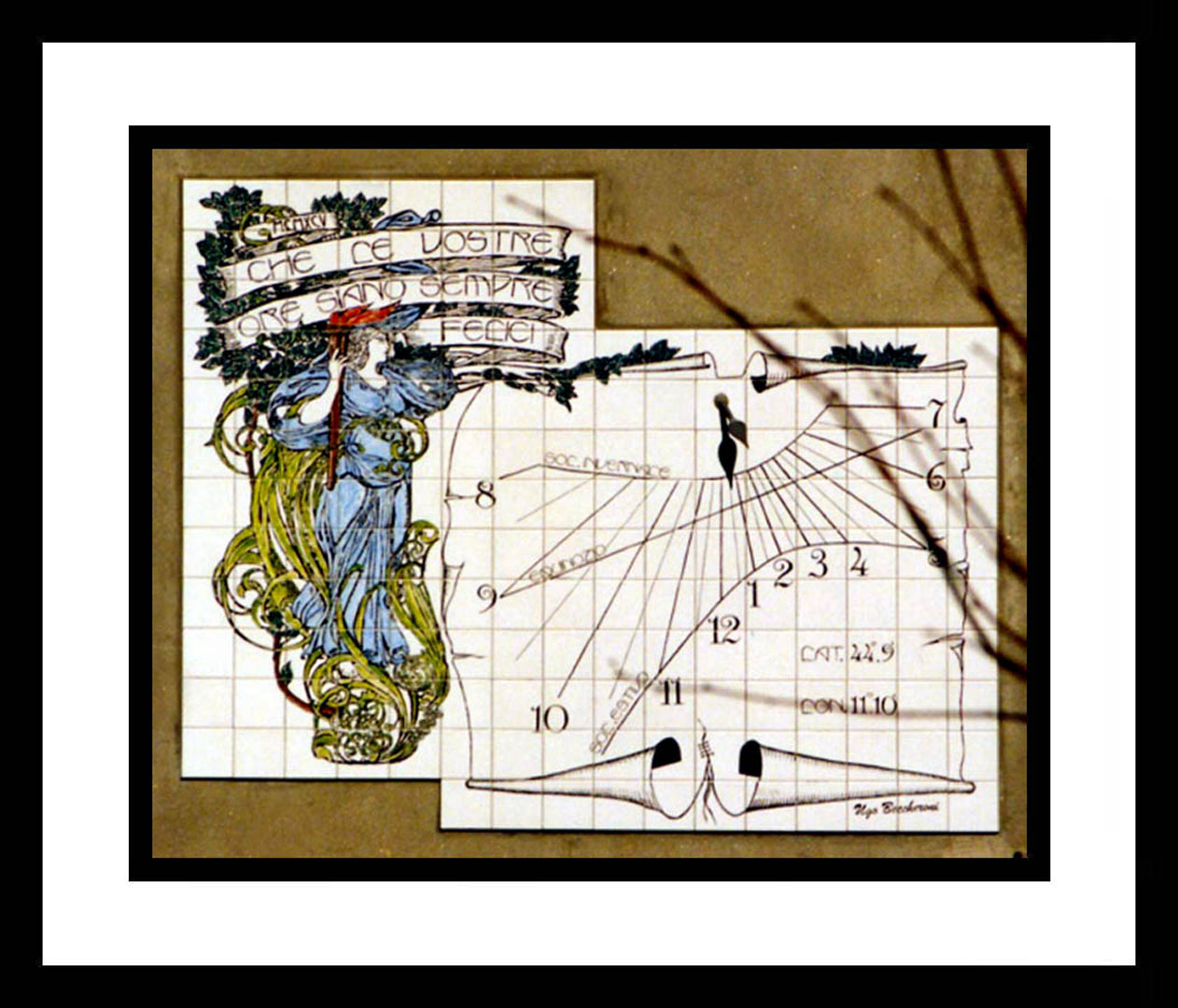
Designer, Painter, Delineator: Ugo Beccheroni Date: 1995 Original Location: at the Comune di Castiglione dei Pepoli, Capoluogo – Albergo Pellicciari (Pellicciari Hotel), Italy Lat: 44° .9' N; Lon: 11° 10' E. Present Location: at original location Orientation: Vertical. Declines 23° 24’ west of south Size: 160 x 130 cm (63 x 51 in) Adornment: a beautiful art-deco style painting of a woman in flowing robe. Sundial depicted on rolled parchment. Has labeled solstice & Equinox lines. Mottos: "Che le Vostre Ore Siano Sempre Felici" (May Your Hours Always Be Happy) Inscriptions: at top: "MCMXCV" (1995), signed by Ugo Beccheroni Condition: good Comments: Sundial is painted on ceramic tiles and has a rod gnomon with arrow that casts an easy-to-read shadow. Galleria Gnomonica Website: Here Ugo Beccheroni’s Email: Here Photo Descriptions: Photo is courtesy of Mr. Beccheroni (taken in 2005). Photos: a |
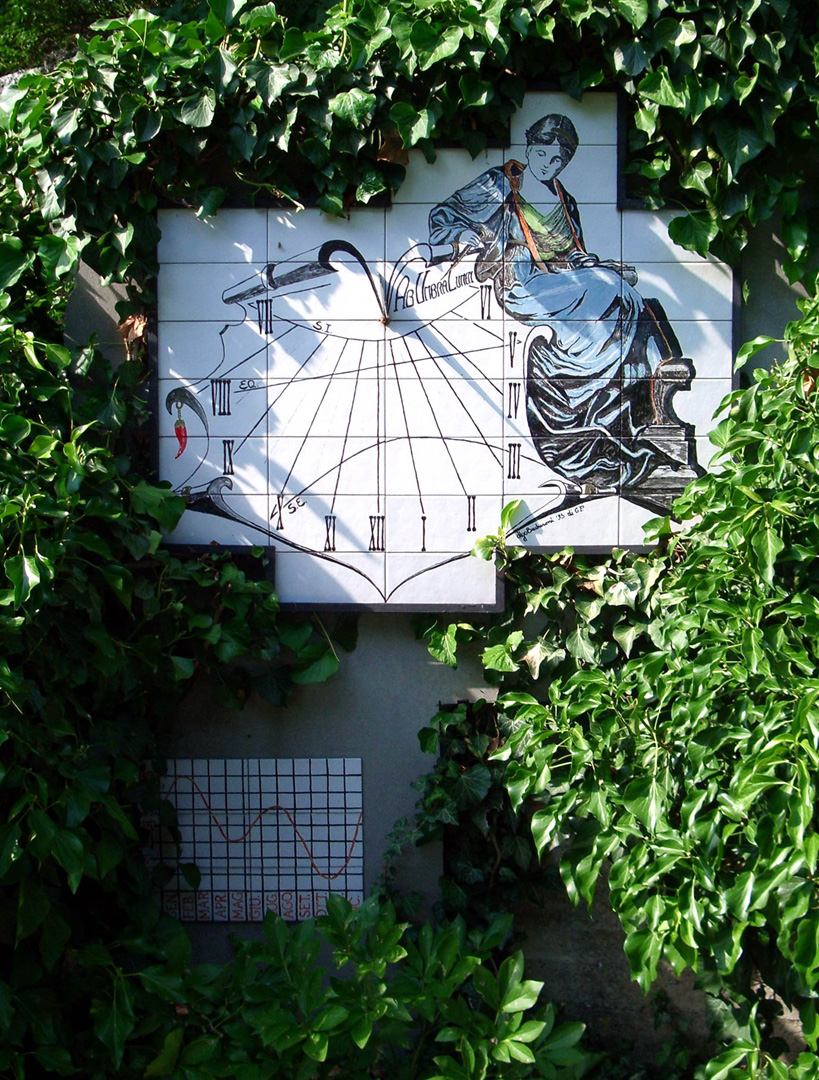
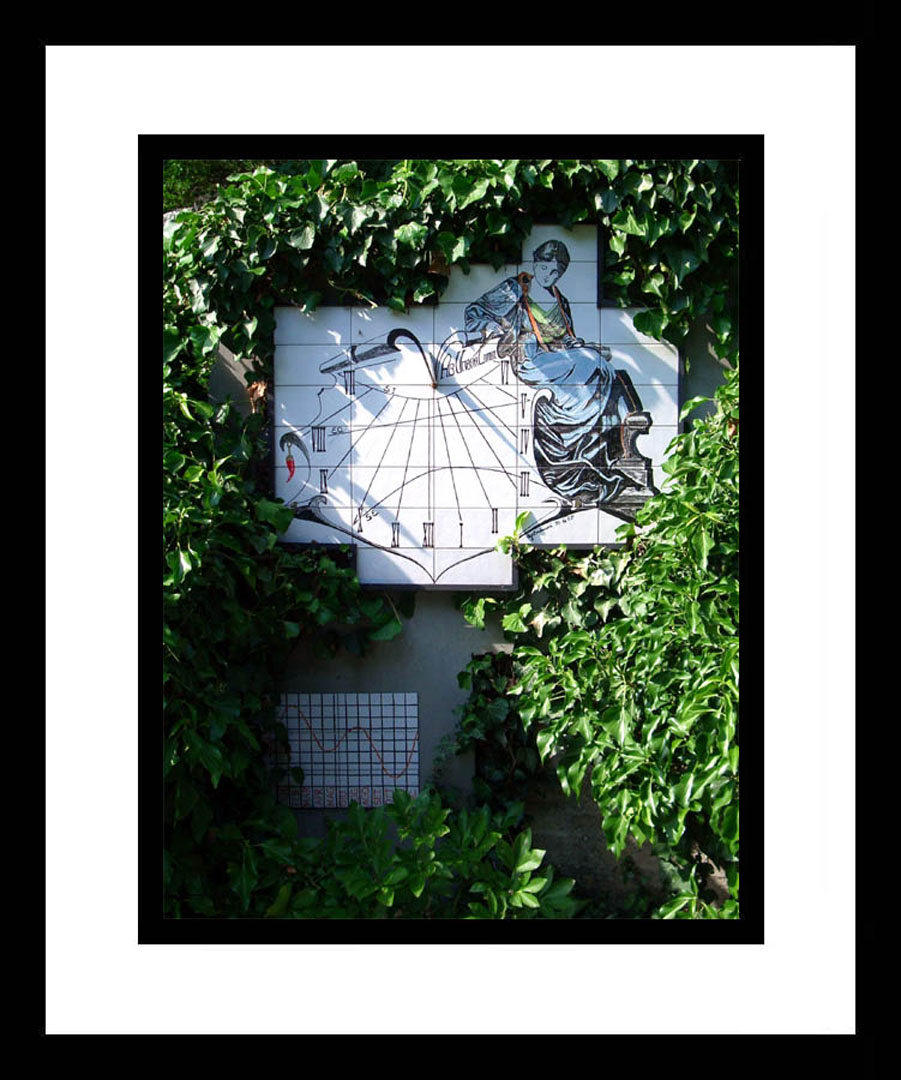
Designer, Painter, Delineator: Ugo Beccheroni Date: 1993 Original Location: Lat: 44° 27' N, Lon: 11° 22' E. At Mr. Beccheroni's home, San Lazzaro di Savena, Bologna Italy. Present Location: at original location Orientation: Vertical. Declines 15° 36' west of south. Size: 100 x 90 cm (39.3 x 35 in) Adornment: Art deco depiction of seated woman in flowing robes. Dial face appears as a parchment and has labeled solstice & equinox lines and the Equation of Time graph. A red chile hangs on the left. Mottos: “AB UMBRA LUMEN” (From Shadow, Light) Inscriptions: signed and dated Condition: good Comments: Beccheroni painted the ceramic tiles at his home. Sundial has a triangular sheet gnomon. Ugo Beccheroni’s Email: Here Photo Descriptions: Photo is courtesy of Mr. Beccheroni (taken in 2005). Photos: a |
 |
 |
 |
| Designer & Maker: unknown. Probably by Jean Claude Art. Date: unknown Original Location: unknown, probably made in France Present Location: Offered for sale in 2006 on the French antiques website below. Orientation: Vertical, Probably declines south Size: unknown Adornment: a large smiling sun fills the center Mottos: unknown if any are present around the circumference Condition: unknown Comments: We are looking for a better photograph and more information on this dial. Jean Claude Art Website: Here Jean Claude Art’s Email: Here Photo Descriptions: Photo was copied from Google images. Photos: a |
Designer: Gianni Cornacchiari Artist: unknown Date: 1991 Original Location: Lat: 45’ 30” N, Lon: 10’ 15” E. Flero (BS), Italy Present Location: at original location Orientation: Vertical. Declines slightly to the west of south. Size: 140 x 100 cm (55 x 39 in) Adornment: depicts the inside of a courtyard with Flero countryside behind. Mottos: “E Nel Peregrinar Di Sol Io Vivo” (and in search of the sun I live) Inscriptions: “Ora Vera Locale”, 1991, Lat. & Long., signature of artist (unreadable) Condition: unknown Comments: We’d like to find out the name of the ceramic artist Gnomonica Italiana Website: Here Mario Arnaldi’s Email: Here Photo Descriptions: Photo is courtesy of Mario Arnaldi and was copied from website above. Photos: a |
Designer: Antonio Giorgi Artist: Savina Laudi Date: 2005 Original Location: Lat: 43° 14' 50" N, Lon: 13° 00' 06" E. On private home in Matelica (MC), Italy Present Location: at original location Orientation: Vertical. Declines 31.4° east of south. Size: 200 x 280 cm (78 x 110 in) Adornment: Art Deco design of pensive female figure with zodiac signs Mottos: “Omnia Aliena Sunt Tempus Tantum Nostrum Est” (Nothing Belongs to Us, Only Time is Ours) Inscriptions: Latitude & Longitude, EOT graph Condition: excellent. A beautiful dial! Comments: The website below gives an excellent account of how the dial was designed and made. Arsgnomonica Website: Here Antonio Giorgi Architetto’s Email: Here Photo Descriptions: Photo is courtesy of Antonio Giorgi Architetto and was copied from website above. Photos: a |
 |
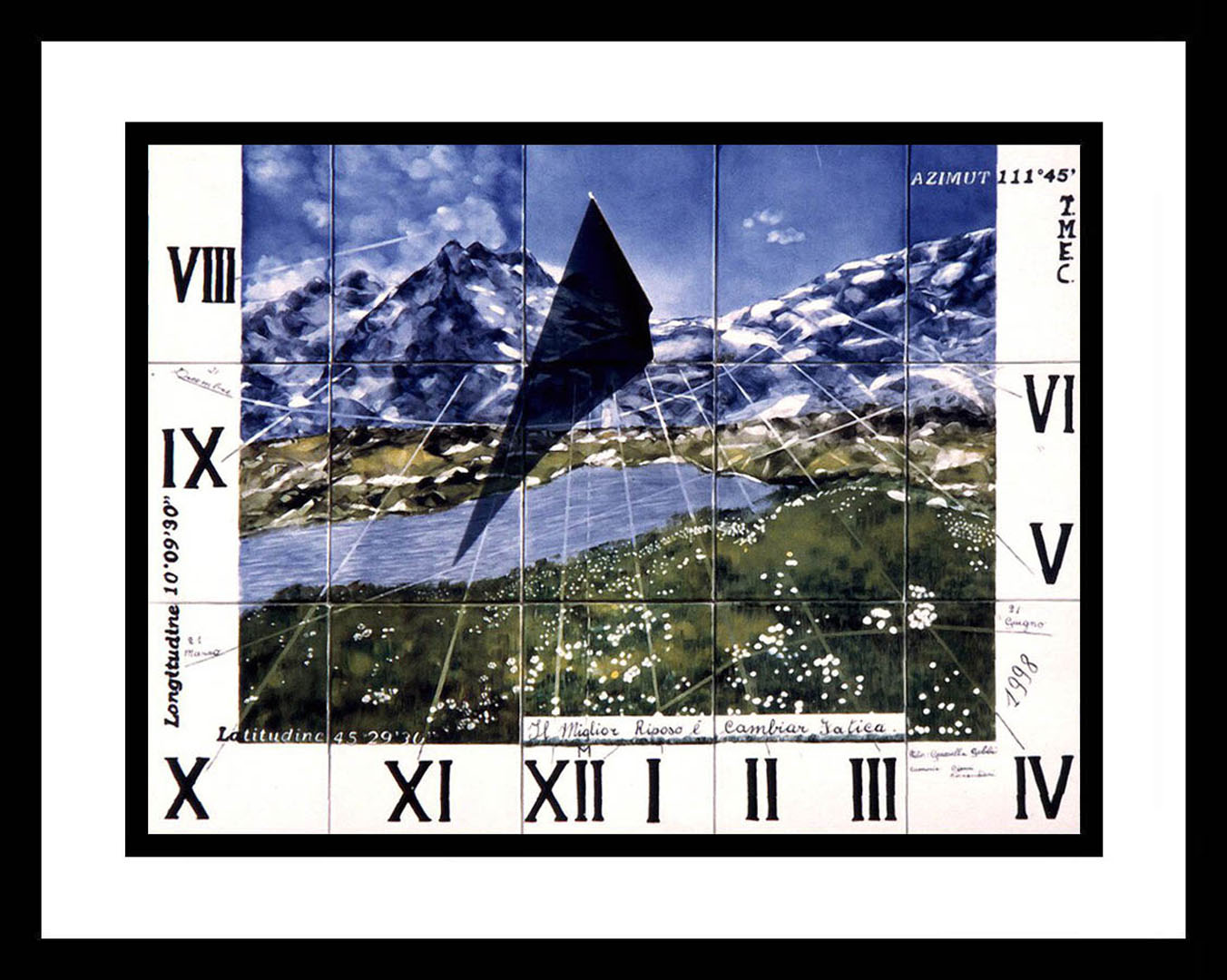 |
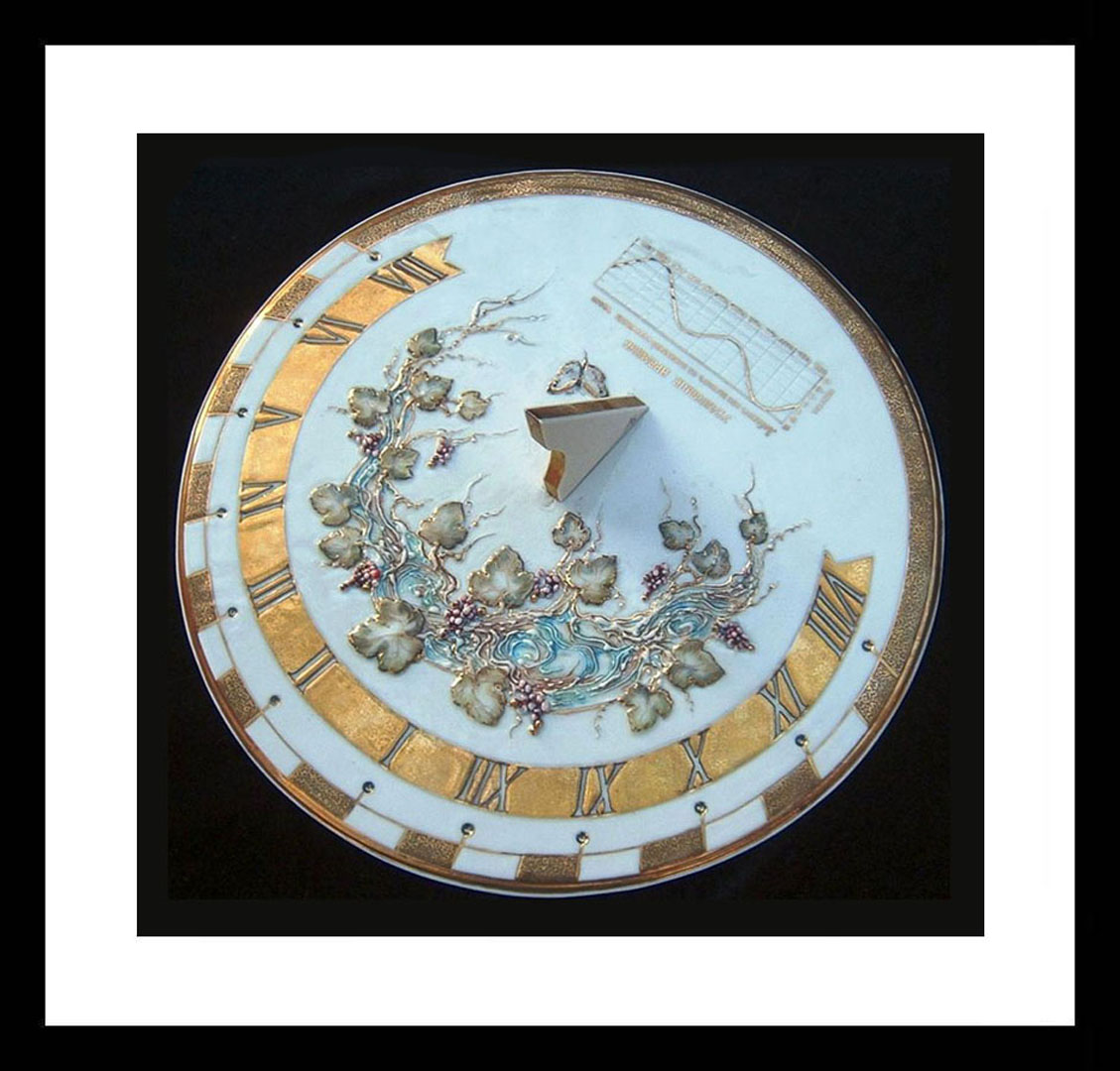 |
| Designer: Aurelio Costa Artist: unknown Date: 2002 Original Location: On the façade of the Natural Museum of Sciences, Ravenna, Faenza, Italy Present Location: at original location Orientation: Vertical. Declines slightly to the west of south. Size: unknown Adornment: signs of the zodiac with stars in background and corners Mottos: “Terrae solo vitam donare solet” Inscriptions: In Memoriam Enni Golfieri Faventini Architecti A.D. MMII Condition: unknown Comments: We’d like to find out the name of the ceramic artist Gnomonica Italiana Website: Here Mario Arnaldi’s Email: Here Photo Descriptions: Photo is courtesy of Mario Arnaldi and was copied from website above. Photos: a |
Designer & Maker: Mariella Gobbi Date: 1998 Original Location: Lat: 45° 29' 30" N, Lon: 10° 9' 30" E. On wall of private home in Castelmella (BS), Italy Present Location: at original location Orientation: Vertical. Declines slightly to the west of south. Size: unknown Adornment: the Mandrone lake and landscape of Castelmella Mottos: yes, but not easy to read Inscriptions: coordinates, wall declination and the names of several people Condition: unknown Comments: A handsome dial. Gnomonica Italiana Website: Here Mario Arnaldi’s Email: Here Photo Descriptions: Photo is courtesy of Mario Arnaldi and was copied from website above. Photos: a |
Delineator: Aleksandr Boldyrev Artist: Elena F. Vasilevskay Date: 2008 Original Location: at unknown location in Moscow Russia Present Location: at unknown location in Moscow Russia Orientation: Horizontal Size: unknown exactly. About 30 cm (1 ft) Adornment: sculpted fired porcelain ceramic dial painted with the grapevine river of life and an Equation of Time with gold leaf Mottos: none Inscriptions: none Condition: excellent in 2008 Comments: This beautiful dial apparently is Russia’s first porcelain sundial. Read the fascinating article below that describes in detail how this dial was made. Article is courtesy of the BSS and the authors. Article by Elena F. Vasilevskay and Aleksandr Boldyrev: ©(2008) Making Porcelain Sundials. "The British Sundial Society Bulletin" Vol. 20(ii), June 2008. 68-72 Sundials.ru Website: Here Vasilevskaya’s Email: Here Boldyrev’s Email: Here Photo Descriptions: Photos are courtesy of Elena F. Vasilevskay and Aleksandr Boldyrev. Photos: a b c |
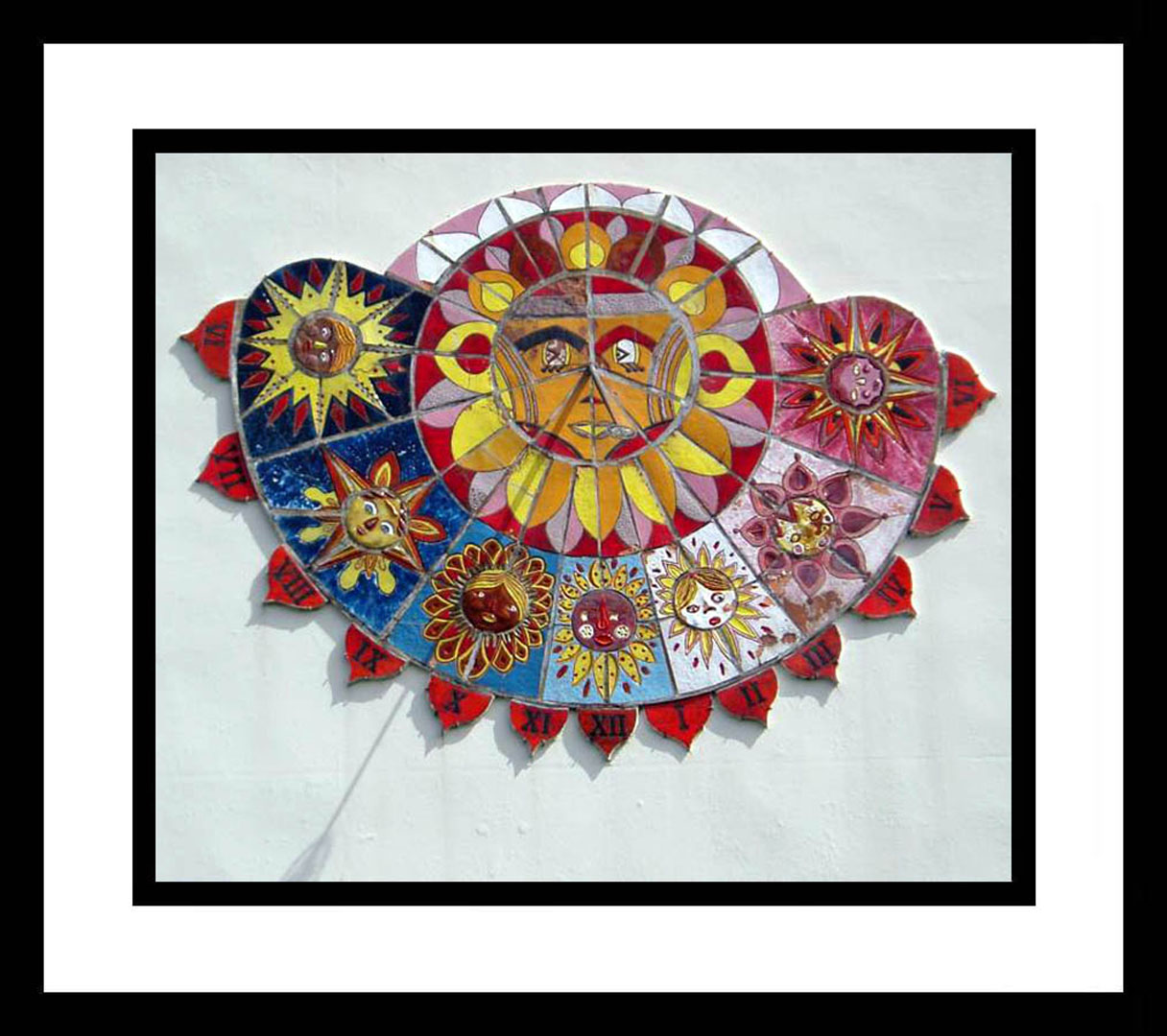 |
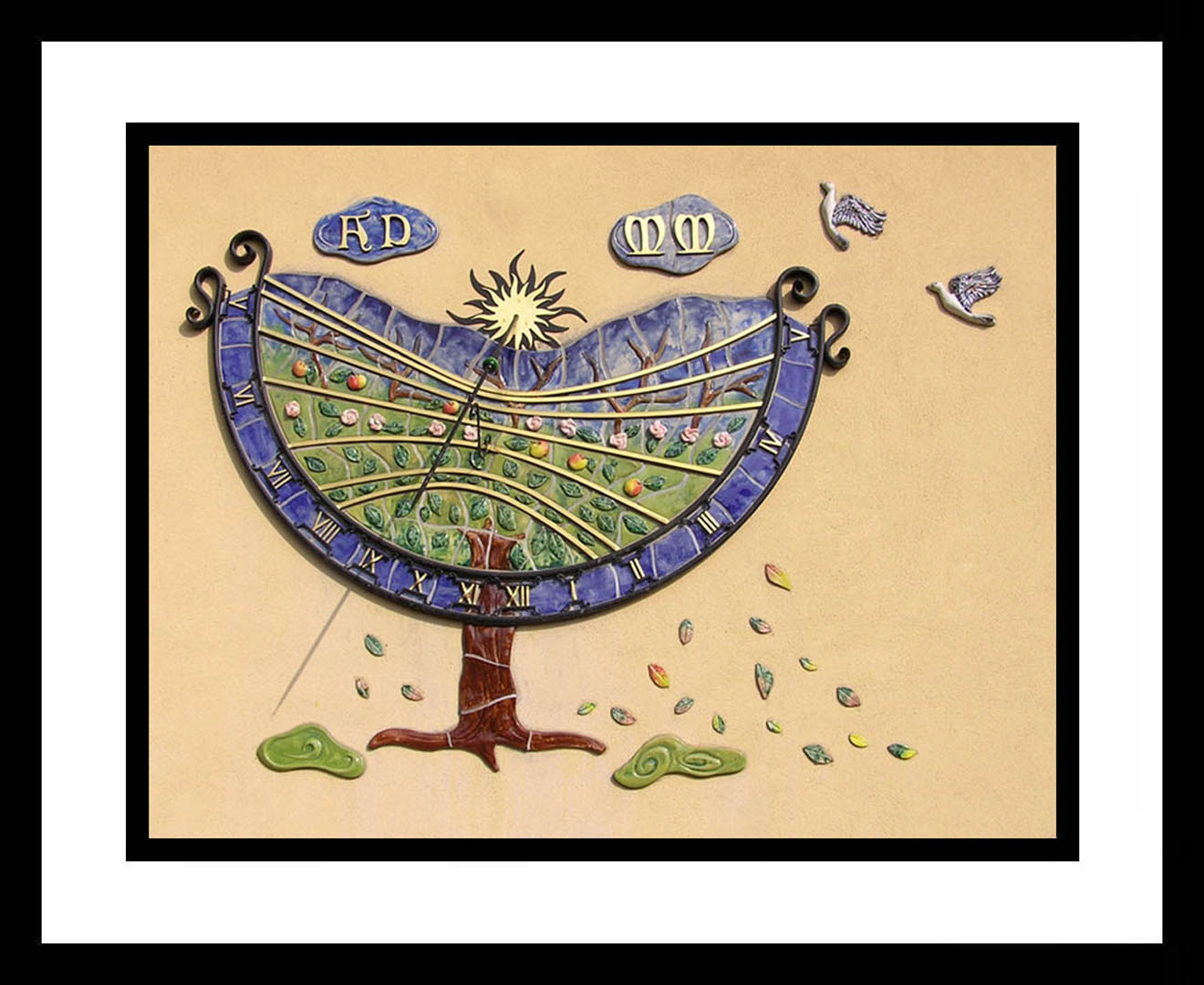 |
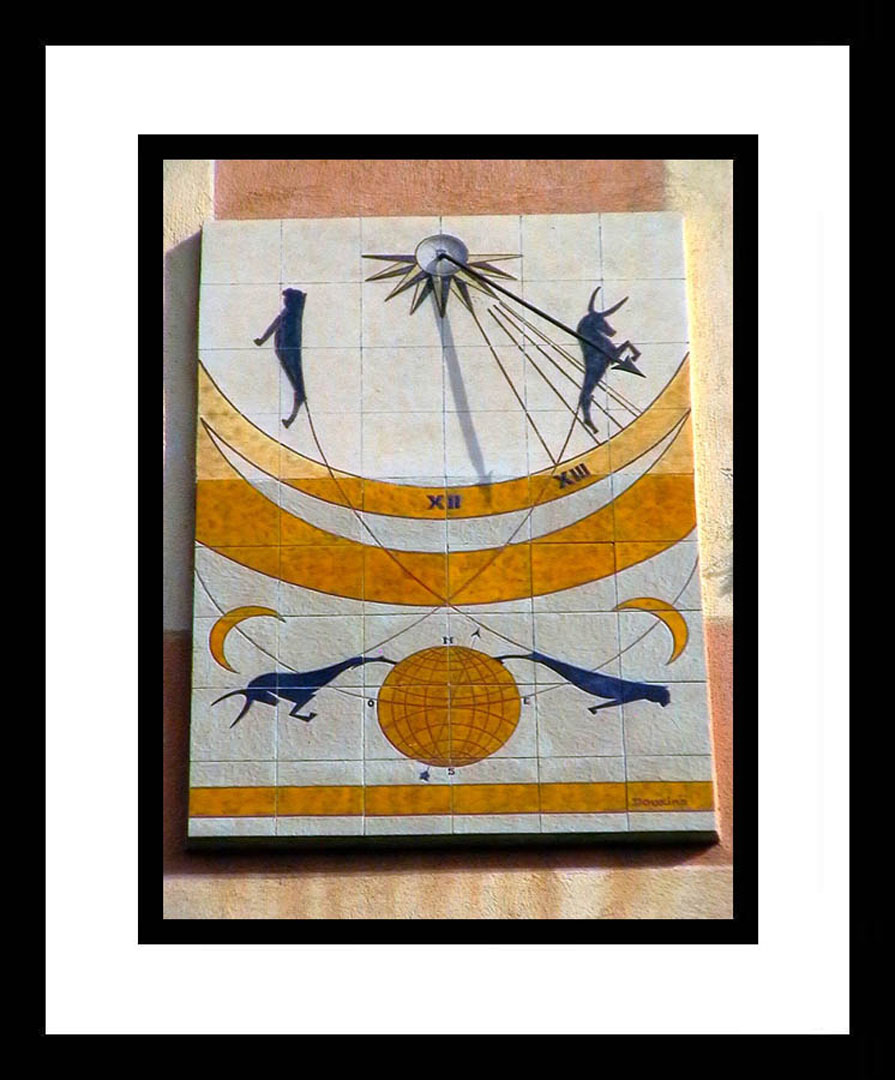 |
| Delineator: unknown Artist: unknown Date: unknown Original Location: Collège Maurice Calmel - Marans - Charente Maritime (17), France Present Location: at original location Orientation: Vertical. Declines south. Size: unknown Adornment: interesting colorful collage of sun faces Mottos: none Inscriptions: none Condition: unknown Comments: Dial is bolted to wall. Michel Lalos Website: Here Michel Lalos’s Email: Here Photo Descriptions: Photo is courtesy of Michel Lalos and is copied from his website. Photos: a |
Delineator: Johann Jindra, Weiten, Lower Austria Artistic Design: Dr. Leonhartsberger, Mank. Ceramic Artisan: Melanie Gruber, Loosdorf. Date: 2000 Original Location: 48° 06’ 35" N, lon: 15° 20’ 33" E. A-3240, Mank, Schulstrasse 9, Lower Austria Present Location: at original location Orientation: Vertical. Declines 15° east of south. Size: 2.5 x 2.2 m (98 x 87 in) Adornment: impressionistic style. Representation of an arbor vitae, symbols of the seasons, sun, datelines of flat metal bars with gold leaf. Mottos: none Inscriptions: “AD MM” Condition: good Comments: Dial shows Local Time (Roman numbers V-XII-V). We need a better photo. Karl Schwarzinger’s Website: Here Photo Descriptions: Photo is courtesy of Karl Schwarzinger and was copied from website above. Photos: a |
Delineator: unknown Artist: Georges Douking Date: 1961 Original Location: in the town of Coaraze, Alpes-Maritimes, France Present Location: at original location Orientation: vertical, declines by unknown amount W. of S. Size: unknown Adornment: modern design with a globe and silhouettes of buffalos and leopards Mottos: none Inscriptions: signed: “Douking” Condition: unknown Comments: Dial’s name in French is: "Les Animaux Fabuleux" Sciences-Edu Website: Here Serge Lagier’s Email: Here Photo Descriptions: Photo is © and is courtesy of Serge Lagier. He sent it to us. Please do not copy it without his permission. Photos: a |
 |
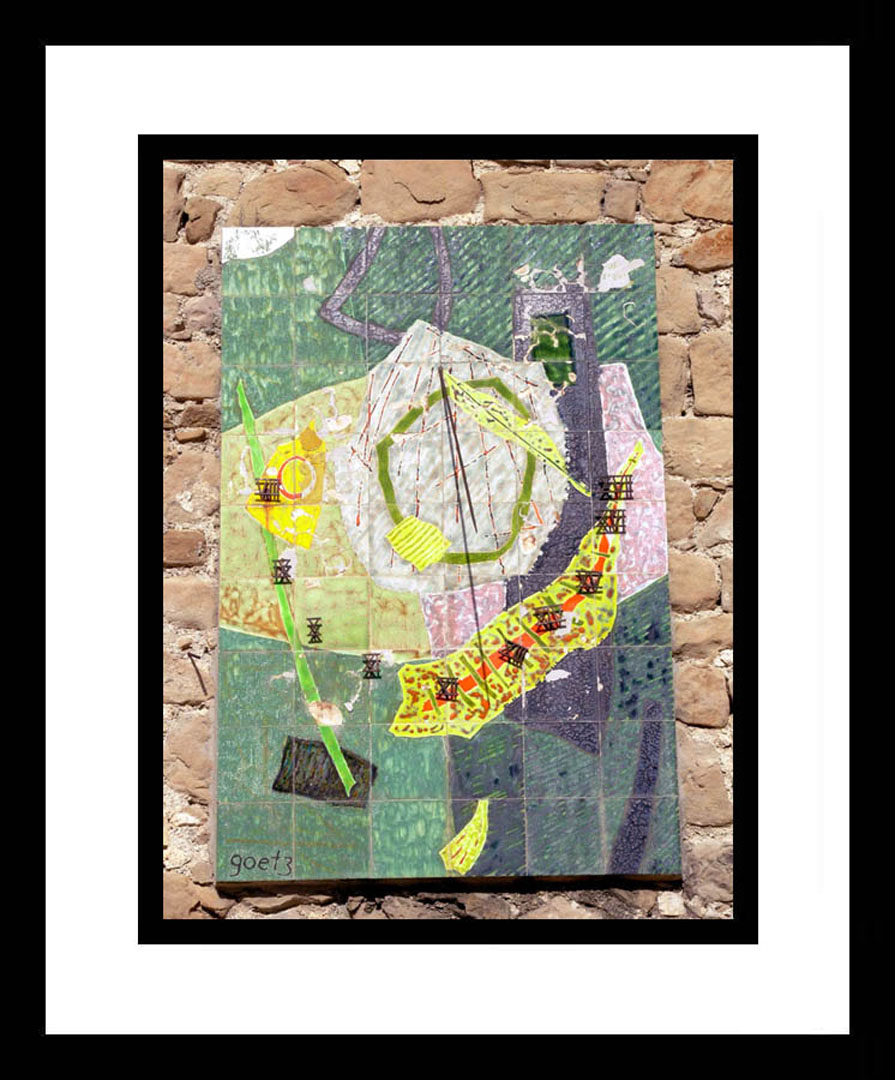 |
 |
| Delineator: Angel Ponce de Léon (Ponce Fidelio) Artist: Gilbert Valentin Date: 1961 Original Location: in the town of Coaraze, Alpes-Maritimes, France Present Location: at original location Orientation: Vertical. Declines south. Size: unknown Adornment: childlike primitive modern design of blue colors with metal Roman numerals Mottos: none Inscriptions: signed: “Angel Ponce de Léon” Condition: unknown Comments: none Sciences-Edu Website: Here Flickr Website: Here Serge Lagier’s Email: Here Photo Descriptions: Photo is © and is courtesy of Serge Lagier. He sent it to us. Please do not copy it without his permission. Photos: a |
Delineator: unknown Artist: Henri Bernard Goetz Date: 1961 Original Location: in the town of Coaraze, Alpes-Maritimes, France Present Location: at original location Orientation: vertical, declination unknown Size: unknown Adornment: modern work represents the victory of greek god over Python, fabulous snake born of Gaïa. Mottos: none Inscriptions: signed: “Goetz” Condition: unknown Comments: Dial’s name in French: "Le Python et sa Couronne en Vert et Or" (The Python and his Crown in Green and Gold) Sciences-Edu Website: Here Flickr Website: Here Serge Lagier’s Email: Here Photo Descriptions: Photo is © and is courtesy of Serge Lagier. He sent it to us. Please do not copy it without his permission. Photos: a |
Delineator: unknown Artist: Gilbert Valentin Date: 1961 Original Location: in the town of Coaraze, Alpes-Maritimes, France Present Location: at original location Orientation: Vertical. Declines west of south by unknown amount. Size: unknown Adornment: very modern design with stylized sunflowers and little half spheres to mark the time Mottos: none Inscriptions: signed “Valentin” Condition: unknown Comments: Dial’s name in French is: "Les Tournesols". Sciences-Edu Website: Here Serge Lagier’s Email: Here Photo Descriptions: Photo is © and is courtesy of Serge Lagier. He sent it to us. Please do not copy it without his permission. Photos: a |
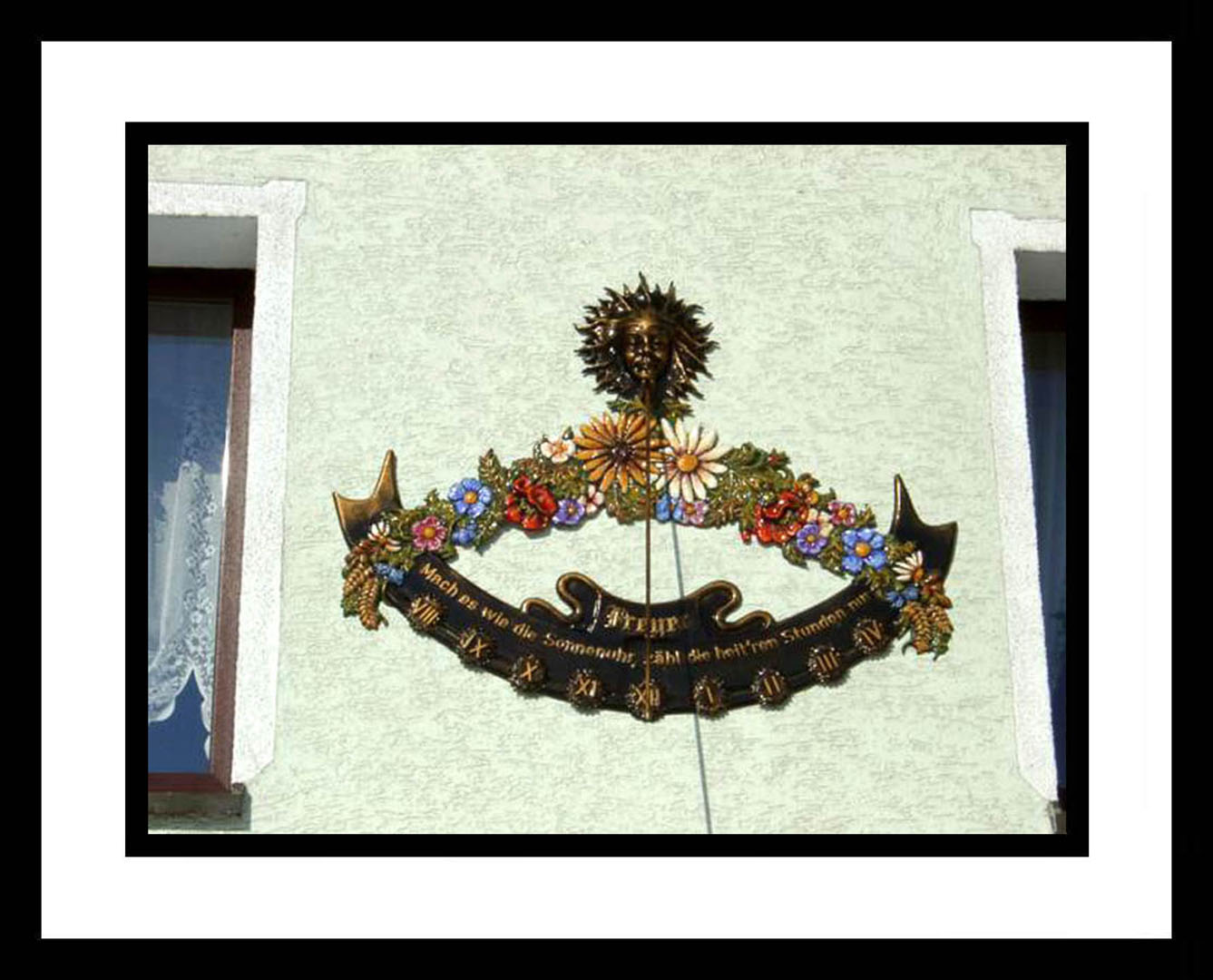 |
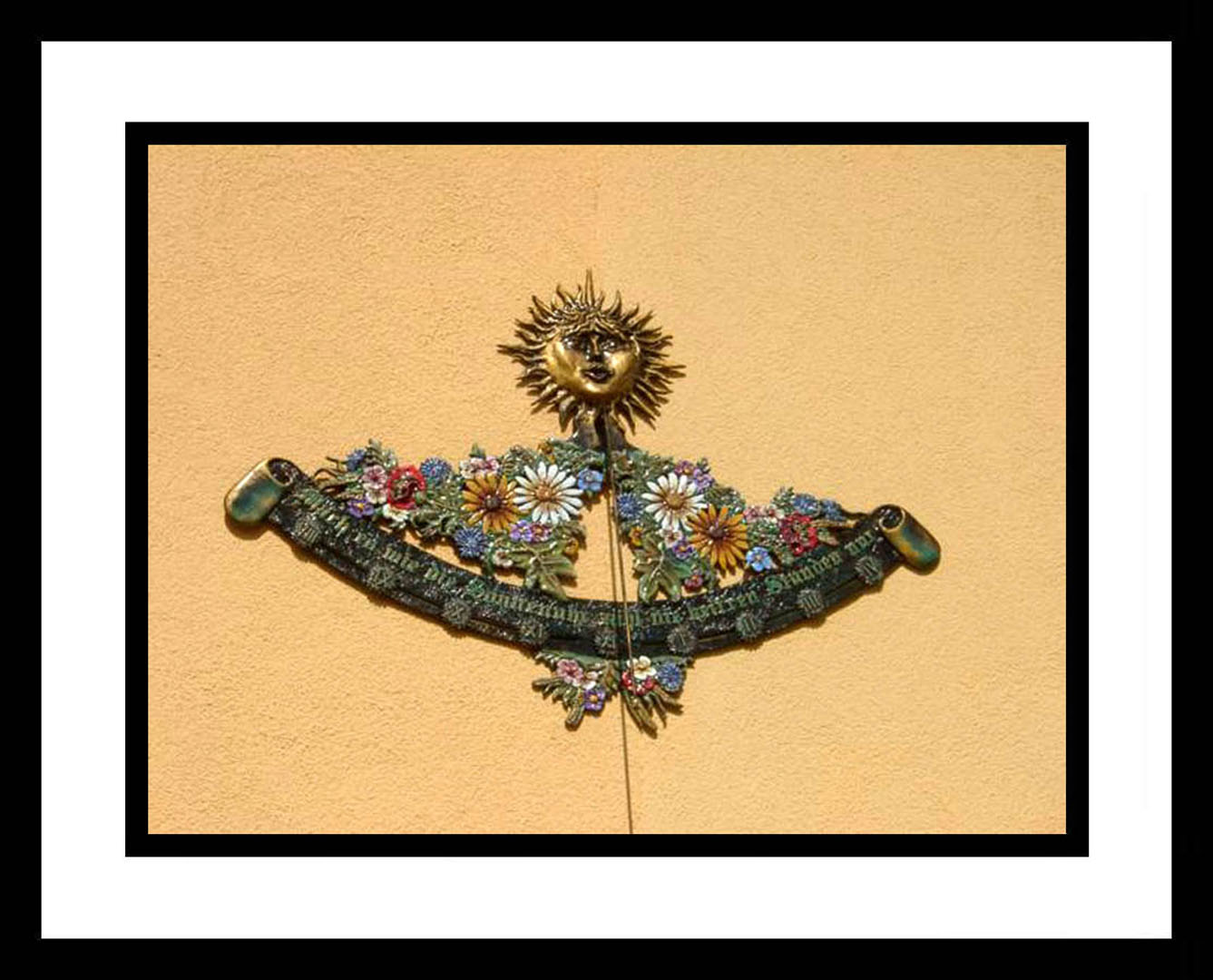 |
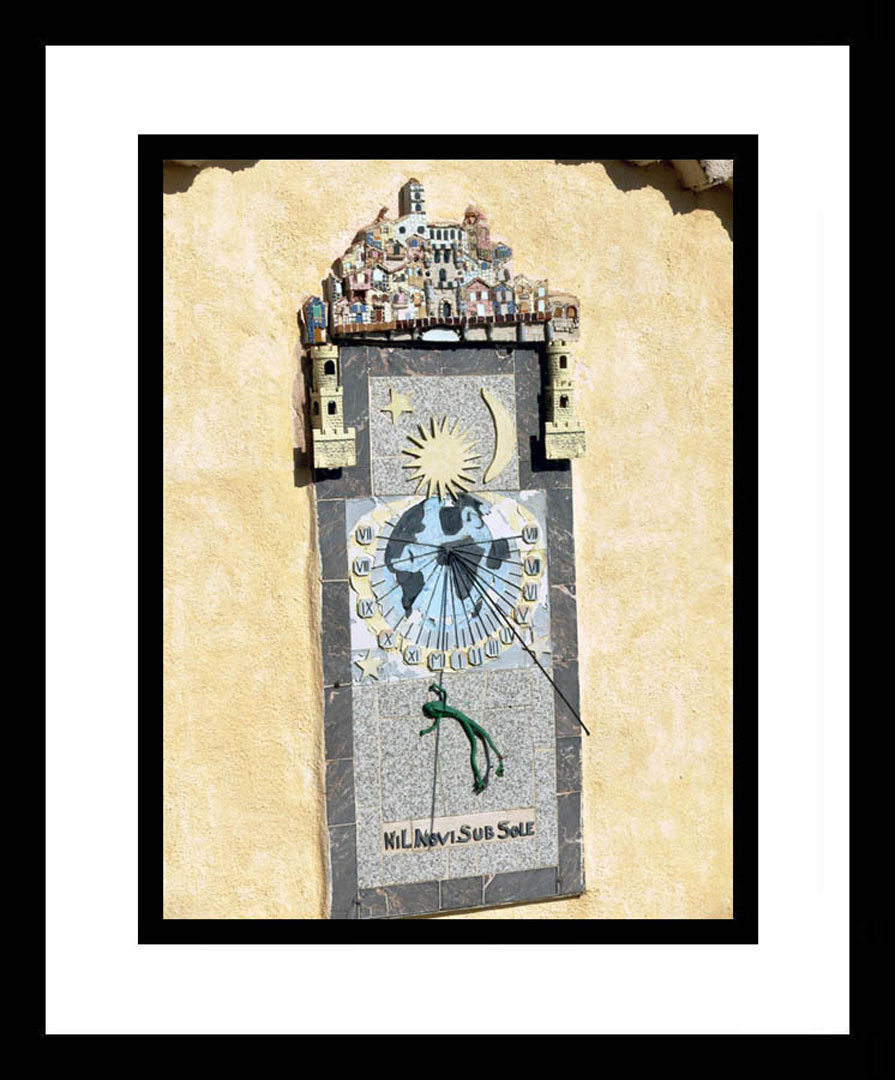 |
| Delineator: unknown Artist: unknown Date: unknown Original Location: Zoeblitzer Str. 1, D-09496 Ruebenau, Germany Present Location: at original location Orientation: Vertical. Declination is unknown. Size: unknown Mottos: none Inscriptions: none Condition: probably still good Comments: Dial is bolted to wall. Home.arcor Website: Here Peter Lindner’s Email: Here Photo Descriptions: Photos are courtesy of Peter Lindner and were taken in May 2005 and copied from website above. Photos: a |
Delineator: unknown Artist: unknown Date: unknown Original Location: Waldteichstr 4, D-01468 Boxdorf, Germany Present Location: at original location Orientation: vertical. Declination unknown Size: unknown Adornment: none Mottos: none Inscriptions: none Condition: probably still good Comments: Dial is bolted to wall. Home.arcor Website: Here Peter Lindner’s Email: Here Photo Descriptions: Photos are courtesy of Peter Lindner and were taken in May 2005 and copied from website above. Photos: a b c |
Delineator: unknown Artist: unknown Date: unknown exactly. late 1900’s Original Location: on a house on the D15 leading to the town of Coaraze, Alpes-Maritimes, France Present Location: at original location Orientation: vertical, declination unknown Size: unknown Adornment: a sculpted village in ceramics at the top. A world map, Sun, Moon, and star. Mottos: “Nil Novi Sub Sole” (Nothing New Under the Sun) Inscriptions: none. Not signed Condition: unknown Comments: very 3 dimensional and textured Sciences-Edu Website: Here Serge Lagier’s Email: Here Photo Descriptions: Photo is © and is courtesy of Serge Lagier. He sent it to us. Please do not copy it without his permission. Photos: a |
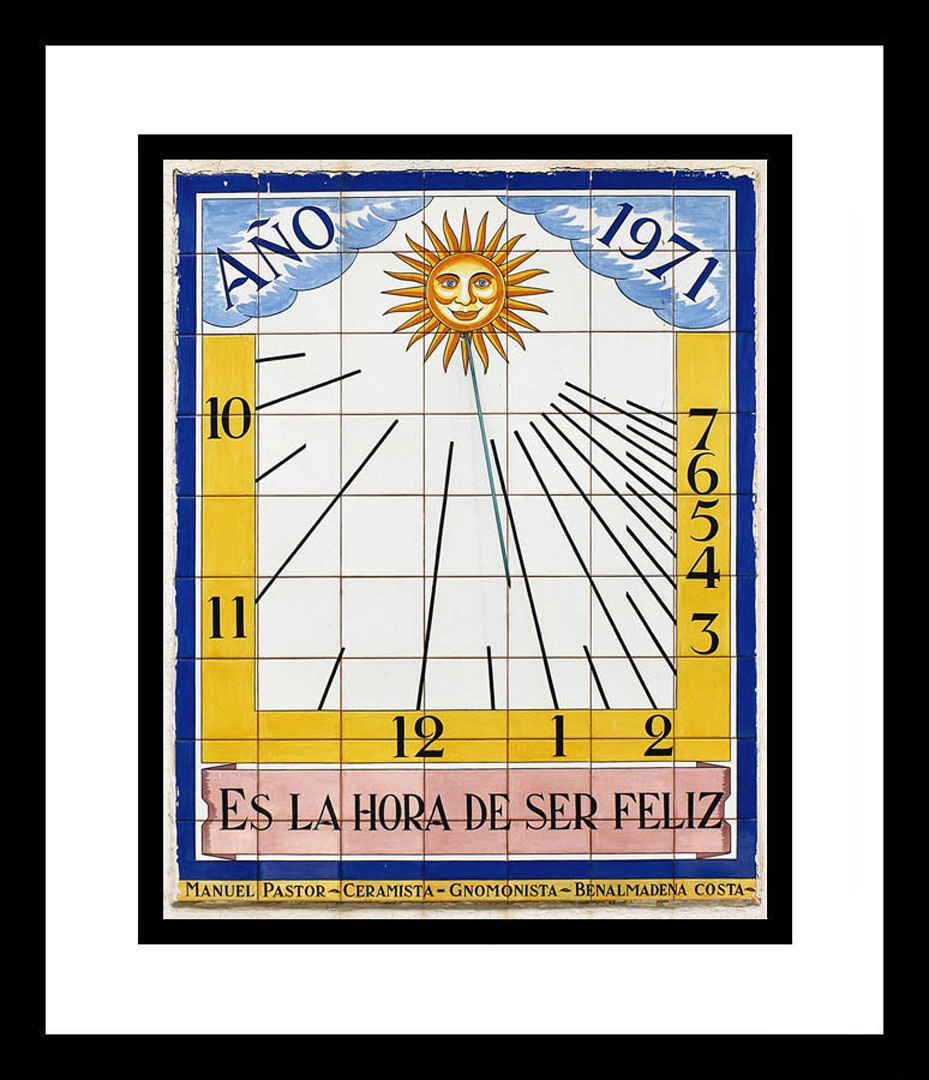 |
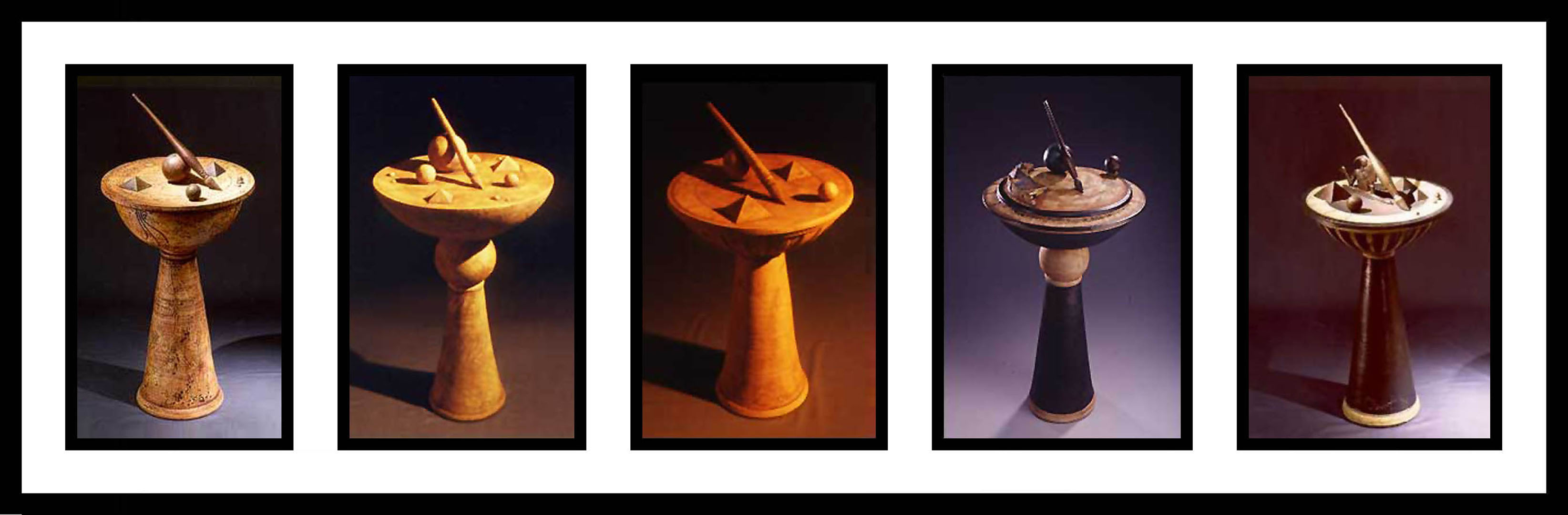 |
 |
| Delineator: Manuel Pastor Ceramic Artist: Manuel Pastor Date: 1971 Original Location: on the wall of a building adjacent to the windmill roundabout on the sea front at Benalmadena Costa in southern Spain Present Location: at original location Orientation: vertical. Declines in a southwesterly direction Size: unknown Adornment: a smiling sun face, a scroll, clouds Mottos: “Es la Hora de Ser Feliz” (It’s Time to be Happy) Inscriptions: “Manuel Pastor-Ceramicista-Gnomonista-Benalmadena Costa” Condition: excellent in 2008 Comments: No website known that shows this dial. We’d like to find out exactly where this is located. Robert Sylvester’s Email: Here Photo Descriptions: Photos are courtesy of Robert Sylvester (2008). Photos: a b |
Delineator: Daniel Oberti Glass Artisan: Daniel Oberti, accomplished ceramic artist from California. Date: unknown, late 1900s or early 2000s Original Location: On pedestals at unknown location in the USA. Present Location: unknown Orientation: Horizontal Size: unknown Adornment: ceramic geometric forms lie on dial face. The gnomons are paintbrushes. The faces are bowl-shaped as seen from the sides. Mottos: none Condition: unknown Comments: We are looking for better photos and more information about these sundials. Daniel Oberti Website: Here Daniel Oberti’s Email: Here Photo Descriptions: Photos were copied in 2005 from website above. Photos: Dial 235: a b Photos: Dial 236: a Photos: Dial 237: a Photos: Dial 238: a b c Photos: Dial 239: a |
Designer & Maker: unknown who designed the original. The copies are sold by Yanzum Gardens Date: unknown when the original was made, the copies are probably early 2000's Original Location: unknown Present Location: unknown Orientation: Vertical. Declines south Size: 55.9 x 38.1 cm (22 x 15 in) Adornment: a sun face with the gnomon coming out of his mouth. Mottos: none Condition: unknown Comments: This is mass-produced from molds and will not function at all locations. Yanzum Gardens Website: Here Photo Descriptions: Photo was copied from Yanzum Gardens website. Photos: a |
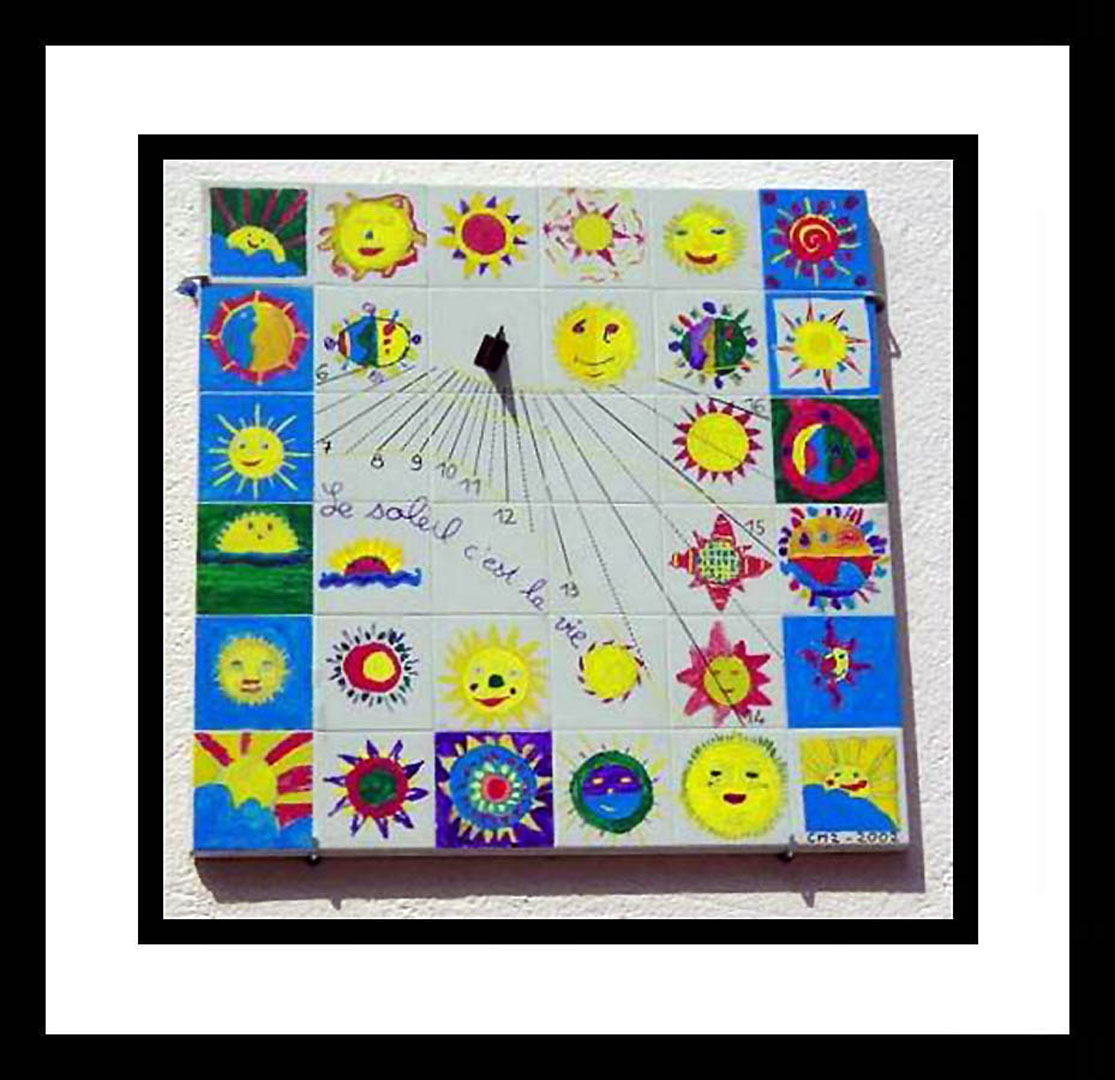 |
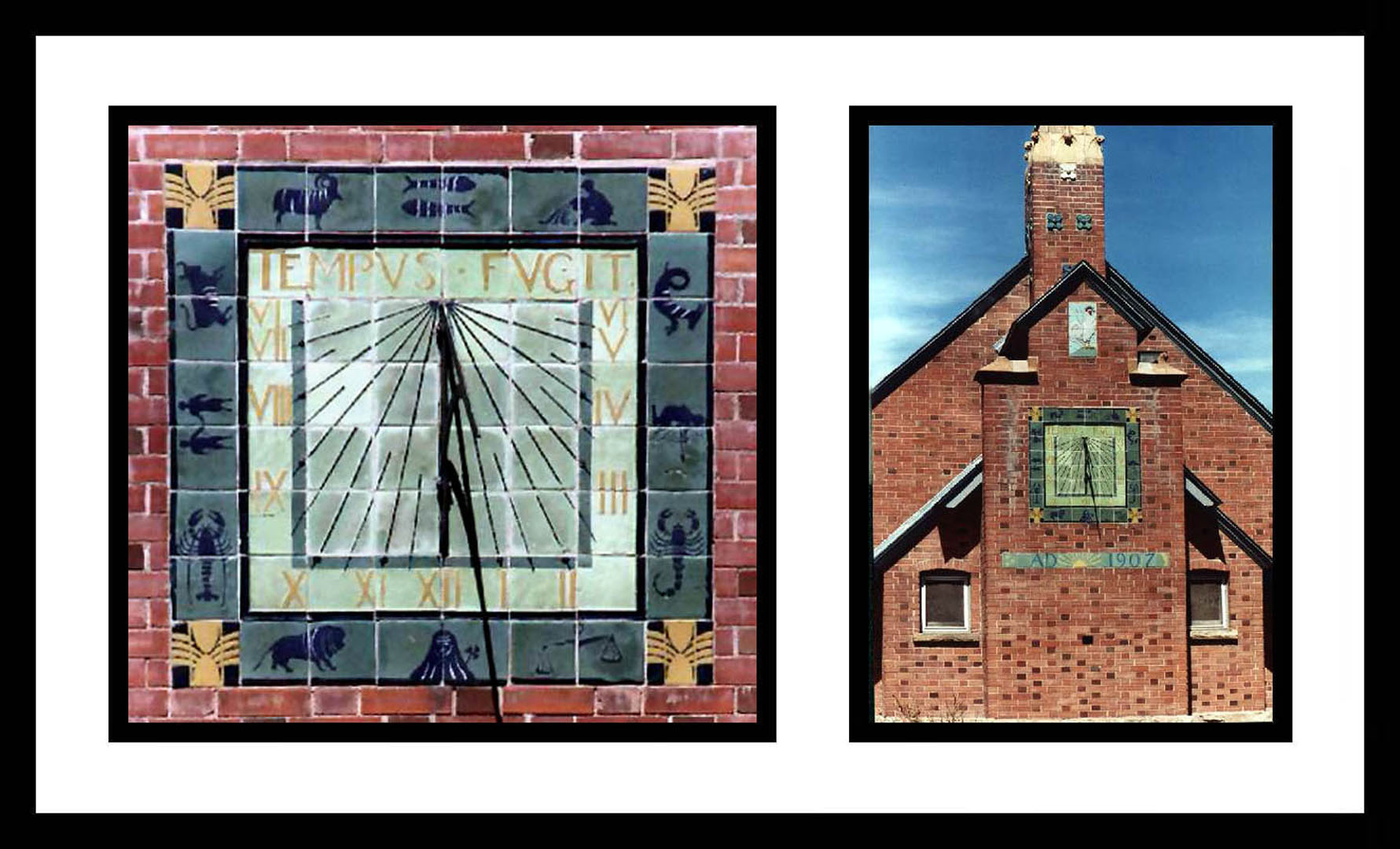 |
 |
| Delineator: unknown. But we know the designer used Shadowspro. Ceramic Artisan: Each tile was painted by different pupils at an unknown school in Banyuls-sur-Mer, France Date: unknown Original Location: On wall of unknown building at an unknown school in Banyuls-sur-Mer, France. Present Location: probably at original location Orientation: vertical. Declines towards the east Size: unknown Adornment: hand painted tiles of the sun Mottos: "Le Soleil c'est la Vie" (the Sun is Life) Condition: unknown Comments: Has a triangular sheet gnomon. We are looking for a better photo and more information about this sundial. Shadows Pro Website: Here Photo Descriptions: Photos were copied in 2005 from shadowspro.com website. Photos: a |
Designer: unknown Maker: unknown Delineator: unknown Date: 1907 Original Location: Lat: 38° 50’ 07” N, Lon: 104° 49’18” W. Built into the wall of the 1907 Van Briggle Pottery building at Colorado College in Colorado Springs, Colorado, USA Present Location: at original location Orientation: Vertical. Declination unknown Size: approximately one meter square Adornment: ceramic tiles with signs of the Zodiac surround the hour lines and Roman numerals Mottos: “TEMPUS FUGIT” (Time Flies) Inscriptions: none Condition: unknown. It was fine in 1994 Comments: Information is from The Nass Sundial Registry. This is also Dial #499 in the NASS registry. In 1994 Colorado College repaired the gnomon and added a metal equation of time plate. We are looking for better photos and more information on this dial. Colorado College Website: Here Photo Descriptions: Photos are from The Nass Sundial Registry. Photos: a b c d e |
Designer & Maker: unknown Date: unknown. Probably early 2000's Original Location: Lat: 38° 51' N, Lon: 0° 27' E. on south wall of unknown building on Calle Sant Josep in Otos Valencia Spain Present Location: at original location Orientation: Vertical. Declines south. Size: unknown Adornment: a Spanish galleon, a sun, sky and clouds, roman numerals Mottos: none Condition: Excellent Comments: We are looking for a better photograph and more information on this dial. Map of Valencia Website: Here Otos Sundial Village Website: Here Gnomonica Meeting Photos (1.4 MB): Here Photo Descriptions: Photo ‘a’ is copied from pg. 20 of Gnomonica Meeting Photos (see link above). Photo ‘b’ is from a Chinese website of unknown URL. Photos: a b |
 |
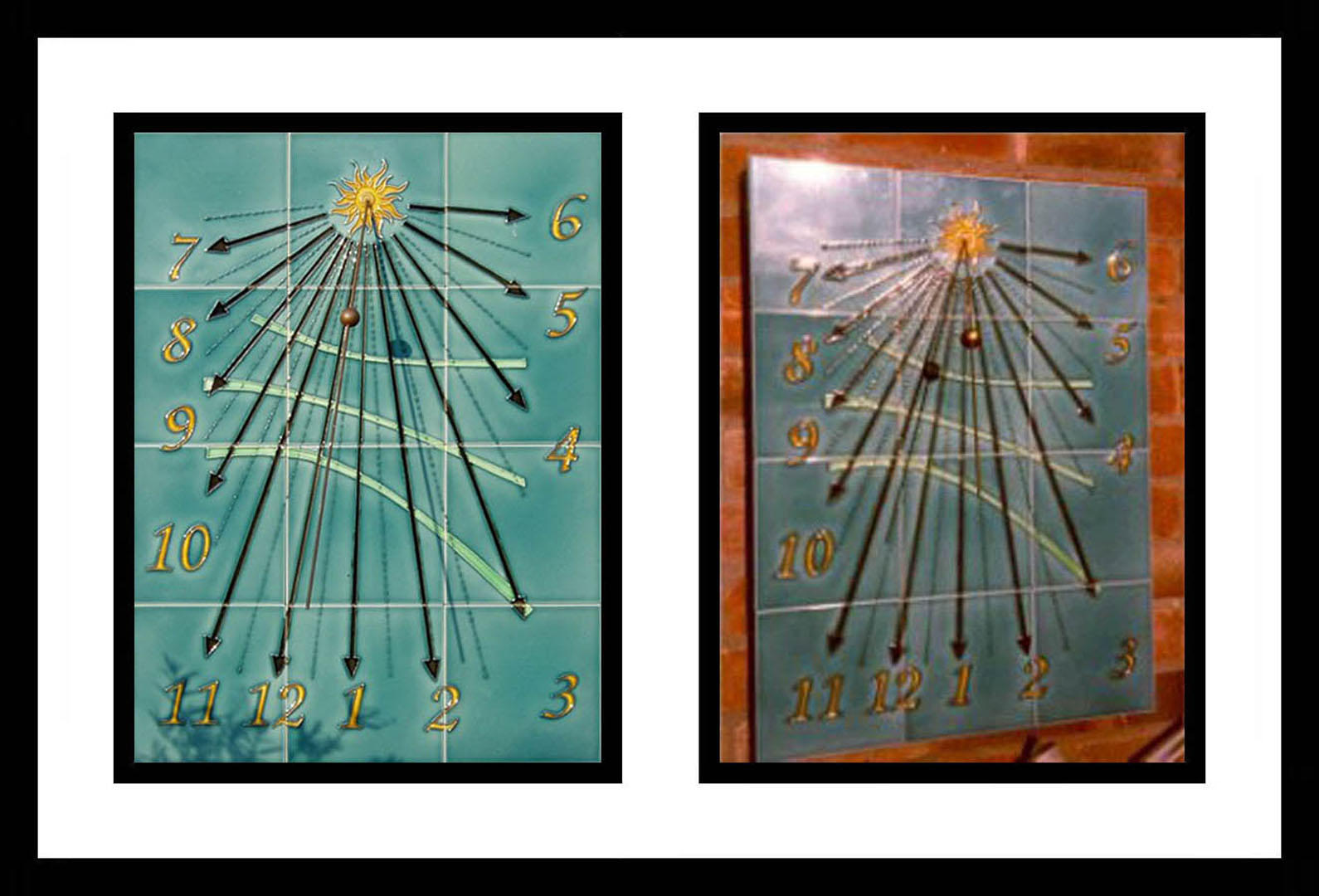 |
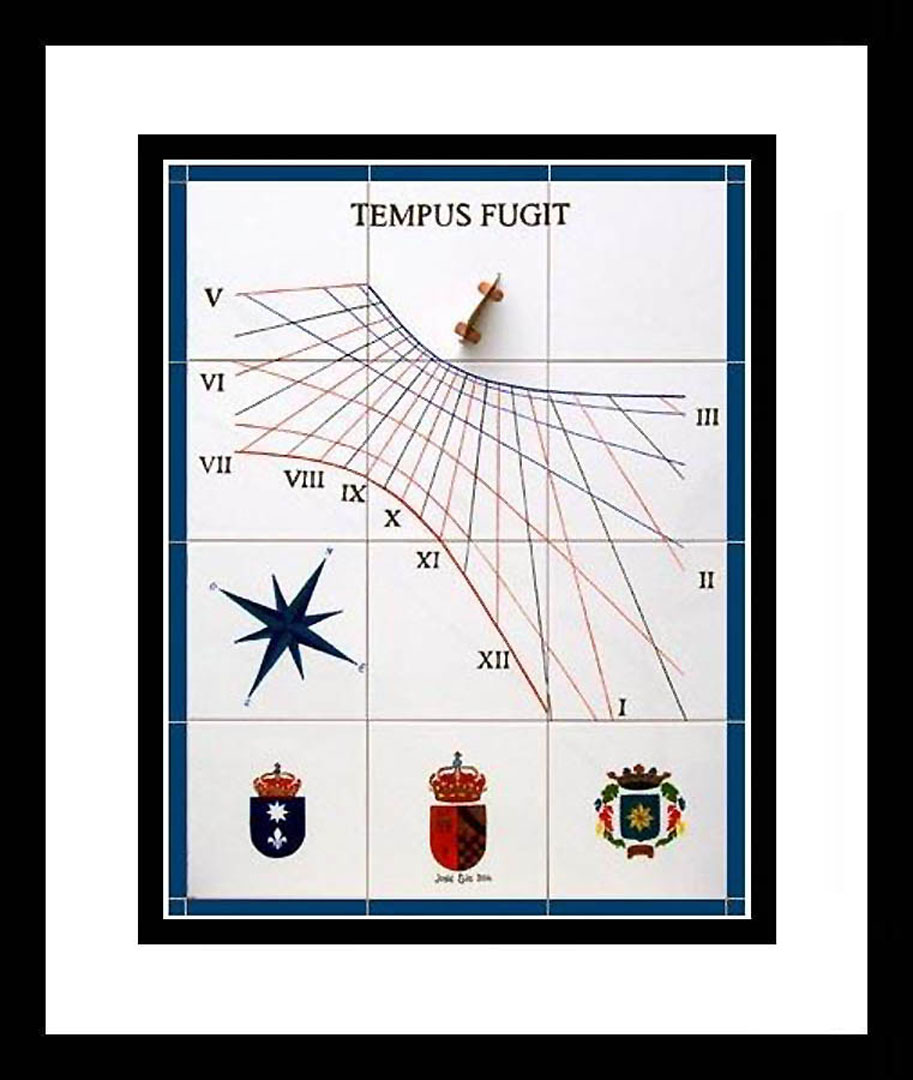 |
| Designer & Maker: C. Casoli and his students Date: 2001 Original Location: San Salvador de Jujuy, Argentina Present Location: unknown. probably at original location Orientation: Vertical. Declines south. Size: unknown Adornment: sun, two constellations, three logos at the bottom Mottos: at bottom in Spanish: "Dios creo el tiempo para que tu hagas las horas" (God created time so that you make the hours). Inscriptions: at top in Spanish: "marco las horas solares" (I mark solar hours). "MMI" and other unreadable text in top corners. Condition: unknown Comments: This is a nice dial. Pagesperso-Orange Website: Here Photo Descriptions: Photo was copied from website above. Photos: a |
Designer: Phil Walker Maker: The tiles were made at the Jackfield Tile Museum by "The Decorative Tile Works". Date: 1998 Original Location: lat: 52° 46' N; lon: 2° 22' W. On Mr. Walker's house wall in Shropshire, England Present Location: at original location Orientation: Vertical. Declines 18° east of south Size: 24 x 60 cm (9.5 x 24 in) Adornment: sun at gnomon foot Mottos: none Condition: Excellent Comments: has 12 tube-lined ceramic tiles, each 15 cm square. Gnomon is copper and has a ball nodus. Shows British Summer Time and has three solar declination dates lines. The upper line is 14th February, Walker's wife's birthday; the lower one is June 24th, Walker's birthday, and the middle one is August 30th, the Walkers' wedding anniversary. Phil Walker Website: Here Jackfield Tile Museum Website: Here Phil Walker Email: Here Photo Descriptions: Photos are courtesy of Phil Walker. Photo ‘b’ was taken on the designer's wife's birthday, at about 11.25 a.m. British Summer Time, (10.25 a.m. GMT), Feb. 14. Photos: a b |
Delineator and Ceramic Artisan: José Luis Mazcuñán, from Llombai, in Valencia Spain Date: unknown, probably early 2000s Original Location: On wall of unknown building in Llombai Valencia Spain. Present Location: probably at original location Orientation: Vertical. Declines east of south by unknown amount. Size: unknown Adornment: twelve square white ceramic tiles. Painted at the bottom are coats of arms from the towns of Motilla del Palancar and Campillo de Altobuey, both belonging to the province of Cuenca and Llombai in Valencia. Face has a blue compass rosette. The gnomon is a brass triangular sheet. Dial has solstice and equinox lines. Mottos: "Tempus Fugit" (Time Flies) Condition: unknown Comments: We are looking for better photos and more information about this sundial. Reloj Andalusi Website: Here Shadows Pro Website: Here Photo Descriptions: Photos were copied in 2005 from shadowspro.com website Photos: a |
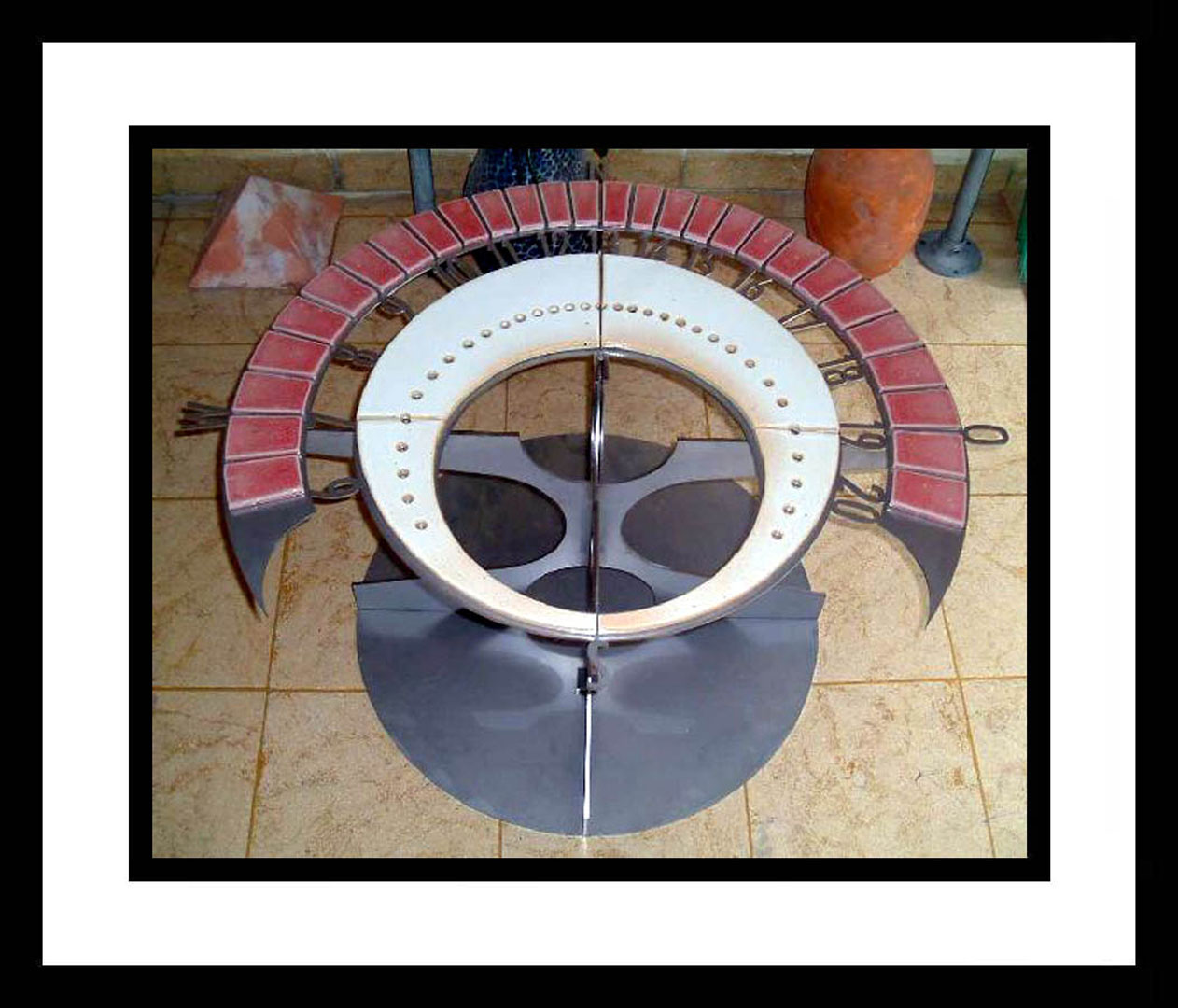 |
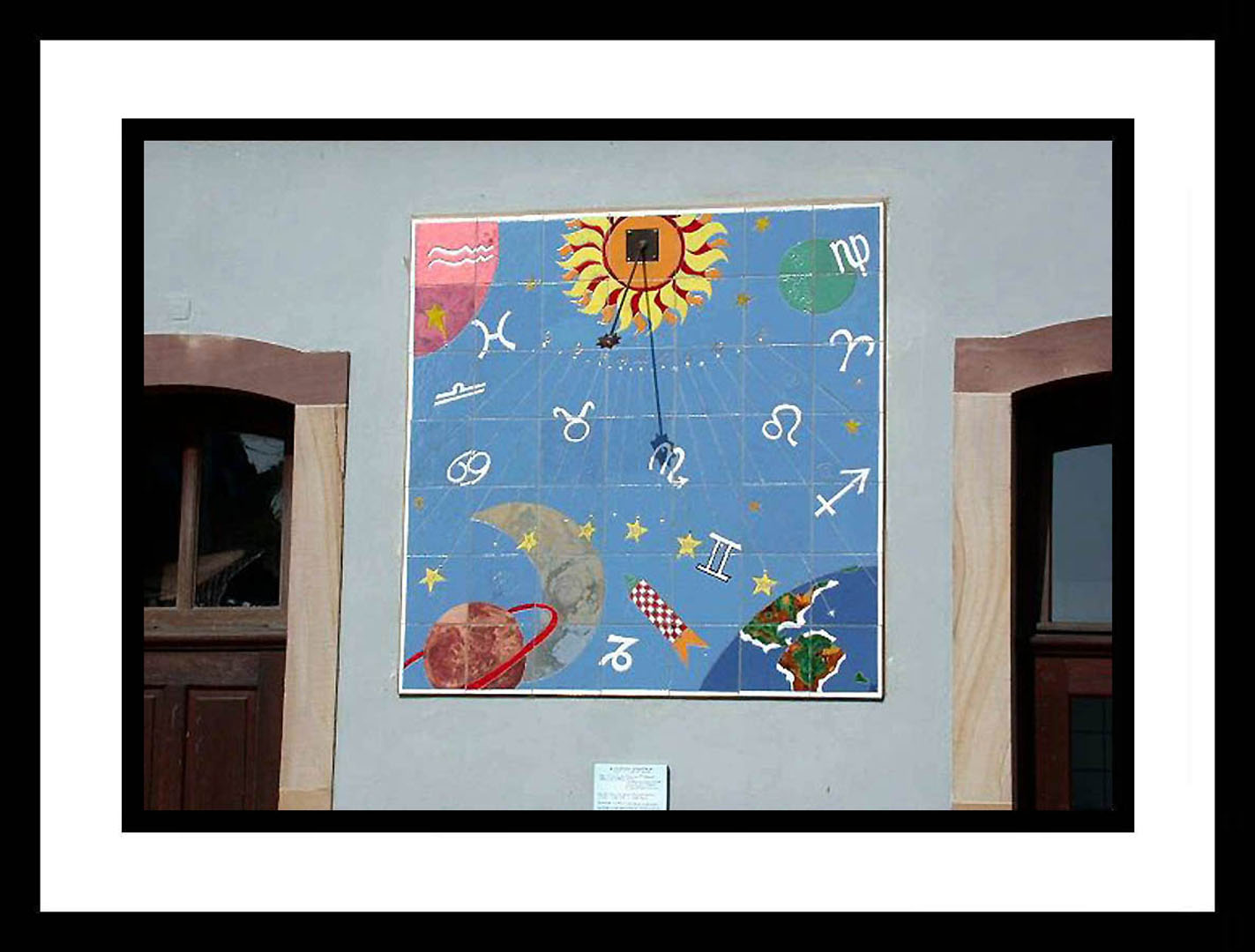 |
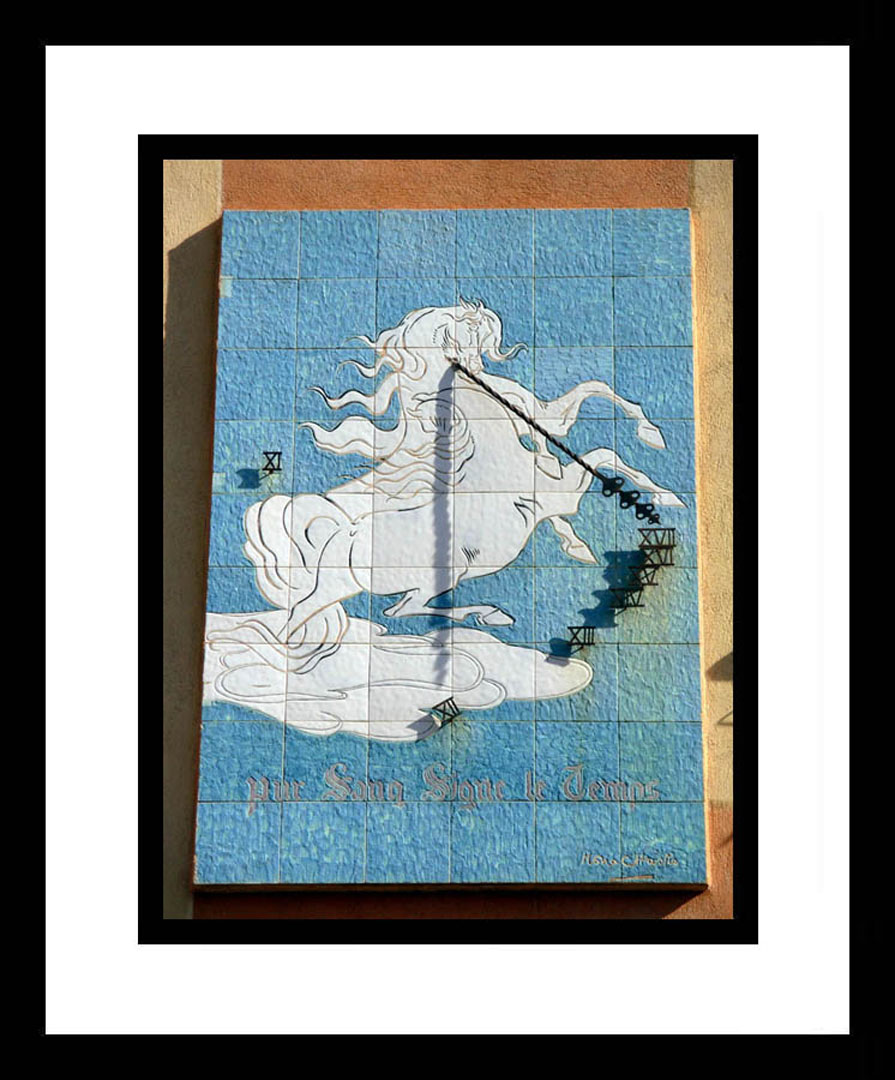 |
| Designer & Maker: Atelier Stüber, German Pottery Studio Date: unknown, probably early 2000's Original Location: A commissioned piece for Gabriele Andreae, Dipl.Ing. Architect, Münster Germany. Present Location: at original location Orientation: Horizontal Size: unknown Adornment: very modern design Mottos: none Condition: unknown Comments: It is difficult to see the gnomon in the website photos. The website indicates that copies of this dial are for sale. It is not known if this dial is properly designed and if it functions correctly. Milan-Keramik Website: Here Photo Descriptions: Photo was copied from Milan-Keramik website. Photos: a |
Delineator: unknown. But we know the designer used Shadowspro Ceramic Artisan: the teacher and pupils at Gertwiller School Gertwiller France Date: unknown, probably early 2000s Original Location: Lat: 48° 24 N (48.41° N), Lon: 7° 28 E (7.47° N) On wall of unknown building at the Gertwiller School in Gertwiller France Present Location: probably at original location Orientation: Vertical. Unknown if dial declines from south. Size: unknown but fairly large Adornment: blue tiles with painted signs of the zodiac and heavenly bodies Mottos: none Condition: unknown Comments: Has an aperture nodus on a metal star-shaped disk. We are looking for a better photo and more information about this sundial Shadows Pro Website: Here Photo Descriptions: Photos were copied in 2005 from shadowspro.com website. Photos: a |
Delineator: unknown Artist: Mona Criste Date: 1961 Original Location: in the town of Coaraze, Alpes-Maritimes, France Present Location: at original location Orientation: Vertical. Declines west of south by unknown amount. Size: unknown Adornment: two white horses on a sky blue background Mottos: “Pur Sang Signe le Temps” (Pure Blood Signs the Time) Inscriptions: signed by Mona Criste Condition: unknown Comments: Dial’s name in French is: "La Chevauchée du Temps" Sciences-Edu Website: Here Flickr Website: Here Flickr Website: Here Serge Lagier’s Email: Here Photo Descriptions: Photo is © and is courtesy of Serge Lagier. He sent it to us. Please do not copy it without his permission. Photos: a |
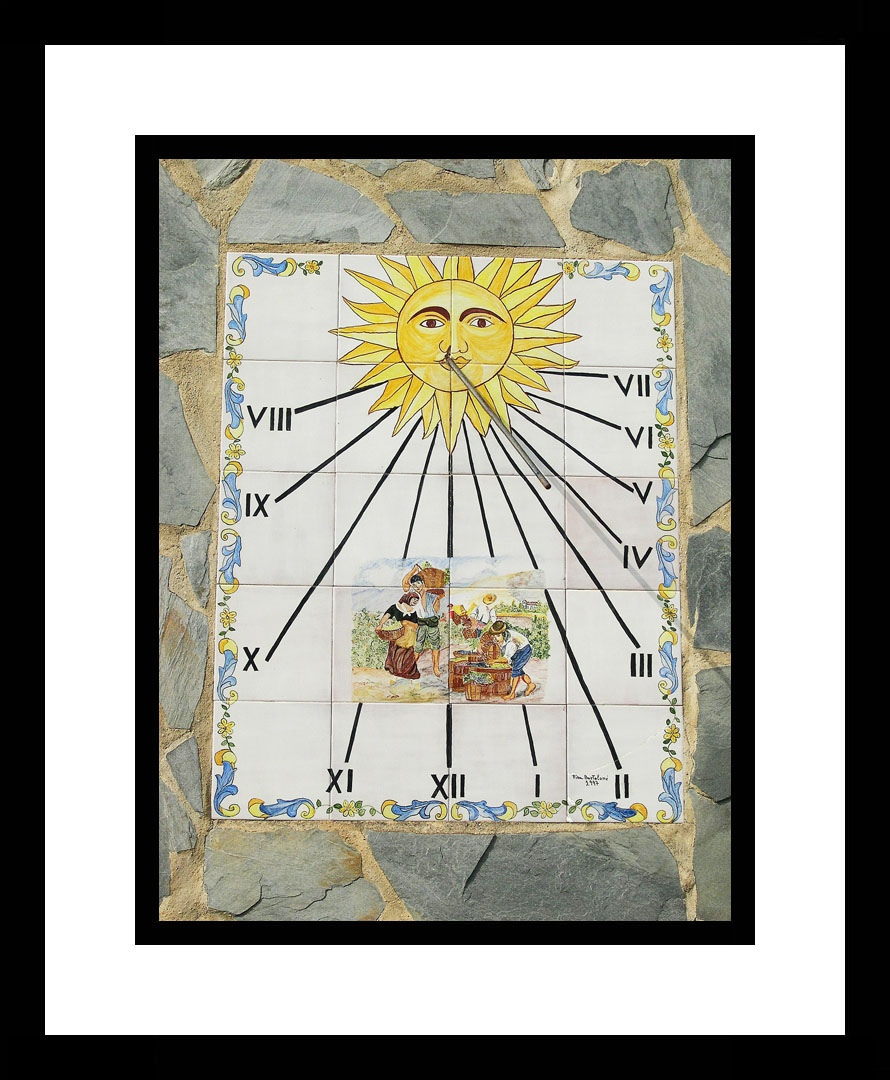 |
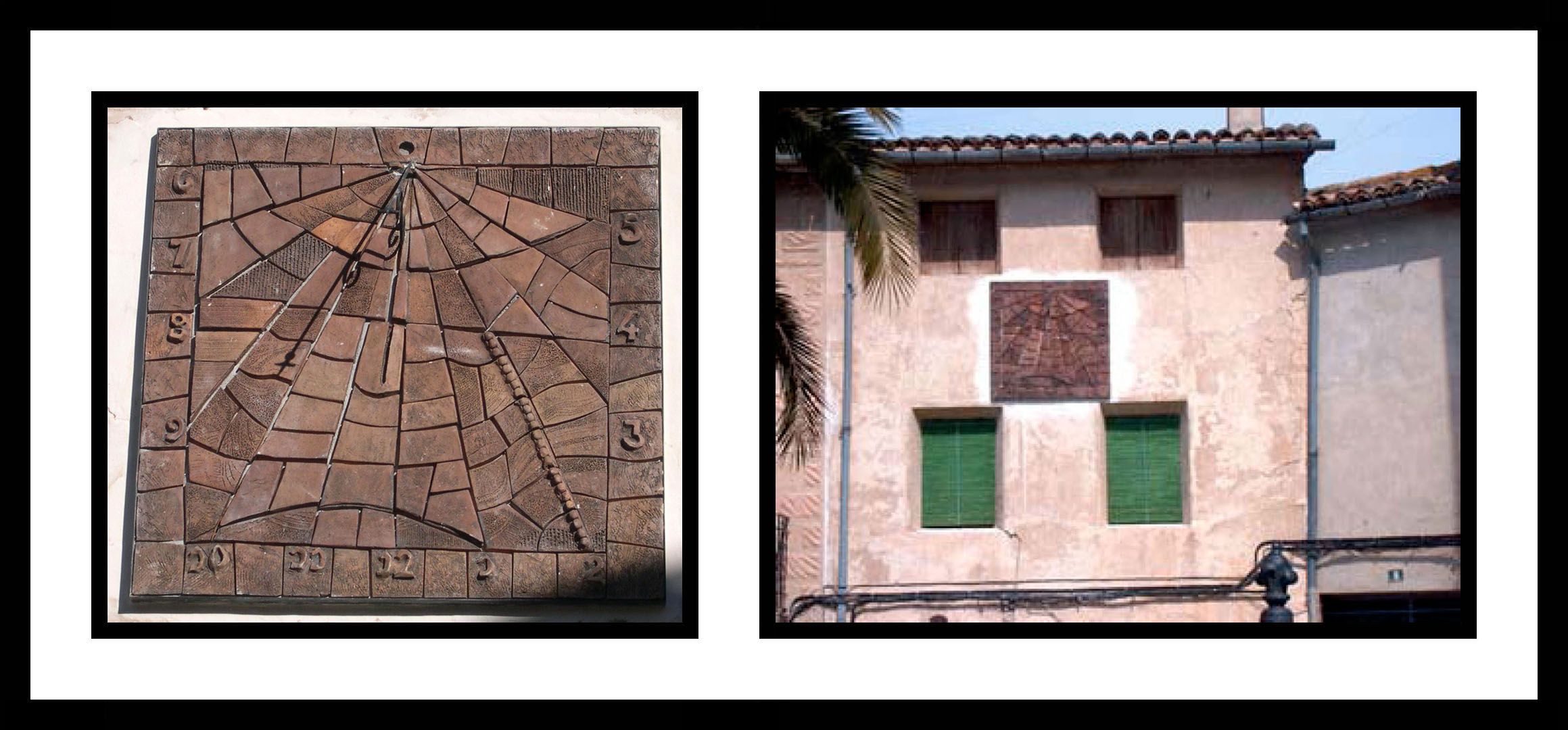 |
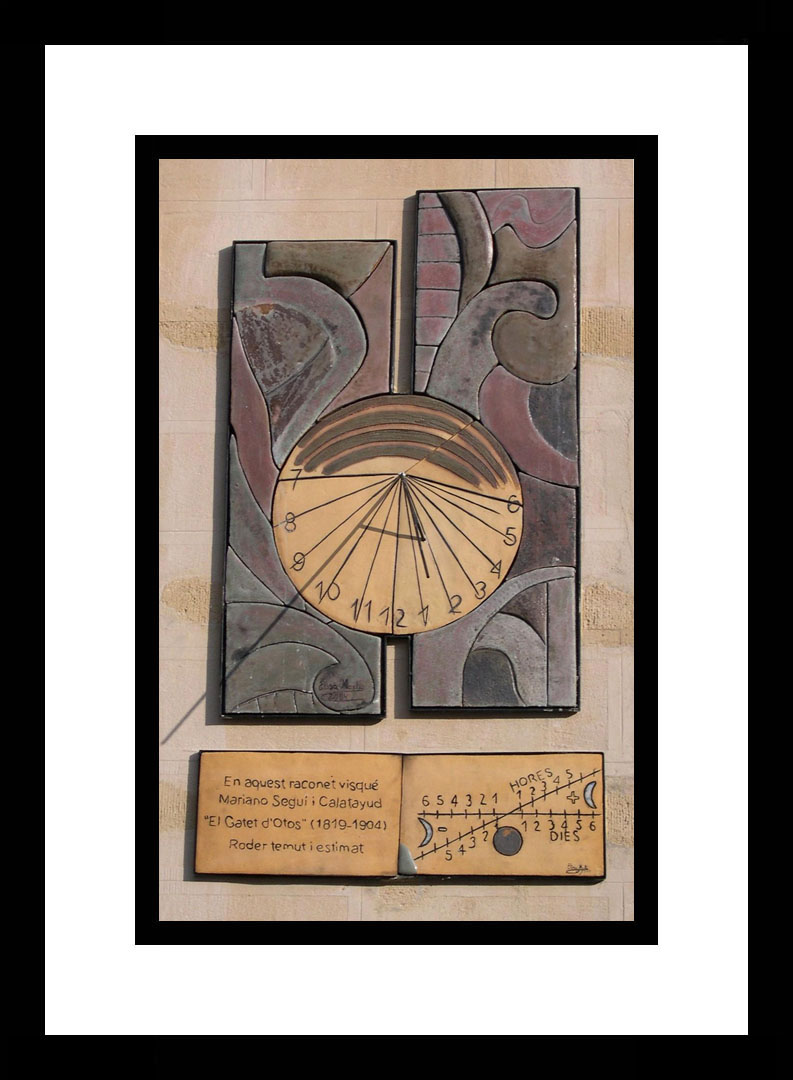 |
| Delineator: notable Spanish dialist, Joan Olivares Ceramic Artist: Fina Batolomé Date: 1997 Original Location: on a farmhouse in the town of Beniatar in Valencia Spain. Present Location: at original location Orientation: Vertical. Declines southwest by unknown amount. Size: unknown Adornment: sunface and grape harvesters in a simple design. Mottos: none Condition: excellent Comments: none Joan Olivares Website: Here Photo Descriptions: Photo ‘a’ was sent to us by Joan Olivares. Photos: a |
Delineator: notable Spanish dialist, Joan Olivares Ceramic Artist: Arcadi Blasco, famous Spanish ceramic artist Date: unknown Original Location: Lat: 38° 51' N, Lon: 0° 27' E. On the wall of unknown building in the Plaça del Llaurador in Otos Valencia Spain. Present Location: at original location Orientation: Vertical. Declination is unknown. Size: unknown Adornment: Ceramic tiles in relief add an interesting textural component. There's an odd series of bumps on the 2 o'clock hour line. Mottos: none Condition: excellent Comments: Information is from pg.15 of "Rellotge de Fang" in Spanish. Dial has solstice and equinox grout lines. "Rellotge de Fang" PDF (1.9 MB): Here "Rellotge de Fang" Website: Here Joan Olivares Website: Here Map of Valencia Website: Here Universidad de Alicante Website: Here Photo Descriptions: Photo ‘b’ was sent to us by Joan Olivares. Photo ‘a’ is a cropped version of photo ‘b’. Photo ‘c’ is from pg.15 of "Rellotge de Fang" in Spanish. Photos: a b c |
Delineator: notable Spanish dialist, Joan Olivares Ceramic Artist: Elisa Martí Date: unknown Original Location: Lat: 38° 51' N, Lon: 0° 27' E. On the wall of unknown building in the Plaza de Llaurador in Otos Valencia Spain. Present Location: at original location Orientation: Vertical. Declination is unknown. Size: unknown Adornment: modern design consiting of several ceramic pieces with curving and spiral patterns. There appears to be two information plaques that I can't read in these poor photos, but the one on the right is a moontime correction graph Mottos: none Condition: excellent Comments: Information is from pg.16 of "Rellotge de Fang" in Spanish and from Mr. Olivares’s website. Dial is called "Unió" (United) in Spanish. It pays homage to Mariano Seguí, “El Gatet d’Otos”, bandoler of the 19th century on the hundredth anniversary of his death. "Rellotge de Fang" PDF (1.9 MB): Here "Rellotge de Fang" Website: Here Joan Olivares Website: Here Otos Valencia Map Website: Here Photo Descriptions: Photo ‘b’ was sent to us by Joan Olivares. Photo ‘a’ is a cropped version of photo ‘b’. Other photos are from pg.16 of "Rellotge de Fang" in Spanish. Photos: a b c d e |
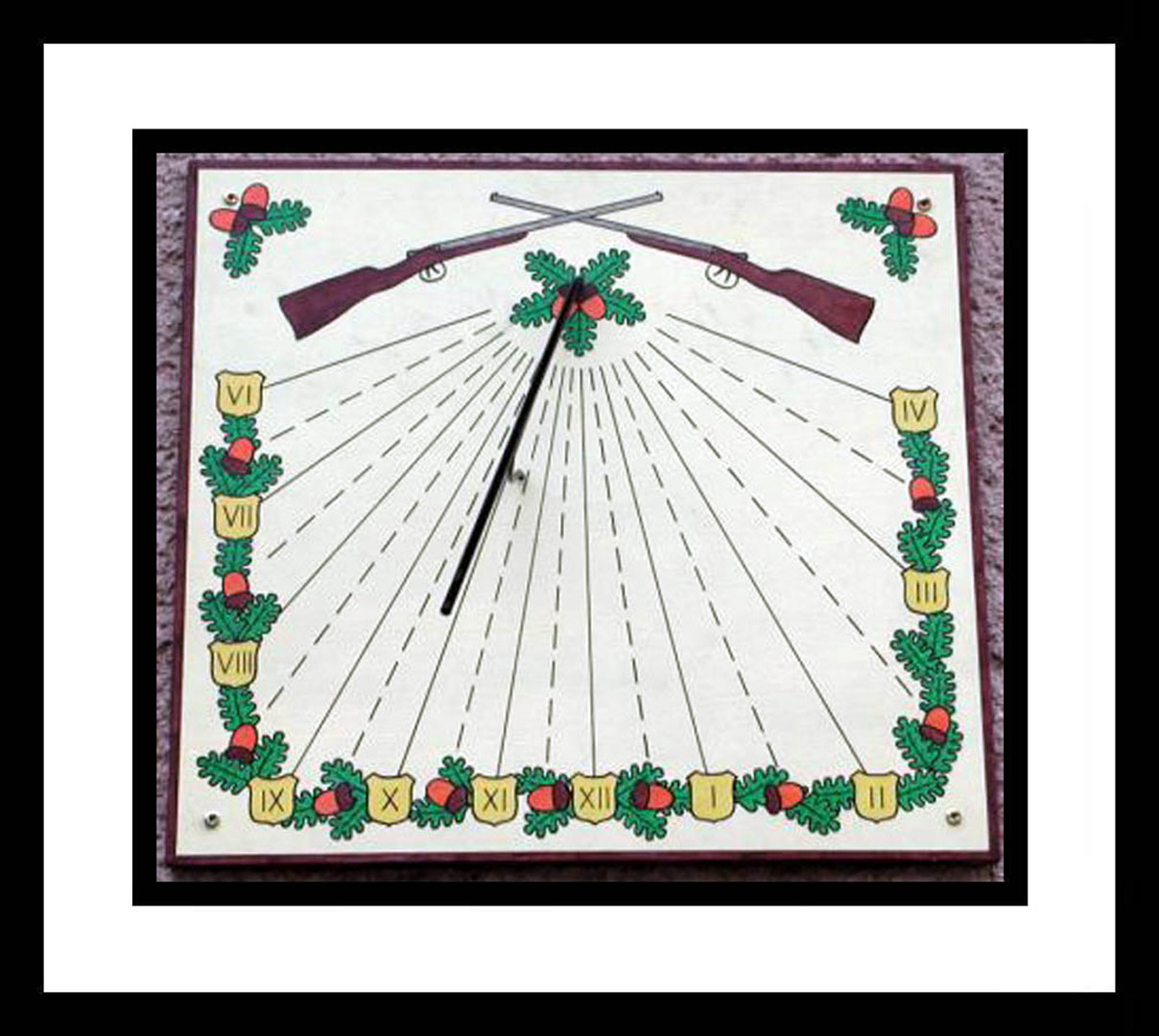 |
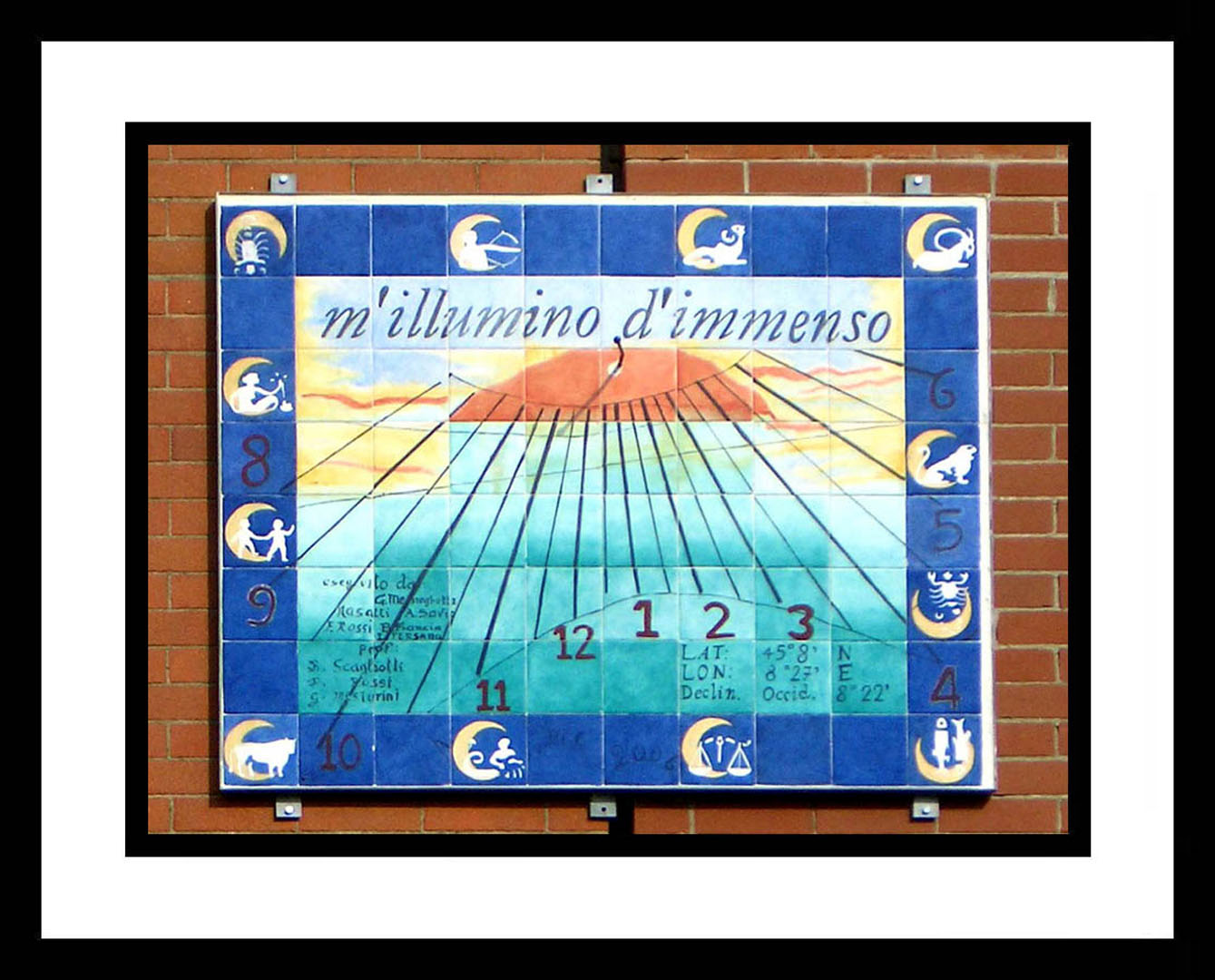 |
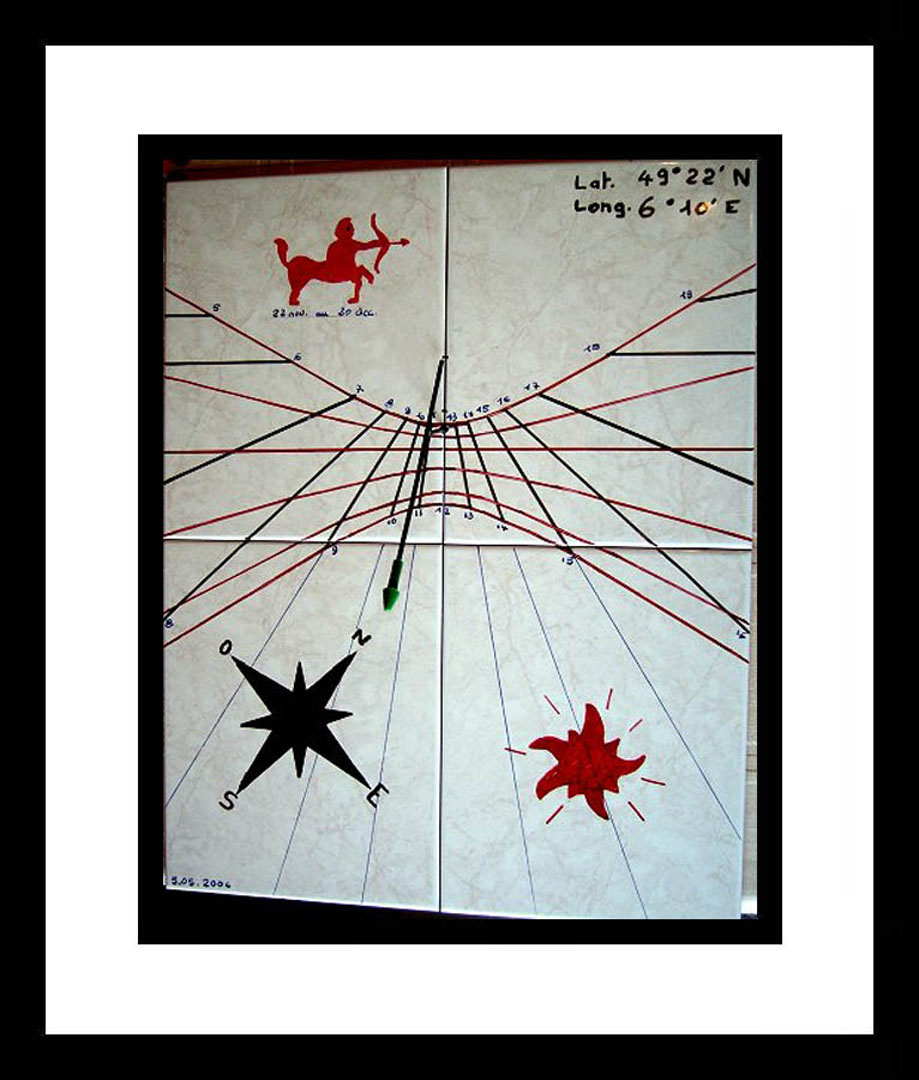 |
| Designer & Maker: Géza Marton Date: early 2000's Original Location: city unknown, Hungary Present Location: unknown. probably at original location Orientation: Vertical. Declines south. Size: unknown Adornment: wreath of red acorns, oak leaves and the hour numerals surround dial face. two rifles crossed on top. Mottos: none Inscriptions: none Condition: unknown Comments: This is a nice dial. Pagesperso-Orange Website: Here Photo Descriptions: Photo was copied from website above. Photos: a |
Designer & Maker: unknown Date: unknown Original Location: Casale Monf. (AL), Italy Present Location: at original location Orientation: Vertical. Declines slightly to the west of south Size: unknown Adornment: a rather primitive painting of the setting sun Mottos: none Inscriptions: coordinates, wall declination and the names of several people Condition: unknown Comments: none Giorgio Mesturini Website: Here Giorgio Mesturini’s Email: Here Photo Descriptions: Photo is courtesy of Mesturini and was copied from website above. Photos: a |
Designer & Maker: Daniel Fanchini Date: early 2000's Original Location: Seremange France Present Location: unknown. probably at original location Orientation: Vertical. Declines south. Size: unknown Adornment: compass rosette, sun, centaur Mottos: none Inscriptions: none Condition: unknown Comments: none Pagesperso-Orange Website: Here Photo Descriptions: Photo was copied from website above. Photos: a |
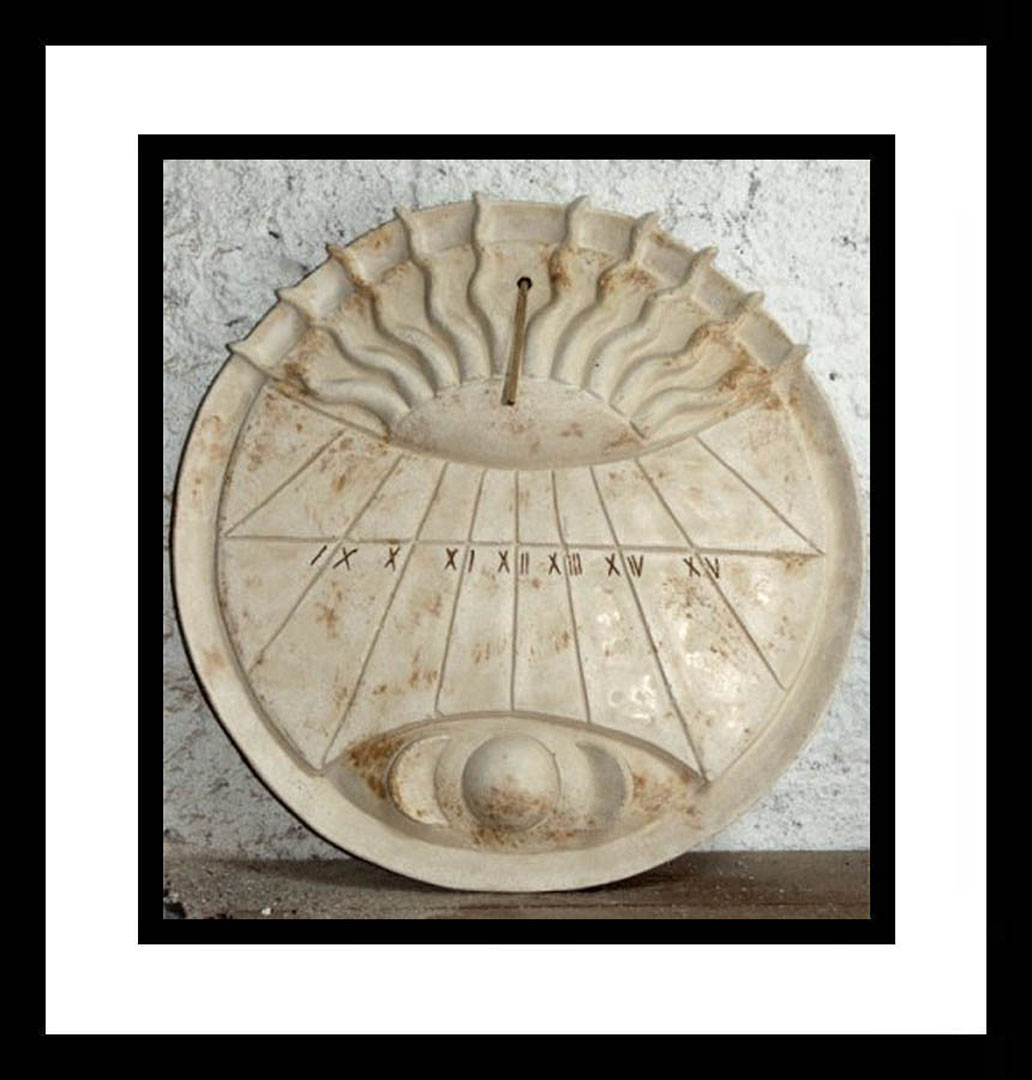 |
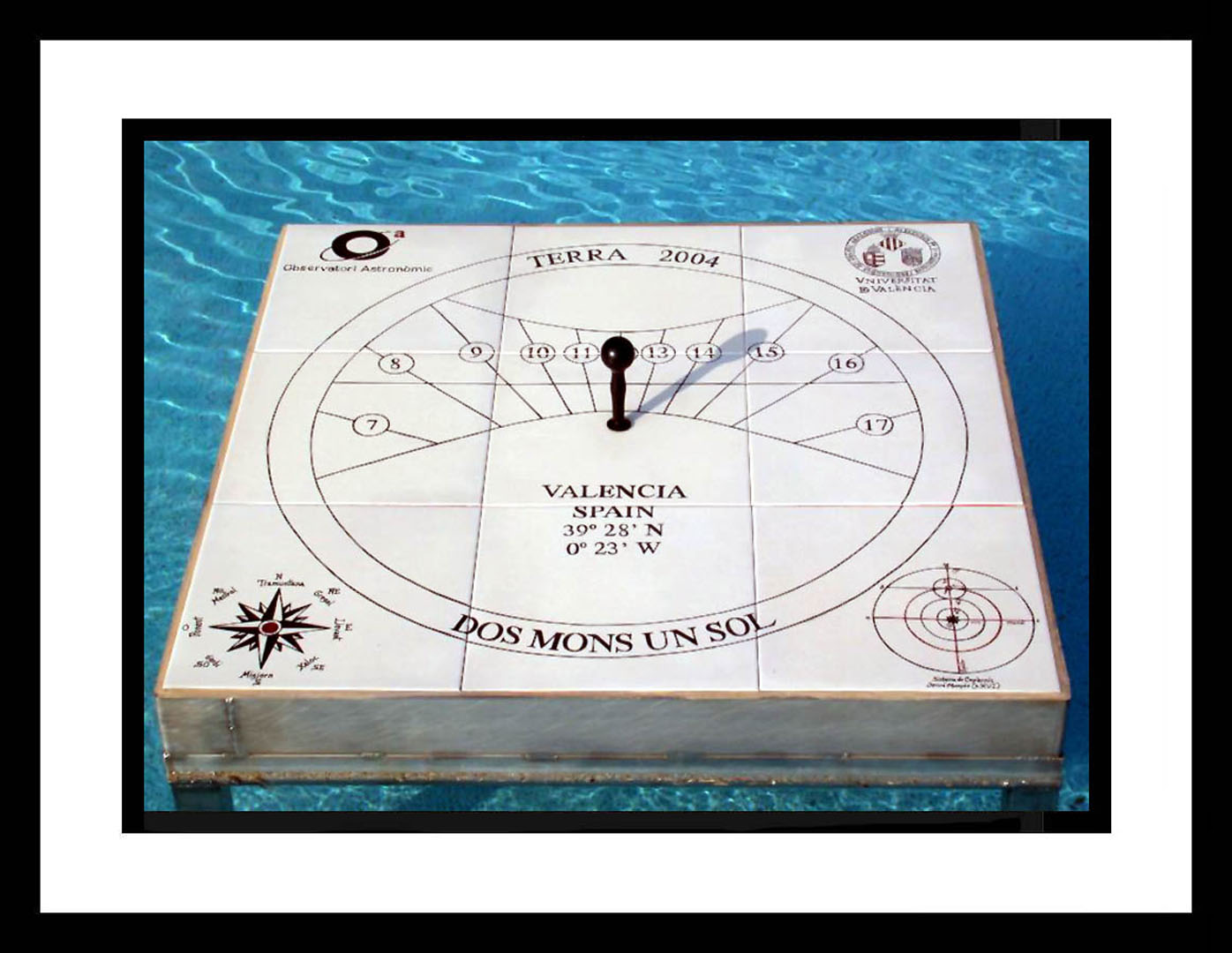 |
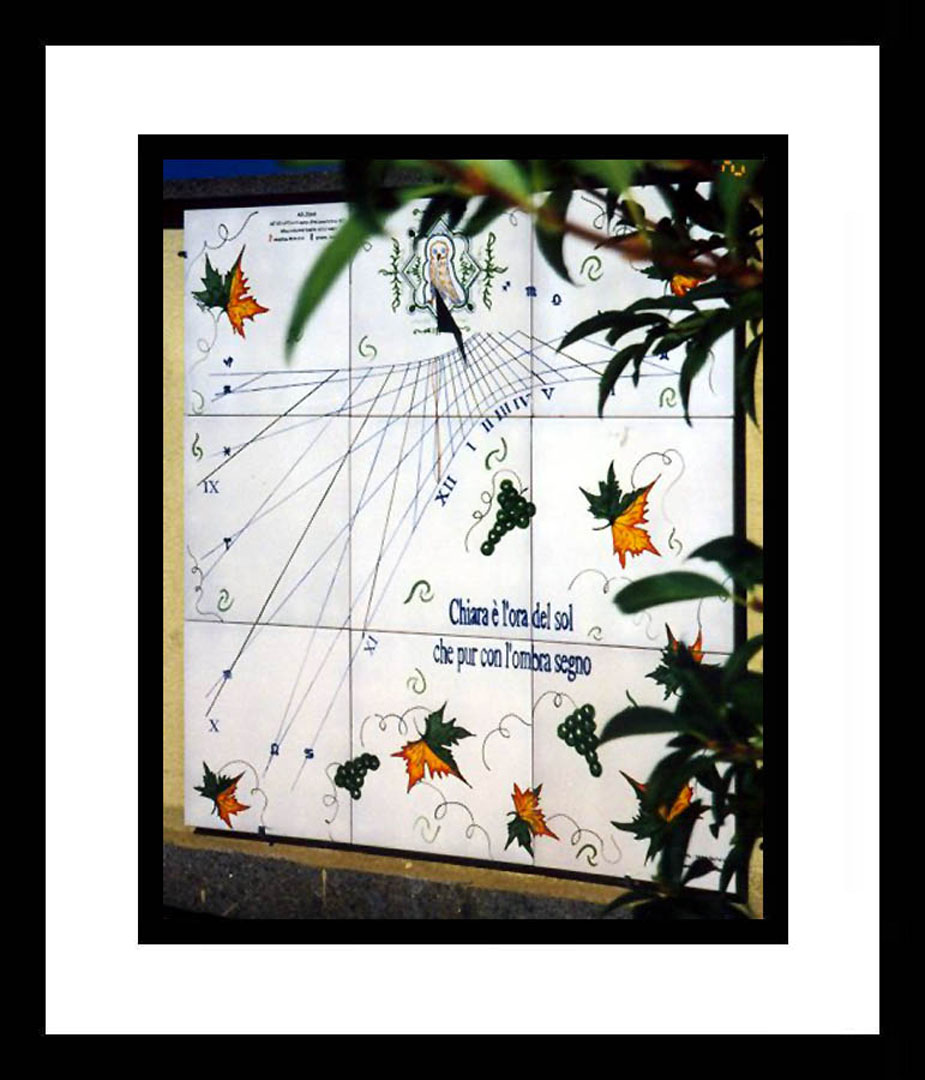 |
| Designer & Maker: Marco Miniussi Date: probably early 2000's Original Location: unknown, but since the makers name is Italian, the dial was probably made for somewhere in Italy. Present Location: unknown. probably at original location Orientation: Vertical. Declines south. Size: unknown Adornment: a simple dial sculpted in 3 dimensional relief with the rays of the sun above the winter solstice line and a sun with two crescent moons below the summer solstice lines. Mottos: none Inscriptions: none other than the roman hour numerals Condition: unknown Comments: nice dial that probably functions correctly. The material looks like ceramic clay that has been sculpted then kiln-fired. Gnomon is a metal rod. The face has an aged weathered look. Pagesperso-Orange Website: Here Photo Descriptions: Photo was copied from website above. Photos: a |
Designer: unknown Tile Artisan: unknown Date: 2004 Original Location: Installed in a pond outside the building of The Astronomical Observatory of the University of Valencia (OAUV), Spain. lat: 39° 28' N, lon: 0° 23' W. Present Location: at original location Orientation: Horizontal Size: 90 x 90 cm (35 x 35 in). Has nine 30 x 30 cm ceramic tiles. Adornment: logos of both the Astronomical Observatory and the University of Valencia. The latter includes the coats of arms of King Ferdinand of Aragon, the Pope Alexander the Sixth (of Valencian origin himself), and the city of Valencia. The three institutions founded the University in 1499. There's a compass rose with the local names of the winds, and a copy of the original diagram of a heliocentric Solar System printed by the Valencian astronomer Jeroni Muñoz in his work "Astrologicarum et geographicarum institutionum libri sex", published in the XVIth century. Mottos: "Dos Mons un Sol" (Two Worlds one Sun) Condition: excellent Comments: This ceramic dial is part of "The Earthdial Project", organized by the Planetary Society and is being seen by a webcam which broadcasts each minute a picture of the sundial via the internet. Logo alludes to the two Mars rover sundials which are also part of the project. The aquatic location in a pond highlights the traditional relation of Valencia with the Mediterranean sea and protects the dial and its camera from vandals. Valencia Earthdial Website: Here Photo Descriptions: Photo is from unknown source. Photos: a |
Delineator and Ceramic Artisan: The Shadowpro website says that Mario Pampana made it, but we don't know if he is both the artisan and the delineator. Date: unknown Original Location: On wall of unknown building in unknown place in Italy. Present Location: probably at original location Orientation: Vertical. Declines towards the west Size: unknown Adornment: hand painted tiles with two-colored grape leaves and grapes. A bird is at the top center. Has a triangular sheet gnomon, the zodiacal date lines, Roman numerals. Mottos: "Chiara e l'oraca del sol, che pur con l'ombra segno" (trans?) Inscriptions: present in top, but unreadable in this photo Condition: unknown Comments: We are looking for a better photo and more information about this sundial. Shadows Pro Website: Here Photo Descriptions: Photos were copied in 2005 from shadowspro.com website. Photos: a |
 |
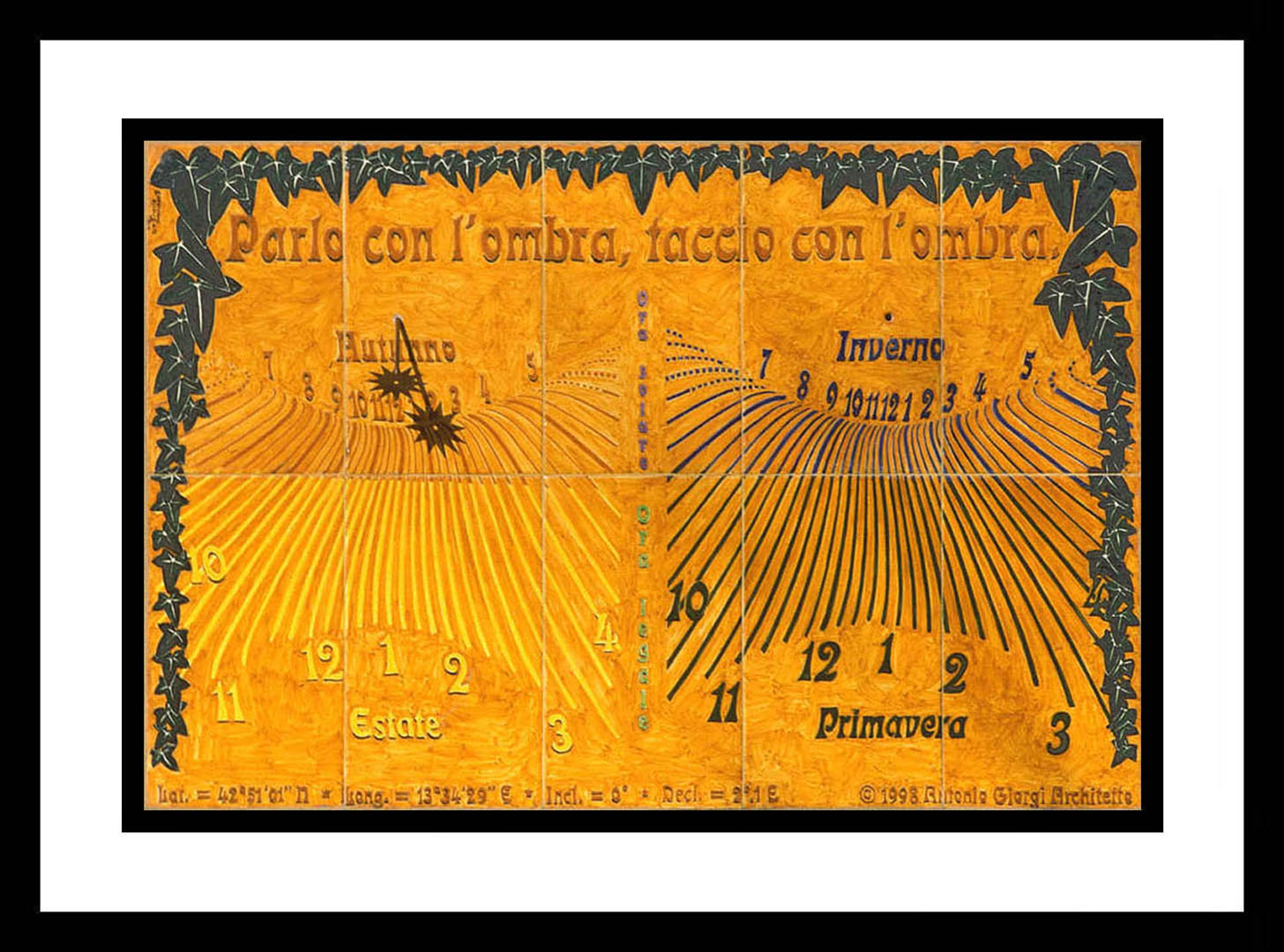 |
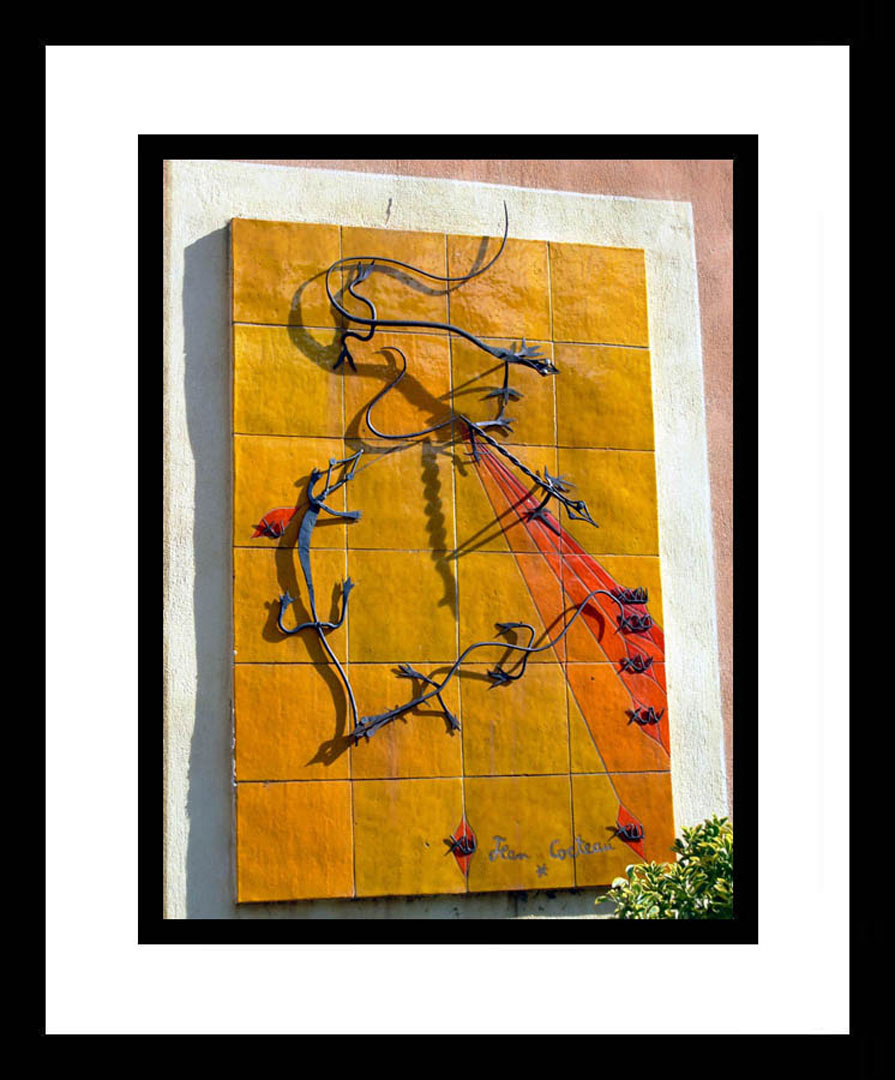 |
| Designer & Maker: Jean-Luc Ambaud Date: 2005 Original Location: Eragny France Present Location: unknown Orientation: Vertical. Declines to the southeast. Size: unknown Adornment: signs of the zodiac surrouund face that has spectral colors Mottos: yes, but not translated Inscriptions: yes, but unreadable in this photo. Date: 2005 Condition: unknown Comments: This is a nice dial. Pagesperso-Orange Website: Here Photo Descriptions: Photo was copied from website above. Photos: a |
Designer: Antonio Giorgi Artist: Luciano Cordivani Date: 1998 Original Location: Lat: 42° 51' 01" N, Lon: 13° 34' 29" E. On the Lungocastellano Sisto V, Antonio Giorgi’s home in Ascoli Present Location: at original location Orientation: Vertical. Declines 2.1° east of south Size: 122 x 82 cm (48 x 32 in) Adornment: Border of ivy, golden orange background Mottos: “Parlo con l’ombra, taccio con l’ombra” (I speak with the shadow, I’m silent with the shade) Inscriptions: Seasons are marked telling user which sundial face to use Condition: excellent Comments: The panel has two sundials. The one on the left functions in the Fall and Summer, and the other works in the Spring and Winter. User must physically move the gnomon to the correct sundial according to the season. The website below gives an excellent account of how the dial was designed and made. Arsgnomonica Website: Here Antonio Giorgi Architetto’s Email: Here Photo Descriptions: Photo is used by permission of Antonio Giorgi Architetto © 1998-2007 and was copied from website above. Photos: a |
Delineator: unknown Artists: Jean Cocteau and Gilbert Valentin Date: April 1961 Original Location: On the facade of the city hall, in the town of Coaraze, Alpes-Maritimes, France Present Location: at original location Orientation: Vertical. Declines by unknown amount. Size: unknown Adornment: very interesting wrought iron work inlaid on orangish ceramic Mottos: none Inscriptions: signed by Jean Cocteau Condition: unknown Comments: iron numerals are a little difficult to read Sciences-Edu Website: Here Flickr Website: Here Serge Lagier’s Email: Here Photo Descriptions: Photos are © and are courtesy of Serge Lagier. He sent them to us. Please do not copy them without his permission. Photos: a b |
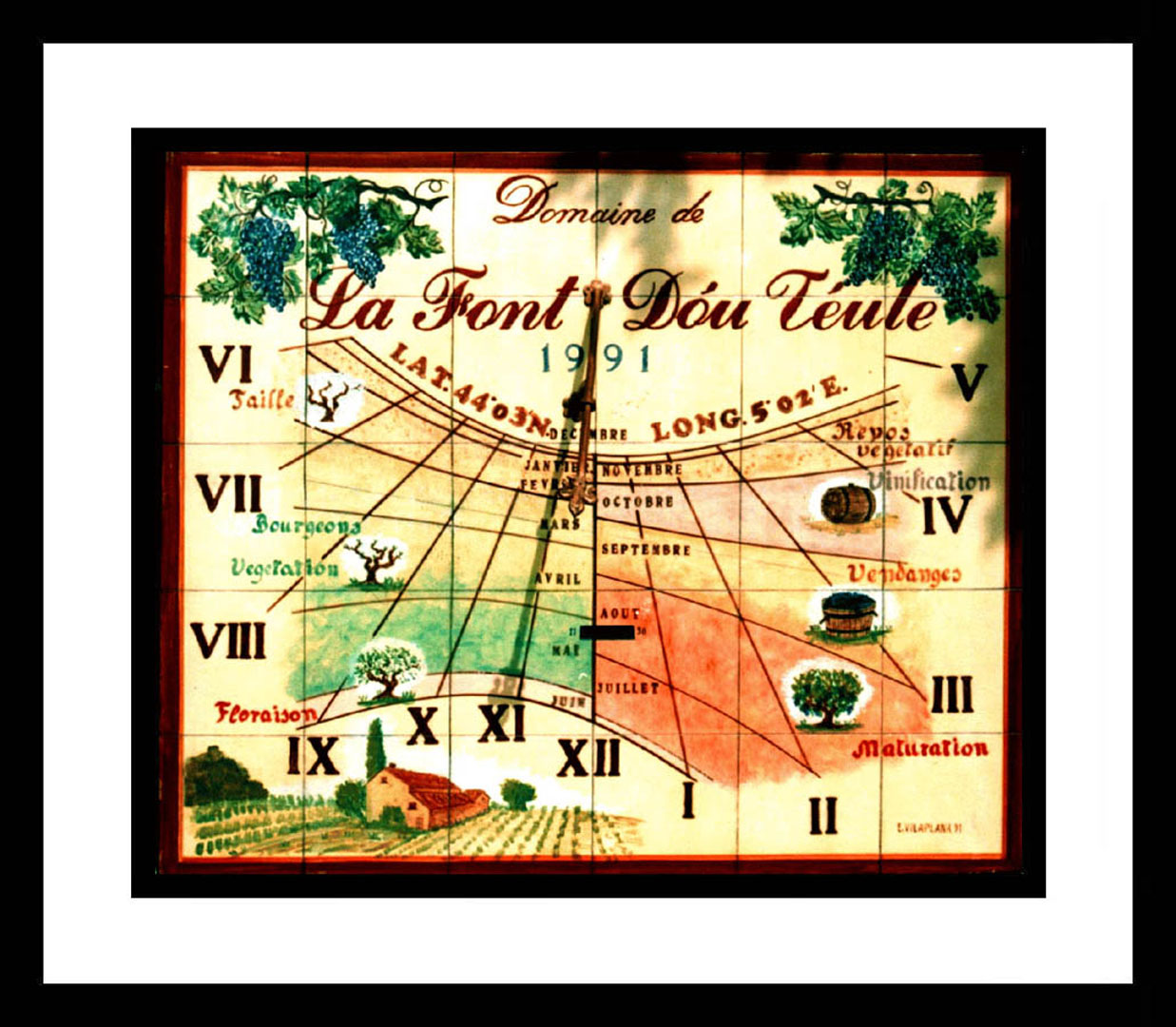 |
 |
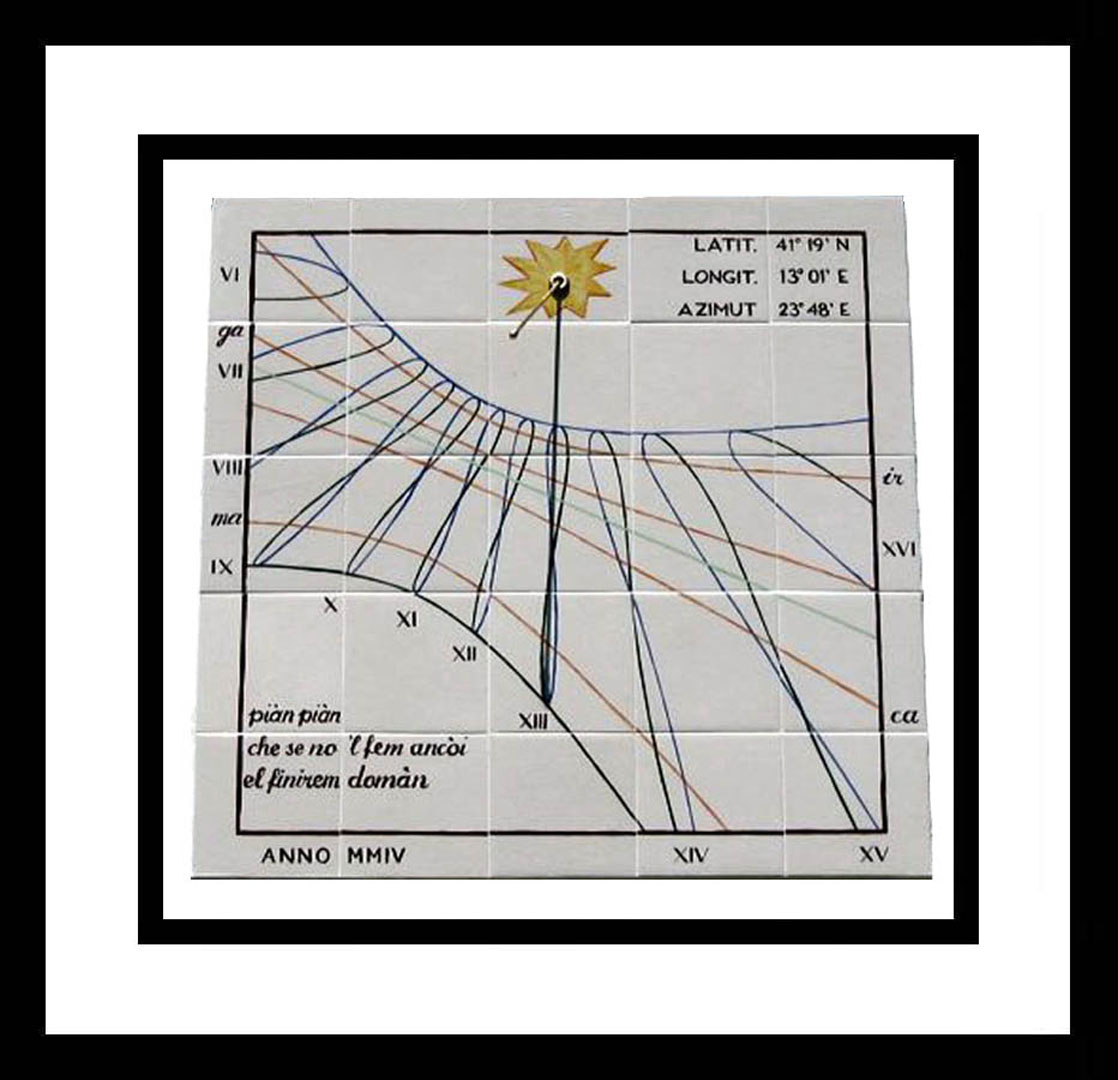 |
| Designer: M. Vilaplana (signed) Artist: M. Vilaplana (signed) Date: 1991 Original Location: Lat: 44° 03’ N, Lon: 5° 02’ E. In Vignerno France Present Location: at original location Orientation: Vertical. Declines slightly to the east of south. Size: unknown Adornment: grape bunches in upper corners, countryside landscape at bottom, declination lines labeled with the stages of grape growing Mottos: none Inscriptions: “Domaine de La Font dou Teule” Condition: unknown Comments: No website known that shows this dial. Alain Ferreira’s Email: Here Photo Descriptions: Photo is courtesy of Alain Ferreira. Photos: a |
Designer & Maker: unknown Date: unknown Original Location: Glorieta del Reloj. Plaza de América, Parque de María Luisa in Sevilla Spain Present Location: at original location Orientation: Horizontal Size: unknown Adornment: decorative hand–painted multicolored ornate designs of plants, animals, flowers, people, smiling suns, and scrollwork. Inscriptions: present, but hard to read in photo. Mottos: none Condition: looks pretty good, but needs cleaning. Gnomon looks a little bent. Comment: very handsome! Wikipedia Commons Website: Here Photo Descriptions: Photo is by Lobillo (2007) and was copied from website above. The copyright holder of this work released it into the public domain. This applies worldwide. In case this is not legally possible, he grants anyone the right to use this work for any purpose, without any conditions, unless such conditions are required by law. Photos: a |
Designer & Maker: Marco Tomljanovich Date: 2004 Original Location: Lat: 41° 19' N; Lon: 13° 01' E. on unknown building in Sabaudia, Italy Present Location: at original location Orientation: Vertical. Declines 23° 48' east of south. Size: unknown Adornment: seven zodiacal date lines, hourly analemmas for Standard Time readings. A yellow sun at dial center. Roman Numerals. Mottos: "pian pian, che se no 'l fem ancoi, el finirem doman" (Take your time (and do it well), because what will be unfinished today will be completed tomorrow) Inscriptions: "Latit. 41°19' N, Longit. 13° 01' E, Azimut 23° 48' E, ANNO MMIV" Condition: probably good Comments: Sundial is painted on tiles and has a rod gnomon. Shadows Pro Website: Here Photo Descriptions: Photo is copied from website above. Photos: a |
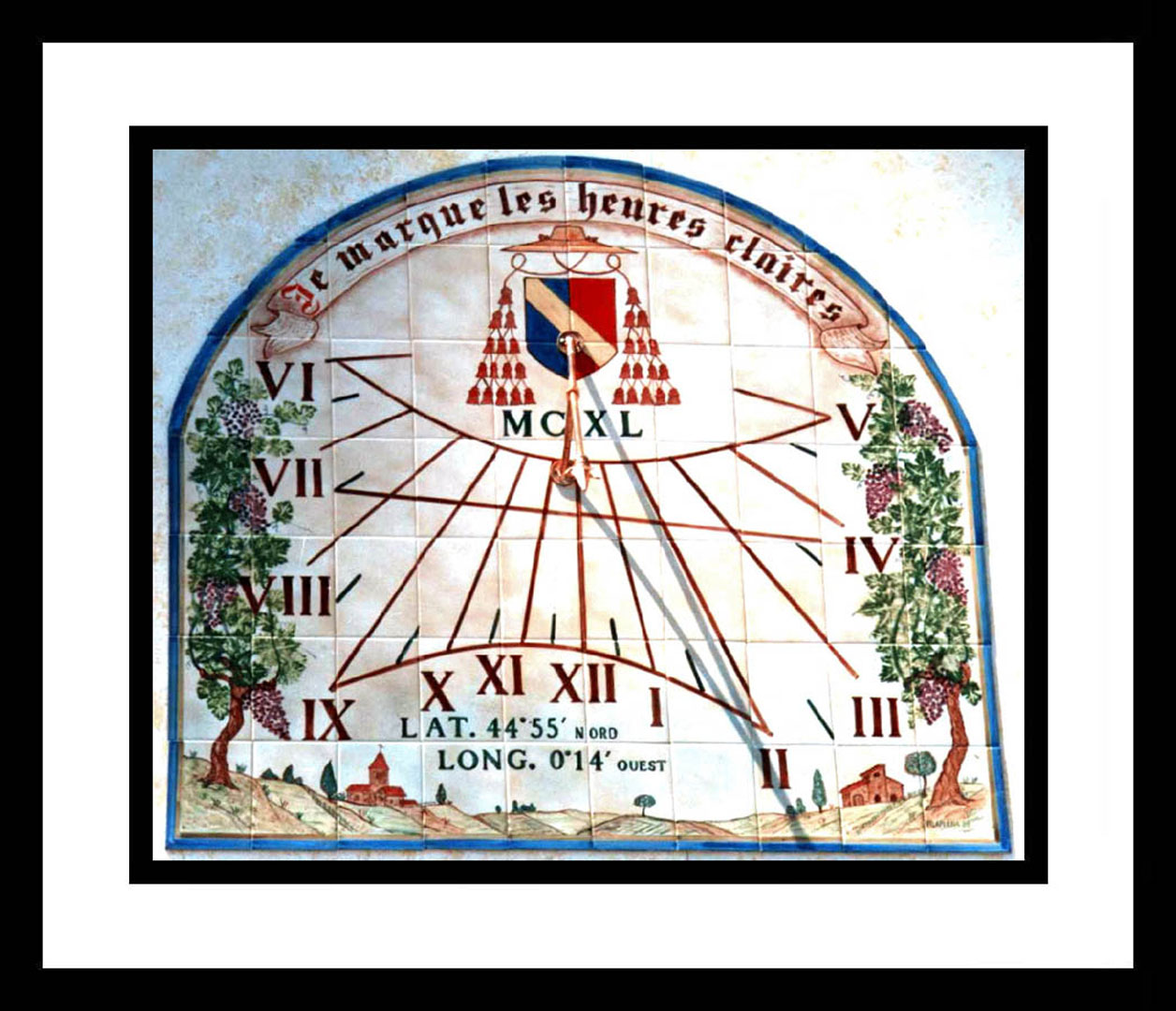 |
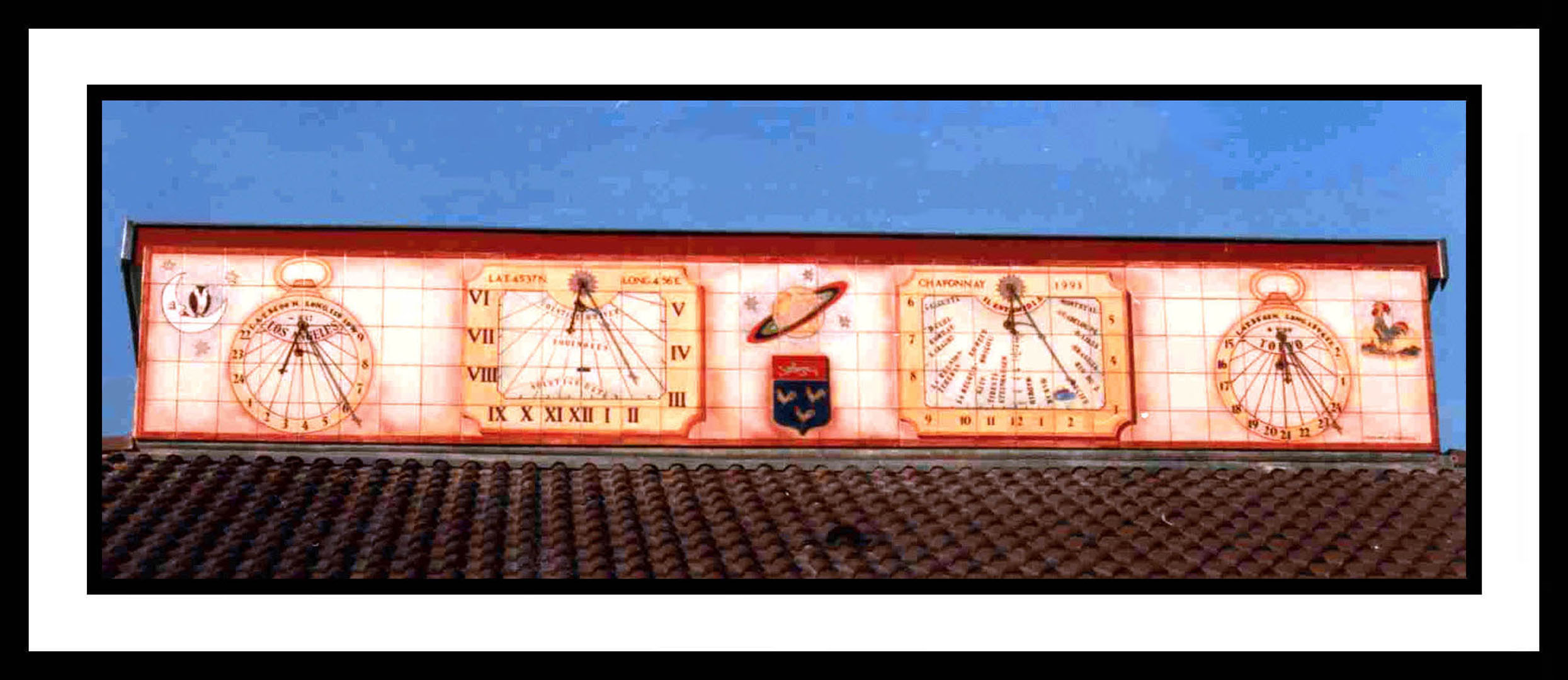 |
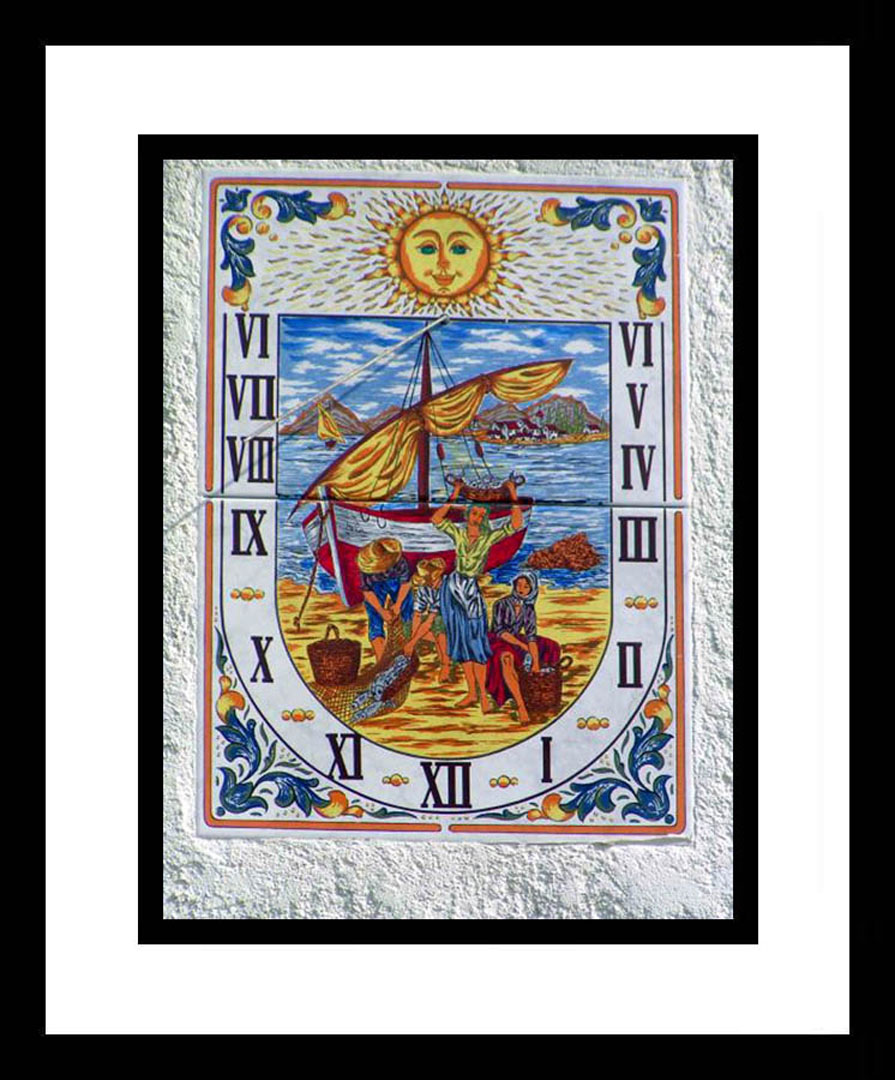 |
| Designer: M. Vilaplana (signed) Artist: M. Vilaplana (signed) Date: 1989 Original Location: Lat: 44° 55’ N, Lon: 0° 14’ W. On unknown building in Assieu France Present Location: at original location Orientation: Vertical. Declines slightly to the east of south. Size: unknown Adornment: grapevine borders and the French countryside. Shield at top. Mottos: “Je Marque Les Heures Claires” (I Tell the Clear Hours) Inscriptions: MCXL Lat: 44° 55’ N, Lon: 0° 14’ W. Condition: unknown Comments: No website known that shows this dial. Alain Ferreira’s Email: Here Photo Descriptions: Photos are courtesy of Alain Ferreira. Photos: a b |
Designer: M. Vilaplana (signature not visible) Artist: M. Vilaplana (signature not visible) Date: 1991 Original Location: Lat: 45° 37’ N; Lon: 4° 56’ E. On unknown building in Chaponnay France Present Location: at original location Orientation: Vertical. Declines slightly to the east of south. Size: unknown but quite large Adornment: moon & Owl, Saturn & Stars, rooster, shield Mottos: none Inscriptions: present but unreadable in this poor photo. Condition: unknown Comments: We need a better photo. There are four separate dials in this piece that show: The time in Los Angeles, Chaponnay, various cities, and Tokyo. No website known that shows this dial. Alain Ferreira’s Email: Here Photo Descriptions: Photo is courtesy of Alain Ferreira. Photos: a |
Designer & Maker: unknown Date: unknown Original Location: maison a Salaunes, France Present Location: at original location Orientation: Vertical. Declines south. Size: unknown Adornment: brilliantly colored painting of fishermen with smiling sun and corner decorations. Mottos: none Inscriptions: none Condition: unknown Comments: it appears that the rod gnomon has been rotated, making the dial nonfunctional Pagesperso-Orange Website: Here Joel Robic’s Email: Here Photo Descriptions: Photo is by Lucien Chaumain and was copied from website above. Photos: a |
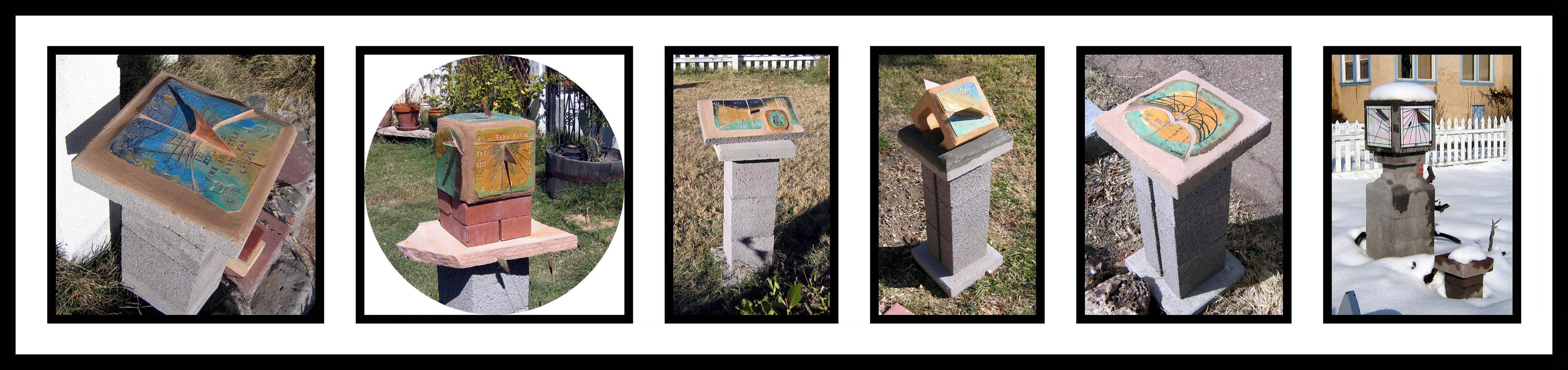 |
||
| Delineator: Simon Wheaton-Smith Maker: Simon Wheaton-Smith Dates: all were made in 2006 Original Locations: Lat: 32° 46’ 52” N, Lon: 108° 16’ 24” W. At private residence at 6th and A Street, Silver City New Mexico, USA Present Locations: all are at original locations Orientations: 372-horizontal; 373-cube dial with four cardinal point vertical dials and one horizontal dial; 374-polar; 375-cardinal points; 376-horizontal; 377-a couple of degrees off the cardinal points Sizes: 372-12 in; 373-8 in cube; 374-8 in x16 in; 375-8” square dial plates; 376-12 in square; 377-5 ft 6 in Adornment: 372-concrete pedestal; 373-colorful faces; 374- concrete block pedestal, glass face, copper border and lines; 375-onb concrete block; 376-on concrete block; 377- on concrete block, glass face, copper border and lines Mottos: 372-“Time and tide wait for gnomon”; 373-“May sunshine fill your hours”; 374-none; 375-none; 376-none; 377-none Inscriptions: 372-longitude & latitude; 373-unknown; 374-none; 375-none; 376-none; 377- on the north face is the equation of time in ceramic Condition: all good in 2007 except 374 which was prematurely fired, and which exploded. What could be saved was, and a new fill in was added Comments: According to Mr. Wheaton-Smith, these dials have a primitive artistic design and are intended to reach the peaceful right brain while still being fairly accurate. They are not intended to be fine works of art, but to generate peaceful moods. Their aesthetic appearance was intended to be more important than their accuracy. 372-a standard horizontal dial, nodus is 2/3 the way along the style, 7 calendar lines, longitude corrected; 373-ceramic stoneware, horizontal, vertical, and two meridian dials all longitude corrected; 374-this dial gets a lot of pleasing comments from passers by. It has the half hours marked, and the solstice and equinoxes, and is longitude corrected; 375-a set of longitude corrected horizontal dials rotated 45 degrees, or, meridian dials rotated. Photo was taken as the mortar was setting before a final stucco coat; 376-a longitude corrected winged azimuth dial of stoneware. It gets a lot of curious comments from passers by who don't understand it, so it tweaks their interest. 377- This is a modern remake in iridescent opalescent glass of an ancient cube dial that Mr. Wheaton-Smith had in England in the 1950s. Illustrating Shadows Website: Here Simon Wheaton-Smith’s Email: Here Photo Descriptions: Photos are courtesy of Simon Wheaton Smith and he sent them to us. Photos: Dial 372: a Photos: Dial 373: a Photos: Dial 374: a Photos: Dial 375: a Photos: Dial 376: a Photos: Dial 377: a |
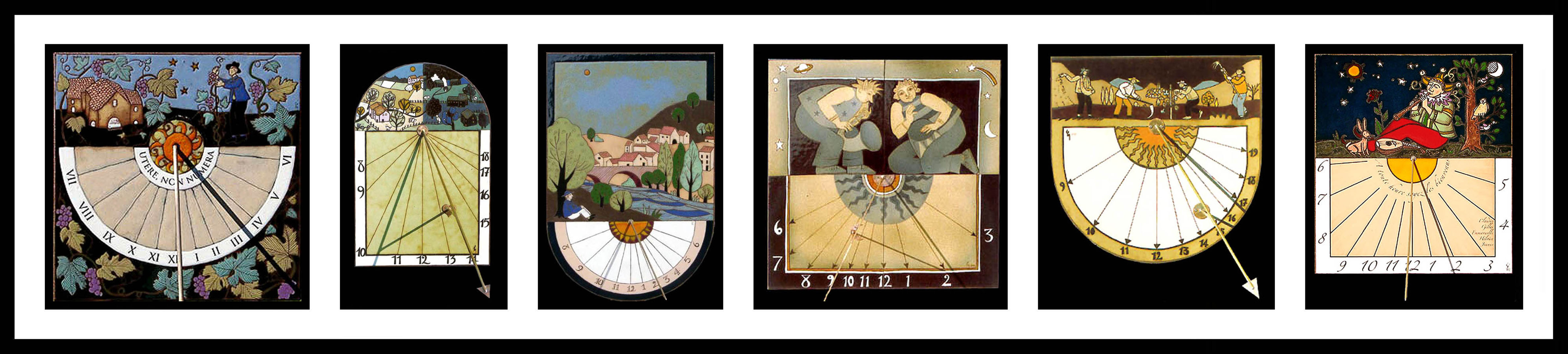 |
||
| Designers & Makers: Francois and Marie Lienhard Delineator: unknown Date: unknown. Probably early 2000's Original Location: unknown. probably somewhere in France. Present Location: unknown. probably at original locations Orientation: Vertical. All dials decline from south by unknown amounts Size: unknown Adornment: dials have colorful attractive stylized depictions of pastoral scenes painted on single ceramic tiles. Mottos: some are present Condition: unknown Comments: Very nice dials! Information is taken from website below in 2005. All dials have brass rod gnomons. We are looking for better photographs and more information on these dials. Francois Lienhard Website: Here Francois Lienhard’s Email: Here Photo Descriptions: Photos were copied from website below in 2005 Photos: Dial 272: a Photos: Dial 273: a Photos: Dial 274: a Photos: Dial 275: a Photos: Dial 276: a Photos: Dial 277: a |
 |
||
| Photos: Dial 226: a b Photos: Dial 227: a b Photos: Dial 228: a b c Photos: Dial 229: a b Photos: Dial 240: a Photos: Dial 241: a Photos: Dial 242: a |
 |
||
| Photos: Dial 243: a Photos: Dial 244: a Photos: Dial 245: a Photos: Dial 246: a b c Photos: Dial 247: a b c Photos: Dial 248: a |
 |
||
| Photos: Dial 249: a Photos: Dial 250: a Photos: Dial 251: a Photos: Dial 252: a Photos: Dial 253: a b Photos: Dial 254: a |
 |
||
| Photos: Dial 255: a Photos: Dial 256: a Photos: Dial 257: a Photos: Dial 258: a Photos: Dial 259: a b |
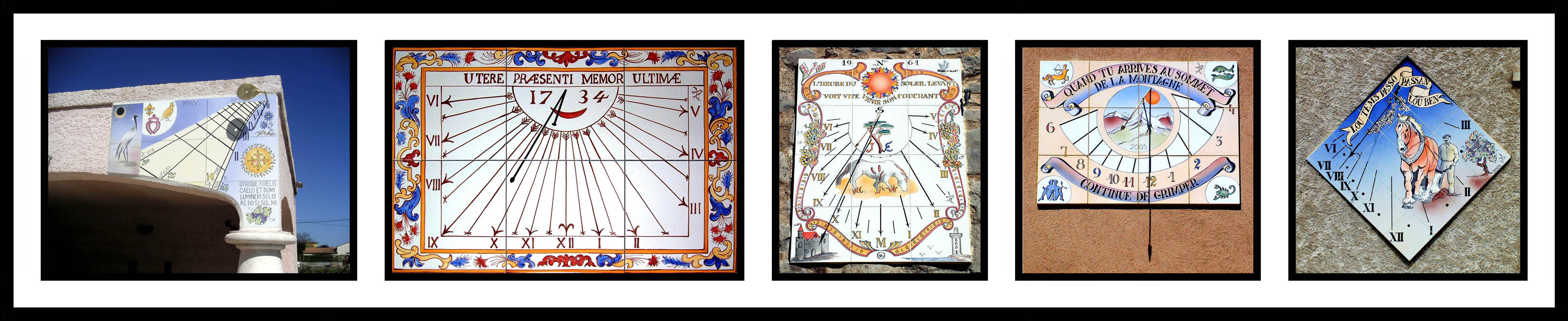 |
||
| Photos: Dial 260: a Photos: Dial 261: a b Photos: Dial 262: a b Photos: Dial 263: a b Photos: Dial 264: a b c d |
 |
||
| Photos: Dial 265: a Photos: Dial 266: a Photos: Dial 267: a b Photos: Dial 268: a b Photos: Dial 269: a |
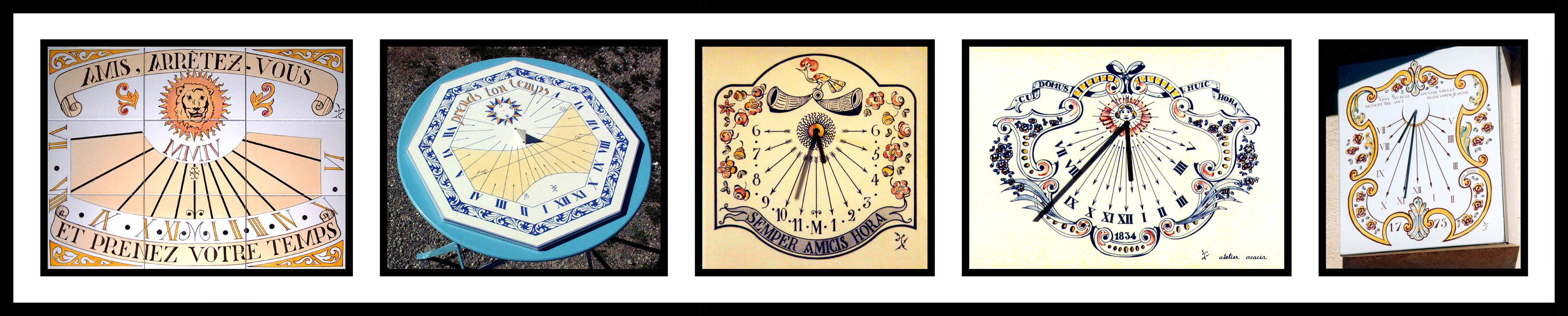 |
||
| Photos: Dial 270: a b Photos: Dial 271: a Photos: Dial 282: a Photos: Dial 283: a b Photos: Dial 284: a |
 |
||
| Photos: Dial 285: a b Photos: Dial 286: a b Photos: Dial 287: a Photos: Dial 288: a Photos: Dial 289: a Photos: Dial 290: a |
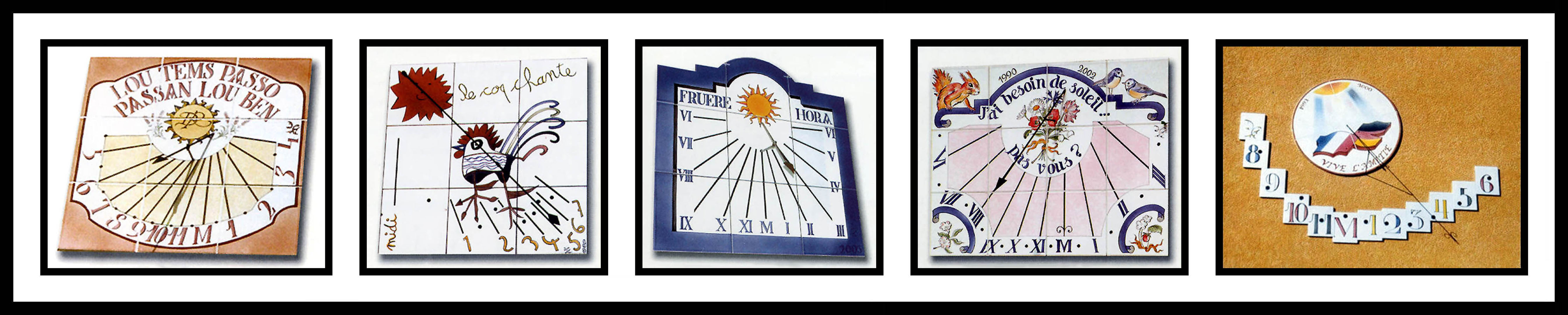 |
||
| Photos: Dial 291: a Photos: Dial 292: a Photos: Dial 293: a Photos: Dial 294: a Photos: Dial 295: a |
 |
||
| Photos: Dial 296: a Photos: Dial 297: a Photos: Dial 298: a b Photos: Dial 309: a Photos: Dial 310: a b Photos: Dial 400: a Designer and Ceramic Painter: Joseph Auvray Ceramic Studio: Atelier Acacia workshop at Mont Dauphin, Haute Alpes, France Dates: All these dials were made between 1990 and 2005. Most have the dates inscribed on them. Some dates are not readable in these photos. Original Location: at various locations in France Present Location: probably at original locations Orientation: Most are vertical south dials. Some decline. Some are horizontal. Size: The larger dials, some over a meter in height and width, are made up of smaller pieces as the size is limited by firing ovens and thermal expansion problems Adornment: Ceramic tiles were made using the silk-screening technique. Dials are notable for their colorful, clean and easy to read designs with attractive artwork and borders on different shaped faces. Inscriptions: Most are signed and dated and have various phrases and inscriptions. Atelier Acacia’s maker’s mark appears on all their dials. Mottos: various Condition: unknown Comments: Information is courtesy of Mr. Auvray, the website below and from comments by Roger Bailey. These are high-quality ceramic dials. Some are reproductions of other dials in the area. Auvray's products range from small series dials with silk screened patterns to large custom pieces for specific locations and wall declinations. He uses slabs of lava rock rather than clay tablets or metal as the base material. This rock is more stable during the firing of the glaze and pigments. There are many examples of his work proudly displayed by his customers through the French Alpes. Dial 227's photo shows Joseph Auvray explaining the dial outside Atelier Acacia. The design of the dial is appropriate for the location within the massive walls of Mont Dauphin, the Vauban fortress built by King Louis XIV, the Sun King. Note the motto "Sol Rex Regnum", the Dauphin crest, and the 25 August declination line for Saint Louis of France, King and confessor. We are looking for better photos of Dials 259, 265, 266, 267 and Dials 287-297. Acacia Workshop Brochure (PDF 1.4 MB): Here Alpages Website (rough English translation): Here Acacia Workshop Examples Pages Website (rough English Translation): Here Acacia Workshop Website: Here Joseph Auvray’s Email: Here |
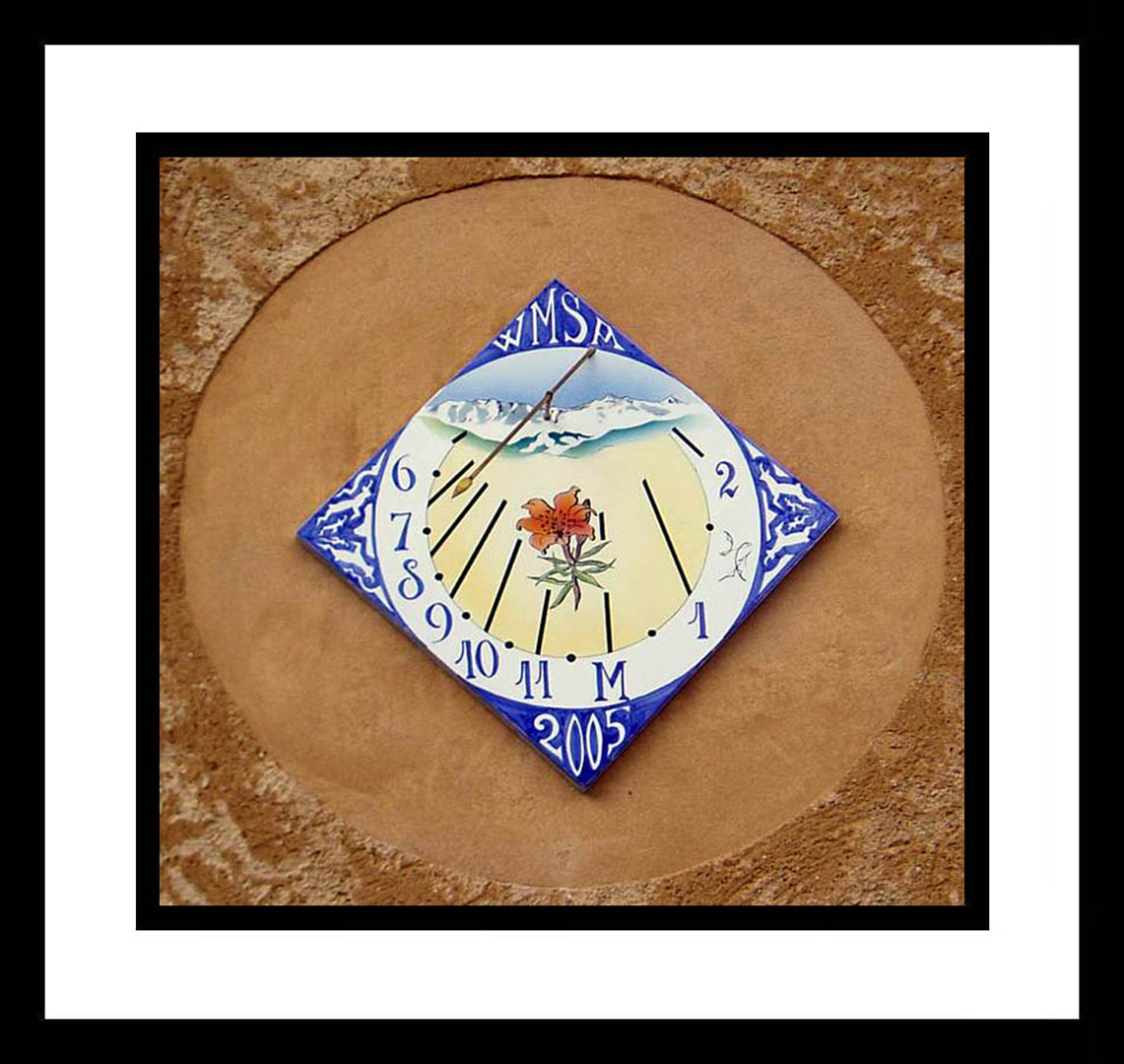 |
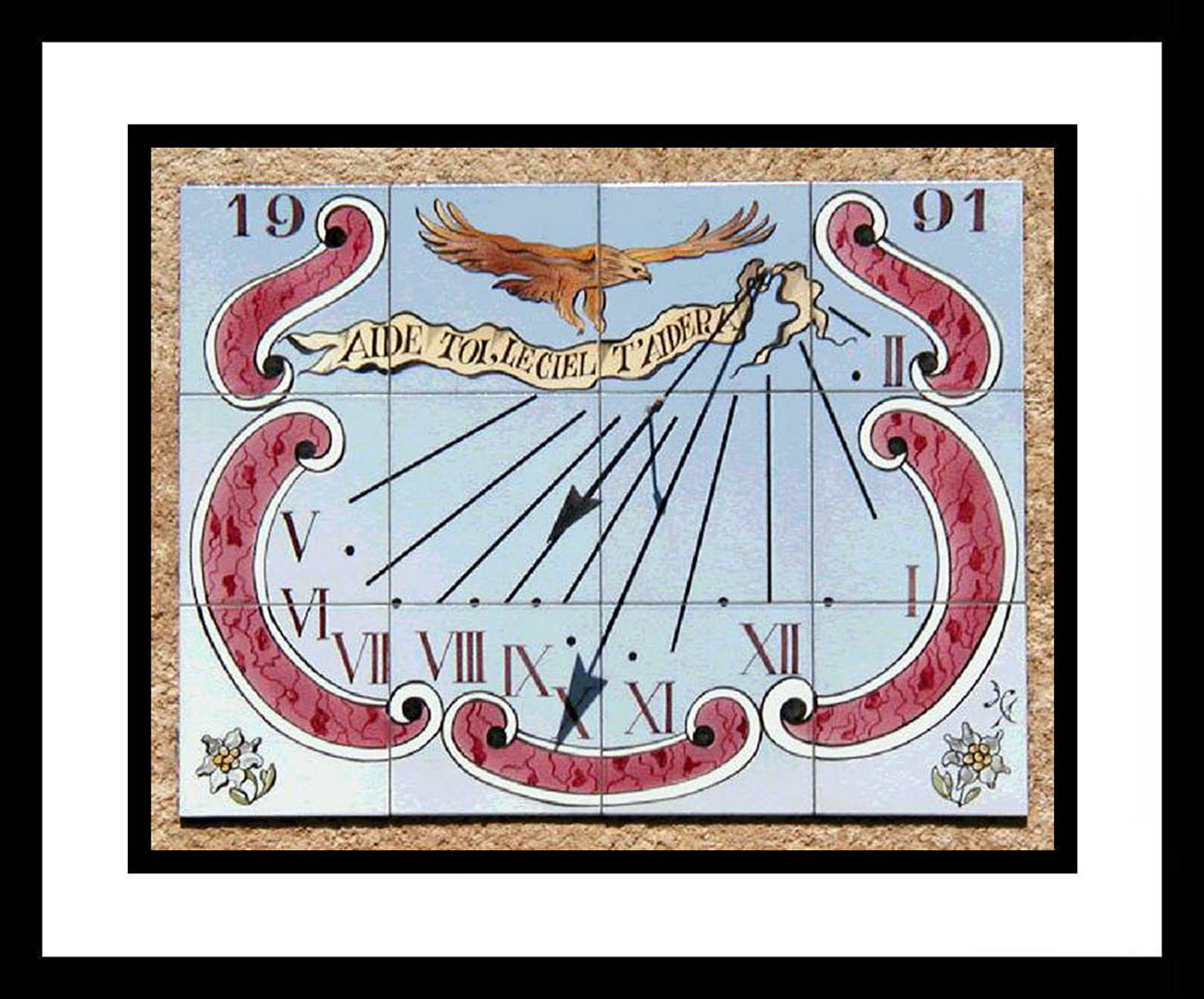 |
 |
| Designer and Ceramic Painter: Joseph Auvray Ceramic Studio: Atelier Acacia workshop at Mont Dauphin, Haute Alpes, France Date: 2005 Original Location: vars ste marie, Guillestrois, Hautes Alpes, France Present Location: at original location Orientation: Vertical. Declines towards the east by unknown amount. Size: unknown Adornment: a flower in center. Mottos: none Inscriptions: “WMSA”, “2005”. Atelier Acacia’s maker’s mark appears in lower right corner. Condition: unknown Comments: Ceramic tiles were made using the silk-screening technique. Acacia Workshop Website: Here Michel Lalos Website: Here Michel Lalos’s Email: Here Photo Descriptions: Photo is courtesy of Michel Lalos and is copied from his website. Photos: a |
Designer and Ceramic Painter: Joseph Auvray Ceramic Studio: Atelier Acacia workshop at Mont Dauphin, Haute Alpes, France Date: 1991 Original Location: Guillestrois, Hautes Alpes, France Present Location: at original location Orientation: Vertical. Declines towards the east by unknown amount. Size: unknown Adornment: a flying eagle Mottos: “Aide Toi, Leciel t'Aidera” (Help You, Leciel will Help you) Inscriptions: the date “1991”. Atelier Acacia’s maker’s mark appears in lower right corner. Condition: unknown Comments: Ceramic tiles were made using the silk-screening technique. Acacia Workshop Website: Here Michel Lalos Website: Here Michel Lalos’s Email: Here Photo Descriptions: Photo is courtesy of Michel Lalos and is copied from his website. Photos: a |
Designer and Ceramic Painter: Joseph Auvray Ceramic Studio: Atelier Acacia workshop at Mont Dauphin, Haute Alpes, France Date: 2005 Original Location: vars ste mari, Guillestrois, Hautes Alpes, France Present Location: at original location Orientation: Vertical. Declines towards the east by unknown amount. Size: unknown Adornment: rams grazing in the country Mottos: “Compagnon Suit Soleil Il T’inclique” (trans: ?) Inscriptions: the date “2005”. Atelier Acacia’s maker’s mark appears in lower right corner. Condition: unknown Comments: Ceramic tiles were made using the silk-screening technique. Acacia Workshop Website: Here Michel Lalos Website: Here Michel Lalos’s Email: Here Photo Descriptions: Photo is courtesy of Michel Lalos and is copied from his website. Photos: a |
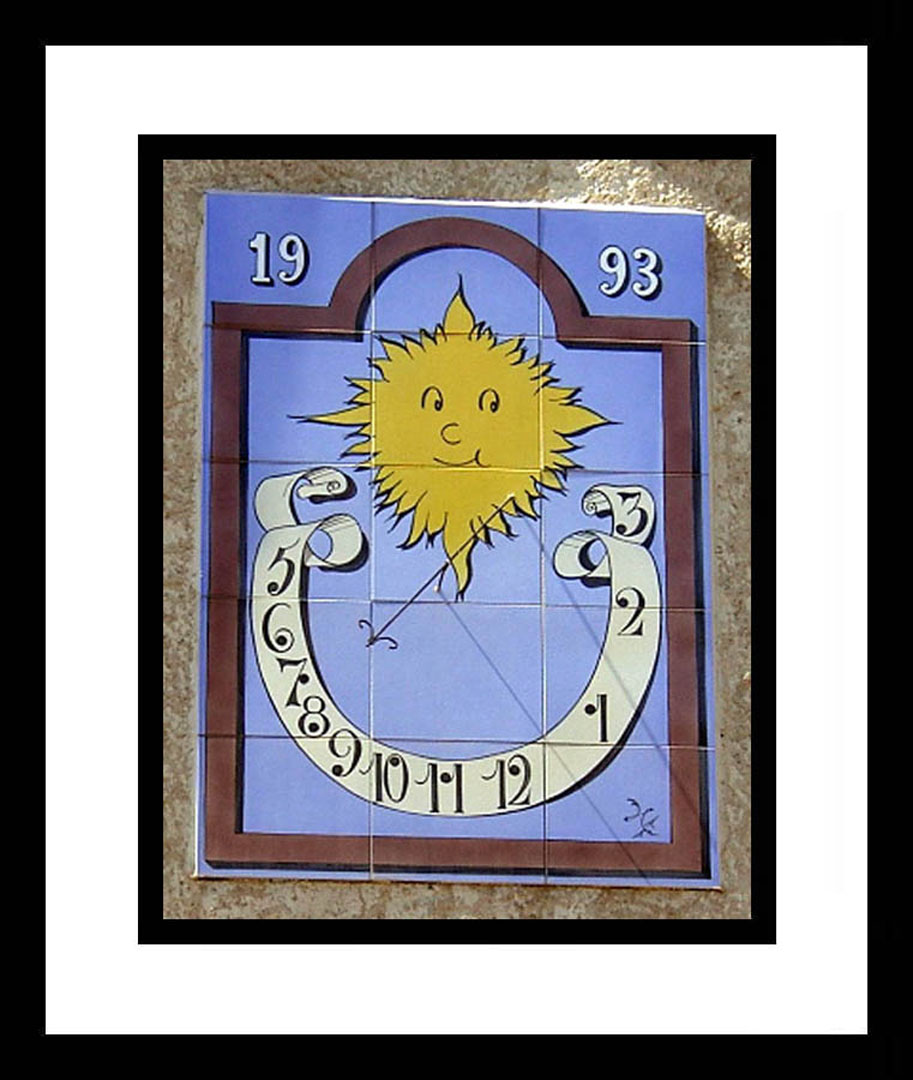 |
 |
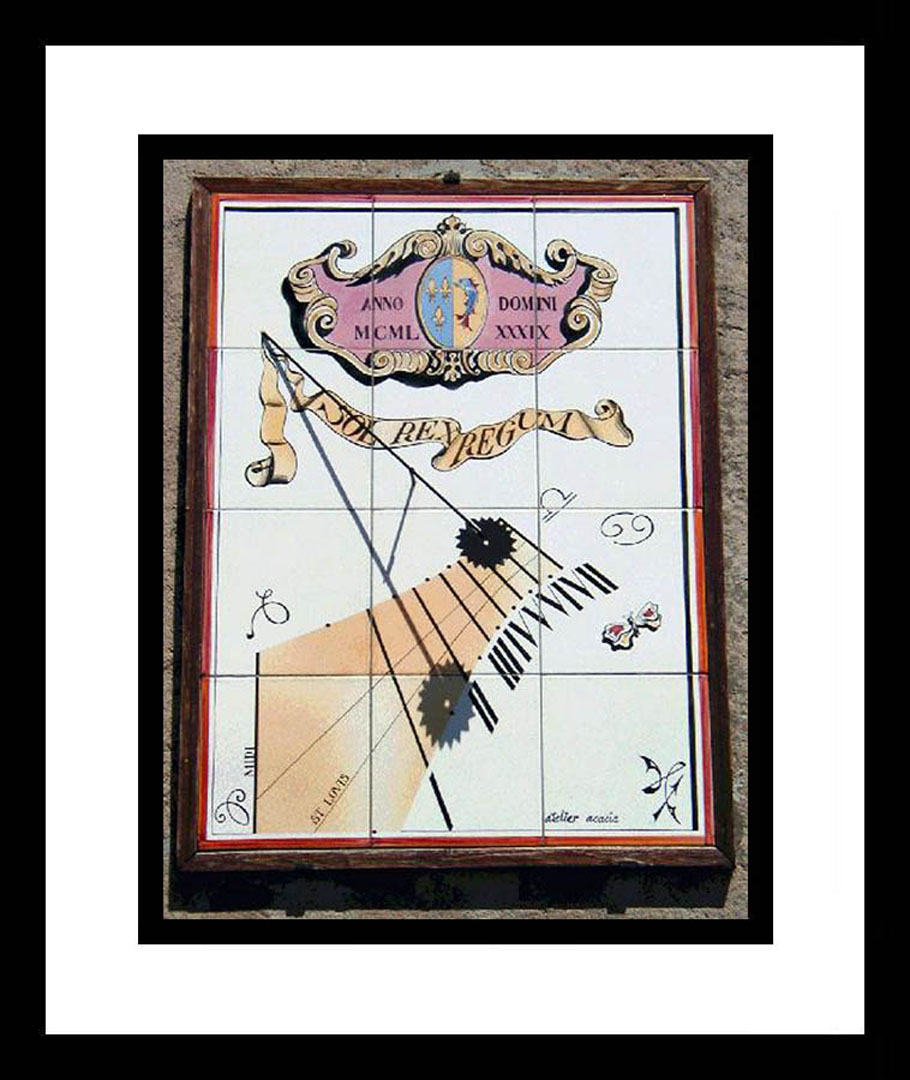 |
| Designer and Ceramic Painter: Joseph Auvray Ceramic Studio: Atelier Acacia workshop at Mont Dauphin, Haute Alpes, France Date: 1993 Original Location: Veynes France Present Location: at original location Orientation: vertical, declines towards east of south Size: unknown Adornment: a cartoonish smiling sun, a ribbon chapter ring on a sky blue background Mottos: none Inscriptions: the Date: “1993”. Atelier Acacia’s maker’s mark appears in lower right corner. Condition: unknown Comments: Ceramic tiles were made using the silk-screening technique. We need help locating information about this dial. We can’t locate the source website. Photo Descriptions: Photo’s source is unknown. It came from an unknown website. Photos: a |
Delineator: Joseph Auvray at Atelier Acacia Ceramic Artist: Joseph Auvray at Atelier Acacia Date: 2008 Original Location: at unknown place in France Present Location: at original location Orientation: Vertical. Declines by towards the northwest by unknown amount. Size: 1 x .75 m. (39 x 29 in) Adornment: Birds, grapes, zodiac symbols, solar eclipse, unknown symbols. Mottos: ‘UTRIQUE FIDELIS CAELO ET DOMILUMINEM SOLIS RE SI SOL MI’ Condition: excellent Comment: none Atelier Acacia Website: Here Photo Descriptions: Photo is from the Atelier Acacia Website. Photo is used with permission from Atelier Acacia. Please do not copy this photo without permission. Photos: a |
Designer and Ceramic Painter: Joseph Auvray Ceramic Studio: Atelier Acacia workshop at Mont Dauphin, Haute Alpes, France Date: 1989 Original Location: Mt. Dauphin, Guillestrois, Hautes Alpes, France Present Location: at original location Orientation: Vertical. Declines towards the west by unknown amount. Size: unknown Adornment: shield, butterfly scrollwork Mottos: “Sol Rex Regum” (trans: ?) Inscriptions: Signed “Atalier Acacia”. Atelier Acacia’s maker’s mark appears in lower right corner. Condition: unknown Comments: Ceramic tiles were made using the silk-screening technique. Acacia Workshop Website: Here Michel Lalos Website: Here Michel Lalos’s Email: Here Photo Descriptions: Photo is courtesy of Michel Lalos and is copied from his website. Photos: a |
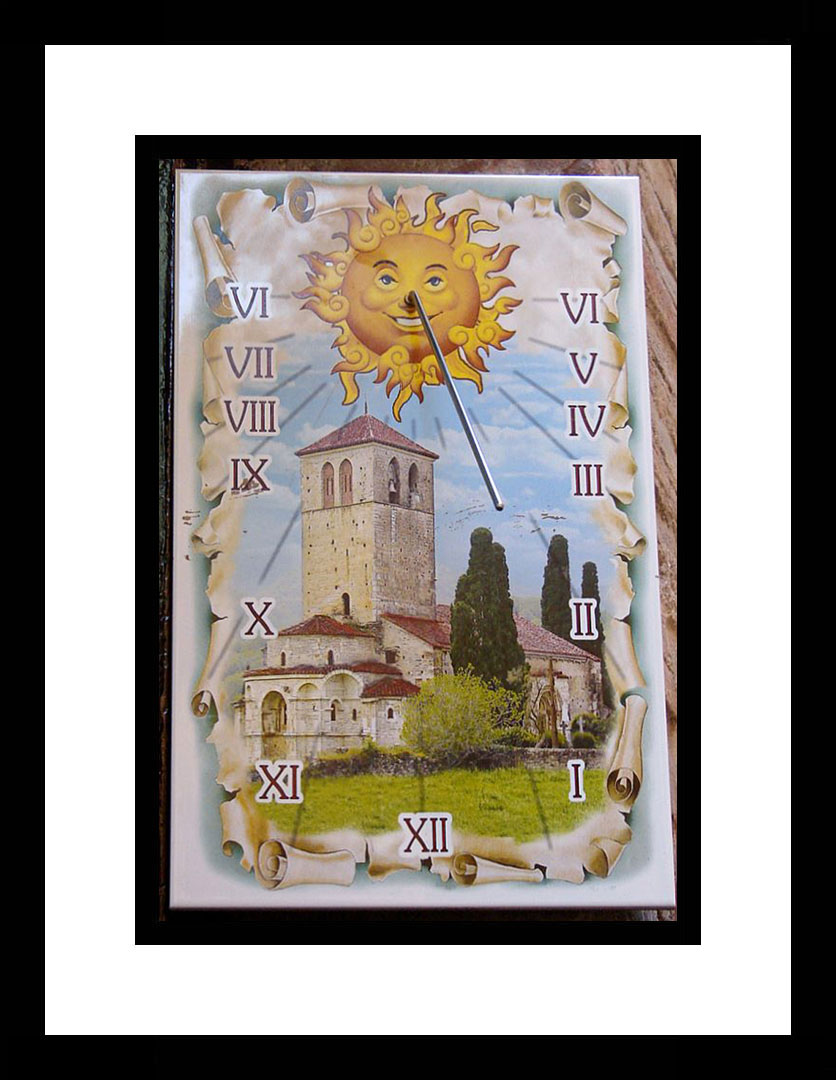 |
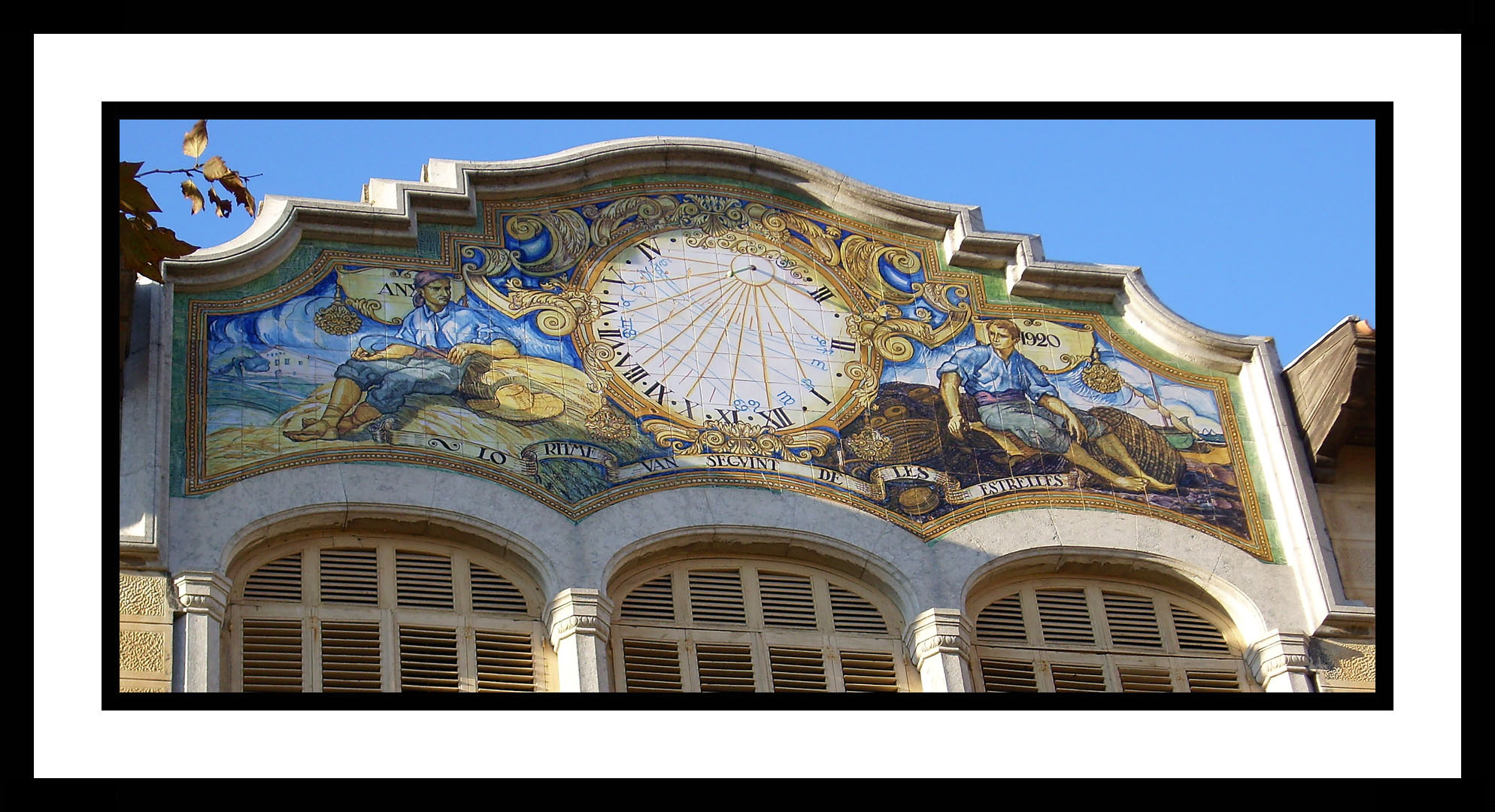 |
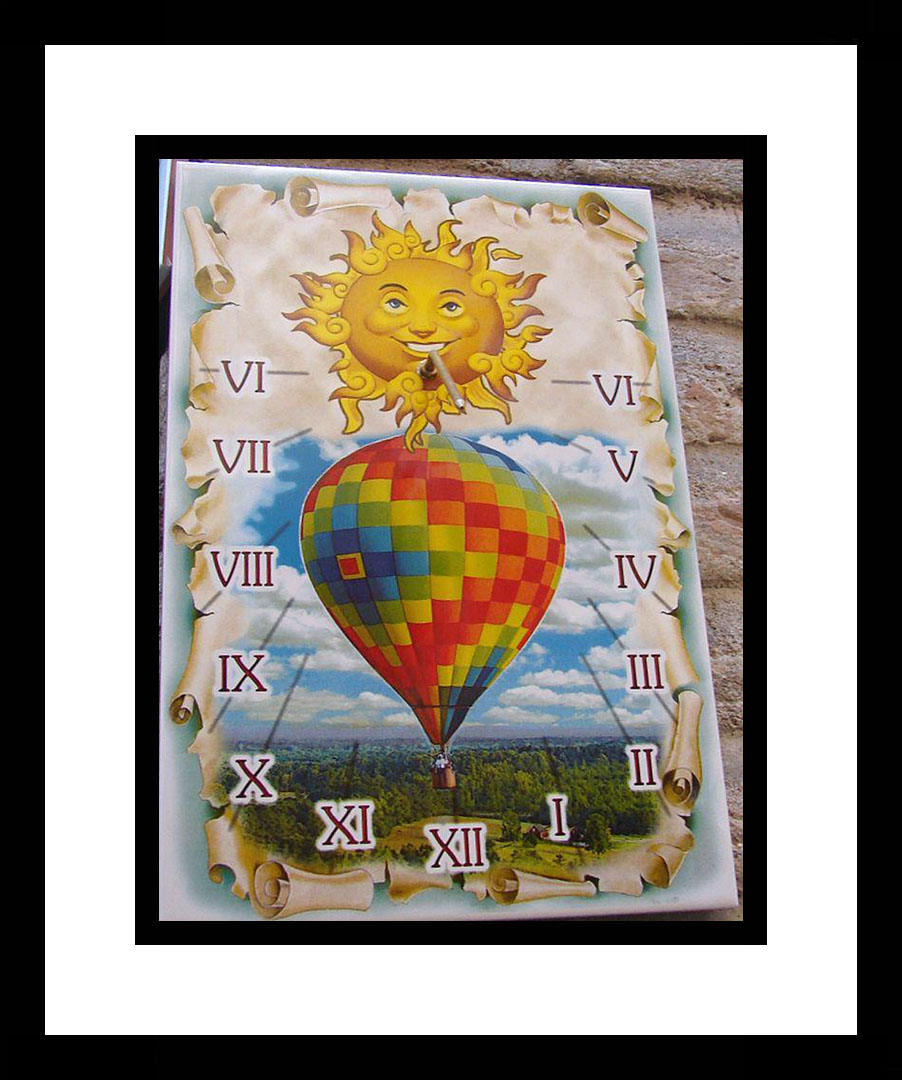 |
| Delineator: unknown Ceramic Artist: unknown. Date: unknown Original Location: unknown place in old part of Toledo Spain Present Location: at original location Orientation: Vertical. Declines south Size: unknown Adornment: smiling sun face and a clock tower Inscriptions: none Mottos: none Condition: excellent Comment: Appears to have been made using a photographic technique. Website: Here Photo Descriptions: Photo is by Márcio Cabral de Moura and was copied with his permission from Flickr website above. All sizes of this photo are available for download under a Creative Commons license. Photos: a |
Delineator: unknown Ceramic Artist: unknown. We’d love to find out the name of this talented artist. Date: 1920 Original Location: Sant Feliu de Guíxols, Girona, Catalonia Spain. Located at number 40 of "Passeig del Mar", this house of a wealthy industrialist Rafael Patxot was built between 1917 and 1920 by architect Albert John i Torner. It is the most important preserved and luxurious manor house of the city. For long time, the house hosted a Patxot-owned astronomical observatory. It now houses the Chamber of Commerce, Industry and Navigation of Sant Feliu de Guixols. Present Location: at original location Orientation: Vertical. Declines towards the southeast by unknown amount. Size: more than 8 meters (26 ft) wide, and different heights Adornment: This is a true work of art with a farmer and a fisherman and beautiful scrollwork designed to fit the shape of the building’s ornate facade. Inscriptions: ‘ANO 1920’ Mottos: ‘LO RITME VAN SEGVINT DE LES ESTRELLES’ Condition: very good, but with a few small chips in a couple of tiles. Comment: I think this is one of the most beautiful ceramic dials in the world. Conxita Bou Vilalta in 2009 told us that it is extremely difficult to photograph because of the growth of trees nearby. Our compliments to Anne Guillamot the photographer. Anne Guillamot’s Flickr Website: Here Montse Poch’s Flickr Website: Here Photo Descriptions: Photo ‘a’ is by Anne Guillamot (Hannah on Flickr) in 2007, and we copied it from the Flickr website. Photo ‘b’ is a cropped version of photo ‘a’. © All rights reserved by Anne Guillamot (Hannah on Flickr). She gave us permission to use it here. Photo ‘c’ is by Montse Poch, © All rights reserved, and is used with permission. Photos: a b c |
Delineator: unknown Ceramic Artist: unknown. Date: unknown Original Location: unknown place in old part of Toledo Spain Present Location: at original location Orientation: Vertical. Declines south Size: unknown Adornment: smiling sun face and a hot air Balloon Inscriptions: none‘ Mottos: none Condition: excellent Comment: Appears to have been made using a photographic technique. Website: Here Photo Descriptions: Photo is by Márcio Cabral de Moura and was copied with his permission from Flickr website above. All sizes of this photo are available for download under a Creative Commons license. Photos: a |
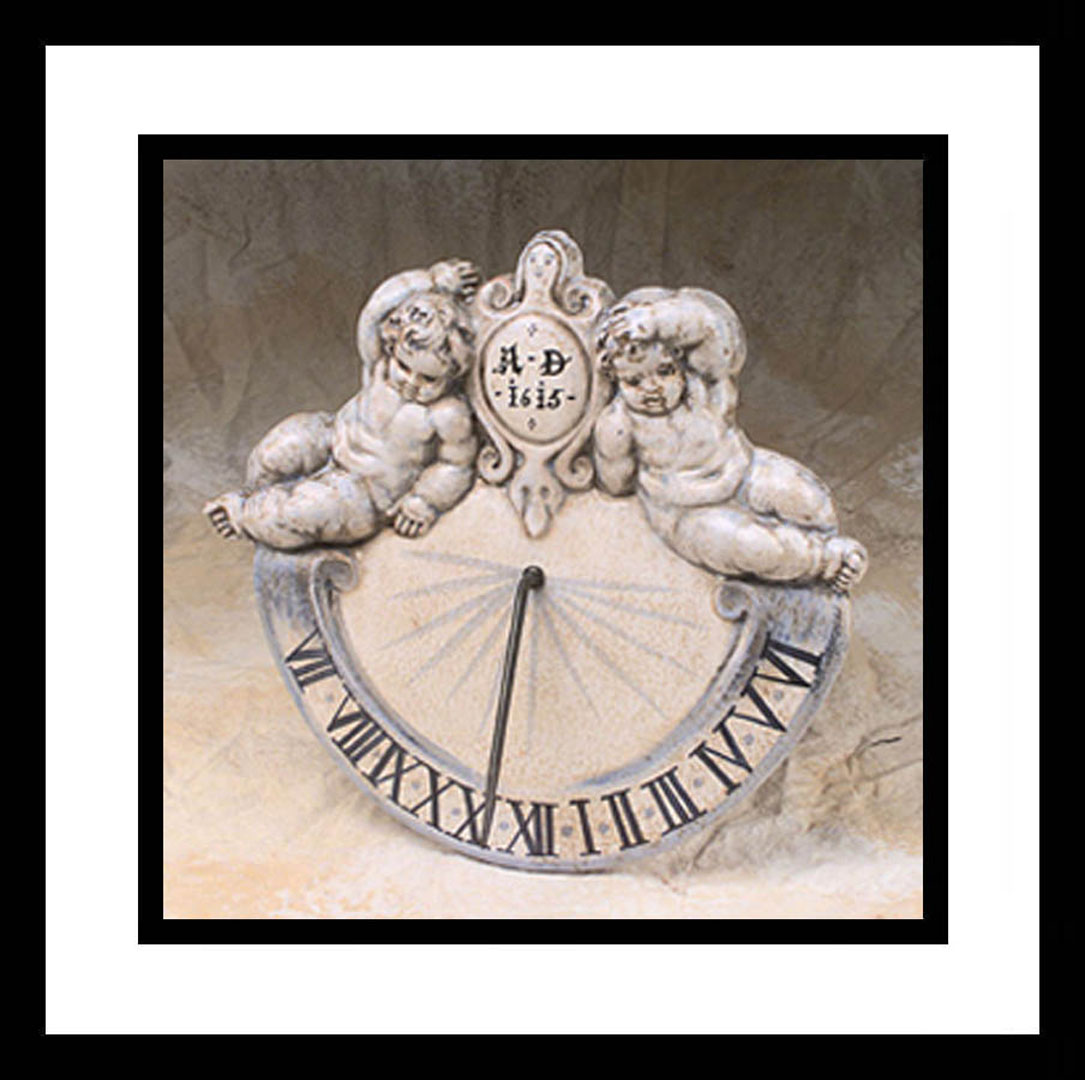 |
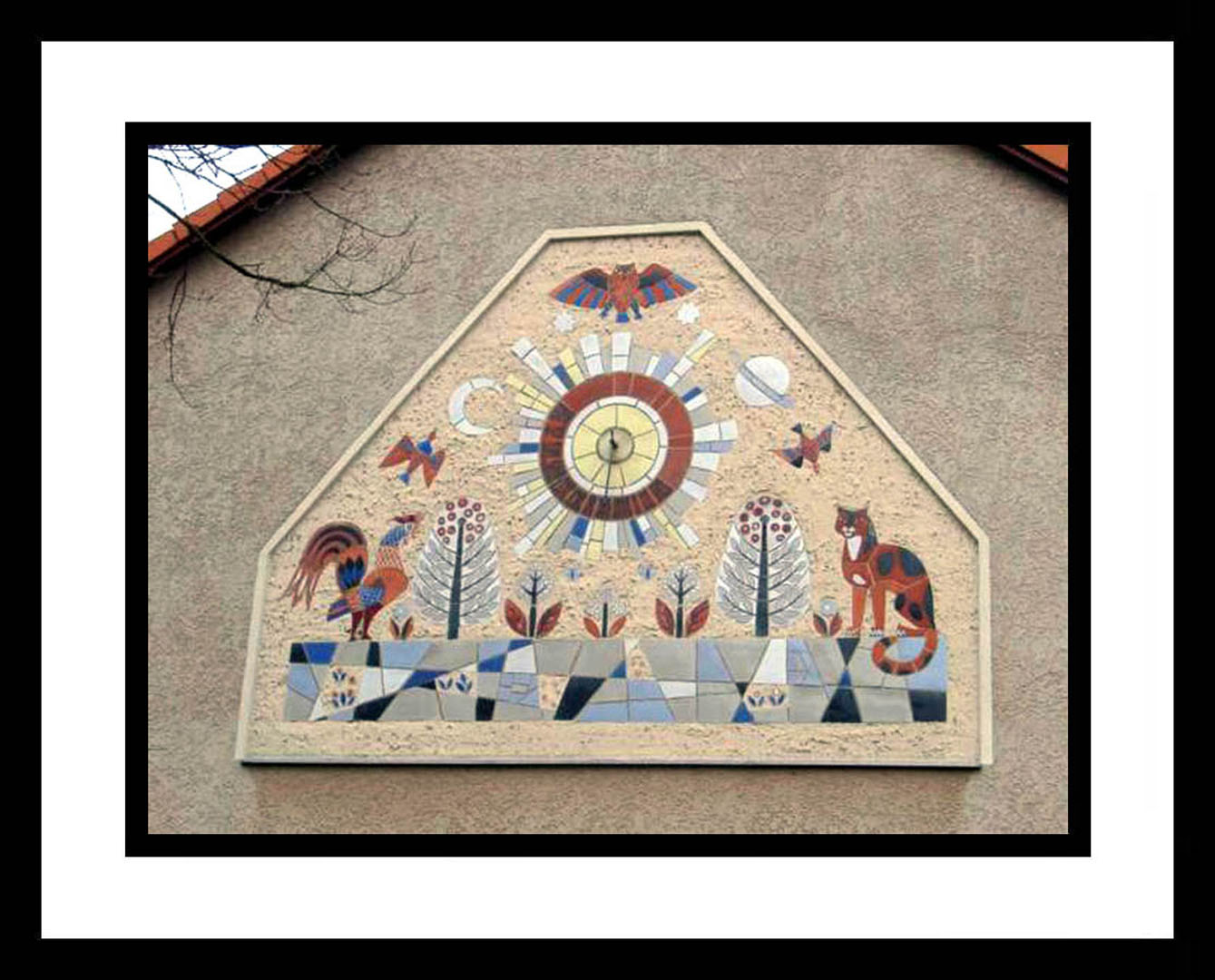 |
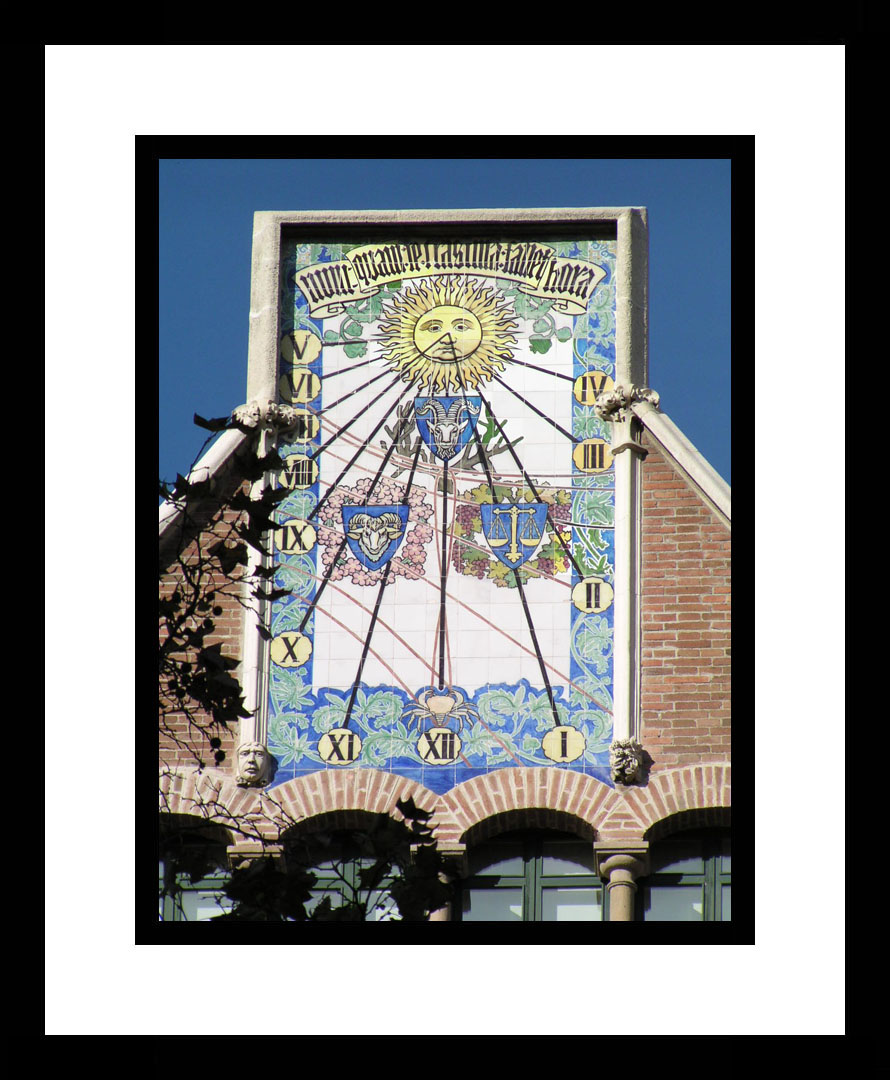 |
| Designer & Maker: unknown, but it is being sold commercially by Bel Tesoro. Date: The original was made in 1615. This one is a copy and is from the 21st century. Original Location: Italy. It's unknown for where this dial was originally designed, but many copies exist in many places. They are made in Italy and are mass-produced from a mold and sold everywhere. Present Location: many locations Orientation: Vertical. Declines south. Size: unknown Adornment: two cherubs sit on top of the dial on either side of a shield. The date, 1615, is on the shield Mottos: none Condition: unknown Comments: These sundials are mass-produced and are only ornamental and will probably not function correctly for their owners. They cost $110. We are looking for a better photograph and more information on this dial. Bel Tesoro Website: Here Photo Descriptions: Photo was copied from Bel Tesoro website. Photos: a |
Delineator: unknown Artist: unknown Date: unknown Original Location: on a wall of a building at Berliner Str. 16 a 15711 Koenigs Wusterhausen OT Funkerberg Germany Present Location: at original location Orientation: vertical. Declination unknown Size: unknown but quite large Adornment: ceramic tiles with a modern design featuring a cat, some birds, the moon, Saturn and trees Mottos: none Inscriptions: none Condition: probably still good Comments: We’d like to have a better high resolution photo taken with the sun shining on the dial face. Home.arcor Website: Here Peter Lindner’s Email: Here Photo Descriptions: Photos are courtesy of Peter Lindner, taken in 2001. Photos: a b c |
Delineator: Puig i Cadafalch, J. Ceramic Artist: unknown Date: 1905 Original Location: Casa Terrades (better known as "Casa de les Punxes"), Barcelona Catalonia Spain Present Location: at original location Orientation: Vertical. Declines south Size: unknown Adornment: Gothic lettering, border of green leaves, three signs of the zodiac, frowning sun Mottos: ‘Nunquam te crastina fallet hora’ Condition: excellent Comment: A very nice dial. Photo ‘a’ Flickr Website: Here Photo ‘b’ Flickr Website: Here Creative Commons Licence Website: Here Photo Descriptions: Photo ‘a’ is by Eddy Van and we copied it from the Flickr website and is used with permission from the author under the terms of the Creative Commons License above. Photo ‘b’ is by Jaume Meneses and used with his permission. Photos: a b |
 |
 |
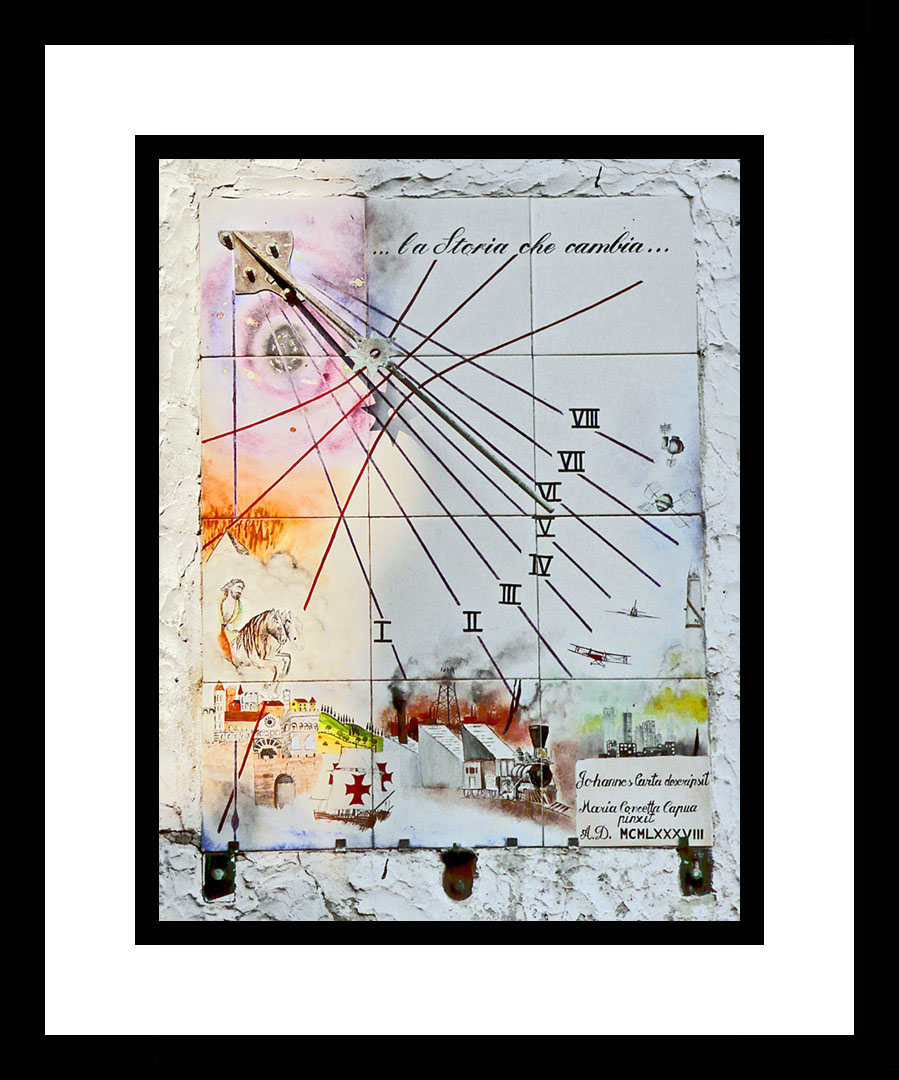 |
| Delineator: Johannes Carta, Vincentias Milazzo Ceramic Artist: Maria Concetta Capua Date: 1982 Original Location: unknown place in Italy Present Location: at original location Orientation: Vertical. Declines far northwest of south by unknown amount Size: unknown Adornment: colorful pastures and farmland Inscriptions: none Mottos: none Condition: excellent Comment: none Website: Here Photo Descriptions: Photo is by Pietro Columba and was copied with his permission from Flickr website above. All sizes of this photo are available for download under a Creative Commons license. Photos: a |
Delineator: Johannes Carta, Vincentias Milazzo Ceramic Artist: Nicla Spinella Capua Date: 1986 Original Location: in Collina Livornese (Collesalvetti) Italy Present Location: at original location Orientation: Vertical. Declines west of south by unknown amount Size: unknown Adornment: pastoral scenes, flowers and birds Inscriptions: L’amore che resta Mottos: none Condition: excellent Comment: none Website: Here Photo Descriptions: Photo is by Pietro Columba and was copied with his permission from Flickr website above. All sizes of this photo are available for download under a Creative Commons license. Photos: a |
Delineator: Johannes Carta Ceramic Artist: Maria Concetta Capua Date: 1988 Original Location: unknown place in (Collesalvetti) Italy Present Location: at original location Orientation: Vertical. Declines east of south by unknown amount Size: unknown Adornment: pastoral scenes Inscriptions: La storia che cambia Mottos: none Condition: excellent Comment: none Website: Here Photo Descriptions: Photo is by Pietro Columba and was copied with his permission from Flickr website above. All sizes of this photo are available for download under a Creative Commons license. Photos: a |
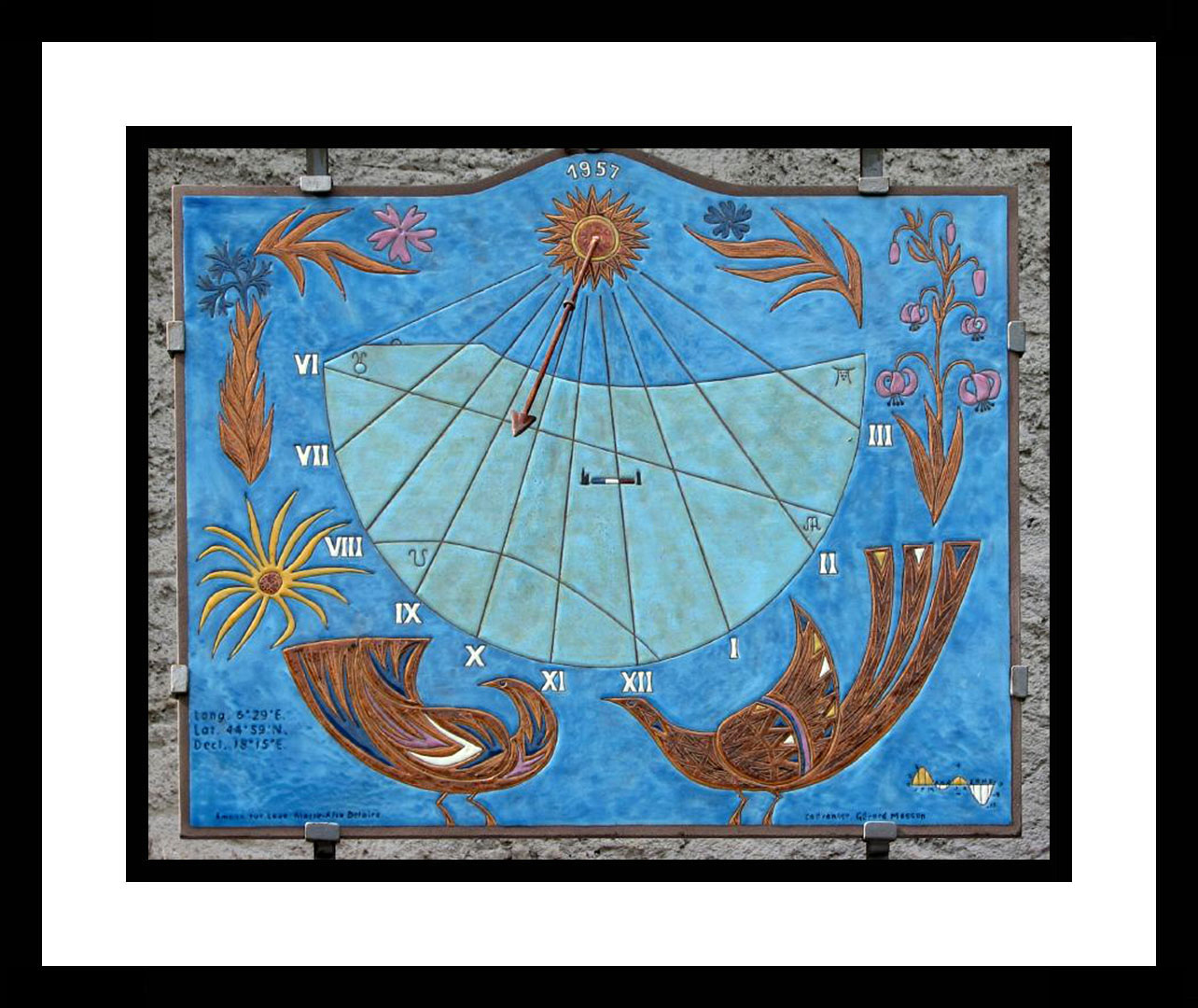 |
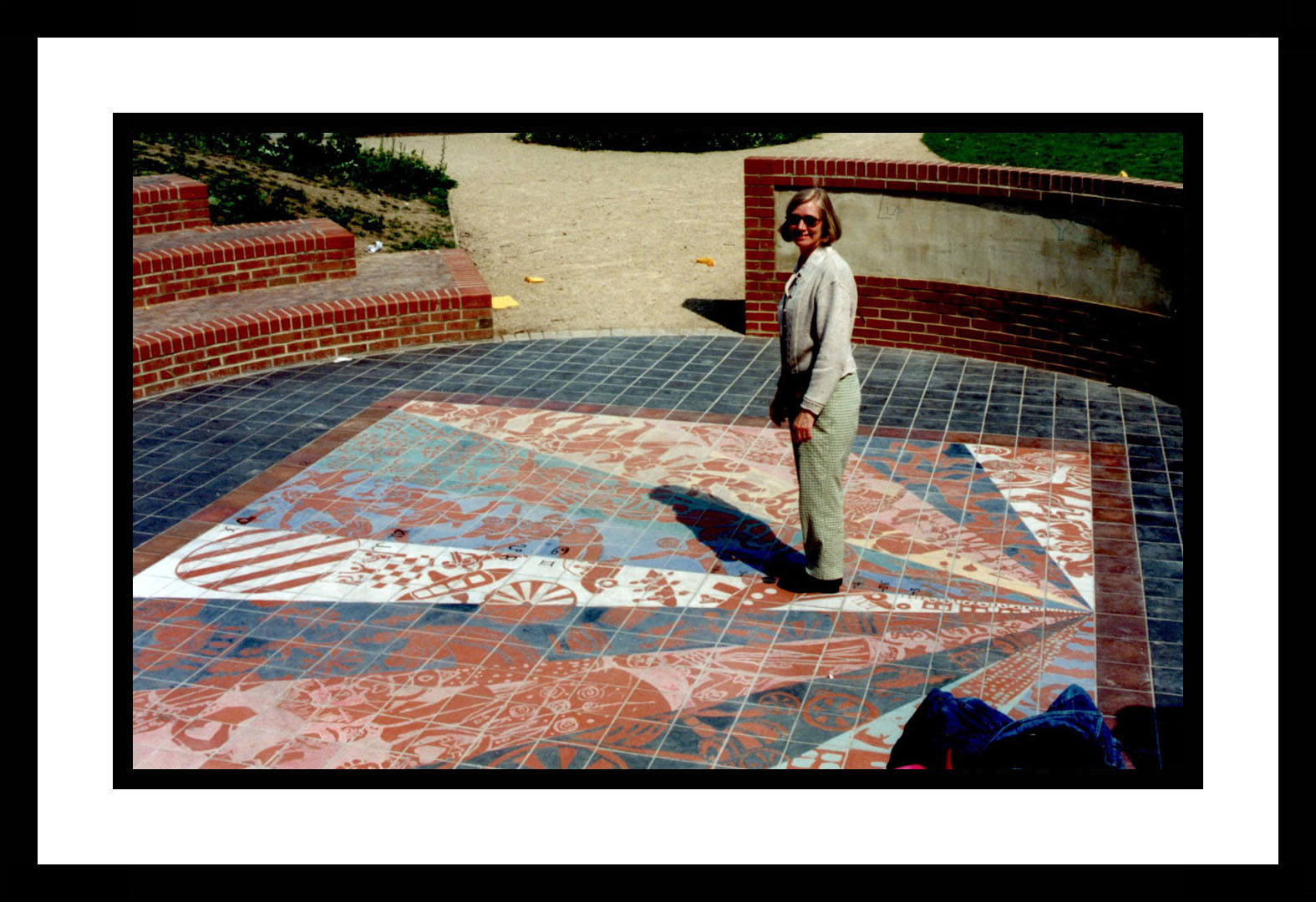 |
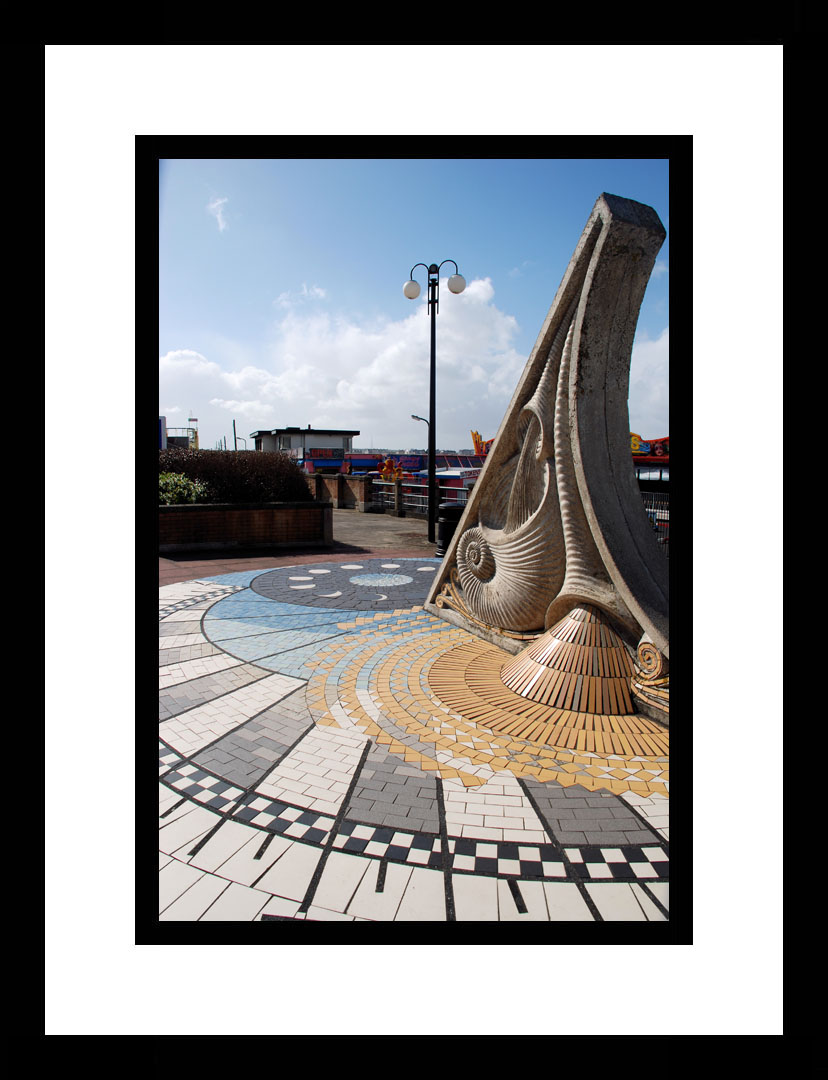 |
| Delineator: unknown Artist: unknown (signed but difficult to read in this photo) Date: 1957 Original Location: Lat: 4° 59’ N. lon: 5° 29’ E. in Casset in the Hautes Alpes (High Alps) in France Present Location: at original location Orientation: vertical, declines east Size: unknown Adornment: modernistic birds, flowers, sun, and the Equation of Time graph, on a sky blue background Inscriptions: “long. 5° 29’ E. Lat. 4° 59’ N. Dec. 18° 15’ E.”, some writing in the lower left corner, and the date “1957” Mottos: none Condition: excellent Comment: none Website: Here Photo Descriptions: Photo is by Olivier07 taken in 2006 and was copied with his permission from Flickr website above. Please do not copy it without his permission. Photos: a |
Delineator: unknown Ceramic Artist: unknown. Date: 2000 Original Location: Lat: 51° 31’, lon: 0” 0’. Inside ampitheater at Aberfeldy Millenium Green in London England Present Location: at original location Orientation: Horizontal Size: 4 meters square Adornment: zodiac signs Inscriptions: none Mottos: none Condition: excellent, but gets covered in silt after rains. Comment: This is a rare a hand painted interactive human shadow ceramic dial. It does not have a traditional gnomon. It works by the observer standing on an ' observer-height' scale so that the top of their head lies at the same point as would a sloping gnomon with its root at the confluence of the hour lines. According to the BSS records: “Horizontal dial where a human standing on a scale of heights allows the tip of the head of the observer to be positioned on the imaginary style of the dial. Shows 7am to 7pm in hours BST (ie Daylight Saving Time). Black height scale on hand painted tiles. Zodiac signs indicate 'date' at noon for a person of 5ft 6ins.” It was designed mainly for use by children. According to Patrick Powers- “There are only two or three in the UK like this as far as I know and this is one.” This is SRN 5056 in the UK Register. Thanks to Patrick Powers for the photos and the information Photo Descriptions: Photo ‘a’ is by John Moirand (2001) and was copied with his permission from The British Sundial Society Register. In this photo, the shadow of the person’s head tells the time- 2pm in this photo. Photo ‘b’ is a photocopy of the BSS records. Please do not copy this photo without permission from Mr. Moirland Photos: a |
Delineator: Professor Adams (now deceased) Artist: Brian Connolly. Brian Connolly was born in Ballymoney, Co. Antrim. He studied sculpture at the University of Ulster, Belfast. He has had a number of exhibitions nationally and internationally with venues including the Project Arts Centre, Dublin, the Collective Gallery, Edinburgh, Banff Centre, Cracow and the City Arts Centre, Dublin. He is currently based near Bushmills. Connolly’s work negotiates universal themes surrounding the human senses, particularly sight and human experience. Throughout his work, the artist has been intrigued by the concept of time. Owner and Funders: Coleraine Borough Council (Owner & Funder), ABSA (Funder), Hutchinson Flooring Contractors (Funder) Date: 1990 Original Location: Kerr Street, Portrush Northern Ireland Present Location: at original location Orientation: horizontal Size: Diameter-5 m (16 ft). Height- 3 m (9.8 ft.) Adornment: moon phases and geometric designs and a wonderfully deeply sculpted gnomon that looks like a big sea shell. Inscriptions: unknown Mottos: none Condition: very good, some graffiti Comment: Owner is Coleraine Borough Council. Funded by Coleraine Borough Council, ACNI, ABSA and Hutchinson Flooring Contractors. Made from ceramic tiles and cast concrete. Through a limited competition in 1990, Connolly was commissioned to make a public sculpture for his hometown of Portrush. This sundial continues the artist’s interest in the importance of time and space. The shell-shape incorporated into this piece had become a recurrent element in Connelly’s work by this stage. Information here is from the Arts Council Northern Ireland website below. ACNI Public Art Handbook: Here Website: Here Website: Here Website: Here Website: Here Website: Here Email: Here Photo Descriptions: Photos ‘a’ is by Pawel Bak and was copied with his permission from first Flickr website above. ACNI photos ‘b’ to ‘h’ are by Harrison Photography and were sent to us by them. We use them with their permission. Please do not copy photos without photographers’ permission. Photos: a b c d e f g h |
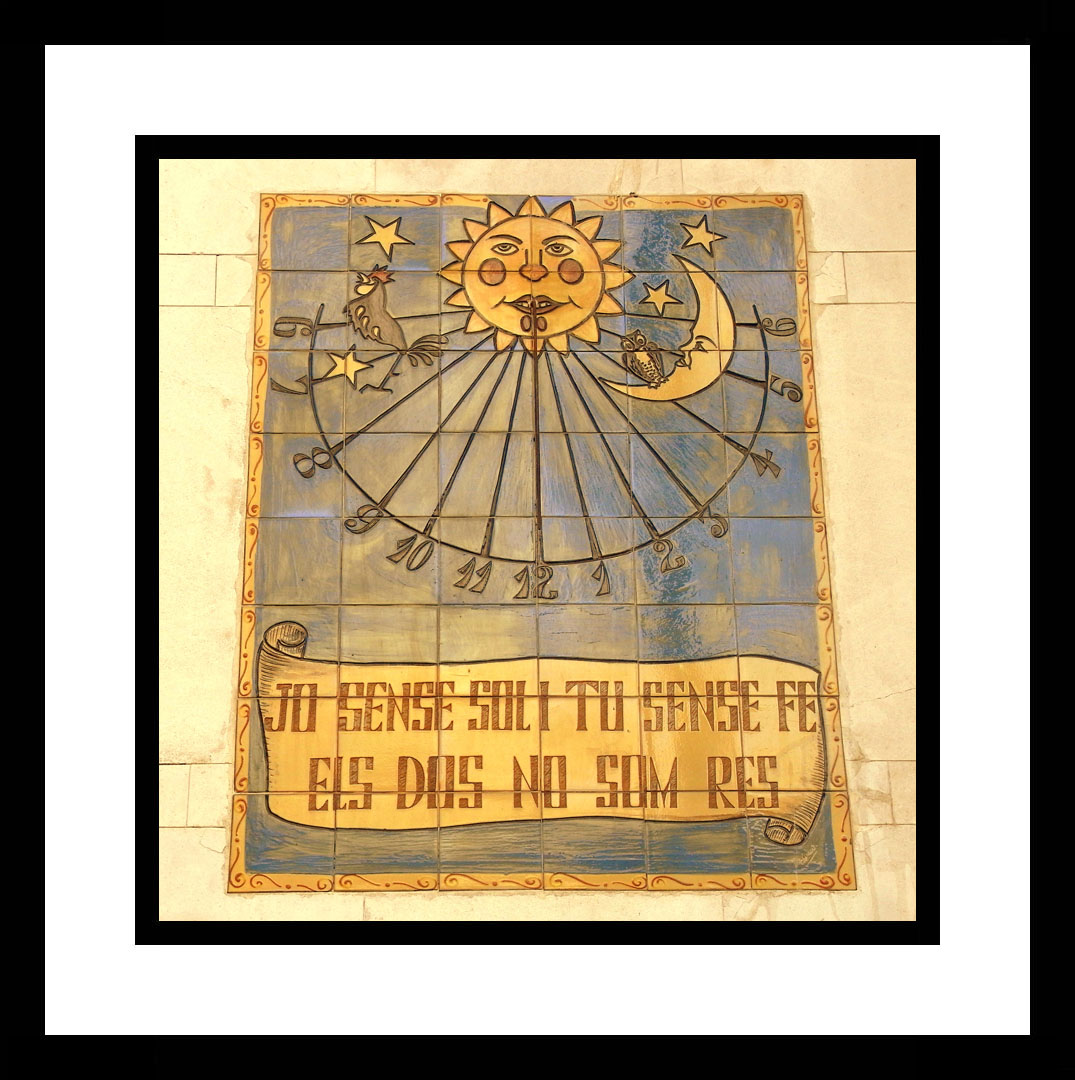 |
 |
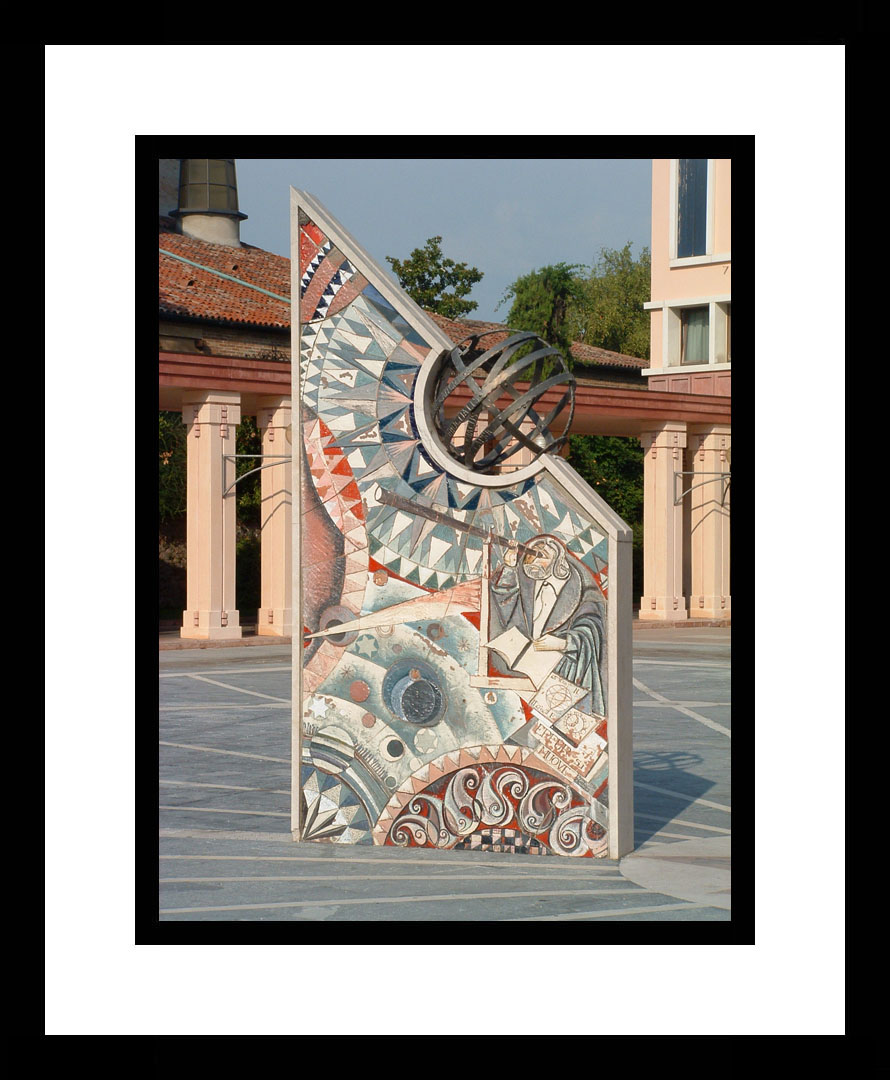 |
| Delineator: unknown Ceramic Artist: unknown Date: unknown Original Location: In Barris - Sant Antoni, on the facade del restaurant "Casa Nostra", on the highway from Parlament to Calàbria. Present Location: at original location Orientation: Inclination-vertical. Declines due south Size: unknown Adornment: smiling sun, rooster, moon, owl Inscriptions: none other than the motto Mottos: present. See photo Condition: very good in 2009 Comments: We’d like more information about this dial. Photo Descriptions: Photo ‘a’ is by Jaume Meneses and is used with his permission. Jaume Meneses’s Flickr Website: Here Photos: a |
Delineator: unknown Ceramic Artist: unknown. Date: unknown Original Location: on Via Cavour in Vimercate (Mi) Italy Present Location: at original location Orientation: Vertical. Declines east of south by unknown amount Size: unknown Adornment: a pastoral scene of a town in Italy Inscriptions: yes Mottos: yes Condition: excellent Comment: none Website: Here Photo Descriptions: Photo is by Marsala Florio and was copied with permission from Flickr website above. Please do not copy this photo without permission. Photos: a |
Delineator: unknown Ceramic Artist: unknown Date: unknown Original Location: at unknown place in Abano Terme (PD) Italy Present Location: at original location Orientation: The main dial is horizontal with a truncated polar axis gnomon. There is an equatorial armillary sphere integrated into the polar axis of the main sundial. Size: unknown Adornment: a handsome modern design of an astronomer and the heavens on the truncated gnomon. Inscriptions: some unknown text appears on the gnomon. Mottos: unknown Condition: excellent Comments: We’d like more information and other photos of this dial. It looks like the gnomon has a narrow gap that would cast a sliver of light on the ground at Solar Noon. Photo Descriptions: Photo ‘a’ is by ma_ri_la © All rights reserved. We have permission to use this photo. ma_ri_la’s Flickr Website: Here Photos: a |
 |
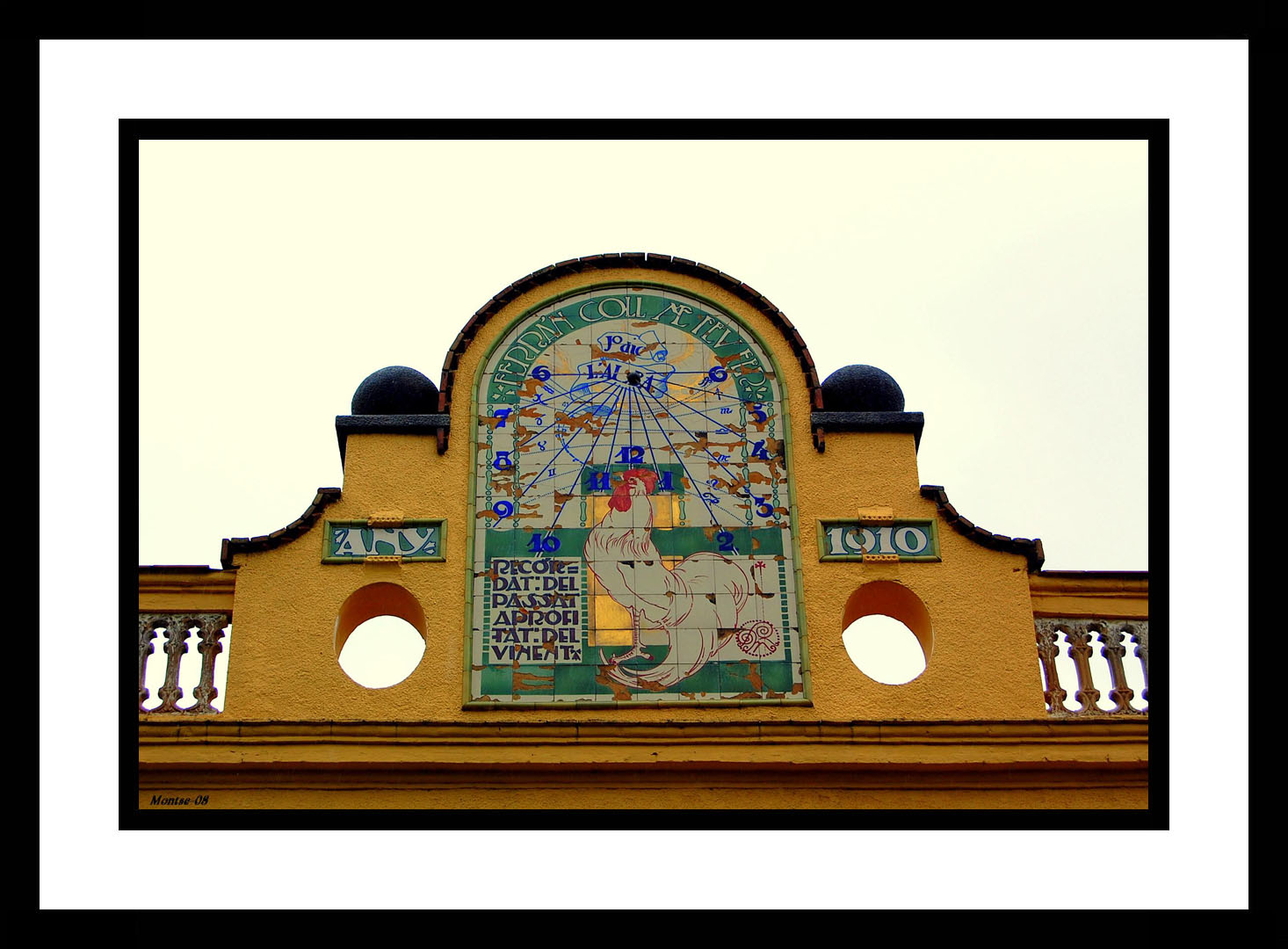 |
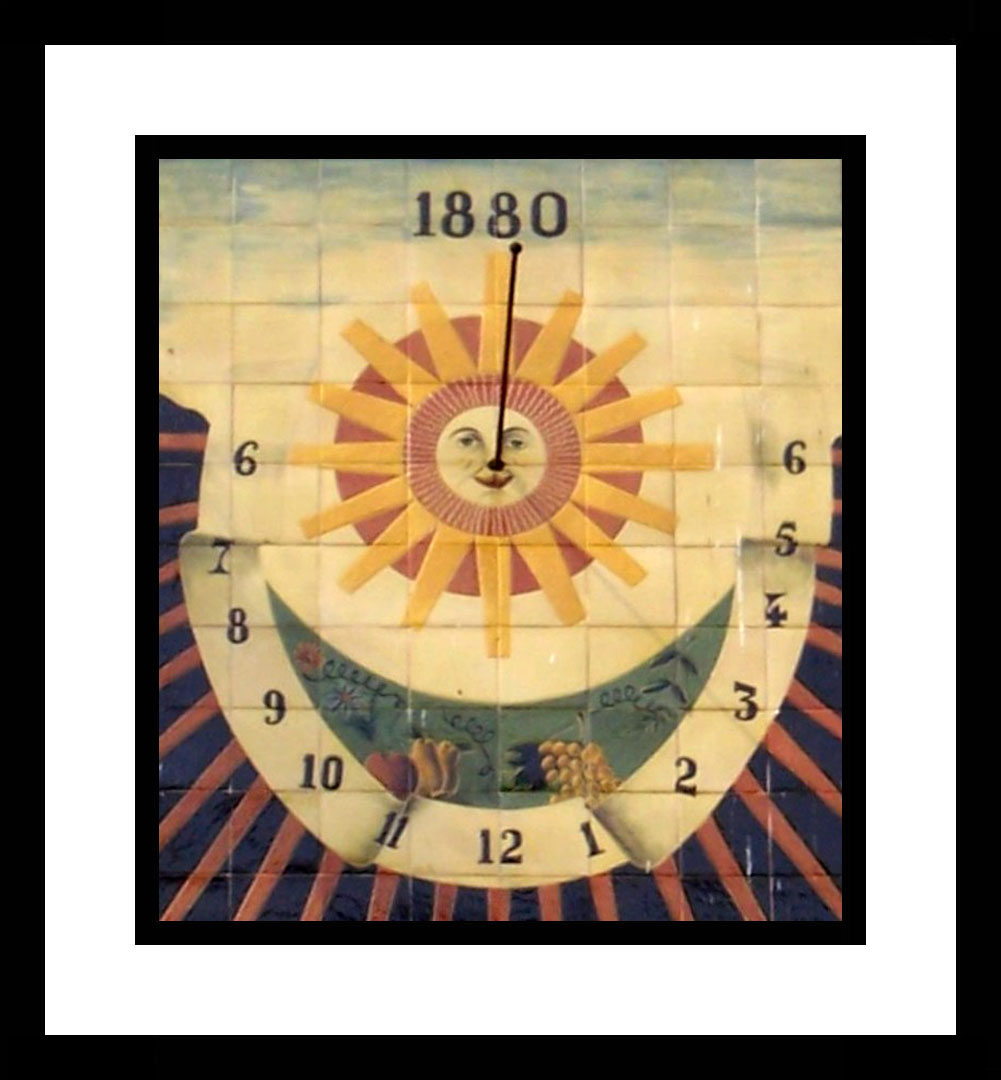 |
| Delineator: unknown Ceramic Artist: unknown Date: unknown Original Location: At Maresme in Vilassar de Dalt Catalunya Spain Present Location: at original location Orientation: Inclination-vertical. Probably declines south Size: unknown Adornment: none Inscriptions: none Mottos: none Condition: Looks like the gnomon is pointing in the wrong direction. Comments: We’d like more information about this dial. Photo Descriptions: Photo ‘a’ is by Jaume Meneses from his Flickr webpage below. Flickr Website: Here Photos: a |
Delineator: unknown Ceramic Artist: Rafael Masó Date: 1910 Original Location: at la casa pairal de Cal Governador, carrer Baix 26, Borrassà Catalonia Spain. Later converted into a restaurant. Present Location: at original location Orientation: vertical. Declines due south Size: unknown Adornment: a big rooster Inscriptions: "Jo dic l'Alba" i "Ferran Coll me feu fer" Mottos: present Condition: 2009 photo shows that many of the ceramic tiles are damaged. Comments: We’d like more information and more photos of this dial Photo Descriptions: Photo ‘a’ is by Montse Poch and is used with his permission. Montse Poch’s Flickr Website: Here Gnomonica Catalonia Website: Here Photos: a |
Delineator: unknown Ceramic Artist: unknown Date: unknown Original Location: at unknown building in Besalù Catalonia Spain Present Location: at original location Orientation: inclination- vertical, declines due south Size: unknown Adornment: sun face and fruit Inscriptions: “1880” which probably is an important date associated with the building. Mottos: none Condition: good in 2009 Comments: none Photo Descriptions: Photos are by Marina Panattoni, © All rights reserved, and are used with her permission. Photo ‘a’ Flickr Website: Here Photo ‘b’ Flickr Website: Here Photos: a b |
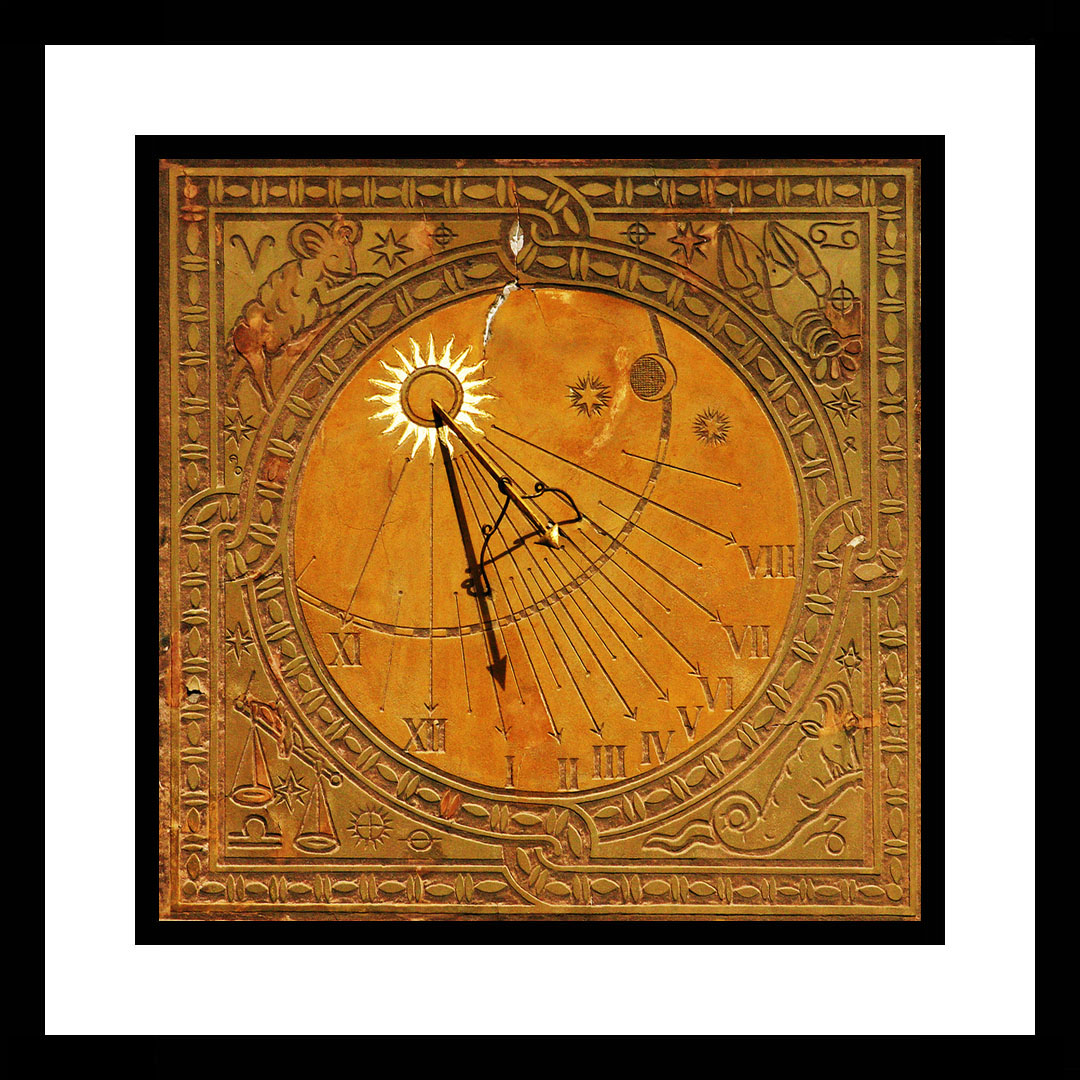 |
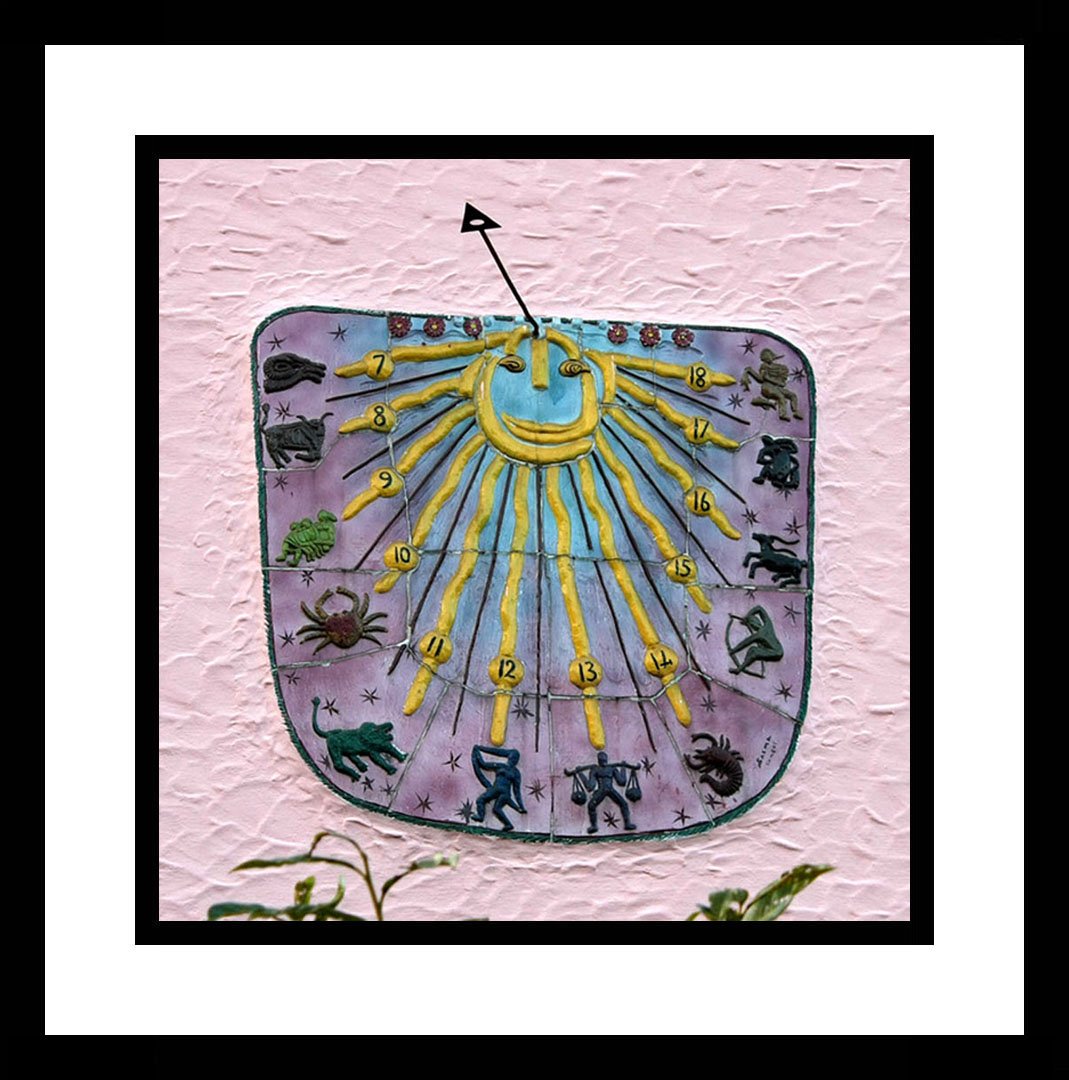 |
 |
| Delineator: unknown Maker: unknown Date: unknown, but probably very old Original Location: On unknown building in Warsaw Poland Present Location: at original location Orientation: Inclination-vertical. Declines west of south by unknown amount Size: unknown Adornment: a balance, a ram, a sheep, a crayfish, stars, moon, and sun Inscriptions: none Mottos: none Condition: pretty good considering that it is probably very old. Has a little chipping. Comments: This dial appears to be made from dyed plaster or some sort of ceramic. We’d like more information about this unusual dial. Photo Descriptions: Photo ‘a’ by frank Flickr Website: Here Photos: a |
Delineator: unknown Ceramic Artist: unknown. It is signed in the lower right, but I can’t read it in this photo. Date: unknown Original Location: unknown building in Verbano-Cusio-Ossola, Piedmont Italy Present Location: probably at original location Orientation: Inclination-vertical, Declination unknown Size: unknown Adornment: has sculpted figures of the 12 zodiacal signs. And the hourlines twist into an image of a sunface. Inscriptions: It is signed in the lower right, but I can’t read it in this photo. Mottos: none Condition: good in 2010, but it appears that the gnomon has been bent upwards. Comments: an unusually rustic and primatively styled ceramic design- but it’s pretty in an unusual way! Unfortunately, it appears that the gnomon has been bent upwards. It should be pointing down and aligned with the polar axis. As it is, it can not tell time correctly I think. We’d like more information about this dial. Photo Descriptions: Photo ‘b’ is by Wozz. Photo ‘a’ is a cropped copy of photo ‘b’. Flickr Website: Here Photos: a b |
Delineator: unknown Ceramic Artist: unknown Date: unknown Original Location: At Sanda (SV) Italy Present Location: at original location Orientation: Inclination-vertical, declines slightly west of south Size: unknown Adornment: Decorative ribbon with motto painted around ceramic dial Inscriptions: “Dono del Comitato, Manifestazionii Sanda” Mottos: TEMPUS MAGISTER OPTIMUS Condition: excellent in 2010 Comments: This is a ceramic dial. We’d like more information about this dial. Photo Descriptions: Photo ‘a’ by antonella.mannini&gianni.borghi. All Rights Reserved Flickr Website: Here Photos: a |
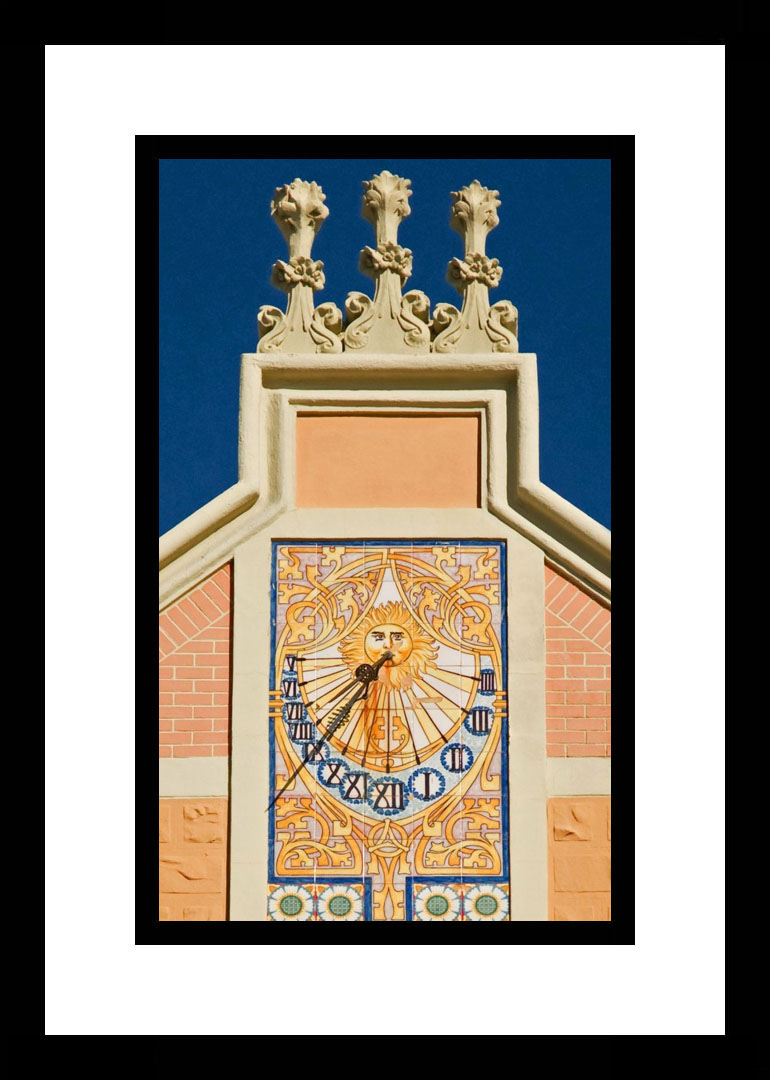 |
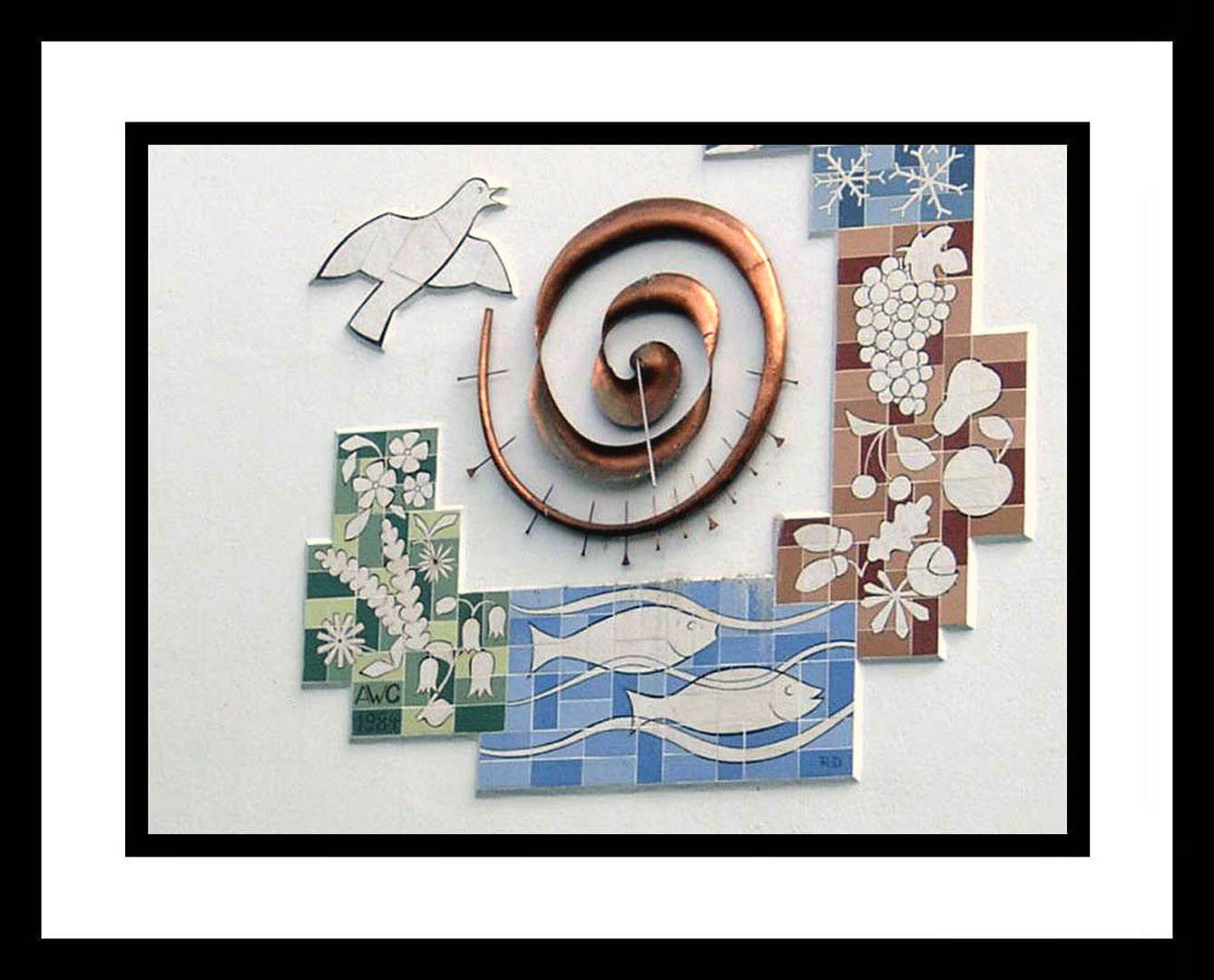 |
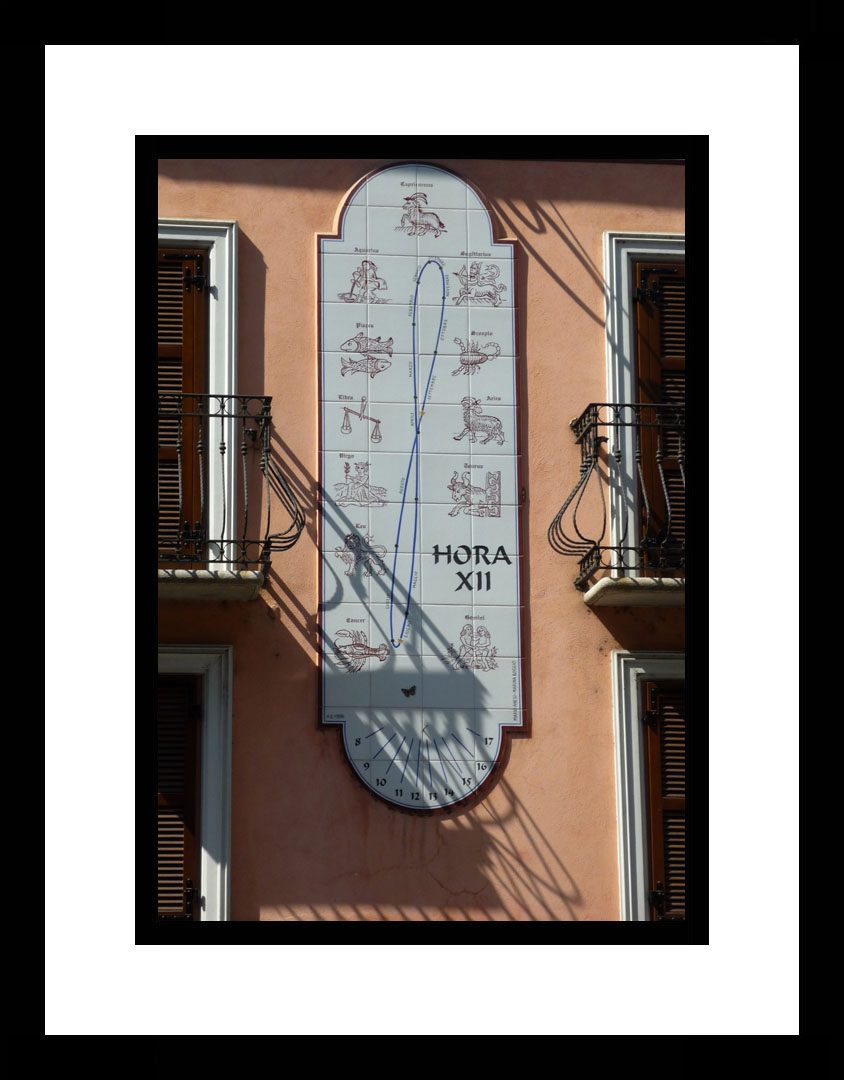 |
| Delineator: unknown Ceramic Artist: unknown Date: unknown. Probably the beginning of the 20th Century. Original Location: at Hotel La Niña. Pg. de la Ribera, 63-69 in Sitges (a small city about 35 kilometres southwest of Barcelona) in Catalonia, Spain. Present Location: at original location Orientation: Inclination-vertical. Declines east of south by unknown amount Size: unknown Adornment: Catalan "Modernist" style with a sunface and beautiful scrollwork and gnomon Inscriptions: none Mottos: none Condition: good, but one tile is chipped Comments: We’d like more information about this dial. Thanks to Conxita Bou Vilalta for the info we have. Flickr Website: Here Photo Descriptions: Photo ‘a’ is by hogsvilleBrit. Photos ‘b’ and ’c’ are courtesy of Conxita Bou Vilalta. Conxitas’s Email: Here Photos: a b c |
Delineator: unknown Artist: unknown Date: unknown Original Location: high on a wall of a building at Wolyniezstr 7, Meissen (Saxony) Germany Present Location: at original location Orientation: Vertical. Declines slightly to the east of south. Size: unknown but quite large Adornment: plants, fish, snowflakes and a dove are on large ceramic pieces surrounding the dial face which is made of a bent copper spiral with metal stakes marking the hours. Mottos: none Inscriptions: the letters: “AWC” and “RD” Condition: probably still good Comments: We’d like to have a better high resolution photo taken with the sun shining on the dial face. Home.arcor Website: Here Peter Lindner’s Email: Here Photo Descriptions: Photos are courtesy of Peter Lindner, taken in August 2001. Photos: a b c |
Makers: Mario Anesi and Marina Baggio Date: 1998 Original Location: At Casa Liberty, next to the church tower of St. James and Philip, 1400 in the old town of Lanzo in Turin Italy Present Location: at original location Orientation: Inclination-vertical. Declination unknown, but faces nearly south. Size: unknown Adornment: Has the 12 signs of the Zodiac and the indication of equinoctial noon. Top gnomon is a star. A butterfly. Inscriptions: none Mottos: none Condition: excellent in 2010 Comments: Made of ceramic tiles in Art Nouveau style. The perpendicular rod gnomon below indicates local times. Has a noon analemma above. We’d like more information about this dial. Photo Descriptions: Photos by arny_bol Flickr Website: Here Flickr Website: Here Photos: a b |
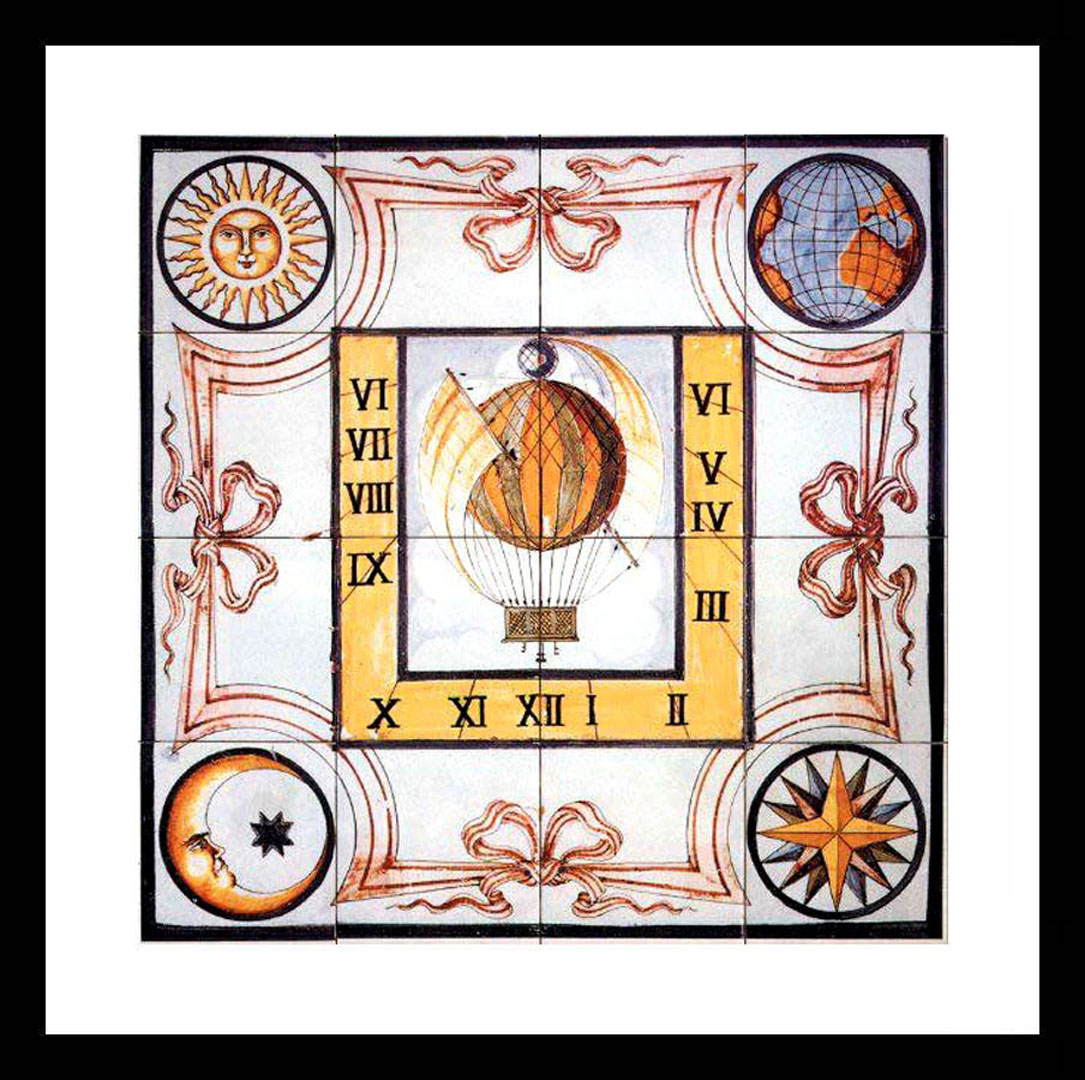 |
||
| Delineator: unknown Ceramic Artisan: Probably an employee at the Tile Terrific company Date: unknown, probably early 2000s Original Location: unknown place in USA Present Location: unknown Orientation: Vertical. Since the hour lines are not symmetric, the dial declines a little from south Size: unknown but fairly large Adornment: This handsome hand-painted dial has corner tiles with a sunface, a world globe, a moonface, and a compass rose. Decorative painted pink ribbons connect them. Square chapter ring has Roman numerals. An old hydrogen balloon with sails decorates the center of the dial. No signature is visible Mottos: unknown Condition: unknown Comments: The photo was probably taken before the dial was installed because the gnomon is missing. It seems the company Tile Terrific no longer exists since their phone number and email address are not in service anymore. I cannot locate them. We need more photos and information about this dial Tile Terrific Website: Here Photo Descriptions: Photos are copied in 2005 from Tile Terrific website (still active in Oct 2005) Photos: a |
This page has received visits, since 20 June 2005
|
 Fight Spam! Click Here!
|