For optimal viewing, set your browser's "View" to Full Screen. Click on any of the images for a larger view. Your browser will automatically downsize the large picture to fit your computer monitor screen. We resized all photos to the standard high definition television height of 1080 pixels or higher so that they will completely fill the height of a 1080 HDTV screen because we think many people will soon connect their computers to new widescreen HDTVs, and some people will want this large picture size. Unless otherwise noted, please ask permission from the photographers if you want to use their photos.
The term "stained glass" commonly refers to any colored flat glass or any object made of this glass joined by metal strips. The term originally applied to colored or clear flat glass cut to fit an artist's design, on which details were painted with a brush using glass enamel. The glass pieces were then heated in a kiln or oven to bond and fuse the enamel to the glass surface. This firing made the painted detail as durable and permanent as the glass itself. Most stained glass sundial and religious windows from medieval times until this century were executed in this manner. In our website, we use a broader definition that includes glass colored by any means including inks and non-fired enamels. Etched glass is not stained glass. But we included a separate etched glass section in the Image Archive since they are so similar in function and use. Some sundials have both stained and etched glass pieces in them, making them difficult to classify, so I follow this rule: If most of the sundial is of stained glass, then I put it in the stained glass section, otherwise I classify it as etched glass.
 |
 |
 |
| Maker: by London glazier William Price the elder (c1644-1710) Date: 1702 Original Location: Gray's Inn Hall, London, England Present Location: removed and stored for safekeeping during World War II. Now lost, mislaid or stolen. Orientation: Vertical. Declines south. Size: unknown (large) Adornment: undetermined Mottos: "Temporas Mutantur ... Et Nos Mutamur In Illis", approximate translation: (The seasons Change ... And We Change With Them), Initials: “TTC” (for 1702 treasurer, Thomas Carter) Condition: unknown. It was cracked then re-leaded. Comments: We are looking for more information and better photos of this dial. Article by Christopher Daniel (5 MB): (Apr 1988) Stained Glass Sundials in England and Wales. "Clocks" 10, 30-37 Article by Geoffrey Lane (6 MB): (2006) Glass Sundial Makers of 17th Century London. "The British Sundial Society Bulletin" Vol. 18(i), March 2006. 40-47 Photo Descriptions: Photos are courtesy of and © by Geoffrey Lane. Photo ‘a’ is the only known photo from "Clocks" magazine. Photo ‘b’ is a Photoshop colorized rendering of how dial might have looked based on the original photo and Gyles' favorite colors. Photos: a b |
Maker: Henry Gyles (1645-1709) Date: 1702 Original Location: Window above Tong Hall's main door, Bradford Yorkshire, England. (near Leeds). Present Location: At original location, but unfortunately, it's now obscured by a new entrance lobby. Orientation: Vertical. Declines slightly west of south Size: 91.4 x 152.4 cm (3 x 5 ft) Adornment: The four Seasons Mottos: undetermined Condition: Fair. Cracked and restored. According to C. Daniel, "it is probably the finest known complete (English) stained glass dial still in place and relatively undamaged." It is unknown if Mr. Daniel was saying that the dial is not cracked. It is also unknown if the dial is currently cracked or if the cracked glass has been replaced. Comments: We need for someone to investigate this historical dial to find out if it is cracked or not and to get new photos. We need interior and exterior high quality new photos. Please help! Article by Christopher Daniel: (2004) “Sundials” a Shire Book Article by Christopher Daniel (5 MB): (Apr 1988) Stained Glass Sundials in England and Wales. "Clocks" 10, 30-37 Tong Bradford Website: Here Tong Family Website: Here Photo Descriptions: Photo ‘a’ is from unknown source and shows exterior view of dial above Tong Hall's main entrance. Photos ‘b’ and ‘c’ show interior view. Photo ‘b’ shows lead came from a restoration to fix cracks. Shadow says 10:50. Photo ‘b’ is courtesy of Christopher Daniel © C StJ H D. Black and while photo ‘c’ shows the dial without cracks. It is unknown which photo is older. But it is my guess that photo ‘c’ is older. Photos: a b c |
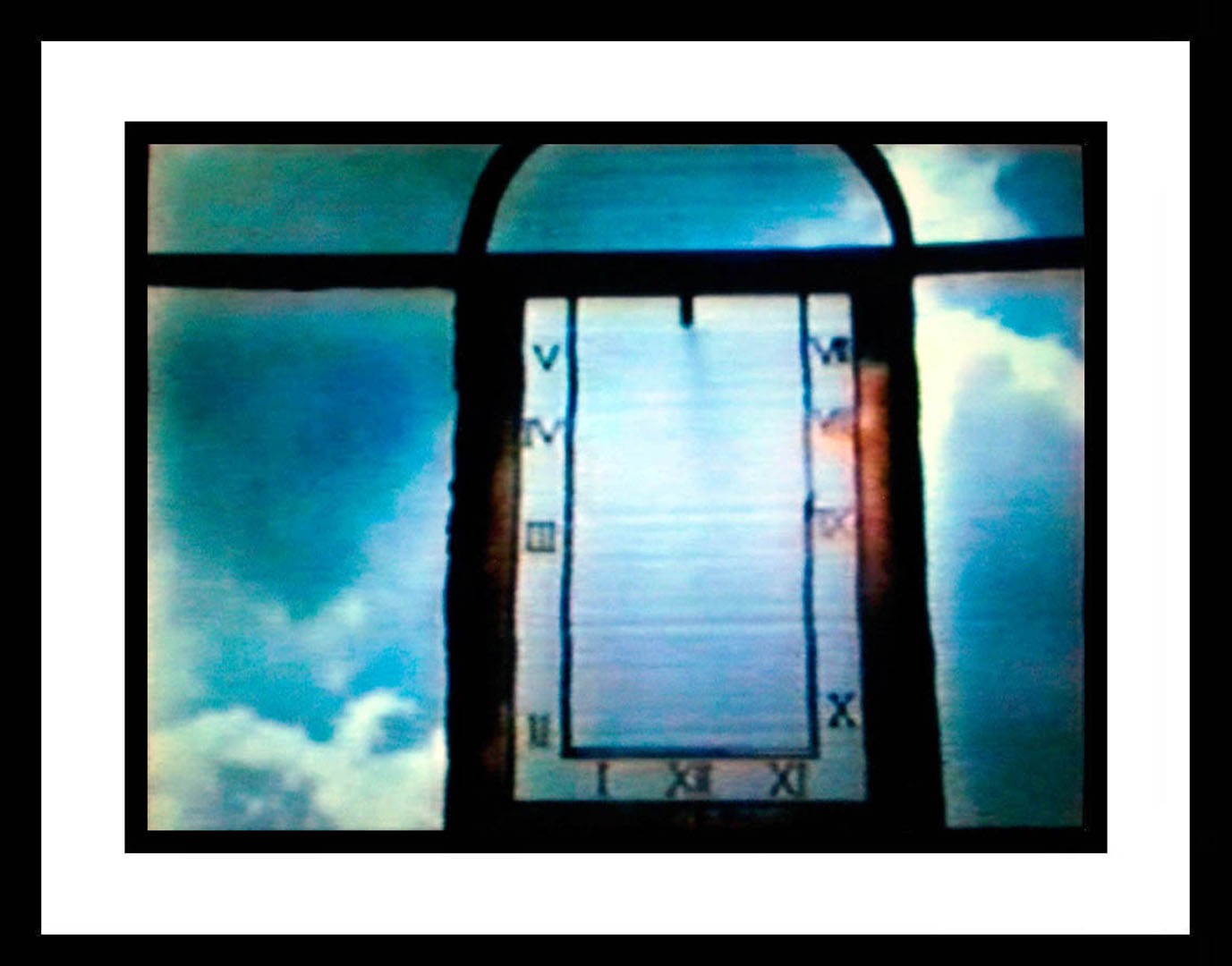
Maker: unknown Date: 1700's or 1800's Original Location: Lat: 52° 02' N. Lon: 02° 25' W. Church of St. Michael and All Angels, Ledbury, Herefordshire, England Present Location: at original location Orientation: Vertical. Declines south. Size: unknown Adornment: flower Mottos: none Condition: good. Restored in 1988. Rumors say that the dial was reinstalled up-side-down, but when last seen by Chris Daniel, it was sitting up-side-down on a window sill. Comments: We need current updated information and new high resolution photos of this beautiful dial. Please help. Article by Christopher Daniel (2 MB): (1987) Shedding a Glorious Light. "Country Life" 181, 72-75 Ledbury, St. Michael Website: Here Photo Descriptions: Photo ‘a’ is courtesy of Christopher Daniel © C StJ H D and is photocopied from his article. Other photos are photoshopped versions of photo ‘a’ Photos: a b c |
 |
 |
 |
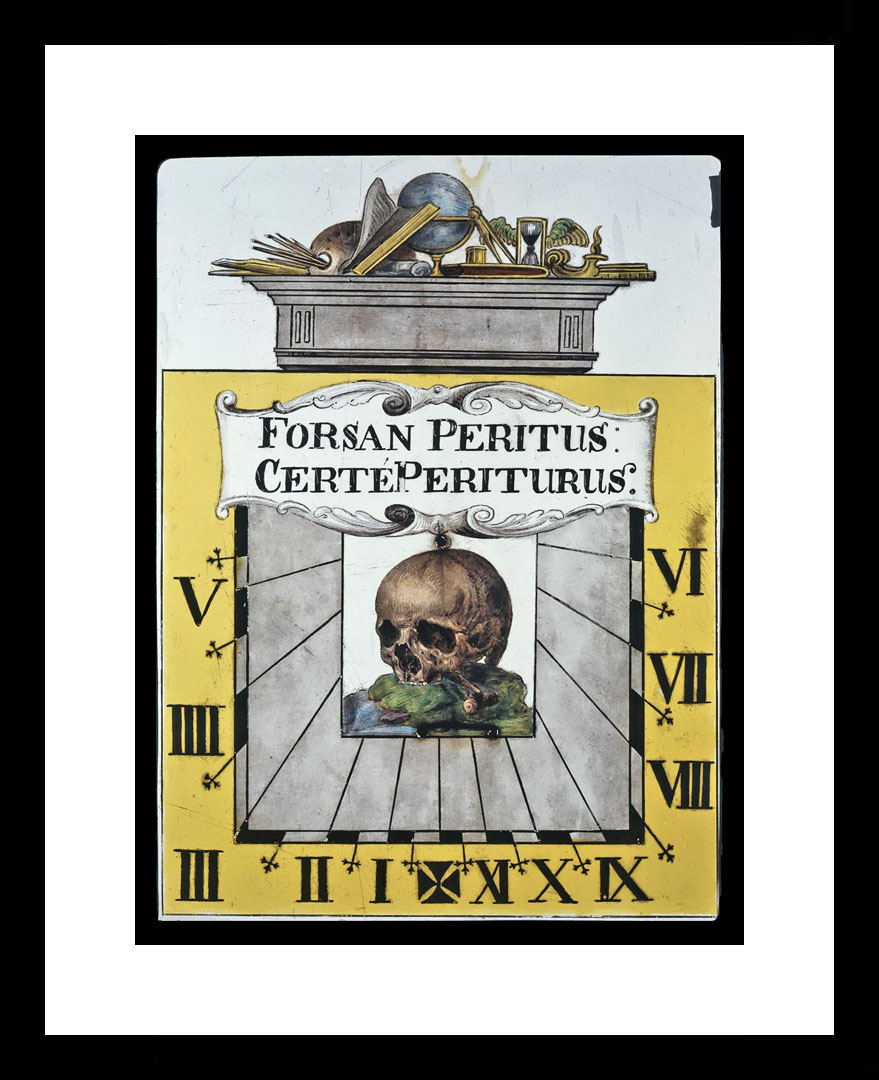
| Maker: unknown Date: made in 1790 Original Location: Juergen Hoefeld told us that it was made for latitude 53° N for an unknown place in England. Perhaps he was referring to the reproduction. The British Museum says that it was made for latitude 55° N for an unknown place in Germany. Carmichael thinks that it is German Present Location: At The British Museum, in the Department of Prehistory and Europe. London England. Its acquisition date was in 1958. Orientation: Vertical. Declines 6° east of south. Size: Juergen Hoefeld says that it measures 31.5 x 20.5 cm. (12.4” x 8.1 in). Perhaps he was referring to the reproduction. The British Museum says that measures 26.0 x 20.2 cm. (10.2” x 8”). Adornment: a skull and various instruments inscribed in cartouche Mottos: FORSAN PERITVS CERTE PERITVRVS (Though you may be that clever, you must die as well) Condition: very good, looks a little dirty in the photos. But the gnomon still exists! The British Museum says this about it: ” Vertical glass dial; rectangular; close-fitting white-metal frame of later date with gabled extension above; dial-plate painted as a vertical dial declining 6 degrees east; brass exterior polar gnomon.” It was purchased through Christie's and donated by Gilbert Edgar. The previous owner/ex-collection was Courtenay Adrian Ilbert. Comments: Photos ‘a’ to ‘d’ are photos of the original sundial © The Trustees of the British Museum, Photo ‘e’ is of a reproduction of the original sundial. British Museum Website: Here Skull Dial Webpage: Here Photo Descriptions: We copied photos ‘a’, ‘b’ and ‘c’ with the written permission of the British Museum from their website. To use these photos, please obtain permission from the museum by going to their website above. Photo ‘d’ is cropped version of photo ‘a’. Photo ‘e’ is courtesy of Juergen Hoefeld and was sent to us in 2003, and was photoshopped to add border. You may use his photo without permission. Photos: a b c d e |
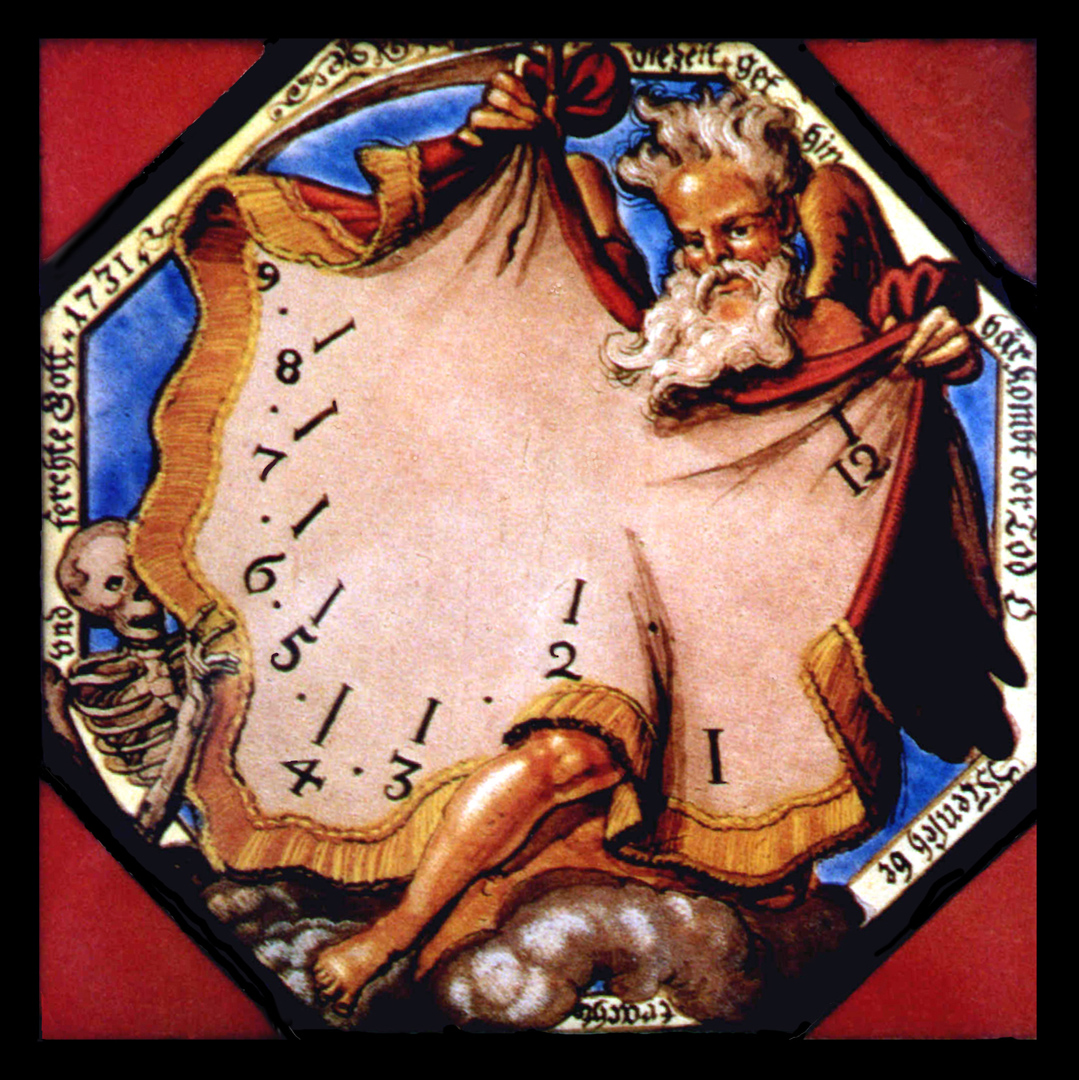
Maker: Johann Rudolf Huber (1668-1748). Date: 1731 Original Location: unknown location in Germany or Switzerland Present Location: At Historic Museum in Basel Switzerland. Orientation: Vertical. Declination unknown Size: 14 x 14 cm (5.5 x 5.5 in) Adornment: Winged god Chronos with scythe, floating on clouds, holding a cloth that Death folds back Mottos: "As time goes by, then comes death, oh man regard, and fear God." Condition: unknown Comments: Design is symbolic representation of a sundial as reminder of the end of human life. Page 184 of Renè Rohr's book "Die Sonnenuhr" shows three glass sundials. The text for the Chronus Dial (picture 288) focuses on the specialty of Basel: For several hundred years the so called Basel-time was used. This is why the noon line goes to 1 o'clock. The two big sundials at the tower of Basel Muenster also show this Basel-time. Photo Plate 8 by Rene Rohr: (1996) "Sundials: History, Theory and Practice" Dover Publications. Basel Tourist Attractions Website: Here Historic Museum, Basel Website: Here Photo Descriptions: Photos ‘a’ and ‘c’ are courtesy of Juergen Hoefeld which he sent to us in 2003. Photo ‘a’ is of the original dial. Photo ‘c’ is of a modern reproduction. Photos ‘b’ and ‘e’ are photoshopped versions of photo ‘c’. Photos ‘d’ and ‘f’ are courtesy of Alain Ferreria (taken in 2008) which he sent to us. They are of the original dial. Photos: a b c d e f |
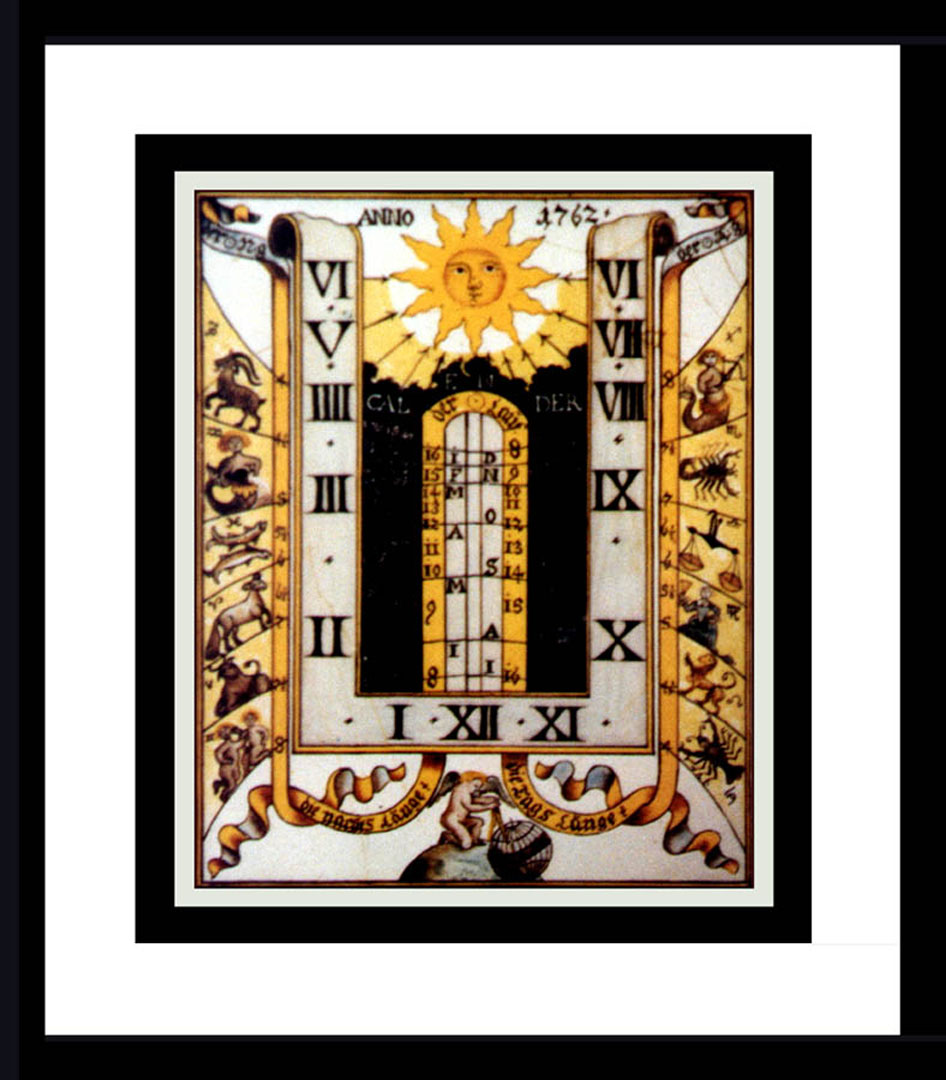
Maker: unknown Date: 1762 Original Location: unknown location at 48° N. in southern Germany Present Location: Wurttembergisches Landesmuseum, Stuttgart, Germany Orientation: Vertical. Declines south. Size: 24 x 20 cm (9.4 x 7.9 in) Adornment: figures of the Zodiac, Angel with Heavens, sphere & compass Mottos: undetermined Condition: unknown Comments: shadow shows the date also. We are looking for more information and good photos of this dial Stuttgart Museum Website: Here Review of Wurttemberg Museum Website: Here Photo Descriptions: Photo ‘b’ is courtesy of Juergen Hoefeld and sent to us in 2003. Photo ‘a’ is photoshopped version of photo ‘b’. Photos: a b |
 |
 |
 |
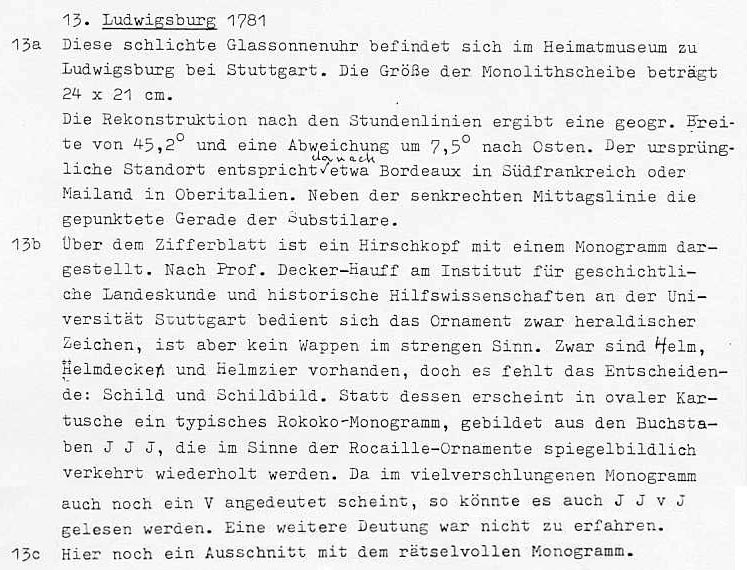
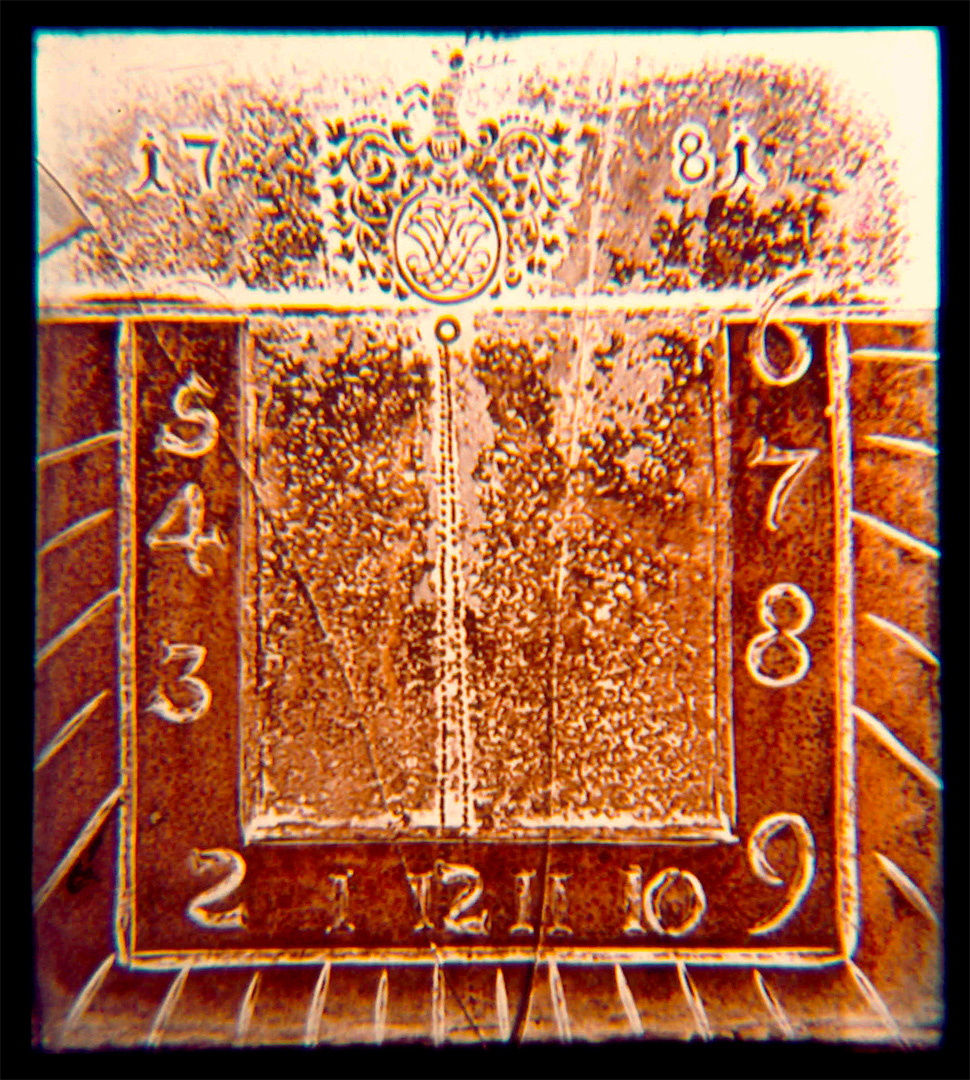
| Maker: unknown Date: 1781 Original Location: Oddly, in Behrendt's article, "Historische Glassonnenuhren", he says it was at: 50° N. in Mainz, Bamberg Germany; but in his videotape, he says reverse engineering calculates its design latitude at 45.2° N, which puts it at Bordeaux in southern France, or Milan in northern Italy. We tend to believe it is german. Present Location: Heimatmuseum (Regional History Museum) of Ludwigsburg near Stuttgart Germany. Orientation: Vertical. Behrendt's reverse engineering calculates its declination as 7.5° east of south. Size: 24 x 21 cm (9.4 x 8.3 in) Adornment & Inscriptions: Simple. 1781. Chapter beam has hours 6-12-5 and short half hour lines on margin. Dotted Meridian and substyle. Mono-colored rust brown numbers and lines. Coat of arms with deer head. Rococo monogram J.J.J. According to Professor Decker-Hauff, of the Institute for Historical Regional Studies and Historical Subsidiary Sciences at the Stuttgart University: "Although the ornamentation uses heraldic symbols, it is not a coat of arms in the strict sense. Helmet, helmet cover, and helmet ornaments are indeed present, but the crucial blazon and blazon picture is missing. Instead, a typical Rococo monogram appears, formed from the letters J J J in an oval cartouche, which are repeated, mirrored, after the fashion of Rocaille ornamentations. Since in the much-entwined monogram there is also the suggestion of a letter V, it could also be read J J v J." Mottos: none Condition: monolithic pane cracked, hole for gnomon Comments: Rudolph Hooijenga kindly translated this information for us from the Behrendt videotape. We need for someone to visit the museum to investigate if this dial still exists there and to obtain good photos. Videotape Transcript of Dial 145 only: Here Heimatmuseum of Ludwigsburg Website: Here Willy Bachmann‘s Email: Here Photo Descriptions: For years, the only photo we had was copied from a videotape movie by Hans Behrendt called "Historische Glassonnenuhren" 1989. Finally, thanks to investigations by German dialist, Willy Bachmann, he found and sent to us in 2008 an archived photo (photo ‘a’) from Bildarchiv des AK Sonnenuhren in der Deutschen Gesellschaft für Chronometrie. This dial’s DGC photo number is (DGC 8652) which specifies the sundial in most German sundial publications. Photo has been lightly photoshopped to correct shape distortion. Photos: a |
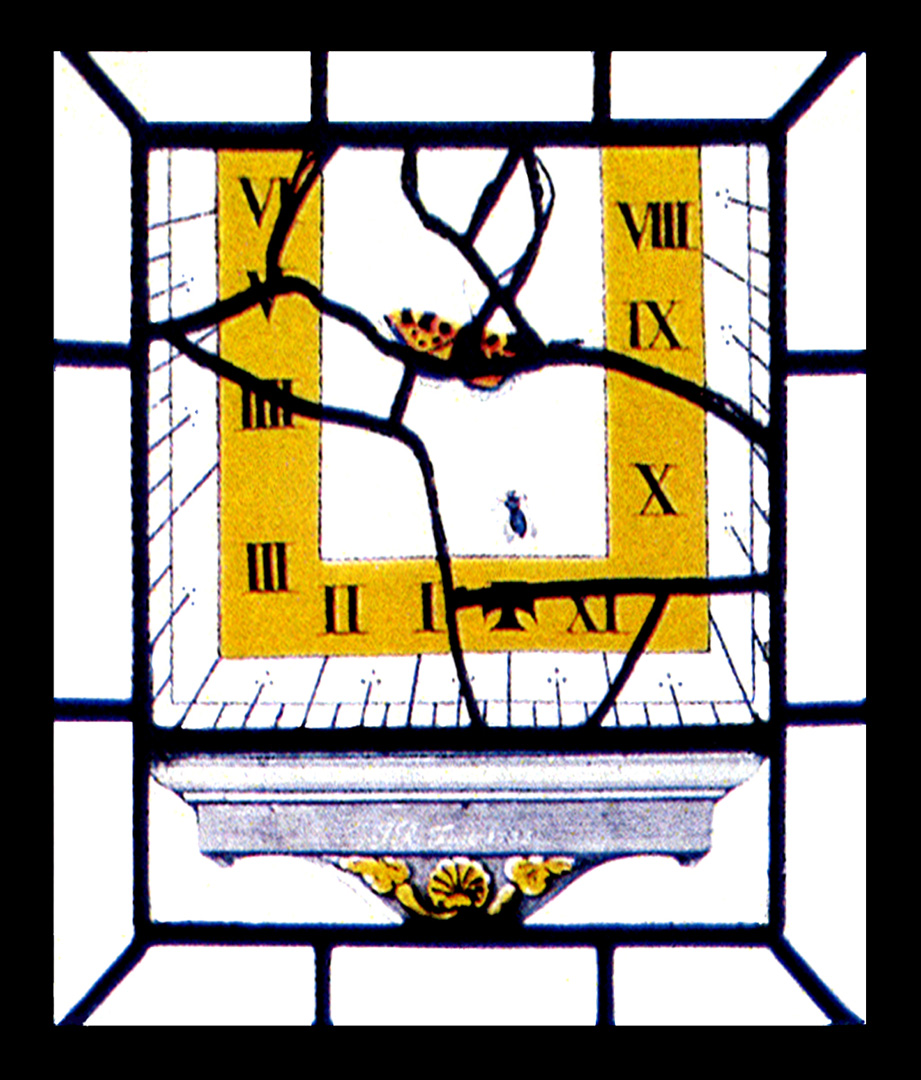
Designer & Maker: John Rowell of Wycombe, England Date: 1733 Original Location: unknown building and town in England. It must have been made for a building which was demolished between 1733 and 1785. Present Location: Dial was evidently bought as a result of the sale of another property. It’s now at Arbury Hall, near Nuneaton, Warwickshire England. Its lower edge is about 142 cm above ground level in a window that doesn't face South. Orientation: Vertical. Designed for a due South window. Size: 23.5 x 30 cm (9.25 x 11.8 in) Adornment: Flesh-fly and butterfly. The fly is so accurate that it can be identified as a "Flesh-fly" (Sarcophaga carnaria) though the butterfly seems to show characteristics of both a Large and a Small Tortoiseshell. Signed and dated by maker. Mottos: none Condition: cracked and restored Comments: Dial was moved to Arbury Hall in 1785 when Sir Roger Newdigate, the 5th Bart, bought it from a dealer, James Broden, among a job-lot of stained glass with which he wanted to adorn his newly built cloisters. We need better high resolution photos. Article by John Davis (3MB): (Dec 2007) John Rowell-Plumber and Stained Glass Dial Maker, "The British Sundial Society Bulletin" No. 19 (iv) pg. 179-183. Article by Christopher Daniel: (Nov 2003) 'Umbrae Sumus'. The Sundial Page, "Clocks" Vol. 26/10 Article by Christopher Daniel (5 MB): (Apr 1988) Stained Glass Sundials in England and Wales. "Clocks" 10, 30-37 Information Britain Hotels Website: Here About Britain Website: Here Photo Descriptions: Photos are courtesy of Christopher Daniel © C StJ H D and are photocopied from his article. Photos: a b |
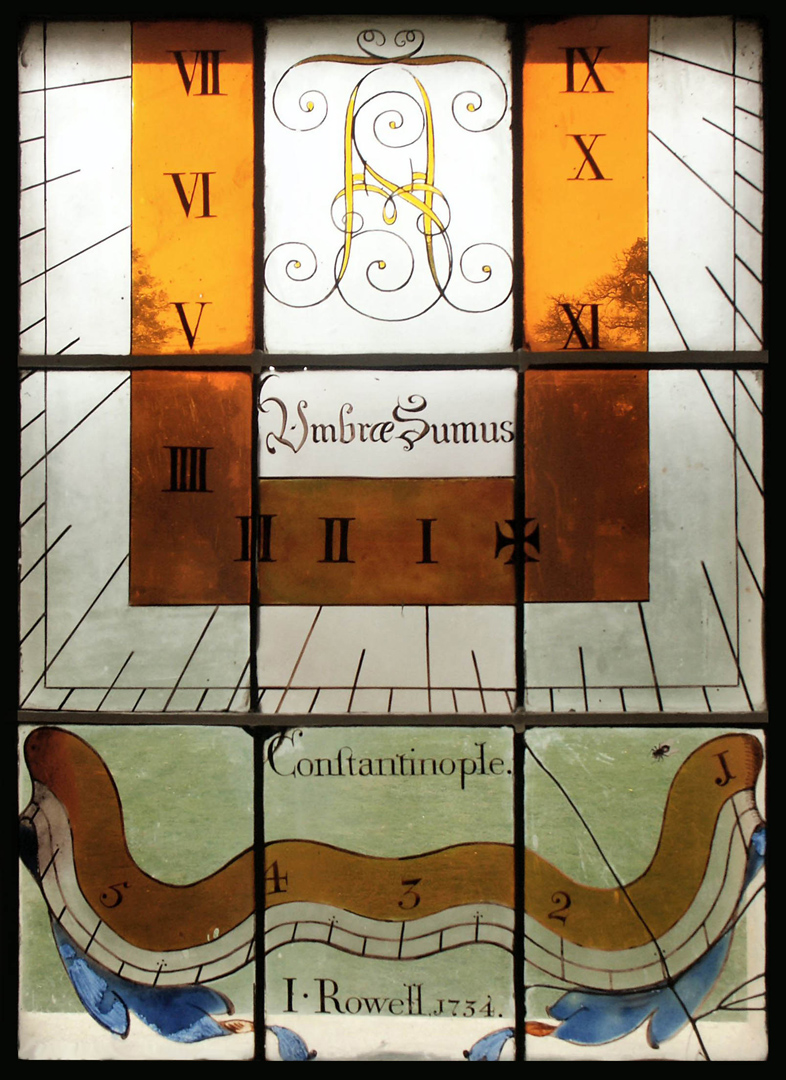
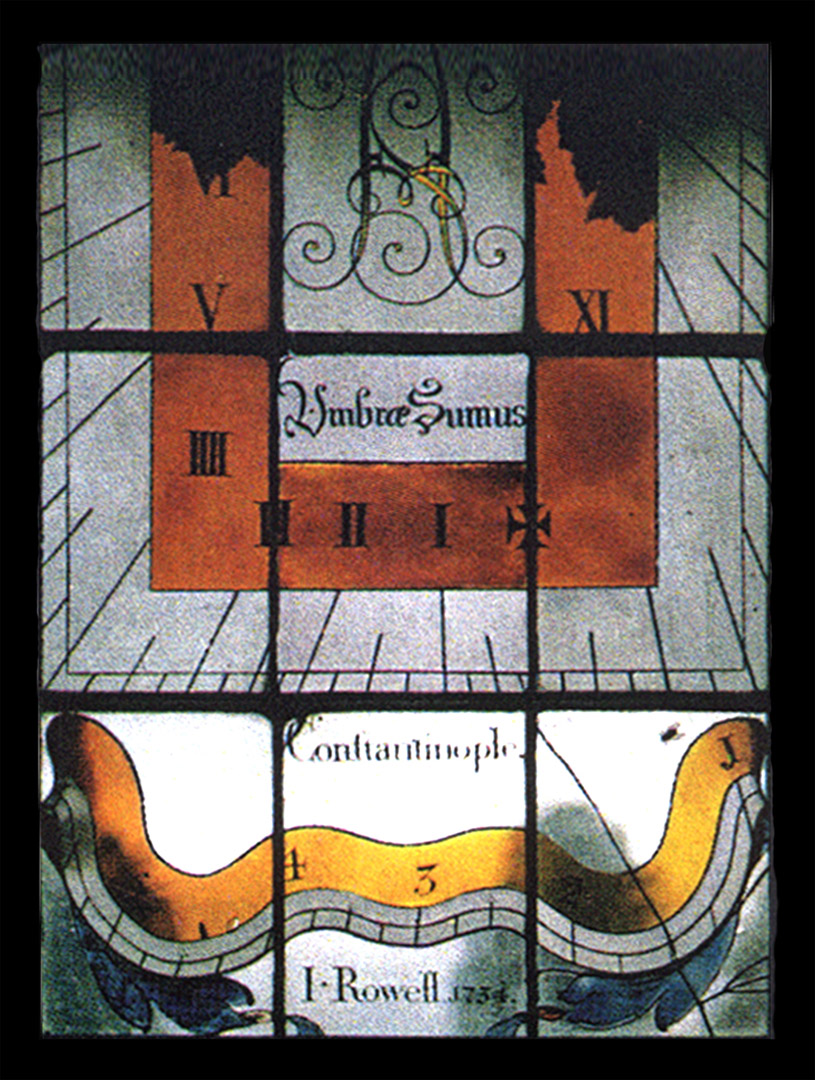
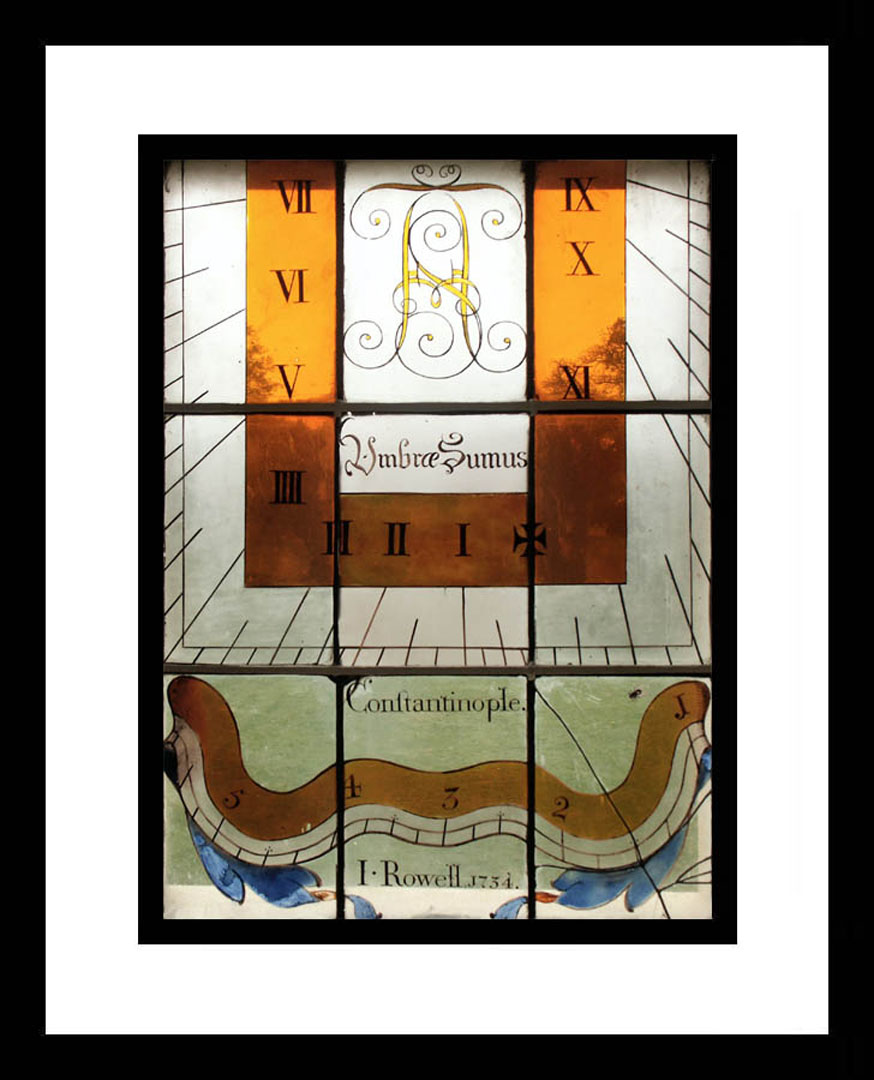
Maker: John Rowell of Wycombe, England (1686-1756) Date: 1734 Original Location: On the ground floor on the southwestern side of Purley Hall, Pangbourne, Berkshire, RG8 8DH, England. Google Earth Coordinates: Lat: 51°28'37.76'' N, Lon: 1°04'15.45'' W Present Location: at original location Orientation: Vertical. Declination: Using Google Earth satellite photos, Carmichael estimated the wall’s declination to be about 22.89° West of South. Physical onsite measurement conducted by John Davis puts it at 22° W. But John Davis’s analysis of hourline placements show that the dial was designed for 26° W. making us conclude that it is mounted incorrectly in its frame by 2 degrees Size: 64.8 x 50 cm (25.5 x 18.5 in) Adornment: fly in lower right. Dial has a second hour scale giving the time in Constantinople Mottos: "Umbrae Sumus", "We are Shadows" Condition: fair. Lower right pane is cracked. Gnomon is missing. An old photo, which we do not have here, shows the center pane with flaking numerals and missing hourlines before a restoration that occurred between 1965 and 1988. Mr. Davis concludes that the center pane was restored, but with poorly placed hourlines. There is a protective outer pane of clear glass. Comments: The owner, Tom Anderson replaced the missing gnomon in 2007 with help from English dialist, John Davis. Gnomon is attached to the outer protective glass pane to prevent damage to the stained glass if stress is applied to the gnomon. Carmichael's analysis of the origin of the hourlines (the place where the gnomon was attached) shows a fairly large error in the hourline angles between 12 noon and 1pm on the center glass pane making us believe that the restorer made mistakes when placing these hour lines. Article by John Davis (3MB): (Dec 2007) John Rowell-Plumber and Stained Glass Dial Maker, "The British Sundial Society Bulletin" No. 19 (iv) pg. 179-183. Article by Christopher Daniel: (Nov 2003) 'Umbrae Sumus'. The Sundial Page, "Clocks" Vol. 26/10 Article by Christopher Daniel (5 MB): (Apr 1988) Stained Glass Sundials in England and Wales. "Clocks" 10, 30-37 Berkshire History Website: Here John Davis’s Email: Here Photo Descriptions: All Photos except photo ‘c’ are courtesy of John Davis. Photo ‘c’ is courtesy of Christopher Daniel © C StJ H D. Photos ‘c’ and ‘d’ show pre-restoration. All other photos show post-restoration. Photo ‘f’ shows Hourline Origin Analysis by Carmichael. Photos: a b c d e f |
 |
||
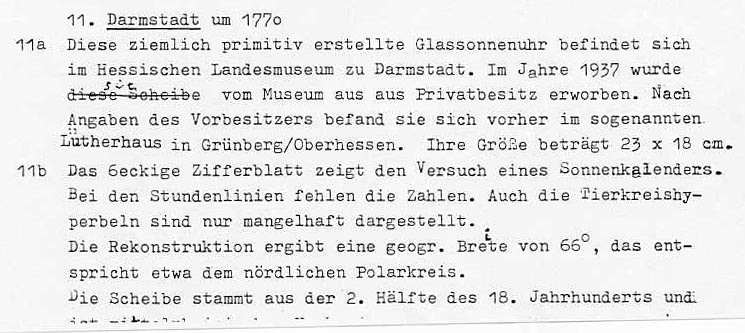
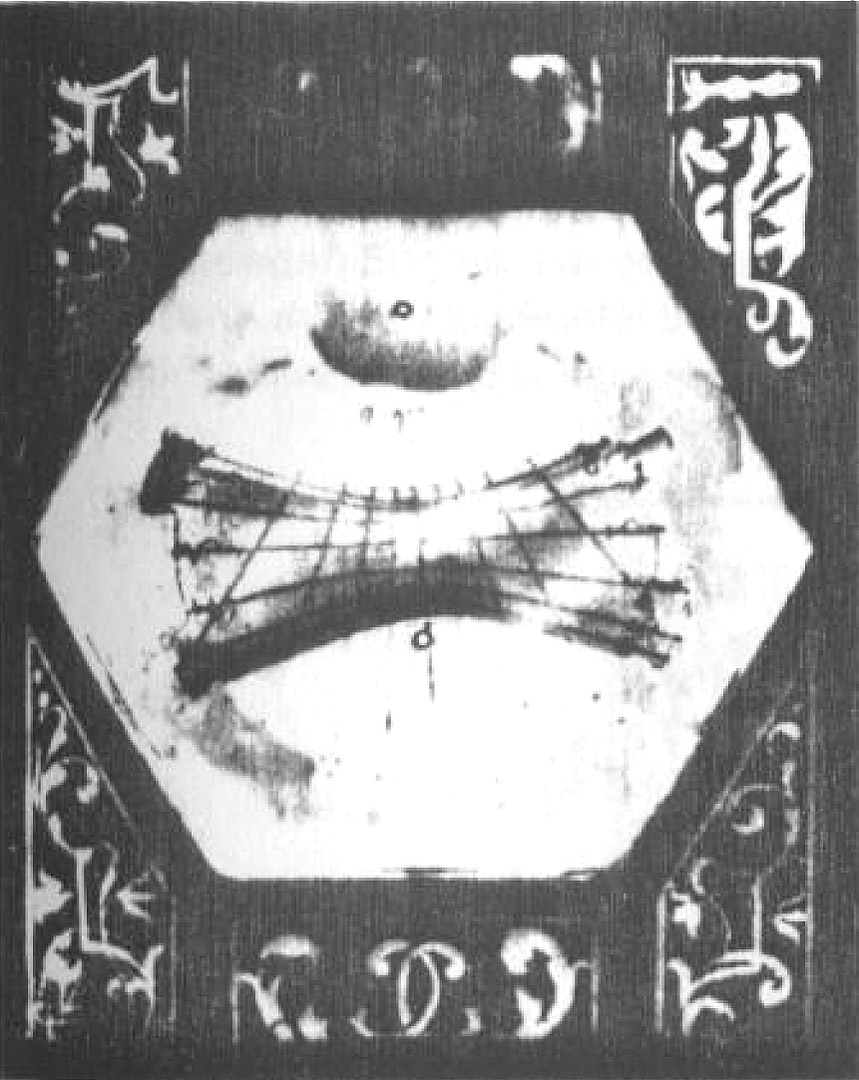
| Maker: unknown Date: 1770 Original Location: Lutherhaus (Luther House) in Grümberg/upper Hassia, Germany. Oddly, Behrendt's reverse engineering calculates its design latitude as 66° N. (Same as the Artic Circle!). Present Location: Hessischen Landesmuseum (Hassia State Museum) in Darmstadt Germany Inv. Nr. Kg 37:19. Acquired in 1957. Orientation: Vertical. Declines south. Size: 23 x 18 cm (9 x 7 in) Adornment: Primitively done. Has incorrectly drawn hourlines and zodiacal hyperbolas (sun calendar) in hexagon, hours 4-9-12 in twisted ribbon. The framework has floral tendrils and there is a sunspot. Chapter ribbon and margin pattern is yellowish brown. Inscription: undetermined Condition: Dial has cracks and holes for gnomon and mounting. Hour numbers are faded away. Comments: Rudolph Hooijenga kindly translated this information for us from the Behrendt videotape. We need better photos of this dial. Videotape Transcript of Dial 143 only: Here Landes Museum Website: Here Photo Descriptions: We copied photo ‘a’ from a videotape movie, and photo ‘b’ from an article. Both are called "Historische Glassonnenuhren" 1989 by Hans Behrendt. Photos: a b |
 |
 |
 |
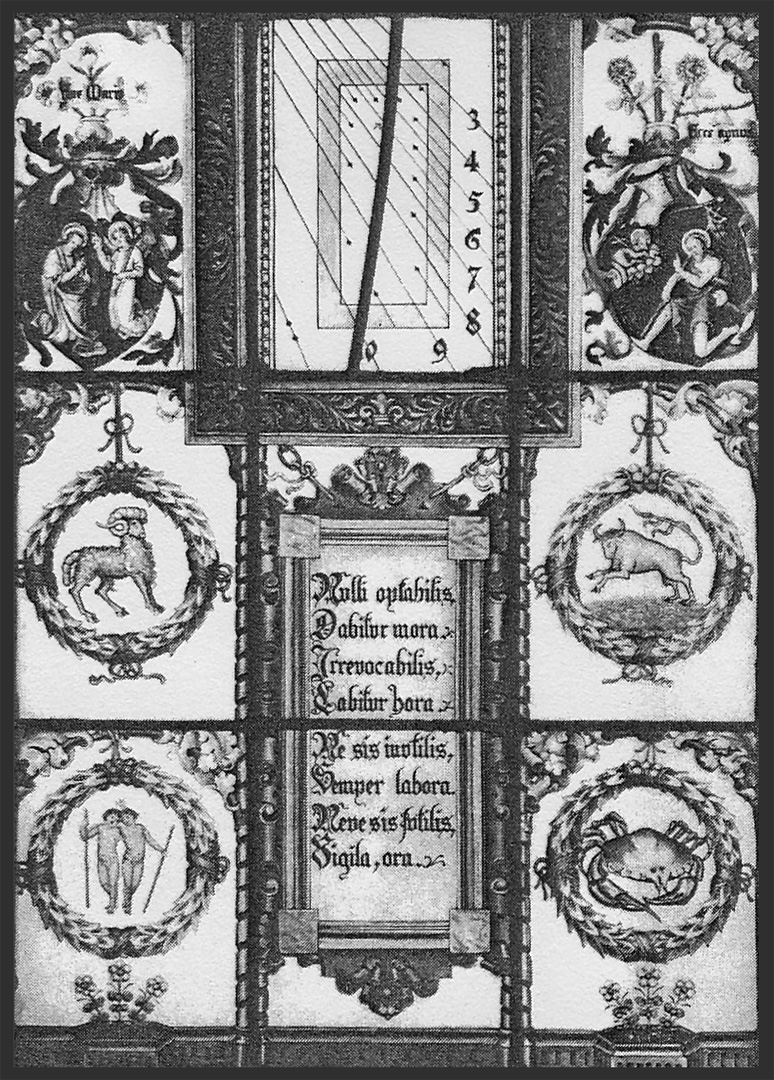
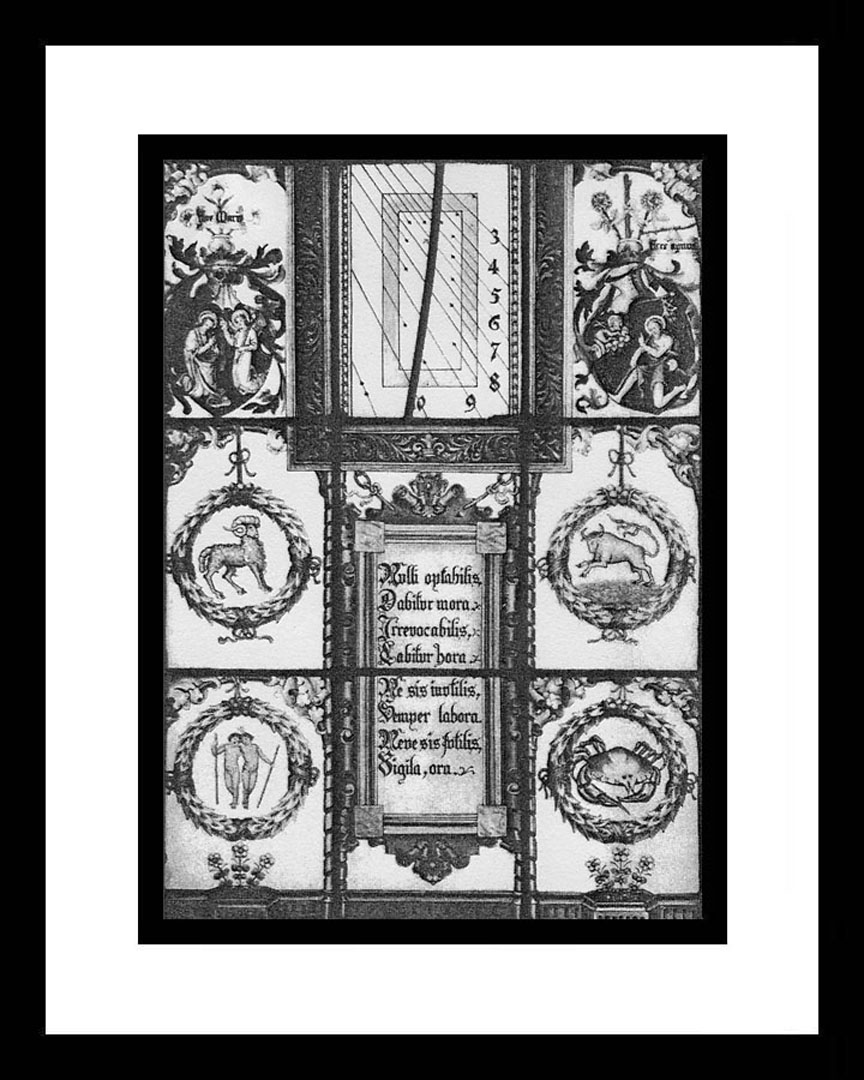
| Maker: Charles Eamer Kempe (1837-1907), highly eminent stained glass artist in the late 19th century. His firm in the south of England near Brighton, Sussex, produced a large number of windows for cathedrals and churches worldwide, including the USA. Date: 1893 Original Location: On the West wall of The Dial Room (Kempe’s bedroom) at Old Place in Lindfield Sussex England. According to a “Country Life” magazine article dated 23rd May 1903, Pages 666 – 669, it states on pg. 669: “In the largest room (Kempe’s bedroom), which is known as the Dial Room, there is an interesting revival of a very old custom - the placing of a sundial on a window pane.” According to page 423 of Mrs. Alfred Gatty's "Book of sun-Dials" she confirms that it was located at Mr. Kempe's home at Old Place in Lindfield along with two other stained glass sundials. Present Location: unknown. It’s possibly at its original location, but is probably not still there since Philip Pattenden says that it was restored in 1920 then sold. Orientation: Vertical. Declines west of south. Size: unknown Adornment: The window dial is quite detailed, and the artwork is quite similar to the South Southwest Lindfield dial. We have not identified the scenes depicted in the upper left and right glass panes. Like the South Southwest Lindfield Dial, it has four signs of the zodiac on the lower panes surrounding the inscription, but they are different ones - the ram, the bull, the heavenly twins, and the crab. This leads us to believe that the lost 3rd Sundial from the Dial Room probably had the remaining four signs of the Zodiac, and that the lost 3rd Dial probably looks similar to the other two. Inscription: Latin inscription on bottom center pane: "Nulli optabilis, Dabilur mora, Irrevocabilis, Labitur bora, Ne sis inutilis, Semper labora, Neve sis fotilis, Vigila ora". This inscription is translated into English on the adjoining South Southwest window. (See Dial 156). Mottos: No motto is clearly visible, but there is some illegible text in the upper left and right panes. Condition: unknown. But Pattenden said that it was restored in 1920 then sold. The almost vertical thick black line on the dial face in the top center pane might be a crack in the glass that was re-leaded during a restoration. Comments: We deeply are indebted to Dr. Robert Berger, Geoffrey Lane, John Davis and David Brown for researching and providing the most of the information here. Page 423 of Mrs. Gatty's " The Book of Sun-dials" says: "In addition to the pillar dial Mr. Kempe, the owner of Old Place, Lindfield, has placed a vertical dial on the stable and three window dials on the house." In the article by Pattenden "A Pelican in Sussex" in History Today, 9/1982, he confirms that these three window dials were formerly located in the Dial Room at Old Place in Lindfield. The "Sunday Chronicle" (Aug 1896) reported: "Mr. Kempe has approximately a dozen sundials in his garden and his house. Most remarkably, he has set up several in such a way that he can tell the time from his bed. Indeed three of his sundials have been set up in the windows and so arranged that they indicate the time on the glass of the window. Each window showed the signs of the zodiac on the four lower panes. In the west window was the inscription: "Nec Sol, nec Umbra" (So little sun, just so little shade), along with the date 1893. The morning dial (Behrendt's catalogue number 47) indicates the hours from 3 to 10, while the southwest dial (No 48) shows the hours 7-12-6. These panes were restored around 1920, and later sold.” We need more information and better photos of this lost dial and for someone to arrange a visit to Old Place in Lindfield to investigate, measure and photograph this dial and the other two lost stained glass dials if they still exist there. If they aren’t there, where are they? Reference in Mrs. Alfred Gatty's "Book of Sun-Dials": Here Lindfield Website: Here ‘History Today’ Website: Here Old Place Photo Website: Here Photo Descriptions: Photo was copied from "A Pelican in Sussex" in ‘History Today’ and has been enhanced by Photoshop. Photos: a |
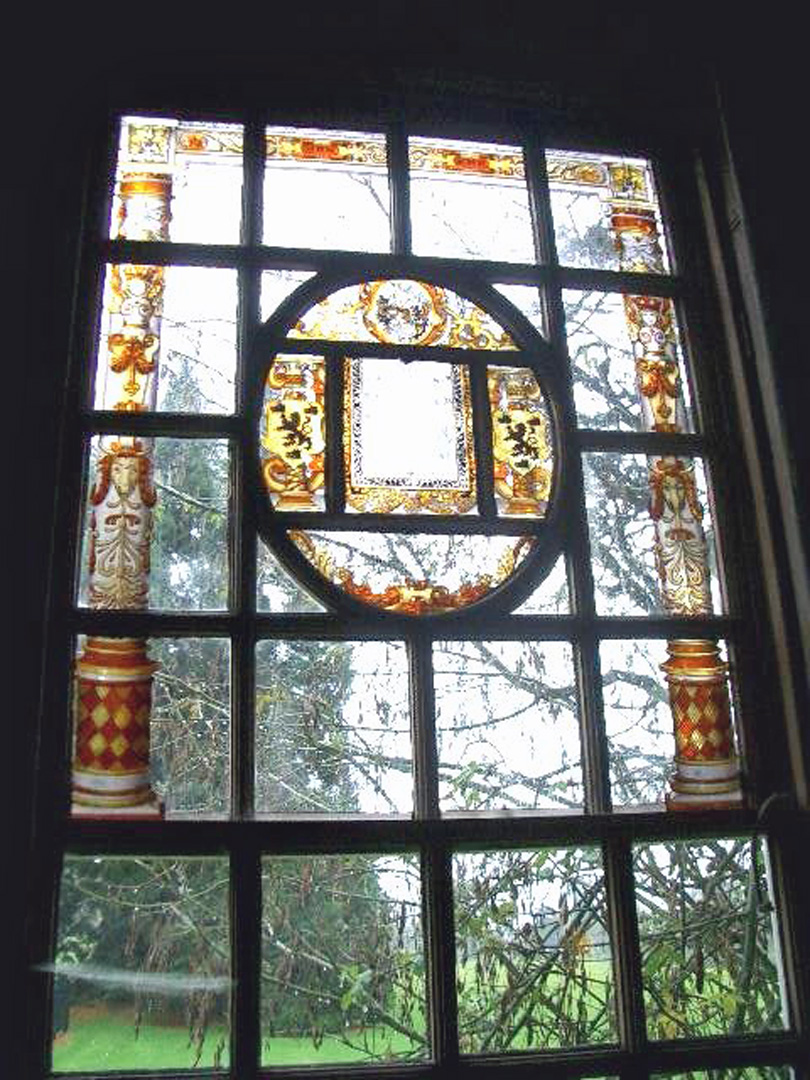
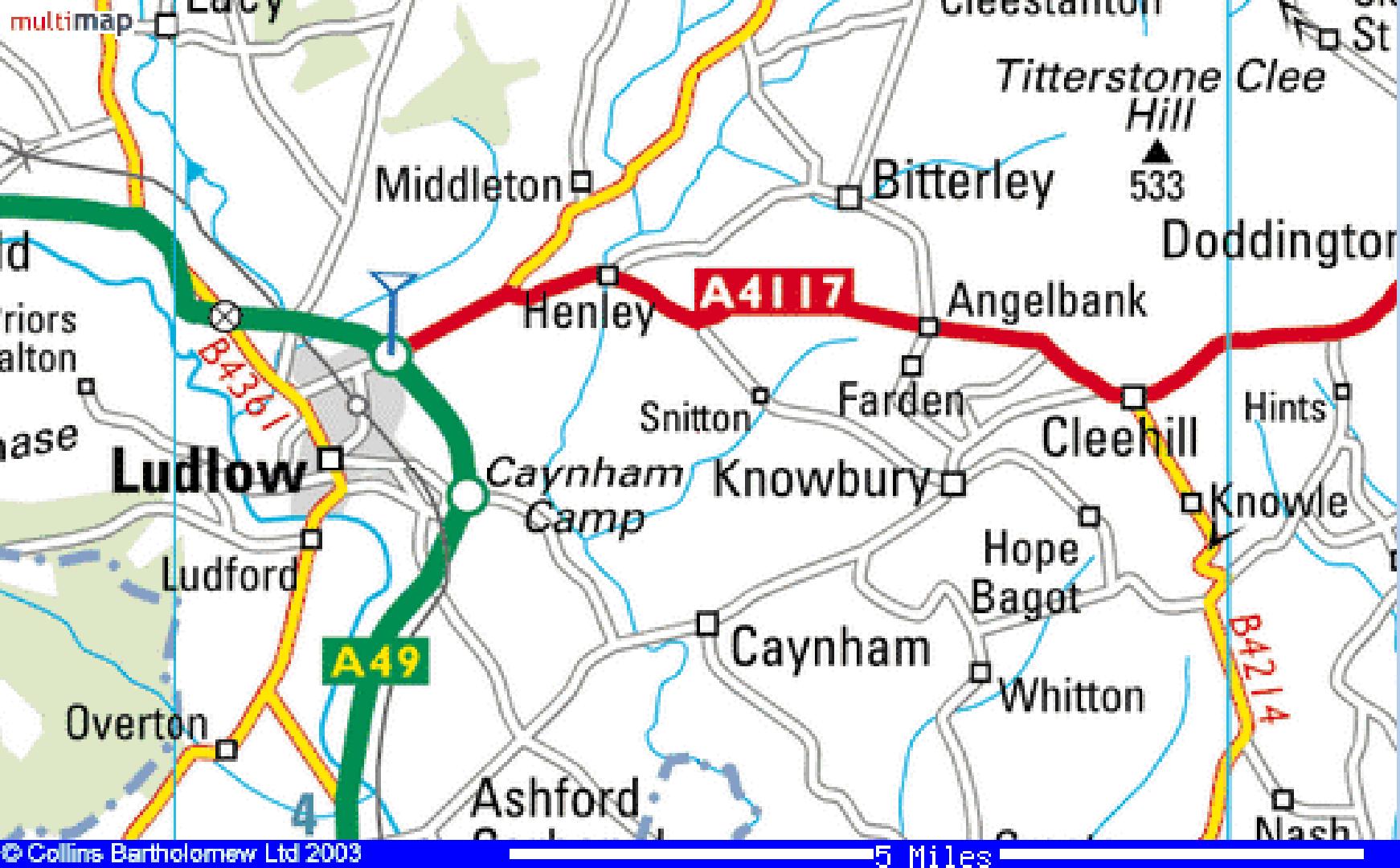
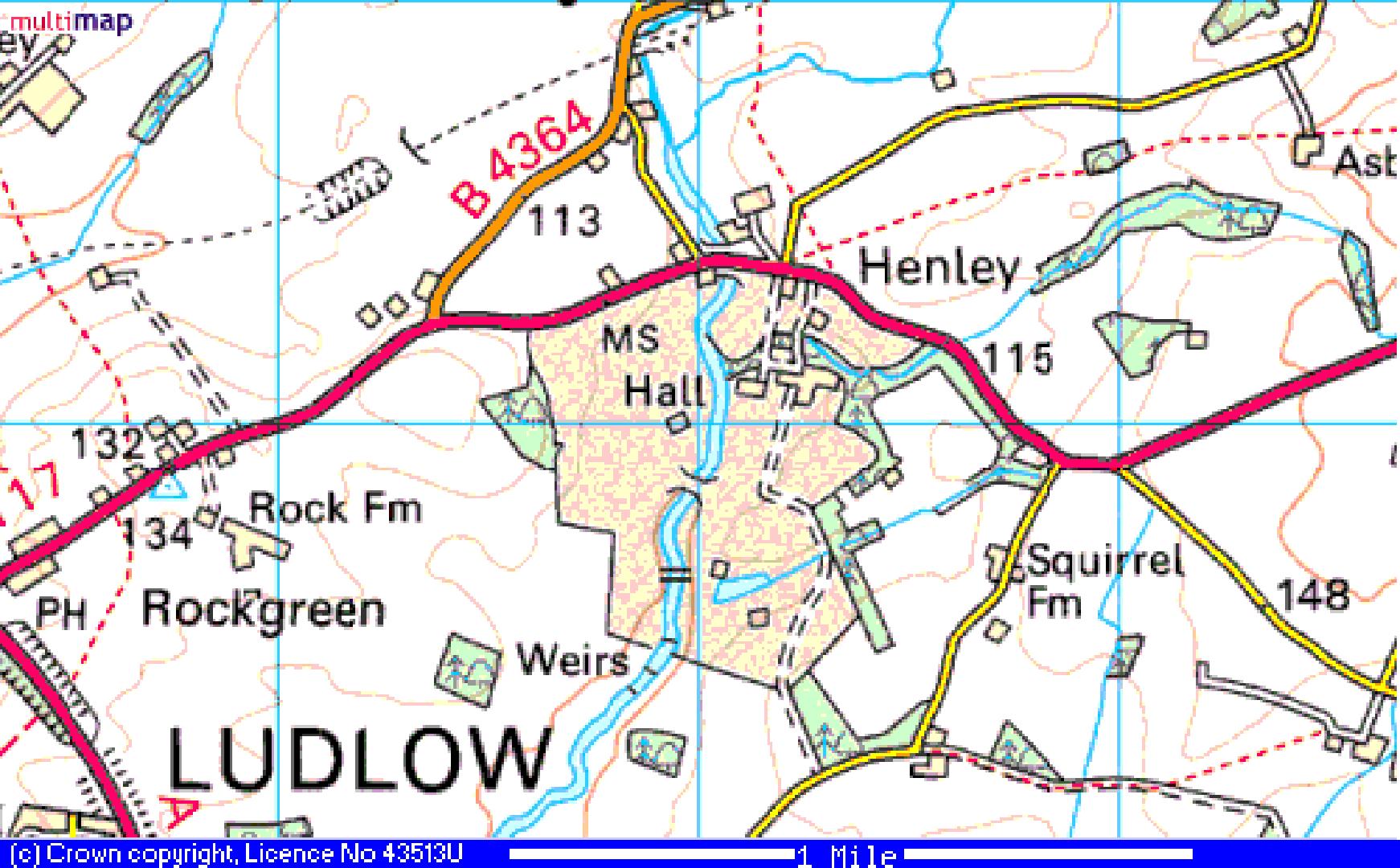
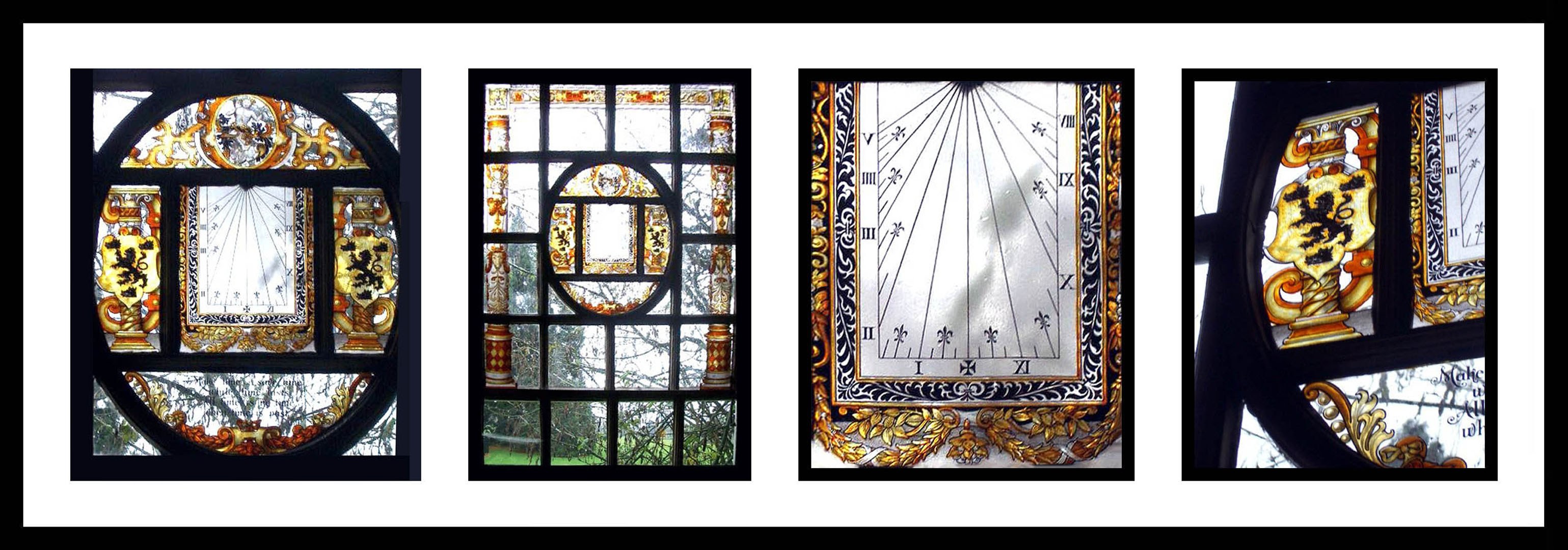
Maker: Charles Eamer Kempe (1837-1907), highly eminent stained glass artist in the late 19th century. His firm in the south of England near Brighton, Sussex, produced a large number of windows for cathedrals and churches worldwide, including the USA Date: 1875 (Victorian) Original Location: Lat: 52.22° N; Lon: 2.40° W. At Henley Hall, in Henley Shropshire, England (Henley is 4 miles East of Ludlow on the way to Bentley. The window is on a small extension to the main house which was added in 1874. Present Location: at original location. Last seen there in 2004 by Silas Higgons. Orientation: Vertical. Declines south. Size: The oval dial window itself measures 45.7 x 55.9 cm (18 x 22 in) and forms the centre of a larger window 91.4 x 114 cm (36 x 45 in). Adornment: richly embellished with Victorian artwork. It is surrounded by various designs including, at each side of it, the coat of arms of the Wood family who were owners of the house at that time. Mottos: The motto below the dial pane reads: "Make Time ~ save time, while time lasts, All time is no time, when time is past" Condition: The gnomon is missing Comments: In the BSS registry BSS SrNo2299. This is a perfect candidate for a new replacement gnomon. Hopefully someone will add one. Information update supplied by Silas Higgons. Mark Breach informed us in 2010 that he thinks Henley Hall in Henley Suffolk was demolished in the 60’s. He said his grandfather sold it for the ‘land’. Article by Christopher Daniel (5 MB): (Apr 1988) Stained Glass Sundials in England and Wales. "Clocks" 10, 30-37 Ludlow Website: Here Photo Descriptions: Photos are courtesy of and © Silas Higgons (taken in 2004). Photos: a b c d e f g h i |
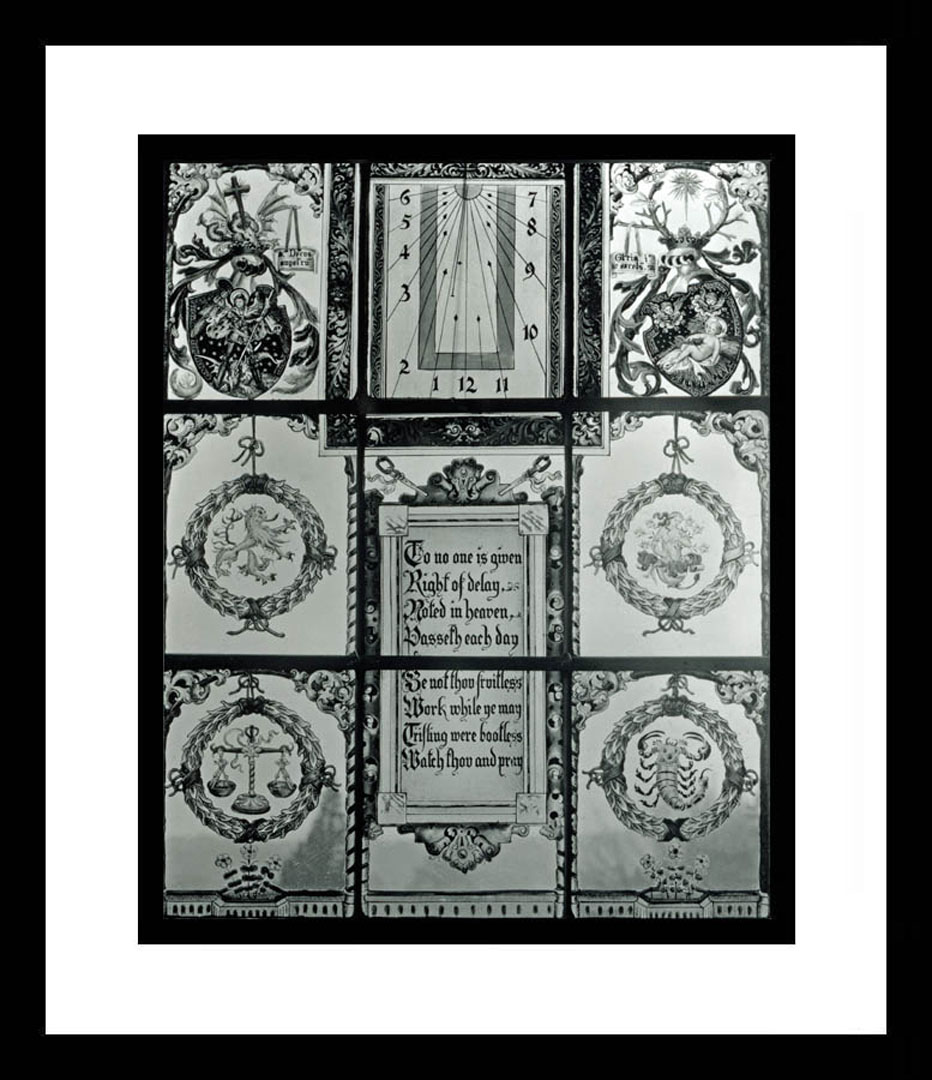
Maker: Charles Eamer Kempe (1837-1907), highly eminent stained glass artist in the late 19th century. His firm in the south of England near Brighton, Sussex, produced a large number of windows for cathedrals and churches worldwide, including the USA. Date: 1893 Original Location: On the South Southwest wall of The Dial Room (Kempe’s bedroom) at Old Place in Lindfield Sussex England. According to a “Country Life” magazine article dated 23rd May 1903, Pages 666 – 669, it states on pg. 669: “In the largest room (Kempe’s bedroom), which is known as the Dial Room, there is an interesting revival of a very old custom - the placing of a sundial on a window pane.” According to page 423 of Mrs. Alfred Gatty's "Book of sun-Dials" she confirms that it was located at Mr. Kempe's home at Old Place in Lindfield along with two other stained glass sundials. Present Location: unknown. It’s possibly at its original location, but is probably not still there since Philip Pattenden says that it was restored in 1920 then sold. Orientation: Vertical. Declines south southwest. Size: unknown Adornment: The window dial is quite detailed, and the artwork is very similar to the West Lindfield dial. The shield upper left shows St George killing the dragon and the one upper right has a Christ child on a bed of straw. Like the West Lindfield Dial, it has four signs of the zodiac on the lower panes surrounding the inscription, but they are different ones - Leo, Virgo, Libra, and Scorpio. This leads us to believe that the lost 3rd Sundial from the Dial Room probably had the remaining four signs of the Zodiac, and that the lost 3rd Dial probably looks quite similar to the other two. An unusual gnomonic feature is the painted substyle line on the dial face. Inscription: The lower center pane has an amusing translation of a Latin inscription that’s on the adjoining West window. "To no one is given right of delay; Noted in heaven passeth each day; Be not thou fruitless; Work while ye may; Trifling were bootless; Watch thou and pray." There are also short Latin inscriptions on the upper left and right panes. We need help translating these. Mottos: The text in the upper left and right panes is something like "Decus angel’ru" (L) and "Gloria excelsis" (R). Condition: unknown. But Pattenden said that it was restored in 1920 then sold. Comments: We deeply are indebted to Dr. Robert Berger, Geoffrey Lane, John Davis and David Brown for researching and providing the most of the information here. Page 423 of Mrs. Gatty's " The Book of Sun-dials" says: "In addition to the pillar dial Mr. Kempe, the owner of Old Place, Lindfield, has placed a vertical dial on the stable and three window dials on the house." One of the three window dials she mentioned is the lost Lindfield dial. In the article by Pattenden "A Pelican in Sussex" in History Today, 9/1982, he confirms that these three window dials were formerly located in the Dial Room at Old Place in Lindfield. The "Sunday Chronicle" (Aug 1896) reported: "Mr. Kempe has approximately a dozen sundials in his garden and his house. Most remarkably, he has set up several in such a way that he can tell the time from his bed. Indeed three of his sundials have been set up in the windows and so arranged that they indicate the time on the glass of the window. Each window showed the signs of the zodiac on the four lower panes. In the west window was the inscription: "Nec Sol, nec Umbra" (So little sun, just so little shade), along with the date 1893. The morning dial (Behrendt's catalogue number 47) indicates the hours from 3 to 10, while the southwest dial (No 48) shows the hours 7-12-6. These panes were restored around 1920, and later sold.” We need more information and better photos of this lost dial and for someone to arrange a visit to Old Place in Lindfield to investigate, measure and photograph this dial and the other two lost stained glass dials if they still exist there. If they aren’t there, where are they? Videotape Transcript of Dial 156 only: Here Page from Mrs. Alfred Gatty's "Book of Sun-Dials": Here Lindfield Website: Here Country Life Magazine Picture Library Website: Here Old Place Photo Website: Here Photo Descriptions: We are indebted to Country Life magazine for sending to us and giving us permission to use their copyrighted photo ‘a’. Please do not use it without their permission. It appeared in Country Life Magazine article dated 23rd May 1903, pgs. 666 – 669. Photo ‘b’ is a transformed version of photo ‘a’. Photo ‘c’ is Scanned Copy of Original © photo from Country Life Magazine Article. Photo ‘d’ is copied from the Behrendt Videotape. Photos: a b c d |
 |
 |
 |
| Maker: W. Doyle Date: 1815 Original Location: Blackheath London England Present Location: unknown, possibly at its original location Orientation: Vertical. Declination is unknown. Size: unknown Adornment: unknown Inscription: unknown Mottos: unknown Condition: unknown, but gnomon is intact in this photo. Comments: We need more information and better photos of this lost dial and an English translation of the videotape transcript. Videotape Transcript of Dial 153 only: Here Blackheath Website: Here Photo Descriptions: This poor resolution photo and information are copied from a videotape movie and transcript by Hans Behrendt called "Alte Englischen Fenstersonnenhren" 1990 Photos: a |
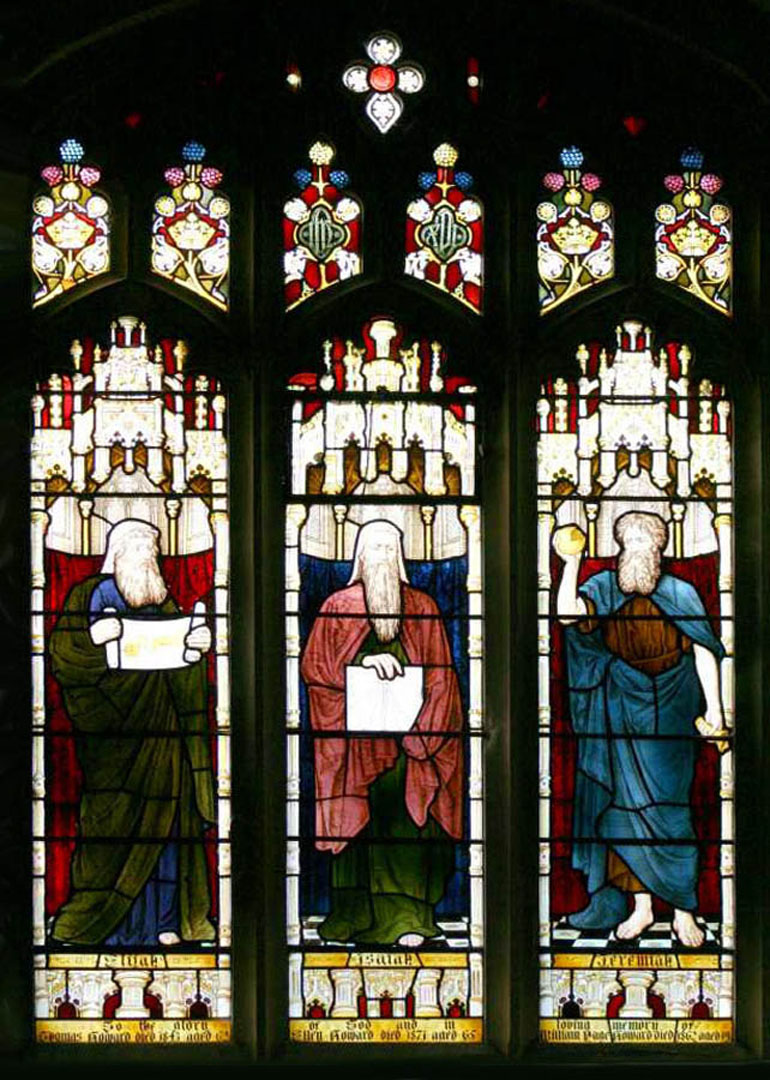
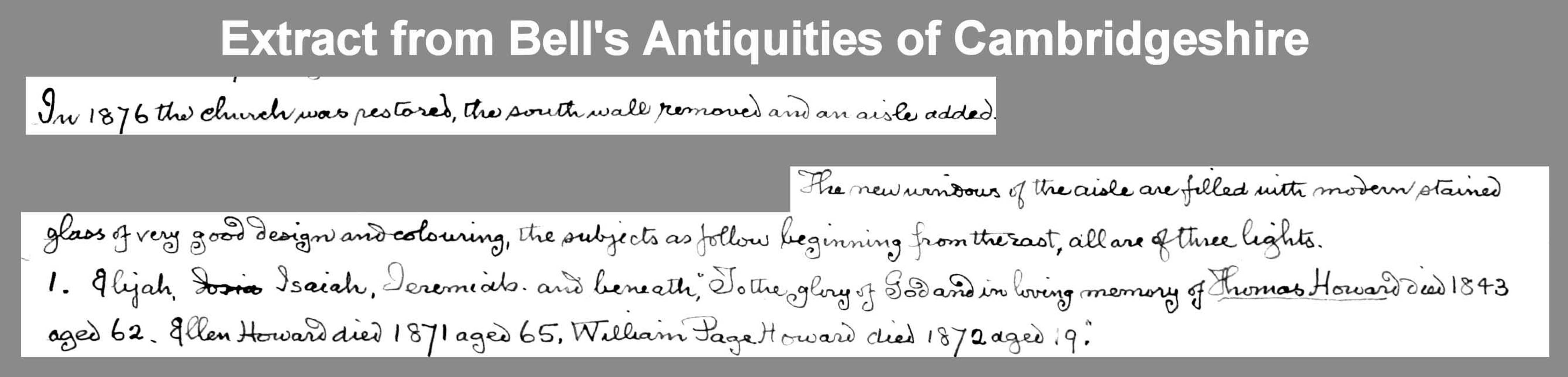
Designer and Glazier: unknown Date: Probably 1877 because in the book, County Churches of Cambridge, it says: "S aisle erected 1877". Original Location: Lat: 52° N; in the south aisle, in the window nearest to chancel, Church of Sts. Mary & Andrew in Grantchester Cambridgeshire, England. Present Location: at original location. Orientation: The window faces south. The sundial depiction is of a south wall vertical dial. Size: Window: unknown; Sundial plate: about 30 cm (11.8 in) Adornment: In center window, the prophet Isaiah holds a vertical sundial that is a depiction, not a real sundial. On the left window is Elijah holding a picture of a Roman chariot, and on the right window is Jeremiah holding up a broken ball. Mottos: "To the glory of God and in loving memory of Thomas Howard died 1843 aged 62, Ellen Howard died 1871 aged 65, William Page Howard died 1862 aged 19". Condition: excellent Comments: The following information is courtesy of Mike Cowham. “This is a well executed sundial depiction, not a real working sundial. An ornate gnomon casts a shadow at about 2:10 pm. Note the uncommon use of hour numerals that are lower case Roman Numerals, and that "j" replaces some of the "i"s. (vj, vji, vjii, ix, x, xi, xii, i, ii, iii, iiii, v, vi). In the unpublished manuscript copy of 'Cambridgeshire Antiquities' by Charles Lingard Bell, written about 1883, he mentions the window and gives the dates. And his layout drawing of the church with this window marked by an arrow. Grantchester was made famous by the poet Rupert Brooke”. Grantchester Website: Here Photo Descriptions: Photos are courtesy of Mike Cowham. Photos ‘a’, ‘b’, ‘c’, and ‘d’ were taken by him in Feb, 2005. Photo ‘e’ is Bell’s Grantchester Church Plan. Photo ‘f’ is an extract from Bell’s Antiquities of Cambridgeshire. Photos: a b c d e f |
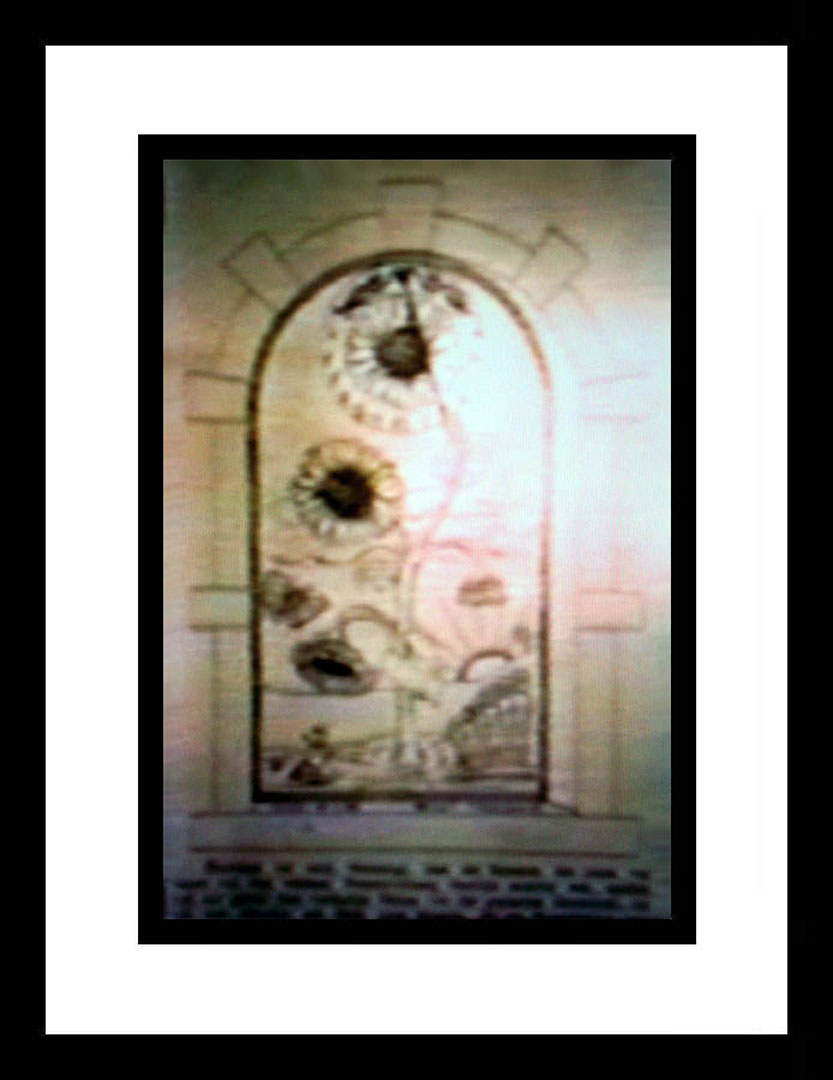
Designer: Willy Triebold Maker: Not applicable Date: 1894 Original Location: n/a Present Location: n/a Orientation: unknown Size: the size of a typical small window Adornment: a sunflower plant with several flowers. Sun is near the horizon. The top flower has the sundial face. Unidentified markings are at the bottom. Mottos: none visible Condition: n/a Comments: This drawing originally appeared in the 'Deutschen Uhrmacherzeitung' (German Clockmakers Journal) of 1899. It described this drawing of a sundial under the heading "Decorated windowpane for a sundial". Author Willy Triebold, Berlin. In this picture, the dial is read from the outside like a typical vertical wall dial. It shows the year 1894. There's no report that this dial was ever actually made. It would be nice to see a new one made using this design. We are looking for better copies of this drawing and a copy of the publication. Photo Descriptions: This poor quality photo is copied from a videotape movie by Hans Behrendt called "Neuzeitliche Glassonnenuhren" (Modern Glass Sundials) 1990. Photos: a |
 |
||
| Delineator: unknown Glass Artists: No record of maker, though the house owners are still looking. The consensus amongst the stained glass folk is that it is the work of Glasgow artist Oscar Paterson. Date: Just below the lettering, round the top of the sundial, is the date 1899. Original Location: Lat: unknown; Lon: unknown. On an unknown house near Glascow Scotland Present Location: at original location Orientation: Inclination: vertical, Declination: The hour lines are similar to a window that faces due South, but are gnomonically flawed. Size: unknown Adornment: Looks very much like art deco. Mottos: “AMDG” means Ad Majorem Dei Gloriam (to the greater glory of God). AMDG is commonly found in churches, but it's not clear why it should be on this house which doesn't appear to have any relation to a church. The owners say it is also the motto of a Jesuit school in Glasgow. Inscriptions: On sundial face is1899. On the upper window is “I Mark Only Sunny Hours” Condition: excellent in 2011 Comments: Appears to be simply an artist's impression of a sundial. The 6 pm line is not in the correct position. And the spacings of the other hourlines are not correct.There is no gnomon. The 1899 date on the window ties in with the major home refurbishment, and the glasses are very much what they were using in Glasgow at that time. Also, the design is very much what was being produced in Glasgow at that time. Dave Bell says: The dial is garbage. (sic) There is a label for 6 AM, just above the screwy line. The 7 AM label falls just below that same line, and all the rest of the AM numbers are skewed counter clockwise. If you mentally shift the 7 – 11 numbers clockwise until they are on the clockwise edge of their segments, the 11 falls where it should. The numbers are all there; it’s just a spectacularly bad design!! I can’t imagine a craftsman building this, and getting paid for it…” Rona Moody’s Email: Here Photo Descriptions: Photos are courtesy of Rona Moody- a friend of the homeowner. Photo ‘a’ is a cropped copy of original. Photo ‘b’ is cropped copy of photo ‘c’. Photo ‘c’ is the original. Photos: a b c |
This page has received visits, since 20 June 2005
|
 Fight Spam! Click Here!
|